Category: Microservices Journal

  • Service Mesh: The Best Way to Scale Enterprise Apps

    Service Mesh: The Best Way to Scale Enterprise Apps

    Microservices are great for DevOps, but the service-to-service communication these architectures depend on are complex to run and manage at production scale. Enter service mesh: the best way for enterprises to scale, secure and monitor apps. A service mesh is a dedicated infrastructure layer enabling service-to-service communication to be quick, secure and reliable. If you’re building cloud-native applications, you need a service mesh.

    After talking to development and operations teams it became clear that microservices are great for development velocity, but the complexity and risk in these architectures lies in the service-to-service communication that microservices depend on. Service mesh is an application-first approach to provide a communication fabric for microservices, giving DevOps teams the flexibility and autonomy they desire while providing the policy, visibility and insights into their microservice environment that operations teams demand for production-grade applications.

    A service mesh provides a robust microservice communication fabric to enable the best possible path to scaling containerized apps whether in the data center or in the cloud (or both). There has also been a recent emergence of enterprise-grade meshes to address the needs and complexity of enterprise production environments. A service mesh needs to do more than just scale apps; it also needs to monitor and secure them. A supported infrastructure allows DevOps teams the flexibility and autonomy they desire while providing the policy, visibility and insights into microservices that operations teams demand for production-grade applications.

    Advantages of a Service Mesh

    Think about your plans for microservices. Maybe you plan to have 10, 50, 100 or 1000’s of services running in your Kubernetes cluster. How do you get all of those services in your new microservice and container environments in an efficient, uniform way?

    Do you know who is talking to whom and if they are allowed to? Is that communication secure? How do you debug something when it goes down? How do you add tracing or logging without touching all of your applications? Do you know what the performance or quality impacts of releasing a new version of one of those services is on the upstream and downstream services?

    A service mesh helps answer those questions. As a transparent infrastructure layer that is inserted between your microservice and the network, it gives you a single point in the communication path of your applications to insert services and gather telemetry. You can do this without requiring changes to your applications.

    2018: The Year of the Service Mesh

    The concept of service mesh is relatively new. In fact, until 2018 was declared “The Year of the Service Mesh” at KubeCon in December 2017, most people had never heard of a service mesh. There are now several open source offerings such as Istio, and several companies building out supported meshes to take the burden out of managing microservices. It will be interesting to see how a service mesh enables organizations to further capitalize on containers and microservices.

    — Zach Jory

  • The Executive’s Guide to Microservices Chapter 3: Choosing A Starting Point

    The Executive’s Guide to Microservices Chapter 3: Choosing A Starting Point

    In the previous chapter, Steve had been asked to provide a comparison of costs and resources needed to migrate to a commercial system versus modernize the current system. He works with Stacey, head of development, who comes up with a modernization plan that includes certain changes that the team will implement to limit downtime.

    Steve has discussed Stacey’s plan with the business, which agreed with the approach toward modernization of the supply-chain system. The business particularly likes the idea that in the future the reduced fragility of the system might mean its IT teams can introduce ongoing improvements even through the holiday season, rather than having to freeze all systems development for a period of four months.

    Now Steve and team are challenged with where to start.

    The team has decided that any changes will require decomposition of the existing monolithic design. The approach to date had been to address requirements functionally, which meant that every time the business requested changes to the system, the code was changed to support those requirements by adding specialized logic to various modules.

    Unfortunately, this approach has resulted in significant amount of technical debt. Each compounded change introduced conditional logic to support prior requirements. Moreover, each new change had the potential to break prior changes, so time-consuming impact analyses had to be done before any changes could be made.

    Steve and team want to decompose the system into a set of microservices that closely resemble the business function they support. Moreover, they want to segregate the specialized business logic into modules that consume the generic business services.

    Obviously, this is a long-term strategy, so Steve and team need to choose how to approach incrementally to enable them to make major strides before this year’s systems freeze. Given the proximity to the holiday buying season and the availability of resources, Steve and team will need to choose wisely which microservices they will create. Moreover, Steve and team know they will be limited by the level of entanglement within the existing code.

    After an initial analysis Stacey’s team determines that the costliest issues stem from the logic to support multichannel customer engagement. That part of the system integrates custom logic with some off-the-shelf ecommerce products. During the holiday season, customer support calls increase in volume and each call can last five to 50 minutes. The large variation is often caused by the inability of the system to address changes in a particular channel post order-placement. For example, if the customer wants to add a gift receipt or wrapping after the order is placed, it must be dealt with out of band. This means that the business has had to add support people during the holiday season just to deal with these issues.

    Stacey and team also believe they can easily isolate the logic for multichannel support within the existing code base and decompose into a set of microservices. The team decide that the existing customer records system must stay as is for the time being, but they can create a new API to more easily access that data from the new microservices. Stacey calls these macroservices.

    The team will create a set of microservices to support the web channel and a set to support the distributor channel, since these each have very different requirements. The current system combines the logic to support both of these in one module today. Since microservices are supposed to be focused on doing one thing well, the team have decided on the following bounded contexts: order creation, order execution (payment), order fulfillment and returns.

    Steve asks Stacey, “Why not just have an order service?”

    Stacey replies, “That is one approach, but we would call that a miniservice as it manages all aspects of orders. However, our goal is to allow parts of the system to change over time with minimal testing and maintenance required. A microservice change should not have broad system implications. Changing the order miniservice could mean that an entire channel could be impacted. With this approach we could change any of these supporting order processes without impacting the entire order function within the company.”

    Steve thanks Stacey for her answer and tells her he has a much better understanding now for what the team is trying to achieve.

    — JP Morgenthal

  • 7 Principles for Using Microservices to Build an API That Lasts

    7 Principles for Using Microservices to Build an API That Lasts


    SparkPost launched the first beta version of our cloud-based email delivery service three years ago. At its introduction, a handful of customers sent a few million emails a month. Now, our API is used by tens of thousands of customers—including Pinterest, Zillow, and Intercom—to send more than 15 billion emails a month. That dramatic growth demonstrates how rapidly our business pivoted from providing on-premises email infrastructure to operating as a fully cloud-based email delivery service.

    It’s a great business story. But how did we manage change at that scale with regard to technology and development management? In this article, I’ll review several of the choices and best practices that have helped us to not simply manage this pace of change, but actually to thrive from it.

    REST Is Best: Be Practical, Not Pedantic

    From the start, we took an “API first” approach. Our email API is our core application, not an afterthought.

    The first, and most important, step we took was deciding to use REST for our API. Our philosophy was to choose the following three elements as our API’s foundation:

    1. HTTP: This covers response codes as well as operators. The operators include POST, GET, PUT and DELETE, and they can be mapped to the basic CRUD (create, read, update, delete) operations.
    2. Resources: These are the entities that the HTTP operators act on.
    3. JSON (JavaScript Object Notation): This is a data-interchange format.

    Those three elements provide everything needed for a practical REST API, including simplicity, portability, interoperability and modifiability. After the API is built, users can easily integrate against it regardless of their programming language, including C#, PHP, Node.js, Java or even cURL in a shell. They can do so without worrying about the underlying technology, including its use of multiple microservices.

    When we created the SparkPost API, we tried not to be too pedantic about following a pure REST model, opting for ease of use instead. Here are two examples that may not follow RESTful best practices:

    1. GET /api/v1/account?include=usage
    2. POST/api/v1/sending-domains/example.domain.com/verify

    The first example uses a query string parameters for GET to filter what comes back in an entity. In the second example, we use the action word “verify” in the endpoint name, which may not be RESTful. We discuss each new use case and do our best to ensure it’s consistent and easy to use.


    Related Content:

    APIs: Automation is Great. So is Usability

    Tips to Optimize the Cloud for Scaling


    Evolving and Managing Change

    We have many developers and teams working on our API’s microservices, with changes delivered on a continuous basis. We automate deployment of a change to production when an engineer (and a second) concludes it has passed our tests. It’s “released” when the product team decides we’re ready to tell customers about the change.

    We decided early on to keep our API consistent in its use of conventions and how changes are managed. We established a governance group that includes engineers representing each team, a member of the product management group, and our CTO. This group establishes and enforces our API conventions, which are thoroughly documented.

    Documenting our conventions reduces inconsistencies and makes it easier to define each new endpoint. Here are a few conventions we’ve established:

    • URL paths are lowercase with hyphens when separating words, and are case sensitive.
    • URL query parameters and JSON fields are also lowercase with underscores, and are case sensitive.
    • Unexpected query parameters and JSON fields in the request body should be ignored.

    Our governance group also sets the ground rules for how changes can be made and what types of changes are allowed. There are a number of good API changes that are beneficial to users and don’t break their integrations, including:

    • A new API resource, endpoint, or operation on an existing resource
    • A new optional parameter or JSON key
    • A new key returned in the JSON response body

    Conversely, a breaking change includes anything that could break a user’s integration, such as:

    • Changing a field’s data type
    • A new required parameter or JSON Key
    • Removal of an existing endpoint or request method
    • A materially different behavior of an existing resource method, such as changing the default for an option from “false” to “true”

    Those kinds of changes will either break users’ integrations or require the addition of a new version, which introduces more overhead.

    Don’t Break Bad When Making Changes – Nearly All the Time

    Breaking changes should be avoided, even if they’re the result of fixing bugs or inconsistencies. It’s usually better to work around such idiosyncrasies rather than risk breaking customers’ integrations. If a change is of the breaking variety, we proceed with extreme caution and seek out alternative ways to achieve our goal. Sometimes that can be accomplished by simply allowing the user to change their behavior through an account setting or an API parameter.

    However, there are times when the benefits to our users outweigh any potential negatives that would be introduced by a change. In those cases, though, we followed these best practices:

    • We received buy-in from our product, support and developer relations teams.
    • We analyzed API logs to see how many users the change might affect.
    • We gave users at least 30 to 60 days of advance warning about the change.
    • We sent an email or published a blog post containing explicit details of the change and why we were making it.
    • We provided guidance in the API documentation.

    One Version to Rule Them All

    After making thousands of changes to our API during the past three years, we’re still on the first version. We decided early on not to version our API beyond the first one because doing so adds a level of unnecessary complexity that can slow down user adoption of our latest and greatest functionality. Versioning an API can also slow down development and testing, complicate monitoring and confuse user documentation.

    In addition, not versioning our API means we can avoid the controversy that tends to swirl around the subject. There are three ways to version an API, and all of them come with potential pitfalls:

    • Put the version in the URL: Easy to do but a bad choice from a semantic perspective because the entity doesn’t change between v1 and v2.
    • Add a custom header: Also easy to do but not semantically correct.
    • Put the version in the accept header: More semantically correct but the most complicated approach.

    Use Client Libraries to Help Non-JavaScript Users

    Some of our users prefer Python, C#, Java or PHP over JavaScript. We make it quick and easy for them to integrate our API into their applications by maintaining client libraries that offer an easy-to-use set of functions for their code.

    Our client libraries have changed over time, and we do version them. We’ve learned that abstraction is hard when wrapping a living, growing API, so we focus on providing a thin layer of abstraction with some syntactic shortcuts that simplify the more complex areas of our API. Doing so lets our users quickly hit any of our API endpoints quickly and with a lot of flexibility—it also lets us “future proof” our API to some extent.

    A ‘Documentation First’ Strategy, Too

    We treat our documentation as code and use it to document our API changes before we write or change a single line of API code. Doing so helps us enforce our conventions, keeps everything consistent and maintains a good customer experience. It also cuts down on support costs.

    We maintain our documentation in GitHub, which makes it easy for technical and non-technical users to contribute changes. We’ve also found that it’s easier to review changes that way. We use API Blueprint Markdown format and Jekyll to generate the HTML docs, along with a nice search service called Algolia. Doing so lets us have full control over the customer experience, including mobile.

    For those who don’t want to “roll their own” documentation, we recommend OpenAPI (previously known as Swagger), Apiary and API Blueprint. It’s important to avoid a tool that isn’t well-suited for REST API documentation. We suggest including a bright orange “Run in Postman” button in the documentation so it’s easy to try an API, along with good examples of success and failure scenarios.

    Listen to Users

    Finally, we recommend that all developers pay attention to what their users have to say. SparkPost has a community Slack channel where thousands of users can easily access members of our product, support, engineering and executive management teams. We also have a dedicated Developer Relations team that’s squarely focused on engaging with the developer community. All of that allows us to listen to our users and incorporate their feedback into our API.

    — Chris McFadden

  • The Executive’s Guide to Microservices Chapter 2: The Business Challenge

    The Executive’s Guide to Microservices Chapter 2: The Business Challenge

    Steve and team have been working diligently to analyze the intricate web of code that has been organically developed over the past 12 years to design a program to modernize the application. Application is actually a poor name for all that Steve and his team manages. Steve’s team manages a complex custom supply-chain system that manages inventory, warehouse, picking, packing, shipping and order management. A hiccup in any module could lead to a serious financial impact to the business.

    The business has discussed multiple times over the years switching to a commercial product, such as Manhattan or SAP, but the costs and challenges of doing so without interruption to the business resulted in a decision to keep maintaining the current system. The business has been judicious in its requests to update the system, understanding that changes take a long time to implement and test due to the design. However, competition from major online retailers are starting to seriously impact profitability, forcing the business to make a considerable investment.

    The supply-chain system is comprised of multiple modules mostly written in the Java programming language, but some of the older modules are in C++ and require a Windows Server operating system. This combination of technology has been a source of strife for Steve’s team. They have tried multiple technologies over the years to make the system more stable and to isolate the older C++ modules in a way that reduces risk of downtime should they crash. The Java modules were written to run inside of a web application server, which provides some linear scalability, but it’s still an issue to scale the C++ modules in a relative manner. Now, increased demands from the online channel is stressing the system in ways that it was never designed to handle.

    The business has asked Steve to provide a comparison of costs and resources needed to migrate to a commercial system versus modernize the current system. However, there is one constraint that is limiting the business moving to a commercial version at this time: There are five months until the winter shopping season freeze, when all changes must be completed with no further changes to the systems until February of the following year. Most of the time estimates from integrators for the commercial version are more than 12 months in duration.

    Steve’s company is really between a rock and hard place. If it doesn’t fix the system Steve is managing, it may not be able to scale to the volumes the company needs to be profitable this holiday season, but the company has waited so long to decide to move to a commercial package that it won’t be ready in time for the holiday buying season regardless.

    Likewise, Steve and team are in a similar difficult position. Their efforts around a modernization program have yielded some potential wins that could allow the business to achieve many of their desired outcomes before the winter shopping system freeze. However, there is a culture of fear that permeates Steve’s team. Whenever this system has failed in the past, there were significant reprisals from the business in the form of multi-day “all hands on deck” sessions, where the entire team was expected to be there from 7 a.m. until 8 p.m. until the system was operational again, not to mention letting go those who introduced bugs into production releases.

    Stacey is Steve’s head of development. She brings the modernization plan to Steve for review, but makes it clear that the team believes there are some potentially high risks associated with the approach. While the Stacey and team believe they will be successful, they want assurances from the business that they have the leeway and support to take the risks without reprisal. In return, Stacey tells Steve that there ares certain changes that the team will implement to limit downtime if something should occur:

    1. They will adopt a strategy that developers are responsible for fixing anything they break.
    2. They will be implementing a new continuous integration and deployment tooling that will automate the integration build, unit testing and review of any code changes speeding release of updates and fixes into production.
    3. They will be adopting the Agile Scrum software development life cycle to deliver functional changes every two to three weeks.
    4. They will set up a Kanban board online that will allow the business to track and understand where the proposed capabilities are and when they will be completed.
    5. Before each sprint the business will have a chance to reprioritize any features or capabilities so as to ensure that the most important features get completed prior to the system freeze.

    Steve likes Stacey’s plan and agrees to take it to the business. He explains to Stacey that there will be a natural tendency to push back, but given the urgency and lack of options, this may very well be the best time to push for these changes in their company. In the past, there has not been a lot of tolerance where IT systems impacted financial performance. It’s now Steve’s job to help the business understand that, with the growing dependency on software in business, its expectations need to change for the business to successfully compete.

    — JP Morgenthal

  • DevOps Chat: Microservices & Containers – Mastering the Replatforming of the IT Infrastructure

    DevOps Chat: Microservices & Containers – Mastering the Replatforming of the IT Infrastructure

    The replatforming of the enterprise IT infrastructure utilizing microservices and containers is no small undertaking and is usually provoked by a shifting set of key business drivers. That is precisely the case today. The term “digital transformation” is in the hearts and minds and on the lips of top-level business executives and IT leaders alike. The underlying traditional or legacy infrastructures that have dominated enterprise IT for nearly 30 years simply cannot handle the workloads or power the applications that will drive business decisively forward.

    Microservices & Containers

    Both microservices and containers are destined to play a major role in this enterprise replatforming, for different reasons. Containers, for their part, hold significant benefits both for developers and the development effort as well as for the organization itself. Understanding this range of benefits is instrumental to securing IT budget for containers going forward.

    In this DevOps Chat, Jim Scott, director, enterprise strategy and architecture at MapR, discusses the most promising and compelling tools, technologies and solutions destined to play a major role in this replatforming of the enterprise. Jim highlights how to stay one clear step ahead as IT undertakes what is arguably its most mission-critical task in a generation.

    You can also download a great ebook on this topic by Jim at here.

    As usual, the streaming audio of our chat is immediately below, with the transcript of our conversation below that.

    Audio

    Transcript

    [su_pullquote align=”right”][su_custom_gallery source=”media: 118809″ target=”blank” width=”300″ height=”300″]Jim Scott
    Jim Scott is Enterprise Strategy & Architecture at MapR Technologies and is very active in the Hadoop community. Jim helped build the Hadoop community in Chicago as cofounder of the Chicago Hadoop Users Group. He has implemented Hadoop at three different companies, supporting a variety of enterprise use cases from managing Points of Interest for mapping applications, to Online Transactional Processing in advertising, as well as full data center monitoring and general data processing. Jim also was the SVP of Information Technology and Operations at SPINS, the leading provider of retail consumer insights, analytics reporting and consulting services for the Natural and Organic Products industry. Additionally, Jim served as Lead Engineer/Architect for Conversant (formerly Dotomi), one of the world’s largest and most diversified digital marketing companies, and also held software architect positions at several companies including Aircell, NAVTEQ, and Dow Chemical. Jim speaks at many industry events around the world on big data technologies and enterprise architecture. When he’s not solving business problems with technology, Jim enjoys cooking, watching-and-quoting movies and spending time with his wife and kids. Jim is on Twitter as @kingmesal.[/su_pullquote]

    Alan Shimel: Hey everyone, this is Alan Shimel devopsy.kinsta.cloud, and we’re here for another DevOps chat. We’ve got a nice chat lined up today. Lucky enough to be joined by Jim Scott of MapR. Jim, welcome to DevOps Chat.

    Jim Scott: Thanks, Alan.

    Shimel: Thanks for having – thanks for being with us today, Jim. So Jim – well, let’s start with this. Our audience may or may not be familiar with MapR, but let’s assume for the moment they’re not. Can you give us a little bit of background about MapR?

    Scott: Sure. So MapR is a converged data platform. The operable words being “data platform.” So MapR provides a data platform for all data. All types of data, all locations, cloud on premise, and it can run in all of those locations simultaneously. The premise of the platform is to deliver a standard open API architecture on top of our data platform, so that customers can reap the benefits of our platform, but not have to worry about being locked in to the vendor, MapR, for the software that we provide through those open APIs, or even the infrastructure that you choose to run on.

    So if you wanna run on your hardware in your own data center, or if you wanna run your software in the cloud or multiple clouds, you can run your software on top of MapR on any of that infrastructure, anywhere you choose, any time.

    Shimel: Great. So Jim – and just for our audience information, what’s your role with MapR?

    Scott: Oh, so for MapR I’m in charge of enterprise architecture, both internally and externally.

    Shimel: Excellent.

    Scott: So what that means is internally, I’m basically lining up and showing how we’re using MapR to solve our own problems, and then externally, it basically means I work with our customers a pretty substantial amount, helping them work through how to be successful with a big data platform. So what is the right way to do something. I’ve personally worked in a large number of different industries, and so my experience comes to the table quite often.

    Shimel: Got it, got it, got it. We got a little vibration there, but I think it went away. And Jim, as we were talking off-mic before we started today, I was telling you I had covered MapR back in Network World when you guys launched, and I’m gonna guess that was around 2008 or so. Correct? 2009, maybe?

    Scott: Yeah, the company went in – or was founded in stealth mode in 2009.

    Shimel: Yep, I remember it. So certainly there’s been a lot of water under the bridge in terms of in 2009, cloud itself was quite the rage. It was relatively new, still, and people were still figuring that out. The whole big data market – there wasn’t a market for big data, frankly. Hadoop and these things had just come out.

    But Jim, probably one of the biggest innovations or changes in infrastructure over the last two or three years, maybe four, has been the big move to containerization of microservices. I would imagine you’re seeing this at MapR as well.

    Scott: Yeah, absolutely. So if we look historically, just say maybe eight, ten years back, message-driven architecture started becoming popular; service-oriented architecture, things of that nature. And that popularity was great – eh, maybe even 15 years back. But the problem was scaling out the messaging platform itself was difficult, it was expensive, and it was really just a pain from an administration perspective, to be able to scale out.

    So we’ve seen this transition over the last handful of years, moving more towards a microservices model. And the term – a lot of people like to throw it around loosely and call something a microservice when it’s not, but the less monolithic in nature, the more difficult to handle the large scale.

    Which is why the Kafka API and what MapR provides with MapR Streams helps enable the customers, because they have the ability to push through massive volumes at a linearly scaling cost model, so they know exactly where they’re going. So it’s pretty easy to push through something like 1.5 trillion events per day on a platform like MapR with as little as five servers.

    And the more micro in nature, the higher the volume you’re going to need to be able to handle. And so those messaging systems of the past – just not there. Just couldn’t handle it. I mean, I remember being excited when we were getting 50,000 to 60,000 messages per second through the system.

    Shimel: For good reason, Jim. You’re talking to someone who was excited when the 386 came out. So yeah, I hear you. But Jim, fundamentally what my – and I just had this discussion, because we actually have a little microservices journal, Microservices Neighborhood, within devopsy.kinsta.cloud. And I was talking to JP Morgenthal, who’s a CTO at DXE, actually, about this just yesterday.

    Fundamentally, fundamentally – and we’re talking about real microservices now, not nonsense, right? But fundamentally, it has such promise to change the way we do development and to change the way our infrastructure runs, right? Especially when you marry it to containers.

    Scott: Yep. Yeah, and I think what you’re alluding to, and this is one of the things that I have the biggest problem with when talking with people about microservices, is the fundamentals are that a microservice is really more about the deployment model than anything else.

    And without a container to be able to put it in and deploy it, it becomes a very difficult and unwieldy thing, even though it’s so small.

    Shimel: Got it. So Jim, you mentioned before you were working on both the internal and external aspects of this. Internally, if you can – let’s not give away any company secrets – but internally, is MapR utilizing your container-based infrastructure with microservices?

    Scott: Uh-huh, absolutely. Yeah, matter of fact, we talk about it pretty regularly. So for our own website, we have implemented customer 360 capabilities. We run our software inside of containers, and we run it currently on one cloud, but we have on-premise hardware, and we will be in the not-too-distant future running multicloud and on-premise all simultaneously. And in order to do that you need a technology like a container to get that type of isolation from your infrastructure.

    Shimel: Yep. An abstract, if you will; an abstraction – I had an interesting conversation, Jim, with I think it was at _____ recently, or another site, another large organization who had totally moved to a containerized infrastructure, and he was talking about what a profound change it was.

    And I asked him about patching containers versus immutable infrastructure, just standing up new ones, replacing the old, rather than actually patching the existing ones. Where are you on that question, if you don’t –

    Scott: Well, I love the concept of being able to go back to my base, default image and be able to run it through my entire devops process, continuous integration process. So I can go patch one instance in my dockerfile, I can test the core out, make sure it’s doing what it’s supposed to, and then I can let all of my downstream builds run, pick up the new container, and run them through their integration tests.

    Shimel: Excellent. So Jim, I don’t know if everyone in our audience understands this whole idea of eating your own dog food, and what it means. But can you maybe give us an example or two of how things you’ve learned by using them internally at MapR have translated into better service, better product, better results for end users?

    So how you’ve taken it out, how you’ve taken certain processes or waves of technology that you use yourself, and translated that into a customer experience.

    Scott: Yeah, so there’s a couple that pop to mind, and number one is actually containers. We only introduced support for containers around the beginning of this year.

    Shimel: Really?

    Scott: But we’ve been using – yeah, it was – I think our press release that we did on it when we officially released support was around February time frame this year. But technically speaking, we have a number of customers who’ve been using containers with MapR for two, three years.

    And little secret here: We use it internally, and have been for two, three years as well. So making sure that we had it fully vetted and very well baked from a support infrastructure perspective was really critical, but getting that out there for customers, really important.

    Because it solves such a major problem with containers, which is you look at something so simple as security, right. If I am responsible for the web server for my company and you are responsible for the financial systems of your company, or of my – or our company, that software in a container has the ability to run on the same server.

    But if they run on the same server and we are utilizing local storage on that server – because you can’t save data inside a container; it blows up. It’s gone when the container dies. So if you save data locally on that server, what happens? Well, suddenly I run these security risks of my web server having access to financial information – probably not a good idea.

    Shimel: No.

    Scott: So we implemented, within our MapR persistent application client container, the ability to talk to MapR from within the docker container. And because MapR offers NFS support, it’s almost invisible and there’s hardly anything to do. And you give it a ticket from your authentication environment, and you’re good to go.

    Whatever’s running inside that container has a user ID, and when it talks to MapR, the data is saved and protected. You don’t have to worry about oh, well, if I’m gonna save data, I’ll save it to the local server. You get rid of that whole problem. It isolates where the data goes, already being protected and highly available, if your server physically dies, just like if your container dies, you don’t care. You don’t have to restore the server to try and get the data off of it.

    Shimel: Got it, got it. That’s 100 percent – that’s the beauty of that whole abstraction layer, if you will.

    Scott: Exactly.

    Shimel: Jim, here’s an interesting question, and I don’t know if you have this info, but I figured I’d ask anyway. We’ve been doing a bunch of surveys about container adoption, and it’s funny, we’ve done several of these surveys now over, let’s say, the last two years, and when we first started, a lot of people had plans of looking at docker and containers.

    Other people, a decent amount of people, had containers in their – they were in the testing dev environment kind of thing, not production. Few had them in production. Then recently, like our most recent surveys, let’s say, over the summer, that number shot up. Probably 40, 50 percent of respondents have containers in production.

    That may be because it’s devopsy.kinsta.cloud, we’re in a devops bubble, and so you get people using this kind of new stuff. But I’m curious, out of the MapR customer base, a gut check if you don’t have the real number, what do you think the percentages are that are using containers in production these days?

    Scott: It’s a pretty big number. I don’t have a hard-and-fast number, but if I just go by the customers that I talk with, I feel like it’s gotta be over 50 percent.

    Shimel: Really? Wow.

    Scott: Yeah. Yeah, we’ve got one extremely advanced customer in Australia, their name is Quantium. And they talk about how they use MapR all the time, and they’ve basically reinvented their entire operating model, and they’ve done it on top of MapR. There’s an enterprise architecture I documented that they talk about periodically; it’s called the zeta architecture.

    They basically use an orchestration layer, they use MapR for persistence, and then they use containers to launch and deploy anything anywhere arbitrarily across their cluster of hardware for their customers. And they turned their entire internal platform to an as-a-service model for internal and external customer consumption.

    Shimel: Got it, excellent, excellent. We’re hearing stories like this all over now, and the interesting thing is it’s almost wherever you see containers, you’re seeing microservices. But you’re also seeing microservices in places where you don’t necessarily also see containers.

    And it reminds me of when I was in school, we used to learn all pasta is macaroni, but not all macaroni is pasta, or something to that effect. But microservices has a place outside of containers, though they seem to just go really well together.

    Scott: Yeah, absolutely, and I think when you start looking at the different types of use cases that you would fit into a microservice, this is where you start seeing how people are going to choose to deploy and manage. If you’re looking at event-driven, message-driven, where it’s taking a message in, it’s doing some work and it’s dropping a message back out, versus it’s a restful service endpoint, where it’s a synchronous response.

    Yeah, people are choosing to do things in different ways, but nearly – everyone that I talked to, they’re using containers in some fashion.

    Shimel: Yep, yep. It’s true in my case too, but like I said, I always figure well, I’m in a bubble, so of course I’m gonna see that. Jim, what’s next for MapR?

    Scott: Oh, that’s an in intriguing question. Recently, we announced our 6.0 launch, and we have greatly enhanced a number of features around our database capabilities. I seem to have this conversation a lot with people, is they start looking at big data technologies, and they say well, this is great and all, but I’ve built this software to work with mySQL or Postgresql or Oracle or whatever RDBMS.

    So that’s fine, you can containerize those applications if you wanna start changing your infrastructure and how you orchestrate your software, and if it’s important enough to you, you could migrate it over onto a no SQL database like MapRDB document database, or you can just leave it running in a container so you have a more flexible infrastructure.

    And the database technology enhancements that we’ve been making are really critical to kind of driving the future of getting people off of those super-expensive to scale RDBMSes that are being used for non-relational purposes.

    Shimel: Excellent. Just time frames – when might we see some more on this stuff?

    Scott: Well, it’s been announced in the last few weeks, and so we’ll start our 6.0 general availability very soon. I forget the exact date. Then we’ll just continue plugging along, adding more new, fantastic features to help enable the customer base.

    Cloud integration with our platform is another really big one, making sure that we can help enable customers to benefit from the concept of cloud neutrality. Cloud providers are never just gonna get together as a consortium and say hey, why don’t we standardize our APIs to the benefit of our customers?

    It just doesn’t happen. It’s not gonna happen. Google, Microsoft, and Amazon are never just gonna call each other up and say hey, what do you think about this?

    Shimel: I agree. Agreed. Well, not – you know what – well, I was just, I’ve seen a lot of changes over the years, but that’s probably a pretty safe bet, Jim.

    Scott: Yeah.

    Shimel: Unfortunately. Anyway, Jim, believe it or not, as I told you when we started, the time goes really quick, and we’re about out of time for this version of DevOps Chat. But we’d like to maybe have you back on in the future. We’d love to keep up with what’s happening with MapR, especially as it relates to microservices and containers and some of the new stuff we have going on.

    Jim Scott: Yeah, sounds great.

    Shimel: Great. But in the meantime, if people wanna get more information about MapR, where can they go?

    Scott: Well, I would recommend they go to MapR.com.

    Shimel: Okay.

    Scott: Or of course, you can always follow MapR on Twitter and/or any of the other social networks that you join and work with. But the website is always my favorite, because there’s a lot of great material there, including the MapR blog, and all of the ebooks, including the “Microservices and Containers” ebook that I wrote is out there, for free.

    Shimel: Got it. Got it, got it, got it. All righty, well, we’ll have to maybe get some links to those we’ll put in the show notes of this as well.

    Scott: Yeah, that’d be great.

    Shimel: Fantastic. Hey, Jim, thanks for being our guest on this episode of DevOps Chat. Look forward to having you back soon and finding out more about MapR. Continued success, and keep us posted about what you guys are doing.

    Scott: Thanks, Alan. Appreciate it.

    Shimel: All right. Hey, everyone, this is Alan Shimel for DevOps Chat on devopsy.kinsta.cloud. Thanks for joining us, and we’ll see you soon on another chat. Take care, everyone. Bye-bye.

    — Alan Shimel

  • NGINX Delivers New Products to Manage Microservices

    NGINX Delivers New Products to Manage Microservices

    At its annual user conference in Portland, Oregon, in September, NGINX delivered releases focusing on the application platform market and support of delivering microservices architectures:

    • NGINX Plus, an application delivery controller that combines a load balancer, content cache and web server.
    • NGINX Controller, a centralized management and monitoring platform for NGINX Plus, which orchestrates the delivery of applications across multiple environments, enabling companies to continuously deploy and update applications using tested and proven policies.
    • NGINX Unit, a multi-language server for applications, designed to work in highly dynamic environments. It features a full REST API that can be fully automated and used to deploy new application versions with no service disruption. It currently supports PHP, Python and Go with more language support coming soon.
    • The NGINX Web Application Firewall (WAF), powered by ModSecurity, which protects web applications against various Layer 7 attacks and provides DDoS mitigation, real-time blacklisting and audit logging.

    In addition to launching the NGINX Application Platform, the company has added the ability to use NGINX Plus as a Kubernetes Ingress Controller. Based on the open-source NGINX Ingress Controller for Kubernetes, this new feature enables the deployment of applications within Kubernetes and Red Hat OpenShift anywhere across a cluster so they can be reached by outside traffic.

    While these products combine to deliver a complete and manageable microservices solution, the most interesting of these is NGINX Unit. According to Owen Garrett, head of products, the complement of tools facilitates management of both north/south and east/west traffic for cloud-native applications. It’s small, lightweight, fast, polygot-enabled and programmable through an API and works with other Unit instances to deliver a service mesh.

    Key features of Unit that should be of particular interest to businesses deploying microservices relate to the ability to foster continuous delivery. For example, when the router accepts new configurations from the Controller process, the worker threads start to handle new incoming connections with the new configuration, while old connections can continue to be processed by the threads according to the previous configuration. That is: Router worker threads can work simultaneously with several generations of configurations.

    Additionally, Unit uses interprocess memory to communicate with the applications, thus allowing the Unit to provide greater agility in routing of HTTP requests. So, rather than forcing the application to directly listen, they can delegate network handling to the service mesh providing for increased scalability. They accept the clients’ requests, pass the requests to the application processes, get responses back from the applications and send the responses back to the clients. Each worker thread polls epoll or kqueue and can asynchronously work with thousands of simultaneous connections.

    — Alan Shimel

  • The Executive’s Guide to Microservices: Chapter 1

    The Executive’s Guide to Microservices: Chapter 1

    Meet Steve. Steve is responsible for a mission-critical application for a very large enterprise. He has a problem: It takes Steve and his team a very long time to make changes to this application and release it to production. Steve has been talking to vendors, consultants and peers about agile software development techniques and DevOps, but Steve and his team have assessed that his application does not lend itself to these approaches.

    See, the system Steve looks after is called a monolith, which is a very confusing title since it was developed using the latest modular software development approaches when it was created, in the latter half of the 1990s and early 2000s. Steve and his team are constantly advised that they need to decompose their monolith into microservices. However, this advice only confuses Steve and his team even more, since the system was designed using a service oriented architecture (SOA) with the intent of ensuring that it was easier to maintain and scale.

    Steve’s team fell into a very common trap associated with many SOA-based designs: The services were designed with deep dependencies, they share a common database and they are very coarse-grained. Indeed, the collections service, which is one of eight services in the system, handles every potential operation a collections agent might ever need. Modifying any operation within the collections service means the entire collections service must go through regression testing and production must enact a very cumbersome deployment strategy that requires a five-hour maintenance window.

    Needless to say, Steve cannot keep up with the requested changes from the business with these constraints. Steve’s advisers have given him some good advice on organizing to develop faster, but he would only be applying Band-Aids faster. However, once the constraints identified above had been pointed out to Steve and his team, they better understood the challenge ahead of them.

    Steve and team are going to have to redefine the data models so they support service independence, then extract subsets of functionality out of the large, intertwined services to deploy as within a well-defined business context—following the “do one thing well” mantra. They then can start to extricate the complex business logic trapped inside the enterprise service bus so it can be incorporated into the services at the edge.

    Steve and his team realize that continuing to enhance the monolithic code base avoids the challenges of redevelopment but reduces the value of that codebase to the business. While there will be a cost of untangling the monolith, the cost of not doing so is lack of competitiveness, lack of agility, long wait times for new features, possible opportunity loss and continued investment in technical debt. Steve’s job will be to present the justification for this to the business based on these risks.

    When the task is completed, Steve and team will be able to deploy new services and modify existing services within weeks. The costs related to development and testing will drop significantly and the finer-grained services will allow developers to address business needs more quickly.

    We’ll check in with Steve and his team as they embark on this journey and deal with the challenges ahead.

    — JP Morgenthal

  • Low-Risk Monolith-to-Microservice Evolution, Part 1

    Low-Risk Monolith-to-Microservice Evolution, Part 1

    In designing and organizing a two-day workshop on microservices, I’ve been thinking a lot about how to explain monolith application decomposition and what a transition to microservices might look like. This is a small subset of that material, but I wanted to share it to get feedback (in the workshop we go into more detail about whether you should even break up your monolith). This is based on my own tried-and-true real-life experience, as well as my work with the many Red Hat customers I’ve met in North America over the last few years. Part I explores the architecture, while the second part (to be released shortly) will cover some technology that can greatly help in this area.

    Before we dig in, let’s set up some assumptions:

    • Microservices architecture is not appropriate all the time (to be discussed in length)
    • If we find we should go to a microservices architecture, we have to decide what happens with the monolith
    • In rare cases, we’ll want to break out parts of the monolith as is; in most other cases we’ll want to either build new features or re-implement existing business processes around the monolith (in a strangler fashion)
    • In the cases where we need to break out functionality or re-implement, we cannot ignore the fact that the monolith is currently in production taking load and probably bringing lots of business value
    • We need a way to attack this problem with very little disruption to the overall business value of the system
    • Since the monolith is the monolith, it will be very difficult/nearly impossible to make changes to the data model/database underneath it
    • The approach we take should reduce the risk of the evolution and may take multiple deployments and releases to make it all happen

    Extracting Microservices

    If you dig into the conference/blog posts this topic, often times you’ll find it offers these words of advice:

    • Organize around nouns
    • Do one thing and one thing well
    • Single responsibility principle
    • It’s hard

    I’m afraid this advice is quite useless.

    The more useful material discusses an approach that at times look something like this:

    • Identify modules (either existing or new ones to write)
    • Break out tables that correspond to those modules and wrap with a service
    • Update the code that once relied on the DB tables directly to call this new service
    • Rinse and repeat

    Let’s take a closer look:

    Step 1: Identify modules

    You start off with some nasty monolith. In the image above I’ve simplified this to denote the different modules and database tables that may be involved here. We identify which modules we wish to break out of the monolith and figure out which tables are involved and then go from there. Of course, the reality is monoliths are far more entangled with modules conflated with each other (if any modules). More on that in a bit.


    Step 2: Break out database tables, wrap with service, update dependencies

    The next step is to identify which tables are used by the Foo module and break those out into its own service. This service is now the only thing that can access those Foo tables. No more sharing tables! This is a good thing. And anything that once did refer to Foo must now go through the API of the newly created service. In the above image, we update the Bar and Cheese service to now refer to Foo service whenever it needs Foo things.


    Step 3: Rinse and repeat

    The last step is to repeat this effort until you’re left with no more monolith. In the above image, we’ve done the same thing for the Bar service and you can see that we’re moving to an architecture in which services own their data and expose APIs—which sounds similar to what we hear about microservices.

    While this approach is generally a decent set of guidelines, it misses a lot of the fidelity that we really need when going down this path. For example, this approach glosses over the fact that we cannot just stop the world to remove tables from databases. Also:

    • Rarely do monoliths lend themselves to nice and neat modularization
    • The relationships between tables can be highly normalized and exhibit tight coupling/integrity constraints among entities
    • We may not fully understand what code in the monolith uses which tables
    • Just because we’ve extracted tables to a new service doesn’t mean the existing business processes stop so we can migrate everyone to use the service
    • There will be some ugly migration steps that cannot be wished away
    • There is probably a point of diminishing returns where it doesn’t make sense to break things out of the monolith

    – Etc., etc.

    Let’s take a look at a concrete example and what the approach/pattern would look like and the options we may have as we go.

    Concrete example

    This example comes from the aforementioned workshop. I’ll be adding some color around the splitting of the services, but there are more detailed guidelines around Domain Driven Design, coupling models and physical/logical architecture that we go into for the workshop that we’ll leave out for now. On the surface, this approach appears to deal with decomposition of existing monolith functionality but applies equally well to adding new functionality around the monolith; this may be the more likely case, since making changes to the monolith can be quite risky.

    Meet the monolith

    This is the Monolith that we’ll be exploring. It’s based on the TicketMonster tutorial from developers.redhat.com. That tutorial explores building a typical Java EE application and ends up being a good example—it’s not overly complicated but has enough meat to it we can use it to illustrate key points. In part two of this blog post we’ll actually go deeper into the technology frameworks/platforms.

    From this image, we’re illustrating that the Monolith has all modules/components/UI co-deployed talking to a single monolithic database. Whenever we need to make a change, we need to deploy all of it. Imagine the application is 10+ years old and very difficult to change (for all the technical reasons, but also for team/organization structure reasons). We would like to break out the UI and key services that will allow the business to make changes faster and independently from each other to experiment with delivering new customer and/or business value.

    Considerations

    • Monolith (code and database schema) is hard to change.
    • Changes require complete re-deployment and high coordination between teams.
    • We need to have lots of tests in place to catch regressions.
    • We need a fully automated way to deploy.

    Extract the UI

    In this step, we’re going to decouple the UI from the Monolith. Actually in this architecture, we don’t actually remove anything from the Monolith. We start to reduce risk just by adding a new deployment that contains the UI. The new UI component in this architecture should be very close (exactly?) to the same UI that’s in the Monolith and just calls back to the Monolith’s REST API. Of course, this implies the monolith has a reasonable API that an external UI could use. We may find this is not the case; typically, this type of API may resemble more of an “internal” API, at which point we’d need to think about some integration between the separate UI component and the backend monolith and what a more consumable public-facing API might look like.

    We can deploy this new UI component into our architecture and use our platform to slowly route traffic to it while still routing to the old monolith—this way we can introduce it without taking downtime. Again, in the second part of the blog post we’ll look at this in more detail; however, the concept of dark launch/canary release/rolling release are all very important here (and for subsequent steps).

    Considerations

    • Don’t modify the monolith for this first step; just copy/past UI into separate component.
    • We need to have a reasonable remoting API between the UI and monolith—this may not always be the case.
    • Security surface increases.
    • We need a way to route/split traffic in a controlled manner to the new UI and/or the monolith directly to support dark launch/canary/rolling release.

    Drop the UI from the monolith

    In the previous step, we introduced a UI and slowly rolled over traffic to the new UI (which communicated directly with the Monolith). In this step we do a similar deployment strategy, except now we slowly release a new deployment of the monolith with the UI removed. We can bleed traffic over and stop/rollback if we see issues. Once we have all traffic going to our Monolith without the UI (termed Backend from here on) we can remove the Monolith deployment completely. By separating out the UI, we’ve now made a small decomposition to our monolith and reduced our risk by relying on dark launches/canaries/rolling releases.

    Considerations

    • We are removing the UI component from the monolith.
    • This requires (hopefully) minimal changes to the monolith (deprecating/removing/disabling the UI).
    • Again, we use a controlled routing/shaping approach to introduce this change without downtime.

    Introduce a new service


    In the next step, and skipping the detail of coupling, Domain Driven Design, etc., we’re introducing a new service: the Orders service. This is a critical service that the business wants to change more frequently than the rest of the application and has a fairly complicated write model. We may also explore architectural patterns such as CQRS with this model, but I digress.

    We want to focus on the boundary and API of the Orders service in terms of the existing implementation in the Backend. In reality, this implementation is more likely to be a rewrite than a port of existing code, but the idea/approach here is the same either way. Notice in this architecture, the Orders service has its own database. This is good; we’re shooting for a complete decoupling. However, we’re not there yet. There are a few more steps we need to consider/undertake.

    This step would also be a good time to consider how this service plays in the overall service architecture by focusing on the Events it may emit or consume. Now is a great time to perform an activity such as Event Storming and think through the events we should publish as we start to take transactional workloads. These events will come in handy when we try to integrate with other systems and even as we evolve the monolith.

    • We want to focus on the API design/boundary of our extracted service.
    • This may be a rewrite from what exists in the monolith.
    • Once we have the API decided, we will implement a simple scaffolding/place holder for the service.
    • The new Orders service will have its own database.
    • The new Orders service will not be taking any kind of traffic at this point.

    Connect the API with an implementation

    At this point, we should be continuing to evolve the service’s API and domain model and how it’s implemented in code. This service will store any new transactional workloads into its own database and keep it separate from any other services. Any services needing access to this data would have to go through an API.

    One thing we will not be able to ignore: Our new service and its data is intimately related (if not exactly the same in some areas) to the data in the monolith. This is highly inconvenient, actually: As we start to build the new service, we’ll need existing data from the Backend service’s database. This could get really tricky because of the normalization/FK constraints/relationships in the data model. Reusing an existing API on the monolith/backend may be too coarse-grained and we’d have to reinvent a lot of gymnastics to get the data in the shape we want.

    What we want to do is get access to the data from the Backend in read-only mode through a lower-level API and have a way to shape the data/data model into the model that fits better with the domain model in our new service. In this architecture, we’re going to temporarily connect to the Backend database directly and query the data directly as we need. For this step, we need a consistency model that reflects a direct database access.

    Some of you may cringe initially at this approach. And you should. However, the plain fact is this approach is totally valid and has been used successfully in highly critical systems—and more importantly, is not the end-state architecture (if you think this may end up being end-state architecture, stop and do not do this). You also may point out that connecting up to the Backend database, querying data and massaging it into the right shape we need for our new service’s domain model involves a lot of nasty integration/boilerplate. I’d argue that since this is temporary in our evolution of the monolith, it’s probably OK: ie, use technical debt to your advantage and then quickly pay it down. However, there is a better way. I’ll discuss this in part 2 of this blog post.

    Alternatively, some of you might be saying, “Well, just stand up a REST API in front of the Backend database that gives lower-level data access and have the new service call that.” This is also a viable approach, but not without its own drawbacks. Again, will discuss this in more detail in part 2.

    Considerations

    • The extracted/new service has a data model that has tight coupling with the monolith’s data model by definition.
    • The monolith most likely does not provide an API at the right level to get this data.
    • Shaping the data even if we do get it requires lots of boilerplate code.
    • We can connect directly to the backend database temporarily for read-only queries.
    • The monolith rarely (if ever) changes its database.

    Start sending shadow traffic to the new service (dark launch)

    In our next step of this approach/pattern, we need a way to actually direct traffic to our new service. However, we don’t want to do a big-bang release. We don’t want to just throw this into our production traffic (especially considering that this example uses an “order” service that takes orders! We don’t want to introduce any issues with taking orders!). Although we cannot easily change the underlying monolith database, if there’s hope, you may be able to make changes to the monolith application carefully to call our new orders service. I highly recommend Michael Feather’s “Working Effectively with Legacy Code” if you’re unsure of how best to do this. There are patterns such as the Sprout Method/Class and/or Wrap Method/Class that could help.
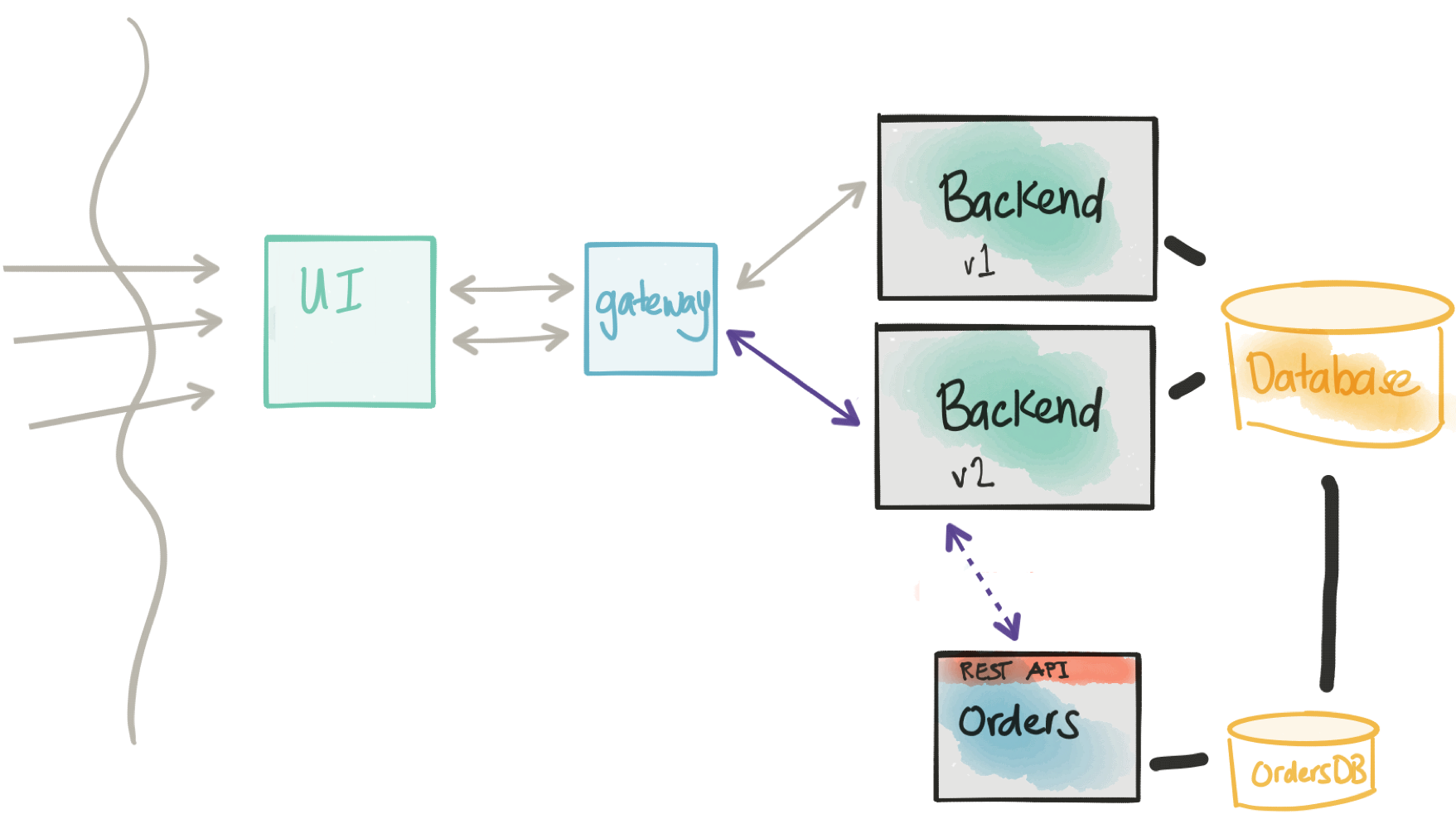
    When we make a change to our monolith/backend, we don’t want to replace the old code path. We want to put in just enough code to allow both the old or the new code path to run—potentially even in parallel—as deemed fit. Ideally, the new version of the monolith with this change will allow us to, at run time, control whether we’re sending to the new Orders service, the old monolith code path or both. In any combination of call paths, we want to instrument heavily to understand any potential deviations between the old and new execution path.

    Another thing to note: If we enable the monolith to send the execution to the old code path as well as calling our new service, we need a way to flag this transaction/call to the new service as a “synthetic” call. If your new service is less critical than in this example, an order service, and you can deal with duplicates, then maybe this synthetic-request identification is less important. If your new service tends to serve more read-only traffic, again, you may not worry as much about identifying synthetic transactions. In the case of a synthentic transaction, however, you want to be able to run the entire service end to end including storing into the database. You may take options here to either store the data with a “synthetic” flag or just roll back the transaction if your data store supports that.

    The last thing to note here is when we make our change to the monolith/backend, we again want to use a dark launch/canary/rolling release approach. We will need our infrastructure to support this. We will look closer at this in the second part.

    At this point, we’re forcing the traffic back through the monolith. We’re trying not to perturb the main call flow as much as possible so we can quickly roll back in the event a canary doesn’t go well. On the other hand, it may be useful to deploy a gateway/control component that can more finely control the call to the new service instead of forcing to the monolith. In this case, the gateway would have the control logic whether to send the transaction to the monolith, to the new service or both.

    Considerations

    • Introducing the new Orders service into the code path introduces risk.
    • We need to send traffic to the new service in a controlled manner.
    • We want to be able to direct traffic to the new service as well as the old code path.
    • We need to instrument and monitor the impact of the new service.
    • We need ways to flag transactions as “synthetic” so we don’t end up in nasty business consistency problems.
    • We wish to deploy this new functionality to certain cohorts/groups/users.

    Canary/Rolling Release to new service

    If we find the previous step does not introduce negative impacts to our transaction path and we have high confidence through our testing and initial experimentation in production with shadowing the traffic, we can configure the monolith to actually send traffic over to the new service. In this case, we need to be able to specify certain cohorts/groups/users to always go to the new service and we’re slowly draining the real production traffic that goes through the old code path. We can increase the rolling release of our Backend service until all of our users are on the new Orders microservice.

    One point of risk we need to make concrete: Once we start rolling live traffic (non-shadow/synthetic traffic) over to the new service, we’re expecting users that match the cohort group to go to this new service always. We’re not able to switch back and forth between old and new code paths. In this case, if we do need to rollback, this will involve more coordination to move any new transactions from the new service back to a state that the old monolith could use. Hopefully this doesn’t happen, but is something to note and plan for (and test!).

    Considerations

    • We can identify cohort groups and send live transaction traffic to our new microservice.
    • We still need the direct database connection to the monolith because there will be a period of time where transactions will still be going to both code paths.
    • Once we’ve moved all traffic over to our microservice, we should be in position to retire the old functionality.
    • Note that once we’re sending live traffic over to the new service, we have to consider the fact a rollback to the old code path will involve some difficulty and coordination.

    Offline data ETL/migration

    At this point, we should have our Orders microservice taking live production traffic. The Monolith or Backend is still around handling other concerns, but we have successfully migrated service functionality out of the monolith. Our immediate pressing concern now is to pay off the technical debt we’ve borrowed when we created a direct database connection between our new microservice and the Backend service. Most likely this would involve some kind of one-time ETL from the monolith database to the new service. The monolith may be required to still keep that data around in a read-only mode (think: regulatory compliance, etc.). If this is shared reference data (ie, read only) this should be okay. We must make sure that the data in the monolith and the data in the new microservice is not some shared/mutable data. If the data is shared/mutable, then we can end up in divergent data/data ownership problems.

    Considerations

    • Our new Orders microservice is now in the last throes of becoming fully autonomous.
    • We need to pay down the technical debt we borrowed when we connected the Orders service database to the Backend
    • We will have a one-time ETL for the data that should reside in the Orders
    • We need to be mindful of divergent data problems.

    Disconnect/decouple the datastores

    Once we’ve completed the previous step, we should have our new Orders microservice-independent and ready to participate in a services architecture. The steps presented here all have their own considerations, pros and cons. We should aim to satisfy all of the steps and not leave technical debt to accrue interest. Of course, there will be variations on this pattern, but the approach is sound.

    In the next blog post, I’ll show how to do these steps with the example service I’ve referred to previously and dig deeper into some of the tools, frameworks and infrastructure that helps assist. We’ll look at things such as Kubernetes, Istio, feature-flag frameworks, data-view tools, and test frameworks.

    Part 2 will follow in December

    Follow along (@christianposta) on twitter or http://blog.christianposta.com for the latest updates and discussion.

    — Christian Posta

  • Welcome to Microservices Journal

    Welcome to Microservices Journal

    Welcome to Microservices Journal, a community dedicated to the design of microservices-based applications and related technologies. The introduction of microservices into the digital application landscape enables a new level of agility for businesses that adopt this model of design. As with any architectural construct, there are no absolutes; hence, no wrong or right way to build microservices-based applications, however, there are some well-accepted tenets, patterns and anti-patterns associated with this design approach. Microservices Journal is being established as a site where practitioners can share their points-of-view and their experiences.

    Following in line with emerging agile development approaches, we are introducing Microservices Journal as a minimal viable product and will iterate rapidly to add new features and content. As with any community, we will evolve and thrive with contributions. These contributions can come in the form of blogs, articles, ebooks, podcasts and videos. Soon, we will add discussion forums, deliver webinars and hold live Q&A sessions with renowned experts in the field.

    In addition to the website, we are also creating Microservices Day events to be held regionally. Our first event will be in Austin on November 16, 2017 as part of the Innotech Austin event.

    Like any community, we’re only as good as our contributors and contributions, and we look forward to your contributions.

    If you wish to contribute, please email editor@microservicesjournal.com

    — JP Morgenthal

  • Microservices Days coming to a city near you

    Microservices Days coming to a city near you

    Microservices is rapidly becoming a design paradigm for developing software. While there are many benefits to microservices designs, it is more complex than traditional application design. For this reason we are formulating a new community around microservices architecture. This community will explore design issues and the intersection with Mobile/IoT, Containers, Cloud, DevOps and APIs.

    Microservices Journal is a newly-launched online community where practitioners can share their experiences and learn from others.

    Microservices Days are a series of regionally delivered one-day seminars led by practitioners.

    Who should attend: CIO/CTO, Application Development Management, Software Engineers, DevSecOps, and IT Operations.

    For our 11/16 program we are lucky to have some strong industry experienced speakers come speak:
    • Michael Cote – Pivotal
    • JP Morgenthal – DXC.technology
    • Deepak Kulkarni – Charles Schwab & Co
    • Irakli Nadarishvilli and Mark Donovan – CapitalOne
    • Ryan Bagnulo – Guarden.io

    This is a great opportunity to come hear from early adopters and learn from their experiences.

    Register Now: http://www.innotechconferences.com/austin/about-2/microservices-day/

    Microservices Days, Austin – Agenda

    Time Presentation 
    8:00am
    9:30am – 10:15am
    10:20am – 11:05am
    jpmorgenthal
    11:10am – 12:00pm Deepak_Kulkarni

    12 Factors for the Enterprise

    12:00pm – 1:00pm Lunch and Expo
    1:00pm – 1:45pm Microservices_Irakli_MarkImplementing Microservices at Capital One
    2:30pm – 3:20pm TBA
    3:30pm – 4:20pm RyanBagnulo
    Microservices Maturity Matrix, Token Authentication & API Gateway Mediation

     Register Now: http://www.innotechconferences.com/austin/about-2/microservices-day/

    — JP Morgenthal