Category: Features

  • Nobl9 Shares SLO-as-Code Methodology

    Nobl9 Shares SLO-as-Code Methodology

    Nobl9 has released version 1.0 of an open specification for defining service level objectives, dubbed OpenSLO, and, in addition, has defined a repeatable SLO methodology.

    Kit Merker, Nobl9 COO, said the Service Level Objective Development Lifecycle (SLODC) methodology represents an effort to create a set of best practices for achieving and maintaining SLOs that are implemented as code within an application environment.

    A survey of more than 300 IT managers and executives conducted by Dimensional Research on behalf of Nobl9 found only 29% of respondents had no plans to implement SLOs. A full 94% of respondents that have or plan to implement SLOs intend to map them directly to business operations, with 91% reporting they expect that effort to improve decision-making. More than 80% also said their organizations are planning to increase the use of SLOs, with 87% indicating SLOs should improve overall microservices performance.

    The challenge is that most organizations have limited visibility into their IT environments. The survey, for example, found less than half of respondents (46%) had visibility into all their IT environments. Only 45% and 35% claim to have visibility into containers and microservices, respectively. More than three-quarters (78%) said hybrid clouds make observability more difficult.

    Ironically, 45% of companies reported they already employed 11 or more observability and monitoring tools. On the plus side, 31% have hired site reliability engineers (SREs), while nearly half (46%) planned to create that role.

    Nobl9 is trying to spur greater adoption of SLOs by making available an open source SLO specification that defines a common interface for constructing SLOs across a Git-based workflow. Since OpenSLO was initially launched, more capabilities have been added including a DataSource object that makes it easier to reuse connection details and which makes creating SLOs less verbose and three alerts have been defined: AlertCondition, AlertPolicy and AlertNotifcationTarget.

    Nobl9 is also releasing an OpenSLO-to-Nobl9 converter to transition OpenSLO YAML files into Nobl9 YAML when required.

    SLOs, of course, are not a new idea. They have been employed as a metric to track the performance of IT services for decades. However, as more microservices-based applications are built and deployed, it’s becoming more challenging to maintain SLOs across applications that have many more dependencies than legacy monolithic applications. Ultimately, each IT team needs to provide some sort of objective benchmark that assesses their overall effectiveness at delivering application services. SLO-as-code is intended to make it simpler to gather the metrics that confirm whether service levels are being achieved. Those SLOs are then tracked and integrated across everything from financial operations to supply chains, noted Mercer.

    It’s not clear to whether reliance on SLOs has waned over the years or if application environments simply became too complex to track meaningful metrics. However, as applications are increasingly viewed as services, it’s now only a matter of time before SLOs become more widely adopted across a modern application environment. The challenge, of course, is that defining an SLO is a lot easier than maintaining it—especially within today’s highly dynamic application environments where services tend to come, change and eventually go unexpectedly.

  • Progress Expands Scope of Compliance-as-Code Capabilities

    Progress Expands Scope of Compliance-as-Code Capabilities

    Progress this week extended its DevSecOps portfolio—built atop the Chef automation framework it acquired in 2020—to now include the ability to programmatically address compliance mandates.

    At the same time, Progress has updated the Progress Chef InSpec framework for automating the discovery of compliance issues to add support for SAP ASE, IBM DB2, Mongo, Cassandra, Oracle, MS SQL platforms along with RHEL, CentOS, Ubuntu and macOS Monterey.

    Progress has also updated the Progress Chef Enterprise Automation Stack (EAS) to add the ability to combine infrastructure configuration processing with compliance audits within a single consolidated policy definition along with a high availability capability that makes certain the platform is always accessible.

    Prashanth Nanjundappa, vice president of product management for Progress, said Progress Chef Cloud Security enables DevOps teams to take advantage of a single policy-as-code platform to consistently implement compliance policies alongside security controls across both multiple public clouds and on-premises IT environments.

    Progress Chef Cloud Security leverages certified industry benchmarks, such as the Center for Internet Security (CIS) benchmark, to continually scan and automatically detect security configuration issues at multiple stages within a DevOps pipeline. Progress has now expanded CIS benchmark profile coverage for Amazon Web Services (AWS), Microsoft Azure and Google Cloud Platform (GCP) to include more than 100 customizable pre-built service and resource templates. DevOps teams can take advantage of automated creation of code, test and documentation artifacts for those resources. Finally, visibility into the status and expected completion time for compliance scans has been added along with advanced Shell command support for control and testing without file output.

    In general, the ability to address compliance requirements within a DevSecOps workflow has become crucial because the number of misconfigurations that occur in the cloud has exploded. Developers that often have little to no security or compliance expertise are programmatically provisioning cloud infrastructure in a way that, for example, leaves ports wide open. As IT organizations embrace more cloud computing platforms, that security issue only compounds, noted Nanjundappa.

    More challenging still, cloud computing environments are becoming more complex with the rise of cloud-native applications based on platforms such as Kubernetes. The odds a developer is going to make a mistake only increase with each microservice deployed.

    Progress is betting that, as cloud computing evolves, responsibility for security and compliance will increasingly shift left toward DevOps teams; they’ll be responsible for implementing polices defined by cybersecurity and compliance specialists. The goal is to provide a set of guardrails that make configuration mistakes less likely because policies are being tested within the context of a DevSecOps workflow, said Nanjundappa.

    It’s only a matter of time before software supply chain security reviews that are occurring in the wake of a series of high-profile breaches force the DevSecOps issue within more organizations. The goal, of course, should be to eliminate the need to identify DevSecOps as separate from a DevOps workflow. Regardless of the approach, however, the one good thing about all this attention is that application environments will inevitably become a lot more secure.

  • Update Those Ops Tools, Too

    Update Those Ops Tools, Too

    We’re all pretty well settled on the idea that the rate of change in IT has been on the increase over time. From the advent of VMs to Agile to DevOps to containers, the movement has been faster—and the same is true for internal development.

    I’m going to approach this topic from three perspectives instead of my usual two. Kind of like breaking the fourth wall in cinema. We’ll discuss this movement just a bit from the perspectives of my two preferred bits, DevOps and DevOps. But for this blog, we’ll also mention DevOps—the infrastructure, tools and processes that enable the other two.

    For DevOps, languages—both updates to those currently in use and the addition of new ones—bring with them a nearly automatic update to tools used. Favorite libraries/modules, IDEs, build tools—these are all looked at and updated more frequently today than at any point in history, by my estimation. For teams that do not change languages or libraries much, source code analysis (SCA) scanning is increasingly helping to take a closer look at all those included tools and filter them based upon impact (normally security impact, but other impacts on occasion, too—like project activity and stability).

    For DevOps, the toolchain is still new enough that evolution is causing regular change, and that change is bringing with it new tools and utilities to solve the problems of this existing infrastructure. In fact, I’ve long thought the DevOps part needed a bit of a cooldown on the change and new tools/utilities front, personally.

    And finally, DevOps has gone a bit sideways in this regard. Every person—whether you call them ops, admin or DevOps—responsible for troubleshooting machines and apps has a collection of tools. But the divergence of platforms has created a divergence of tools. It is possible to work without a dedicated set of tools—and, indeed, many DevOps engineers do. Others have a folder. Meanwhile, there is another dedicated set of DevOps engineers that have a PCMCIA or USB full of useful tools that is always with them. Some have both. Of course, what tools are included in all of this varies widely also. It is an interesting artifact of our growth in IT that developers tend to share or borrow the best libraries/modules/APIs across an organization, but DevOps is more independent. As long as DevOps team members are getting the job done, no one is all that worried about which tools they used to troubleshoot. They do tend to share if asked, but with little physical evidence of what tools they used, it doesn’t come up often.

    So, what am I getting at? Look for ways to enable DevOps tool sharing on an ongoing (or at least regular) basis. An internal social media channel dedicated to the vendor your teams use to communicate, brown bags, a maintained rating system “Why I think fdisk rocks” type of thing, etc. The more power there is at the fingertips of every DevOps member you have, the better. Given our history, building an “approved” list is likely a bad idea, but having that central communication location that security can also peruse to look for red flags is not a bad idea. Of course, they are likely too busy, but worst case, such conversations can help in forensic analysis later. Not being cynical, just living IT in the 21st century.

    And keep kicking it. More and better tools will help keep all those sweet apps and servers clipping along, so there is really only upside here. Give your teams the tools and revel in your considerable uptime.

  • Red Hat Adds Managed Ansible Service on Azure

    Red Hat Adds Managed Ansible Service on Azure

    Red Hat today announced general availability of a managed instance of the Red Hat Ansible Automation Platform on the Microsoft Azure cloud.

    Announced at the Red Hat Summit 2022 event, this offering makes it possible to deploy the control plane for Ansible on the Microsoft Azure cloud as an alternative to existing support for Amazon Web Services (AWS) or an on-premises IT environment.

    In addition, in version 2.2 of the Ansible Automation platform, Red Hat is previewing support for content signing technology that automatically validates content to improve overall security.

    Thomas Anderson, vice president of Ansible for Red Hat, said this managed service enables IT teams to take advantage of integrated Microsoft billing in addition to the latest features and content provided for the platform and other capabilities that have been added to optimize Microsoft Azure environments.

    The open source Ansible platform has been gaining traction as an automation framework that enables IT teams to declaratively automate tasks. It requires less programming expertise than rival automation frameworks, which Anderson said is the primary reason so many third-party vendors have adopted Ansible to automate a range of IT tasks.

    The challenge many organizations encounter today is managing multiple islands of automation across multiple clouds and on-premises IT environments. Ansible presents IT teams with the ability to begin unifying all those islands under a single framework, said Anderson.

    It’s not clear to what degree DevOps teams that have embraced rival automation frameworks might be willing to replace them with Ansible. However, as more IT teams embrace automation to make up for shortages of IT personnel, it’s apparent that Ansible is being used across a wide range of IT disciplines spanning everything from DevOps to network management.

    Regardless of the approach, the need to automate as many tasks as possible is becoming critical as IT environments grow increasingly more complex. Many of the scripts that IT teams created on their own simply don’t scale. More challenging still, they are not often documented, so every time the IT professional that created that script leaves the organization it becomes difficult to maintain that scripting code.

    In the longer term, of course, automation frameworks will be increasingly infused with machine learning algorithms capable of learning the unique nuances of individual IT environments. It’s not likely those algorithms will replace the need for IT professionals any time soon. However, rather than resisting automation, more IT professionals have concluded that the tasks required are simply too challenging to manually perform. Many will conclude they simply prefer to work for organizations that have a consistent approach to IT automation that makes it feasible for them to manage a wide range of IT tasks.

    One way or another, IT automation is becoming a standard capability that now goes well beyond the scope of a few isolated DevOps workflows. The issue is finding a way for IT professionals with varying skill levels to collaborate across a common framework that is both easily accessible and highly extensible.

  • Does GraphQL Introduce New Security Risks?

    Does GraphQL Introduce New Security Risks?

    The GraphQL query language is an excellent tool for increasing the ease of data sharing. The premise is that you request the fields you need in a single bundled request, avoiding multiple network calls. Due to its usability, GraphQL is a growing area of development. Yet, as with any new technology, it comes with caveats.

    REST APIs function as a request-and-response paradigm in which the receiver accesses one resource at a time. On the other hand, GraphQL exposes many fields at once, requiring additional rate-limiting and time-outs to avoid nefarious queries. Additionally, the ability to traverse the entire schema could be abused by attackers to expose intricate data linkages. There are also some usability features with GraphQL that could be abused if misconfigured.

    GraphQL is a friendly alternative to REST. But how do we handle the security implications of GraphQL? I recently chatted with Mike Benjamin, vice president of security research, Fastly, to dive deeper into the security repercussions of adopting GraphQL. Below, we’ll consider the unique insecurities associated with GraphQL and suggest specific steps to limit the impact of these risks.

    Four GraphQL Security Vulnerabilities

    1. Introspection

    GraphQL provides built-in documentation that tells developers what the fields are, providing a schema of everything you can query. You’ve essentially given the entire dataset schema to a developer, meaning they can perform introspection to capture attack surface information. Hackers will most commonly look for injection or mutation capabilities that they can exploit, explained Benjamin. Or, they might seek to leverage the interlinkages between data to map a way through to classified information.

    To mitigate this problem, Benjamin cautioned against over-exposing all documentation publicly. Instead, he suggested using a restrictive security model for external viewers. “Provide appropriate user documentation in a different method,” he says. This may end up looking more like the standard REST API view of documentation.

    2. Field Suggestions

    Another usability benefit in GraphQL could also be a potential security concern—field suggestions. Field suggestions occur when you don’t enter the correct field name or enter a partial input and the system returns a hint. You might type in 0 or user, and the system makes a suggestion to fill out the rest of the field.

    This user interaction improves the developer experience, but, unfortunately, it could be abused by a hacker, said Benjamin. Thus, he recommended disabling hints after initial development. Or, if you decide to keep it in, he recommended placing a limit on its use. For example, if you try this more than five times in a second, the system could flag it as a bot.

    Right now, this attack vector is pretty limited, but Benjamin anticipated that, over time, hackers could automate this introspection with mass scanners to divulge more information.

    3. Denial-of-Service-Oriented Attacks

    Without the proper guardrails, all web APIs are prone to denial-of-service (DoS) attacks. Such an attack may pummel a service with a million queries per second to shut it off completely. In the case of GraphQL, these queries can dive very deep in a nested data relationship. A social network, for example, might expose friends of users, friends of users’ friends and so on.

    Or, hackers might utilize GraphQL’s bulk query ability to perform reconnaissance, brute-forcing the enumeration of data to query hundreds of user IDs to see which are valid. If you’re allowing unlimited data retrieval bundled within a single request, you could be inviting hundreds of bundled queries that could expose large swaths of the underlying database in one fell swoop.

    To counter these actions, Benjamin recommended limiting the testing depth. This could involve placing limits on how long a query can run, which would cause a time-out for requests that require suspiciously high degrees of processing. Another option is to limit how deep the bundling can get, said Benjamin. For example, perhaps the system restricts going three levels deep into a graph database, as that could expose millions of interconnected endpoints.

    4. Lack of Object-Level Authorization

    Another vulnerability that GraphQL endpoints may be prone to is a lack of object-level authorization, which hackers could leverage to get at a datapoint through its edges, said Benjamin. Since the idea is that you can access any data from one all-encompassing endpoint, authorization rules are often too abstracted away from the actual data. Queries may be able to access nested data or query relationships between data, too, which may unintentionally divulge information.

    Benjamin recommended placing authorization closer to your objects or data to rectify this issue. Use authorization-level controls that align permissions structure and roles with users. “Everyone needs a common authorization model,” said Benjamin.

    Future Evolution: GraphQL Security Matures

    As I’ve written before, the greatest strength of GraphQL is also its greatest weakness. Using GraphQL with default settings is a security trade-off in favor of usability. But according to Benjamin, we’re seeing more GraphQL servers disabling some introspection features, which he sees as a very positive move and a sign of maturity of the base configuration.

    GraphQL might suffer from similar threats that all APIs are vulnerable to, such as XSS, injection, DDoS attacks and broken authorization. However, Benjamin stressed that the added complexity of GraphQL makes it a unique case. “The most important thing for folks to consider is that GraphQL is more complicated than a REST endpoint—much more complicated,” said Benjamin. “GraphQL is unique in that it has linkages of data which contributes to complexity. It takes a little more time to think about how that’s confirmed, how it’s presented and how it would be attacked.”

    In other words, with great power comes great responsibility.

    Although exploits in public GraphQL APIs are still rare, we should stay vigilant. Benjamin encouraged developers to continue reading about, understanding and thinking about these attack vectors when designing their interfaces, as these risks will become more prominent as GraphQL usage grows and hackers become more familiar with these specific frailties.

  • Semiconductor Shortage May Be Here to Stay

    Semiconductor Shortage May Be Here to Stay

    Intel CEO Pat Gelsinger has cautioned that the semiconductor shortage will last until 2024, a scary reality for manufacturers, businesses and consumers alike.

    Semiconductor chips, or microchips, are essential for many digital consumer products. Anything that processes information uses these chips and with the exponential growth of technology, there has been a massive increase in demand. 

    “The rapid acceleration of the internet of things (IoT) to date and to come forever moves semiconductors ahead of oil as the world’s key commodity input for growth,” according to economic investment firm TS Lombard. 

    Although the U.S. leads the world in developing and selling semiconductors, manufacturing has shifted to Asia. Taiwan and Korea account for 83% of global processor chip production and 70% of memory chip output, according to the Semiconductor Industry Association. 

    In many of these Asian economies, harsh lockdown measures were put in place in response to COVID-19, causing bottlenecks in the supply chain. As a result, certain manufacturing tools are unavailable, limiting chipmaking capacity. 

    The shortage was originally projected to last until 2023, but Gelsinger now predicts that it will roll into 2024. 

    “The shortages have now hit equipment and some of those factory ramps will be more challenged,” Gelsinger explained.

    Semiconductor Shortage Impacts More Than Just Tech

    Semiconductors are especially important in the automobile industry. Microchips are an essential component of the modern-day car, and they enable many innovations within the industry. 

    As a result of the bottleneck, some automotive companies have limited or paused production. Tesla, for example, has halted production in 2022, citing supply chain issues as the limiting factor. 

    In response to the shortage, companies are urgently building new manufacturing facilities. Samsung is building a $17 billion semiconductor factory in Texas and Intel is spending $20 billion on two new factories in Arizona. 

    The shortage has also prompted legislative action in Florida and Texas that calls for increased funding for microchip and semiconductor factories. 

    “The more we have this capacity within our own country the more opportunities there’s going to be for people and the more secure both our economic supply chains will be and our national security,” Florida governor Ron DeSantis said of the measures he’s taking to combat the shortage. 

    No Definitive End in Sight

    Although industry experts predicted the shortage will end in 2024, there is no definitive end in sight, prompting manufacturers and businesses to strategize accordingly. 

    Some companies, like Tesla, have resorted to alternative chips and software-based solutions to endure the shortage. Companies like Latent AI offer software packages that optimize alternative hardware, which could prove to be a technological lifesaver for the many companies affected by the shortage. 

    Although the current shortage is a byproduct of the pandemic, some of the alternative solutions that have arisen may be revolutionary in filling the ever-growing demand for semiconductors. 

  • OpenSSF Adds Open Source Package Analysis Tool Prototype

    OpenSSF Adds Open Source Package Analysis Tool Prototype

    The Open Source Security Foundation (OpenSSF) has made available a prototype of a package analysis tool that has already identified more than 200 malicious packages uploaded to PyPI and npm software components.

    Caleb Brown, an OpenSSF maintainer of the project, said the goal is to understand the behavior and capabilities of packages available on open source repositories. It also tracks how packages behave over time to make it easier to identify when previously safe software began to act in a suspicious manner.

    Most of the malicious packages detected are employing dependency confusion and typosquatting techniques, Brown said. They usually contain a simple script that runs during installation and provides a few details about the host to an external command-and-control system. Most of these packages are not exfiltrating meaningful data except the name of the machine or a username, but they make no attempt to disguise their behavior. The issue is that any one of these packages could have done far more damage, noted Brown.

    Future goals for the project include detecting differences in package behavior over time; automating the processing of the package analysis results; storing the packages themselves as they are processed for long-term analysis and improving the reliability of the pipeline. As such, the OpenSSF is looking for application developers and cybersecurity researchers to contribute to the project. The expectation is that many providers of application security tools will incorporate the package analysis tool within their offerings rather than requiring each vendor to create their own version of the same tool, said Brown.

    The OpenSSF has launched a series of initiatives to improve the overall state of open source security. Most recently, it added an Alpha-Omega Project to automate security testing processes for open source software using a $5 million initial investment provided by Microsoft and Google. The core challenge is that many organizations are dependent on open source software projects created and maintained by just a handful of volunteer maintainers and contributors. The individuals that created those projects don’t always have a lot of cybersecurity expertise. In fact, many of them would argue that the onus for securing open source software is on the organizations that use what amounts to free software. It’s not the responsibility of the contributors and maintainers to, for example, drop everything and immediately create a patch to address a zero-day vulnerability.

    It’s not clear how easily open source software could be compromised by cybercriminals that insert malware into downstream applications that rely on that code. However, in the wake of a series of high-profile breaches, it’s safe to assume that more cybercriminals than ever are trying to compromise open source software projects. While some organizations may opt to limit their dependency on open source code that has not been properly vetted, there is no way to entirely avoid using open source code. The challenge is finding a more efficient way to ensure the integrity of that code for all concerned.

  • Checkmarx Report Highlights Need for AppSec Collaboration

    Checkmarx Report Highlights Need for AppSec Collaboration

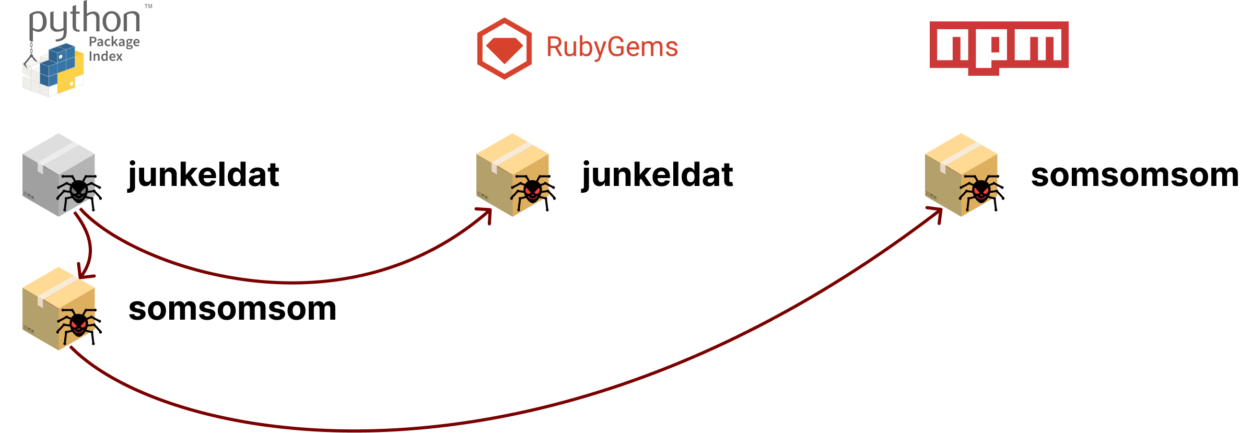
    A research report published by Checkmarx finds the same basic malicious software developed using multiple programming languages as cyberattackers industrialize their malware development processes.

    Checkmarx, a provider of code scanning tools, shared examples of malicious packages written in multiple programming languages. These example packages share the same indicators of compromise that have gone undetected for years. A “junkeldat” PyPI package for Python applications, for example, that has been compromised also shows up in a Ruby version of the package.

    Tzachi Zornstain, head of supply chain security for Checkmarx, said much like any other development team that uses multiple programming languages, it appears cybercriminals are also sharing techniques. These examples highlight the need for development teams to share security intelligence even if they build applications using different programming languages, he added. There is a tendency for development teams using one programming language to ignore application security issues that appear to only impact applications written in another programming language, noted Zornstain.

    The fact that the packages remained undetected for such a long period of time is due—at least in part—to the lack of information sharing in the ecosystem, said Zornstain.

    Cyberattackers are, of course, trying to take advantage of the implicit trust many development teams have in open source projects. However, now that more cybercriminals are making a concerted effort to compromise downstream software components, it’s imperative that every component be vetted, said Zornstain. In fact, organizations should not use any code provided by strangers, he advises.

    The core issue is that many open source projects are maintained by a small number of programmers contributing their time and effort to building components that others are free to use. Many of them argue that the onus for making sure software is secure is on the organizations that decide to deploy that software. Nor is it their responsibility to keep track of cybercrimimals distributing malicious versions of their software.

    Unfortunately, many IT vendors and large enterprise IT organizations that rely on that code are, unfortunately, not contributing anything meaningful back to the project, either in terms of financing or helping open source maintainers find and remediate vulnerabilities. Many of those same organizations, however, are assessing whether the open source software they employ is, from a security perspective, actually sustainable in the absence of those contributions. As a result, it may be only a matter of time before these long-simmering open source software security concerns boil over into a larger crisis.

    One way or another, DevSecOps best practices will need to be applied to application development at a deeper level. Organizations can’t assume that the software components they are relying on have been scanned for vulnerabilities by someone else. It’s simply too easy for a development team to make a mistake. The need for higher levels of security may lengthen the development process, but the alternative—malware infestations wreaking havoc—is far less desirable.

  • Stytch Launches New, Flexibility-First SDK

    Stytch Launches New, Flexibility-First SDK

    Passwordless solutions have been a trend for a while now, improving user experience (UX) while reducing exposure to common attack vectors. Now, Stytch’s new JavaScript SDK aims to make password-free authentication a bit easier by increasing customization and flexibility while offering fully baked authentication out of the box.

    Julianna Lamb, Stytch CTO, said the solution provides dual benefits by doing the heavy lifting of implementation while providing the flexibility to create a powerfully branded UX from the customer’s first sign-on experience. The Stytch JavaScript SDK can offer an all-in-one experience that handles the entire user auth journey with a pre-built frontend component. But it can also give teams complete control over designing a sophisticated and tailored authentication journey. In an era where tech companies chase the ultimate customer experience as their holy grail, this should appeal to teams wanting to improve a customer’s first impression of their brand, Lamb said.

    Multiple Options for a Smarter Front Door

    Like many authentication tools, Stytch’s product suite originally offered two options: One was a standard widget to handle frontend components while backend APIs provided logins. The other option provided direct API integration, in which the developers built their frontend, handled tasks like session management and setting cookies on the frontend and used the API to do things like send a one-time passcode or email a magic link.

    “But we found people really want flexibility when it comes to any solution they’re using,” Lamb said. “They also don’t want to do the heavy lifting when it comes to things like session management. Those things can be complex to reason through and having those out of the box is really compelling.”

    The new SDK decouples drop-in UIs from helper functions, giving teams multiple options. They can place Stytch’s UI components anywhere they want in the product, sculpting the authentication flow to their specifications. As a headless SDK, it can be embedded client-side in the application to handle all the calls to the API, do the authentication, create a session and check its validity. The result: Less backend code to write and less logic to implement.

    Customizable UI flows mean that teams can fully own the UX experience and build a UI that is customized exactly how they want it to look—and they can do this without having to build an internal API to route authentication requests from client to server. Teams looking for ways to make a brand impact right out of the gate can capitalize on this ability by creating a unique user experience.

    “Authentication is the front door to your application,” Lamb said. “Sign-up is the first impression the user has of your app—and the ability to customize it with your brand look and feel so the UI fits your aesthetic is super-critical.”

    Frictionless Flexibility in Identity Verification

    Because teams may have different authentication needs within one product, the SDK can be used in tandem with the core Stytch API to meet shifting needs. Teams could generate embedded magic links via the API while providing Google OAuth and Google One-Tap sign-in options via the SDK.

    The solution also reduces friction by making it easier to not only authenticate users but verify them on return visits to continue the same session. By loading the SDK on the frontend, teams can automatically connect Stytch’s sessions product to the browser cookie, feeding user session data directly into the cookie.

    The Stytch team is currently building out more SDK functionality and frontend components, Lamb said. Given the ongoing evolution of simple authentication tools that meet complex requirements, it will be interesting to see where innovative authentication goes next.


  • Twitter/Bluesky ADX Algorithm | Cloud Energy Use ‘Tripled’ | Apple Staff are Revolting

    Twitter/Bluesky ADX Algorithm | Cloud Energy Use ‘Tripled’ | Apple Staff are Revolting

    Welcome to The Long View—where we peruse the news of the week and strip it to the essentials. Let’s work out what really matters.

    This week: Bluesky—Twitter’s research spinout—opens its ADX algorithm, Irish data center electricity worries grow, and Apple employees are the latest to rise up against hybrid working. (more…)