Category: Features

  • CodeSee Unveils Open Source Hub

    CodeSee Unveils Open Source Hub

    CodeSee today launched a free Open Source Hub (OSH) community through which developers can more easily analyze the codebase that makes up an open source software project.

    Shanea Leven, CodeSee CEO, said that capability is crucial because making it easier to explore open source codebases reduces the level of effort required for developers to understand where to make contributions.

    OSH is based on a namesake visualization tool that CodeSee created. The CodeSee tool makes it possible for developers to see how a codebase has been constructed using graph technologies that scan software repositories and identify components and their relationship to one another. Developers can also use CodeSee to better understand what impact changes to that codebase will have.
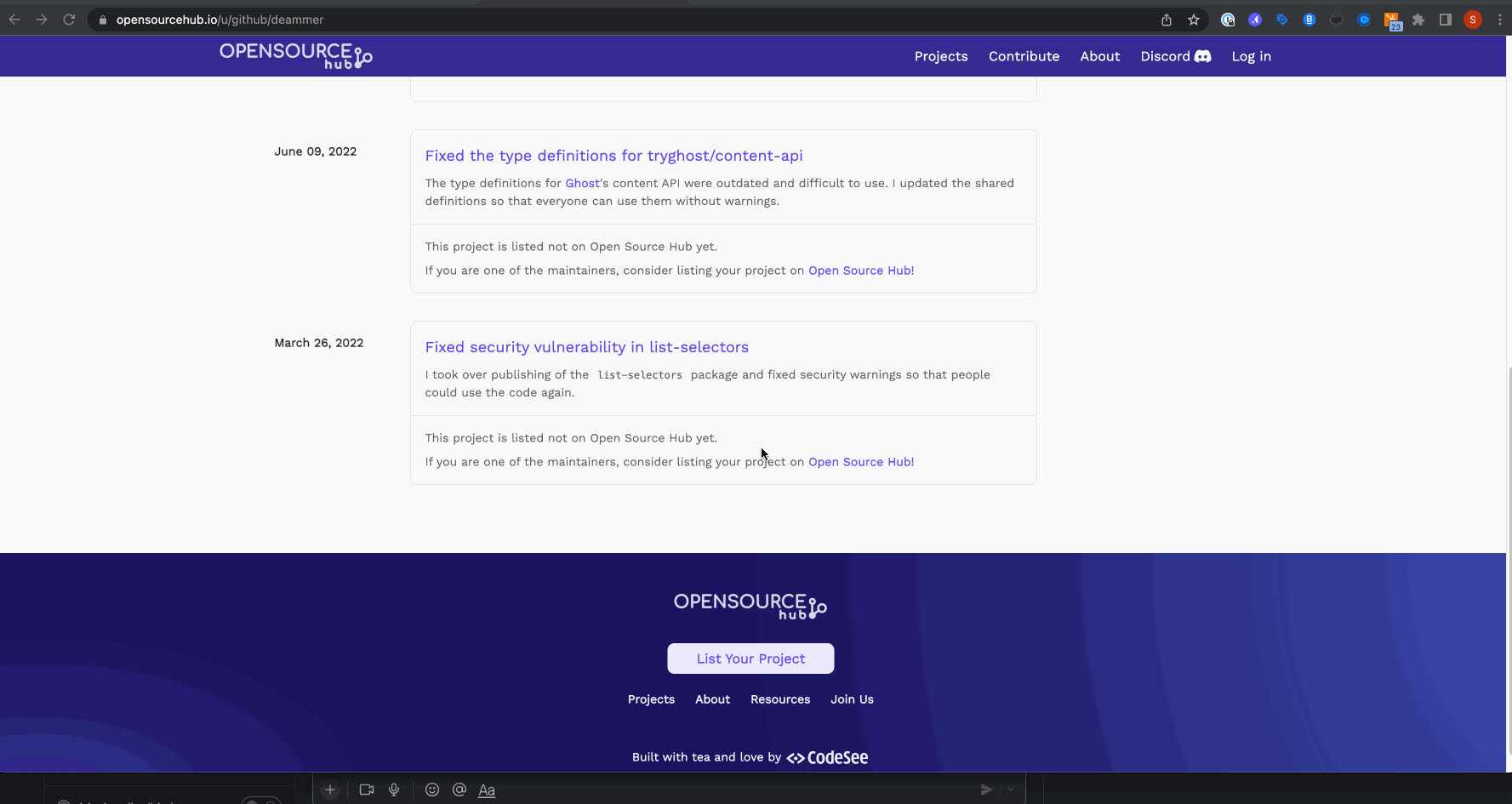
    In addition to making it easier for developers to discover open source software projects, OSH also enables maintainers and contributors to create personal profiles through which other members of the open source community can see how their efforts have impacted various projects.

    CodeSee, as part of OSH, is also providing integration with Discord, an online voice, video and text collaboration service, to make it simpler for maintainers and contributors of open source software projects to collaborate.

    Leven said it simply takes too long today for most developers to pore over a codebase to understand where they might contribute. The larger a codebase becomes, the less likely it is a developer will want to take the time required to begin making a meaningful contribution, she noted.

    OSH is arriving at a time when maintainers of open source projects are especially looking for help securing open source software. The core issue is that many of those projects are maintained by a small number of programmers that voluntarily contribute their time and effort to build components that others are free to use. Like any other developer, the amount of security expertise those individuals have is limited. Many of them simply don’t have the time to immediately provide a patch to an application when a zero-day vulnerability is discovered.

    Unfortunately, many IT vendors and large enterprise IT organizations benefit from open source code without contributing anything meaningful back to the project—whether in terms of financing or helping open source maintainers find and remediate vulnerabilities. Not every contribution has to be in the form of code, either. Many open source projects simply need help with documentation which, once provided, should free up other contributors to focus more of their time and effort on application security.

    It’s not clear to what degree business and IT leaders realize how dependent their organizations actually are on open source software. Even when they do, it’s not easy to onboard a developer to any software development project. It can take months before a developer is actually making meaningful contributions to a project.

    Application development, by definition, is now a group effort. The days when a lone developer cared for an entire application are long over. The issue is finding a way for teams of developers to more easily collaborate when most of them have never actually met in person.

  • Hasura SDK Integrates GraphQL Platform With More Data Sources

    Hasura SDK Integrates GraphQL Platform With More Data Sources

    At its HasuraCon ’22 conference, Hasura today announced the early release of a software development kit (SDK) that extends the reach of its GraphQL platform to additional data sources.

    In addition, Hasura is making generally available integrations with the GitHub repository, support for OpenTelemetry Traces within the Hasura Cloud Platform and Microsoft SQL event triggers.

    Finally, Hasura Cloud can now be deployed on the Google Cloud Platform while the Hasura Cloud Enterprise edition is now available on the Amazon Web Services (AWS) marketplace.

    Hasura CEO Tanmai Gopal said that while the company already provides support for widely used data sources such as the Postgres database, there are many data sources that organizations also want to be able to query via GraphQL application programming interfaces (APIs). Organizations want to be able to join data using GraphQL regardless of what repository it resides in, he added.

    The open source Hasura engine at the core of the company’s offerings automatically generate a GraphQL schema from a data source. That can then be used to accelerate the development of APIs to make it easier for a wider range of developers to build applications that aggregate data across multiple sources.

    That approach eliminates the backend complexity that IT teams encounter when adding GraphQL APIs to an application environment that already has a range of APIs for internal IT teams to support, noted Gopal.

    GraphQL was originally created by Facebook, but it’s still not clear to what degree GraphQL APIs will supplant REST APIs. Developers tend to prefer GraphQL APIs because they provide more granular control over what data is accessed. The challenge is the number of backend services that expose GraphQL APIs is still comparatively limited.

    It’s not likely IT teams will replace REST APIs with GraphQL-based APIs overnight, but the percentage of new applications that rely on GraphQL APIs will steadily increase. Overall, the number of APIs employed within IT environments is rapidly expanding as more microservices-based applications are deployed. Each microservice generates its own API. Over time, IT teams will find themselves managing a wider variety of types of APIs.

    The challenge is that it’s not always clear who within IT organizations will manage those APIs. They are often created by developers and are left to IT operations teams to maintain. It’s not uncommon for IT teams to find themselves managing hundreds, perhaps thousands of APIs.

    In addition, many of those organizations are now consuming data via APIs exposed by other organizations. Over time, the level of interdependency between APIs and applications will serve to make application environments much more complex to manage.

    In the meantime, DevOps teams will need to extend existing DevOps workflows to both support and secure GraphQL-based APIs. The amount of sensitive data being accessed via those APIs is likely to accelerate the rate at which organizations are adopting DevSecOps best practices. Let’s hope this happens before they wake up to discover GraphQL APIs have already proliferated across the enterprise.

  • Dynatrace Adds Synthetic Tests to Validate App Experiences

    Dynatrace Adds Synthetic Tests to Validate App Experiences

    Dynatrace today extended the application release management capabilities it provides to include synthetic tests for validating and assuring user experiences.

    Saif Gunja, director of product marketing for Dynatrace, said the user experience validation and user experience assurance (UXA) capability spans everything from application availability and performance to actual engagement with specific features based on the service level objectives (SLOs) defined by a DevOps team.

    Dynatrace views application release management as an extension of its observability platform, said Gunja. While application release management has historically been viewed as an extension of a continuous delivery (CD) platform, Gunja said that observability platforms—such as the Dynatrace platform, which is infused with a Davis artificial intelligence (AI) engine—provide the visibility required to better automate the process.

    In fact, as DevOps continues to evolve, it’s apparent that CD and continuous integration (CI) are becoming more loosely coupled as DevOps processes mature, said Gunja. Most organizations have yet to implement CD simply because it’s been too difficult to achieve. Each platform that applications have been deployed is unique. Dynatrace provides the foundation for automating application release management via the agent software it makes available to instrument applications, said Gunja.

    It’s not clear whether DevOps teams are reevaluating their approach to application delivery, but Gunja noted that much of the interest in the Dynatrace approach is coming from organizations that have already installed the Jenkins CI/CD platform. The number of extensions that have been built and that need to be supported has created a level of technical debt that is unsustainable for many DevOps teams, he noted.

    Many IT leaders concluded they would rather allocate more resources to building applications than maintaining DevOps platforms, added Gunja.

    Most DevOps teams are committed to ruthlessly automating as many IT processes as possible. Observability has always been a core DevOps tenet in pursuit of that goal. Applications that are not instrumented can be programmatically managed. The issue is that providing observability isn’t enough—DevOps teams need to be able to take actions across the entire software development life cycle based on the data collected by the observability platform, said Gunja.

    Obviously, it’s still early days as far as observability is concerned. While application performance management (APM) platforms have been employed for decades, it’s only recently that observability platforms capable of correlating application and IT infrastructure data have emerged. Thanks to the rise of open source agent software, it’s also becoming less costly to instrument IT environments. The challenge, of course, is, as always, deploying and maintaining all that agent software.

    Regardless of the approach to observability and DevOps, it’s clear that IT teams will soon have a lot more visibility into their IT environments. The days when IT teams determined the root cause of an IT issue by process of elimination are finally coming to an end. Observability, however, is not an end in itself, but instead is the end of the beginning of a previous DevOps era.

  • Quality Is a Top Challenge for Data-Driven Projects

    Quality Is a Top Challenge for Data-Driven Projects

    Software systems continue to produce more and more data. And making use of it has proven benefits — so much so that many analysts have, over the years, referred to data as the new oil. As a result, the majority of organizations are expending effort into refining their data — in fact, a recent study found that 84% of organizations have either already deployed or have data-driven projects on their roadmaps.

    Corporations like Facebook and Google are the poster children for business models that harvest and monetize end-user data. However, this is only one aspect; valuable data is being produced by internal systems as well, which, if leveraged correctly, can provide insight into software observability and increase process automation for DevOps teams and developers. For example, time-stamped application logs are necessary for informing SLOs to maintain reliability standards. There is an ongoing parallel investment into AI/ML deployed with cloud-native tools to act upon production data to drive further business growth. As such, 63% of IT decision-makers say new revenue opportunities have emerged due to data and analytics.

    The 2022 Data & Analytics Study, conducted by Foundry (formerly IDG Communications), explored how data-driven initiatives continue to be an important investment area for executive leadership. Below, I’ll review the key results from the survey to consider how organizations can continue to make intelligent decisions now and into the near future.

    The State of Data-Driven Investments

    We undoubtedly live in a data-driven world, and investment in related projects continues to rise. More than half (55%) of IT decision-makers plan to increase their data-focused investments — the report found the average spend to be $12.3 million in the coming year. This figure rises to an average of $23 million for financial services, which makes sense given the nature of modern banking.

    Naturally, the use of analytics platforms is increasing in tandem with the amount of data generated. In terms of specific analytics tools, 50% of respondents said they used business intelligence platforms while 47% used relational databases and 19% planned to invest in them in the next one to two years.

    We’re also noticing an increasing use of cloud-based solutions. For example, 27% of an organization’s data analytics workloads now run in the cloud. The report also found an uptick in cloud-based enterprise-scale data warehouse technologies, an area that shows signs of increasing in the coming year.

    Common Objectives

    So, what are the most common driving factors behind these types of projects? Well, automating internal business processes is the top goal for data-driven projects—half of IT leaders described this as a primary objective. This is closely followed by other ambitions such as improving customer insights (46%), aiding customer support (43%) and automating IT operations (43%).

    In terms of type, transactional data tends to be the most useful—54% of companies are using transactional data in their data-driven projects. This includes consumer purchasing behaviors such as sales, returns and credits. The next-most-common type is machine-generated data, which includes information from logs, sensors, telemetry, networks, security systems and/or IoT devices. The third-most-common type is customer profile information.

    Data has a powerful impact in a business context as a means to refine existing digital products. Other respondents added that a data-driven approach to DevOps helps increase visibility and drives continuous improvement.

    Data Quality: Highest Ranked Challenge

    Undoubtedly, particular challenges remain. The greatest hurdle is retaining data quality—41% of organizations reported dealing with this issue. Quality may be poor because data is unstructured or incompatible with other sources. Other widespread challenges include governance issues and integrating data from multiple sources.

    For those undertaking data-driven projects, 44% said they lacked appropriate skillsets, such as analytics training, data management, security, business intelligence and integration expertise. Companies also often faced funding and talent-related quandaries when beginning data-driven projects. For example, 26% of small-to-medium-sized businesses lacked the necessary funding to take on data-driven projects, according to the research.

    Another challenging area (that I’ve covered previously) is optimizing how data is collected and stored. As cloud storage fees rise, organizations will likely want to refine retention and resolution to avoid creating unnecessarily large, expensive data lakes.

    Rising Deployment of AI/ML

    AI/ML is already well-established as a way to advance the use of data. More than half (54%) of companies used predictive analytics or planned to incorporate it into their systems in the next 12 months. Just under one-third (31%) also either used or planned to use anomaly detection in the future. These areas along with other functionalities (such as natural language processing and predictive analytics) can be used to aid applications such as process automation, decision support, customer analysis, virtual agents and others.

    The industry is at an exciting moment for leveraging data in DevOps. Data is becoming more and more accessible to enable DevOps with a full-stack picture of the application life cycle. To direct future engineering investment, data-driven decisions will rely on things like performances and usage habits. Thus, it’s an interesting time to consider how you might leverage data for greater process automation and software development fluidity.

    The 2022 Data & Analytics Report surveyed 872 IT decision-makers (ITDMs) from around the globe working in various industries. The respondents’ average company size was about 12,000 employees. To view the report for more insights, you can pick it up here.

  • ServiceNow Adds Lightstep Notebooks to Visualize Observability Data

    ServiceNow Adds Lightstep Notebooks to Visualize Observability Data

    ServiceNow today added a visualization tool to its Lightstep observability platform that will make it simpler for DevOps teams to correlate metrics, logs and traces.

    Ben Sigelman, general manager for Lightstep at ServiceNow, said Lightstep Notebooks will make it easier for DevOps teams to make sense of the massive amounts of data collected by the observability platform.

    Lightstep Notebooks is an extension of the Change Intelligence analysis engine that ServiceNow already makes available within an observability platform it acquired in 2021.

    Included with Lightstep Notebooks are a set of ad hoc charts that include access to heat maps and time-series data with trace exemplars using the database at the core of the Lightstep observability platform.

    An instantly generated investigative path also makes it simpler to identify the root cause of any issue, and each instance of Lightstep Notebooks can be shared with other members of the IT organization via an embedded link. Finally, 100% of trace data can be retained for up to three days.

    Sigelman said the ability to share Notebooks via embedded links will also help bridge the divide between DevOps and IT service management (ITSM) teams that often need to collaborate to resolve an IT issue.

    Naturally, the level of collaboration between those teams tends to vary widely by organization. However, as DevOps best practices are more widely embraced, the number of organizations that are trying to achieve that goal continues to steadily increase. Earlier this year, ServiceNow added an incident response offering to orchestrate on-call escalation, group alerts and provide analytics in further pursuit of that goal.

    Observability platforms aggregate the collection of logs, metrics and traces in a way that makes it possible for DevOps teams to query that data. The goal is to make it easier for DevOps teams to both identify the root cause of an IT issue and pinpoint any anomalies that might disrupt an application environment. The goal is to eliminate the need to convene a “war room” meeting that requires IT teams to suffer through the painstaking process of elimination to identify the root cause of an issue.

    Of course, before an IT environment can be observed, it needs to be instrumented. Thanks to advances in the form of open source agent software being advanced via the OpenTelemetry project managed under the auspices of the Cloud Native Computing Foundation (CNCF), it’s becoming less costly to instrument IT environments. That’s especially critical at a time when more DevOps teams are deploying microservices-based applications that are more complex to manage than legacy monolithic applications. While generally more resilient, the dependencies that exist between the microservices that make up an application can be difficult to identify without the aid of an observability platform.

    As a core DevOps tenet, the need for observability and instrumentation has always been apparent. The challenge has been finding the best way to achieve that at an acceptable cost, Fortunately, there is now no shortage of observability platforms. The only remaining issue is to determine which one best fits within the construct of the organization’s defined DevOps workflow.

  • TechStrong Con: Open Source Software Community Needs Security Help

    TechStrong Con: Open Source Software Community Needs Security Help

    The only way to make significant improvements in the state of open source security is if more organizations that benefit from open source projects commit to making more resources available to achieve that goal.

    At the virtual TechStong Con event, executives on an Open Source and DevOps panel called for more contributions from enterprise IT organizations to ensure the integrity of open source software.

    Organizations of all sizes now benefit from open source software whether directly or indirectly. Those organizations have a responsibility to participate in the development of that software in any way they can, said Jeffrey Barnes, senior software engineer for Remote Operations, a provider of medical transcription services. “We need to give back to the community,” he said.

    Those efforts don’t necessarily have to involve contributing actual code, added Barnes. Many open source projects are in need of documentation and testing help because the number of actual maintainers of the project is relatively small, he noted.

    The challenge is that many enterprise IT organizations don’t understand how to participate in open source software development processes, noted Tom Sweet, CIO for Industrial Refrigeration Pros. An organization might download a piece of open source software and then extend it. Rather than continuing to maintain that branch on their own, organizations should contribute that code back to the project to reduce maintainers’ overall IT burden, Sweet said.

    “Many organizations are struggling to contribute back,” said Sweet. “It’s an evolution.”

    Organizations clearly need to make contributing code back to open source software projects a natural extension of their DevOps workflows. In the meantime, the Open Source Security Foundation (OpenSSF), an arm of the Linux Foundation, is focusing on 10 streams of investment that, in total, would require more than $150 million in funding to drive greater adoption of DevSecOps best practices among maintainers of open source software projects.

    The core issue is that many of those projects are maintained by a small number of programmers that voluntarily contribute their time and effort to build components that others are free to use. Like any other developer, the amount of security expertise those individuals have is limited. The onus for making sure the projects and software are secure is on the organizations that decide to deploy that software.

    Unfortunately, many IT vendors and large enterprise IT organizations reuse that code without contributing anything meaningful back to the project—whether that be in terms of financing or helping open source maintainers find and remediate vulnerabilities.

    It’s not clear to what degree business and IT leaders realize how dependent their organizations actually are on open source software. Many of them assume that open source projects are supported by IT vendors when, in reality, there are many projects that are dependent on the efforts of a small handful of developers volunteering their time and skills.

    Many organizations, of course, may soon decide not to employ open source software if it doesn’t have a critical mass of developers working on it. However, in an era where DevOps teams and developers routinely download software, enforcing those policies is going to be problematic. The best thing enterprise IT organizations can do is engage with the open source software community more rather than less.

  • Cloudflare Outage Outrage | Yet More FAA 5G Stupidity

    Cloudflare Outage Outrage | Yet More FAA 5G Stupidity

    Welcome to The Long View—where we peruse the news of the week and strip it to the essentials. Let’s work out what really matters.

    This week: Cloudflare suffers another huge outage while the FAA and FCC still disagree over 5G/NR near airports. (more…)

  • ShiftLeft Report Reveals State of Application Security

    ShiftLeft Report Reveals State of Application Security

    A report published today by automated application security testing platform ShiftLeft found only one in three applications has an attackable vulnerability. The report also found organizations that prioritized their remediation efforts based on the level of actual threat are fixing 76% of those vulnerabilities within two sprints lasting 12 days, on average.

    Based on millions of scans performed in the last year using the ShiftLeft platform to identify vulnerabilities, organizations have reduced the number of vulnerabilities they need to address by 97% on a year-over-year basis, the report found.

    In addition, the report noted that the average median scan time is only 90 seconds, which helped drive an overall 68% increase in daily scans year-over-year. Overall mean-time-to-remediate (MTTR) has dropped by 37%, the report also found.

    ShiftLeft CEO Manish Gupta said given the increased number of vulnerabilities, it’s more critical than ever for organizations to focus their remediation efforts on those that can be exploited within their IT environment. For example, the report found that only 4% of all Log4j instances discovered in the IT environments analyzed were vulnerable. Rather than spending weeks looking for every instance, Gupta said IT teams would be much better off focusing their efforts on the instances that might actually be exploited.

    The challenge is that not enough organizations have a way to score vulnerabilities based on the risk they represent to the business, Gupta added.

    While there is a lot more focus on adopting DevSecOps best practices in the wake of a series of high-profile breaches of software supply chains, the ShiftLeft report made it clear that presenting developers with a long list of potential vulnerabilities is counterproductive. The bulk of vulnerabilities that are being discovered are not actually attackable, noted Gupta.

    That doesn’t mean application security doesn’t need to improve, but it is clear that a lot of time and effort is being wasted, added Gupta.

    In theory, at least, as the cultural divide been application development teams and cybersecurity teams continues to narrow, the overall ability to prioritize remediation efforts should improve. The first step toward achieving that goal is making it easier to identify what percentage of the application attack surface is really vulnerable. Otherwise, developers presented with a long list of theoretical vulnerabilities will continue to prioritize developing new features and capabilities versus remediating vulnerabilities.

    One way or another, vulnerability remediation issues will soon come to a head. In the wake of an executive order from the Biden administration to improve overall application security within federal IT environments, many organizations will adopt similar policies and processes. Developers, naturally, will inevitably either push back or do an end-run around processes they deem too onerous. Rather than allowing a stalemate to occur, Gupta said savvy DevOps teams will invest more time in identifying the critical vulnerabilities that need to be addressed before cybercriminals exploit them.

    The issue, of course, is that cybercriminals are getting more adept at discovering and exploiting those very same vulnerabilities.

  • Survey Sees Alternative Cloud Service Providers Gaining Ground

    Survey Sees Alternative Cloud Service Providers Gaining Ground

    A survey of 458 development professionals, managers and senior leaders conducted by Techstrong Research, a sister entity of DevOps.com, found 43% are considering adding additional cloud service providers in the next 12 months. In total, nearly two-thirds said they are at least considering, evaluating or are ready to buy from a trusted alternative cloud vendor, with 20% reporting they have already contracted one.

    The survey, conducted on behalf of Linode, an arm of Akamai Technologies that provides cloud services, found a full 93% of survey respondents are already using either Amazon Web Services (AWS), Microsoft Azure or Google Cloud Compute Platform (GCP). Nearly two-thirds (65%) reported they already used more than one cloud service provider. More than a quarter (28%) said they are using alternative providers to augment services they consume from either AWS, Microsoft, Google, Oracle, IBM Rackspace or Alibaba. And 19% said they are using a hyperscaler and an alternative cloud service provider.

    The biggest drivers respondents cited for using alternative providers are reducing reliance on a single provider (55%), improved price/performance (38%) and recent cloud outages (31%).

    Respondents also said they are concerned that large providers might one day compete with them as they expand their reach into other industry segments (24%) or may engage in business practices that would create a moral conflict (19%). A quarter (25%) said they already viewed their cloud service provider as a competitor.

    Dan Kirsch, principal analyst for Techstrong Research, said as cloud computing continues to mature, it is becoming apparent that more organizations are considering their options when it comes to consuming commodity compute, storage and networking services. Many organizations simply don’t need to access complex cloud services, he noted. A total of 42% of respondents said a cloud service provider offering core infrastructure primatives could handle 90% of their typical workloads. In many cases, alternative cloud service providers are being used to augment rather than replace a hyperscale cloud service provider, noted Kirsch.

    Overall, nearly three-quarters of respondents (74%) said they expect their infrastructure will be cloud-based by the end of this year. Nearly three-quarters of respondents buy cloud services directly from an infrastructure provider, with the rest employing a managed services provider or some other type of third-party cloud services reseller.

    More than one-third of respondents also reported using a payment mechanism other than a contract or request for proposal (RFP), according to the study. Among customers of alternative cloud providers, more than two-thirds (67%) are using some other payment mechanism, with one-quarter using cryptocurrencies to pay. That option is becoming increasingly important because more organizations are looking for ways to reduce costs by employing alternative payments, said Kirsch.

    In other cases, IT professionals are looking for an end-run around cumbersome purchasing processes or simply opt to use alternative payment methods as a matter of personal preference, he added. Alternative providers, as a general rule, are more open to processing these types of payments, noted Kirsch.

    The shift to the cloud has clearly been accelerating since the start of the COVID-19 pandemic. But as the landscape continues to evolve, there are now more options than ever for IT organizations to consider as the cloud becomes the preferred platform on which to deploy applications.

  • Survey Shows Correlation Between Open Source, DevOps Skills Demand

    Survey Shows Correlation Between Open Source, DevOps Skills Demand

    A survey published this week by the Linux Foundation suggested enterprise IT organizations now prefer to hire IT professionals that have both open source software and DevOps experience.

    Conducted in collaboration with edX, a leading global online learning platform from 2U, Inc., the survey polled 1,672 open source professionals and 559 respondents with responsibility for hiring open source professionals. The results revealed there is also a high correlation between demand for that expertise and familiarity with DevOps.

    In terms of skills most sought, 69% of employers said they are looking for IT professionals that have cloud and container technology expertise followed by Linux (61%) and DevOps/GitOps/DevSecOps expertise (57%). Another 40% are looking for individuals with cybersecurity skills.

    More than three-quarters of the IT professionals (76%) surveyed currently work with Linux (76%), while 60% have worked with cloud/container technologies and 53% have DevOps/GitOps/DevSecOps experience. Well over three-quarters (79%) said it was either very important (44%) or extremely important (35%) to be familiar with DevOps.

    Clyde Seepersad, senior vice president and general manager for training and certifications at the Linux Foundation, said with all things being equal in terms of salary and benefits, more IT professionals preferred to work for organizations that are clearly viewed as open source software leaders. Organizations that want to recruit the best talent should make an effort to be seen as significant contributors to open source software projects to attract the best IT talent.

    Roughly half the respondents currently work for IT vendors, but the rest represented some type of end-user organization that typically consumes open source software. That distribution showed that demand for open source software expertise has now moved well beyond IT vendors that build commercial applications and IT platforms, he noted.

    Overall, the survey found 93% of employers struggling to find enough skilled talent, with nearly half of respondents (46%) planning to hire additional IT professionals with open source software expertise in the next six months. A full 86% said hiring IT professionals with open source software expertise was a priority. Well over two-thirds of employers (69%) said they are more likely to hire an open source professional with a certification. A total of 90% of employers said they will pay for employees to obtain certifications, with 58% reporting that open source IT professionals typically have higher salaries.

    A total of 81% of the open source software professionals surveyed also said they planned to add certifications this year. Nearly three-quarters of them (73%) also noted it would be easy for them to find a new job. About a third of those respondents either left or changed jobs in the last year, the survey revealed. Two-thirds of open source software professionals said a higher salary would deter them from leaving a job.

    More than three-quarters of IT professionals (77%) also noted they would benefit from additional cybersecurity training.

    However, only 43% of employers identified training as a means to close their current skills gaps. Another 41% said they hired consultants to fill these gaps. Only 16% of those respondents said they were willing to delay projects because of a skills gap.

    It’s clear that IT vendors and enterprise IT organizations are, in many ways, competing for the same talent. The challenge enterprise organizations face is making sure they have a high enough profile to be perceived as a place where IT professionals can make a meaningful open source software contribution.