Category: Blogs

  • Cloud-Based Documentation at the Speed of DevOps

    Cloud-Based Documentation at the Speed of DevOps

    Welcome back to this (semi-)regular column where I attempt to answer questions about DevOps, especially in larger enterprises. This time I address a vexing issue facing many large enterprises – how to make sure downstream processes move as fast as development and operations:

    Q. In my enterprise we are getting faster at releasing code, but we are still slow to update and translate downstream product documentation. How can documentation and technical writing be optimized as part of a DevOps approach?

    As I have said before, you can ask me any question you want (in the comments below, via e-mail, or on Twitter), but that doesn’t mean I know all the answers. If (when) I don’t know, I have promised to try to find someone who does – and this is one of those times.

    This question stumped me, so I asked around to find some insight into this issue. As it turns out, my company (a large enterprise, building out our DevOps capabilities, developing and operating new software every day, in many different languages, across about 40 countries worldwide) is working with what we think is an answer to this question. So I asked my colleague Jim Turcotte to explain what we are doing to address this problem. Here is what he said:

    The problem – serial downstream processing

    I know exactly the problem that this writer is facing! We have been wrestling with this ourselves. The problem is that with current industry practice, a team of technical writers shadow developers to document the latest product functionality. By the time product is delivered, it’s a mad dash to publish the PDF/HTML. Then, to make matters worse for international customers [our software users], it may be days or weeks before localized [translated] versions of content follow. It’s a slow, tedious, serial process that ends up being a rush to the content finish line every time.

    To make matters worse, both documentation and code are typically “thrown over the wall” for Support to discover and address bugs. Documentation bugs are often handled by Support engineers writing dozens of knowledge docs.  The end result is that skilled Support engineers are often diverted from addressing customer issues, to updating documentation.  We then expect users of our software – our customers – to search through the product documentation and sometimes hundreds of Support knowledge documents to find answers to their questions—not exactly an optimal self-service experience!

    Introducing a cloud-based collaborative approach

    Something we have started doing to address this concern is by applying what we call ‘DocOps.’ It is a continuous content supply chain that connects all the stakeholders, and which is agile and collaborative. In this way, our approach mirrors many of the characteristics and culture of DevOps.

    Instead of waiting until code is complete before starting on documentation, multiple writers “curate” content throughout the product lifecycle. Instead of producing static, standalone knowledge documents in PDF (or even HTML), we use cloud-based documentation, wikis, forums and chat groups. Instead of a single one-time effort, original content topics are matured continuously in a collaborative effort.  Instead of channeling documentation through a single technical writer, we allow developers, operations, support, and even technical field staff [pre-sales] to curate documentation.

    On-demand translation is performed as needed using local cloud-based translation services. Highly automated workflows determine which vendors will be used for each product and language. The platform senses the customer’s language preference and automatically pulls up the content in the language they prefer.

    Then there’s online help. With the approach, we provide contextual help by linking content directly to product UIs. This allows customers to access additional sources of information like education courses and discussion threads all from the same source. Customers no longer have to log into multiple systems or sites to find the information they need to be successful.

    Benefits of the new approach for end-users – and for us

    For end-users, collaborative curation ensures documentation is always crisp and relevant, reducing the age-old problem of large quantities of duplicated knowledge/content. Customers who need help using a product are always able to find and use the latest curated content – in their language, relevant to their experience. Customers can also now access not only the developer’s original instructions, but also knowledge from other product experts, colleagues and peers.

    For us, we can use its analytics to provide real-time operational feedback, so technical writers can make updates on the fly to further improve the customer experience. The new approach also enables us to close the feedback loop, connecting end user questions with engagement and lead generation tools such as Marketo, marking the first time product documentation can also be leveraged as a serious sales tool.

    The old school Content Supply Chain cannot support the business agility that DevOps requires to be successful. The new documentation approach solves that. It was conceived and built around the need for an improved customer experience with product information. Do you really want to maximize your DevOps platform? Support the content with the new approach for the ultimate agile experience.

    Jim Turcotte is a Senior Vice President with CA Technologies and the Business Unit Executive for its Information Services team. For more information about DocOps, follow him on LinkedIn Pulse.


  • Mobility Means Enterprises Need to Get Lean with DevOps

    Mobility Means Enterprises Need to Get Lean with DevOps

    When people say “mobile” most folks think “devices.” Phones. Tablets. Phablets. Smart things. Wearables.

    But what we really ought to be talking about in most cases is apps.

    A McKinsey & Company survey noted, “When we recently surveyed 250 CIOs on their mobility strategies, 56 percent reported strong demand from employees to support a wide range of mobile devices.” With no direct mention of applications you might think CIOs are reporting just that employees be allowed to use mobile devices, but dig deeper into this and similar surveys and you’ll find what CIOs and employees mean by “support a wide range of mobile devices” is really this: make applications available across all the myriad devices we might want to use.

    When we say “mobility” is a driving factor for the adoption of a technology or an emerging methodology like DevOps, we don’t mean just the insatiable demand consumers have for engaging with you through mobile apps. We also mean your employees, who have an increasing appetite for engaging with business applications and tools through mobile apps.

    For enterprises, mobile means apps as much as devices – and lots of them. If there is one area of enterprise concern that aligns well with the startup mentality of measuring the success of a DevOps approach by the number of deploys per , it is around mobile applications.

    the state of applications

    That’s because mobile apps change a lot. According to an Oracle-sponsored survey, “35 percent of midsize and large enterprise organizations update their application portfolio monthly, while an additional 34 percent update their applications quarterly. More than four-fifths (82 percent) of respondents expect those rates to increase over the next two years.”

    That rate may seem trivial to organizations seeking to achieve “X deploys per day” but traditionally enterprises plan for a single change window a month, and if you can’t fit in that window, you’ll just have to wait. There’s only so much time – and so many cans of Mountain Dew one can drink – in a single Saturday night change window and these numbers don’t take into account existing applications – both new and updates to existing – that are being pushed out on a monthly basis.

    A 2012 survey from VersionOne found 37% of organizations push 6-25 net new applications per year. Nearly half (46%) push 11-50 upgrades during the same time period. That’s atop an existing base of apps that must be managed, scaled and secured.

    One of the ways DevOps is able to assist is through the optimization of deployment processes that take that app or app update to production. Whether it’s through value-stream mapping or Six Sigma or automation – or all of the above- the precepts of “lean” that underpin many DevOps concepts are invaluable to enterprises looking to up their number of deploys – even if it is just per window.

    If you can automate and optimize deployment processes to fit 2 or 3 more applications into each window, you gain ground. And gain ground you must, because mobile isn’t going away and neither is cloud and neither is the application economy we’re running headlong into.

    There is certainly room for operational improvement – and DevOps – in the enterprise to accommodate the increasing number of applications (mobile and otherwise) that need to get to market faster and with greater assurance of availability and competitive performance.

  • Webinar: What DevOps Need To Know About Web App Security

    Webinar: What DevOps Need To Know About Web App Security

    You’ve seen the headlines— With Global Presence Falls Victim to Hackers. These data breaches result in the theft of millions of names, passwords, credit card numbers, and other personal data. Imagine the consequences of a breach leading to the theft of your confidential data. . .

    If multi-national companies with dedicated security teams and expansive budgets aren’t immune to the impact of hackers, how can you adequately prepare yourself to defeat this threat?

    What can be done to make apps more secure? From both development and operations, how can web app security and DevOps work together to make it better?

    This webinar will explore the web application threat landscape. It will zero in on some of the most common attacks wreaking havoc on the internet, teaching you how to defend your online assets from them by leveraging development and operations teams to be more security aware.

    Date: Tuesday, November 11th, 2014

    Time: 2pm eastern standard time

    REGISTRATION LINK: (Limited registration, so don't wait!) 

    About Speaker:


    orion backward 1x1As Product Marketing Manager for Incapsula, Orion Cassetto is experienced in web application security and SaaS security solutions.  Orion previously held product marketing positions at Imperva and Amorize Technologies as well as having earned degrees in Asian Studies and Chinese Language from Washington State University.


  • Eight critical DevOps practices:  innovate, deliver, repeat

    Eight critical DevOps practices: innovate, deliver, repeat

    DevOps has been garnering a lot of interest for some time. Discussions and debates on forums like devopsy.kinsta.cloud are improving our collective understanding of the right approach and now we are seeing concrete proof points of fast-movers applying DevOps practices to disrupt entire industries with rapid-fire, digital-innovation based on Cloud, Big Data and Mobile technologies. I have personally been part of this transformation at IBM for several years and would like to reflect on what we have learned, and also share with you results of a recent study from Forrester Research.

    DevOps helps organizations address a critical business challenge – that of continuously capturing and responding to feedback (both internal and external) so we can rapidly and repeatedly turn innovative ideas into highly relevant, and desirable, products and services.  This involves not only development and operations, but all aspects of the organization, as it entails the collaboration across the entire organization including business and supply chain. Compared to single-direction,  traditional models, DevOps is bi-directional and is based on not just pushing something out to the customer but also on getting their feedback to make improvements.

    In a recent webcast, I discussed eight DevOps practices that speed up software delivery with Kurt Bittner, Principal Analyst at Forrester and a leading expert on agile and iterative software development. This webcast highlighted a recent Forrester survey on DevOps practices, cycle times and where enterprises are in terms of the maturity of DevOps practices adoption. 
    You can watch the webcast replay here to know more –
    ibm.biz/Forrester-talk

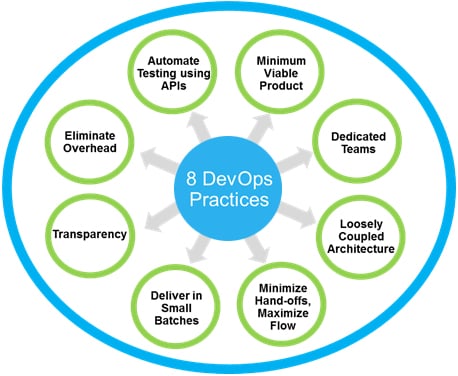
    Their survey of 600 IT professionals with application development responsibilities found that about a third of teams consistently deliver at cadences of one to three weeks and that the fastest teams generated higher business satisfaction than slower teams, an indication they don’t sacrifice quality to deliver fast. The study reveals how these teams did it: by adopting the following eight DevOps practices:

    8_DevOps_practices


    1. Minimum Viable Product – Deliver the smallest viable product or application and then improve it in subsequent rapid releases, based on feedback, and delivering value incrementally.
    2. Dedicated Teams – Form dedicated, cross-functional teams, avoid over-specialization and ensure they are not interrupted by side projects.
    3. Loosely Coupled Architecture – Use loose architectural coupling within and between applications to reduce complexity and enable delivery in small increments.
    4. Minimize Hand-offs, Maximize Flow – Eliminate unnecessary steps, delays and friction between steps to increase the flow of work.
    5. Deliver in Small Batches – Deliver in smaller batches helps to expose the most uncertain issues first and enables feedback on the most valuable usage models earlier.
    6. Transparency – Transparency into progress helps everybody to see where you are at any point in time and also visibility into risk without decreasing productivity.
    7. Eliminate Overhead –Eliminate the overhead of periodic and manual status reports and status meetings which absorbs valuable time and distracts focus from delivering value.
    8. Automate Testing using APIs – Shift away from heavy manual testing to improve delivery speed, quality, and testing accuracy, and dramatically reduce cost.


    The study refutes the myth that releasing fast requires you to sacrifice quality and accept higher risk. Adopting these eight DevOps practices, especially automated testing and delivering in small batches, does exactly the opposite:  small incremental releases are more thoroughly tested, more stable and lower risk.

    The best part about DevOps adoption is the flexibility to choose which practices to adopt first, based on each organization’s priorities, and then to incrementally adopt the rest of the practices as needed to optimize the software delivery lifecycle and accelerate innovation.

    To learn more about the survey and the eight DevOps practices, download the Forrester study along with the approach that you can follow to adopt these as per your organization’s current state of delivery cycles.

    About the Author

    ashokAshok Reddy is responsible for Product Management & Strategy, product Design/user experience and Business Development for Rational Software Division of IBM Software Group and for the IBM DevOps portfolio.  He is based in Raleigh, NC, USA.  Ashok’s role involves all aspects of global product delivery including setting product strategy and for product line management, establishing product roadmaps and partnerships for IBM DevOps portfolio.

  • The fashionable IT crowd

    The fashionable IT crowd

    The IT Crowd

    I was recently reading an article in Marie Claire UK (yes I do read non-nerdy publications, some higher AI should sentence my brain to enter a loop without an exit condition) which explained that women should start learning how to code in order to become successful professionally. That triggered my curiosity and I started to wonder when IT became classy enough to be mentioned in a fashion magazine. This might be the time for a little history.

    Don’t blame Information Technology.

    Once upon a time, well before the internet – yes kids, there was a time where people had to read books to access knowledge – IBM was ruling them all. It was such an important and powerful company that you could likely compare it to Google today. IBM salesmen were to wear suits, ties and an attaché case every day like other any other corporate person and techies had to wear a simple white shirt with an IBM logo on it. IT fashion at that time was pretty much neutral and IT was seen as any other field of work.

    In the early eighties, Bill Gates who started to do business with IBM had a look that would, for some reason, stick with IT people for decades: oversized glasses, poorly shaped and tasteless beige tops with a pair of equally bad looking trousers.

    Steve Jobs on the other hand when not representing his company officially was already seen wearing his now infamous denim and black turtleneck combo. The power of branding.

    How come then that with so many different styles in circulation, one prevailed in people’s minds as the standard geek outfit? Well, in order to understand, we have to broaden our search a bit and we can then realize one thing: in the eighties, almost every person that had an interest in science had poor social skills and or almost no interest in fashion or styling. While this is a gross generalization a quick internet search for images of “nerd 80s style” should demonstrate what I mean.

    Music has changed it all.

    In 2001 Mp3 players had existed for years but were a niche market as their price was too high, their storage capacity too low (one album would fill up a player) and they required a computer and some technical knowledge. Downloading a song was also an obstacle as there was no massively spread peer to peer or legal solutions at that time.

    Then came Apple with its iPod, almost like a piece of art that created curiosity and attraction and offered enough storage space for many albums at once. I think this was the first time the public saw an interest in a computer or mac related device. CDs while hugely popular were impractical – think of carrying more than one of them with you everywhere you go – huge and mostly unreliable for jogging or walking fast.

    People who wanted an mp3 player and who did not own a computer had to get one and access to the internet. The internet which was mostly used by “people who knew” became more and more popular and people started to massively use emails and chats (msn, aim and all those brands which do not exist any longer) and slowly gained the knowledge to use internet in a more efficient way. This led internet providers to offer higher bandwidth and the development of a plethora of websites with ever more content.

    With access to everything at all times, computers gained in popularity and the emergence of smartphones spread the use of internet even a bit further.

    In the mid-2000s, technology, the people traditionally associated with it and their culture then became hip. That was the beginning of the “geek chic” trend, often confused nowadays with the hipster subculture. People started to wear old style clothes such as suspenders and those oversized horn-rimmed glasses. Not adapted to the business world, this trend quickly faded however with the public gaining awareness of things beyond glasses, thanks to popular TV shows such as The Big Bang Theory or Chuck, the geek culture spread widely.

    Finally recommendable

    All those factors contributed to IT becoming less and less a world of “freaks and geeks” and more and more a profession as acceptable and as open to everyone as any other, finally showing up as a recommendation for a professional path in a women’s magazine.

    It was about time.

  • Microsoft partners with Docker to bring containers to Windows Server

    Microsoft partners with Docker to bring containers to Windows Server

    Docker has taken the DevOps world by storm, and that has caught the attention of Microsoft. Now, Microsoft and Docker are teaming up to bring native support for the container technology to the next generation(s) of Windows Server.

    Docker is an open platform that enables organizations to run any application as a Docker container. The Docker containers can be implemented across virtually any infrastructure—delivering tremendous agility and flexibility for managing virtual applications. The container concept accelerates software development timeframes, and allows organizations to reduce costs and improve efficiency at the same time. It’s easy to understand why Docker is so popular.

    There have been more than 21 million downloads of the Docker platform, and there are over 45,000 “Dockerized” applications available on the Docker Hub Registry, and 13,000-plus Docker-related projects on GitHub. Just last month Docker took in $40 million in another round of investment.

    Major names in tech, like Rackspace, Google, and IBM have already pledged their support for Docker. Now Microsoft wants to bring the hot technology to Windows.

    Docker Engine for Windows Server will allow customers to create Docker container applications that can run locally on Windows Server, or on virtual Windows Server instances in the cloud on Azure. In a blog post announcing the Docker partnership, Ross Gardler of Microsoft Open Technologies explains, “As part of this announcement, MS Open Tech is contributing code to the Docker client that supports the provisioning of multi-container Docker applications on Azure. This code removes the need for our cross-platform CLI to bootstrap the Docker host. In other words, we have taken a simple process and made it even simpler.

    “This development is interesting because Docker has been a really fast moving technology having come out of almost nowhere a year ago to where now it is an incredibly widely supported technology,” stated Al Hilwa, an IDC analyst. “It is a bit of engineering but Microsoft wisely decided that they did not want to leave Windows developers out of the Docker party. This is good for Microsoft because those 45K ‘Dockerized’ applications will be able to run on Windows.”

    To be fair, Microsoft isn’t completely new to Docker. Earlier this year it added support for Docker in Azure, but only on Linux. This new partnership launches an open source project to develop a Docker Engine runtime for building, running, and managing Docker containers natively within Windows Server. Docker Engine for Windows Server will be managed as a Docker open source project, but Microsoft will be a major contributor to the community.

    The Microsoft blog post describes why Docker’s container technology is so important for the fast-paved development of a DevOps environment. “Containers do not include a full operating system, consequently rapid development and scaling of container-based applications is possible through very quick boot and restart operations. Furthermore, highly efficient creation of modified container images, by virtue of only capturing the differences between the original and new containers, enables improved management and distribution of containerized applications; the resulting images are both small and highly portable across almost any platform.”

    Hilwa summed up with some thoughts about the new strategic vision of Microsoft. “What is even more interesting is that the work on the Docker engine in Windows is being done in open source—really showcasing the new Microsoft attitude towards open source (e.g. the open sourcing of Roslyn a few months ago). I really think we are seeing a faster and more open Microsoft, one that is more willing to integrate and collaborate with competing technologies without a lot of hesitation.”

  • DevOps + IoT

    DevOps + IoT

    The Internet of Things (IoT) is part marketing hype and partly a real movement. After low power WiFi chips have allowed small devices to connect to the web for a long time. Remember Eye-Fi founded in 2005?

    But there is no denying it is BIG. Service revenues rooted in micro-controller-based IoT are expected to reach a whopping $7.3 trillion by the year 2017 according to a recent IDC report, with the radical new paradigm shift of DevOps leading to the perfect storm of IoT adoption.

    IoT is set to be a disruption those building and connecting things. It forces a transformation that is largely driven by the integration of development, IT operations and quality assurance practices delivered for IoT under a single automated umbrella in the DevOps-oriented world.

    (more…)

  • Enterprise DevOps: same medicine, different dose

    Enterprise DevOps: same medicine, different dose

    I am presenting at the DevOps Summit in Santa Clara early next month.  The title of my presentation is “Enterprise DevOps: Same medicine, different dose.”  I will be attempting to tackle the sometimes sticky subject of whether Enterprise DevOps is a unique species or is there just DevOps for organizations big and small.

    My personal feeling is DevOps is DevOps. That being said though, I don’t think anyone would argue that large enterprises are a different animal than smaller companies. The inertia in these organizations make culture change on a large scale harder, if not slower.  Just as you would give a different dose of medicine to a child then you would to an adult, I think you have to inject DevOps differently into a larger organization than you would a smaller one.

    That doesn’t necessarily mean that anyone selling enterprise DevOps services or tools is a snake oil salesmen though. I think understanding the differences between a large organization and smaller ones creates opportunities for vendors. I think that some in the community think that large vendors are just using the term enterprise DevOps to protect their existing turf from usurpers.

    Anyway, I will be diving deeper into this subject at my presentation. I will post the abstract link shortly and will post me slides after the show.

    In the meantime you can help me. I am interested in your thoughts on this subject and what you think is important for me to cover.  I respect all opinions so if you don’t agree with me, feel free to say so, but if you do, say why.


    Thanks!


  • The DevOps Culture Cocktail

    The DevOps Culture Cocktail

    As I have written in previous posts, I believe that IT has accumulated decades of cultural debt that is now due.  We are a young  industry that grew up in silo neighborhoods, each with it’s proprietary practices, language and population of like-skilled specialists.  Left unchecked, the resulting “framework culture” contributed to IT’s cultural debt and is partially the motivation behind DevOps.

    The goal of DevOps is not to undervalue or replace the frameworks that are in place.  On it’s own, DevOps is not a framework – in fact,  successful DevOps relies on combined effect of best practices such as Agile, Lean and ITSM.   By recognizing and adapting the best of each, IT can formulate a potent recipe for enhancing performance and increasing customer satisfaction.

    So let’s belly up to the bar and mix ourselves a DevOps Culture Cocktail by taking the best guidance from the top shelf of each of the frameworks and practices.

    Ingredient 1:  ‘Git R Done’ Scrum

    Scrum is the most prominent of the Agile frameworks and with good reason:  it focuses on getting work “done” in manageable increments while reducing work in progress.

    Pair it with a Kanban Board

    While deceptively simple, Kanban is a powerful method for visualizing workflow, identifying constraints and keeping a team focused.

    Ingredient 2: Automation

    There is a lot of debate around the balance of automation use in DevOps, but there is no dispute that automation and metrics play a key role in successful DevOps.

    Ingredient 3: IT Service Management

    ITSM is the deployment’s “ever after”.  Agile and repeatable service management processes lead the way to stable continuous delivery and increased flow.

     Ingredient 4: Lean

    Let’s make it a skinny by creating more value for customers with fewer resources and less waste.

    Ingredient 5: People

    The most important ingredient.   DevOps relies on the way people think, behave, interact and trust their colleagues.   According to Lloyd Taylor,  “You can’t directly change culture. But you can change behavior, and behavior becomes culture.”

    Finally, add a splash of common vocabulary and a shot of the alcohol of your choice and you now have a DevOps Culture Cocktail!  Serve it daily, share it with your neighbors or sip it while reading a good book like The Phoenix Project.   It does get more potent with age.

    DevOps Culture Cocktail 2I recently had the opportunity to present the DevOps Culture Cocktail Party at Fruition Partner’s FruDevCon Conference.  One of the attendees, a hobby mixologist,  formulated her vision for a signature DevOps Culture Cocktail during my presentation.  We asked the hotel bartender to mix it up, passed it around and a new cocktail was born. Here goes:

    The DevOps Culture Cocktail
    1 part pear vodka
    1 part St. Germain
    1 part Chardonnay
    2 parts simple syrup or 7 up

    Top with a spear of pineapple and a cherry.

    Improvement recommendations are of course welcome.  Could this become a staple at all future DevOps events?

  • Share Your Thoughts about On-Call

    Share Your Thoughts about On-Call

    We all know that being on-call sucks. What we don’t know is how other people are dealing with the problem.

    It’s time to dig deep, ask the hard questions and collect data around what it’s really like to be doing the hard job of keeping the machines up & running. That’s why VictorOps needs you!

    We’re conducting the first State of On-Call survey and would love to hear what you have to say about the topic. Whether you’re currently on-call or manage a team of on-call folks, we’d like to know what tools you’re using to make the process easier and what sort of pain points you’re still experiencing.

    On-Call-600x150

    We’re thanking you in advance for your time & feedback. Additionally, your survey response gets you automatically entered into a drawing for a Nexus 7 tablet. Help us to better understand the problem so that we can help you make on-call suck less.