Category: Blogs

  • The Impact of DevOps and Continuous Testing in 2018

    The Impact of DevOps and Continuous Testing in 2018

    At its core, DevOps is meant to touch an entire organization; however it’s heavily weighted in the software development life cycle (SDLC). That’s why DevOps is going mainstream in 2018. Companies are making the business benefits of DevOps a top priority—it’s all about delivering value to the customer faster through maximum automation of the release cycle/processes. And that begins with organizations realizing that to mature their DevOps processes, they need continuous testing as part of their continuous integration practice.

    Cross-platform Engagement and IoT Will Mean More Devices—and More Apps

    With organizations shifting processes and innovation to a mix of digital technologies—a concept known as digital transformation—consumers are engaging with different apps across various platforms 24 hours a day, seven days a week. Add in the rise of internet of things (IoT) devices, which allow for seamless transitions across smartphones, TVs, tablets and other devices. Now is the time for optimum user experience (UX).

    In 2018, industries such as financial services, health care, retail and automotive will fully embrace IoT. We may also see new types of applications replacing current ones, as consumers and developers embrace the constantly evolving innovative capabilities coming in 2018. However, until the C-suite implements the tools needed to keep up with the growing demand for cross-platform upkeep and testing, other industries will experience slow adoption.

    A critical step in delivering flawless UX is testing, and lots of it. Never has there been more to test, measure and develop than in this digital revolution we are seeing today.

    Frequent New Releases Will Require Even Faster Updates

    As the number of platforms consumers engage with rapidly grows, so does the pressure for developers to ensure apps are running as they should at all times. Same goes for the pace of cloud adoption: Cloud test labs will need more sophisticated capabilities, meaning more platforms and blind spots which require continuous optimization to ensure market readiness. This need for faster turnarounds on update releases and bug fixes will multiply in 2018.

    To maintain and grow customers and profitability, CIOs must recognize the importance of empowering developers with the tools and time to implement continuous testing across the SDLC. Tools, such as those powered by automation and the cloud, increase efficiencies and free up time developers previously spent on manual quality-checking, allowing them to ensure the apps they are producing are keeping up with consumer expectations. If users feel their app is not delivering on the experience they want, they will delete it and move on to the next competitor, which has a direct negative impact on the company’s bottom line.

    Outdated Technologies Will Make for Even Slower Updates

    There is a suite of new tools being introduced to the market for all stages of the SDLC in the hopes of keeping up with the heightened speed of testing. As many DevOps environments struggle to adapt their pipelines to these new tools, many are powered by emerging technologies including machine learning and automation. In 2018, developers should ditch outdated infrastructure and processes in favor of more modern architectures, including implementing microservices.

    Modernizing pipelines will allow developers to design in next-gen engagement methods such as artificial intelligence (AI), augmented reality (AR) and virtual reality (VR) without compromising velocity.

    AI Will Experience Its Shining Moment (for Some)

    In the coming year, AI will start to move from a theoretical concept to a commonly applied technology, especially within the DevOps space. However, developers first must understand what they want AI to help them accomplish—and how—within the SDLC and across the DevOps pipeline. One logical place to start is figuring out how they can best leverage it to analyze test automation strategies.

    The value of a well-oiled, or not-so-well-oiled, DevOps process can make or break an organization. As the new year begins, be sure to include the IT leadership in these conversations to ensure developers are getting what they need, when they need it, to keep business moving as usual. IoT, AI and the cloud are just a few things to keep in mind as the industry moves to implement the latest tools in 2018.

    About the Author / Eran Kinsbruner

    Eran Kinsbruner is the lead technical evangelist at Perfecto and the author of the “Digital Quality Handbook.” He is a software engineering professional with nearly 20 years of experience at companies such as Matrix, Qulicke & Soffa, Sun Microsystems, General Electric, Texas Instruments and NeuStar. He holds various industry certifications such as ISTQB, CMMI, and others. Eran is a recognized mobile testing influencer and thought leader. He is also a patent-holding inventor (test exclusion automated mechanism for mobile J2ME testing), public speaker, researcher and blogger. Follow him on Twitter, connect with him on LinkedIn and check out his professional mobile testing blog.

  • DevOps Chat: Chef Habitat Project Continues to Mature

    DevOps Chat: Chef Habitat Project Continues to Mature

    When Chef Habitat was released a little more than two years ago (good DevOps.com story on Habitat here and a good DevOps Chat on it here), many people in the DevOps community wondered where Chef was going with Habitat. It was a really ambitious vision, but could it meet its lofty goals?

    Habitat is now made up of many different packages that provide different functionalities. There is, of course, much more to Chef Habitat. This DevOps Chat will tell you all about it.

    Joining us on this DevOps Chat are Jaime Winsor, a co-author of Habitat, and Tasha Drew, senior product manager of Habitat, and Blake Irvin of SmartB, a Habitat user. Between the three of them, there is a ton of great information here. If you are interested in Chef Habitat or would like to find out more, this is a great place to start!

    As usual, the streaming audio of our conversation is below, followed by the transcript of our conversation. Enjoy!

    Audio: Chef Habitat

    Transcript: Chef Habitat

    [su_pullquote][su_custom_gallery source=”media: 118811″ target=”blank” width=”250″ height=”250″]Blake Irvin
    Blake has spent over a decade working in systems and software engineering automation, on platforms ranging from on-premise metal to containers-as-a-service, BSD and Solaris systems to embedded Linux sensor platforms. He lives and works in Berlin, Germany, where he’s Senior Operations Engineer at smartB, GmbH, an energy-efficiency and sustainability startup.[/su_pullquote]

    Alan Shimel: Hey, everyone, this is Alan Shimel from DevOps.com here for DevOps Chat, and we’ve got a really great chat lined up for this episode. It is all about Chef Habitat, and we’ve got some really-we actually have three guests on the show today, so we’re gonna move it along to keep it moving.

    Let me first of all introduce my two Chef guests or from Chef. One is Tasha Drew, who’s a Product Manager for Chef Habitat, and one is Jamie Winsor, an engineer with Chef and one of the co-authors of Habitat. Jamie, Tasha-welcome to DevOps Chat.

    Tasha Drew: Thanks so much. Happy to be here.

    Shimel: Thank you.

    Jamie Winsor: Yeah, thanks for having us, man.

    Shimel: Hey, it’s my pleasure. And then, joining Jamie, Tasha, and myself today, all the way from Berlin, is Blake—and I hope I’m not gonna mess this up—Irvin. Blake, are you there?

    Blake Irvin: Yep.

    Shimel: Okay. Thanks. Hey, Blake, I appreciate you taking the time to join us. Blake, you’re with, is it BusyBee, is that what’s the name of the company?

    Irvin: It’s called smartB.

    Shimel: smartB.

    Irvin: Yeah, and the B essentially stands for business, because we are building, because we focus on providing energy efficiency analysis for businesses—small to very large businesses and the buildings that they operate.

    [su_pullquote align=”right”][su_custom_gallery source=”media: 118812,118813″ target=”blank” width=”200″ height=”200″]Tasha Drew
    Tasha Drew is the Product Manager for Habitat. She previously launched Chef Automate’s analytics capabilities, was Head of Product at Rentlytics, was responsible for product for Engine Yard Cloud, and spent several years in various data center endeavors on behalf of Lockheed Martin. Tasha holds an M.S. in Management from RPI and a B.S. in Computer Science from USC. When not in front of a computer, Tasha prefers to be cruising around Napa or at the beach with her dogs—all while having intensely deep thoughts about how to save application developers from tedious rework via the wonders of application automation with Habitat.
    Jamie Winsor
    Jamie Winsor is a lead engineer at Chef Software and the coauthor of Habitat, an open source project built upon distributed system protocol Butterfly to provide a self-healing, self-configuring, stack-agnostic, frictionless abstraction for running applications—regardless of their complexity—to software developers. Jamie has been a software engineer in the video game industry for 10 years, focusing on networked application servers on such titles as League of Legends, Lord of the Rings Online, and Dungeons and Dragons Online. One of Jamie’s responsibilities in his game development tenure was to bring what we today know as DevOps into the daily lives of the other developers on his team, which Jamie accomplished by building, evangelizing, and teaching methods to his peers. He draws on that experience today in building Habitat, as he helps enable all software developers, regardless of their experience, bring their ideas to life without investing in the details of operationalizing an application.[/su_pullquote]

    Shimel: Wow, that’s really good stuff. Jamie and Tasha, you both work for Chef, no need to introduce who Chef is to our DevOps audience, but Blake-welcome. And we have you on today because we’re gonna talk a little bit about Habitat, and Blake, if you don’t mind, I wanted to start with Tasha and Jamie and talk a little bit-just a little background. Maybe we have some folks on here who are not familiar with Habitat.

    So, Jamie, you’re a co-author. Why don’t you take that one, right? What’s Habitat, for people who may not be familiar?

    Winsor: Yeah, sure. So, the Habitat project is a number of pieces of software, and the overall goal is to, I hope, redefine what application automation means by focusing on the application instead of the infrastructure. In the past, we have been building computers in service to host our applications, and what Habitat does instead is it says, “Let’s focus on what the applications are that we need to run our application, what software we need down to a bare minimum, and then provision the machine around it,” and Habitat runs exactly the stuff that you need.

    It does so with a packaging system and a build system and then a process supervisor. The process supervisor runs the packages, the process supervisor communicates to other supervisors using a gossip protocol to share and spread information about what software they’re running, which allows us to enable things for free, just by packaging your software with Habitat, such as service discovery, leader—follower failover, rolling configuration updates, rolling software updates—and it’s all coordinated using the gossip ring.

    Finally, the piece that we built, the last piece of Habitat is simply called Builder, which we can also chat about today, which we just launched about a month ago. And Builder is a hosted Software as a Service build service that’s currently in preview mode. It’s free, and it builds your software that’s packaged with Habitat and hosts it as well in release channels, which allows you to have supervisors subscribe and then receive automatic updates using a complete CI/CD process of promotion between an unstable branch to a stable branch and so on. That’s basically it.

    Shimel: Yeah, no, more than basically-that was a great description and great stuff there, Jamie.

    Tasha, now, Habitat was released as an open source project by Chef, and it’s probably about two years ago now, right?

    Drew: Yeah, yeah.

    Shimel: And so, Tasha, tell us kinda what’s been the latest with Habitat.

    Drew: Sure. So, basically, we have been working nonstop since the initial reveal of Habitat about two years ago, just adding functionality and capability across both that Builder system and that process supervision system that Jamie’s been talking about.

    We’ve also been working on the deployment piece of the overall integration between those two which, in Habitat’s world, is highly agnostic. So, the idea is, use whatever tools you need to deploy those artifacts and supervisors that you’re using with Habitat. And so, we’ve been working with partners to have a really great cloud foundry ecosystem story, Kubernetes ecosystem story, AWS and Azure story, and then Terraform as well.

    So, the idea is, we have been making it easier and easier for people to come get started using Builder, and that’s why we’ve released Builder in free preview mode, it’s because we just want to have this very low friction way for people to get started with Habitat and start rebuilding all of their workloads, and then deploy using your favorite technologies and then start seeing the benefit of the supervisor in Builder, communicating between the two.

    Shimel: Absolutely. And as you mentioned, Builder is in free preview right now. You know, some people look at things like Habitat and some of the other great open source projects Chef is kind of shepherding, and they say, “This is all great, great, great, but how—you know, where does, how do they stay in business? Where do they make money?”

    So, Tasha, can you talk a little bit about sort of where Chef sees commercial opportunity with Habitat?

    Drew: Yeah, absolutely. So, for our enterprise customers, having on prem solutions that integrate with all of our open source products in order to have that really strong control plane management layer is super important. And so that’s, with Chef Automate, something that we continue to invest and see incredible success with.

    And then, with Habitat, Habitat becomes the technology that continues to support enterprises while they want to move fast to deliver applications to production at scale. And so, having this part of the technology suite be adopted by our core set of enterprise customers will continue to be part of our strategy, but then we also have Builder to enable smaller shops to just get started—really low friction point, really easy to use. And how we monetize Builder itself over time will be something that we investigate as we see how people adopt and use the technology.

    Shimel: Excellent answer. Great, Tasha. So, Blake, I didn’t wanna leave you too long in the cold. Let’s bring you into this now. First of all, Blake, I don’t think I asked you, and I don’t know if our audience is savvy to it, but what exactly is your role at smartB?

    Irvin: So, I—we have a team of sort of multidisciplinary, polyglot engineers at smartB. We do all kinds of things because we’re a small shop and a small company, still. But the focus that I have—and this has been my focus and my interest, sort of, for the last, it’s actually been a little bit over 10 years is on all manner of operations engineering.

    So, what I used to do would be something more like traditional systems administration, and now I would say I’m more of a software engineering operations specialist. In other words, I’m focusing on improving and streamlining the process of software engineering and less focused on things like racking servers.

    Shimel: Sounds like you’re doing DevOps to me, man. [Laughter] But Blake-

    Irvin: Yeah, you could say that.

    Shimel: Yep. So, Blake, smartB is using Habitat?

    Irvin: Yeah, that’s true.

    Shimel: Let’s talk about why.

    Irvin: I would say, for the moment, about-sorry?

    Shimel: I was gonna say—why? What are you using it for?

    Irvin: Well, we’re using it for almost everything. We have one—yeah, we have one production service that is not yet what I called Habitized or wrapped up in the Habitat package, and we’re just waiting for some work in the community to be finished before we can do that. But yeah, like, 85, 90 percent of our services are running under Habitat, using the Habitat supervisor, and we’re using as much of that workflow that Jamie and Tasha were describing as we can at the moment.

    And that’s actually been a pretty good process for us, I think, because the way that Habitat’s designed, the adoption process can be incremental. So, when Tasha was referring to giving Habitat users the freedom to pick and choose how they want to deploy or how they want to go about adopting, that’s definitely something we’ve leveraged a lot to make our story good for ourselves.

    Shimel: Got it. And so, Blake, I mean, when did you guys adopt, start with Habitat?

    Irvin: So, when I saw the launch video, which was, I think, Adam speaking in Seattle-Adam Jacob, the Chef CTO. I was sort of, I was watching it originally just out of curiosity and then, as the talk went on, my mouth started hanging open further and further, I think. Not because I thought it was the most groundbreaking thing that I’d ever seen, but more because I couldn’t-I was surprised to see how many of the check boxes that I had in my mind from 10 years ago around this kinda stuff, all this kind of operations work, how many of those check boxes were getting checked off by the project as the architecture and the behavior of the tools was described.

    So, we really started looking at the feasibility of adoption within weeks, I think, of that launch video.

    Shimel: Wow.

    Irvin: And started doing the rollout probably a few months afterwards. So, we’ve been doing it like a very slow, incremental rollout to, you know, ensure that we don’t disrupt any of our current software development process or our current production environments. That’s what’s been going on. It’s been a continual process for, I’d say, like eight months now, but just done very slowly.

    Shimel: Very cool. So, Blake, you know, I have a long history of working in open source-related projects and stuff, and I’m always curious, you know, as a consumer, if you will, or a user of this open source project, have you guys—what have you contributed back? Have you contributed any code, bug findings, suggestions for new features? How are you giving back to the community, here?

    Irvin: Yeah, sure. I think the thing, since we’re a really small team, what we’ve really focused on is trying to use the tool in the way that it’s been designed to be used and then giving feedback to the community and/or to the core maintainers whenever we find bugs or places we want to see improvements, and just keeping that conversation really open and fluid, which has been great. It’s one of the reasons that I’ve continued to use Chef software stuff for—not quite my whole career, but a sizable majority of my career. It’s just that, I think, as an organization, Chef believes that community is very important, and in fact, perhaps, one of the most important things about building a company. And compared to other experiences I’ve had with other open source groups, I think that’s been a real win for everybody involved.

    So, in terms of code contributions, I think mostly what we’ve done is put out a lot of plans, which are the sort of blueprints for packages that Habitat uses when you set up like a set of dependencies for your application. So, we’ve definitely published a lot of those back into the community. I think you can find them if you look on the Builder site under the smartB origin, you’ll see all the packages we’ve published. And we’ve also published some stuff back into the core plan side, just the ones that the Habitat team maintains.

    Shimel: Got it, got it. So, Jamie and Tasha, does Blake and smartB sort of represent the kind of prototypical Habitat user?

    Winsor: I’d say so. You know, with Habitat, you can pick and choose what pieces you want, and it’s been great to watch Blake and smartB grow from—back to the packaging manager and the supervisor and gradually moving toward adopting Builder. They’ve been great to work with in the community. They gave us a lot of great feedback. You know, they’re users, so one of the things that is really important is, you build a feature or you build—you know, you fix a bug, and then you immediately get the feedback from the community, and they’ve been unbelievable to work with.

    I’d say that Habitat would work for any team that ships software, though. So, they’re absolutely a typical user, because they ship software, right?

    Shimel: Mm-hmm. Cool beans. Guys, we’re almost at the end of time, unfortunately, leading up here over 15 minutes. But Tasha, for people who may want to, you know, go explore Habitat themselves, where can they go to get information?

    Drew: Yeah, we would love them to visit our website, Habitat.sh. There, you can see, we have a quick, you know, just kick the tires, 10-minute kinda step-through demo. We have more in-depth tutorials if you want to start just playing around with both the run and build time features of Habitat, and our community is very active on our Slack channel, which you can find a link there to join, but it’s just at Slack.Habitat.sh. So, as you get started, if you wanna just jump in that Slack channel, the entire core team is there, our community is there, and we seek to be super welcoming to new people. New questions are very welcome in the general channel. So, you can just hop in and get support and ask whatever questions you have.

    Shimel: So, it’s Habitat.sh?

    Drew: Yeah, yeah.

    Shimel: Excellent, excellent. Guys, listen. Thank you very—all three of you, Blake Irvin, Jamie Winsor, Tasha Drew—thank you so much for being our guests in this episode of DevOps Chat. Continued success, Blake, with you guys in your bigger business as well as using Habitat, and Jamie and Tasha, with you guys continuing to develop and make Habitat, you know, an indispensable tool for companies around the world. Alright?

    Drew: Thanks so much.

    Winsor: Thank you.

    Shimel: Alright, everyone, have a great day. This is Alan Shimel for DevOps Chat. We’ll hopefully see you soon on the next chat. Until then, take care, everyone.

    — Alan Shimel
  • How Data Drives the Business of a Clean Energy Company

    How Data Drives the Business of a Clean Energy Company

    Imagine using kerosene lanterns to light your way into the evening, at home so you can cook, read, shower and the kids can do homework, or outside to keep a business or medical center open or play night games in a park or field. This is life in undeveloped nations. Not only is the light source insufficient, but burning kerosene is harmful to individual health and pollutes the air.

    These issues are important to the team at BBOXX, a new generation utility company that develops clean renewable solar energy products for developing countries. Its team has developed its own “Battery Box,” a solar-powered battery box that powers lights and appliances for rural Africa—providing clean energy for numerous products and appliances including TVs, lamps and mobile phones and any other item that lights up or needs to be powered.

    BBOXX describes itself as a service company, not a technology company, and as such focuses on being a data-driven company, capturing customer data, analyzing and manipulating it to provide better services and to continue to improve the battery box.  Customer data is critical to its overall success: Knowing how and why customers buy and use the battery, when they use it, length of time … there are a number of data points that help BBOXX understand the customer. In addition, BBOXX needs to monitor the batteries to ensure they’re working properly, help maintain connectivity and disable units, if need be.

    BBOXX’s development team captures data by remotely monitoring units. They are able to access data that is being sent from sensors via a 2G network and through the Amazon Web Services infrastructure into the cloud. Once the raw sensor data is in AWS, it is then stored in a database designed for metrics and events. From here, they are able to analyze it, provide business dashboards, generate predictive maintenance alerts and notifications and predict and find interesting business trends such as energy consumption spikes during soccer events, for example.

    In addition, the team at BBOXX can also correlate and aggregate usage information, which helps them upsell additional power capacity based on upcoming events. For example, a football match between Kenya and Zambia increased demand for more energy to support extended viewing times.

    Becoming a data-driven business meant that BBOXX needed access to real-time data at its core, which had another set of challenges:

    • Securely monitor a distributed set of devices across low bandwidth 2G networks
    • Provide real-time 24-7 monitoring to a distributed team who expects the data to always be right and available
    • Provide the ability to monitor and react to high-speed time-series data
    • Ability to remotely monitor and manage the distributed devices
    • Ability to track usage statistics and bill based on these statistics
    • Proactively monitor units so they could be repaired before the customer lost power
    • Provide insight into customer usage patterns to develop compelling pricing plans
    • Gather, harmonize and use three different sets of data from the various components:
      • Raw telemetry data (voltage, current, temperature)
      • Logs from the box firmware
      • Derived data (power, daily energy usages, state of charge)
    • Lack of staff to manage another solution
    • Keep latency systems at a minimum – their systems were already hosted in AWS and the performance was meeting the needs of the company

    BBOXX is now able to gain insight into its data and apply lessons learned from analyzing past data to develop new and exciting products. The company now uses data stored in a whole new way:

    • Developers ​analyze the data for ways to create new data streams
    • Analysts look for irregularities in usage and write algorithms to detect alerts
    • Business managers look for customer usage patterns
    • Technicians analyze time series voltage and current patterns for remote diagnostics
    • Centralized call center operators reconcile more technical issues for customers by seeing the reason for the outage (hardware failure, over-usage, non-payment)

    In addition, their investors are highly interested in their data collection and analysis as a marker for competitive advantages, reduced delinquencies, growth potential and decreased risk.

    BBOXX uses Amazon Web Services (AWS) to receive store and analyze its steadily increasing portfolio of products. By designing its software architecture with scalability in mind, BBOXX takes advantage of a wide range of AWS’s integrated features including load balancing, auto scaling groups and code deploy to maintain fast, reliable and consistent access both internally and externally.

    Without access to user data, BBOXX would not be able to offer the unique services it does today, which is a fully vertically integrated service, controlling every part of its customer experience.

    About the Author / Mark Herring

    Mark is a zealous marketer who believes that the road to marketing success always leads with the developer. Before InfluxData, Mark was VP of corporate marketing and developer marketing at Hortonworks, SVP of Products at Software AG, VP of Middleware, Java and MySQL Marketing at Sun Microsystems, and VP of Marketing at Forte Software. Earlier in his career, Mark was a developer and technical support engineer for Oracle. Mark holds a B.S. Degree from the University of Witwatersrand, South Africa. Connect with him on LinkedIn and follow him on Twitter.

  • Cuba Embraces DevOps, Despite Infrastructure Challenges

    Cuba Embraces DevOps, Despite Infrastructure Challenges

    A few weeks ago I had the pleasure of speaking at the second DevOpsDays event in Cuba alongside some great technologists from across the United States, Europe and Latin America. The conference was held in a beautiful hotel in Varadero overlooking a marina right by the beach. Varadero is approximately two hours by car from Havana.

    The first thing I noticed is that Cuba is full of anachronisms. This became evident as soon as I walked out of Havana Airport and realized that the whole “they have some old cars” thing was real. It was fascinating to see that every single car was pre-1950s, some perfectly maintained with great paint jobs and others in worse condition yet still capable of doing their core job as a mode of transport.

    Talking technology in Cuba was eye-opening, to say the least. Do not expect to have 3G or 4G data on your cellphone. Do not expect to have WiFi in most hotels (you can purchase prepaid internet credit, but the speed will be slower than what you are used to) and definitely do not expect to have WiFi in a private home. These are luxuries.

    But here’s the surprising part: There are companies in Cuba with fully automated CI/CD pipelines achieving 10 to 12 deployments per day and solving real problems, such as the team working under Anesto del Toro at Datys. Cuba even has its very own Docker Captain, who gave a superb demonstration on the value of Docker in front of the DevOpsDays audience.

    Now let me remind you, these guys are not working with stable internet connections and they manage to get the job done on a daily basis.

    Why am I Rambling on About Cuba?

    Engineering is about solving problems. No matter how big or small, it’s about looking at a problem and finding the solution. Now, this is part of Cuban life. If something is broken, they don’t throw it in the trash and buy a new one; they fix it. Their 80-year-old car breaks down two hours outside of town? They get out of the car to fix it and—take my word for this—their friends, family and neighbors will come outside to fix the problem, too. This creates a mindset of solving the problem at hand without fail. This is easily demonstrated when you talk to Cubans about software development: They won’t say they are a Python engineer, a Java engineer or any other choice of language—they are software engineers who understand how development works as a whole. They will use the language required to get the job done to the highest standard.

    Like everywhere else in the world, there were huge differences in levels of DevOps adoption between the various organizations in the country. In contrast to the companies mentioned earlier, there also are organizations that have only just heard of these methodologies or are now considering setting up their first CI pipelines. Like many of us, they are still figuring out how to solve their technical debt and modernize their IT Infrastructure, but the key point is that the stakeholders, C-level executives, junior engineers and everyone else in between want to learn. They are open-minded to the principles of DevOps. Every person in the room at DevOpsDays Cuba was focused and listening to what we had to say. This excited me as a speaker and everyone else in attendance. We could see people who really did want to change and transform the cultures within their technology teams and overall businesses to start adopting these modern and proven practices.

    The journey ahead is a long one. The infrastructure challenges remain in place and there is much to be learned, but it was great to see such positive energy and eagerness to adapt. I want to thank everyone who attended DevOpsDays Cuba for making it such an amazing experience. An even bigger thanks to the organizers Enrique Carbonell, Rudy Gevaert, Yadier Perdemo, Manuel Oliver, Mike Rosado, Manuel Morejon and anyone I’ve missed. The event couldn’t have been better and it was a genuine pleasure to visit Cuba, I hope to return soon and reconnect with as many of you as possible!

    About the Author / Conor Delanbanque

    conordelanbanque

    Conor Delanbanque has been recruiting and leading recruitment teams in the DevOps space for the past few years. As well as being exclusively responsible for growing some of the most innovative DevOps & SRE teams in the US and Europe as an external consultant and recruiting partner, Conor also founded the Future of DevOps Thought Leaders Debate, sponsors DockerNYC Meetup on a regular basis and co-hosts ServerlessNYC. You can tweet him at @ConorDevOps, find him on LinkedIn or at events, expos and writing articles on DevOps.com.

  • Top 5 Best Practices for DevOps Monitoring

    Top 5 Best Practices for DevOps Monitoring

    Today organizations are required to deliver on higher levels of customer satisfaction for their online services. Many, however, are forced to support these initiatives with an interrupt-driven approach as they react to fix things after they break. However, for a more proactive approach and to manage expected high levels of SLAs, organizations can opt to reduce their amount of unscheduled downtime by implementing a continuous delivery (CD) model to their development efforts.

    What is critical in the CD model is the ability to monitor and manage systems in a structured way, getting early detection of problems so organizations can make changes before the system is impacted. While unexpected failures make interrupt-driven work unavoidable at times, organizations can become more proactive by examining their current approach and toolset against business needs to help create a path to continuous service delivery optimization.

    Effective CD Models Need Effective Monitoring

    As a starting point, organizations need control and visibility into their DevOps environment by collecting and instrumenting everything. Considering the amounts of data, this can be an insurmountable challenge for most organizations. To get started, follow these five best practices to perform DevOps monitoring efficiently and quickly in a measurable and scalable way.

    Step 1: Collect the Data. You can’t manage what you don’t measure! It is important to take inventory of what is being collected today and align with business and executive teams to collaborate on the aim of the services delivered. Analyze the inventory collection of metrics with questions such as: “Why aren’t we collecting this? How does this fit into our goals? Have you ever seen a failure in X? How often should we be measuring this? How long should we keep it for? Is that important?” Teams also should evaluate how they are collecting the information and consider the best architectural approach for collecting their metrics, including whether pull, push or pull collection methods are better. Once goals are understood and the inventory of data is collected, look at what else your organization should consider collecting.

    Step 2: Correlate and Triage. Correlation of data is needed to understand it, but data comes in at different frequencies, in different time frames and from different sources. Work to normalize the data to understand it, perform comparisons against the different incoming metrics and establish baselines for basic service availability. Since organizations aim to go beyond basic service level agreements (SLAs) and offer a high-performing solution, constantly ask what the organization is missing from a data perspective and how it relates to business initiatives. Asking that question from the collection, correlation and triage perspective is critical.

    Step 3: Identify Trends. Organizations need to examine historical data to identify trends and take action before issues arise and customers complain. Establish alerting thresholds by outlining what a normal day looks like from a monitoring performance and customer perspective, and then identifying examples of what makes an abnormal day. This ties in with managing infrastructure inventory and understanding safety thresholds for each of the components that potentially could impact the service offering. It’s critical to communicate these findings with teams and business-line managers to prevent service delivery problems from happening and optimize offerings based on identified trends.

    Step 4: Notify and Act (Automation). In manual mode, a notification is delivered and then the team reacts. But teams are continually pushed to do things faster, and automation can help. To get to that point, organizations must understand where best to add more automation. How do you gather the right telemetry that delivers consistent answers that the machine can operate rules against, and do you leverage an automated process or notify a person? The desire to improve to a faster process requires a shift from manual to automated practices.

    Step 5: Predict (What-if Analysis). If you don’t take the time to go through the first four steps in a methodical way, it’s very difficult to reach this final step without always remaining in a manual mode. To balance costs and availability, it’s critical to discuss with the executive team how to predict customer service consumption (revenue) against the amount your services are going to cost the business.

    For example, developing a service that can alert customers of a potential service disruption due to disk space can be accomplished only by clearly setting business goals, then using the right metrics and events platform leveraging a time series database. In this case, the business goal is to ensure no service disruption due to failures such as low disk space; the metric monitoring is for disk space for each customer instance with the appropriate threshold alert set off by an automated trigger; and the action is an email to the customer letting them know of the situation and what action they can take (reduce load or upgrade for more disk space). In this example, it is important to marry business logic with the monitoring practice to make service a successful experience for customers. Furthermore, this approach will help teams to not only predict user experience but also help to predict OpEx and CapEx better into the future.

    That’s the benefit of the ability to predict with the right monitoring approach—to make informed business decisions based on results. Customers appreciate that, and proactive support is much better than being reactive.

    Emerging trends such as microservices, containerization, elastic storage, software defined networking and hybrid clouds are pushing the boundaries of DevOps monitoring. The right monitoring plan can identify and resolve problems before they affect critical business processes and enables customers to plan for upgrades before outdated systems begin to cause failures and outages for users.

    About the Author / Mark Herring

    Mark Herring is CMO at InfluxData. He is a well-rounded silicon-valley executive with proven experience in taking complex technology and making it understandable to the broader audience. His deep developer roots are never far from his mind as he looks at trends and asks the tough questions on whether the technology is here to stay or just another fad. Currently Mark is Chief Marketing Officer at InfluxData. Follow him on Twitter and connect with him on LinkedIn.

  • How to Make Your Software HIPAA-Compliant

    How to Make Your Software HIPAA-Compliant

    Creating software for the healthcare industry must always follow strict requirements and limits set by both state regulators and medical organizations. In this article, we will focus on becoming compliant with HIPAA (the Health Insurance Portability and Accountability Act of 1996) by building a proper IT solution for corresponding institutions, while also considering the HIPAA compliance software checklist.

    By the end of 2017, the North American healthcare IT market is forecast to value $31.3 billion. According to Healthcare IT News, the annual growth rate is about 7.4 percent, which will allow the market to become almost $10 billion bigger than it was in 2012. Why has the market grown so fast? The main reason is the need to implement more IT systems in medical organizations, thus creating a higher demand. Of course, there are also other factors that drive market growth.

    Other factors that increase the healthcare IT market include:

    • A growing pressure to cut medical costs;
    • A high demand for healthcare system integrations;
    • A higher ROI due to implementing IT systems in health care;
    • Serious governmental financial support;
    • The need for computerized physician order entry (CPOE) adoption; and
    • Aging populations.

    Healthcare IT tools must correspond to all HIPAA requirements to make medical institutions integrate them. Let’s talk about the major aspects of software development in this industry.

    How to Become HIPAA-Compliant

    Here, we will cover the elements that must be implemented in software for medical organizations to ensure HIPAA IT compliance. Based on the following recommendations, developers can adopt the features they need to adhere to all requirements.

    Audits

    According to the Act, healthcare providers must perform regular audits to identify possible risks for data breaches or privacy violation. A HIPAA-compliant software should utilize these audits to analyze the compliance level of a particular medical organization and provide it with detailed information concerning risks and current errors, including recommendations. The audits may include a form of quizzes, which will make them easy to use for medical staff.

    Recovery Plan

    The above-mentioned audits will help forecast risks or detect errors related to HIPAA compliance. On the other hand, a remediation plan will allow healthcare providers to correct mistakes and prevent their reappearance. That is why such plans have to be included in medical software. Furthermore, every medical institution has to develop its own recovery plan, taking into account its specialization and implemented systems. The software should be able to initiate a particular plan for a specific situation.

    Documentation

    The main task of any medical software is to work with documents. Since the software helps facilitate documentation processing, many healthcare providers implement such systems in their organizations.

    Required principles, which software development organization Archer Software uses in its own projects, for medical software in documentation processing include:

    • Comprehensibility;
    • Simplicity;
    • Strict structure; and
    • Secure data storage

    HIPAA violation fees are huge. The price of breaking a rule can reach up to $1 million. Reliable data storage, which protects from hacker attacks, will allow organizations to save money and ensure electronic protected health information (ePHI) security.

    Managing Relationships with Business Associates

    HIPAA-compliant software must also handle the company’s relationships with its business associates, including contractors responsible for managing ePHI. A system must monitor the execution of specific agreements regulated by the Omnibus Rule of HIPAA. This will help healthcare providers ensure the security of PHI while entrusting it to business associates.

    Security

    It is almost impossible to fully exclude the risk of data breaches in any medical organization. Software must be able to detect those breaches, create a corresponding report and apply preliminary measures to avoid further data “sharing.” It also has to prevent data breaches by blocking the use of portable data storage devices.

    HIPAA Compliance Checklist for Software Development

    Below is a list of all the necessary elements for HIPAA-compliant software, based on the safeguards listed in the HIPAA Security Rule. The implementation of these elements will allow your software to ensure both ePHI security and privacy.

    The necessary features for HIPAA-compliant software include:

    • User authorization;
    • Access control;
    • Authorization monitoring;
    • Data backup;
    • Remediation plan;
    • Emergency mode;
    • Automatic log off; and
    • Data encryption and decryption.

    Now that we’ve covered off the requirements for IT solutions designed for medical organizations, let’s proceed to the aspects of hospital management software development.

    Hospital Management System Development

    Besides HIPAA rules, custom hospital management systems (HMSs) have to correspond to other internal requirements that will allow medical staff to get as many advantages as possible from using the medical software without compromising patient privacy or data security.

    The requirements for HMSs are as follows:

    • An HMS has to be comprehensive for any medical employee.
    • The UI must be highly informative and laconic.
    • The system has to have a user access control based on employee responsibilities.
    • An HMS must contain a reliable security system that encrypts stored data.
    • The software has to provide functionality for extending or improving clinic automation.

    Taking into account the tremendous financial penalties for violation of HIPAA principles, healthcare institutions strive to implement IT systems that fully correspond to the requirements of the Act. That is why software developers have to be aware of new state requirements in the healthcare industry to offer medical organizations convenient IT solutions at a reasonable cost. This is especially crucial for startups just entering this market. This knowledge will allow healthcare providers to get HIPAA compliant software and help IT outsourcing companies grow their business.

    About the Author / Adam Edmond

    Adam Edmond is a technology writer, interested in the cloud, app and software developing niche. However, he can’t stand mathematics. Edmond has also lead courses in visual effects, animation and digital marketing for both the Western Australia School of Art and Design and Murdoch University. Connect with him directly.

  • The 7C Holistic Approach to DevOps

    The 7C Holistic Approach to DevOps

    The DevOps methodology was first adopted in 2007 with a bigger purpose of improving organizational efficiency by bridging the gap between software release and IT operations teams. This started as the core practice of continuous integration (CI) and continuous delivery (CD) with a prime focus on better quality of releases and more frequent releases. Now, DevOps is becoming the norm of the industry and is being embraced by multiple organizations as a digital transformation with a shared goal, involving all stakeholders, to serve the customers better with higher quality product release and more frequent releases.

    DevOps has evolved beyond release and deploy and now involves product owners, project managers and all aspects of software development life cycle. This is the key reason it has evolved as a holistic approach starting from the service team interacting with the customers to product release and production monitoring. In this blog, we will explain how the 7C approach of DevOps is a natural evolution of DevOps and how it helps different organizations to perform better.

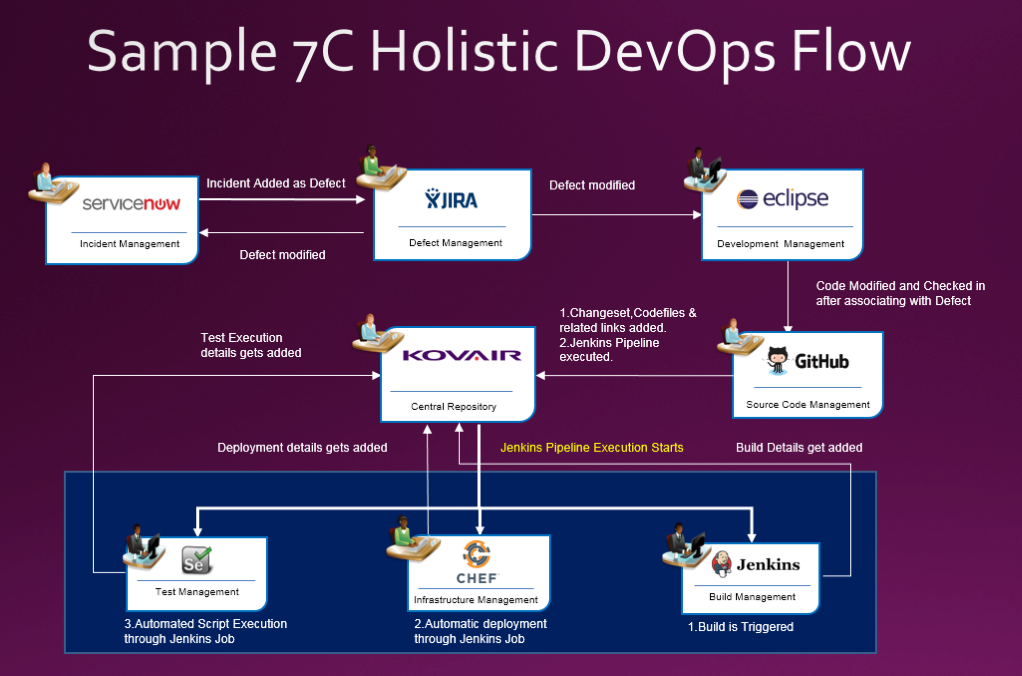
    DevOps now spans across the entire organization involving customer service, marketing, product owners, project managers, program managers, and different levels of developers, QA, release or build teams and infrastructure team. As the main focus of DevOps is to serve the customer better and faster, it is important that all the stakeholders have better end-to-end visibility of operations, planning, integration, testing, monitoring, delivery and feedback. This is the 7C approach of DevOps, as illustrated in Fig 1. This requires an efficient integration of processes and tools to automate the seamless information exchange and execution. This approach also empowers all the stakeholders to better contribute in product’s success and efficient execution.

    Fig. 1: 7Cs of DevOps

    The 7C holistic approach to DevOps also requires efficient collaboration between all stakeholders, empowering them to contribute more. The 7C approach removes all silos of information and execution.

    Startups were fast to adopt DevOps as many of them were setting up things from scratch. But the latest industry trends show large enterprises embracing DevOps primarily with the focus on efficiency and better, more frequent releases.

    The DevOps domain includes lots of tools and many of them are open source. This has provided a toolset for engineers to tinker with or experiment. This tends to have problem of its own, as too many toolsets in the flow create silos of information and execution, which creates confusion and inefficiency. This is becoming a problem and that’s why solutions are required which provide better integration and execution across multiple tools. The right solution for this will be a platform with deep integration capabilities.

    A deep integration platform for DevOps will enable seamless integration and execution across different tools, even home-grown proprietary tools, to provide a holistic solution starting from customer initiation to production deployment and feedback. This approach is significantly important for large enterprises, as this enables them to have the flexibility of preserving their existing investments on tools and processes while also allowing them to selectively introduce new tools. Rather than trying everything new, large enterprises can manage changes while primarily focusing on efficiency, automation, collaboration, better quality of releases and more frequent releases.

    This 7C approach gives same visibility to all stakeholders and everyone knows what feature is being released when. This approach also helps to move information/execution in both left and right direction with powerful traceability features, analytics and dashboards. Deep integration of information and execution also reduces dependency on other teams and promotes self-service.

    Fig. 2 illustrates a sample DevOps flow where service team uses ServiceNow; software, product and project managers are using Jira for Agile management, developers are using Eclipse as their integrated development environment, GitHub is used for source code repository, QA team uses a test management tool for test and defect management, and finally the release team uses Chef and Jenkins to orchestrate build, release and deployment. In real-world examples, teams add more tools for code analysis, security and production monitoring. All such complex flows are supported within DevOps 7C holistic approach by utilizing the deep integration platform. The 7C approach is more productive as it allows faster detection, analysis and resolution of problems.

    Fig 2. Sample DevOps Flow with Deep Integration

    The 7C approach works well with both traditional waterfall software management as well as Agile software management—mainly because of better end-to-end visibility, efficiency and collaboration.

    To conclude, 7C approach of DevOps is the natural evolution of DevOps, empowering the team to achieve better efficiency and execute better. This empowers all the stakeholders in the organization by providing better end-to-end visibility and powerful means of collaboration. Involving all stakeholders also creates a better environment of trust and collaboration. With this 7C approach, DevOps is not limited to build and release but it has spanned across the entire spectrum of software development lifecycle. This is especially highly beneficial for large enterprises as it enables them to preserve their prior investments and enhance their existing flows. This gives them leverage to selectively try new tools and technology while preserving what is working well. This is a great approach to expedite the enterprise level digital transformation.

    About the Author / Devendra Joshi

    Devendra Joshi is Sr. Director, Customer Solutions and Products at Kovair. He is a software professional with over 20 years of experience in enterprise software, social media, healthcare, SaaS companies, and EDA. He has worked with startups and large enterprises in engineering management, and product and solutions management roles.

  • Cloud Foundry Study Confirms Accelerated App Development

    Cloud Foundry Study Confirms Accelerated App Development

    When it comes to accelerating the development of applications, having a standard set of runtimes can make all the difference. A new study of 753 IT professionals conducted by ClearPath Strategies on behalf of the Cloud Foundry Foundation (CFF) finds a marked decrease in the time it takes organizations using the Cloud Foundry platform-as-a-service (PaaS) environment to develop code—just 18 percent need three months or longer, compared with 51 percent of respondents that don’t use the Cloud Foundry Application Runtime. And, according to the study, the 46 percent of responding companies that use the Cloud Foundry Application Runtime see application development times of less than a week, compared with only 16 percent of non-users.

    Abby Kearns, executive director for CFF, says use of Cloud Foundry Application Runtime has expanded considerably in the last year. Nearly half (45 percent) of the respondent have been using the PaaS environment in the last year. The survey also finds that more than half (51 percent) now have more than 10 developers employing Cloud Foundry Application Runtime, while 28 percent now have more than 50 developers.

    Kearns says those results are noteworthy because it shows that CF is now being used for a lot more than simple proof-of-concept projects. In fact, Kearns notes use of CF to develop a broader range of cloud-native application is increasing. The study finds half of Cloud Foundry users currently use containers, with another 35 percent evaluating or deploying containers.

    Kearns says there’s a high correlation between implementations of CF and adoption of DevOps processes. He notes that often organizations decide to implement CF to force the DevOps issue—a PaaS environment the size and scale of CF requires every process and function within an IT environment to participate in what has become a large-scale continuous application/continuous integration (CI/CD) platform operating at scale. Confronted with that requirement, Kearns says it’s not too long before the IT culture adjusts to that new reality by implementing a new organizational structure.

    CF is not the only PaaS game in town. But via CF distributions from Pivotal, IBM, SAP and others, use of CF has steadily grown, especially among larger enterprises that have the skills required to implement CF at scale. The survey finds that enterprise IT organizations with more than $1 billion in revenue account about half (49 percent) of all CF users. As deployments of the various elements of a PaaS environment becomes more automated, adoption of CF in small-to-medium enterprises should increase.

    In the meantime, IT organizations need think through the amount of time and money developers are wasting using alternative approaches. Not every IT organization appreciates the opinionated workflows that are baked into a PaaS environment. But given the length of time it takes to build applications using other platforms—as well the total cost of maintaining those environments—building and deploying applications at a higher level of PaaS abstraction is difficult to ignore. In fact, managing IT at a higher level of abstraction may eventually prove to be the difference between thriving and merely surviving.

    — Mike Vizard

  • With a Multicloud Infrastructure, Control is Key

    With a Multicloud Infrastructure, Control is Key

    Ask any developer or DevOps manager about their first experiences with the public cloud and it’s likely they’ll happily share some memories of quickly provisioning some compute instances for a small project or new app. For (seemingly) a few pennies, you could take full advantage of the full suite of public cloud services—as well as the scalability, elasticity, security and pay-as-you-go pricing model. All of this made it easy for teams to get started with the cloud, saving on both the IT budgets and infrastructure setup time. Public cloud providers AWS, Azure, Google Cloud, Rackspace and others made it easy to innovate.

    Fast forward several years and the early promise of the cloud is still relevant: Services have expanded, costs have (in some cases) been reduced and DevOps teams have adapted to the needs of their team by spinning up compute instances whenever they’re needed. But for many companies, the realities of their hybrid-IT infrastructure necessitates support for more than one public cloud provider. To make this work, IT Ops needs a control layer that sits on top of their infrastructure, and can deliver applications to customers over any architecture, including multicloud. This is true, no matter what the reason teams need to support multi-cloud environments.

    Prepare for the Worst

    As any IT Ops manager, or anyone who has lost access to their web app knows, outages and cloud service degradation happen. Modern Ops teams need a plan in place for when they do. Many companies choose to utilize multiple public cloud providers to ensure their application is always available to worldwide customers, even during an outage. The process of manually re-routing traffic to a second public cloud in the event of an outage is cumbersome, to say the least. Adding an app delivery control plan on top of your infrastructure allows companies to seamlessly and automatically deliver applications over multiple clouds, factoring in real-time availability and performance.

    Support Cloud-driven Innovation

    Ops teams often support many different agile development teams, often in multiple countries or from new acquisitions. When this is the case, it’s likely that the various teams are using many architectures on more than one public cloud. Asking some dev teams to switch cloud vendors is not very DevOps-y. A better option is to control app delivery automation with a cloud-agnostic control plane that sits on top of any cloud, data center or CDN architectures. This allows dev teams to work in their preferred cloud environment, without worrying about delivery.

    Avoid Cloud Vendor Lock-in

    Public cloud vendors such as Amazon Web Services or Microsoft Azure aren’t just infrastructure-as-a-service (IaaS) vendors, they sell (or resell) products and services that could very well compete with your company’s offering. In the beginning, using a few cloud instances didn’t seem like such a big deal. But now that you’re in full production and depend on one of these cloud providers for your mission-critical app, this no longer feels like a great strategy. Adding a second public cloud to your infrastructure lessens your dependence on a single cloud vendor who you may be in “coopetition” with.

    Multiple-vendor sourcing is a proven business strategy in many other areas of IT, giving you more options during price and SLA negotiations. The same is true for IaaS. Cloud services change often, as new services are added or removed, and price structures change. Taking control over these changes in public cloud service offerings, pricing models and SLAs is another powerful motivator for Ops teams to move to a multi-cloud architecture. An application delivery automation platform that can ingest and act on cloud service pricing data is essential.

    Apps (and How They’re Delivered) Have Changed

    Monolithic apps are out. Modern, distributed apps that are powered by microservices are in. Similarly, older application delivery controllers (ADCs) were built for a static infrastructure world, before the cloud (and SaaS) were commonly used by businesses. Using an ADC for application delivery requires a significant upfront capital expense, limits your ability to rapidly scale and hinders the flexibility to support dynamic (i.e. cloud) infrastructure. Using ADCs for multiple cloud environments compounds these issues exponentially. A software-defined application delivery control layer eliminates the need for older ADC technology and scales directly with your business and infrastructure.

    Regain Control

    Full support for multicloud in product may sound daunting. After all, Ops teams already have plenty to worry about daily. Adding a second cloud vendor requires a significant ramp-up period to get ready for production-level delivery, and the new protocols, alerts, competencies and other things you need to think about. You can’t be knee-deep in the details of each cloud and still manage infrastructure. Adding in the complexity of application delivery over multiple clouds can be a challenge, but much less so if you use a SaaS-based application delivery platform. With multicloud infrastructure, control is key.

    About the Author / Andrew Marshall

    Andrew Marshall is the Director of Product Marketing for Cedexis, and has driven product marketing efforts at New Relic, Amazon Web Services and Microsoft. Connect with him on LinkedIn.