Category: Blogs

  • How to Overcome Web Test Automation Challenges

    How to Overcome Web Test Automation Challenges

    Web test automation is transforming software development for the better. Automation empowers test teams to easily prepare test data, execute complex test cases across multiple platforms rapidly and accurately, and catch defects early on in the development cycle. Modern-day test automation solutions benefit organizations in multiple ways;  when used correctly, such solutions can boost a test team’s productivity, enhance software quality and accelerate time to market.

    Automation Is Transforming Web Testing

    Today, mobile and web-based applications are important revenue streams for organizations. Various business-critical activities revolve around web apps, so flawless functionality and superior user experience are critical. However, testing often takes a backseat to speed and quality suffers. The limited timeframes in agile development coupled with cost factors make it challenging for organizations to sufficiently identify all the underlying issues and ensure optimum release quality.

    Such concerns can be adequately addressed by implementing web test automation. Automating web testing ensures better test coverage, improves detection of all major underlying discrepancies and allows faster test execution. Test automation is critical to achieving high-quality web applications; however, testers face many challenges performing automated web testing.

    Challenges of Web Test Automation

    Web test automation enables testers to test the functionality of web applications thoroughly and quickly, ensuring there are no deviations in the results from the expected user experience and interactions. However, even this beneficial process involves certain challenges for testers, such as:

    • Handling frequent UI changes: Many components of a web application’s UI are prone to frequent changes to logic, or due to new integrations or the addition of new features or functionalities. As a result, maintenance of UI testing scripts becomes a challenge for testing teams.
    • Multiple error handling: Error handling can be a cumbersome process with web test automation, especially when test teams must tackle large projects with complex scenarios and large data volume.
    • Image comparisons: Accurate detection of pixel variations in shape, size, color and formats are an important part of the web testing process. Test automation can help make handling image comparisons more efficient.
    • Long test script execution time: Typically, web test automation is a time-intensive affair. It requires significant test script execution time, depending upon the number of test cases involved. However, in the fast-paced technology landscape and agile development environment, testers get limited time to ascertain the quality of releases.
    • Complexities in testing various UI elements: As technology evolves, so do the possibilities for enhancing web apps with new capabilities. Modern web apps have complex features such as embedded frames, flowcharts, diagrams, maps and more. As a result, functional and non-functional web testing becomes more challenging.
    • ROI of web testing automation: As mentioned earlier, any application’s UI undergoes constant changes, and the test scripts have to be adjusted accordingly. This primarily increases the time spent on the creation and maintenance of test automation scripts. As a result, it becomes difficult to calculate ROI while continuously performing web tests.

    How to Overcome Challenges

    Mentioned below are some measures that can be implemented to make web test automation efficient, impactful and cost effective.

    • Choose a codeless solution: To maximize benefits, it is essential to choose the right web test automation solution. It is necessary to consider codeless (scriptless) test automation solutions, as these tools ease the process of script maintenance, allowing the testers to save both time and money. Codeless solutions simplify web test automation and improve ROI.
    • Choose common UI elements to uncomplicate UI testing: Organizations should strive to uncomplicate web testing, as much as possible. Developers can help by using common UI elements, so testers more easily understand them and can strategize efficiently and test vigorously.
    • Leverage an object repository: The creation of a shared repository enables organizations to reduce the costs and efforts involved with test maintenance. To ensure the success of UI test cases, it is preferable to reduce the UI test cases during the early testing stages and then slowly increase the count as testing moves forward.
    • Adopt organizational-level best practices for automated testing: For web test automation to be truly successful and deliver sustainable results, it must become a fundamental part of the testing process. Organizations that successfully integrate web test automation have well-established best practices and governance mechanisms. They follow organizational-level best code review processes to ensure the best test automation outcomes.

    Web test automation is a critical testing process that allows testers to verify and validate the functionality of a web app’s UI and backend features. Successful adoption of web test automation enables QA teams to significantly reduce regression testing efforts and time. However, it’s critical to mitigate certain challenges associated with web test automation to truly benefit from such an implementation. Effectively handling these challenges helps teams to deliver a robust and user-friendly web app that delivers superior UI and UX.

  • Internal Makes On-Premises Edition of No-Code Tool Available

    Internal Makes On-Premises Edition of No-Code Tool Available

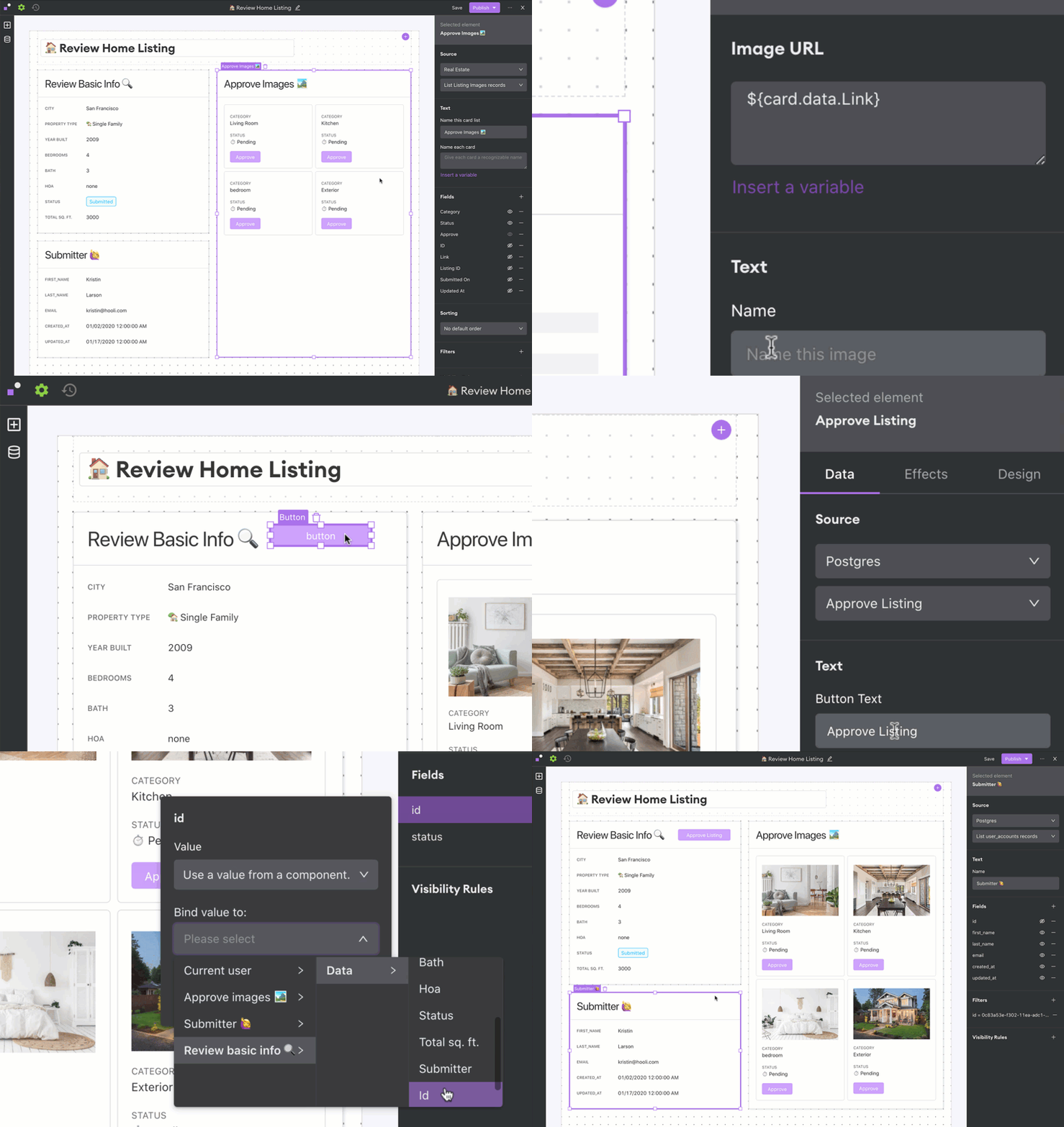
    Internal today launched an on-premises edition of its eponymous no-code development platform that promises to simplify application development backlog reduction for enterprise IT organizations.

    Arisa Amano, CEO of Internal, said many professional developers regularly find themselves building simple applications that, if given access to the right tools, could be built instead by end users. Internal was created to provide that capability either through a cloud service or, now, through an on-premises edition.

    The on-premises edition makes it simpler for developers to work with databases, application programming interfaces (APIs) and applications that reside behind a corporate firewall, Amano said.

    As organizations accelerate digital business transformation initiatives, professional developers are pressed to build and deploy more complex applications faster. Many lower-priority application development projects are sidelined simply because developers don’t have time to take them on. Internal, and other no-code and low-code application development tool providers, are making a strong case for enabling end users to build their own applications using graphical tools, or encouraging professional developers to use these tools to build less complex applications more quickly.

    A survey published by Internal finds 62% of respondents report their developers spend more than 25% of their time fulfilling requests to build internal tools. More than three-quarters of respondents (79%) said engineers use any extra time they can find to develop customer-facing features or other applications.

    Most of the projects filling application backlogs tend to involve workflows that span multiple applications running in a data center. The challenge organizations face is low-code and no-code tools that reside in the cloud can’t easily access that data. As such, Amano said there’s a clear need for a no-code tool that can be deployed in an on-premises IT environment.

    Of course, regardless of who builds the application, it still must be deployed. Challenges arise as developers build more applications, which must be concurrently deployed in production environments. The addition of no-code and low-code tools, and the applications created with those tools, will require organizations to rethink and refine their DevOps processes.

    Historically, professional developers have tended to view no-code and low-code tools as the application development equivalent of a black box preventing them from building reliable, robust applications that can scale. Many low-code and no-code applications that organizations build, however, are meant to used internally by a finite number of end users. At the same time, no-code and low-code tools become more robust with each major update.

    Whatever bias may exist, the current application development backlog in most organizations is only going to increase. Professional developers may prefer to write code at a lower level than a no-code or low-code tool allows; however, most business executives are more interested in application performance than in how it was constructed.

  • Predict 2021: What Does the Future Hold?

    Predict 2021: What Does the Future Hold?

    While 2020 was a challenging year, it was also a year of resilience, innovation and rapid acceleration of digital transformation. So, what does 2021 have in store for us? At Predict 2021 Virtual Summit, taking place Jan. 21-22 at 10 a.m. ET, top industry leaders will share their speculations on what the future holds in the realms of DevOps, cybersecurity, digital transformation, cloud native and IT.

    Predict 2021 is a free, multi-track virtual event featuring a conference lobby, presentation theater, expo hall and more. Attendees will be able to interact with sponsors and peers, watch videos and download information. It will be a great opportunity for networking and learning about what the “new normal” will look like for DevOps.

    In addition to the great speaker sessions, there will be panel discussions, interactive Q&As with speakers, a scavenger hunt, giveaways and other interactive activities.

    This year’s event features outstanding sessions from industry leaders, including:

    • “Sustaining The Pace of Digital Change,” keynote by Emmet B. Keeffe III of Insight Partners.
    • “Digital Transformation Panel,” keynote by Flint Brenton of Centrify, Ashok Reddy of Digital.ai and Tracy Ragan of DeployHub.
    • “Welcome to the Data Care Industry,” keynote by Ron Gula and Cyndi Gula, Gula Tech Adventures.
    •  “What Does 2021 Hold for DevOps and CI/CD?,” by Jim Rose, CircleCI.
    • “Cloud Native Tech,” by Tracy Miranda of CloudBees, Tracy Ragan of DeployHub and Isaac Mosquera of Armory.
    • “Software’s Not Living Up To Its Cloud-Enabled Promise,” by Jen Grant, Appify.
    • “Observability and AI: Bringing DevOps Back to the Future,” by Adam Frank, Moogsoft.
    • “Increase in Cloud-Native Apps Drives Key Challenges and Opportunities in 2021,” by Ankur Singla, Volterra.

    On the second day of Predict 2021, MediaOps CEO and DevOps.com Editor-in-Chief Alan Shimel will also be announcing the 2020 DevOps Dozen² Awards winners.

    To check out the full agenda and to register, please visit the Predict 2021 website.

  • How Managed Detection and Response (MDR) Solutions Benefit DevOps

    How Managed Detection and Response (MDR) Solutions Benefit DevOps

    Managed Detection and Response (MDR), a relative newcomer in the cybersecurity realm, is starting to have a noticeable impact on enterprises seeking to better secure their operations. Research giant Gartner notes that, “By 2025, 50% of organizations will be using MDR services for threat monitoring, detection and response functions that offer threat containment capabilities.” Despite rising adoption rates, though, much confusion remains about MDR and how it should fit into enterprise IT.

    MDR is typically defined as an outsourced security service that enables organizations to better detect malicious activity over the network. MDR is usually sold as a service, and vendors offer tools and technologies that integrate into a business’s IT to detect and mitigate network intrusions, malware attacks, attempted data theft and other malicious threats. MDR can be a powerful ally in the quest to contain cyberattacks, but only if deployed correctly and leveraged properly.

    Enterprise Benefits

    MDR offers obvious benefits for enterprises, but there’s enormous potential when MDR is integrated with DevOps. Many organizations are turning to DevSecOps methodologies to build cybersecurity into their development and deployment pipelines, and MDR can help.

    “One challenge is that DevSecOps is a term that is poorly defined in most cases, and misunderstood in many others,” said Dave Martin, senior director, product management – threat response at Open Systems. “Some people think of DevSecOps as an extension of a quality assurance department, which means that cybersecurity is mostly an afterthought, and not part of the development cycle. MDR, at least how we do it at Open Systems, brings forth a full-time security operations layer, which includes a security analyst, that can become part of the DevOps team,” Martin said. 

    Martin makes an interesting point. As more organizations attempt to implement DevSecOps, knowledge, along with action, are lacking. MDR has the potential to supplement knowledge and insight into the security posture of the code being generated. Many organizations leave cybersecurity to the network or operations teams, expecting endpoint or network security tools alone to contain threats. However, many threats in the wild may leverage older code, or target unpatched applications. MDR can enable DevOps teams to get ahead of the latest threats by keeping developers informed about evolving threats and vulnerabilities, as well as incorporating tools for continuous cybersecurity into the development and deployment pipelines. One of the core concepts of MDR is providing access to experts that can take action to mitigate an attack. This is an important consideration, according to the Enterprise Strategy Group, which reports that 51% of survey respondents face a problematic shortage of skills in the area of cybersecurity.

    What’s more, MDR becomes a tool to secure the DevOps environment, as well as a tool for developers to make code more secure. “It is critical to find advanced threats, ones that may have bypassed existing security controls, before those threats impact DevOps, yet people need to be made aware of those threats so they are not mistakenly included in the development pipeline,” said Martin.

    Choosing an MDR Provider

    With so many players in the MDR space, choosing a provider that fits into a DevOps and enterprise strategy can be daunting. According to Reports and Data, the global MDR market is expected to grow at a CAGR of 30.4% until it reaches $4.6 billion by 2026. Today, providers number in the dozens, and while many claim they have “complete” offerings, they may not consider the needs of DevSecOps along with traditional network operations concerns.

    There are some important considerations when choosing an MDR platform. For example, visibility of the attack surface is a critical concern. If an MDR provider does not have visibility into all potential attack surfaces, breaches and compromises may still occur. Also, adopters should be keenly aware of how false positives are contained, as well as the level of alert activity. Many cybersecurity solutions can introduce alert fatigue and obscure effectiveness. Automation should be a key part of any MDR solution, as it can help to categorize threats, initiate responses and identify the latest threat trends without human interaction. 

    “MDR should tear down many of the cybersecurity silos that businesses have today, and bring the various pieces of IT together into a unified cybersecurity sensitive culture,” said Martin.

    Ultimately, MDR is about people, processes and technology, and should bring these elements together to ensure success in the ongoing battle against cybercriminals. 

  • The Top Benefits of a Scrum Certification

    The Top Benefits of a Scrum Certification

    The Scrum framework is a staple part of many businesses – and for good reason. The agile process is used to construct, deliver and iterate products and has proven to boost cross-functional teams’ productivity, as well as product quality. And, like most processes, Scrum can be mastered with the right training and commitment. Specifically, a Scrum certification teaches the fundamentals of the framework and serves as proof of qualification for a particular role within that framework.

    Scrum certifications vary, but are typically awarded for the roles of Professional Scrum Master, Product Owner and Scrum Developers. These positions have become increasingly more popular over the years; one report reveals that 24% of organizations have ten or more Scrum Masters or Agile Certified Practitioners, while in a sample of 500,000 certified people, 85% correspond to a Scrum certification program.

    Having a Scrum certification opens many doors, both professionally and personally, as it provides a competitive edge and demonstrates an in-depth understanding of contemporary workflows. Whether you’re considering taking a Scrum course through your company, or pursuing a class independently, here are a few of the top benefits.

    Adapt to Changing Conditions

    Throughout the COVID-19 pandemic and its significant disruption to businesses, organizations had to swiftly adapt to new ways of working. Operating remotely, adopting new digital tools, complications in supply chains, just to name a few, are all challenges met with patience and proactivity. People who work under the tenets of the Scrum mindset tend to be more resilient and better able to respond to unexpected events in a practical manner.

    Rapid fluctuation in personnel, technology and working practices have less of a negative impact on employees, and especially leaders, that are Scrum certified. In shifting environments, the larger organization can be confident that their teams are being guided by Scrum principles and constantly progressing.

    What’s more, people with a Scrum certification can help their teams better adapt to sudden changes without compromising business goals. Scrum emphasizes prioritization of tasks in order of importance; placing the task with the biggest impact on ROI at the top of the list. This method not only maintains productivity but can actually increase it, despite external disruptions.

    Master all Things Scrum

    A Scrum certification highlights that a person is dedicated and hardworking, and is committed to continuous learning and improvement. It is a reflection of the certificate holder’s expertise in helping others and meeting goals. On a more granular level, the certification can help people discover and become familiar with concepts like product backlog, sprint backlog and burndown charts – elements that are common across businesses and industries.

    A Scrum certification can also boost personal communication skills, as it forces people to regularly produce and share relevant reports, deadlines and calendars with their team. These exchanges demand clarity, timeliness and emotional intelligence, which are core soft skills that contribute to the collective success of a team.

    Certified Scrum holders also benefit from their inclusion in a network of qualified Scrum authorities where they can leverage others’ exclusive guidance and knowledge. They can subsequently bring innovative ideas from fellow Scrum experts to their workplace, and leave a powerful legacy through the changes they implement.

    Gain an Advantage in the Hiring Pool

    A Scrum certification also makes a person a much more appealing candidate in the recruitment process. In a competitive hiring landscape, a Scrum certification demonstrates that a candidate is willing to devote time to solving complex, adaptive problems – a quality that will always catch employers’ eyes.

    In fact, 87% of people agree that Scrum improves the quality of work life for teams, while 81% of people believe certifications improve their use of Scrum. A certification shows that someone knows how to manage dynamic priorities, how to deliver products to market in a short space of time and how to increase project visibility. The Scrum qualification is particularly useful for managing large, cross-functional teams. For these reasons, a person with a Scrum certification will be a prime applicant in any hiring pool.

    There can be financial benefits too. Possessing a Scrum certification can lead to higher salaries, because these credentials are so highly sought-after. Certified Scrum Managers tend to earn more, on average, than their non-certified peers, so Scrum candidates are in a stronger position when negotiating compensation.

    The COVID-19 pandemic has presented new opportunities for professionals to invest in their careers on a long-term basis. Scrum techniques and methods prepare workers to generate ideas that make sense in an uncertain sphere, and those who invest in Scrum are making themselves invaluable in today’s workplace.

    A Scrum certification is a way to develop business ideas, projects and services in a smarter, more agile manner. But more than that, a Scrum certification also leads to heightened personal skills, employment desirability and resilience.

  • Top 10 Common Software Vulnerabilities

    Top 10 Common Software Vulnerabilities

    An essential part of an effective software security process is being familiar with software vulnerabilities, which are flaws or weaknesses in your code. Often, testing and manual code reviews are unable to identify every single vulnerability, which can impact the performance and security of your software. For that reason, it is important to have a working understanding of software vulnerabilities as it will enable you to more effectively manage potential security threats.

    The top 10 most common security vulnerabilities are as follows:

    1. Insufficient Logging and Monitoring: Insufficient logging and monitoring process are dangerous as they leave your data vulnerable to tampering, extraction, or even destruction.
    2. Injection Flaws: Injection flaws can trick the targeted system into executing unintended commands as well as provide untrustworthy agents access to protected data.
    3. Sensitive Data Exposure: Sensitive data—which includes addresses, passwords and account numbers—must be adequately protected against human-error and security breaches to avoid potential exposures.
    4. Using Components with Known Vulnerabilities: Components—which are made up of libraries, frameworks and other software modules—are often run on the same privileges as your application. Which means if a component is vulnerable, those weaknesses can be exploited in an effort to access your application.
    5. Cross-Site Scripting (XSS) Flaws: Cross-site scripting flaws can be exploited by untrustworthy agents in an effort to execute their own scripts in your system.
    6. Broken Authentication: If authentication and session management application functions are implemented incorrectly, a software vulnerability can be created.
    7. Broken Access Control: If user restrictions are broken, it can create a software vulnerability that can be exploited.
    8. XML External Entities (XXE): In order to properly understand an XML data, an XML parser is necessary. However, if the parser is poorly configured and the XML input that contains a reference to an external entity, it can provide a flaw that an untrustworthy agent can exploit.
    9. Security Misconfiguration: Security misconfigurations are often brought upon for numerous reasons, including: insecure default configurations, incomplete or impromptu configurations, open cloud storage, misconfigured HTTP headers and wordy error messages that contain sensitive information.
    10. Insecure Deserialization: Deserialization flaws often result in remote code executions, which enables untrustworthy agents to perform replay, injection and privilege escalation attacks.

    Prevent Software Vulnerabilities

    In order to efficiently and effectively prevent software vulnerabilities, we recommend the following best practices:

    • Establish software design requirements.
    • Use a coding standard.
    • Test your software.

    To read more, please visit: https://www.perforce.com/blog/kw/common-software-vulnerabilities

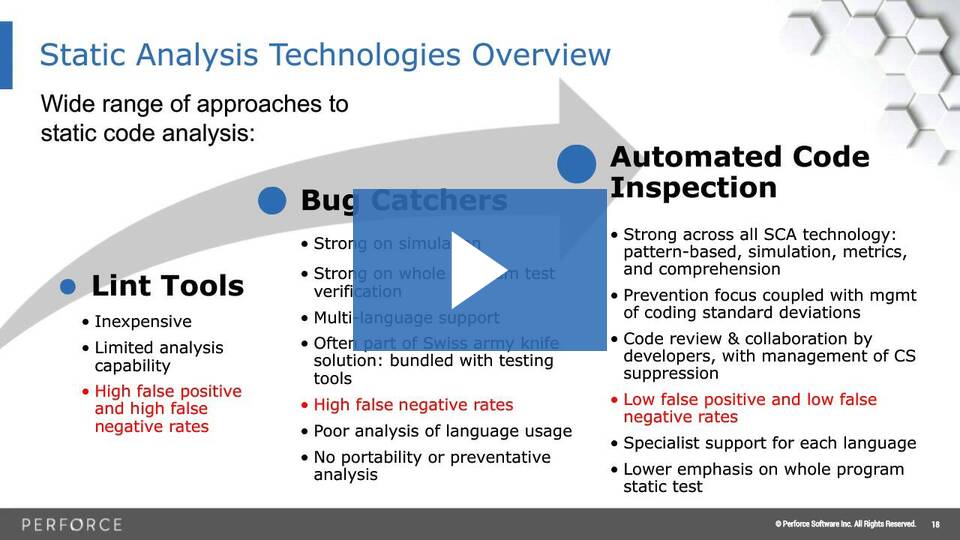
  • How to Improve Code Quality, Efficiently, with Static Analysis

    How to Improve Code Quality, Efficiently, with Static Analysis

    As hard as they try, no programmer is perfect. Testing and manual code reviews cannot find every problem in their code, so software vulnerabilities and bugs persist.

    Unfortunately, the amount of software errors will only continue to grow as your systems get larger and more complex. Which begs the question: How can you find all of the critical problems present in your code while still releasing a quality product on time? Simple: Use a static code analysis tool.

    In this webinar, we will discuss the following topics:
    1. Why bug-free software is difficult to achieve.
    2. Why automated software tools are the most effective solution.
    3. How safe, secure and reliable software can be achieved at lower costs.
    4. How static code analysis and manual code reviews can work together.

    In addition, we will also provide examples of software vulnerabilities that are easily missed by manual code reviews.


    To read more, please visit: https://www.perforce.com/webinars/qac/how-improve-quality-static-code-analysis

  • DARPA Enlists GrammaTech to Apply AI to Reverse Engineer Code

    DARPA Enlists GrammaTech to Apply AI to Reverse Engineer Code

    The Defense Advanced Research Projects Agency (DARPA) has awarded a research contract to GrammaTech for low code technology that will make it possible for end users to leverage artificial intelligence (AI) without requiring intervention from the original software developer.

    GrammaTech’s AI tool, dubbed ReMath, aims to ease application updates by automatically inferring high-level mathematical representations from existing binaries in systems and embedded software. The tool is currently in development.

    Dr. Alexey Loginov, vice president of research for GrammaTech, said development teams spend a lot of time using low-level tools such as disassemblers, debuggers and decompilers to manually analyze binaries. ReMath will accelerate that reverse engineering process by recovering and converting machine language into representations that end users can directly manipulate, said Loginov.

    The goal is to free developers up to build new software, rather than continuously updating software that has already been deployed, noted Loginov. This approach should ultimately reduce the backlog of application and software development projects organizations have, added Loginov.

    GrammaTech

    The ReMath project is the latest in a series of DARPA contracts awarded to GrammaTech. In general, the company is working towards applying AI to advance DecSecOps via a static application security testing (SAST) tool that identifies vulnerabilities in code. The ReMath project focuses on applying AI to use cases involving, for example, industrial control systems. These systems could benefit from allowing domain experts, with no coding expertise, to maintain and update them on their own, said Loginov.

    Other DARPA projects GrammaTech is actively researching include a type-ahead capability that automatically recognizes existing artifacts in a software repository, said Loginov. This capability will make it simpler for developers to reuse code within the context of a GitOps process without inadvertently introducing additional errors, Loginov said.

    In the future, the potential impact of AI on software development could be profound, as more reliable code moves into production environments. The percentage of code graduating into those environments on the first attempt should increase considerably in the years ahead. That should enable more reliable delivery of application code via continuous integration/continuous delivery (CI/CD) platforms.

    As software development becomes more efficient, the current developer shortage should also ease, and open up resources to launch a greater number of application development projects. Rather than spending time on manual tasks that provide no differentiated value, Loginov said software engineers will be able focus more of their time and energy on process innovation.

    In the meantime, developers should expect to see a rash of development tools with AI capabilities in the months ahead. None of those tools are likely to eliminate the need for developers any time soon; however, much of the drudgery involved in writing code today is likely to be sharply reduced as machine learning algorithms and other forms of AI are applied to software development.