Category: Blogs

  • DevOps Connect at RSAC 2021: Insightful Talks, Live Q&A, Workshops, Pilates and More

    DevOps Connect at RSAC 2021: Insightful Talks, Live Q&A, Workshops, Pilates and More

    We are excited to announce the return of DevOps Connect: DevSecOps Virtual Summit on May 19, as part of the RSA Conference 2021. This year, internationally recognized speakers will take a deep dive into “Securing the Cloud Native World.”

    DevOps Connect is a full-day event, featuring four different content tracks, with more than 50 speakers, including keynote presentations, demos, insight talks and featured sessions.

    The agenda features a mix of topics, including cloud security, CI/CD, Kubernetes, GitOps, AppSec, security risks, shift left, open source, case studies covering DevSecOps and more. Attendees will learn how the finance, manufacturing, healthcare and hospitality industries are securing their cloud environments, and how to better secure and monitor their systems.

    DevOps Connect 2021 Lineup

    DevOps Connect 2021 features an exceptional lineup of the most prominent and respected security and DevOps leaders, including:

    • Featured keynote speaker: Christopher Krebs, former director of the Department of Homeland Security’s Cybersecurity and Infrastructure Security Agency (CISA), and co-founder of Krebs Stamos Group LLC
    • Chenxi Wang, founder and general partner at Rain Capital
    • Allan Friedman, director of cybersecurity initiatives at National Telecommunications and Information Administration in the U.S. Department of Commerce
    • John Willis, senior director of Global Transformation Office at Red Hat
    • Cyndi Gula, managing partner at Gula Tech Adventures
    • Alessandro Vozza, principal software engineer at Microsoft
    • Caroline Wong, CSO at Cobalt
    • Thomas Krane, principal at Insight Partners
    • Charles J. Kolodgy, principal at Security Mindsets LLC and analyst at Accelerated Strategies Group
    • Nisha Kumar, open source engineer at VMware
    • Mike Rothman, president at DisruptOps
    • Dave Howell, VP at ZeroNorth
    • Maciej Mensfeld, senior product manager at WhiteSource
    • Matt Wilson, senior product manager at GitLab
    • Erkang Zheng, founder and CEO at JupiterOne
    • Philippe Humeau, CEO at CrowdSec
    • Jennifer Czaplewski, director of product security at Target
    • Al Sargent, senior director of product at InfluxData

    Former CISA director Christopher Krebs, our featured keynote speaker, will be answering questions from the audience during a live Q&A.

    Workshop Friday

    We are also hosting Workshop Friday, as we wrap up the RSAC 2021, offering live workshops designed to be as interactive and hands-on as possible with experts from Google, JupiterOne, Sysdig and Sonatype. These workshops provide professional guidance and training on a variety of topics, including Site Reliability Engineering (SRE), AWS cloud security and protecting against supply chain attacks. On May 21, attendees will have the opportunity to interact with the experts, share their process, get immediate feedback and personal assistance. Each workshop will be live-streamed through our online platform at no cost to attendees. We have limited spots available. Seats are reserved on a first-come, first-served basis. To save your spot, visit the Workshop Friday website.

    A Unique Virtual Environment and a Few Surprises

    The virtual environment features an auditorium with different tracks where attendees can watch the sessions by industry experts. There will be an expo hall lined with booths featuring interactive chats and downloadable resources. The expo hall will be open throughout the event, giving attendees the opportunity to chat with sponsors, including GitLab, Prisma Cloud by Palo Alto Networks, Sonatype, WhiteSource, Sysdig, JupiterOne, Snyk and more.

    We have a few surprises planned to make this year’s DevOps Connect extra special. Take a break between presentations, grab your yoga mat and enjoy a Pilates class by a certified instructor, dance to the music of our featured DJ and check out how to make a delicious cloud drink by a professional mixologist. You can also participate in a raffle to win a copy of “You Can Stop Stupid” by Ira Winkler, author and president at Secure Mentem, and a copy of “Security Yearbook 2020” by Richard Stiennon, industry analyst at IT-Harvest.

    DevOps Connect 2021 offers the best of a physical environment in a virtual context combined with the advantages and convenience that a virtual environment offers.

    Registered attendees will receive a link to access the virtual environment on-demand. To check out the full agenda and to register, visit the DevOps Connect website.

  • Survey Illuminates Long Dark Road to Hybrid Cloud

    Survey Illuminates Long Dark Road to Hybrid Cloud

    While hybrid cloud computing will play a critical role in enabling digital business transformation it turns out most IT organizations lack the skills and technologies required to achieve it.

    A survey of 108 IT executives conducted by the research firm Pulse on behalf of CloudBolt Software, a provider of a cloud management platform, finds 94% believe hybrid cloud computing will be critical to digital transformation. A total of 92% also noted that empowering end users through self-service IT is a digital transformation accelerator, while 99% said successful automation depends on streamlining integrations.

    However, 78% of respondents said they lack the visibility necessary to optimize cloud deployments. More than half (56%) believe that their self-service offerings fail to meet user needs and more than three-quarters (76%) still rely on some form of custom coding when it comes to integration.

    In terms of the capabilities respondents are looking to acquire, 80% noted they want real-time insight into cost optimization and security remediation. A total of 71% want self-service to be easy for end users, while 62% want an approach to integration that doesn’t require deep domain knowledge or special expertise.

    CloudBolt CEO Jeff Kukowski said the biggest immediate obstacle when it comes to hybrid cloud computing is the lack of visibility IT organizations have into their existing IT environments. IT teams are not going to be able to unify the management of distributed IT environments without it, much less achieve anything approach observability, noted Kukowski.

    Pressure on IT organizations to accelerate application development while simultaneously reducing costs rose as the economic downturn brought on by the COVID-19 pandemic began. The challenge is that each new platform adopted by an organization tends to increase the total cost of IT as organization acquire tools and hire specialists to manage those platforms. It’s not likely all those platforms will be managed via a single console, but Kukowski said it’s clear IT organizations are moving toward a more federated approach that will enable them to centralize the management of IT.

    In the meantime, Kukowski noted organization are collectively wasting billions of dollars on IT platforms that are employed inefficiently. Most of that waste stems from either overprovisioning of IT infrastructure, or simply because someone didn’t think to turn off a virtual machine left running on a cloud service.

    It may be a while before IT organizations are able to strike that perfect balance between flexibility and control that currently remains elusive. However, organizations that focus on improving a few small things today will find themselves in a much better position to manage what is rapidly becoming an over extended enterprise tomorrow. Right now, Kukowski estimated only about a quarter of IT organizations have the sophistication required to manage a hybrid cloud computing environment.

    There’s no doubt the management of IT will become more automated in the months and years ahead. The challenge organizations face today is determining what tasks either can or soon will be automated. Once that’s determined, it becomes a lot easier to identify what DevOps skills those IT teams will require tomorrow.

  • Lessons in User Engagement From Game Development

    Lessons in User Engagement From Game Development

    Quarantine measures forced most of the world to stay physically distant — a shift that has forever changed consumer behaviors, and especially how humans interact and spend their free time. A clear change over the past year was the rapid boom of gaming, which saw a massive increase in both console and mobile games — estimated to be as much as 50%. With this sudden increase in new players, how can developers keep gaming experience fresh and exciting? What can game developers do to keep players coming back after they hit ‘Close’? And are there lessons developers in other industries can learn from those game developers to make their applications more engaging?

    While this article is geared toward game developers specifically, there are multiple lessons that could apply to any application with regard to user experience and engagement. It’s especially applicable if you have a gamified corporate application or continuing education app for your enterprise users.

    Much of the answer to the engagement question comes down to users’ journey before, during and after they play a game. Effectively communicating why someone should download a mobile game is the first step, but communicating with players during and after their experience is equally important for long-term engagement and overall experience.

    A vast majority of mobile games still don’t implement basic messaging best practices for improving user engagement and retention. At the same time, COVID-19 has raised the bar for digital experiences. More than ever, game developers need to improve their communication strategies to survive and succeed.

    One difference between established gamers and the large number of new gamers from the pandemic is that they are increasingly diverse. This wave of new gamers are also more likely to play on their mobile device, or even across multiple devices like their smartphone and tablet, which will likely require a friendlier, more streamlined experience than their more experienced peers.

    Hence, creating the right communication strategy, whether through in-game events, updates on exciting new content, or relevant promotions, will all go a long way in keeping gamers coming back after they hit close.

    User Onboarding is Crucial

    There’s been over a 700% increase in game titles available on the Apple and Google app stores in the past decade, with nearly a million titles to choose from. With so much more competition, developers struggle to find and keep players; the top 25% of mobile games have an average 28 day retention rate of just 4%.

    Mobile games have minutes (or even seconds) to convey value and engage users. How a game onboards a player can mean the difference between a loyal customer and a missed opportunity. If you drop a player into a game with no support or context, they might fumble through the rules and features, and could get frustrated enough to abandon the game.

    Here are some ways to onboard players more effectively:

    Function-Oriented Onboarding – This can take the form of a deck-of-cards tutorial immediately after a user opens your game. Through full-screen in-app messages, it educates the player on game mechanics, app navigation and enables players to swipe through the information at their own pace.

    Benefit-Oriented Onboarding – This method reveals features that improve the player’s experience in addition to the game’s basic mechanics. For example, highlighting how a user can resume from a checkpoint instead of starting over.

    Progressive Onboarding – This method helps players interact with the game interface and guides them through different actions when they reach milestones in the game. It’s well-suited to games that have more complex or varied mechanics.

    Enhancing the Post-Game Messaging Experience

    Re-engaging users outside of the game through push notifications, email messages or even SMS can be incredibly powerful. At the same time, if your message’s quality does not match the quality of your in-game experience, users are much more likely to block your messages or uninstall your game entirely.

    The differences come down to personalization, timeliness and progression.

    Players want to get recognition for their achievements and milestones, plus get instantly notified about making their next move, attack or strategy. Generic messages like, “You haven’t played in a while. Come back today!” are unlikely to have much of an impact on user retention. Instead, enhancing the in-game experience with personalized messages that provide incentives tend to perform far better: “Congrats, Matilda! Your hero is nearly at level 10 – get double XP for every level you complete today!” is a much more engaging option.

    In Zynga’s popular “Words with Friends” game, the granular personalization of notifications tells users when a friend made a move, which word they played and its point value. This helps increase messaging utility and encourage reengagement by promoting friendly competition.

    Another way to enhance the experience both within and outside of the game is by leveraging achievements and recognition. These can turn a mundane milestone into a moment of celebration, or convince a player to return to the game to get another reward. Displaying the daily high score of top players can also motivate players. With set goals, players strive to achieve a higher score, push harder to win a level, and play the game more.

    Developers who only focus on building great game mechanics often overlook basic (and critical) communication features to engage and retain users. By employing these best practices for engagement, game developers can build a solid, growing community of happy players that keep coming back for more.

  • Using RPA for DevOps Process Automation

    Using RPA for DevOps Process Automation

    Modern operations teams today are at the cutting edge of automation. DevOps and SRE practices are entirely based on an automation-first philosophy. CI/CD is fully automated and the next generation of automated testing is now being adopted.

    However, these same teams are still running their human processes based on hastily thrown-together wiki pages. The increase in remote work over the last year has amplified the problem. Engineering teams that were used to quickly getting the right people physically into a war room now struggle to find the people with the right knowledge to troubleshoot or resolve a problem.

    Teams with ample resources have built tools and bots for DevOps process automation and orchestration. These tools can help automate things like getting communications channels set up quickly, with the right people, the moment an incident is identified. Or, they may automate actions across the DevOps toolchain that would otherwise live as static documentation for an on-call engineer to try to decipher and execute. But only a handful of organizations have the resources to build this kind of automation technology in-house.

    These higher-level DevOps processes are ripe for innovation similar to robotic process automation (RPA). Companies like UiPath and Automation Anywhere have shown that there’s an enormous market for this in every business unit and industry. Process automation for DevOps needs to be another layer of automation available to any engineering team. Automated remediation of incidents and resolution of service desk tickets has to be the future of this space. However, there are important differences in how automation is optimized for DevOps versus the application of RPA for business functions.

    Where RPA Fits on the Automation Spectrum

    RPA is great for solving deterministic problems – those that can be resolved in the same way every time you run into them – which are fully automatable. An example of this type of end-to-end automation is any back-office task, which are consistently good candidates for the application of automation. It’s the reason why fields like HR and finance have made some of the greatest progress in automating business processes to date. Every time you close the books, for example, the steps are pretty similar.

    Process automation for DevOps and SRE, however, is on the other end of the spectrum. Although teams may benefit from RPA for simplistic, repeatable tasks, many DevOps processes are dynamic and unpredictable, making full end-to-end automation too often fallible. The complexity of modern technology stacks and infrastructure requires processes to be agile and adaptable to change, rather than deterministic. This is where it’s important to enable humans to step into the spectrum of automation. Human-in-the-loop automation – the idea that lets humans be in the cockpit while letting machines provide guidance and support – is the future of DevOps automation.

    Applying Process Automation to DevOps

    To use automation in a meaningful way, DevOps teams need a mix of what RPA provides with the added element of human judgment. Human-in-the-loop automation can be applied to numerous DevOps processes including incident management, service requests and continuous deployment and delivery.

    Rather than automating from end-to-end right from the start, DevOps teams should use incremental automation to strengthen and build trust in automation. This starts by codifying free-form processes so teams can more easily identify predictable steps that can be automated. Then teams can mature to more complex workflows, automating pieces within processes and incorporating human checkpoints for areas that will need judgment or approvals.

    As teams incrementally automate, they build up sustainability – in their systems and their roles – in high-stress environments and are able to orchestrate processes across the continuum. The goal is to find the right balance between leveraging machines to make lives easier while creating room for human judgment and adaptability.

    Level-Up DevOps Automation

    Looking ahead to the next few years, what the RPA movement did for back office tasks will also happen for DevOps and SRE. Technology leaders can take notes from the RPA movement and apply them to eliminating the toil of modern production operations. The issue is that, in DevOps, many problems are unique.

    The next evolution of DevOps automation will force us to look at how we can model the real world in a more holistic way, which includes incorporating human judgement and manual execution of non-repeatable tasks while automating repetitive steps.

  • Dear Management: Letter to DevOps Leaders

    Dear Management: Letter to DevOps Leaders

    My occasional reminder that “Change is good, but predictability is better,” is in the form of a message to DevOps upper management. I thought it would be fun to write, and would offer a different perspective and drive than normal. Hope you enjoy!

    Dear Management,

    Too much of anything is bad. No matter the topic, once too much of it is present, problems crop up. That is just as true in DevOps as any other topic.

    We need some level of standardization, because too many different toolchains is bad. If there is a tool learning curve before team A can assist team B, we are not taking advantage of standardization. In fact, we’re creating a well of technical debt that someone is going to have to clean out. Are we really going to maintain separate toolchains for each project on top of the variety of languages and targets we already have to manage? For years? Is that the most productive use of our time? Do we even have an exit plan to replace that dying open source project that is the core of one of our apps?

    So let’s do some level of standardization on toolchains, shall we? That is the most stable route to standardized tests and easy-to-troubleshoot environments.

    But let’s not get too standardized, either. Because too much of anything is bad, and too much standardization is stagnation.

    We have never seen an environment nor talked to peers and heard them say, “Oh yeaaahh, our environment is perfect! We made everything work smoothly, and all metrics are headed in the right direction while development and deployment have gotten easier.” Those people don’t exist, because in our age of near-constant change, those environments don’t exist.

    In spite of standardization, we need to keep trying new tools, options, environments and policies to increase our quality and deliverability. Give a team the OK to ignore standard X and bring in something they think is better suited to their needs; then see if you can adopt it more widely.

    In short, we want standardization to make our jobs easier, but we don’t want stagnation. We don’t need fifty languages, twenty CI tools, and half a dozen security scanners. We need a few good ones, and the ability to look around at new products/ideas in the space to find better ones.

    In fact, that app that no one is allowed to mess with? Let’s rewrite it, so it is newer and more maintainable; and, while we’re at it, let’s try some of these new and different products and processes. After all, we’re biting the bullet re-writing, we may as well take the extra step, and we might find something useful to the broader collection of DevOps teams.

    And trust us when we tell you a tool or process is the right fit. Ninety percent of the time, the buzzword of the day that you saw on Twitter is either not ready for production yet, or is already in use at our org. It’s our job, so we’re paying attention. And buzzwords are marketing lingo aimed at you, to force us into using something we’ve already looked at.

    You’re doing a good job, we just think we could be doing better. Give us standards, along with room to challenge them a bit. Of course some of us won’t be happy when our tool isn’t the one chosen to standardize on, but we’ll pull together in the end, if you remind us that we’re working to put the org on a more stable and maintainable footing.

    Thank you,

    More of your DevOps employees than you think.

  • Clearlake & TA Associates-Backed Precisely to Acquire Infogix

    Acquisition Extends Precisely’s Leadership in Data Integrity Software as Businesses Seek Trusted Data for Confident Decisions Across the Enterprise

    BURLINGTON, MA – May 5, 2021 – Precisely, the global leader in data integrity software, newly backed by Clearlake Capital Group, L.P. (together with its affiliates, “Clearlake”) and TA Associates, today announced a definitive agreement to acquire data integrity and governance software provider Infogix. The announcement comes less than two weeks after Clearlake and TA completed their acquisition of Precisely and represents the first major step to accelerate growth under their ownership. Terms of the deal were not disclosed.

    Precisely helps companies achieve a foundation of trusted data on which to build their digital futures. The company’s market-leading data integrity software portfolio provides maximum accuracy, consistency and context in data for more confident business decisions. In Infogix, Precisely is acquiring Data Governance, Data Catalog and Strategic Data Services that extend its data integrity software leadership. Infogix also brings highly complementary Data Quality capabilities that help ensure customers’ business decisions are made with the right data at the right time and with the right context.

    “As companies seek to position and differentiate themselves for the digital era, they quickly realize that success requires trusted data. Precisely provides that foundation with maximum accuracy, consistency and context so businesses can make confident data-driven decisions,” said Josh Rogers, CEO of Precisely. “Infogix is a perfect fit for Precisely, with highly complementary data quality products and services, and a leading data governance solution that our customers have been seeking.”

    The cloud continues to empower users from across the enterprise to make critical business decisions with data and analytics. Infogix’s suite of SaaS capabilities across governance and data quality helps accelerate these decisions and ensure they are made with trusted data. In addition, Infogix’s pre-packaged, self-service tools built for specific vertical or business use cases help business users across a range of industries gain strategic value from data more quickly. The Infogix Strategic Services team has successfully helped more than 200 organizations develop and execute a strategy to leverage data assets to propel their businesses forward. These strategic service engagements will help Precisely scale to meet customer demand for its products, including the Precisely Data Integrity Suite.

    “Precisely is the perfect home for Infogix, with complementary products, the largest customer base in the data integrity software space and the global scale and partner ecosystem to turbocharge our business to the next level,” said Early Stephens, CEO of Infogix. “At Precisely, the Infogix team will be well-equipped for success in empowering every data consumer with the ability to harness data to drive outcomes that align to overall business objectives.”

    “Precisely’s acquisition of Infogix represents the importance of data intelligence for organizations wanting to achieve trusted data with integrity,” said Stewart Bond, research director, Data Integration and Intelligence Software at IDC. “Infogix will bring technical, business, relationship and usage intelligence about data into the Precisely data integrity portfolio, adding another dimension to data integrity and enabling data governance.”

    “We are excited to support Precisely in this strategic transaction that extends its leadership in data integrity software and adds new capabilities in data governance, an important and growing focus for enterprises seeking to ensure trusted data is used properly,” said Behdad Eghbali, Founder and Managing Partner, and Prashant Mehrotra, Partner, of Clearlake. “This acquisition is a continuation of Precisely’s long history generating exceptional growth through organic and inorganic initiatives.”

    “Complete, reliable and accurate data is essential for successful digital transformations and, as a result the data integrity software space, has seen continued growth,” said Harry Taylor, a Managing Director, and Michael Libert, a Principal at TA. “With the acquisition of Infogix, Precisely extends its market leadership position as data becomes increasingly democratized across the enterprise. We look forward to the completion of this acquisition and supporting Precisely’s ongoing efforts to bolster M&A, fuel product innovation and accelerate growth.”

    To learn more about this acquisition and the Precisely Data Integrity Suite, please register for the Trust ’21 Data Integrity Summits in the Americas on June 15th, in Asia-Pacific on June 16th, and in EMEA on June 17th.


    About Precisely

    Precisely is the global leader in data integrity software, providing accuracy, consistency, and context in data for 12,000 customers in more than 100 countries, including 90 percent of the Fortune 100. Precisely’s data integration, data quality, location intelligence, and data enrichment products power better business decisions to create better outcomes. Learn more at www.precisely.com.


    About Infogix

    In its fourth decade as an industry pioneer, Infogix continues to provide large and mid-market companies around the globe with a broad range of integrated and configurable tools to govern, manage and use data. From operations and the office of data to sales, from product and customer service to marketing—users across the entire organization rely on our software to remove barriers to data access, accelerate time to insight, increase operational efficiency and confidently trust business decisions. Our best in class retention rate is proof of our customer-centric focus as we partner with them to thrive in today’s data-driven economy. To learn more, visit http://www.infogix.com.

    About Clearlake

    Clearlake Capital Group, L.P. is an investment firm founded in 2006 operating integrated businesses across private equity, credit and other related strategies. With a sector-focused approach, the firm seeks to partner with experienced management teams by providing patient, long-term capital to dynamic businesses that can benefit from Clearlake’s operational improvement approach, O.P.S.® The firm’s core target sectors are technology, industrials and consumer. Clearlake currently has approximately $35 billion of assets under management and its senior investment principals have led or co-led over 300 investments. The firm has offices in Santa Monica and Dallas. More information is available at www.clearlake.com and on Twitter @ClearlakeCap.

    About TA Associates

    TA is a leading global growth private equity firm. Focused on targeted sectors within five industries – technology, healthcare, financial services, consumer and business services – the firm invests in profitable, growing companies with opportunities for sustained growth, and has invested in more than 500 companies around the world. Investing as either a majority or minority investor, TA employs a long-term approach, utilizing its strategic resources to help management teams build lasting value in high quality growth companies. TA has raised $33.5 billion in capital since its founding in 1968 and is committing to new investments at the pace of over $3 billion per year. The firm’s more than 100 investment professionals are based in Boston, Menlo Park, London, Mumbai and Hong Kong. More information about TA can be found at www.ta.com.


  • The Time for Collaborative Security Is Now

    The Time for Collaborative Security Is Now

    As Bruce Schneier famously said, “security is a process, not a product.” We commonly see companies pour millions of dollars into cybersecurity products and tools to protect against vulnerabilities and lower risks, and yet, more often than not these ample funds are not enough to defend against attacks. 

    Within the span of two decades, we have seen how social power can be leveraged to benefit the masses with applications like Waze, Airbnb, Uber and many others. This same innovative idea could revolutionize the way the cyber world operates by giving security professionals the edge in identifying potential threats. 

    CrowdSec CEO Philippe Humeau recognizes the capabilities of crowd power to invigorate the cyber realm. The community firewall created by CrowdSec uncovers thousands of malicious IP addresses worldwide and helps cripple hacker behavior before it can evolve into major cyberattacks and data breaches. Additionally, the start up just announced it raised $5 million to help take the collaborative firewall to the next level as they work to transform the cybersecurity landscape. 

    In the interview below, Philippe emphasizes the benefits of collaborative, open and transparent security environments in tipping the scales against the hacking dilemma that plagues companies across the globe. 

    Join Philippe at DevOps Connect 2021 on May 19, during the RSA Conference, where he expands on this topic in his session “The Age of Collaborative Security.” Also, learn more about CrowdSec and see a demo of the tool during his spotlight session, “Introducing CrowdSec, The Open-Source Massively Multiplayer Firewall.”

    To see the full agenda and secure your free spot at the virtual event, visit the DevOps Connect website.

  • Splunk Unveils Unified Observability Platform

    Splunk Unveils Unified Observability Platform

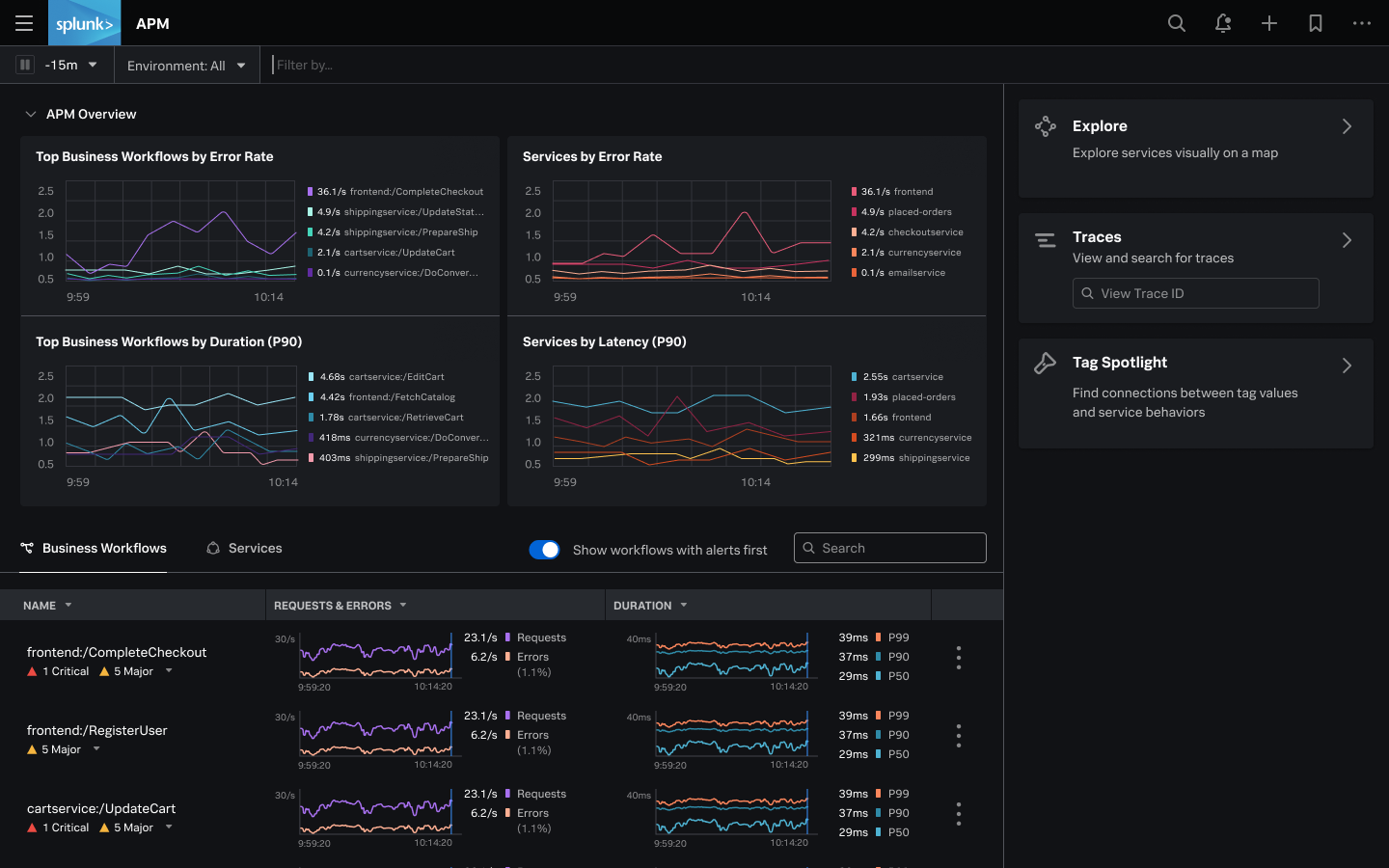
    Splunk today unveiled an observability platform delivered as a cloud service that captures all metrics, traces and logs in real-time without relying on sampling.

    Spiros Xanthos, vice president of product management for observability and IT Ops at Splunk, said Splunk Observability Cloud collects all that data via a single agent based on open source OpenTelemetry software to instrument an application.

    Historically, application performance management platforms (APMs) have only analyzed samples of data to identify a potential anomaly. Splunk Observability Cloud analyzes all the streaming data captured by its agent software to enable IT teams to pinpoint the root cause of an issue faster, said Xanthos.

    As a result, Xanthos said the signal-to-noise ratio dramatically improves compared to legacy monitoring platforms. It will then be up to each IT team to decide how much of that data they want to store after it’s been analyzed, added Xanthos. Pricing for Splunk Observability Cloud is based on the number of hosts employed rather than the amount of data collected.

    The Splunk Observability Cloud unifies a Splunk analytics portfolio by including capabilities provided via Splunk Log Observer, Splunk Real User Monitoring (RUM), Splunk Synthetic Monitoring, Splunk Infrastructure Monitoring, Splunk APM and Splunk On-Call. Splunk Synthetics Monitoring is based on technology Splunk gained with the acquisition of Rigor last year.

    Splunk

    The Splunk Observability Cloud is one of the first such platforms to rely solely on OpenTelemetry agent software being developed under the auspices of the Cloud Native Computing Foundation (CNCF) to collect data. That project not only reduces the cost of instrumenting applications, it also reduces the number of agents an IT team might have to deploy to collect metrics, traces and log data.

    Many rival observability platforms can collect data from OpenTelemetry agent software, but also tend to encourage DevOps teams to deploy proprietary agent software that they claim is easier to install and collects data at a more granular level. Splunk has decided OpenTelemetry has matured to the point where those proprietary agents are no longer required, said Xanthos.

    The rise of observability platforms presents an opportunity for IT teams to rationalize a raft of monitoring tools that often surface conflicting analyses. IT teams today spend an inordinate amount of time convening so-called “war room” meetings to determine the actual source of an issue. Those meetings can go on for hours, only to eventually discover an issue that only takes a few minutes to fix.

    While observability has always been a core DevOps principle, the level of visibility most IT teams have into their application environments is limited. There is no shortage of monitoring tools, but because there is no unified approach to observing an IT environment, there simply isn’t enough context being provided. As IT environments become more complex – thanks primarily to the rise of microservices-based applications that have lots of dependencies – that lack of context is rapidly becoming a major issue. A microservices-based application is designed to degrade gracefully if one microservice suddenly become unavailable. The issue is that it can take a very long time to discover the root cause of performance degradation.

    It may be a while before most IT teams achieve true observability, but once they do, many will wonder how they previously managed IT without it.

  • Debugging is Broken – Here’s How To Fix It

    Debugging is Broken – Here’s How To Fix It

    Let’s face it, debugging is broken.

    Whether you wholeheartedly agree or vehemently disagree with that statement, I think we can all agree that debugging, at the very least, has room for improvement. In fact, the way software developers debug their code hasn’t changed much. Of course, there are now a wide array of observability and monitoring tools available to make a developer’s life easier, but when we look at the process developers typically follow when debugging code, it’s stayed relatively unchanged over the years.

    Having the right tools available definitely improved the overall debugging experience, but they’re not the only factor. Internal organizational processes are equally as important, and should be adapted to make developers’ lives as smooth and stress-free as possible while still maintaining the proper levels of organizational security and compliance. Inefficient or highly restrictive processes, while great for the compliance team, can adversely affect the velocity of getting to the bottom of issues quickly. The right solution is typically a combination of adapting those processes to fit the company culture, along with a combination of tools that allow for compliance with industry standards and best practices.

    How Developers Debug Code

    When you talk to developers today about how they debug their applications, the process is typically not all that different than it was many years ago. The standard approach to debugging is still through the use of logging frameworks. Of course, teams are taking advantage of things like application performance management (APM) tools and other tools in the monitoring and observability space, but when you look at the primary method of debugging issues that require developers to dive into the code, logging is typically the main approach.

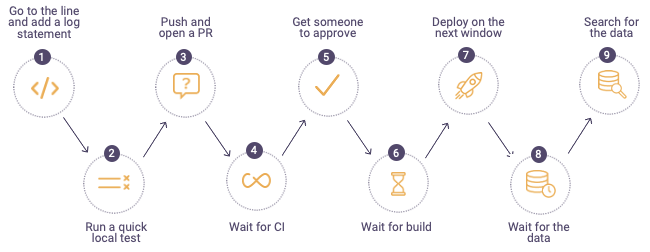
    The process typically looks something like this:


    debugging process

    When a defect is found, developers will first go to the log files on the production or pre-production servers in the environment where they are debugging. If they can’t find information in the logs to help them get to the root cause of the issue, they go back to their code and add additional log lines, finally sending their code through the process shown above. For highly advanced organizations, the process can take minutes or hours, but more often than not, this process drags on for days – or even weeks. It becomes especially time-consuming when the defect developers are trying to find and remediate is in production. In these cases, the cost to the business can be staggering; there’s got to be a better and more efficient approach to debugging.

    Where Tools Can Help

    While new and shiny tools don’t always solve all debugging problems, they can often ease some of the pain developers face and, in the process, make their lives a little bit easier. Debugging, observability and monitoring tools can get developers the data they need to solve problems faster than the more traditional method of digging through logs and using trial and error.

    The place many organizations start when considering diagnostic tools is with APM. These types of tools focus specifically on monitoring and management of the application availability, and can help to collect metrics and other relevant application information that can aid in pinpointing infrastructure issues. Most often, these tools are not actually used by developers themselves, but rather operations or production support teams to ensure availability and performance thresholds of applications.

    Another critical category of telemetry are tracing tools, which can help developers better understand how requests flow through multiple tiers of applications and even help identify error rates and latency. There are many vendors selling this category of tools, but there are also open source options which allow developers to integrate tracing into their applications via a vendor-neutral approach.

    After diagnosing an issue with an APM solution, there is often a handoff to development to remediate the issue. When developers need to debug, they often use their local IDEs or, even better, a remote debugging solution. Remote debuggers are used directly by developers to simplify debugging of applications in remote environments. These tools helps developers get to the bottom of customer issues faster by giving them direct access to the underlying application data in a safe and secure way while the application is running without stopping it or having to redeploy it. A major benefit of remote debuggers is that they can give developers the data they need from production environments without compromising security or requiring developers to have direct access to sensitive environments. While remote debuggers and other debugging tools are not a silver bullet, they can be a critical component that empowers developers to better address critical issues.

    Fixing Organizational Problems

    If solving customer issues is taking longer than expected or is potentially hurting your brand, it’s critical to sit down with your development team and use a data-driven approach to identify where the problems lie. Do a deep dive into your issue tracking or ITSM system to identify trends or recurring issues within particular application components. Development teams can often become so overwhelmed tackling issues and building out new features that valuable information in these internal systems can go untapped. Customer issues and defects should be reviewed periodically to assess things like business impact, cost to fix and alignment with the product roadmap. There is valuable information that can help focus the team’s effort on time-saving activities as well as improving the product, making for happier customers.

    Another area to look at is your software delivery process. Are there bottlenecks in your delivery pipeline that could be made easier or more efficient but have been overlooked? The speed and efficiency of your software delivery pipeline has a direct impact on developers’ ability to debug effectively and can contribute to a broken or slow debugging process. Developers should have the ability to push code into new environments as quickly as possible to remove slowdowns from too much context switching. This means automating as much of the delivery pipeline as possible, removing unnecessary manual deployment approvals and shifting left as many activities as possible.

    When it comes to empowering developers and fixing broken debugging processes, organizations should focus on fixing organizational bottlenecks as well as equipping developers with tools that can save them time and improve their daily workflows. Focusing on these areas can increase development team velocity and eliminate costly day-to-day slowdowns which add up over time and negatively impact productivity. With a few key changes, debugging can be a much more manageable and predictable process.

  • More and More Enterprises Go Headless

    More and More Enterprises Go Headless

    IT faces high expectations for building and supporting omnichannel digital experiences. Simultaneously, web developers hold an evolving toolkit of architectural approaches to deliver content. One such framework gaining mindshare is headless, a style that decouples front end user experiences from back end application logic.

    Legacy options for content delivery can be somewhat cumbersome in that they don’t apply well to scenarios beyond websites. On the other hand, a headless framework uses web APIs to communicate with clients, making it a more adaptive model to support new devices and use cases.

    WPEngine recently released global research on the state of headless. Below, we’ll review the top findings from The State of Headless: A Global Research Report. I also met with Matt Landers, developer relations manager, and Jason Bahl, principal software engineer at WPEngine to discuss the evolution of headless and its future implications for developers.

    What is Headless?

    First off, what is headless? Headless decouples the front end from the back end, thus separating the user interface (UI) from the data and code that powers it. The headless movement represents a shift from traditional content management systems (CMSs) such as WordPress, Squarespace and Wix.com. These platforms are less extensible, as they intrinsically unite the back end with user-facing representations. Traditional CMS is “typically not that easy to scale,” noted Landers.

    Headless challenges the status quo by offering more flexibility. As headless adopts API-based content negotiation, it could essentially deliver highly personalized experiences to any connected device. This could help support emerging platforms, like mobile, voice assistants or augmented reality (AR).

    Simply put, headless is “a CMS that is not responsible for rendering the site,” Landers explained. “What attracts people to headless is component-based architecture and the ability to build isolated components,” he added. For example, a headless framework could include an author bio component that is reused in any custom style across devices. By deploying to a CDN, headless could enable high-speed performance, as well.

    Headless Adoption Surges

    Interest in headless is increasing across the board. Currently, 64% of enterprises surveyed adopt a headless approach, representing about a 25% increase from 2019. Furthermore, headless use is expected to grow: over 90% of organizations not currently using a headless setup plan to evaluate a headless option in the coming year.

    The strong interest in headless likely represents a growing necessity for large enterprises to support various digital channels in a consistent manner. In fact, 92% of organizations credit headless with delivering a more consistent content experience, the report found.

    Benefits of Headless

    A key benefit to introducing headless is the decoupled nature of the approach. This makes it possible to support multiple platforms, such as websites, mobile apps, IoT devices, connected kiosks, smartwatches, voice assistants, AR and virtual reality (VR) from the same source.

    Respondents also cited additional benefits to adopting headless such as increased performance, quicker time to market and rapid innovation. These positive attributes make sense because, with headless, applications only request the data they need. Therefore, headless could certainly facilitate more dynamic applications and custom-tailored user experiences. If used effectively, headless setups reduce bloat to create fast-loading digital experiences that further the SRE agenda.

    Tech Choices and Use Cases

    An average organization is spending $2.6 million on their headless implementation, found the report. So, what are they spending it on? Well, some common headless frameworks and SaaS platforms include Contentful, GraphCMS, Atlas, DatoCMS, Cosmic, Netlify, Sanity.io and Prismic, among others.

    While the report didn’t query respondents on their exact headless stack, it revealed a general satisfaction with headless solutions, with relatively high net promoter scores (NPS). When selecting a headless provider, respondents tend to consider performance (41%), e-commerce (35%), scalability (33%) and APIs and extensibility (30%).

    Though headless spans many use cases, e-commerce is clearly a primary use case for the headless stack, with 51% of respondents adopting headless to support e-commerce. Other top use cases for a headless approach include a website (52%), IoT (47%) and progressive web apps (40%).

    Drawbacks of Headless

    Though headless provides impressive malleability, it does require a shift in thinking, and implementors must inevitably overcome certain drawbacks. API security, for example, is at stake as API attacks and threats increase.

    Headless could also require additional administrative burden in terms of data integration and upkeep. With headless, instead of using plugins, IT must enlist front-end developers to integrate data and build front-end behaviors. Debugging a decoupled front end and back end can also be an added development burden. “There is an opportunity in the headless ecosystem in general to mature the experience for the content publisher,” describes Bahl.

    Future of Headless

    Within today’s remote economy, most acknowledge that digital experiences are now crucial to supporting business at large. In fact, 92% of organizations believe digital experiences are vital to their organization’s success, found the report.

    Headless architecture promises to retain a stable back end to support these escalating digital demands — especially useful considering the ever-changing nature of front end clients. On that note, the report found that 32% and 31% of respondents adopt headless for VR and AR experiences, respectively. Therefore, the headless approach appears to be a valuable technique to future-proof current investment against emerging digital trends.

    The State of Headless: A Global Research Report, conducted by Vanson Bourne between January and February 2021, surveyed 400 IT/technical employees with knowledge of headless. For more insights, you can read it in full here.