Category: Low-Code/No-Code

  • Dual-Track and Low-Code’s Excellent Adventure

    Dual-Track and Low-Code’s Excellent Adventure

    Digital transformation can be a bogus journey. Here’s how low-code and dual-track transformation efforts can help.

    Large-scale enterprise digital transformation can take a while. Transformation initiatives like cloud migration, mainframe upgrades or refactoring monolithic systems could easily take five to seven years. Yet, this slow pace is at direct odds with today’s digital innovation standards and the pressure to release software rapidly.

    COVID–19 has amplified this drive to innovate, especially complicating matters for non-cloud-native companies, which struggle to attract and retain talent amid a developer shortage. Not to mention, developers are experiencing surmounting pressure to perform, which could result in burnout if not supplemented by new strategies.

    To maintain agility while diligently advancing multi-year digital transformation projects, some proponents argue for a dual-track approach. This approach uses low-code platforms to increase operational agility (the fast track) while digital transformation initiatives (the slow track) progress methodically on the side.

    I recently sat down with Jay Jamison, chief product and technology officer at Quickbase, to discuss today’s digital transformation concerns. According to Jamison, implementing a dual-track approach affords great rewards, but it requires an organizational cultural shift. He recommends establishing centers of excellence (COE) to evangelize low-code practices and encourage citizen development, enabling subject matter experts of lower technical acuity to automate operational workflows and operations.

    Dual-Track Transformation

    “Digital transformation is an important element for businesses of all sizes,” said Jamison. However, mainstream digital transformation projects, like rationalizing an ERP, moving to the cloud, or upgrading a network, can take an exorbitant amount of time and money. It’s hard for IT to meet business requirements. “We really need a second track of digital transformation — one that is more agile.”

    Jamison likens dual-track transformation to chipping out “small rock” projects from the larger digital transformation cliff. This strategy focuses on streamlining realizable goals in shorter timespans, empowering teams of people — with subject matter expertise — with tools to transform and digitize their workflows.

    Low-Code’s Role in Dual-Track

    A recent study conducted by Harvard Business Review found that 80% of executives “strongly agree” that a dual-track approach is essential for digital transformation. Yet, only 31% of companies have adopted said approach.

    To realize a dual-track process, Jamison recommends low-code for its “low-risk, high-throughput capability.” According to Jamison, low-code enables the edge of business to quickly adapt new solutions and run them in parallel with big rock digital transformation. For example, non-engineer government employees in a Texas county recently used a low-code platform to help distribute coronavirus vaccines.

    For a citizen developer culture to flourish, “you really need to have all hands in the pile,” Jamison said. IT stakeholders and business members must collaborate and work together to bring low-code to fruition. This process combines setting goals, outlining guardrails, and forming learning groups with progressive leadership at the helm.

    Introducing Centers of Excellence

    Naturally, many factors can affect IT innovation (leadership commitment, collaboration, organizational expectations, etc.). But arguably, the most common roadblock to digital innovation is culture. In fact, 45% of executives report that organizational structure is a major transformation challenge.

    That’s where centers of excellence (COE) come in. No, centers of excellence is not an archive of Bill & Ted’s adventures. COEs aim to fix the cultural barrier by encouraging progressive leadership, collaboration, and innovation. The Playbook for Centers of Excellence defines COE as “a concentration of expertise and resources in a specific capacity, designed to maximize the focus on a specific project.”

    A COE aims to foster shared understanding between IT leadership and business leadership. In Jamison’s words, “a center of excellence provides the ability to utilize low-code to sustainably build and empower applications in a safe, sustainable way.”

    Building a Most Triumphant Center of Excellence

    The COE goal is to empower business users to innovate. Yet, COE is a governance framework, which seems a bit contradictory. So, how does an organization go about implementing it? Well, there is a range of how companies adopt COE, but Jamison shared some common steps:

    Step one is establishing your goals. This could be increasing productivity, enhancing customer satisfaction or improving service reliability. Step two involves inviting the right people and perspectives — the key personnel to own the COE program.

    Next, develop transparent policies around security. This helps preempt concerns around data security and compliance. Finally, now that goals and rules are established, communicate the initiative across an organization.

    Throughout this process, investing in training is paramount. There are many project management philosophies for encouraging low-code adoption, but Quickbase recommends a training and education team to “roll out information and goals in a structured, targeted way”. They also encourage a community focus — user groups, internal events and knowledge-sharing initiatives can build excitement within the employee base.

    Benefits of Low-Code Enabled COE

    A COE aims to bring disparate parties to the same table. For example, companies could hold what Jamison described as an “appathon,” in which business executives present their goals, like rolling out new installations or driving 5G deployments. Then, priorities are assigned to individual groups, who apply domain knowledge to construct applications.

    Setting up a COE by accelerating ground swell innovation “catalyzes the dual-track innovation that we think is really key,” said Jamison, reducing the mean cycle-time to introducing new features. Low-code could also lower the integration barrier, enabling connectivity with CRM systems, or connecting with big, heavy systems like SAP or Oracle.

    Jamison also described low-code platforms as encompassing “the spirit of microservices,” as they introduce a relatively lightweight application process and easy deployment model. Furthermore, if teams are tapped into the same PaaS, they receive data reusability benefits, he said. “Everyone can utilize the same data in a way that’s relevant for what they need.”

    Citizen Developers: Bogus or Non-Bogus?

    Personally, I think it would be great if the future of application development ushered in a democratizing effect, allowing more people to participate in software creation. Yet, the skepticism around a fully working citizen developer model is hard to shake.

    The “citizen developer” seems to have a negative connotation among coder elites, too. As one reader commented:

    “So top talents are overpaid extravagance and bored secretaries working from home will be driving innovation by writing no-code workflows, am I right with understanding what is written here?”

    I pressed Jamison on the reality of the citizen developer concept in practice and how he responds to naysayers. He jokingly equates it to a witch hunt.

    “Saying that only people that get to participate in software development is professional software developers is ridiculous,” he said, noting the importance of subject matter expertise.

    According to Jamison, companies often fail when they attempt to transmit subject matter expertise to developers. Organizations would rather teach subject matter experts low-code than teach the subject matter to programmers, he noted. It’s not hard to imagine why allowing subject matter experts to build their own workflows for specialized fields, such as accounting, natural science, or mathematics, makes sense.

    Regardless, Jamison adds there’s nothing really to worry about — “The full stack developer isn’t going anywhere.”

    Dual-Track Digital Transformation? Excellent!

    A dual-track approach combines large-scale transformation and rapid-cycle development. By separating “small rock digital transformation” out from the larger puzzle, organizations can increase operational agility to meet business needs a bit quicker.

    Establishing a center of excellence seems to boil down to bringing people together to share ideas, collaborate, and drive better productivity. If anything, this way of thinking will help operationally-intensive industries consider how they can automate parts of their business.

    Ultimately, the goal here is to enable organizations to collaborate better and drive better productivity. By empowering more creators, you can start seeing creativity at the edge of business emerge too, said Jamison. If that involves citizen developers creating event-driven workflow automation, so be it. “We invite people to take on the challenge,” said Jamison.

    Hopefully, then, business and IT can be excellent to each other.

  • Survey: DevOps Growing Pains in Salesforce Environments

    Survey: DevOps Growing Pains in Salesforce Environments

    IT organizations that have adopted software-as-a-service (SaaS) application platforms from Salesforce in part to jumpstart their digital business transformation initiatives are experiencing some DevOps growing pains.

    A survey published this week of 230 executives, managers, and members of Salesforce delivery teams conducted by Beagle Research on behalf of Copado, a DevOps platform for IT teams building custom applications, shows that while 82% have increased or maintained the size of their Salesforce development teams, the change fail rate jumped from 23% last year to 33% in 2020 when compared to a similar survey conducted a year ago. The survey also notes time to recover increased from 110 hours in 2019 to nearly 196 hours in 2020.

    Andrew Leigh, chief marketing officer for Copado, said those results generally reflect the nature of the more complex application initiatives being launched on top of Salesforce applications. The survey also noted 55% of respondents don’t consistently automate their Salesforce deployments, with less than a quarter of respondents (23%) having a way of automatically deploy a configuration from development through testing to production.

    In fact, in teams with fewer than 10 members, only 28% of survey respondents automated Salesforce deployments compared to 56% of teams with more than 100 developers that have automated their deployments, the survey found.

    The survey also noted that more than a third (34%) of respondents said features that development teams create may not be adopted. That issue suggests there is more work to done in terms of better aligning development teams with the goals of the business, Leigh said.

    Organizations building applications on top of Salesforce don’t typically embrace DevOps best practices until development teams have 25 or more members, Leigh noted. Salesforce environments generally require their own DevOps platform, because applications are constructed using a set of objects and tables unique to the platform. Those objects and tables are most often invoked using a set of low-code application development tools. Nearly three-quarters of respondents (73%) employed at least one commercial Salesforce development tool.

    Overall, the survey finds 82% of organizations have increased their budgets for or effort toward digital transformation, with 53% reporting they have exceeded their performance goals for the year. The survey also identifies a set of elite DevOps performers that are reporting 30x shorter lead times; 46x more frequent deployments; 5x lower change fail rate; and 37x shorter time to restore. Elite performing teams are 65% more likely to have adopted continuous integration than low performing teams, the survey notes.

    More than half of respondents (53%) said that they found it easy to find people who have DevOps experience in a Salesforce environment, with salaries typically in the $90,000-$140,000 range.

    The survey also finds the majority of organizations (82%) expect the systems integrators they contract to build applications to help define their DevOps processes.

    As organizations continue to adjust to new business realities in the age of COVID-19, there’s no doubt more custom applications will be built and deployed on top of SaaS application platforms such as Salesforce. The challenge is finding the best way to accelerate the development of those applications in a way that consistently produces the desired result.

  • Sauce Labs Acquires AutonomIQ to Advance App Testing

    Sauce Labs Acquires AutonomIQ to Advance App Testing

    Sauce Labs is acquiring AutonomIQ, a provider of a scriptless test automation platform based on machine learning (ML) algorithms.

    Matt Wyman, chief product officer for Sauce Labs, said the acquisition of AutonomIQ will play a critical role in enabling Sauce Labs to push testing further left toward developers and, ultimately, “citizen testers” that are becoming part of the DevOps testing tool chain.

    The acquisition of AutonomIQ comes on the heels of the company announcing its intent to acquire API Fortress, an application programming interface (API) testing platform provider. Terms of neither acquisition were disclosed.

    Wyman said the rise of DevOps coupled with an increase in the volume of applications being developed using low-code tools are the primary drivers of a need to shift testing further left. As more citizen developers are building applications, they require access to a testing platform that doesn’t require them to know how to write scripts to test applications, said Wyman.

    The AutonomIQ platform employs machine learning to understand, for example, natural language descriptions of test cases or captured mouse clicks. It then generates synthetic data and test cases that can self-heal when an application changes, said Wyman.

    That approach to testing is more feasible in software-as-a-service (SaaS) environments, where a custom application based on a platform such as Salesforce, ServiceNow, Workday, Oracle or SAP doesn’t tend to change as radically as an application being built from the ground up, Wyman said. Those classes of applications will still require either developers or a dedicated team of testers to build tests using scripts, said Wyman.

    In fact, Wyman said testing those applications is becoming more challenging in the age of microservices. The API Fortress acquisition addresses that issue, because microservices are dependent on APIs to communicate with other microservices, said Wyman. In general, Wyman said Sauce Labs is now moving beyond being focusing only on functional testing of user interfaces.

    It remains to be seen how quickly testing will move to the left. Developers are being held more accountable for the quality of their applications, so testing integration within the application development process has increased. This has led to application testing becoming more tightly integrated with continuous integration/continuous delivery (CI/CD) platforms. Less clear is to what degree those efforts might have reduced the burdens of a dedicated application testing team that typically evaluates applications after they have been constructed.

    Exactly where and how citizen testers are being incorporated into those processes is also unclear. In theory, citizen testers can bring more business process expertise to the testing process. Getting individuals with that level of expertise to make time to participate in application testing while an application is being built can be a challenge.

    Regardless of approach, however, it is already apparent that machine learning algorithms, along with other forms of artificial intelligence (AI), will play a much larger role in application testing in the coming months and years.

  • Hybrid Low-Code: The Next Step in App Development

    Hybrid Low-Code: The Next Step in App Development

    The promise of low-code development has long been the ability to develop business-critical applications by humans with little programming experience. In fact, over the past year or two, the lines between low-code and no-code have become increasingly blurred. Low-code platforms have incorporated more and more functional no-code features to increase the efficiency of the developer even further. Some of these platforms have become so intuitive to use, the idea that anyone can create an app has evolved into the idea of citizen developers. But is low-code really the be-all and end-all when it comes to app development? Seems the answer to that is, “It depends.”

    It has become glaringly obvious that exclusively no-code platforms can’t create complex applications. But then again, these platforms were never really designed with that kind of functionality in mind. No-code can be a highly valuable, rapid prototyping tool as well as a decent tool for very small, very specific apps. These apps would be best suited for intradepartmental use or to extend the functionality of very specific SaaS tools. No-code is not going to power your business-critical applications, and a not-quite-a-developer is not going to lighten your IT load.

    But what about low-code? Can low-code be the bridge between citizen developers and the ever-growing list of backlogged apps? Maybe. Using citizen developers comes with a whole heap of issues that need to be addressed. While this topic can be the subject of an entire blog in its own right, I can quickly highlight the major issues to consider. How much of a citizen developer’s time should be dedicated to app development? Is using citizen developers going to create backlog issues in their primary departments? Who is going to train and support citizen developers? How is IT ensuring that citizen developer-created apps are secure, scalable and extendable? As great as citizen developers sound, they still are not a definitive solution.

    A realization has dawned in the low-code industry. Low-code can’t be and do everything, but it can be a useful development tool to speed up application development. However, most low-code platforms are in their own development silos, separated from other development tools with their own IDEs. Instead, one idea is to create a quick and easy-to-use user interface, drag and drop some app functionality, and then finish complex apps in a language the low-code platform can integrate with, such as Java, or via a Visual Studio plug-in. Even the biggest and best low-code vendors admit that just using low-code isn’t going to power your business.

    Low-code can’t be everything, but it can be a major part of everything. It just needs to look different from how most low-code platforms are designed. Using a hybrid low-code approach will allow organizations to truly use low-code from start to finish in the app development process. Rather than looking at low-code as a separate tool in the development process, a hybrid low-code approach brings low-code inside an IDE where traditional coding methods are still used.

    Is hybrid low-code the future of app development? I would say hybrid low-code is a next step in the evolution of app development. Low-code development tools shouldn’t be isolated in their own IDEs. It can be frustrating to leave a low-code IDE to finish the app in another IDE, and then have to connect the different elements into one cohesive app. As you can see, efficiency is reduced every time a developer leaves one IDE for another. Hybrid low-code views low-code as a tool inside a bigger development toolbox. It is there when convenient, but a developer isn’t forced to use just low-code. They can import already created assets from other languages, hand-code complex solutions, drag-and-drop when it makes sense, and create all the necessary components of a progressive web app with a click of a button.

    While there might be a profound realization that “traditional” low-code can’t do everything it originally promised, hybrid low-code could, instead, fulfill that promise.

  • CloudBolt Software Aims to Bridge DevOps and IT Divide

    CloudBolt Software Aims to Bridge DevOps and IT Divide

    CloudBolt Software today released a Winter update to its cloud management platform that aims to bridge the divide between DevOps teams and traditional IT administrators.

    IT administrators can now employ the CloudBolt platform to invoke the open source Ansible framework for automating IT processes and workflows using a graphical user interface (GUI) surfaced via a OneFuse Ansible Tower module.

    Additionally, the OneFuse Scripting module will now make it possible to automate script creation for anyone who creates a script using, for example, Terraform, and package that script in a way that IT administrators can invoke via a graphical tool.

    Jeff Kukowski, CEO of CloudBolt Software, said the goal is to make it easier for IT teams across the organization to reuse code created by a DevOps team. OneFuse provides IT with a codeless integration tool. In addition to the core cloud management platform, CloudBolt Software also provides access to a Kumolus service that enables IT teams to optimize cloud costs and provides additional governance capabilities such a generating an audit trail.

    Other capabilities added in the Winter release include deeper cost optimization analysis for VMware vCenter and Microsoft Azure environments, support for the latest release of VMware vRealize and additional C-level dashboards and reports.

    As the number of workloads deployed in production environments increases, there is going to be a greater need for some form of détente between DevOps teams and traditional IT administrators. Site reliability engineers (SREs) can typically manage a much wider range of workloads than an IT administrator. However, SREs are both expensive and hard to find and retain. IT organizations will need to find a way for IT administrators that, at best, have limited programming skills, to pick up some of the slack.

    Those IT administrators can play a critical role in minimizing the number of misconfigurations arising from provisioning IT infrastructure as code. Misconfigurations as a result of developer mistakes are rife across the cloud, and IT administrators are more inclined to check for these than are developers who are racing to deliver their next application.

    The truth is, there are a wide range of tasks that DevOps teams would just as soon see managed by IT administrators, especially if a script or runbook that addresses common issues has already been created. The trick is making that script or runbook easily accessible.

    In the meantime, IT organizations are racing to keep up with complexity in IT environments, often by applying automation at scale in a way that is both repeatable and well-documented. Whether IT professionals like it or not, the days of writing automation scripts and failing to document them are coming to an end. The real issue is ensuring that what does get automated actually works as expected, each and every time a script is applied.

  • Using Automation to go All-Digital, Fast

    Using Automation to go All-Digital, Fast

    Before the pandemic, digital transformation was a five-year plan for many companies — or in some cases, a distant vision that kept getting kicked down the road. Now, companies in every industry face an urgent imperative to adapt to an increasingly online-first world: If you don’t go digital, fast, you’re simply out of the game.

    Increasing productivity has been critical for companies as they make this shift. But too often, speed is hindered by time-consuming and repetitive processes that companies can and should easily automate. By automating mundane tasks, employees and businesses can focus on what really matters — increasing scale in today’s work-from-anywhere world, and improving experiences for both employees and customers.

    The Benefits of Automation

    Fundamentally, automation is about digitizing existing business processes to streamline results, and it will be a key element in helping businesses survive and get back to growth. Until now, many companies have focused on applying these tools to the front office: sales, marketing, commerce and supply chains. With most employees now working remotely, it’s harder than ever for team members to do their jobs efficiently. Automating the back office and improving the employee experience is key for businesses to achieve the speed they need to thrive right now.

    Here are three key advantages of bringing automation to the back office:

    1. It improves productivity.In virtually every industry and role, employees are still spending hours every week on mundane and labor-intensive tasks, such as data entry. Automation can speed up these repetitive tasks and streamline lengthy processes, freeing employees up to focus on the “human” aspects of their jobs, like interacting with customers, planning ahead, making decisions or learning new skills. By taking over routine tasks and allowing employees to concentrate on what matters most, automation makes workers more efficient and productive.
    2. It increases scale.There’s only so much an employee can do manually. The time-consuming processes that worked yesterday can’t scale to meet the demands of an all-digital environment.  Automating repetitive tasks means that employees can achieve more in the same amount of time, allowing them to scale their workloads. With time-consuming tasks being taken care of in the background, workers can spend their time on more meaningful work and customer relationships.
    3. It enhances employee experience.Nobody enjoys entering numbers into a spreadsheet. An often overlooked aspect of automation is that it leaves employees more satisfied and engaged with their companies and their jobs. Having fewer tedious tasks on their plates gives employees the chance to tap the skills that machines aren’t as good at, like creativity, communication and decision-making. This is especially beneficial at a time when most employees are juggling more responsibilities at work and at home. Making a more valuable contribution and more meaningful connections is not only rewarding for employees, but also translates to higher satisfaction among the customers they interact with.

    Real-World Examples

    Not everything can be automated, but there’s a lot of room to take the drudgery out of most roles. Take onboarding, for example. Traditionally, when a new hire started, everything happened in person: They attended an orientation, picked up their laptops at the tech bar, met with benefit providers — all of which required orchestration on the part of human resources. With automation, all of this manual coordination can be replicated with an intelligent workflow capable of guiding employees through an onboarding process customized to their specific role and location.

    In another example, HR departments are facing an unprecedented volume of queries about policies around caring for children and other dependents. Using low-code development, companies can easily set up automated, online bots to handle frequently asked questions and guide employees through processes needed to enroll in new services. Automating these queries with bots not only makes the employees themselves more productive, but it also delivers better experiences for both the HR team and the employees seeking answers.

    Automation is Here to Stay

    In today’s world, there is no alternative to a digital business model. Automation is the recipe that will help companies achieve the speed they need to survive now and the edge they need to thrive in the future.

    And there is no turning back — automation is here to stay, regardless of the trajectory of the pandemic. The process of change is never easy, but done right, automation not only leads to a more agile workforce, but also to a happier one.

  • The No-Code Revolution: 5 Industries That Will Win Big

    The No-Code Revolution: 5 Industries That Will Win Big

    The year 2020 tested the mettle of countless businesses and industries, but those who were able to stay afloat had one thing in common: the ability to adapt to an increasingly digitized world by embracing future-facing technology.

    For companies already steeped in the tech world, these changes came more naturally, but not all industries were equally equipped to transform. For those caught on their back foot, the key was to apply existing technologies to old systems and analog problems.

    No-code platforms quickly shot to the fore of these innovative solutions, and their importance will long-outlive the pandemic that was the catalyst for their growth. At its core, the no-code revolution is leveling the development playing field and lowering the barrier to entry of digitization. Programmers and non-programmers alike can now create enterprise-grade application software through graphical user interfaces (GUIs) and configuration instead of traditional computer programming.

    It is increasingly clear that these tools will form the prevailing wind of innovation, filling the sails of digital transformation for years to come—some have already called it the most disruptive trend of 2021. Yet many industries are only just beginning to realize the possibilities that no-code truly holds. Here are five of the industries that are benefiting most from the no-code revolution, and tips for how companies in each sector can continue to successfully implement no-code tools.

    1. Retail
    For years, online shopping was a convenience for many consumers. In 2020, it became a necessity.

    After a decade spent struggling to keep up with the rise of online conglomerates, the fate of retail industries was already questionable when the COVID-19 pandemic hit. Indeed, many of the businesses that first began to fail in the earliest days of the pandemic were retail giants who relied too heavily on their brick-and-mortar appeal. For brands that bit the dust, the “why” is no big secret: they failed to adopt new digital technologies and lost the loyalty of couch-bound customers.

    With no-code tools, the transition from “customer-friendly storefront” to “customer-friendly front end” is becoming quicker and easier than ever before. By allowing retailers to develop brand-tailored digital storefronts and progressive web apps that are as easy to design as they are to use, these tools will undoubtedly be one of the keys to success as the retail industry fights through the pandemic and looks toward a sustainable future.

    2. Insurance
    As with many legacy industries, insurance was long caught in the shadow of flashy innovators from the tech sector. But the push for transformation in insurance came not a moment too soon—not only did the year leading up to the pandemic see insurance leaders set their sights on digital innovation, but it was no-code tools that played a crucial role in leading the charge toward change.

    By allowing traditionally slow-moving enterprises to operate with startup agility, no-code tools are giving legacy insurance leaders in previously sheltered markets the edge they need to compete with digital-first newcomers.Today’s consumers increasingly expect a seamless digital user experience with everything from social media to gaming to insurance. With no-code tools, these expectations can be met without the need for high-level programmers or IT professionals.

    As they look toward the future, insurers who implement no-code platforms will be able to spend more time focusing on the quality of their products and less time losing customers due to outdated tech, all while cutting costs and simplifying operations at every level of their organization.

    3. Banking, Fintech and Payments
    Banking, another industry rife with legacy enterprises, has faced many of the same hurdles as its insurance counterpart, and it is for many of the same reasons that no-code development tools have extensive potential in the ever-shifting landscape of banking and its adjacent sectors.

    Mobile banking applications have already changed the way that everyday people think about, track and interact with their money. In a digital era where remote functionality is as urgent as it is practical, no-code tools can provide financial enterprises of any size with the opportunity to build, maintain and update consumer-facing platforms that meet customer standards, offer cross-platform integration and uphold necessary private data security.

    4. Health Care
    The COVID-19 pandemic has been a powerful accelerant for a diverse array of health care technologies, fueling rapid growth in fields like telemedicine and remote patient monitoring. As health systems continue harnessing technology to become more efficient and to improve patient outcomes, no-code tools can provide innovative solutions to multiple problems through the entire process of healthcare and treatment.

    Calendaring and scheduling platforms that make it easier for patients to arrange appointments, and easier for providers to keep track of them, can be developed and curated without writing a single line of code. No-code platforms are also one of the simplest ways that health care practitioners can offer user-friendly virtual visits, saving time for patients and providers alike, and minimizing unnecessary trips to and from germ-filled waiting rooms. Additionally, the ability of no-code platforms to turn high-level back-end data functionality into a widely accessible tool will make it easier than ever for health care organizations to log patient data securely and swiftly, which can ultimately be leveraged to track illnesses and find treatments, fast.

    With the ease of no-code development, health care professionals can spend less time addressing technical difficulties and more time addressing their patients.

    5. Manufacturing
    Manufacturing leaders have already expressed a keen understanding of the need for no-code solutions.

    Manufacturing Execution Systems (MES) have long been tasked with coordinating, executing and tracking the processes at a given factory or plant, but the rigidity that makes MES so useful for IT components of the manufacturing process also makes it difficult to use for shop floor personnel.

    Compared to MES, no-code platforms are cheaper to customize, quicker to implement and easier to update in accordance with changing operational needs. As manufacturers are increasingly expected to produce new, customized products with increasing speed and frequency, the need for no-code solutions will go from being a tech trend to an industry necessity.

    Unlike many past disruptive trends, which have often been characterized by their uniqueness, the rise of no-code is making innovation easier and more accessible across the board. While the industries listed above—retail, insurance, banking, health care and manufacturing—are each particularly well-poised to benefit from the no-code revolution, these five sectors mark only the beginning of what is to come.

    The development capabilities of no-code platforms will only continue to grow in the coming years. So, too, will the reach of these innovative tools.

  • Citizen Development Program: Selecting the Right Use Cases

    Citizen Development Program: Selecting the Right Use Cases

    The COVID-19 pandemic forced us into new ways of working that demanded a truly digital enterprise. Digital enterprises require we deliver applications for our everyday tasks and processes with unprecedented speed. Our traditional development resources – our professional developers – and traditional, professional code development environments simply cannot meet the demands from our lines of business.

    Citizen development

    The rapid adoption of low-code application platforms and the ability to use more readily available “low-code developers” partially closes the demand-supply gap by improving app delivery velocity for IT organizations. But velocity is only half the battle. Because our app development teams (pro and/or low code) can be so focused on the application itself, they may not fully understand the larger context around that application, the business processes they are attempting to digitize or how to connect with the process owners to gain that understanding. We become faster at app delivery, but not necessarily more agile. True business agility comes when we push app development to the edge; out into our lines of business and into the hands of “citizen developers.”

    citizen development

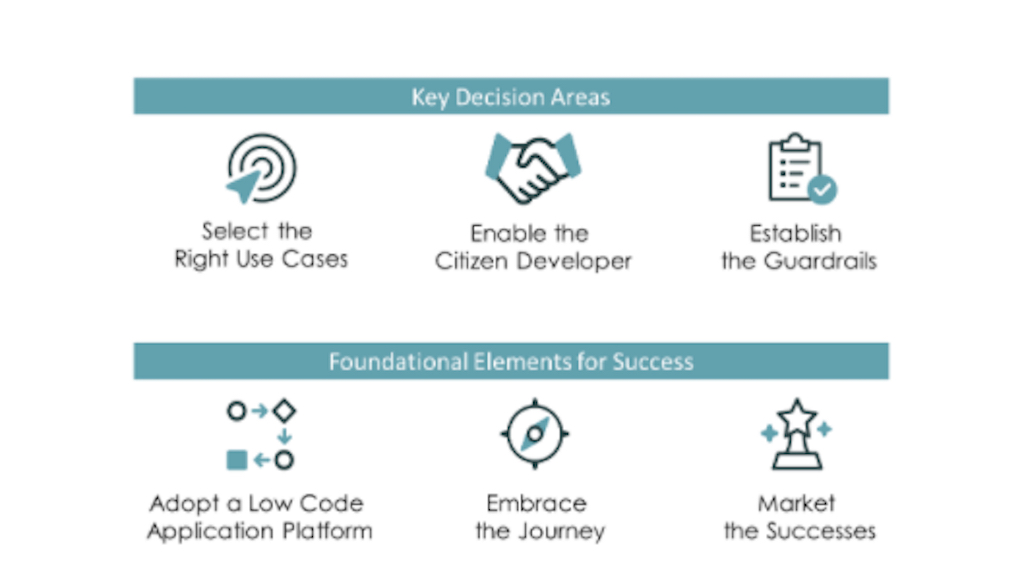
    Now let’s all take a deep breath, pause for a moment, and accept that citizen development is not the panacea for all our digitization needs – nor is it the beginning of application anarchy. A well-executed citizen development program can dramatically improve delivery velocity and business agility if organizations make good decisions in three key areas: 1) selecting the right use cases for citizen development; 2) enabling and empowering our citizen developers; and, 3) establishing citizen development guardrails that protect our organization.

    Before exploring the key decisions, it is important to note a few elements that are consistent across successful citizen development programs:

    • Adopting a Low-Code Application Platform (LCAP) – LCAPs benefit IT developers (both professional and low-code) but are critical to citizen developers. Teaching Java to your lines of business is what’s called a distributed development model – and that’s a whole different article.
    • Embracing the Journey – A citizen development program is a learning process for both the IT organization and the lines of business. Start focused, learn from the experience, adjust the approach and expand the reach.
    • Marketing Success – It is important to raise awareness of the program by telling the company about both the successes and the lessons learned – be candid and clear. People feel good about successful programs and rally around them.

    Selecting the Right Use Cases for Citizen Development

    We want to set up citizen developers, and the citizen developer program, for success, which means matching the business need to the citizen developer skillset.
    We need answer the following questions regarding line of business needs.

    • What business use cases are a good fit for our LCAP?
    • What technical requirements are a good fit for our LCAP? What technical requirements are not?
    • What types of applications in our enterprise are a good fit for citizen development?
    • Are there lines of business / departments that could benefit more than others from empowering citizen developers?
    • Are there specific risk, compliance, security and legal (RSCL) mandates that need to be addressed?
    • Are there other core enterprise systems that need to be considered for certain use cases?
    • Are there legacy technologies and/or is there technical debt that should be targeted?
    • What is the potential return on investment? How quickly can we start achieving that ROI?

    The answers to these questions are not binary. These questions, and others unique to each company, provide a filter to vet – and possibly score – use cases to determine suitability for a citizen development program.

    Just as important as selecting the right use cases is finding the right citizen developers. We need to answer the following questions about any potential citizen developers.

    • Will we have different categories of distributed / citizen developers? Are those categories based on skill level, organization and/or access?
    • Have we identified the aptitude and attitude characteristics of a good citizen developer?
    • How will we recruit and incentivize developers to join the program?
    • What is our value proposition to the citizen developer’s manager? Why would they support allocating some portion of their resource(s) building apps?

    In the early stages of a citizen development program, the most successful programs tend to prioritize the right developer over the right use case. A “high fit” developer delivering a “medium value” use case is a better bet than a “low fit” developer attempting a “high value” use case. Early wins matter.

    In part two of this series, we will explore enabling and empowering our citizen developers. We have now identified the right use cases and the right citizen developers, so let’s set them up for success.


    This post is the first of a three-part series offering real-world insights on delivering business value from citizen development initiatives.

  • Internal Makes On-Premises Edition of No-Code Tool Available

    Internal Makes On-Premises Edition of No-Code Tool Available

    Internal today launched an on-premises edition of its eponymous no-code development platform that promises to simplify application development backlog reduction for enterprise IT organizations.

    Arisa Amano, CEO of Internal, said many professional developers regularly find themselves building simple applications that, if given access to the right tools, could be built instead by end users. Internal was created to provide that capability either through a cloud service or, now, through an on-premises edition.

    The on-premises edition makes it simpler for developers to work with databases, application programming interfaces (APIs) and applications that reside behind a corporate firewall, Amano said.

    As organizations accelerate digital business transformation initiatives, professional developers are pressed to build and deploy more complex applications faster. Many lower-priority application development projects are sidelined simply because developers don’t have time to take them on. Internal, and other no-code and low-code application development tool providers, are making a strong case for enabling end users to build their own applications using graphical tools, or encouraging professional developers to use these tools to build less complex applications more quickly.

    A survey published by Internal finds 62% of respondents report their developers spend more than 25% of their time fulfilling requests to build internal tools. More than three-quarters of respondents (79%) said engineers use any extra time they can find to develop customer-facing features or other applications.

    Most of the projects filling application backlogs tend to involve workflows that span multiple applications running in a data center. The challenge organizations face is low-code and no-code tools that reside in the cloud can’t easily access that data. As such, Amano said there’s a clear need for a no-code tool that can be deployed in an on-premises IT environment.

    Of course, regardless of who builds the application, it still must be deployed. Challenges arise as developers build more applications, which must be concurrently deployed in production environments. The addition of no-code and low-code tools, and the applications created with those tools, will require organizations to rethink and refine their DevOps processes.

    Historically, professional developers have tended to view no-code and low-code tools as the application development equivalent of a black box preventing them from building reliable, robust applications that can scale. Many low-code and no-code applications that organizations build, however, are meant to used internally by a finite number of end users. At the same time, no-code and low-code tools become more robust with each major update.

    Whatever bias may exist, the current application development backlog in most organizations is only going to increase. Professional developers may prefer to write code at a lower level than a no-code or low-code tool allows; however, most business executives are more interested in application performance than in how it was constructed.

  • DARPA Enlists GrammaTech to Apply AI to Reverse Engineer Code

    DARPA Enlists GrammaTech to Apply AI to Reverse Engineer Code

    The Defense Advanced Research Projects Agency (DARPA) has awarded a research contract to GrammaTech for low code technology that will make it possible for end users to leverage artificial intelligence (AI) without requiring intervention from the original software developer.

    GrammaTech’s AI tool, dubbed ReMath, aims to ease application updates by automatically inferring high-level mathematical representations from existing binaries in systems and embedded software. The tool is currently in development.

    Dr. Alexey Loginov, vice president of research for GrammaTech, said development teams spend a lot of time using low-level tools such as disassemblers, debuggers and decompilers to manually analyze binaries. ReMath will accelerate that reverse engineering process by recovering and converting machine language into representations that end users can directly manipulate, said Loginov.

    The goal is to free developers up to build new software, rather than continuously updating software that has already been deployed, noted Loginov. This approach should ultimately reduce the backlog of application and software development projects organizations have, added Loginov.

    GrammaTech

    The ReMath project is the latest in a series of DARPA contracts awarded to GrammaTech. In general, the company is working towards applying AI to advance DecSecOps via a static application security testing (SAST) tool that identifies vulnerabilities in code. The ReMath project focuses on applying AI to use cases involving, for example, industrial control systems. These systems could benefit from allowing domain experts, with no coding expertise, to maintain and update them on their own, said Loginov.

    Other DARPA projects GrammaTech is actively researching include a type-ahead capability that automatically recognizes existing artifacts in a software repository, said Loginov. This capability will make it simpler for developers to reuse code within the context of a GitOps process without inadvertently introducing additional errors, Loginov said.

    In the future, the potential impact of AI on software development could be profound, as more reliable code moves into production environments. The percentage of code graduating into those environments on the first attempt should increase considerably in the years ahead. That should enable more reliable delivery of application code via continuous integration/continuous delivery (CI/CD) platforms.

    As software development becomes more efficient, the current developer shortage should also ease, and open up resources to launch a greater number of application development projects. Rather than spending time on manual tasks that provide no differentiated value, Loginov said software engineers will be able focus more of their time and energy on process innovation.

    In the meantime, developers should expect to see a rash of development tools with AI capabilities in the months ahead. None of those tools are likely to eliminate the need for developers any time soon; however, much of the drudgery involved in writing code today is likely to be sharply reduced as machine learning algorithms and other forms of AI are applied to software development.