Category: IT as Code

  • CloudBolt Acquires SovLabs to Advance Hybrid Cloud Strategy

    CloudBolt Acquires SovLabs to Advance Hybrid Cloud Strategy

    CloudBolt Software this week announced it has acquired SovLabs, a provider of a framework that extends the reach of automation frameworks from VMware.

    Company CEO Jeff Kukowski said that as a provider of a cloud management platform, the SovLabs framework will extend CloudBolt’s reach deeper into VMware environments that have already invested in automation tools from VMware.

    As IT environments become more widely distributed across a range of platforms, demand for a platform that enables IT teams to centralize the management of multiple cloud computing environments has increased, Kukowski said. The addition of SovLabs to the CloudBolt portfolio will make it easier to bridge the divide between cloud computing platforms and enterprise on-premises IT environments that have standardized on VMware.

    CloudBolt has been making a consistent effort to enable IT teams to invoke its cloud management framework via whichever IT automation framework they have adopted, including tools such as Terraform. The goal is to reduce the need for IT organizations to rely on their own custom-built code to achieve that goal, said Kukowski.

    In general, many IT organizations are now investing more heavily in centralizing the management of multiple IT environments as part of an effort to reduce the total cost of IT in the wake of the economic downturn brought on by the COVID-19 pandemic. That shift is accelerating a transition to hybrid cloud computing models that require increased reliance on IT automation.

    The challenge many organizations face is enterprise IT environments tend to have many islands of IT automation in place. CloudBolt is pursuing a strategy that enables IT teams to extend those islands of automation or access CloudBolt directly to manage hybrid cloud computing environments.

    The CloudBolt approach offers IT teams an alternative to relying on a single platform vendor to achieve hybrid cloud computing. VMware, for example, has been making a case for deploying VMware vSphere on multiple clouds versus relying on the virtual machines provided by a cloud service provider. Most of the large cloud service providers are simultaneously pushing to deploy instances of their platforms in on-premises IT environments that can be managed as an extension of a public cloud.

    It’s too early to say how this titanic battle for control over hybrid cloud computing will play out. CloudBolt, however, is betting that rather than getting locked into a single platform, many IT organizations will prefer to run toward some neutral ground to deploy a control plane capable of managing multiple clouds and on-premises IT environments.

    Of course, CloudBolt is not the only provider of a cloud management platform making this case. Competition between providers of hybrid cloud management platforms is heating up as interest in hybrid cloud computing starts to move beyond the theoretical. Regardless of the path forward chosen, history would suggest that most IT organizations in the months ahead will be seeking more control over their IT environments.

  • AWS Looks to Accelerate Windows Migrations to the Cloud

    AWS Looks to Accelerate Windows Migrations to the Cloud

    Amazon Web Services (AWS) is ratcheting up pressure on Microsoft by devoting more resources to enable IT organizations to migrate Windows workloads to the cloud.

    Fred Wurden, general manager for enterprise engineering at AWS, said a Migration Acceleration Program (MAP) for Windows, now generally available, provides IT teams with prescriptive guidance, consulting support, tools, training and service credits to help reduce the risk and cost of migrating to the cloud.

    The service is being delivered in collaboration with partners including Rackspace, 2nd Watch, Accenture, Cloudreach, Enimbos Global Services, Onica and Slalom. Wurden said AWS has been migrating Windows workloads to the cloud for more than a decade now and claims to have more than half of all Windows workloads deployed in the cloud.

    Microsoft has clearly been making strides in recent years to close the gap between it and AWS by running both Windows and Linux workloads on its cloud alongside instances of Microsoft Office 365. Microsoft most recently reported a 39% year-over-year growth in commercial cloud revenue, reaching $13.3 billion for its fiscal third quarter. However, Microsoft does not break out Azure revenue from Microsoft Office 365 revenue or disclose what percentage of the workloads running on Azure is based on Windows versus Linux.

    At the same time, Microsoft now charges more for instances of SQL Server that run on other clouds. AWS contends that decision will only accelerate the rate at which organizations are transitioning to open source databases deployed on Windows or Linux.

    Competition for Windows workloads is growing in ferocity in the wake of the COVID-19 pandemic because more workloads are being lifted and shifted into the cloud as organizations realize that on-premises IT environments can be rendered inaccessible. IT staffs in many geographies will be working from home at least through the end of the year. Many organizations are also moving workloads to the cloud in anticipation of a second potential outbreak of the pandemic.

    At the same time, the rate at which new workloads are being deployed in the cloud is also accelerating. Many of those cloud-native workloads are based on containers running on Kubernetes. Support for containers on Windows platforms is still relatively nascent when compared to Linux platforms.

    AWS and Microsoft, along with a host of rival cloud service providers, are focusing on legacy workloads because the expectation is that monolithic workloads running on Windows will be re-engineered to run as a set of microservices that can be updated more flexibly within the context of a larger digital business transformation initiative. It may be a while before that transformation fully manifests; however, it’s clear the battle for control over millions of workloads in anticipation of that transition is reaching a higher level of intensity.

    There’s no doubt many of those workloads will run on the Microsoft Azure cloud. However, the degree to which Microsoft might be winning in the cloud era may not be as great when everything that is being lost to AWS and other cloud service providers is taken into consideration.

  • Morpheus Data Automates Hybrid Cloud Management

    Morpheus Data Automates Hybrid Cloud Management

    Morpheus Data has updated to its cloud management platform by making it easier to dynamically integrate different implementations of automation tasks created using different tools and frameworks any Git or GitHub repository.

    In addition, the company has expanded the operating systems it supports to include Amazon Linux 2, Red Hat Linux 8.x and SUSE Linux, in addition to extending existing support for Microsoft Azure, Amazon Web Services, Oracle Cloud and Google Cloud Platform.

    Morpheus Data has also added support for VMware NSX-T and Unisys Stealth networking software as part of an effort to advance DevSecOps by making it easier to apply microsegmenation to networks to create a zero-trust IT environment. Interest in zero-trust IT environments is on the rise as a way to combat the lateral movement of malware once an IT asset is breached.

    Finally, Morpheus Data has updated the graphical user interface (GUI) it provides as a single pane of glass for managing multiple cloud platforms.

    Brad Parks, vice president of business development for Morpheus Data, said DevOps teams can now employ the Morpheus cloud management platform to orchestrate tasks developed in Ansible, Python, Groovy, Shell, Powershell, jRuby and even e-mail. Those tasks can then be chained together to create a workflow process, said Parks.

    The update to the GUI also makes it possible to create custom views of application instances across clouds as well as export custom datasets into CSV or JSON data formats for analysis, including chargeback, showback and project reporting. Navigation has also been streamlined with updates to global search, navigation and granular sorting of tabular data.

    Parks said in the wake of the economic downturn brought on by the COVID-19 pandemic more IT organizations will need to reduce the total cost of IT. The challenge they face is the IT environment has become more distributed than ever. The Morpheus platform makes it possible to centralize the management of multiple platforms, which should enable IT teams to substantially lower the total cost of IT by applying IT automation more aggressively across a hybrid cloud computing environment. Today most organizations have adopted multiple clouds, each of which is usually managed in isolation. That approach not only requires tools to manage each platform but also dedicated IT support specialists for each platform.

    It’s not clear to what degree IT organizations will move to centralize the management of IT in the wake of the pandemic. Many of the cloud platforms that organizations are employing have been funded by line-of-business executives rather than the central IT organization. However, now that many of those business executives are under pressure to reduce costs, the amount of discretionary spending made available to business executives might be curtailed. At the same time, however, many organizations are increasing investments in digital business transformation initiatives that most commonly involve applications being deployed on the cloud.

    Regardless of the path forward, the one thing that is clear is the current status IT quo within most organizations is not going to hold.

  • Cisco Moves ACI Strategy Forward

    Cisco Moves ACI Strategy Forward

    Cisco is advancing its hybrid cloud computing strategy with release of version 5.0 of Cisco Application Centric Infrastructure (ACI), a software-defined networking (SDN) that can be deployed on cloud platforms or networking equipment deployed in an on-premises IT environment.

    The latest version of Cisco ACI adds support for a transit gateway between virtual private cloud (VPC) instances on the Amazon Web Services (AWS) cloud to provide a more efficient means of routing traffic across east-west and north-south cloud computing environments.

    Cisco is also extending the networking services it provides for the Microsoft Azure cloud to include VNET peering within the Azure Virtual Network, shared service deployments, additional service automation functions.

    Via ACI 5.0, IT teams are now provided a centralized view of cloud resource inventory within AWS and Microsoft Azure along with status indicators and a set of wizards to simplify configurations.

    Cisco also has deepened the level of integration between Cisco ACI and Kubernetes as well, to increase the level of scale that can be achieved in IT environments based on platforms such as VMware vSphere.

    Finally, Cisco has added support for role-based access control (RBAC) in multi-tenancy environments along with two-factor authentication (TFA) capabilities enabled by the Cisco DUO platform. Cisco also added a more flexible policy construct, dubbed Endpoint Security Group (ESG), that can be employed to group endpoints based on L3 attributes and apply contracts between ESGs.

    Srinivas Kotamraju, senior director for product management for Cisco ACI, said the latest update to the SDN platform provides IT teams with the equivalent of many of the same networking services that Cisco historically has provided in an on-premises IT environment.

    Cisco has been making the case for a hybrid cloud computing approach to delivering network services that enables IT teams to manage those services via a central console. Rather than having to manage networking services provided by each cloud service provider, Cisco ACI makes it possible to deploy the same SDN across multiple clouds and on-premises IT environments. Cisco contends that approach ultimately serves to reduce the total cost of delivering networking services by both centralizing management and making it easier to automate the management of networking services across multiple IT environments.

    There are two primary ways Cisco exposes those networking services. DevOps teams can take advantage of application programming interfaces (APIs) to programmatically invoke ACI services. Alternatively, Cisco provides network managers access to a graphical user interface (GUI) through which they can access a command-line interface (CLI) to configure a specific router or switch.

    Kotamraju said with the rise of DevOps the number of organizations giving developer programmatic control over networking services continues to rise. It’s too early to say to what degree NetOps and DevOps teams might ultimately converge; however, Kotamraju said finding ways to meld those two groups is being discussed more frequently within many IT organizations as applications become more distributed.

    Of course, the biggest challenge when it comes to achieving that goal will be more cultural than technical. However, as networking services become more accessible via APIs, it’s now more a question of when and how than if.

  • Cloudian Adds Object-Based Storage Platform Monitoring Tool

    Cloudian Adds Object-Based Storage Platform Monitoring Tool

    Cloudian today added a monitoring and observability tool to its object-based portfolio of appliances for storing unstructured data in on-premises IT environments.

    Jon Toor, chief marketing officer for Cloudian, said HyperIQ provides access to analytics and health checks that enables predictive maintenance, enhances security and optimizes storage utilization. Cloudian is also pledging to extend the reach of HyperIQ in the future to other IT infrastructure via connectors.

    HyperIQ comes in the form of a virtual machine that IT teams download and install on-premises. A free HyperIQ Basic version comes with pre-configured dashboards. HyperIQ Enterprise comes with support and access to more advanced analytics features and is licensed by capacity at 0.025 cents per GB per month.

    Cloudian is also providing integration to multiple notification channels, including Slack, OpsGenie, Kafka and PagerDuty, to share alerts based on parameters IT organizations define in HyperIQ. In addition to pre-configured dashboards, IT teams can also leverage more than 100 data panels to drill into user or storage data at a more granular level.

    Toor said HyperIQ will become the foundation upon which Cloudian will also start to add AIOps capabilities to its platform. Based on machine learning algorithms, HyperIQ will enable Cloudian to collect the data required to train those algorithms, he said.

    Cloudian has been making the case for a distributed storage system that enables IT teams to globally manage appliances via a single user interface. As modern applications have become more complex, the need to access unstructured data stored within on-premises IT environments has become more pronounced.

    The challenge IT teams face is they don’t have enough staff available to manage each of those systems locally. In the wake of the economic downturn brought on by the COVID-19 pandemic, that issue has only become further exacerbated. Many IT organizations are either trying to reduce the size of their IT staff or limit the number of additional full-time employees they hire.

    At the same time, the amount of unstructured data an organization needs to store continues to grow. While much of that data can be stored on public clouds, a wide variety of global compliance regulations require much of that data to be stored in an on-premises IT environment.

    Given how distributed that data is, there is a clear need for deeper levels of analytics that ultimately should enable the management of distributed storage systems to be more automated. Many IT organizations have already significantly automated the management of storage systems within a local data center. The challenge now is to automate distributed systems residing in multiple geographic regions.

    Reliance on object-based storage systems to manage unstructured data within local data centers is still a relatively new phenomenon. Cloud storage service providers have been making use of object-based storage systems for the better part of a decade to manage massive amounts of data. Now internal IT teams are starting to follow suit. It’s not likely object-based storage systems will completely replace file-based storage systems anytime soon. However, the opportunity to automate the management of modern object-based storage systems may be far greater.

  • Cisco Acquires ThousandEyes to Advance Network Visibility

    Cisco Acquires ThousandEyes to Advance Network Visibility

    Cisco Systems this week announced its intent to acquire ThousandEyes, provider of an internet monitoring platform that Cisco plans to leverage to embed ThousandEyes agent software into a range of devices including network routers and switches, security tools and application performance management (APM) software from AppDynamics.

    As part of that effort, ThousandEyes will become the foundation of a newly formed Networking Services business unit in Cisco led by ThousandEyes CEO Mohit Lad. The terms of the acquisition were not disclosed.

    Todd Nightingale, senior vice president and general manager for enterprise, networking and cloud at Cisco, said the goal is to employ the data collected by ThousandEyes agent software to drive intent-based automation across the entire IT environment.

    ThousandEyes provides a networking intelligence service by deploying its software on points of presence across the internet. The data collected is then fed back to data centers operated by ThousandEyes to help organizations understand why, for example, a particular software-as-a-service (SaaS) application is performing suboptimally in one geographic region versus another.

    Nightingale said with multi-cloud computing now becoming a reality in the enterprise, the need for that level of insight into what are becoming highly distributed computing environments has dramatically increased.

    Once the deal closes, it may take Cisco a while before it can embed agent software from ThousandEyes across its portfolio. However, DevOps teams that deploy applications in IT environments with Cisco networking equipment should be able to troubleshoot applications more easily once the agent software from ThousandEyes is embedded in Cisco networking hardware and software.

    At the same time, Cisco will be feeding that data into AppDynamics, the application performance management (APM) platform it acquired in 2017. The AppDymanics platform is employed mainly by cloud operations teams to optimize the performance of applications deployed on various cloud computing platforms, noted Nightingale.

    Lad said by becoming part of Cisco, ThousandEyes will become the central nervous system through which organizations will be driving user experiences.

    Less clear at the moment is to what degree open source networking software initiatives may have on Cisco’s long-term ambitions. Open source agent software is now being widely deployed to instrument applications that in turn feed metrics back to a wide variety of platforms, including AppDynamics. It’s not only a matter of time before various open source initiatives extend agent software to the networking level.

    Regardless of that approach, DevOps teams should be able to count on attaining deeper insights into how network congestion is impacting application performance. As that analytics data becomes more accessible, it should become more feasible to dynamically reroute application traffic to maintain service levels.

    In the meantime, network operations and DevOps teams will continue to move closer together. The NetOps team may not necessarily be completed folded into DevOps. However, as networking becomes more programmable, it’s apparent DevOps teams will be exercising more programmatic control over networking services. The challenge and the opportunity now are to find a way to bring those disparate cultures together to minimize the inevitable friction that will ensue.

  • How SD-WAN Is Driving Business Continuity in a COVID World

    How SD-WAN Is Driving Business Continuity in a COVID World

    The coronavirus outbreak has thrown the economy into flux, creating changes to entire industries that would have been unpredictable a few months ago. While demand for travel has decreased dramatically, other businesses such as grocery chains, financial services and retailers are under immense pressure to serve customers in new ways. Enterprises with thousands of employees have been forced to work from home on a moment’s notice. For the IT departments powering these industries, SD-WAN will be key in increasing visibility for newly remote companies, ensuring company data is heavily guarded and managing demand for products.

    As stay at home orders made their way across the U.S., companies with thousands of employees had to immediately start working from home, many for the first time. In other words, companies were forced to navigate a completely remote workforce with little opportunity to put the infrastructure and tools in place to support its employees. Without adequate time to prepare for a smooth transition, a number of issues arose, such as realizing that IT departments didn’t have insight into the user experience of business applications for their employees’ home networks. As a result, they were unable to monitor performance and usage patterns to anticipate potential issues for employees. IT workers were unable to remotely troubleshoot and fix networking issues, increasing pain points across teams and decreasing overall productivity.

    SD-WAN Becomes IT’s Saving Grace

    This is where an AI-Driven SD-WAN can play a major role in managing remote enterprise networks to deliver better experiences and ultimately boost productivity. By providing full visibility into what’s happening across the network, AI-driven SD-WAN solutions can ease the burden of a remote workforce by proactivity responding to real-time issues. The sources of problems across the network can be vast. Intelligent SD-WAN systems not only find the root causes of problems, but also provide solutions. This can save IT departments significant time and effort in troubleshooting an issue, improving the remote IT operational experience as well as the employee work from home experience. 

    Doubling Down on Secure SD-WAN

    Security is another network concern that comes into play when employees work from home. There is an overwhelming amount of confidential data flowing across each network, and in this new environment, enterprises must take extra precautions to ensure data is heavily protected. As employees move out of the office, they’re relying more on home and public networks, moving sensitive corporate data to insecure spaces. 

    IT teams are increasingly relying on SD-WAN to help improve network security by encrypting traffic and segmenting the network to minimize damage if breaches do occur. Secure SD-WAN incorporates security solutions including firewall, anti-spam and web filtering. These solutions work together to prevent remote employees from accidentally leaking data or causing network security disruptions that can affect the rest of the workforce. SD-WAN is critical in improving a company’s overall security posture. By implementing a secure SD-WAN solution, companies can have more peace of mind, and employees can focus on their task at hand.

    The Role of SD-WAN in Evolving Supply Chains

    As employees spend more time working and living at home, their new consumer behaviors are quickly changing overall demand and forcing supply chains to evolve accordingly. Companies have scrambled to get a handle on their supply chains, and SD-WAN has become a key component in managing the demand for products; by shifting to the cloud and integrating SD-WAN into product inventory, companies can have access to cloud resources to power their inventory systems. For example, by integrating SD-WAN into grocery store chains, individual stores have been able to communicate with each other and support constantly changing customer needs. An increased demand for yeast at one store can be balanced by a decrease in demand in another. Enterprises can use the inventory system to allocate their products accordingly and record patterns to provide restocking guidance that is up to date as consumer behaviors continue to evolve.

    The Bottom Line

    Ease of management, security and visibility are the key pillars to ensure business continuity for enterprises in a COVID world, and by doubling down on SD-WAN, organizations can benefit from all three.

    SD-WAN is quickly becoming the unsung hero in this shift to remote work by giving organizations the network visibility IT managers require as well as extra security precautions that are more critical than ever. And as businesses and our ways of working continue to evolve with the times, SD-WAN will enable employees across organizational networks to communicate safely and securely.

  • Dell Technologies Advances Hybrid Cloud Strategy

    Dell Technologies, in collaboration with VMware and Google, today advanced its hybrid cloud strategy by making its CloudFS storage system available on Google Cloud Platform (GCP) and adding support for VMware Tanzu Kubernetes Grid and VMware Cloud Foundation 4 to its VxRail hyperconverged infrastructure (HCI) platforms for on-premises IT environments.

    Varun Chhabra, vice president of product marketing for Dell Technologies, said both moves are part of Dell’s ongoing effort to provide IT organizations with a consistent cloud operating model spanning both on-premises IT environments and public clouds.

    In the wake of the economic downturn brought on by the COVID-19 pandemic, Dell is more aggressively making a case for reducing IT costs by consolidating the management of multiple clouds.

    Kit Colbert, vice president and CTO for the Cloud Platform Business Unit at VMware, said current spending levels on multiple cloud platforms are unsustainable. However, that doesn’t mean IT organizations should consolidate clouds. Rather, he said, organizations need to streamline the management of multiple clouds to reduce costs.

    VMware has been making a case for deploying its VMware vSphere platform both on-premises and on public clouds from Google, Amazon Web Services (AWS) and others to make it easier to build and deploy application workloads as organizations best see fit. Just because an application workload was created on a specific public cloud, for example, it doesn’t follow that workload needs to be deployed on that platform, Colbert said.

    At the same time, VMware has been making a case for deploying cloud-native workloads based on Kubernetes on top of VMware vSphere as well. VMware Cloud Foundation 4 provides access to a complete stack of infrastructure software that includes a distribution of Kubernetes that has been embedded in the latest update to VMware vSphere. VMware also provides a VMware Tanzu cloud service that can be employed to build, manage and deploy containerized applications across multiple distributions of Kubernetes.

    In effect, VMware and Dell are pushing to extend a management plane that is already widely deployed in on-premises IT environments to encompass both monolithic and microservices-based applications running in the cloud. There may be more workloads moving into the cloud than ever, but Colbert noted the bulk of application workloads and data still reside in on-premises IT environments.

    While Dell and VMware may have an advantage because of the number of IT organizations that already rely on its platforms to manage IT, every provider of a rival platform is making a similar hybrid cloud computing case. AWS, for example, is enabling VMware vSphere to run on its cloud while simultaneously pushing adoption of its infrastructure in on-premises IT environments as an alternative to platforms from Dell and Hewlett-Packard Enterprise (HPE).

    It may be a while before IT organizations define their hybrid cloud computing strategies. Most IT organizations today continue to manage IT environments in isolation from one another. However, the pressure to reduce the number of specialists required to manage each IT platform is mounting. Most IT organizations are being directed to do more with less regardless of how complex the IT environment becomes. The challenge now is figuring out how best to automate the management of what by any measure is now a confusing mix of platforms and workloads.

  • Lucidchart Launches Tool to Visualize AWS Cloud Environments

    Lucidchart Launches Tool to Visualize AWS Cloud Environments

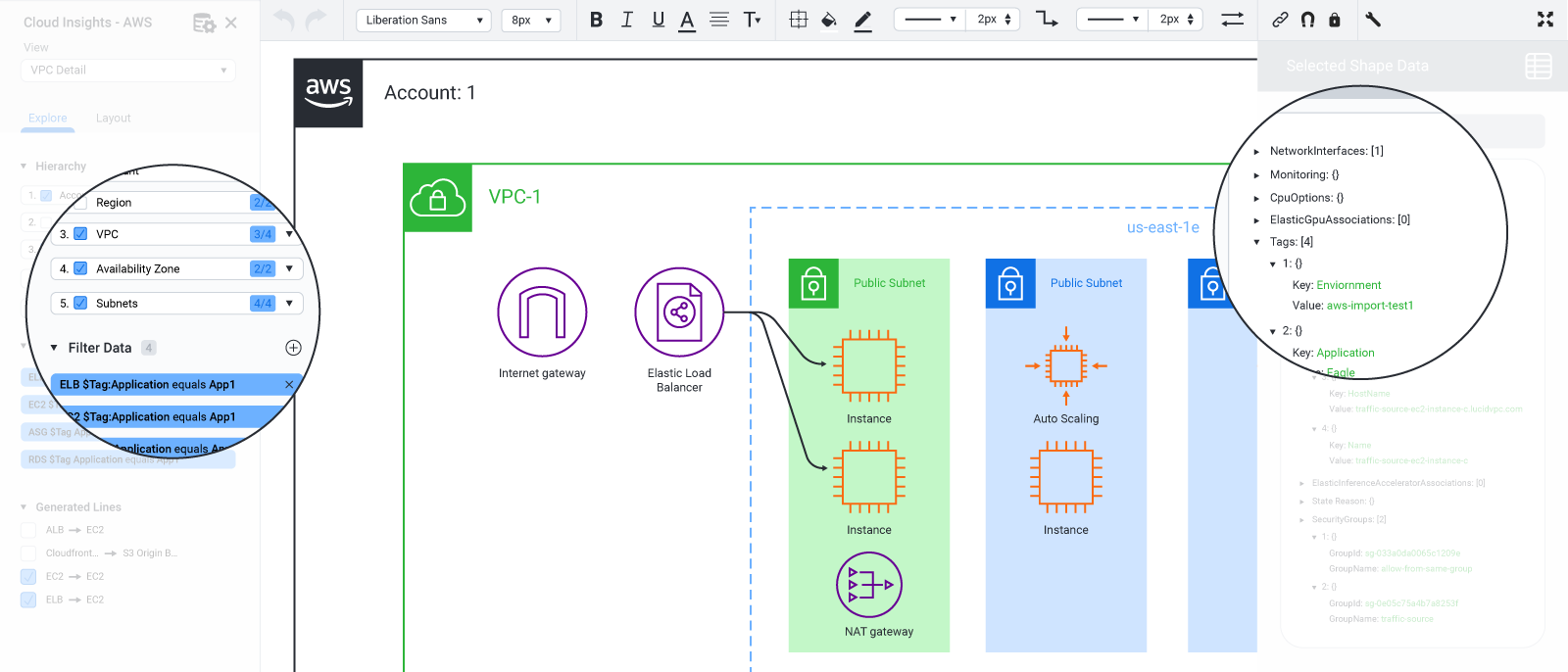
    Lucidchart today added a visualization tool that generates interactive diagrams of an IT organization’s Amazon Web Services (AWS) environment.

    Dan Lawyer, senior vice president of product at Lucidchart, said Lucidchart Cloud Insights makes it possible to automatically visualize all the services an organization is consuming from the cloud service provider, with support for other cloud platforms planned.

    One of the biggest challenges organizations regularly encounter today is the only way they have of understanding what services are being consumed is to analyze the monthly bill made available by a cloud service provider, he said.

    Lucidchart Cloud Insights is designed to make it easy to determine what services are being consumed in real-time, Lawyer said, noting IT teams can also visualize cloud governance data along and apply filters and save views.

    Armed with that information, IT organizations can then better control spending across cloud services that, in terms of costs, are often widely divergent. Developers, for example, don’t always pay close attention to which tiers of service provide the optimal level of cost of a certain class of workloads. A high-fidelity approach to visualizing how services are consumed provides an effective means to have that conversation, noted Lawyer.

    Once an issue arises it can be resolved faster because everyone involved is capable of visually inspecting the same set of interactions occurring at the same time, he added.

    Lucidchart already provides visual workspaces in the cloud that combine diagramming, data visualization and collaboration tools to make it easier for teams to collaborate. Lucidchart Cloud Insight now extends that capability into IT operations, Lawyer said, noting IT teams traditionally have relied on tools such as Microsoft Powerpoint to try and visualize consumption patterns.

    The launch of Lucidchart Cloud Insight comes at a time when more workloads are moving on to public clouds in the wake of the COVID-19 pandemic. Given the uncertainties surrounding when IT staff might be able to access an on-premises IT environment, many organizations are accelerating the rate at which application workloads are being deployed in the cloud.

    The challenge IT organizations face is that moving applications into the cloud doesn’t always yield consistent cost savings. IT teams constantly need to monitor how IT infrastructure resources are being consumed to keep IT budgets under control. The issue is that developers frequently spin up cloud services without telling anyone in IT about it until a bill shows up. Worse yet, many developers often forget to de-provision virtual machines and other cloud resources they’re no longer using.

    Of course, as more cloud platforms are invoked, the management issue only becomes that much more complex. Going forward IT teams will want to visually compare and contrast how services are being consumed across multiple clouds. Whatever the motivation, it’s a lot easier to overlook the implications of a cloud service that is presented as part of a static bill than it is one that visually presents itself as part of an interactive diagram that is always up to date.

  • Fortanix Adds Platform to Manage Confidential Computing on Azure

    Fortanix Adds Platform to Manage Confidential Computing on Azure

    Fortanix today announced that a software-as-a-service (SaaS) platform for managing instances of confidential computing on the Microsoft Azure cloud is now generally available.

    Confidential computing is an emerging approach to encrypting data while it is running in memory. Today encryption is only applied to data at rest. Confidential computing makes it possible to set up secure enclaves for processing encrypted data in memory, which has become an increased source of concern for vulnerabilities in IT environments.

    Faiyaz Shahpurwala, chief product and strategy officer for Fortanix, said Confidential Computing Enclave Manager provides IT teams with a SaaS platform that enables them to provision a confidential computing environment, verify the integrity of those environments and manage the application life cycle for secure enclaves. Applications running on secure enclaves are built using Docker containers and images.

    Fortanix, along with Alibaba, Arm, Baidu, Google Cloud, Huawei, Intel, Microsoft, Red Hat, Swisscom and VMware, is a member of the Confidential Computing Consortium, an arm of The Linux Foundation. Confidential Computing Consortium projects include a Software Guard Extensions (SGX) software development kit (SDK) from Intel, an open source Open Enclave framework that allows developers to build Trusted Execution Environment (TEE) applications using a single enclaving abstraction, and Enarx, a project providing hardware independence for securing applications using TEEs.

    Microsoft earlier this month made available a DCsv2-series of virtual machines (VMs) that provide access to a TEE based on Intel SGX. Fortanix, for its part, already makes available a Fortanix Self-Defending Key Management Service on Azure.

    Shahpurwala said over time most applications will take advantage of trusted computing environments. Most of the initial use cases will focus on applications in which data privacy and securing personally identifiable information (PII) is critically important, he said.

    In the meantime, cloud service providers are racing to make available platforms for building and deploying TEE applications. Less clear is to what degree those environments will be integrated with DevOps platforms. The Confidential Computing Enclave Manager provides a management framework from which to begin that process. The Confidential Computing Enclave Manager also provides tools to convert applications to enable them to run on Intel SGX.

    There may come a day when confidential computing makes security a core element of any DevOps process. As such, the idea that there needs to be a distinct approach to DevSecOps may in time fade away as security becomes a series of infrastructure capabilities that are invoked programmatically. As that approach matures, application security would simultaneously evolve to become a natural extension of any quality assurance process.

    Of course, it may be a while before confidential computing is employed pervasively. Not every IT team has made the switch to containers to build applications. However, given all the focus these days on data privacy regulations it’s clear the requirements for protecting data within an IT environment are becoming more stringent with each passing day. The challenge now is finding a way to address those concerns during the entire application lifecycle management process in a way that doesn’t slow down the rate at which applications are being built and deployed.