Category: IT as Code

  • Puppet Brings Orchestration to IT Automation

    Puppet Brings Orchestration to IT Automation

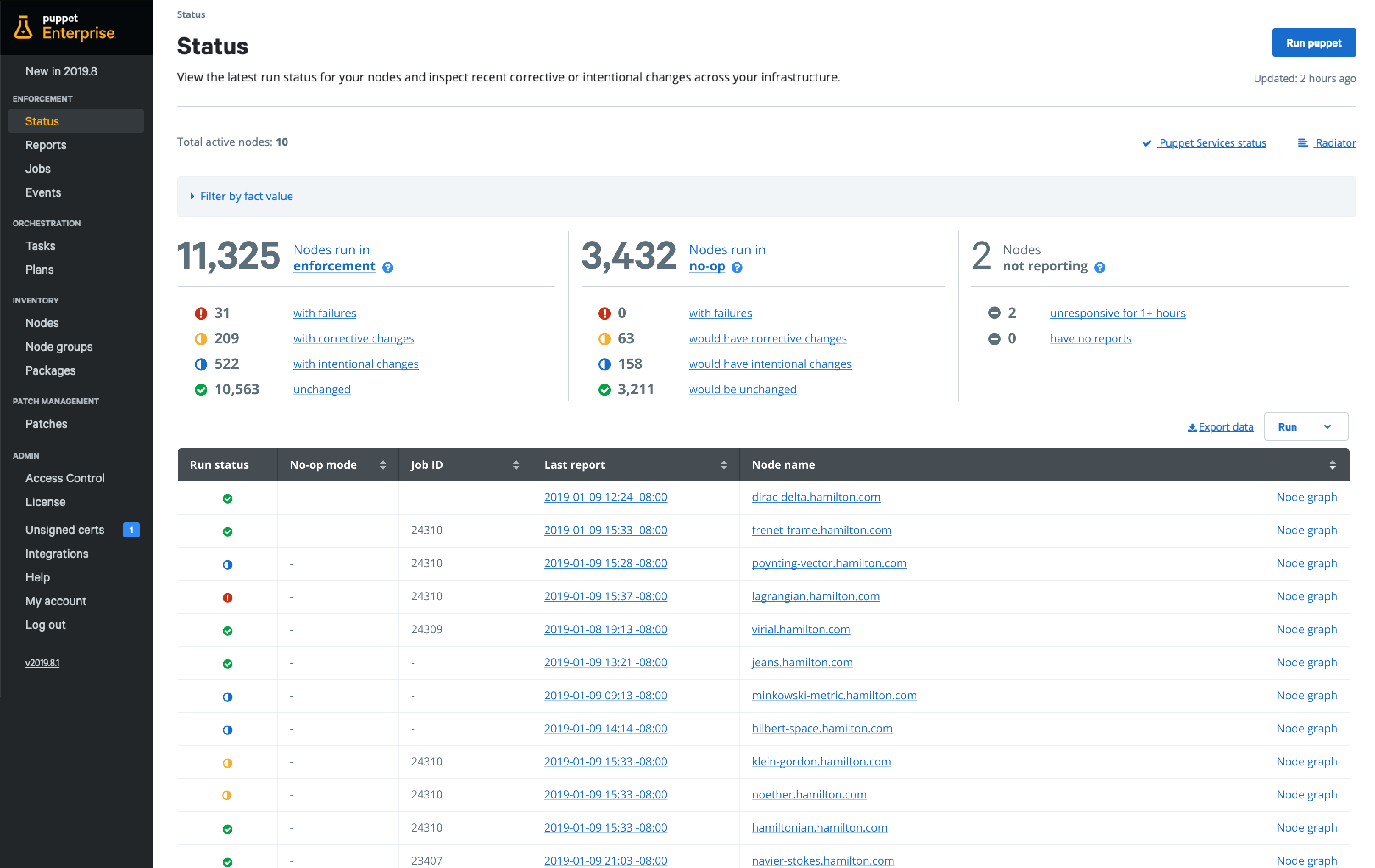
    Puppet today unveiled its summer release of Puppet Enterprise that promises to make it easier for DevOps teams to construct automated workflows within a Puppet console.

    DevOps teams can now mix and match thousands of declarative state-based modules available on Puppet Forge repository to compose and orchestrate workflows.

    At the same time, Puppet has added out-of-the-box guided patch management workflows that replace standalone patch management tools with orchestrated workflows. That capability is based on a Relay tool that Puppet launched earlier this year.

    Finally, Puppet is now also including an upgrade pre-check module that assesses and identifies potential risks along with surfacing what changes should be made before running an upgrade.

    Puppet CTO Deepak Giridharagopal said in the wake of the economic downturn brought on by the COVID-19 pandemic, more IT teams will need to rely heavily on automation. Most IT teams either will remain the same size or be downsized. The IT environment, however, will continue to grow more complex. The only way to enable IT teams to do more with less is to automate more rote tasks, he said.

    Automation is not likely to replace the need for IT administrators, added Giridharagopal. Rather, investments in automation will augment those teams in a way that enables IT teams to scale.

    In fact, Giridharagopal said, resistance to IT automation is declining as IT teams continue to appreciate the scope of the challenge they now face as IT environments not only continue to expand but also become more heterogeneous. Most business leaders now expect smaller IT teams to be able to automate a wide range of tasks as part of their overall strategy, he noted.

    Longer-term, Giridharagopal said IT organizations will also discover that many rote tasks will be performed more consistently once automated. Patches, for example, are not always applied as quickly or as often as they should be simply because there isn’t enough time for the IT team to manually install them.

    The latest update to Puppet Enterprise comes on the heels of a $40 million investment made in Puppet led by BlackRock, a private equity firm. As more IT teams recognize the need to automate tasks, competition to automate those tasks has intensified among providers of frameworks.

    It’s not clear how deeply and how many IT tasks can be automated. The more standardized an IT environment is, the easier it becomes to automate. Additionally, the amount of time an IT organization devotes to writing scripts to automate tasks should be reduced sharply. Instead, IT teams will increasingly employ a mix of modules that already exist to address a broad range of use cases. The challenge going forward isn’t so much finding the right IT automation tool, but rather constructing an IT environment that lends itself to being automated.

  • Jump Over the Hidden Barriers to Digital Transformation

    Jump Over the Hidden Barriers to Digital Transformation

    Digital transformation is critical to success in the new normal. Here’s how to achieve it in an uncertain economy

    Bit by bit, we’re reopening the economy. No one knows how long it’ll take to get the economy back on track or what kind of regulations there will be to keep everyone safe. But we do know it’ll take a great deal of tech to get the machinery running again.

    Consumer expectations have changed. Many in-demand employees have learned how much they prefer the flexibility of working from home—so much so that startups and even large corporations are launching “work from home forever” plans (and we can expect companies in other sectors of the economy to follow), and they need to adjust their tech to make this possible.

    Digital transformation—the term we seem to be stuck with—will be the answer; companies that put it off now have to play catch-up.

    Everyone’s trying to regain lost customers. They also don’t want to lose their top employees, who now expect to have a remote workplace (or at least the option of one).

    We’re in a reluctant revolution, and many companies are short on cash because incoming revenue isn’t quite what it was before. There’s never been such a big need for digital transformation while keeping a close eye on the budget line.

    Speak the Language of Business

    Before COVID-19, a McKinsey survey concluded transformation is more challenging to pull off than traditional change efforts: Fewer than one-third of organizational transformations succeed at improving a company’s performance and sustaining those gains.

    A key reason for the failures: a lack of clear, measurable business goals. Right now, no matter the business, eyes everywhere are on IT. To push through the transformation, you need to benefit not just yourself but your organization. You need to be able to speak the language of business, and here’s how you can do it.

    Make It C-Suite Friendly

    If you’re going to ask the company to support your program, talk about it in a way the C-suite can understand. Think about the use case they’ll be most interested to hear about. Shortening customer wait times? They’ll care. Aiding supply chains? They’ll listen.

    Remember, they’ll want numbers, too. The C-suite will do a cost-benefit analysis, but you should preempt this by conducting one beforehand. This shows your commitment to making the company more successful and inspires trust in the project through data. Avoid using too much technical jargon; doing so will get glassy-eyed looks and perhaps inspire them to give some other department a budget increase or greenlight a different project.

    Develop Your Soft Skills

    Never make the C-suite do your work for you: Make them understand the value of your plans. Doing so may develop your soft skills.

    At SolarWinds, we goad each other with the line, “Explain it to me like I’m 5.” If we can’t do it, then we know we don’t understand the concept well enough to “sell” someone else on it.

    Explain your program to someone using simple language and measurable goals, but explain it so clearly a 5-year-old can understand it.

    And remember, if you’re working remotely, you’ve lost the possibility of a hallway conversation. You can’t meet somebody in an elevator and throw them a pitch. You may only get a moment on a Zoom call. So work on your game. Practice your pitch on someone not involved—even a loved one at home—who can give feedback on the level of comprehension for the end goal.

    It’s not always as simple as you think, and sometimes you’ll need to go above and beyond. This may mean taking a course, reading a book, or watching a YouTube video to improve communication. But do it anyway. You’re learning a new language, so use every tool at your disposal to relay your transformation pitch.

    Develop the Process Documents

    Once you have approval for your initiative, nurture it. Make sure it succeeds.

    If the program has been customized, explain why and give out customized documentation. Your goal is to turn end users and the staff into evangelists.

    In departments I’ve worked in over the years, I’ve often noticed a failure in this area. No one properly explained the goal. They maybe have buttoned down the tech, but the humans didn’t understand why they were using it instead of something else. They couldn’t explain it to someone new because no one produced the process documents.

    And when they can’t explain it, here’s what always happens: One person makes an effort and becomes the department expert. False information develops. No one wants the program to succeed because they hate it. You end up with a boondoggle.

    Clean Out Your Closets

    While working from home, you probably focused on your closets and were amazed at the stuff jammed in there.

    Do the same at work. What’s the business value for those apps you have? Do you have multiple systems in different departments?

    Use monitoring to assess usage. You may save money when you realize there are plenty of apps on hand you’re not using to their full capability.

    You could also discover you already have the functionality you need—you just didn’t know it because only one department used the app.

    I’ve worked with a lot of companies where one person was using an app nobody else knew about. Someone had to approve the budget line, but it was a blip on the radar. When you have ten blips on the radar, it can add up. Do you need all those blips?

    I can’t count the number of times I’ve seen people with oddball applications somebody built at some point. Clean out the closets. Taking inventory will help you find ways to work toward business efforts at little to no additional cost. Saving the business money while achieving progress toward digital transformation during this time is a big deal.

    Monitor Your Whole Stack

    If you can monitor from the database to the network connection and then from the application to the front end, you get the entire story without the guesswork. This is why I like to monitor the whole stack.

    You can correlate this data and see what went wrong. You get the information capable of helping you fix the problem and prevent it from happening again.

    But monitoring is different than alerting. I’ve come across this countless times: People set up too many alerts, which they later ignore because of fatigue. No one wants to discover their website has been down for a half-hour and no one knew about it because the emails were ignored.

    Instead, start by setting up monitoring on anything potentially important. Then get alerts on actionable things: You need to know about them because you can do something about these issues when you receive an alert. If you’re not going to work on issues until the next day, maybe you don’t need an alert at 2 a.m. Better still, automate actions where you can with alerting.

    Conclusion

    It’s a confusing time. No one knows how this story will end, so let’s button up the details. Learn how to speak the language of the business sending you a paycheck.

    Help those paychecks keep coming by thinking in terms of what will help the company transform and succeed. Then communicate those thoughts in the language of business.

    Monitor your stack and clean up: If you can clean out the mess, you’ll save money, and maybe you’ll be ready for what’s to come.

  • Barracuda Networks Partners With Microsoft on SD-WAN Service

    Barracuda Networks Partners With Microsoft on SD-WAN Service

    Barracuda Networks today launched a software-defined wide area network (SD-WAN) service that runs natively on the Microsoft Azure cloud.

    Klaus Gheri, vice president of network security for Barracuda Networks, said Microsoft has made it possible to launch an SD-WAN service using Azure Virtual WAN Hubs, a networking service based on a hub-and-spoke architecture that unifies networking services such as security and routing under a common interface. Those services span branch connectivity, multiple types of virtual private networks, cloud interconnects, firewalls and encryption services.

    Gheri said rather than having to replicate all those networking services, Barracuda Networks is layering a Barracuda CloudGen WAN service on top of the Azure Virtual WAN Hubs to provide a service that, like any other cloud service, can be consumed per billable hour.

    Developed in collaboration with Microsoft, the Barracuda CloudGen WAN service provides the management framework needed to convert Azure Virtual WAN Hubs into an SD-WAN service that IT teams can employ to securely connect remote offices to cloud applications or on-premises IT environments, he said.

    SD-WAN services today come in four basic forms. IT teams can deploy and manage their own SD-WAN appliances. Alternatively, telecommunications carriers make SD-WAN services available on their networks or a managed service provider (MSP) can create its own SD-WAN service by deploying the appliance on points of presence (PoP) on a global network it manages. More recently, cloud service providers have been making SD-WAN services available via the networks they built to connect all their data centers.

    Gheri said Microsoft is now taking that SD-WAN capability a step further by adding a management portal created by Barracuda Networks.

    A recent survey of 750 business and IT professionals conducted by Vanson Bourne on behalf of Barracuda Networks finds more than half (52%) are looking to employ SD-WAN services delivered via the cloud. In comparison, the survey finds 16% prefer to get SD-WAN from an independent vendor, 15% would opt for a telecommunications partner and 12% would rely on a value-added reseller.

    With more application workloads moving into the cloud, the way networks are deployed and managed is evolving rapidly. Instead of connecting branch offices to local data centers to access cloud applications, more organizations are employing SD-WANs to provide direct access to cloud applications without having to backhaul network traffic through a local data center. That approach significantly improves overall application latency and, in many cases, reduces the need to rely on leased MPLS lines from a telecommunications carrier.

    Rather than build those SD-WANs themselves, many IT organizations want to be able to access and manage them via a portal through which they can allocate bandwidth to applications as they best see fit. It’s not clear to what degree IT organizations will continue to prefer to deploy appliances versus consuming SD-WAN as a service. However, given the complexity of managing SD-WANs, there’s a high probability that SD-WAN services delivered via existing cloud networking infrastructure will soon become a widely employed alternative.

  • Collibra Employs Microservices for Data Management

    Collibra Employs Microservices for Data Management

    Collibra has launched a Collibra Data Intelligence Cloud based on a microservices architecture that promises to alter the way data is managed in enterprise IT environments.

    Jim Cushman, chief product officer for Collibra, said its approach sets the stage for leveraging microservices to create data workflows made up of reusable components. In fact, there may come a day soon when some data sets are accessed and managed as a reusable microservice, he said.

    The Collibra Data Intelligence Cloud provides a catalog for managing metadata that, in addition to making it possible to build workflows, ensures the integrity and security of data being accessed and stored. End users can then analyze that data using a wide variety of third-party tools, said Cushman.

    At the same time, Collibra enables metadata ingestion from data sources such as data lakes and data warehouses, which means IT teams don’t have to move all the data they need to manage into Collibra Data Intelligence Cloud to create a workflow.

    Collibra is also making available a beta version of its Data Matching tool for qualified customers. That tool identifies duplication within a data source and how that data might overlap with other data sources.

    Finally, Collibra has added a data scoring component to its catalog to identify the most relevant data sets; provide enhanced support for third-party business intelligence (BI) and extract, transform and load (ETL) tools; and strengthened rights management capabilities to make it easier to enforce compliance requirements.

    Cushman said the goal is to provide organizations with an easier approach to storing and organizing trusted data. As the amount of data an organization collects grows, so, too, does the opportunity for conflicting data to be incorporated in applications. The Collibra Data Intelligence Cloud creates an opportunity to make data universally available to applications without requiring them to copy it, he said, noting that approach reduces not only the amount of data that might be in conflict as data sources are updated but also the amount of infrastructure that would have been required to process and store duplicate data.

    Organizations have been struggling with data management since the dawn of IT. That’s become a more pressing issue as more organizations seek to turn data into a strategic asset that drives digital business transformation initiatives. However, those initiatives are often derailed because so much of the data is either conflicting or simply too stale to be relevant. Collibra is making the case for a single platform to bring order to what historically has been a chaotic process.

    It’s not clear to what degree organizations will be focusing more on data quality and management in the months ahead. In the wake of the economic downturn brought on by the COVID-19 pandemic, it’s clear digital business transformation has become a necessity. The challenge is that unifying how data is managed in any enterprise requires a massive amount of political capital. Each business unit within an enterprise IT environment tends to guard its data privileges jealously.

    However, as microservices make it possible to make the business a lot more agile, the day when organizations finally confront their longstanding data management issues may finally be at hand.

  • Google Taps AMD for Confidential Computing Service

    Google Taps AMD for Confidential Computing Service

    Google Cloud, at a Google Cloud Next 2020 Online event, announced it is making available in beta Confidential VMs, a new service that represents the cloud service provider’s first foray into the realm of confidential computing.

    Based on second-generation EPYC processors from AMD that provide access to an embedded Secure Encrypted Virtualization (SEV) capability, Confidential VMs encrypt data while it is being processed.

    At the same time. Google unfurled Assured Workloads for Government, a service also in beta through which the company will ensure workloads are run in a specific location to meet government requirements.

    Sunil Potti, general manager and vice president of cloud security for Google Cloud, said Confidential VMs will complement existing secure cloud computing services that already isolate workloads and encrypt data at rest. Google has also invested in creating a zero-trust security model dubbed BeyondCorp that ensures access controls are strictly enforced, he noted.

    Google Cloud is following Microsoft Azure into the realm of confidential computing, which is being enabled by new classes of processors from AMD and Intel. Both Microsoft and Google Cloud are founding members of the Confidential Computing Consortium, an arm of The Linux Foundation which also includes Alibaba, ARM, Baidu, IBM, Intel, Red Hat, Swisscom and Tencent.

    Amazon Web Services (AWS) has yet to join the consortium or outline its approach to confidential computing. It already offers Nitro Enclaves through which it isolates compute environments to securely process sensitive data within their Amazon EC2 instances. Nitro Enclaves is based on the Nitro Hypervisor technology that AWS developed to provide CPU and memory isolation for EC2 instances. AWS for several years now has been making a case for “encrypt everything,” which has yet to become the default setting in most IT environments.

    It’s not clear to what degree IT organizations will embrace confidential computing services. There’s a clear need to secure data. However, many organizations may decide that paying extra to encrypt data while it’s processing may be one extra layer of security too many. There will always be financial services firms and government agencies that will prefer to encrypt data on an end-to-end basis. However, many organizations will be weighing the security benefit of those services against the cost and potential impact processing encrypted data in memory might have on applications.

    It’s also now only a matter of time before servers configured with processors that support the processing of data become available in on-premises IT environments. Many IT teams may decide that because of compliance requirements sensitive data still needs to processed within an on-premises data center.

    Of course, cloud security concerns go well beyond merely how data is encrypted. Most often, the biggest issues when it comes to cloud security is misconfigurations. Encrypting data might render any data inadvertently exposed useless. However, IT teams are just now coming to terms with best DevSecOps processes. Confidential computing services may have a role to play in enabling IT teams to achieve that goal, but it may be a while before the processors on which confidential computing depends are employed widely across an extended enterprise.

  • HPE Acquires Silver Peak to Gain SD-WAN

    HPE Acquires Silver Peak to Gain SD-WAN

    Hewlett Packard Enterprise (HPE) announced its intent to acquire Silver Peak, a software-defined wide area network (SD-WAN) platform provider, which will be incorporated into its Aruba Networks subsidiary.

    Keerti Melkote, president of Intelligent Edge for HPE, told industry analysts the $925 million acquisition will eventually lead to edge computing devices all being managed via the same cloud framework regardless of physical location.

    Aruba Networks has been making a case for unifying the management of wired and wireless networking in branch offices via a cloud management platform. The acquisition of Silver Peak will extend the reach of that framework to SD-WANs, which are becoming more widely employed to connect both remote offices and end users working at home to applications running both in the cloud and in the local data center.

    In the wake of the COVID-19 pandemic, the number of employees working from home and needing direct access to applications has exploded. Rather than employing virtual private networks (VPNs) to connect all those home offices to a local branch office, it’s more efficient and secure to connect those working at home to applications residing in both the cloud and on-premises IT environments via SD-WANs.

    HPE claims the total addressable market for networking services aimed at various edge computing use cases is north of $32 billion, which includes both SD-WANs and wireless and wired networks deployed in the branch office.

    Silver Peak currently has more than 1,500 customers and in its last fiscal year generated $132 million in revenue. The challenge HPE and its Aruba Networks subsidiary will face is most SD-WANs that have been deployed thus far use appliances that were acquired by internal IT teams. Increasingly, however, SD-WANs are being consumed as a managed service. Aruba provides customers access to a cloud console to manage networks deployed in remote offices. It’s not clear how many internal IT organizations moving forward will want to manage remote networks versus relying on a managed service provider (MSP).

    Of course, HPE and Aruba can opt to provide a managed service. However, they will need to build out the points of presence (PoPs) to deliver a managed SD-WAN service—something many MSPs, especially telecommunications providers, and cloud service providers have already done.

    Longer-term, it’s also not clear to what degree wireless 5G services will eliminate the need for not just wired networks, but also wireless local area networks (LANs) in branch offices. Some IT organizations may conclude the cost of a 5G cellular service is less than the total cost of managing a LAN.

    There is, of course, no absolute when it comes to networking. However, if more employees are working from home for the foreseeable future, the dynamics of networking at the edge will never be the same. Developers especially will need to take into account a whole different level of network latency dynamics when deploying applications. The irony is that as applications become more distributed, the management of the networks on which they depend is becoming more centralized.

  • AIOps Greasing the Wheel of Digital Security amid COVID-19

    AIOps Greasing the Wheel of Digital Security amid COVID-19

    Amid the most challenging era for business infrastructures and transformations, AIOps (AI for IT Operations) can help industries operating in the digital environment to be vigilant when it comes to network operations or the digital security measures.

    AIOps has the potential to significantly align well with the cybersecurity needs of a company. A cybersecurity department in every organization needs to be active with respect to the latest and innovative security-related solutions. Threat detection and data security are crucial for every business entity.

    The corporate networking infrastructure for communication purposes is always under the threat of unauthorized third-parties that try to access confidential communications. Whether they are wireless, wired or connected to internet of things (IoT) devices. AIOps, through its intelligent algorithms, detects the communication requests and their source to accept them and restrict the fraudulent entities from becoming part of the legitimate network. Visibility and speed are two important aspects of platform security. If the source of the incoming request is known, it would be easy to verify it.

    The following are some of AIOps applications:

    Regulatory Framework

    General Data Protection Regulation (GDPR) corresponds to the protection of online customer data online. Businesses are required to ensure enough security measures to protect the personal and financial information of customers stored in an online account from identity theft and data breaches. AIOps can be used to secure the data from unauthorized third-party access in order to comply with the regulatory requirements.

    Real-time Data Processing

    In this era, communications, connection, data transmission and storage activities are performed online. Real-time data collection and processing in AIOps help streamline the operations and ensure the security of platforms in a centralized database. Technologies are shaping future investments. Enterprise management with respect to the performance attributes such as data analysis and monitoring for controlled access are in high demand. Advanced automation techniques have become possible with the innovative AIOps that help undergo operations in efficiently, eliminating the time-consuming and frustrating manual tasks. Machine learning and artificial intelligence algorithms collectively help reduce the overall response time, provide optimal user experience and protect network systems.

    Applications of AIOps amid the COVID-19 outbreak pave the roads for leading challenges. The rapid digital transformations during the pandemic are giving birth to various challenges with respect to security, user experience and the downfall of industries. Businesses are revamping operational infrastructure and fraudsters are actively exploiting vulnerabilities in the digital environment. The density with which the fraud is increasing each passing day is high. AIOps, under these circumstances, help businesses take into consideration vigilant security measures. The innovative solutions employ AI algorithms for the security of online platforms.

    Information Security and AIOps

    Information security highlights three major factors: confidentiality, integrity and availability. Confidentiality takes into account the need for protecting confidential customer information. Integrity keeps the form of data intact and availability ensures that the data is present at the moment when it is required. AIOps help ensure this CIA triad of information security through its high potential applications online security.

    High-scale data breaches, identity theft, account takeover frauds, malicious executables injection and similar cyberattacks are due to the uncontrolled access over user accounts and data. The list of fraud calls for stringent actions that AIOps provides in the form of digital security. The AI-powered identity verification systems help verifies the identity of customers online before onboarding them. Biometric sign-in every time while accessing the accounts help mitigate the risk fo fraud and bad actors that become the reason for malevolent activities. The spoofing detection and prevention techniques use AIOps that identify the spoofing elements in user-uploaded identity proofs and discard their communication request, which in return curb the likelihood of cyberattacks.

  • Bringing NetOps Up to Speed With DevOps

    Bringing NetOps Up to Speed With DevOps

    Automation can be an unwieldy topic for network operations and DevOps teams who have enough challenges working together cohesively. Networks have been traditionally viewed as the long pole in the tent for emerging DevOps practices.

    But for DevOps practitioners and business leaders alike, there’s good news: NetOps are more prepared than ever to embrace automation and programmability—increasing the likelihood of on-time service delivery, with far less friction between IT teams.

    According to Enterprise Management Associates (EMA), a strong majority (77%) of organizations deem network automation a high priority, and 58% have already implemented or are planning to implement, approved solutions. This is an important and promising shift.

    Traditionally, network leaders have favored an operating model that emphasizes stability and resiliency over agility. Understandably so, as any network interruption can have a cascading impact on the business’ operations and profitability.

    While ensuring five 9s of availability remains a top priority for NetOps, the growing need to support DevOps, containerized infrastructure for applications and cutting-edge digital services—among other initiatives—continues to highlight some of the glaring inefficiencies of traditional network management tools that are too error-prone and bound by scalability issues.

    With the right automation framework, NetOps can play an equal part in enabling DevOps practices by becoming more adaptable to evolving business and application requirements in the cloud and locally.

    Centralizing Management With Cloud-Based Service Delivery

    For decades, improving agility has been a dyed-in-the-wool practice for network teams. Organizations worldwide have now realized enormous benefits by implementing new software-defined management tactics that allow the network to become more centralized, programmatic and dynamic in nature. By disaggregating software from hardware, networking teams now can manage many more services and devices with less effort and resources.

    Among NetOps’ new arsenal of tools and best practices, centralized management has become one of the key ingredients driving toward greater efficiencies. Utilizing a cloud-based approach for provisioning, deploying and managing network services closely mirrors the way IT has spun up cloud storage and compute over the last decade. Now, DevOps teams no longer have to wait days or weeks for the NetOps team to provision the right networking resources so that they can begin designing, testing and deploying new applications.

    Along with the added efficiencies, NetOps teams have greater and more uniform control over device configurations and policies, where security vulnerabilities lie in wait if these do not establish a zero-trust environment. Orchestrating these elements centrally, rather than device by device, places far less burden on individual network operators for protecting high-value corporate assets. Rock-solid network access control also reduces the risk of security or performance degradation that commonly arise from using an ad hoc patchwork of scripts, templates and CLI commands.

    Advancing Network Automation Frameworks

    Because creating a cloud-native network infrastructure does not all happen with the press of a button, network operations won’t become fully automated overnight. Other factors come into play that inhibit broader adoption of automation frameworks, including budget constraints, difficult technology implementations that lack integration with legacy systems and skill gaps for existing staff.

    It’s essential that NetOps teams embrace a network automation framework that aligns to current and future operating models. Through proactive collaboration, NetOps folks can extend the value of automation platforms already used by their DevOps or application counterparts.

    Fortunately for NetOps teams, myriad networking vendors today readily offer pre-built, certified solutions for DevOps platforms, making it easier to get started on a cloud-native journey by automating activities such as device onboarding and configuration changes. This way, network administrators can leverage existing vendor partnerships, in-house knowledge and technology that is already proven within the larger IT environment.

    Additionally, network engineers shouldn’t need—and won’t have the extra time—to become top-notch developers to take advantage of programmability during their cloud-native journey. Developing basic programming skills is advantageous, but network management systems that offer Python scripting, a consistent set of APIs and webhooks can perform the “heavy lifting” when it comes to enabling extensibility with third-party IT platforms.

    Today, this level of extensibility includes being able to integrate with third-party IT service management tools. A common use case that can realize significant time savings and greater network and application availability is to auto-trigger and assign an incident ticket when a performance SLA is breached. It’s very easy to collect and use machine learning-based tools to correlate all of the relevant diagnostics data in order for a network operator to immediately begin a root cause analysis and quickly resolve the issue.

    On the Horizon: AI-Driven Operations

    Another core aspect of DevOps is continuous improvement—both in terms of elevating service levels, as well as enhancing user experiences. But faster rates of change resulting from continuous improvement processes can negatively impact application performance, and the network is often the first to be blamed.

    But there is a huge silver lining within this cloud created by faster rates of change, which also highlights another growth area for NetOps teams to learn and master. That is, the use of AIOps.

    Today’s networks are bound by human scale. When things break, it takes a human to realize it broke, research the issue and then apply the fix. While traditional management and monitoring tools can alleviate some of the burden, alert fatigue often becomes a huge problem—in other words, too many false alarms, false positives or, worse yet, drawing attention away from more critical issues.

    AIOps tools and technologies mitigate these issues and limitations by combining artificial intelligence, machine learning, and advanced network analytics to automate many aspects of traditional monitoring and troubleshooting. Once deployed, IT organizations have the ability to predict and preempt failures,\ or quickly recover from issues when they do occur. This includes being able to:

    • Leverage ML-trained data sets to continuously monitor network performance and detect anomalies.
    • Eliminate guesswork by prioritizing fixes or improvement efforts and validating that those efforts have the desired business impact.
    • Continuously optimize network performance based on benchmarks.

    Put another way, AIOps systems are worth their weight in gold by helping networks move toward a self-healing, self-securing and self-optimizing model. Even in the interim, during the early phases of deployment, such AI-assisted operations can help IT identify and resolve network- or user-impacting issues faster and easier. The results are that dramatic.

    Next Steps: Bring a DevOps Mentality to NetOps

    Contrary to popular belief, the goals of NetOps are not diametrically opposed to DevOps. Both groups want to deliver more value and help the business innovate.

    Equipping NetOps teams to build on existing DevOps-based automation frameworks, paired with AI-driven insights and modern management tools, will go a long way in ensuring frictionless delivery of new services.

    Now is the time for network operations teams to get to know your DevOps team, learn how they operate and come together to create new methods for advancing the organization’s IT mission. The investment in time and effort should be a creative win-win for both groups and produce a big payoff in IT’s strategic position and importance to the organization.

  • How IaC Bridges the Divide Between DevOps, Security

    How IaC Bridges the Divide Between DevOps, Security

    IaC provides a connection between security and DevOps teams in a subtle, non-intrusive manner

    Companies often choose DevOps as means to provide value and responsiveness through rapid, high-quality service delivery. Instead of traditional siloed development and operations teams, DevOps embraces multidisciplinary teams that share efficient practices and tools. Essential DevOps practices include agile planning, continuous integration, continuous delivery and application monitoring. But how does security fit within this framework?

    Traditional models of product development have explicitly defined processes and people dedicated to security assessments, analysis, testing and maintenance. While this doesn’t offer the efficiency and agility of DevOps, many organizations find comfort in having a set place and time for security.

    In DevOps, with the absence of strictly defined and linear processes, there is perhaps a less explicit definition of where and how security fits in. But sometimes there is power in the less obvious aspects of life. In fact, just because there aren’t dedicated, standalone security processes as there are in traditional product/project management models doesn’t mean that security isn’t there.

    Some could argue that the less apparent security is, the higher its efficacy. This is particularly true in the DevOps world, where security teams are sometimes perceived as impeding the speed and agility of DevOps teams. This perception is unjust because, quite often, it is not the security team that is necessarily impeding the progress of the DevOps team. The root of the problem is a fundamental disconnect between the security and DevOps teams.

    So, how can teams overcome this divide? By evolving their DevOps team into a DevSecOps team. Every company’s goal should be to make security part of the development workflow. Again, DevSecOps is the natural evolution of DevOps. The process can either take the benefits that DevOps gives to the development and operations branches of your IT department and extend them to the security team, or it can integrate the security processes into the DevOps team. With the latter approach, the bridge is then built by shifting cloud security left using infrastructure as code (IaC) plans and templates. Security teams can build these plans and templates for developers as a way of guiding them toward security and compliance and preventing policy violations and cloud misconfigurations from the very beginning. Shifting much of the security team’s work earlier in the development life cycle, long before runtime, is a smart and efficient approach.

    Through the use of IaC templates and plans, DevSecOps teams are engaged in security from the very start. And, for the most part, the layer of security in the form of an IaC template or plan is silent. It is a noninvasive way for security to participate in DevOps, without the friction that sometimes arises in the midst of chaotic runtime security fixes. Though its presence may be subtle, the benefits of hard-coding cloud security through IaC are pronounced.

    Most conspicuously, it prevents the need for security to intervene in recurring problems. The same security issues, policy violations and misconfigurations that took time and resources to resolve can be addressed at a global level through IaC plans and templates. Secondly, the efficiency of the security team grows exponentially. Time previously spent tracking down the right developers to fix ephemeral security issues and misconfigurations is redirected and refocused. Security teams are able to spend their time more wisely, creating thoughtful, holistic approaches delivered through IaC plans and templates. Another benefit of creating DevSecOps teams and using IaC is that it can empower individual teams to use the tools of their choice.

    While some companies mandate the use of specific cloud service providers or third-party tools, others do not. When used correctly, security achieved through the use of IaC templates provide the flexibility of incorporating variables from any cloud environment. DevSecOps teams that have the opportunity to use the cloud service providers and tools of their choice will work more efficiently and effectively. The final and most significant benefit is the connection that IaC provides between security and DevOps teams. Not only does it broaden participation in security, it does so in a gentle, non-invasive manner.

  • Oracle Extends Managed Cloud to On-Premises

    Oracle Extends Managed Cloud to On-Premises

    Oracle today announced it will make available as a managed service in on-premises IT environments all of the software it currently provides access to on Oracle Cloud.

    In addition, Oracle is making available Oracle Autonomous Database on Exadata Cloud@Customer, which brings a managed database service to the Exadata servers optimized to run Oracle databases. Oracle also announced it has certified Siebel, PeopleSoft and JD Edwards applications for Oracle Autonomous Database along with the availability of Oracle Autonomous Data Guard, a managed high-availability and disaster recovery service that ensures near-zero data loss (RPO) and instant recovery times.

    Vinay Kumar, senior vice president for cloud engineering in North America at Oracle, said while cloud service provider rivals have made some services available in on-premises IT environments, Oracle will be the first to deploy a full range of software-as-a-service (SaaS) applications via an Oracle Dedicated Region Cloud@Customer service.

    Priced starting at $500,000 per month, Kumar said the Oracle Dedicated Region Cloud@Customer service is intended to appeal to organizations that because of compliance requirements need to deploy applications in an on-premises IT environment but still want to be able to treat IT as an operational expense.

    Kumar also noted in the wake of the COVID-19 pandemic there are more organizations that would prefer to rely on a service to remotely manage Oracle applications rather than having to set up and manage the networking infrastructure necessary to let IT staffs manage those applications from home.

    Like existing Oracle Cloud services, Kumar said Oracle applications can be deployed on virtual machines, bare-metal servers or Kubernetes clusters. In some cases, Oracle expects IT teams will opt to deploy some applications on-premises while also taking advantage of the existing Oracle cloud services.

    It’s not clear to what degree organizations will shift to relying on vendors to provide managed services versus ether deploying and managing applications themselves or relying on managed services provided by third-party IT services firms. Historically, less than 20% of all IT is consumed as a managed service. However, in the wake of the economic downturn brought on by the pandemic, it’s expected more organizations will prefer to treat IT as an operational expense. Oracle is now making it possible to make that decision regardless of where its applications are physically deployed.

    As applications become consumable as a service anywhere the distinction between what constitutes a cloud service running locally versus in data center owned by some other entity will start to dissipate. Many workloads that make the same application are likely to be running in different locations based on the sensitivity of the data being processed. Regardless of the path forward, the days when “the cloud” applied to only some external service are finally coming to an end.