Category: IT as Code

  • Puppet Deepens Windows Integration

    Puppet Deepens Windows Integration

    Puppet today announced it has extended support for Windows environments across its portfolio of IT automation tools by adding a Group Policy Migration capability that enables multiple Windows configurations to be tracked simultaneously and offering to assist organizations seeking to deploy the open source Chocolately package manager.

    In addition, Puppet has extended its support for Microsoft tools by adding a Puppet PowerShell Desired State Configuration (DSC) Builder module, through which the Powershell tools Microsoft relies on to configure operating systems are directly exposed.

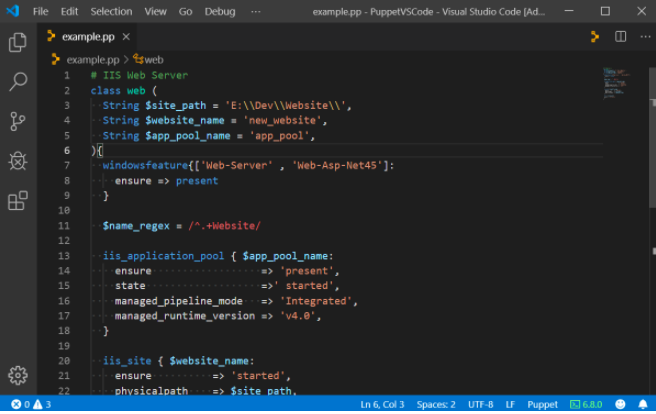
    Finally, Puppet has also added a Puppet VSCode Extension that gives Windows administrators the ability to invoke the Puppet Domain Specific Language (DSL) to access capabilities such as Intellisense and error-checking using their existing user interface and text editor for Windows.

    Puppet CTO Abby Kearns said interest in IT automation has significantly increased in the wake of the downturn brought on by the COVID-19 pandemic. While IT organizations that have been running instances of Linux have had access to a broad range of IT automation tools for years, Windows environments have not enjoyed the same level of parity even though half the workloads organizations are trying to manage today are based on Microsoft.net code, she said.

    With more pressure to automate than ever, Puppet sees an opportunity to fill that void, Kearns added.

    By relying on Puppet tools to automate both Linux and Windows platforms, an opportunity to reduce the total cost of IT also presents itself as organizations look to either limit or reduce IT headcount. Puppet claims there are already more than 40,000 organizations using its tools, including more than 80% of Global 5,000 organizations.

    It’s not clear to what degree Microsoft is invested in IT automation tools, especially compared to IT vendors that make managing infrastructure as code both inside and out of the cloud their sole focus. However, since it launched Azure Microsoft has been investing in tools to manage infrastructure as code. The depth of the Puppet portfolio enables IT organizations to also apply IT automation to operating systems and now to applications via Chocolately.

    Less clear is to what degree IT organizations may finally unify the management of Windows and Linux systems as part of an effort to reduce costs in the wake of the downturn. Most organizations continue to manage Windows and Linux systems in isolation. However, as IT organizations embrace IT automation more broadly, many are looking to standardize on a common set of best DevOps practices whenever possible.

    In the meantime, the opportunity to extend IT automation into the midmarket remains significant. Most enterprise IT organizations have already embraced IT automation to a significant degree. Midmarket IT teams have generally not had the skills and resources required to manage infrastructure as code. However, as IT automation tools become more accessible to the average IT administrator, there may come a day soon when broad swaths of IT systems deployed by midmarket IT organizations will finally be automated.

  • Harmonizing Real-Time on Edge Platforms

    Harmonizing Real-Time on Edge Platforms

    Edge computing platforms sit at the boundary between the real-time world and the digital enterprise. Uninterrupted, uncorrupted data from the edge is a must if analytics in the cloud drive reliable business decisions. What’s the best approach: using Linux, an RTOS (real-time operating system), a hypervisor or something else for edge platforms?  Let’s talk about harmonizing real-time on edge platforms and introduce a new foundation project in the Linux Foundation’s LF Edge family.

    Real-Time and Deterministic

    Real-time only means events are captured, tagged and processed as they unfold in the real world. That cadence can be seconds, milliseconds or microseconds depending on how many events and how often they occur and how tasks and algorithms stay in control. Three operating system characteristics determine how well real-time execution keeps pace: prioritization, interrupt response time and context switch time.

    Prioritization ensures that tasks receive resources when needed. Tasks at a lower priority should pre-empt when a higher priority task requests service. A task refusing to yield to pre-emption can throw off the prioritization scheme, causing missed deadlines.

    Interrupt response time measures the latency from the time an event requests service via a hardware interrupt to when the handler task executes. Real-time hardware platforms often place high-priority events on hardware interrupts for fastest pre-emption.

    Context switch time is softer scheduling at work. It measures the time for a change in processing control from one execution entity to another, swapping out resources including registers, cache and memory as needed.

    Deterministic means there are no surprises in behavior. The faster real-time events happen, and the harder a system works, the more likely non-determinism surfaces. One venture into virtual memory paging or a burst of networking activity can show up at an inopportune time, even though under most conditions real-time performance is adequate.

    ‘Hard’ vs. ‘Soft’ Real-Time

    That’s why most people think of real-time as “hard” with a fast, deterministic operating system. RTOS platforms optimize the kernel and only build things in around it that are necessary, providing rigorous and sometimes mathematically proven scheduling for many tasks.

    “Soft” real-time is more forgiving. On a fast processor, interrupt response time is tiny compared to the execution window. A system that isn’t deterministic can, if there is enough margin in context switch time, keep up with real-time events on a slower scale. Linux, while not deterministic, can handle some real-time needs through minimizing packages and tuning the kernel for better prioritization.

    Linux also benefits from lighter context switching. Originally, execution entities in Linux were resource-heavy processes. Now, threads can handle tasks with far less switching overhead. POSIX threads standardized the approach with portability between Linux and RTOS environments.

    How fast are threads? According to a recent synthetic thread benchmark by Eli Bendersky, switching on server-class platforms with enough memory, cache and storage can be in the range of 2 microseconds with 10,000 threads under ideal conditions. Eli pointed out his test environment has more RAM than many edge hardware platforms provide, but most edge applications won’t need that many threads, either.

    So, the line for soft real-time has moved down into new territory, making the trade-off between hard and soft a bit blurrier.

    Hypervisors and Orchestration

    If your DevOps team commits to an RTOS, you may give up some familiar functionality and have a learning curve to deal with, but you get assured hard real-time performance. If you go with Linux, you get the tools and coding practices you’re used to, but soft real-time performance can be an issue as code piles up.

    The leaders in RTOS platforms with enterprise networking noticed this, too. Recently they’ve turned to hypervisors in a bare-metal approach. A hypervisor can capture the benefits of environments working together, so teams are not forced into an either/or operating system choice. This is especially important if the edge application requires some form of certification, such as in medical, industrial or defense applications. Certified code can be compartmentalized on an RTOS, while Linux runs alongside.

    Linux providers are turning more toward orchestration layers and containers. It’s an application focus speeding up deployment, with more scalability and less hardware dependence. It also brings the edge into the enterprise faster with the same application deployment strategy anywhere. More code means more determinism risk.

    Convergence is a faint hope on this landscape with competing objectives, but a new approach offers a path for software reuse and rapid deployment.

    Harmonizing the Edge

    The Linux Foundation is active across the spectrum of IoT development, from the Zephyr open source RTOS to various embedded Linux projects. One of the newest projects in the LF Edge initiative is a foundation targeting a blend of deployment models in a consistent, open approach.

    Project EVE (short for Edge Virtualization Engine) supports containers, clusters, virtual machines and unikernels simultaneously. It’s a slim bare-metal runtime offering hardware root of trust, device resource management and software update and patch functions. EVE can host any combination of apps in virtual machines or containers, including running an RTOS with its application in a virtual machine. It can even assign CPU and GPU cores to specific applications for enhanced determinism.

    On the EVE road map is support for the ACRN hypervisor (another LF Edge project) and shrinking the EVE runtime for smaller embedded-class edge platforms. These efforts are essential where real-time requirements become harder and a hypervisor plus an RTOS makes sense. For softer real-time environments, EVE is adding support for Kubernetes K3S, Docker Compose, VPNs for public clouds and mesh networking for data flow between edge platforms.

    While the project is still young, EVE holds great promise for DevOps teams working the edge. We’d look forward to seeing some benchmarking on a real-time scale; it likely handles soft real-time needs as well as Linux today. By harmonizing a range of diverse approaches into one foundation, EVE is creating a space for real-time on edge platforms no matter which development perspective teams come from.

  • Are We There Yet? The Long, Hot Road Trip to the Cloud

    Are We There Yet? The Long, Hot Road Trip to the Cloud

     “If I have to pull this car over, there will be trouble!” Does this sentence evoke childhood memories of summer adventures in the family car? It’s the same sort of dread we get when the IT budget-holder turns around and threatens to pull over on our journey to the cloud or hybrid cloud. The family summer road trip may be filled with great expectations, but the last thing we want is an unforeseen disruption along the way. And migration to the cloud is no different. To continue this analogy, the bumps on the road to avoid are the ones around cost, performance and risk. So, here are some thoughts on how to identify the challenges and navigate to your destination smoothly.

    The Line of Business Needs To Pee (They Think) …

    Or even worse—“we just stopped, why didn’t you go then?!?!” Planning business needs is always a challenge—especially at the speed of change in today’s disruptive markets. The unforeseen impact of the COVID-19 pandemic is one example. We hear it a lot in our industry: “We don’t know which applications are using the most bandwidth and how much they are costing us.” And with 59% of infrastructure managers citing infrastructure cost overruns as their biggest concern, there’s definitely room for immediate improvement. Having clarity into your application topology with a clear map to performance is mission-critical for a successful hybrid cloud journey.

    Because this is such a dynamic process, it needs to be mapped and measured daily, in real-time. But simply automating VMs to workload balance does not give you the clarity needed to understand what and when to move in your hybrid journey. You need the ability to understand why and when things changed so you can effectively plan or resolve the issues. According to Gartner Research, on average, AWS deployments are 40% over-provisioned to meet unexpected capacity and performance issues, which defeats the purpose of moving to the public cloud. “Know before you go” should be a mantra for every hybrid journey manager—and parent managing backseat bladder needs.

    IT Just Hit a Major Pothole and Now Has a Flat Tire

    A flat tire only ruins a trip if you don’t have a spare, the tools and the knowledge required to fix it. For most, the actual solution is to call AAA or in this case, get a third-party systems integrator (SI). Calling an SI to help solve an unforeseen problem is not a bad idea, but it does come with a hefty price tag and a level of dependency that doesn’t mirror the model of moving to a public cloud.

    With the right solutions in place, even a pandemic like COVID-19 should not disrupt your business. Every IT leader should have confidence in their infrastructure systems. That said, it takes time and effort to get there, and no journey worth taking is easy. Having integrated solutions and partners are critical to the hybrid cloud journey. And so is knowing when to fix it yourself and when to call in support to save you millions.

    Too Much Luggage From the DBAs

    Packing the back of the family Ford “Wagon Queen Family Truckster” is a special skill set. It’s like playing Tetris with your family’s luggage. Right-sizing infrastructure capacity while supporting applications is like making sure all the luggage fits in the car and that you still have room to move your feet. Sure, you could buy a bigger car to manage the payload, but the expense doesn’t justify the performance. You need the clarity to act across your private and public cloud infrastructure in a single solution without disruption is required. That level of optimization is a constant to remaining competitive, enabling you to transform your infrastructure from being seen as a cost of business to being recognized as a revenue generator.

    Compliance Just Gave You a Speeding Ticket

    No matter how well-intentioned and on the right side of the law your compliance team is, it can feel like you are being chased by Sheriff Rosco P. Coltrane. And while you don’t mean any harm, the law is the law. In the rush to the cloud, you’re not often asked how you will manage the migration, you’re simply asked how fast you can move—reminiscent of another epic journey: “We’ve got a long way to go and a short time to get there.” Regardless of whether you identify with Smokey or the Bandit, you cannot deny that Sheriff Buford T. Justice (aka, Compliance/Security Officer) will slow you down. So, work early and often with your compliance team to ensure that where you store your data and who has access to your data always remains in compliance.

    Leadership Just Ran Out of Gas on the Migration Budget …

    … and now they want to know when the cost of running applications is best on-premises versus across the public clouds? Don’t break out your abacus just yet. Cost is all about transparency to the needs of the application infrastructure. Too many enterprises are finding that the rush to the cloud was expensive and not well-planned and are shifting critical apps back to the private infrastructure. But you need to go beyond just resourcing noisy neighbors with VM automation. A long-term solution is to optimize the application performance with an integrated APM and infrastructure solution. A more immediate and tactical solution is to leverage a hybrid infrastructure platform that works across multiple on-premises vendors and public cloud vendors to give you the cost analysis you need.

    Application Managers Are Fighting Over the Music  

    On-premises versus public cloud, VMs versus containers, AWS versus Google versus Azure. Where should those applications be running and how can they migrate them? These may seem like the most trivial of issues to be concerned about, but DevOps, architects and managers have deep loyalties way beyond rational factors such as cost, performance and control. Having the ability to manage and plan cost across a multi-vendor hybrid infrastructure to maintain your performance SLAs is critical. Don’t let blind loyalty or the loudest voice control your path. Your hybrid optimization platform should afford you real-time planning and cloud brokerage to ensure you are optimized for cost and performance.

    Your Early Talent Team Has Been Doing the Same TikTok Dance in the Backseat for the Past 8 Hours

    Hearing the same story about why the journey is behind schedule or the same ask for more budget to meet performance SLAs, or even a repeated request to deviate from the existing road map, can wear you down or dilute your focus. It’s important to have a multi-department/cross-functional plan and mapped roles and to measure performance. Keeping the entire team (multiple owners of the “cloud” in a large enterprise) engaged and on the same plan to avoid going into a loop of burned resources and nerves.

    Are We There Yet?

    As with most family trips to magical destinations, the road to a successful cloud migration is fraught with unexpected disruptions—but a good plan can avoid most common challenges. So, no matter what stage you might be at in your hybrid cloud journey, we hope you will reach out to us before you feel the need to pull over when the going gets tough.

    Hope you are all happy and healthy. Please, during this increased time of need, remember to give back to your community as you can.

  • The Rise of the Cloud Economist: The Other CFO

    The Rise of the Cloud Economist: The Other CFO

    The new Cloud Economist job title wrangles runaway cloud costs

    Have you ever forgotten about a subscription? Maybe it was that Amazon Fresh upgrade you never used, charging you monthly payments. Or, your phone carrier slyly tacked on a feature and it went unnoticed for years. All these charges may seem insignificant, but they mount up over time.

    The same is true for cloud IT tools. Many Ops engineers know all too well the surprising bills that accompany cloud infrastructure. While cloud prices may start low, they often rise unexpectedly with hidden server costs, data replication charges, escalating API fees and other fun add-on expenses.

    Conversely, remaining at a low service tier could cause latency and a loss of revenue. Drowning in a sea of hybrid trends and feeling pressure to deploy at lightning speed, it can be difficult to keep track of which cloud models actually advance business objectives.

    Some believe an entirely new role is needed to rectify the gap between cloud and business repercussions—a Cloud Financial Officer, or the Other CFO (OCFO). An OCFO could act as a Cloud Economist, a tech-savvy ambassador who both understands the financial implications of a cloud strategy and optimizes service tiers to their necessary levels.

    I recently chatted with Leon Adato, Head Geek at SolarWinds, on how businesses could better drive cloud cost optimizations. Like a determined accountant sent in to save a struggling city (h/t to Ben Wyatt in Parks and Recreation), the OCFO may be the star companies need to slash the budget and balance the cloud checkbook.

    Why Do We Need a Cloud Economist?

    According to the “Flexera 2020 State of the Cloud Report,” 74% of companies report their annual cloud spending exceeds $1.2 million each year. At 20% of companies, it’s more than $12 million. As cloud spending skyrockets, balancing these expenses becomes business-critical.

    Yet, forecasting cloud costs is tricky. Unexpected complexities often arise with the cloud, skewing initial cost projections. Maintaining cloud oversight becomes especially complex as COVID–19 accelerates more cloud adoption across the board. Budgets are shrinking, and some companies are undertaking extreme measures to remain lean.

    Simultaneously, the ones that advocate for new technology don’t always consider cost implications. “Three clicks and you’re done means a DevOps engineer in the driver’s seat may not be aware of the cost considerations,” said Adato. In recent years, SaaS companies have stressed easy onboarding and developer experience as a top priority. The staying power of developers to adopt new tools is arguably at an all-time high. But while it’s important to improve developer workflows, developers don’t necessarily have business acumen. “Finance is a lexicon of itself,” noted Adato.

    Thus, some view a Cloud Economist role as necessary for translation across divisions. “IT divisions shouldn’t be encountering sticker shock when they view their cloud infrastructure bills,” he said. “We need IT folks to be able to pay attention to cloud costs in a meaningful way.”

    What Does a Cloud Economist Do?

    A Cloud Economist is an expert that specializes in cloud-spending and cloud cost optimizations. Such a role could help teams realize the efficiency benefits of cloud-native architecture while keeping costs lean.

    This job title truly requires “hands for code and a head for money,” described Adato. He laid out three simple goals of a Cloud Economist:

    1. Increase revenue.
    2. Decrease cost.
    3. Remove risk.

    A Cloud Economist understands the technical underpinnings behind cloud tools and how they support each other within a cloud-native ecosystem. They also appreciate maintenance realities, asking tough questions such as: Will it take 200 code pushes per day to support this microservices integration pipeline? How will server costs change as bandwidth scales? Which plan is most optimized for our needs?

    Specific Cloud Economist Duties

    A Cloud Economist must manage runaway costs associated with cloud adoption. They see the bigger picture and understand the repercussions behind cloud technologies. In terms of specific duties, the role may wear many hats.

    For example, a Cloud Economist may encourage a CSP migration, such as from AWS to GCP. Or, they may foresee the implications of future feature introduction, such as limitations across geographic zones, and advise IT teams accordingly.

    An avid Cloud Economist should also interface with monitoring and testing teams. “API testing before launch can mean the difference between a $25 cloud database bill and a $30k bill,” wrote Rapid API’s Chris McCallister in a separate blog post.

    Other Cloud Economist duties could include:

    • Logging and forecasting rising cloud costs.
    • Becoming Terms of Service (ToS) experts.
    • Avoiding costly data replications.
    • Upgrading servers.
    • Discontinuing unused instances and features.
    • Ensuring elasticity of applications.
    • Database scalability.
    • Increasing CPU power or data loads.
    • Optimizing subscription plans.
    • Considering implications behind feature updates.
    • Limiting the intake of new cloud tooling.
    • Acting as an ambassador between a company and CSPs.

    Traditional IT, or information services, as it was originally called, “has been able to avoid the need to integrate with business,” said Adato. That will likely change drastically as cloud costs escalate and thousands of very small charges amount to “death from a thousand cuts.” It appears that any business size, from startup to enterprise, could benefit from more cloud expense forethought.

    Inherently, DevOps is a cultural movement, not a technical movement, Adato noted. Assigning a Cloud Economist encourages specialization and de-siloing between disciplines, freeing up DevOps engineers to work on projects that matter to them. The role of a Cloud Economist “offloads responsibility that has always been there that may have been ignored,” he said.

    Avoid Ice Town With a Cloud Accountant

    Software architects are often sold on the idea that cloud infrastructure is a cheaper alternative to on-premises. “That statement is false,” Adato said. As an organization cloud evolves out of freemium tiers, where it began cost-wise is often far from where it ends up.

    To navigate the opaque cloud, “we need someone that has fluency and familiarity with tech, understands the platform, understands how code is updated and maintained, and can right-size the cloud platform,” said Adato. Cloud-native certainly has its benefits, but if runaway cloud costs aren’t wrangled, they could equate to revenue loss.

    As author Bob Lewis wrote: “There’s no such thing as an IT project.” We don’t do technology for the sake of doing technology. Rather, we do it in service to the business. A Cloud Economist could help ensure technology answers the business call, not vice versa.

    As of now, the OCFO is mostly a theoretical title; it could materialize as an internal team member or contract hire. Regardless, such a role could advocate for the business and keep operational overhead as lean as possible.

    In general, it may require a dash of hard realism to learn how to avoid plunging the books into a debt-ridden Ice Town.

  • NGINX Expands Portfolio to Include Service Mesh

    NGINX Expands Portfolio to Include Service Mesh

    NGINX at its online Sprint conference today launched a bevy of offerings including a service mesh as part of an expanded effort to meld network and security operations within the context of a larger DevOps workflow.

    Rob Whiteley, chief marketing officer for the subsidiary of F5 Networks, said NGINX Service Mesh 1.0 provides an easier alternative to deploy a service mesh based on the open source NGINX proxy server software already widely employed in enterprise IT environments. That lighter-weight service mesh is also integrated with the NGNIX ingress controller to enable it to be employed across microservices spanning both legacy virtual machine environments and Kubernetes clusters, he said.

    In general, Whiteley noted, most organizations will not need a service mesh unless they are looking to integrate more than a thousand microservices. If an organization only has hundreds of microservices, an ingress controller should suffice, and anything involving less than a hundred microservices can be handled by proxy software.

    NGINX Service Mesh 1.0 will be offered by NGINIX and F5 Networks will continue to offer a service mesh based on the Istio project for Kubernetes environments that relies on Envoy proxy software, which is not as lightweight as the NGINX platform, noted Whiteley. DevOps teams will have to decide which service mesh to deploy.

    In the meantime, NGINX is also updating its NGINX Controller to add support richer analytics, a declarative application programming interface (API) for continuous integration/continuous delivery (CI/CD) integration, role-based access controls and enhancements to the developer portal for API management.

    NGINX is also driving tighter integration between Controller and NGINX App Protect, a web application firewall that will inherit the API, analytics and self-service capabilities of Controller. NGINIX App Protect is also now being integrated with NGINX Ingress Controller for Kubernetes. The Controller App Security tool that enables those integrations is in private beta now, with general availability expected by end of 2020.

    Finally, NGINX is now leveraging services made available by F5 Networks via software-as-a-service (SaaS) platforms in the form of NGINX Analytics Cloud, which replaces NGINX Amplify. That capability will be available in the first quarter of 2021.

    In general, Whiteley said NGINX is trying to serve the needs of traditional network operation teams that want to provide self-service capabilities to development teams as well as via programmatic interfaces to DevOps teams. In many cases, enterprise IT organizations are employing both approaches to expose network services, noted Whiteley.

    Of course, the issue that ultimately might drive the convergence of NetOps and DevOps is the rise of the service mesh. In addition to integrating microservices, the service mesh provides developers with a consistent set of interfaces for invoking network and security services spanning a dizzying array of servers and appliances. As that transition occurs, IT teams will become much more agile than they are today. The challenge, of course, will be melding network operations and DevOps cultures that today don’t have all that much in common.

  • NVIDIA to Create AI Powerhouse by Acquiring Arm for $40B

    NVIDIA to Create AI Powerhouse by Acquiring Arm for $40B

    NVIDIA has announced its intention to acquire Arm from SoftBank for $40 billion as part of an effort to create a juggernaut that will build processors optimized for artificial intelligence (AI) applications that span edge computing deployment to the cloud.

    Under the terms of the proposed deal, Arm will operate as a subsidiary of NVIDIA and will continue to headquartered in Cambridge, UK. NVIDIA will pay to SoftBank a total of $21.5 billion in NVIDIA common stock and $12 billion in cash, which includes $2 billion payable at signing. SoftBank will retain a 10% stake in NVIDIA.

    NVIDIA CEO Jensen Huang during a conference call also committed to licensing the software NVIDIA uses to make graphical processor units (GPUs) using the same licensing model Arm has employed to encourage manufacturing partners to create processors based on its designs. In theory, that approach could substantially lower the cost of GPUs once the deal closes.

    However, because of all the regulatory approvals required, Huang said NVIDIA could not commit to a timeframe for the close of the deal. Previously, Huang noted it took NVIDIA a year to close the acquisition of Mellanox, a provider of storage and networking infrastructure.

    In addition to providing processors that drive gaming and CAD/CAM applications, GPUs from NVIDIA are widely employed to train AI models more efficiently than x86 processors from Intel or AMD. Processors from Intel are used more often to run the inference engines for an AI model once it is deployed. With the acquisition of ARM, NVIDIA gains access to processor technology that is emerging as a rival architecture for deploying AI models on a wide range of server and mobile computing platforms. Currently, Arm is best known for providing processors for mobile computing devices such as smartphones, which eventually will also be infused with a wide variety of machine and deep learning algorithms.

    In the meantime, many organizations continue to struggle with implementing AI. It typically takes a team of data scientists six months or more to build an AI model. Once that model is built, it then needs to be incorporated into an application as part of a DevOps workflow. In the meantime, business assumptions may change, rendering the AI model irrelevant. That requires the data science team to build a new AI model. In addition, as new data sources become available, AI models need to be updated. Most organizations are just now defining the processes for building and deploying those models, otherwise known as machine learning operations (MLOps), using many of the principles that were first defined by DevOps teams.

    Once those MLOps processes are defined, of course, IT teams then need to meld MLOps and DevOps workflows to keep applications that are updated more frequently synchronized with the AI model on which those applications increasingly depend.

    At this point, it’s clear every application will incorporate some level of AI. However, the speed at which AI might become pervasive is not likely to be all that fast anytime soon.

  • Custom Coding: An Obstacle Along the Hybrid Cloud Journey

    Custom Coding: An Obstacle Along the Hybrid Cloud Journey

    If you’re like 80% of enterprises, you’re somewhere along a hybrid cloud journey. The imperatives of digital transformation, the emergence of DevOps as the de facto enterprise development methodology and the rapidly growing demand for continuous innovation have made hybrid cloud the go-to infrastructure for competitive enterprises.

    Hybrid Cloud Governance Requires Automation

    Despite hybrid cloud becoming the new normal, there are inherent challenges to managing these infrastructures. Not only do IT departments (and those they serve) need to adapt to different processes for provisioning public and private clouds, but they also need to ensure security and compliance across an increasingly heterogeneous cloud landscape. On top of these challenges, IT departments also need to monitor and control cloud costs and manage day-2 operations while seamlessly orchestrating private, public and on-prem systems.

    To tackle these new complex challenges, you need management and automation tools, which help alleviate the security, governance, and cost-control challenges that hybrid clouds inevitably bring. But integrating them with your existing IT infrastructure (e.g., networking, security, backup, etc.) burdens your IT team with significant custom coding requirements.

    The Dreaded ‘Custom Code Tax’

    So, you have your hybrid cloud, and you have your automation tools to optimize it. But now, each one of these tools—whether it’s for simple use cases such as resource naming or complex tasks such as multi-tier workload provisioning—requires integrations with dozens of underlying networking, security and backup endpoints, typically from dozens of vendors.

    These integrations often require custom coding, which is arduous and time-consuming. Your IT people will be stuck writing and maintaining thousands of lines of custom code to integrate your automation tools with all of these endpoints. It’s also expensive. Research by the Standish Group shows that over half of custom-coded projects cost almost double their original estimate, while about one-fifth of custom-coded projects will be canceled before they are completed.

    And the tax doesn’t end there. Governance and security become increasingly complicated and expensive because the proliferation of new tools and processes prevents IT from having a unified view of integration policies, automation playbooks and role-based access. Without the end-to-end visibility necessary to manage and monitor this proliferation of tools and processes or standardized provisioning across all IT platforms and tools, costs are only going to compound over time. Since 60% of all infrastructure outages are caused by human error, end-to-end automation and visibility are now mission-critical for enterprise organizations

    But what is to be done? Organizations need hybrid cloud to meet the demands of digital transformation, and they need automation tools to effectively manage and secure hybrid clouds. Your monetary costs and governance burdens will scale along with your IT, and as your organization invests in new automation platforms, the “custom code tax” will only keep increasing. But if you want your hybrid cloud to work right, there really is no choice but to pay it.

    Hybrid Cloud Management with Codeless Integrations

    Enterprise IT departments need to implement cloud management solutions that offer an alternative to custom coding. Cloud management that takes a policy-based, codeless approach to these integrations eliminates the need to custom-code, thus repealing the custom code tax.

    Take the example of cloud management platforms (CMPs). In the past, CMPs mainly focused on management. However, the complexity of hybrid clouds now requires an equal focus on both management and integration. Software-based, low-code/no-code methods for integrating automation solutions with relevant systems not only eliminate the high costs associated with custom coding but also ensure a governed, standardized approach to integrating automation tools with networking, security and backup endpoints.

    Not only will you save valuable time and budget dollars, but when your integrations are software-based and no longer rely on custom code, you will be able to apply advanced intelligence tools more easily as your organization grows and evolves. If your company wants to integrate certain tools that utilize artificial intelligence (AI) and machine learning, for example, you will run into obstacles trying to abstract data from custom-coded workflows. You can’t apply AI to a language that is unique in business logic because it has been custom-written. There could be a hundred thousand lines of custom code, so you would have to manually go through it all and try to figure out what’s there, who built it, why they built it and what the business logic behind it is.

    Codeless Will Rule the Day

    In a world where multi-tool reigns supreme, the more tools you want to use, the more custom coding you have to do. Enterprises today must be able to use their tools of choice in a best-of-breed approach while maintaining standardization through a robust integration layer. Going forward, this means that cloud management platforms will need to be built around extensibility and make integration a core capability, not an expensive afterthought.

    Forward-looking CIOs are choosing software-based solutions to enable multi-tool to work seamlessly in hybrid cloud environments. This results in lowers costs, better governance, and more robust security, especially as organizations advance their hybrid cloud journey.

  • Micro Focus Strengthens Hybrid Cloud Hand

    Micro Focus Strengthens Hybrid Cloud Hand

    Micro Focus has made available a multi-tenant cloud management platform that can be deployed in a public cloud or on-premises IT environment.

    Travis Greene, senior director for IT operations management at Micro Focus, said the Hybrid Cloud Management X (HCMX) platform makes it possible to unify the management of IT services across a hybrid cloud computing environment spanning a diverse range of platforms, including public clouds and VMware environments.

    At its core, HCMX is a unified portal and service catalog through which IT teams can find, request and consume information and enterprise services. It is built on the same framework as Service Automation Framework, X (SMAX), an IT service management (ITSM) platform also offered by Micro Focus. As such, HCMX can also leverage the same natural language engine, search and virtual agent technologies that Micro Focus makes available on SMAX.

    HCMX also provides a library of reusable workflows through which IT teams can automate processes along with a set of governance policies that automatically trigger workflows based on events or input from an IT administrator that would, for example, limit usage of a specific cloud service.

    In the wake of the economic downturn brought on by the COVID-19 pandemic, there is more pressure than ever to rein in IT costs. One way to reduce those costs in the multi-cloud era is to centralize the management of those environments under a common control plane. Most IT organizations today rely on separate tools and consoles to manage IT platforms in isolation from one another. Not only are licensing fees incurred for each management platform, but also IT often has to hire specialists to manage each individual platform. As hybrid cloud computing platforms continue to mature, it becomes possible to rely on a fewer number of IT generalists to centralize the management of IT.

    Of course, transitioning to a single hybrid cloud computing environment requires a significant amount of time and effort. IT organizations need to make a multiyear commitment to a single platform to reduce the total cost of IT. Many organizations simply lack the ability to enforce the adoption of a single management platform across multiple divisions within an organization regardless of potential savings. However, organizations that do make the transition should be able to not only reduce the total cost of IT but also more flexibly choose where to deploy their next generation of application workloads based on the cost and merits of one platform over another.

    In addition, at a time when the parent company of any one of the major cloud service providers might become a direct competitor overnight, many organizations now prefer to keep their IT options open. The challenge, of course, is making sure workloads deployed on any of those platforms are not dependent on a proprietary interface that doesn’t exist anywhere else.

    Micro Focus, of course, is not the only provider of IT management tools focused on hybrid cloud computing. The decision IT organizations need to come to terms with is determining which of these platforms provides the greatest amount of flexibility at a cost that organizations can absorb.

  • Survey Shows Most IT Teams Adapting in New COVID-19 Normal

    Survey Shows Most IT Teams Adapting in New COVID-19 Normal

    A survey of 122 IT professionals published today by SolarWinds in advance of IT Pro Day next week, finds that while IT teams are enjoying greater respect within their organizations in the wake of the COVID-19 pandemic, nearly a third (31%) admit there’s a need to rethink internal processes to better accommodate rapid change.

    Overall, nearly two-thirds (64%) of respondents said despite contending with challenges such as reduced budgets, greater decision-making responsibilities and longer hours, they were instilled with a new sense of confidence in the wake of the pandemic. Just under half (46%) also said they feel empowered to bring more ideas to the table, while 58% said they now feel more prepared to succeed in similar unexpected situations. Another 29% reported feeling prepared to manage change but require additional resources, training and support. In addition, 40% said they believe they will now be involved in more business-level meetings.

    Patrick Hubbard, head geek at SolarWinds, said in the wake of the pandemic it’s clear the historic divide between IT and the rest of the business has narrowed considerably. The challenge will be maintaining that closer alignment in the era of the new normal, added Hubbard.

    In general, IT teams have proven themselves to be more adaptable than might have been anticipated prior to the pandemic. Many respondents also reported working longer hours due to stretched teams (29%), more responsibility (28%) and decision-making requirements (28%). However, only 22% of respondents said they were experiencing job-related stress.

    However, it’s also clear organizations will need to revisit their IT strategies as workers continue to work from home well into 2021. It’s also clear that while many employees will eventually return to the office, many of them will also be working from home more frequently. As such, the need to create digital workflows spanning a highly distributed workforce will require new approaches to networking and security, among other things.

    Just over a quarter of IT professionals (26%) said it was necessary to learn new skills to support their organizations’ transitions to a remote workforce. However, it would appear additional training is required. Systems management (55%), network management (50%), security policy and compliance (43%) and hybrid IT monitoring/management tools and metrics (28%) were identified as the top skills in need of development. Nearly half of respondents said they received the training they needed to learn these new skills, but (25%) said they are still waiting for training resources to be made available.

    That skills shortage may prove to be especially crucial when it comes to security, which Hubbard noted is usually the last thing to get funded. In the rush to enable remote networking, for example, many organizations did not pay much attention to the need to secure endpoints that were frequently accessing cloud applications, which aren’t protected by a corporate firewall.

    It’s still not clear to what degree the pandemic may drive more organizations to adopt best DevOps practices to enable IT teams to become more flexible. However, it’s apparent to all that when it comes to IT in post-COVID-19 era, there has never been a greater need for speed.

  • Challenging Cloud Migration Myths in the Wake of COVID-19

    Challenging Cloud Migration Myths in the Wake of COVID-19

    The COVID-19 push to cloud migration, unfortunately, is riddled with myths. Here are some worth busting

    With a substantial increase in the number of businesses now operating from their employees’ homes, and organization leaders realizing that their office buildings are now somewhat unnecessary until a vaccination against the coronavirus is widely distributed, the cloud has played an increasingly important role in IT operations.

    For many, migrating to the cloud has had to happen quickly and at a large scale to cope with the increased pressure on IT infrastructure during the pandemic. At such a turbulent and challenging time, it’s never been more important for businesses to ensure they have the correct IT infrastructure in place.

    As more businesses of different shapes and sizes begin to use cloud computing technology, the realization that greater flexibility, efficiency and scalability can be achieved is being understood by the majority. However, there are still a significant number of enterprises that have misconceptions about how cloud technology can enhance or replace their current IT environment. The outsourcing of IT infrastructure to a dedicated provider can make it difficult for organizations to understand where and how their operations are running and can become a breeding ground for misunderstanding and myths.

    To help clear up some of these myths, I’ve put together a guide to support organizations in the decision-making process and help them understand whether moving to the cloud is the right option for their business.

    Myth 1: Companies should hold tight and do nothing in the wake of COVID-19 as moving IT operations to the cloud is too risky

    This is absolutely not true. While it might seem scary to overhaul IT operations at such an uncertain time and invest in cloud computing technology, there is no doubt that it will be worth it in the long run. Business leaders and IT directors are understandably apprehensive about buying into a cloud migration platform when their budgets are already strapped and the future of their business is uncertain, however, our own research has proven migrating to the cloud can have significant financial benefits.

    Our recent Forrester Consulting TEI (Total Economic Impact) study examined the potential return on investment enterprises may realize by deploying hybrid infrastructure optimization solutions for both the public and private cloud platforms, and found those that have already deployed a cloud migration service have seen a 145% return on investment across a three-year period. Businesses shouldn’t fear that moving into the cloud will have a negative impact to their company economics even though things are difficult in a post-COVID environment, as in fact, deploying a cloud migration strategy will have the opposite result.

    Our Current State of Hybrid Cloud and IT report found that companies that decided to halt their cloud migration altogether as a result of the pandemic are 2.5 times more likely to experience detrimental outages that can hurt company KPIs, as opposed to those that have continued their journey to the cloud over the last four months.

    Myth 2: Cloud migration has to be a quick, ‘one and done’ process if organizations are to cope with the infrastructure demands that remote working practices create

    The term “one and done” cannot be applied when migrating to the cloud. The fact is that cloud migration is a process, and being able to scale up accordingly first requires the right technologies in place. While the pandemic has exacerbated some significant IT challenges across businesses, it has placed a greater focus on ensuring employees can effectively work from home instead of a faster migration to the cloud, which has, understandably, been put on the backburner. For some organizations, remote working has never been part of their practices, but with government guidelines and lockdown restrictions, working side by side has not been an effective way to continue to keep employees safe.

    The immediacy of the shift to remote working has meant ensuring operations could continue as a priority focus for businesses. But as we begin to settle into the “new normal” and most employees are now accustomed to working from their home, vision can be turned to a digital transformation process and ensuring the correct technologies are in place for companies to thrive.

    Myth 3: Halting your cloud migration during COVID-19 will save you time and money and won’t impact your IT systems’ performance

    This is in fact an untrue statement, as businesses that have halted their cloud migration journey because of the pandemic have already experienced significant issues in their IT systems. Our report, which was conducted to better understand how businesses were coping with their migration strategies during the pandemic, has revealed that more than three-quarters (77%) of respondents have reported a lack of access to the correct tools. In addition, 81% of those surveyed have said they have spent more time working across multiple systems to create a single report on IT bandwidth and resources, increasing the amount of time spent on a singular task.

    There is no doubt that deciding to halt a cloud migration strategy because of the pandemic will have impacted organizations’ information technology systems. But that’s not to say it’s too late. Businesses can get back on track and ensure the move to the cloud is just as effective in post-COVID operations.

    Myth 4: COVID-19 has made system transparency and measuring performance more complicated than ever before, especially when factoring in cloud migration

    Measuring performance and system transparency post-COVID can only seem complicated if the appropriate resources aren’t put in place. If businesses and IT decision-makers ensure the correct technologies are readily available and accessible, measuring the performance of a cloud migration strategy should be relatively simple.

    Our survey reveals that access to the correct tools and support services has a direct correlation to business cloud performance. More than three-quarters of those who experienced performance issues during the beginning of the pandemic also say they lack sufficient access to tools. However, companies that had already begun (or actually completed) their migration process at the onset of global lockdowns experienced fewer IT outages. In fact, for more than half of businesses, having impacted access to the correct support services has created a significant hurdle to overcome at a time when they’re already trying to cope with a number of challenges. Comparing this to those that maintained good performance, just under half said access to either type was not an issue.

    As with most things at the moment, apprehension in investment is unsurprising. For businesses, attempting to get sales, productivity and efficiency back on track is the most critical post-COVID action. But, beginning to understand how a digital transformation and cloud migration strategy should be adopted or continue at this time is crucial for survival.