Category: Infrastructure/Networking

  • Should I Stay or Should I Go? A Cloudy Decision

    Should I Stay or Should I Go? A Cloudy Decision

    If you’ve been operating in the cloud for some time now, chances are your business has changed since you first made that move and particularly during the current climate. Has your cloud usage grown considerably — and your OpEx costs? Is that just the cost of doing business in the cloud?

    It doesn’t have to be. Here’s how you can rationalize your infrastructure and determine if there are cloud expenses you can reclaim and even if it makes sense to move some of your cloud deployments into colocation.

    The rush to the public cloud has now slowed as organizations realized that it is not a one-size-fits-all solution. The main issue is the lack of deep visibility into the performance of applications provided by the host. Our own research has recently revealed that 32% of public cloud resources are currently under-utilized, and without proper direction and guidance, this will remain the case. What is needed is real-time data and intelligent recommendations to lower costs and assure performance.

    In order to optimize cloud resources, a third-party AIOps based resource is needed. This will provide an independent and granular view of how applications are using capacity and if it is right-sized. In addition, it will monitor the performance of the applications in real-time and provide metrics and analytics to eliminate bottlenecks. The allocated capacity can also be monitored to ensure an accurate match to workload requirements via real-time performance data.

    Although the major hosts provide cost optimization tools, these are not very accurate. Analysis of billing and how it matches capacity over time — as well as in real-time — is what is needed for the cloud to remain a vital part in IT infrastructure. Armed with this information you can plan capacity purchases and discover wasted spend. By using a single platform for cloud management, you can monitor your infrastructure, plan capacity and eliminate performance risks. Performance bottlenecks can be predicted before they affect clients and SLAs with multi-conditional alerting powered by advanced anomaly detection.

    Cloud solutions are not only publicly provided by the likes of AWS and Azure. Colocation is also a strong option where your applications are managed on your behalf by a system integrator. This is increasingly becoming a stronger option for more business-critical applications. But to determine which is best for you, you need to start with the facts. 

    The cloud promises IT organizations unprecedented value in the form of business agility, faster innovation, superior scalability and, most importantly, cost savings. For many organizations, it is at the core of their IT digital transformation strategy. It is a disruptive force that requires application workload behavior knowledge, careful planning and collaboration from well-informed, trusted advisors.

    As a first step, enterprises frequently target a subset of their less critical on-premises applications for migration to the public cloud. Typically, organizations will take one of two paths to the cloud:

    1. Going Cloud Native. Rewrite your application to use resources offered by a cloud provider.
    2. Lift and Shift. Very minimal or zero code changes to the application. Largely, just replicate the application in the cloud.

    The faster time-to-production choice is to lift and shift the targeted applications to a cloud service provider’s Infrastructure as a Service (IaaS). In the lift and shift option, the advantage is a reduction in the cost incurred in the physical infrastructure such as hardware, floor space, cooling, security, etc., and the management of that infrastructure. Savings will differ depending on your unique computing resource needs, workload refactoring and business models.

    Even in its simplest form, IaaS migrations must be carefully planned requiring answers to some fundamental questions:

    1. Will my application perform as expected in a public cloud? (Application Fitness)
    2. How much will it cost to run my applications in a public cloud? (OpEx)
    3. Which cloud service provider is the best choice for my applications? (Cost and Fit)

    IT managers need answers to these questions before the actual migration is performed. As most internal IT organizations don’t have deep cloud expertise, the question is: Who can you trust to provide you with the answers and help you make better business decisions?

    As technology and the cloud stands to play an ever-increasing role throughout organizations, ensuring that you’re adopting the right type of infrastructure specifically for your business has never been more vital for continued success. Choosing a service that provides the answers to your key questions, before the actual migration takes place and prepares you with vital insights into your applications and workloads targeted for cloud migration, has to be an important part of the decision-making process.

    As organizations continue to battle the COVID-19 storm, understanding the product that will overhaul your IT infrastructure, before you fully buy into it, is going to provide the confidence and assurance you need to make that decision a little less cloudy.

  • AWS Looks to Accelerate Windows Migrations to the Cloud

    AWS Looks to Accelerate Windows Migrations to the Cloud

    Amazon Web Services (AWS) is ratcheting up pressure on Microsoft by devoting more resources to enable IT organizations to migrate Windows workloads to the cloud.

    Fred Wurden, general manager for enterprise engineering at AWS, said a Migration Acceleration Program (MAP) for Windows, now generally available, provides IT teams with prescriptive guidance, consulting support, tools, training and service credits to help reduce the risk and cost of migrating to the cloud.

    The service is being delivered in collaboration with partners including Rackspace, 2nd Watch, Accenture, Cloudreach, Enimbos Global Services, Onica and Slalom. Wurden said AWS has been migrating Windows workloads to the cloud for more than a decade now and claims to have more than half of all Windows workloads deployed in the cloud.

    Microsoft has clearly been making strides in recent years to close the gap between it and AWS by running both Windows and Linux workloads on its cloud alongside instances of Microsoft Office 365. Microsoft most recently reported a 39% year-over-year growth in commercial cloud revenue, reaching $13.3 billion for its fiscal third quarter. However, Microsoft does not break out Azure revenue from Microsoft Office 365 revenue or disclose what percentage of the workloads running on Azure is based on Windows versus Linux.

    At the same time, Microsoft now charges more for instances of SQL Server that run on other clouds. AWS contends that decision will only accelerate the rate at which organizations are transitioning to open source databases deployed on Windows or Linux.

    Competition for Windows workloads is growing in ferocity in the wake of the COVID-19 pandemic because more workloads are being lifted and shifted into the cloud as organizations realize that on-premises IT environments can be rendered inaccessible. IT staffs in many geographies will be working from home at least through the end of the year. Many organizations are also moving workloads to the cloud in anticipation of a second potential outbreak of the pandemic.

    At the same time, the rate at which new workloads are being deployed in the cloud is also accelerating. Many of those cloud-native workloads are based on containers running on Kubernetes. Support for containers on Windows platforms is still relatively nascent when compared to Linux platforms.

    AWS and Microsoft, along with a host of rival cloud service providers, are focusing on legacy workloads because the expectation is that monolithic workloads running on Windows will be re-engineered to run as a set of microservices that can be updated more flexibly within the context of a larger digital business transformation initiative. It may be a while before that transformation fully manifests; however, it’s clear the battle for control over millions of workloads in anticipation of that transition is reaching a higher level of intensity.

    There’s no doubt many of those workloads will run on the Microsoft Azure cloud. However, the degree to which Microsoft might be winning in the cloud era may not be as great when everything that is being lost to AWS and other cloud service providers is taken into consideration.

  • Cisco Moves ACI Strategy Forward

    Cisco Moves ACI Strategy Forward

    Cisco is advancing its hybrid cloud computing strategy with release of version 5.0 of Cisco Application Centric Infrastructure (ACI), a software-defined networking (SDN) that can be deployed on cloud platforms or networking equipment deployed in an on-premises IT environment.

    The latest version of Cisco ACI adds support for a transit gateway between virtual private cloud (VPC) instances on the Amazon Web Services (AWS) cloud to provide a more efficient means of routing traffic across east-west and north-south cloud computing environments.

    Cisco is also extending the networking services it provides for the Microsoft Azure cloud to include VNET peering within the Azure Virtual Network, shared service deployments, additional service automation functions.

    Via ACI 5.0, IT teams are now provided a centralized view of cloud resource inventory within AWS and Microsoft Azure along with status indicators and a set of wizards to simplify configurations.

    Cisco also has deepened the level of integration between Cisco ACI and Kubernetes as well, to increase the level of scale that can be achieved in IT environments based on platforms such as VMware vSphere.

    Finally, Cisco has added support for role-based access control (RBAC) in multi-tenancy environments along with two-factor authentication (TFA) capabilities enabled by the Cisco DUO platform. Cisco also added a more flexible policy construct, dubbed Endpoint Security Group (ESG), that can be employed to group endpoints based on L3 attributes and apply contracts between ESGs.

    Srinivas Kotamraju, senior director for product management for Cisco ACI, said the latest update to the SDN platform provides IT teams with the equivalent of many of the same networking services that Cisco historically has provided in an on-premises IT environment.

    Cisco has been making the case for a hybrid cloud computing approach to delivering network services that enables IT teams to manage those services via a central console. Rather than having to manage networking services provided by each cloud service provider, Cisco ACI makes it possible to deploy the same SDN across multiple clouds and on-premises IT environments. Cisco contends that approach ultimately serves to reduce the total cost of delivering networking services by both centralizing management and making it easier to automate the management of networking services across multiple IT environments.

    There are two primary ways Cisco exposes those networking services. DevOps teams can take advantage of application programming interfaces (APIs) to programmatically invoke ACI services. Alternatively, Cisco provides network managers access to a graphical user interface (GUI) through which they can access a command-line interface (CLI) to configure a specific router or switch.

    Kotamraju said with the rise of DevOps the number of organizations giving developer programmatic control over networking services continues to rise. It’s too early to say to what degree NetOps and DevOps teams might ultimately converge; however, Kotamraju said finding ways to meld those two groups is being discussed more frequently within many IT organizations as applications become more distributed.

    Of course, the biggest challenge when it comes to achieving that goal will be more cultural than technical. However, as networking services become more accessible via APIs, it’s now more a question of when and how than if.

  • Cloudian Adds Object-Based Storage Platform Monitoring Tool

    Cloudian Adds Object-Based Storage Platform Monitoring Tool

    Cloudian today added a monitoring and observability tool to its object-based portfolio of appliances for storing unstructured data in on-premises IT environments.

    Jon Toor, chief marketing officer for Cloudian, said HyperIQ provides access to analytics and health checks that enables predictive maintenance, enhances security and optimizes storage utilization. Cloudian is also pledging to extend the reach of HyperIQ in the future to other IT infrastructure via connectors.

    HyperIQ comes in the form of a virtual machine that IT teams download and install on-premises. A free HyperIQ Basic version comes with pre-configured dashboards. HyperIQ Enterprise comes with support and access to more advanced analytics features and is licensed by capacity at 0.025 cents per GB per month.

    Cloudian is also providing integration to multiple notification channels, including Slack, OpsGenie, Kafka and PagerDuty, to share alerts based on parameters IT organizations define in HyperIQ. In addition to pre-configured dashboards, IT teams can also leverage more than 100 data panels to drill into user or storage data at a more granular level.

    Toor said HyperIQ will become the foundation upon which Cloudian will also start to add AIOps capabilities to its platform. Based on machine learning algorithms, HyperIQ will enable Cloudian to collect the data required to train those algorithms, he said.

    Cloudian has been making the case for a distributed storage system that enables IT teams to globally manage appliances via a single user interface. As modern applications have become more complex, the need to access unstructured data stored within on-premises IT environments has become more pronounced.

    The challenge IT teams face is they don’t have enough staff available to manage each of those systems locally. In the wake of the economic downturn brought on by the COVID-19 pandemic, that issue has only become further exacerbated. Many IT organizations are either trying to reduce the size of their IT staff or limit the number of additional full-time employees they hire.

    At the same time, the amount of unstructured data an organization needs to store continues to grow. While much of that data can be stored on public clouds, a wide variety of global compliance regulations require much of that data to be stored in an on-premises IT environment.

    Given how distributed that data is, there is a clear need for deeper levels of analytics that ultimately should enable the management of distributed storage systems to be more automated. Many IT organizations have already significantly automated the management of storage systems within a local data center. The challenge now is to automate distributed systems residing in multiple geographic regions.

    Reliance on object-based storage systems to manage unstructured data within local data centers is still a relatively new phenomenon. Cloud storage service providers have been making use of object-based storage systems for the better part of a decade to manage massive amounts of data. Now internal IT teams are starting to follow suit. It’s not likely object-based storage systems will completely replace file-based storage systems anytime soon. However, the opportunity to automate the management of modern object-based storage systems may be far greater.

  • Cisco Acquires ThousandEyes to Advance Network Visibility

    Cisco Acquires ThousandEyes to Advance Network Visibility

    Cisco Systems this week announced its intent to acquire ThousandEyes, provider of an internet monitoring platform that Cisco plans to leverage to embed ThousandEyes agent software into a range of devices including network routers and switches, security tools and application performance management (APM) software from AppDynamics.

    As part of that effort, ThousandEyes will become the foundation of a newly formed Networking Services business unit in Cisco led by ThousandEyes CEO Mohit Lad. The terms of the acquisition were not disclosed.

    Todd Nightingale, senior vice president and general manager for enterprise, networking and cloud at Cisco, said the goal is to employ the data collected by ThousandEyes agent software to drive intent-based automation across the entire IT environment.

    ThousandEyes provides a networking intelligence service by deploying its software on points of presence across the internet. The data collected is then fed back to data centers operated by ThousandEyes to help organizations understand why, for example, a particular software-as-a-service (SaaS) application is performing suboptimally in one geographic region versus another.

    Nightingale said with multi-cloud computing now becoming a reality in the enterprise, the need for that level of insight into what are becoming highly distributed computing environments has dramatically increased.

    Once the deal closes, it may take Cisco a while before it can embed agent software from ThousandEyes across its portfolio. However, DevOps teams that deploy applications in IT environments with Cisco networking equipment should be able to troubleshoot applications more easily once the agent software from ThousandEyes is embedded in Cisco networking hardware and software.

    At the same time, Cisco will be feeding that data into AppDynamics, the application performance management (APM) platform it acquired in 2017. The AppDymanics platform is employed mainly by cloud operations teams to optimize the performance of applications deployed on various cloud computing platforms, noted Nightingale.

    Lad said by becoming part of Cisco, ThousandEyes will become the central nervous system through which organizations will be driving user experiences.

    Less clear at the moment is to what degree open source networking software initiatives may have on Cisco’s long-term ambitions. Open source agent software is now being widely deployed to instrument applications that in turn feed metrics back to a wide variety of platforms, including AppDynamics. It’s not only a matter of time before various open source initiatives extend agent software to the networking level.

    Regardless of that approach, DevOps teams should be able to count on attaining deeper insights into how network congestion is impacting application performance. As that analytics data becomes more accessible, it should become more feasible to dynamically reroute application traffic to maintain service levels.

    In the meantime, network operations and DevOps teams will continue to move closer together. The NetOps team may not necessarily be completed folded into DevOps. However, as networking becomes more programmable, it’s apparent DevOps teams will be exercising more programmatic control over networking services. The challenge and the opportunity now are to find a way to bring those disparate cultures together to minimize the inevitable friction that will ensue.

  • How SD-WAN Is Driving Business Continuity in a COVID World

    How SD-WAN Is Driving Business Continuity in a COVID World

    The coronavirus outbreak has thrown the economy into flux, creating changes to entire industries that would have been unpredictable a few months ago. While demand for travel has decreased dramatically, other businesses such as grocery chains, financial services and retailers are under immense pressure to serve customers in new ways. Enterprises with thousands of employees have been forced to work from home on a moment’s notice. For the IT departments powering these industries, SD-WAN will be key in increasing visibility for newly remote companies, ensuring company data is heavily guarded and managing demand for products.

    As stay at home orders made their way across the U.S., companies with thousands of employees had to immediately start working from home, many for the first time. In other words, companies were forced to navigate a completely remote workforce with little opportunity to put the infrastructure and tools in place to support its employees. Without adequate time to prepare for a smooth transition, a number of issues arose, such as realizing that IT departments didn’t have insight into the user experience of business applications for their employees’ home networks. As a result, they were unable to monitor performance and usage patterns to anticipate potential issues for employees. IT workers were unable to remotely troubleshoot and fix networking issues, increasing pain points across teams and decreasing overall productivity.

    SD-WAN Becomes IT’s Saving Grace

    This is where an AI-Driven SD-WAN can play a major role in managing remote enterprise networks to deliver better experiences and ultimately boost productivity. By providing full visibility into what’s happening across the network, AI-driven SD-WAN solutions can ease the burden of a remote workforce by proactivity responding to real-time issues. The sources of problems across the network can be vast. Intelligent SD-WAN systems not only find the root causes of problems, but also provide solutions. This can save IT departments significant time and effort in troubleshooting an issue, improving the remote IT operational experience as well as the employee work from home experience. 

    Doubling Down on Secure SD-WAN

    Security is another network concern that comes into play when employees work from home. There is an overwhelming amount of confidential data flowing across each network, and in this new environment, enterprises must take extra precautions to ensure data is heavily protected. As employees move out of the office, they’re relying more on home and public networks, moving sensitive corporate data to insecure spaces. 

    IT teams are increasingly relying on SD-WAN to help improve network security by encrypting traffic and segmenting the network to minimize damage if breaches do occur. Secure SD-WAN incorporates security solutions including firewall, anti-spam and web filtering. These solutions work together to prevent remote employees from accidentally leaking data or causing network security disruptions that can affect the rest of the workforce. SD-WAN is critical in improving a company’s overall security posture. By implementing a secure SD-WAN solution, companies can have more peace of mind, and employees can focus on their task at hand.

    The Role of SD-WAN in Evolving Supply Chains

    As employees spend more time working and living at home, their new consumer behaviors are quickly changing overall demand and forcing supply chains to evolve accordingly. Companies have scrambled to get a handle on their supply chains, and SD-WAN has become a key component in managing the demand for products; by shifting to the cloud and integrating SD-WAN into product inventory, companies can have access to cloud resources to power their inventory systems. For example, by integrating SD-WAN into grocery store chains, individual stores have been able to communicate with each other and support constantly changing customer needs. An increased demand for yeast at one store can be balanced by a decrease in demand in another. Enterprises can use the inventory system to allocate their products accordingly and record patterns to provide restocking guidance that is up to date as consumer behaviors continue to evolve.

    The Bottom Line

    Ease of management, security and visibility are the key pillars to ensure business continuity for enterprises in a COVID world, and by doubling down on SD-WAN, organizations can benefit from all three.

    SD-WAN is quickly becoming the unsung hero in this shift to remote work by giving organizations the network visibility IT managers require as well as extra security precautions that are more critical than ever. And as businesses and our ways of working continue to evolve with the times, SD-WAN will enable employees across organizational networks to communicate safely and securely.

  • Is Your Infrastructure Ready for Edge Computing?

    Is Your Infrastructure Ready for Edge Computing?

    Like many IT innovations, edge computing began with engineers as a natural extension of technology to address a growing need. The concept isn’t new; distributed computing has been around for decades. But, at the same time standards began to converge and edge hardware started making the rounds at trade shows, the hype machine saw an opportunity. It amplified edge’s considerable promise in reducing latency, offering software-defined deployment, decreasing cloud networking costs and more. But as is too often the case, the bold feature bullets ignored the production concerns businesses must address, including edge computing’s rough spots and the additional operations complexity it adds.

    Of course, edge computing will survive a little overexcited promotion, just like many of the once improbable technologies before it. People used to say, “What? Abstract all my data center applications away from the hardware as virtual servers? Impossible!” A decade later, we can’t imagine how we’d deliver traditional enterprise services, cloud computing, online retail, media streaming and everything else in between without exactly this. Virtualization survived its awkward hype adolescence, and edge computing will, too. The needs edge computing addresses are only growing.

    Thanks to engineers and operations teams, the edge distributed model is moving toward practical use. It’s proving itself capable of meeting requirements for new levels of network performance through reduced latency, scalability and, more importantly, manageability. For some businesses, it’s even reducing costs over the long haul.

    Not All Data Is Created Equal

    With the proliferation of connected devices and a growing focus on 5G-enabled technology, tech pros should set aside their natural reluctance to wade through the edge hype and consider it a genuine possibility. Its adoption is following the rise of emerging technologies and the applications taking best advantage of it: 5G, augmented reality, autonomous vehicles, IoT and smart manufacturing. These environments require not only low upstream latency, but high-performance compute and timely result data. Light only travels so fast, pushing infrastructure closer and closer to consumers for faster, more seamless processing in the form of brand-differentiating user experiences.

  • Chef Adds Support for Arm Graviton 2 Processors on AWS Cloud

    Chef Adds Support for Arm Graviton 2 Processors on AWS Cloud

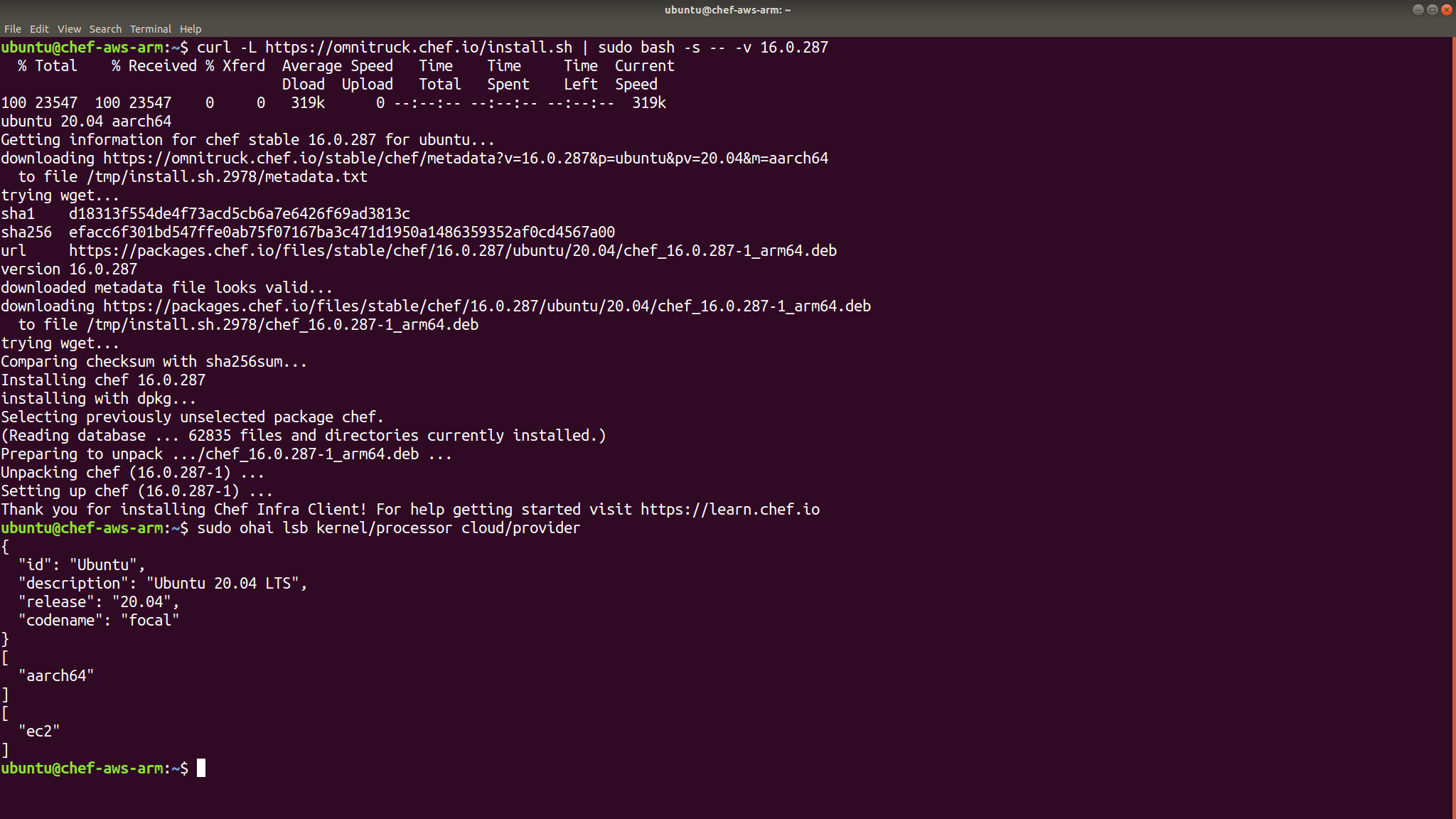
    Chef announced this week that its offerings for managing and testing infrastructure as code now support Graviton 2 processors from Arm on the Amazon Web Services (AWS) cloud.

    AWS this week announced the availability of an M6g instance of processors on its public cloud. Based on a 64-bit Arm Neoverse N1 architecture, the M6g processors were jointly designed by Arm and Annapurna Labs, a unit of Amazon.

    According to AWS, during a preview program platforms such as Honeycomb consumed 30% fewer instances on M6g than the widely employed AWS C5 instances. Treasure Data, a provider of data analytics software, reported a 30% performance increase while seeing a 20% cost reduction compared to similarly sized M5 instances. The Amazon ElastiCache service team found that M6g instances deliver up to 50% throughput improvement over M5 instances on Redis.

    In addition, AWS this week revealed it also plans to add compute-optimized C6g instances and memory-optimized R6g instances based on 64-bit Arm processors.

    The Arm processors in the cloud are expected to provide a foundation for building hybrid internet of things (IoT) applications spanning AWS cloud services and instances of Arm processors that are widely employed in embedded systems. Previously, AWS launched an AWS Greengrass initiative through which it encourages developers to build and deploy cloud-enabled IoT applications on edge computing platforms.

    Vikram Ghosh, vice president of business development for Chef, said DevOps teams can now automate the provisioning of Arm processors using the same Chef tools they employ to provision instances on other types of processors running on the AWS cloud.

    It won’t be long before 64-bit instances of Arm processors start showing up on other cloud computing platforms, noted Ghosh. In fact, between the rise of Arm processors alongside graphical processor units (GPUs) the types of processors readily available in the cloud have never been more diverse, which Ghosh said is driving increased demand for tools to manage infrastructure as code.

    It’s still early days as far as adoption of best DevOps practices to build and deploy IoT applications is concerned. However, the highly distributed nature of IoT applications—which in many cases will need to be updated frequently—lend themselves to being managed more efficiently using DevOps processes. In most cases, these IoT applications represent “greenfield” applications where there is no legacy process in place that potentially would create a culture clash.

    Forecasting demand for edge computing applications in the wake of the COVID-19 pandemic is difficult. However, the general expectation remains that more application code will be moving closer to the point where it is being consumed, especially when 5G wireless networking services become more available. In fact, many of those applications are being built now in anticipation of those networking services being able to connect edge computing applications with backend cloud resources.

    Once those applications are built, the next big challenge will be finding a way to secure and continuously update them. In the meantime, however, the number of edge computing applications being built today in the cloud for edge computing platforms based on Arm processors is about to increase substantially.

  • HashiCorp Extends Consul Service Mesh Reach

    HashiCorp Extends Consul Service Mesh Reach

    HashiCorp today made available an update to its Consul service mesh that makes it easier to integrate legacy and modern applications.

    Service meshes have emerged as a framework for documenting and controlling how application services interact with one another. Most of the adoption of service meshes thus far has involved applications built using microservices. With potentially hundreds or even thousands of microservices to manage, a service mesh framework becomes essential.

    HashiCorp Consul 1.8 extends the reach of the Consul service mesh by making available additional gateway and compliance features that make it easier to integrate any service into any mesh, in addition to adding support for audit Logging and single sign-on (SSO) capabilities.

    Amith Nair, vice president of product marketing for HashiCorp, said organizations that adopt Consul can apply a service mesh to both microservices and monolithic applications. That approach also eliminates the need to deploy a service mesh such as Istio, which only works when deployed in conjunction with a Kubernetes cluster.

    In general, Nair said Consul enables IT organizations to gain the benefits of a service mesh without being required to retire existing application services or manage them in isolation from modern cloud-native applications.

    Longer-term, Nair said HashiCorp expects an ecosystem to develop around Consul as technology partners extend the core capability of a service mesh to add, for example, application firewall services.

    It’s too early to say to what degree IT organizations will embrace service meshes as a technology. However, as IT environments become more complex many enterprise IT organizations are shifting toward managing services rather than individual applications. That approach enables IT organizations to align their IT strategy more easily with specific business outcomes.

    At a time when many organizations are also trying to accelerate a transition to digital business processes in the wake of the COVID-19 pandemic, most of those digital business processes are typically a collection of loosely coupled application services that could be managed via a service mesh.

    Nair said while it’s still early in terms of adoption, most enterprise IT organizations are now at least aware of what a service mesh does and why they might need to deploy one. The challenge, of course, will be getting IT organizations to prioritize the deployment of a service mesh when many IT budgets have become suddenly constrained. It’s also not clear who inside of those IT organizations will fund service mesh projects, which benefit a variety of application projects—application owners tend not to directly fund centralized IT management services, which leaves it up to IT leaders to fund. The challenge is, most IT budget dollars are already allocated.

    In the meantime, developers will continue to embrace everything from Kubernetes to serverless computing frameworks. However, the rate at which new applications are deployed generally far exceeds the rate at which applications are retired. As such, IT organizations should expect to find themselves managing a wide array of different types of application services for many years to come.

  • Cisco Aligns With Google to Meld DevOps and NetOps

    Cisco Aligns With Google to Meld DevOps and NetOps

    The extension of a partnership between Cisco Systems and Google to drive tighter integration between their respective software-defined wide area network (SD-WANs) offerings and cloud platforms promises to accelerate the convergence of NetOps and DevOps.

    John Apostolopoulos, vice president and CTO for Intent-Based Networking Group at Cisco, said in the wake of the COVID-19 pandemic it’s clear more organizations will be employing SD-WANs as an alternative to virtual private networks. Many of those SD-WAN deployments, however, will be on public clouds rather than in a traditional on-premises data center, he added.

    As that transition occurs, DevOps teams will increasingly invoke SD-WAN services via application programming interfaces (APIs) residing in the cloud to provide users with access to cloud applications, noted Apostolopoulos.

    Cisco and Google have a technology alliance in place that spans everything from Kubernetes to cloud management software. That partnership is now being extended to include forthcoming deployments of Cisco SD-WAN software on Google Anthos, a cloud platform based on Kubernetes that can be deployed on any cloud or on-premises IT environment, sometime in the first half of 2021.

    The availability of SD-WAN services from Cisco on multiple cloud platforms will naturally have significant implications for NetOps teams. Rather than having to manage individual routers and switches, the future of SD-WANs is moving more toward being a set of software services that are programmatically invoked. It’s not clear to what degree NetOps teams might be folded into DevOps teams as that transition occurs. IT teams will always require networking experts to optimize networking services to one degree or another, said Apostolopoulos. However, the days when DevOps teams had to wait days or weeks for a NetOps team to manually provision network services on their behalf are coming to an end.

    Apostolopoulos said in the wake of the COVID-19 pandemic, flexibility has become a highly prized IT asset. As such, more applications will soon be deployed in the cloud than ever. Cisco is betting that rather than having to manage multiple cloud network services, more organizations will prefer to extend enterprise networking services from Cisco across multiple clouds. That approach will enable IT organizations to more easily centralize the management of network services via a management console built on top of a consistent set of APIs, he noted.

    Just as importantly, Cisco will provide the integrated tools needed to secure those network services, added Apostolopoulos.

    In effect, Cisco is betting that enterprise IT organizations are going to consolidate networking and security services as part of an effort to reduce the total cost of IT. Cisco may not always be the least expensive provider of an individual router or switch. However, the total cost of integrating networking and security offerings from multiple vendors can add up quickly. The degree to which organizations have the political will and economic capital required to achieve that goal, of course, remains to be seen. Nevertheless, it’s also clear that maintaining the current networking and security status quo is not going to be able to hold for very much longer.