Category: DevSecOps

  • Catch Emerging Security Risks Earlier by Leveraging Kubernetes Audit Logs

    Catch Emerging Security Risks Earlier by Leveraging Kubernetes Audit Logs

    When a Kubernetes deployment suffers a security breach, it can be difficult for security teams to diagnose and identify the source of the intrusion and its impact. Each Kubernetes cluster may host multiple applications, and each application may be composed of dozens or even hundreds of interacting microservices deployed as pods.

    The complex and dynamic communication between the applications’ components, as well as the automated Kubernetes orchestration activities, makes it difficult to understand the structure of each application and differentiate between normal behavior and malicious behavior from the observed network activity. The ephemeral nature of pods, which may exist only for moments to perform an activity before they are disposed of, makes this task even more difficult. A pod that was vulnerable may be gone by the time security teams are investigating a breach, or resume normal operation as the attacker pauses its abuse or pivots or escalates the attack to another Kubernetes resource.

    K8s is by nature dynamic, flexible and scalable, and it is this same advantage for cloud native application developers that becomes a challenge for security professionals. How can one understand the source of a breach, let alone how it propagated through the system, without deep understanding of the architecture of the application?

    One solution to the problem of tracing breaches is to examine the Kubernetes audit logs since they record all cluster-administration activity, even for pods that may have existed for seconds and are now gone. But K8s audit logs are complex and often convoluted, requiring deep expertise to understand. Therefore, security teams need to not only increase their proficiency with K8s audit logs, but also to apply automation and software tools to the K8s logs to detect suspicious behavior after the fact and even during their occurrence.

    In fact, there are many potential threats that can be discovered when observing audit logs for suspicious behavior. They include:

    • Stolen or misused credentials, enabling hackers to gain access to K8s-based clusters or pods.
    • Misconfigured Rules Based Access Control (RBAC), enabling lateral attack propagation, privilege escalation and unauthorized data access or manipulation.
    • Exploitation of vulnerabilities in the Kubernetes API Server, enabling bypassing of authentication, authorization, admission control or validation of cluster administration requests. This lets users gain access to privileged and sensitive resources.
    • Violations of security policies diverge from compliance requirements and best practices.

    Detect Breaches in Near Real Time by Watching K8s Audit Logs

    There may be a vast time span between an initial breach and the detection of the compromised application or the unauthorized access of secure data and private information. Security teams must seek to close the gap between a breach attempt and its detection as much as possible, while still being able to diagnose the causes of a breach after it has been detected and assess its scope and impact.

    Since K8s deployments can be vast and intricate, machine learning and artificial intelligence are preferred tools to monitor audit logs and flag suspicious behavior. An automated tool could continuously scan logs to learn what normal behavior looks like in the company’s clusters, and then flag network behavior that is unusual or suspicious for security teams to qualify, prioritize and investigate. This methodology would enable security teams to investigate possible security violations in near real time to protect and secure the applications.

    In addition to detecting security risks, security tools that leverage K8s audit logs should provide reporting that is easy to understand and consume by security teams. By providing the correct user experience, companies can make their K8s logs accessible to more than the hard-core experts, effectively opening a new vista of security possibilities for more security professionals. The difficult learning curve of Kubernetes will no longer be a wall between K8s pros and newcomers with less experience, relieving pressure from understaffed security teams.

    Step Up to Security and Compliance Needs

    As Kubernetes moves toward the mainstream, with roughly 71% of Fortune 100 companies using Kubernetes as their main container orchestration tool, companies must also look toward compliance with standards and government regulations designed to protect financial transactions and private or personal information such as PCI, GDPR and HIPPA. The penalties for violating these standards and regulations can be severe, so companies should proactively adopt K8s audit log monitoring as a way to identify breaches earlier, to limit their impact on customers and data, and to document the behavior of the application and would-be hackers for possible legal inquiries. An effective audit log strategy will be vital in determining what happened in the case of a breach.

    Leverage Audit Logs for Real-Time Security Observability in K8s

    Many tools exist to secure the perimeter of the data center and to identify possible security risks during application development. The benefits of analyzing and leveraging Kubernetes audit logs at runtime have been relatively overlooked. K8s audit logs are a prime way to comprehend the behavior of any cloud-native application orchestrated by Kubernetes, as well as the best way to comprehend how the Kubernetes infrastructure itself can be abused by an attacker to compromise the applications it is hosting. As such, security teams have a responsibility to deploy tools and gain a proactive, real-time view into K8s audit logs in order to minimize the time between breach and remediation and to validate compliance conformance at runtime. Such a thoughtful approach to Kubernetes security will go a long way to protect your deployments from harm.

    To learn more about containerized infrastructure and cloud native technologies, consider coming to KubeCon + CloudNativeCon EU, in Amsterdam. The CNCF has made the decision to postpone the event (originally set for March 30 to April 2, 2020) to instead be held in July or Aug. 2020.

    — Nitzan Niv

  • The DevOps Sweet Spot: Inserting Security at Pull Requests (Part 1)

    The DevOps Sweet Spot: Inserting Security at Pull Requests (Part 1)

    Today’s organizations are increasingly benefiting from the modernization of the software development lifecycle (SDLC), including the adoption of cloud, DevOps, Agile methodologies, containers and more. Thanks to this modernization, organizations are innovating and releasing updates faster than ever before. But these benefits aren’t without challenges.

    Application security arguably tops the list of challenges. Security has inherently manual bottlenecks, and is unable to keep up with the pace of automated DevOps pipelines. The result is that security is often left behind, overlooked or simply ignored in the development process. Developers aren’t willing to slow innovation down today for the potential of security breaches tomorrow.

    As a result, more and more applications are being shipped into production with vulnerabilities and security flaws. Today, most of the vulnerabilities are found in post-production either via red teams, bug bounty programs or siloed and irregular code analysis scans. At best, these vulnerabilities are fixed in the next version that’s shipped. At worst, your organization is making headlines for millions of personal records being breached.

    However, security in the modern SDLC is becoming more symbiotic thanks to two key advancements—speed and accuracy. Overcoming these two challenges enables security to be inserted into developer workflows earlier than ever before. By automating security with every pull request, development organizations can finally embrace security without slowing down innovation.  

    Automation — Security at the Speed of DevOps

    These days, many vendors claim to insert security into DevOps pipelines, often during the build. While it’s true that security scans may be automatically started, they still finish in siloed processes that don’t keep up with the pace of releases. We call this “automation for automation’s sake.” It does not measurably improve defect density, slow the accrual of technical debt or reduce mean time to repair (MTTR). The only value that automating this way provides is checking a box on a compliance form.  

    So, how can organizations more effectively automate security quality decisions? 

    First, security tests and scans need to be dramatically faster. Legacy code analysis takes such a long time that many vendors recommend sacrificing comprehensiveness by scanning only differentials. Even then, they still aren’t fast enough to keep up with CI/CD. It goes without saying that organizations cannot meaningfully automate security into processes such as builds or pull requests, that take just a fraction of the time.

    Second, the results need to be more reliable. The goal of security automation should be to fail insecure code. However, historically, code analysis tools are plagued by so many false positives that no code would ever pass any test. Only with reliable results can insecure code be confidently failed. 

    Third, security scans must be comprehensive as false negatives lead to vulnerabilities going undetected into production. This is, in part, because developers are not asking the right security questions when scanning their code. Traditional code analysis tools leverage pattern matching techniques—they look for symptoms of a vulnerability that are common across all code bases. For example, lack of input validation from sources is a classic cause of injection vulnerabilities. However, there are many vulnerabilities that are unique to each code base, such as business logic flaws, data leakage, hard-coded literals and insider threats.

    For example, all applications are purpose-built to meet specific business needs, meaning vulnerabilities may go beyond coding errors and present themselves as business logic flaws in the design of an application. Take the First American Financial breach. Thanks to an insecure direct object reference (IDOR), an attacker has the potential to manipulate an internal implementation object. In the case of First American Financial, this was a URL or form parameter. Given the asymmetrical advantage that attackers have, defenders must protect from all possible vulnerabilities, but attackers need to only find one vulnerable route. As such, partial security can be as problematic as no security.

    Only when security is completely comprehensive—reliable enough to fail with confidence and fast enough to keep up—can it be meaningfully automated into developer workflows without slowing them down.

    Yet, comprehensive security scanning is only part of the equation. In the second article of this series, I’ll dig into where these security scans should be taking place in the development cycle to make them most effective.

    — Chetan Conikee

  • Better Apps and Better Security When You Shift Left

    Better Apps and Better Security When You Shift Left

    Tens of thousands of people and hundreds of cybersecurity vendors descended on San Francisco at the end of April. While the RSA Conference was the primary draw, there are a number of peripheral events that go on throughout the week as well, such as the Cloud Security Alliance Summit, the CIO/CISO Interchange, BSides San Francisco and the Qualys Security Conference.

    I was able to attend some of the Qualys Security Conference and I had the opportunity to see Alex Mandernack, security solution architect for product management at Qualys, presenting on the need to shift left when it comes to cybersecurity.

    Mandernack outlined some of the issues organizations face today when it comes to security. Migrating to the cloud and embracing DevOps culture means more ephemeral, elastic environments and compressed development time frames. He pointed out that these trends make security more challenging, but also described the opportunity they present to change our approach to streamline and improve security.

    The Traditional Pipeline is Broken

    The traditional model of application development is much more linear. Each app team builds their own image—often in a silo or vacuum disconnected from other teams. Penetration testing is conducted on a sporadic or infrequent basis, and eventually the app is deployed. Vulnerability scans are run on the app in production, and issues or deficiencies are reported back to the developers to address or incorporate into the next build.

    The process is slow and cumbersome. It also has the potential to introduce redundancies that waste resources and make the organization less efficient. As companies embrace DevOps and move to the cloud, the traditional development pipeline simply doesn’t work—especially not for security.

    DevOps, and Cloud, and Containers — Oh My!

    The cloud and DevOps fundamentally change the development lifecycle. Development time frames are compressed, and the process is a self-feeding, iterative circle rather than a repeating linear approach. The traditional approach of identifying and resolving security issues after an application is deployed won’t work in a DevOps environment because by the time issues are identified and fixed, the app itself may have already moved on to the next version.

    Cybersecurity and the development pipeline have enough challenges with the cloud and DevOps, but there is also a newer technology trend that exacerbates the problem—containers. Containers are designed to get code quickly and to operate fast. They are also built for scalability—spawning and spinning down hundreds or thousands of containers constantly to keep pace with demand.

    There is a diverse array of tools and platforms associated with cloud, DevOps and containers. Organizations often employ a complex collection comprised of some combination of AWS, Azure, Docker, Kubernetes, OpenShift and others. The result can quickly become a black hole when it comes to security—which is why it’s important to push security left into the CI/CD pipeline.

    Shift Left to Help Security Teams Do Better

    In a DevOps culture, developers and security teams need to think about security sooner. It’s important to get the security tools into the process earlier. Thankfully, with the DevOps lifecycle and the tools commonly used within a DevOps environment, it can be done.

    For starters, companies should build a golden image. Developers shouldn’t have to patch and update the base operating system before they even start developing. The golden image takes a baseline operating system such as Ubuntu or CentOS, and completely patches and configures it so everyone has a standard, consistent image to develop on.

    With the golden image in place, the next step in shifting security left is to implement testing and scanning in the CI/CD pipeline. Put vulnerability information at the fingertips of developers as they’re developing and implement vulnerability gates in the pipeline to ensure that applications that don’t comply with policies and meet minimum requirements are not allowed to be deployed.

    New Role of the Security Team

    Part of shifting security left includes providing tools that make security self-service for the DevOps team. Automating actions with scripting, APIs and CI plugins ensures that security is simplified and streamlined to provide value for developers.

    In this shift left scenario, the security team has to redefine its role in the process. The security team is still vital, but rather than being the police or a roadblock in the development process, the role of security focuses on verifying and auditing the process. The security framework should have dashboards and live data that enable the security team to monitor activity and identify trends that may need further attention.

    Better Security, Faster

    There is often conflict between developers and security teams, but there doesn’t need to be. Mandernack stressed that developers don’t want to create insecure apps either.

    Shifting security to the left into the CI/CD pipeline streamlines the whole process. Ultimately, the result is higher quality, more secure applications that are developed faster.

    — Tony Bradley

  • EP 2: DevSecOps and AppSec

    EP 2: DevSecOps and AppSec

    In this second episode of our DevOps Unbound streaming broadcast on TechStrong TV and devopsy.kinsta.cloud’s sister site Digital Anarchist, Mitchell Ashley of ASG and Alan Shimel are joined by Caroline Wong, CSO at Cobalt.io; Andrew Van Der Stock, executive director at OWASP; and Dr. Grigori Melnik, CPO at Tricentis, to discuss DevSecOps and application security.

    The video is immediately below, followed by the transcript of our conversation. Enjoy!

    Transcript

    Alan Shimel: Hey, everyone. This is Alan Shimel, and you’re watching DevOps Unbound. This is episode two of DevOps Unbound, and on our show, which airs biweekly with a monthly roundtable open to the public, we explore topics in DevOps. You know, if it’s DevOps-related, it’s fair game. Today’s topic is DevSecOps, and I realize that DevSecOps has become sort of a mouthful, intrinsically linked into AppSec now and everything we do around that.

    We’re gonna explore today about really, security—whose job is it, anyway? Right? Who, ultimately—there’s a lot more developers, DevOps testers than there are security people, and we increasingly rely on them to make sure our applications are secure, are being developed and released and maintained as securely as possible. And we’ve got a great panel of experts to talk about this today.

    I want to quickly mention, though, this is episode two; episode one aired two weeks ago, and we will be doing our monthly roundtable, so stay tuned on that.

    But let me now introduce you to our panel. Joining me first is Founder and CEO of Accelerated Strategies Group, my partner and friend, Mitch Ashley. Mitchell, welcome.

    Mitchell Ashley: Thank you, Alan. Great to be on with you and with this great panel.

    Shimel: Yep. The rest of the panel, I’m gonna just say their name and who they work or, and if you can give a little bit of your background. Let’s first start with Andrew van der Stock. Andrew, welcome, and if you can introduce yourself.

    Andrew van der Stock: Good day. My name is Andrew van der Stock, I’m the Executive Director of OWSP. I was recently appointed to that role, and I’ve been doing application security since 1998. When we first talked about application security, it was called mobile security, because, well, it was applets and ActiveX controls that were running in browsers. So, it was a rather exciting and very different time.

    Shimel: That took me back—yes, it did. Next, the one and only Caroline Wong. Caroline, you want to introduce yourself?

    Caroline Wong: Hi, Alan. Thank you so much for having me on today. My name is Caroline Wong, I am the Chief Strategy Officer at Cobalt.io. We’re a company that builds security software. I’ve been in infosec now for 15 years, starting out at eBay and Zynga, some of the original DevOps companies, if you will. I also do a podcast called Humans of Infosec, and I’m a LinkedIn learning instructor for the OWASP 10. Almost 10 years ago now, I published a book called Security Metrics: A Beginner’s Guide.

    Shimel: Very cool. And a fantastic speaker, too, I may add. I love watching Caroline present. And then last but not least, a holdover from our first episode of DevOps Unbound, Dr. Grigori Melnik, Chief Product Officer at Tricentis. Grigori, welcome.

    Grigori Melnik: Thank you, Alan. Thanks or having me back and hello, everybody, wherever you are in the world. Yes, as Alan said, I’m the Chief Product Officer of Tricentis, the continuous testing platform and company that’s building the testing tooling for the future. And previously, I’ve been at Splunk, so this is where, actually, a lot of my kind of security mindset has been forged; also, MongoDB and Microsoft. So, good to be here with this panel

    Shimel: Excellent. So, let me start things off and then we’ll be off and running. Andrew, as the Executive Director at OWASP, right, there was a time where, clearly, the OWASP member, the user, the person who was gonna, who you were existing for was the security professional who was in charge of, you know, as you called it, mobile app security and then, of course, appsec has become all the rage probably for the last at least 12 years, right? Appsec is, a lot of people say if it’s not appsec it don’t mean a thing, when it comes to security.

    How has the rise of DevOps, DevSecOps as some call it, some not, how has that kinda changed who you serve, or who does—not you, personally, obviously, but OWASP—who do you guys cater to?

    van der Stock: So, that’s actually really interesting. I had a conversation with Mark Curphey, the Founder of OWASP, a little while ago as I was appointed. And the original thing the OWASP folks worked on was the developer guide, which, it’s a developer guide or developers. And the reality is, is that we missed. We stopped talking to developers. We became very, very internally focused, and we’ve converted the vast majority of the infosec folks to the fact that apps are the firewall. I’ve done almost all my pen tests through firewalls and over SSL. So, the reality is, is that the application has always been the firewall. We should have been talking to developers much earlier than this.

    My personal opinion is that the thing that OWASP has to do right now is to refocus on talking to developers and having tools and information they can actually use in their toolchain. If we’re constantly just having that internal echo chamber conversation, we will fail. And it’s really important to me that we actually start doing more stuff like the OWASP dependency check which can be pipelined, GitHub actions and things like that. These are where we need to start focusing, not on .pdfs, as the person who does the OWASP Top 10 and the developer guide and the ASVS, .pdfs are probably what we’re famous for, but the reality is, developers don’t know of it, they don’t use it.

    I really want us to get involved in Stack Exchange. The number of people who post to Stack Exchange, just to copy and paste stuff, and that information is just wrong? It’d be really great or people like the volunteers and the chapters and the communities to get involved in things like Stack Exchange and other places where developers hang out.

    Shimel: Excellent. I didn’t realize that the original focus was developers. Caroline, you’re in a funny place because you’re Chief Strategy Officer at a security tools company and of course, as you mentioned, you’re a LinkedIn—not professor, LinkedIn teacher or whatever the exact term is around appsec and OWASP. How does that, you know, what Andrew said, how does that jive with what you guys, where you guys see the world.

    Wong: Yeah, so, you know, when I started my infosec career at eBay and Zynga, in both cases, these were companies that were running online operations 24 by 7, with millions of simultaneous users daily. And so, it was always clear to us that we had to get it right when it came to talking with the developer.

    A couple of years before I began my career in infosec in 2003, the first version of the OWASP Top 10 was released. And right now, I wanna say we’re on version 6 or so. Andrew has been spearheading this project for a long time and we’re actually looking at the next revision coming out in February, 2021. If I look at the most recent version, which is 2017 RC2, and I compare that to the original OWASP Top 10 that came out in 2003, one of the things that’s very striking to me is that at least half of the stuff is the same.

    So, that says to me that, on some level, some of these basic security fundamentals that I think appsec practitioners understand are not either being implemented by developers and where is that disconnect? So, I actually think that, as an industry, appsec tends to focus on sort of the hot and sexy things, which is, like, finding cool stuff and really interesting sort of sophisticated breaks.

    But I think that, if you were to look at, for example, the past year or so, you know, if you look at the 10 largest data breaches, I’d be willing to bet you that the majority of those occurred because of something that had to do with, like, a Security 101, basic kind of thing gone wrong. And that tells me that we’ve been really focused on technology, and actually, the hard part is getting the people and the process to work out together.

    So, that’s something that I think a lot about, and I think it really speaks to the core of what we’re addressing today, which is—whose job is it? You know, a security person can find all the vulnerabilities that he or she wants. Until that security person is effective at communicating what the security vulnerability is to a developer who can actually fix it and convincing that individual that it’s a priority enough to actually spend time remediating, then the code will never be more secure.

    So, it’s always needed to be a partnership, and I think that, you know, these days, because of things like the transition of software development methodologies from waterfall to agile to DevOps, I think that culturally, we’re beginning to see some changes.

    van der Stock: I just want to highlight one of those choices that you said.

    Shimel: Oh, I’m sorry—go ahead, Andrew.

    van der Stock: Realistically, the thing that I see as the OWASP Top 10 leader is, it’s self-referential. The things that people pay attention to is the things in the OWASP Top 10. And, in fact, CWE is, the MITRE Group are about to release the CWE Top 25 in a few weeks’ time, and it’ll look like the last one in 2011. And this is really sad, because people are actually concentrating on these.

    What we really need is for developers and security people to work hand in hand, and I would like to see the security folks stop delivering .pdfs and start delivering, you know, pull requests. If you can fix the problem, you don’t have to convince anyone. If you actually start talking in developers’ terms and actually convince the product managers that this is the right thing to do, we’re gonna be a lot more successful than just saying, “Look, your baby is very ugly.”

    Ashley: Andrew, bless your heart—bless your heart. [Laughter] That’s something I’ve advocated for. It’s not that, necessarily, security people have to become the expert software developers, but I think we’ve sort of done this to ourselves by thinking security as a penetration activity, right, something that we’re testing from the outside. I mean, now we’re talking about very porous software architectures and API security and Kubernetes container security. It’s a much more different world than even 5 or 10 years ago.

    So, what I’ve advocated for—and it’s a little bit scary at times, but advocated for security people to learn software architecture, whether they learn how to code or not. But they need to understand what’s going on inside the m&m as well as the outer hard shell, if you will. And, you know, one way to do that is to bring software people into security groups. You don’t have to go learn it all yourself, you can learn from other people and bring in skills, as well.

    But to your point, you know, it’s not an after the fact thing, it’s gotta be right there in the flow and the process. If it gets fixed as soon as you find it because it’s a priority—great. If it’s a day to a week, month later—forget about it, it goes into the prioritization process and it may be months or quarters before it gets fixed.

    Shimel: Grigori, we’re all looking at you, man.

    Ashley: [Laughter]

    Melnik: Yeah, I was ready to jump in to talk to Caroline.

    Shimel: Go ahead.

    Melnik: Because what she said absolutely resonated with me, and then what my other esteemed colleagues just added to it, you know, rings the bell. Because, you know, I always looked at the security—and again, for a very, very long time, I was focusing predominantly on the developer audience, ________ engineer and then the development teams, platforms, tools, and all of that. And, you know, kind of designing for security something that’s been a focus of the teams that I was part of. Starting from, you know, as early as back at the beginning of the century with the Microsoft, if you remember the early days, having the disastrous year 2000, 2001 with lots of worms and breaches and —

    Ashley: [Cross talk] virus —

    Melnik: And then, you know, the bagman CTO, Craig Mundie had the internal initiative that later turned into the actual company-wide letter from Bill Gates, Bill G. himself. And that was the beginning of what’s known as the Trustworthy Computing initiative, which was company-wide. Again, we’re talking about tens and tens of thousands of people had been trained regularly, not just once, but on a regular basis on the fundamentals of security, on design with security. The whole life cycle, we even didn’t talk about SDLC, software development life cycle, we’re talking about secure software development life cycle and all the practices that came from it.

    And it actually beared the fruit, right? Because in general, you look at the history and how much more secure, you know, Windows and Microsoft has become—that’s actually, you know, the results of those early initiatives, right? So, by the same token, I think that when we’re talking about security and whose job is it anyway, we need to start from the ground up. And maybe even before the junior developer, maybe even at school, right, if you think about software engineering schools, boot camps, whatever format you are learning your code in, it’s super important to be introduced to those secure practices, to be aware of the patterns and anti-patterns, right?

    Like, I think ________ and ACM, the official ones that define the curriculum, they had included, for years, the topic of software security in there, but realistically, how many graduates of computer science degree has actually dived somewhat deeply in it, right? It’s amazing that now it’s been so many, what, two, three decades that we talk about, you know, design for security notions and trustworthy computer initiatives, and we still see what Caroline said, the Top 10 breaches—you still see something as basic as a SQL injection attack, right? Cross-site scripting—all that stuff that is almost, you know, I view it as part of developer hygiene, right? It’s just something that you do fundamentally.

    It’s like, these days, it’s not something that developers, we don’t even have this conversation, should developers write their own tests or not? Well, by the same token, there should be no conversation, should developers think about threat modeling, should developers think about, you know, various mitigation strategies? Should they get involved more with the security specialists when it comes to defining or going through the release gate. And yet—and yet, when you look around, those secure practices still hasn’t made into, you know, the mainstream as much as I would’ve liked it to happen.

    So, I don’t know what you guys think if there are some other ways to—it just feels like people start looking at it only when the breach occurs and the you’re facing a massive litigation, right? It’s like—but it’s too late, right? We need to think about all this ahead of time. And, of course, everything that OWASP is doing and other organizations and kind of advocating for security, promoting the secure mindset, this whole movement of DevSecOps, I absolutely welcome it. Because anything that we can do to make developers and everybody on the team to think about security early on as opposed to the afterthought is a good thing.

    Ashley: I have a question or the panel. You know, these vulnerabilities have been around, as you mentioned, Cynthia and Andrew—

    Shimel: Caroline, excuse me.

    Ashley: – Caroline, sorry—forever. And you know, it’s not like we don’t know what they are. You know, we have really smart ID environments that will bring up the objects and what all the methods and parameters are. Isn’t there something we can do, either through AI or just in the tool side so when we’re creating software we have fewer of those basic vulnerabilities, is that—

    Shimel: Spoken like a real security person! I think that sounds too magic bullet to me, but Andrew, go ahead.

    van der Stock: I want to give Caroline some time to answer this, because there’s actually some things I wanna talk about education underneath from Grigori’s talk before. But fundamentally, we need to take the OWASP Top 10 to frameworks and say, “These are the things you must not have—end of story, done. You must not have these.” And then the developers don’t have to think about those other things, and then they can use the developer tools like OWASP Cornucopia, which is like the elevation in privilege game that Microsoft came up with.

    Do you know what? The reason why we do this again and again and again is, we allow people to use insecure frameworks and they’re not given the guidance they need. If we had engineering students who didn’t know about, you know, wind loads and things like that, we’d never have a bridge that stood up. Yet, we allow our computer science and software engineering students to graduate without taking one single semester of security.

    Shimel: Amen.

    van der Stock: That’s why we established an education committee before, and we have to get people to actually do it. The ACM syllabus is okay, but it is focused on crypto, and we don’t need a lot of crypto folks, we need a lot of people who know how to engineer security properly. Now, I want to hand it over to Caroline.

    Wong: Thank you, Andrew. And, you know, Mitch, I love your question, because I think that one of the things that security leaders must think a lot about is what combination of machines and humans to bring into their application security programs.

    So, anyone who’s only using people is clearly missing out on efficiencies that can be found on machines or implemented, as Andrew was saying, with patterns and pre-written things that people should just be using, HSDS. And anyone that’s only using machines is, on the other side of the coin, missing out on entire classes of vulnerabilities, you know?

    So, I think that, ideally, you know, security professionals are working with development teams to use scanners in order to find low hanging fruit and then using that information to provide context for analyzing the risk that’s posed by those issues. I think it’s absolutely a hand in hand sort of thing, even if one of those hands is a computer hand. And, you know, kinda the more that we can do via automation and by simply using secure libraries, using secure frameworks, you know, that allows the sort of precious and often more expensive human technical skills to be focused on things that can’t be found by machines. Finding things like business logic bypasses, race conditions, chained exploits—those are the kinds of things that people should really be focused on. You know, not things that can be solved by, again, simply, in quotes, because to get folks to actually do it turns out to be a whole, another challenge in and of itself, but I really do think it’s very much the mix of both.

    Shimel: Agreed.

    Ashley: I love the framework idea, too, Andrew, and thank you, Caroline—sorry to mispronounce your name earlier. [Laughter]

    Wong: Just think of “Sweet Caroline” like Neil Diamond and you’ll never forget it.

    Ashley: There you go. What a wonderful way to remember your name. [Laughter] You know, I wonder, too, if you layer on top of putting into the framework, security people love sort of standards like a NIST framework or something like that. If there was something that, “Okay, all of our frameworks must meet this,” right, then that’s gonna get kinda into the process and the psyche of the organization to say, “Okay, we’re only using software that meets blah, whatever that is,” it seems like that’s one more element that would help with the adoption of standardization of that. Is that practical for something like that to happen.

    van der Stock: So, I’ve really been pushing for the idea of the generally accepted security principles, the equivalent to GAAP in the accounting world. There are some fundamentals that we should be trying to do.

    The very, very, very, very first NIST special publication had the OWASP Top 10 in it. It was written in 1976.

    Ashley: Wow.

    van der Stock: It was classified.

    Shimel: Really …

    van der Stock: When it was—yeah. When it was unclassified and I found it, I found it as I was preparing the OWASP Top 10 2017. The only thing that we don’t have in the OWASP Top 10 is race conditions. Those guys had race conditions in the first one in 1976 when there was just mainframes and they only had one processor and they did things in batch. And quite frankly, for them to think that far forward just shows how early those folks were thinking. However, I think we need to make sure that we give the developers time to think about the desire for security.

    I just want to touch back on what Grigori said before, and I think this is where strategy comes into it. When Microsoft, when Bill Gates wrote that memo, they then followed it up with action—executive action. They reset the Longhorn build. Windows 2003 server release 2 is a very different beast in terms under the head than the original 2003. And what was released as Vista was very, very different to what XP was, and that then created Windows 7.

    So, quite frankly, it was—yes, we need support from the top, and we need people at the bottom to understand what this really means. But the fact that they had executive support means that things like SQL server just doesn’t have remotely exploitable bugs today. You know, that is a really good outcome, and it’s because of executive support.

    Shimel: Agreed, agreed. So, you know, we live in a world right now where, quite frankly, without modern applications that we’ve been surviving on these past months with COVID and everything, imagine how ugly it would be without them. But do we really—do we really have that executive support, maybe not to the level of Bill G. and Microsoft and the Trustworthy initiative. But Caroline, at Cobalt, you’re dealing with dozens of organizations, right? Andrew, you know, at OWASP, hundreds of organizations. Grigori, Tricentis has how many customers that you guys are providing—hundreds as well.

    Do you really see that top-down support at most organizations, or was that Microsoft thing sort of a catching a firefly in a jar kind of thing, lightning in a bottle, right? You’re not—we just don’t see that, unfortunately.

    Wong: So, I’ll tell you what. A lot of times, when I think about security, I kind of go back to, like, the principal concept that the only reason security matters is when you have value to protect. And so, these days, naturally, a lot of value is moving from the physical to digital worlds—cyber security is more important.

    I’d actually really like to challenge something that Mitch and Andrew put out with regards to sort of an all-encompassing security framework that says everyone’s gotta do this. Having worked on the ISO 27034 standard, I’ll actually ask if anyone on this panel has even heard of the ISO 27034 standard. Cool, so that’s great, Alan. [Laughter]

    van der Stock: So, I actually tried to provide advice to that when it was coming out, and I couldn’t because I was part of the national organization and that’s the reason it failed.

    Wong: You know, there are a lot of different things, right, and I think that the standards route is one that we’ve been trying. And I think that sometimes it works better than others. What’s really gonna work is the market route.

    So, when Bill Gates wrote that memo, my understanding is that Bill did not do it for any sort of noble pursuit. He did it because he recognized that if Microsoft was going to continue building security vulnerabilities into their products, that they were gonna lose customers, that they were gonna lose market share.

    And so, what’s kind of cool that I see happening when I talk to our customers like VeriFone and MuleSoft and health care organizations and HelpSpot and financial organizations is that, due to the proliferation of cloud and SaaS, today it’s not like you have a CIO who goes and plays golf and has steak dinners with their one big IT software vendor. You know, now, anyone in an organization with a credit card and an Internet connection—buy something and it becomes shadow IT.

    So, the whole concept between these business relationships of trust has been transformed. And what you see is tons of software companies using tons of other software companies. So, every software company is also a buyer of other software products and services, and that business transaction requires a level of trust, where I’m seeing customers asking for things like a penetration test in order to prove that there’s some adequate level of security before a business engagement begins.

    So, my perspective is actually that frameworks are cool and great, education is cool and great. And I think it’s really gotta be the market that drives the power and the adoption and the prioritization of security.

    Ashley: You know, Caroline, there was also—thinking back to the Microsoft example Andrew was talking about—I think an important factor in that was Apple, because they were marketing very heavily as a secure —

    Shimel: That was it, yeah. Microsoft was afraid of Apple.

    Ashley: So, they have competition, you know? And I hate to use the Vista word, but you know, there was some pretty crappy software that had a lot of security vulnerabilities in Microsoft’s code, and that’s—it was the market, as you said, but it was also competition. Because that’s when Apple was doing pretty well or at least rising up in the laptop market.

    Maybe there’s some group of vendors, companies that band together and say, “We’ve got better software because it’s more secure” and that now becomes more attractive. I don’t know, something like that might happen, too.

    van der Stock: So, we just got involved with the—sorry, just really quickly. We just got involved with the Linux Foundation and we just established the Open Source Security Foundation, the Open SSF. And it’s early days yet, but I see that as actually being way more successful than, for example, ISO 27000. Not 27034, which has got very low adoption, but 27000 bakes in a risk-based approach which says the business needs to only do that that it thinks is right and can’t really hurt it. And unfortunately, that then becomes whack-a-mole, whereas the Open SSF works from the other way around that I think, you know, with the participating members of GitHub, Google, IBM, Red Hat, and others, and obviously OWASP, we’re gonna be able to do a lot more there than I think in a traditional standard-setting body.

    Shimel: I wasn’t aware of that organization, Andrew. That sounds fantastic. We’re gonna look into it here and see what we can do to help get behind that—really, really good stuff.

    Grigori, I know you wanted to talk and I’m gonna give you a chance before I jump in.

    Melnik: Oh, no, I was just gonna kind of sum up—so, we talked about the importance of frameworks, we talked about the importance of market forces driving these secure initiatives, now the new organizations that have been put in place. But I am still convinced that it’s the developer’s mindset that needs to do sort of the most in order for us to be, you know, winning in this space.

    So, doing whatever it takes to take them, take us, the developers, the responsibility for security. It seems like somebody else’s job—“Oh, I have this broadsec group that, you know, that looks at the metrics and the static scans and then occasionally does some kind of a penetration test and exercises or whatever and then sends me a bunch of reports, many of which I’ll try to justify as by design.” No. It’s like, as I’m doing my job, day in and day out, to be thinking about the security, to be thinking about, “Okay, what are the different ways how it can be breached?” and again, making it part of my daily routine, I think, is important.

    I can tell you, internally, at Tricentis, I kind of, I’ve been in the process of launching this Trustworthy Computer Initiative, because we have opportunity to improve in this space, big time. But I can tell you, even with some easy things where, you know, we do things like hackathons, right? Not everybody participates in the hackathon, right? So, what we did at MongoDB, I actually loved it, and that actually did require a little bit of effort, but we had our Product Security person put together this type of competition, kind of catch the flag where you would actually have this increasing set of security challenges where you would have to go and break in or identify all these different holes and then, of course, reflect on that.

    And actually, that raised awareness of many, many, many, many developers. So, I’m just thinking about what can we do with, you know, the small wins, small initiatives, not necessarily at the level of defining the major standards and pulling the big initiatives, but in this kind of a baby steps to move the needle, I think, is important. The other point —

    Shimel: I got—oh, I’m sorry, go ahead, Grigori. I was just trying to get to my next place in line, but you go.

    Melnik: Ah, okay. No, the other point I was going to make is that I also think that, for the future of the Internet becoming safer and securer and all of our systems, the other dynamics or the other initiative that I’ve seen happening and getting more and more popular, this whole collaborative testing or collaborative secure, you know, that companies like Hacker One is doing by engaging the white hat hackers in kind of—

    Shimel: [Cross talk] and stuff.

    Melnik: – inviting them. In fact, inviting them to go and launch the attack, but for the purpose of learning and raising awareness. And even, you know, if you look at the Department of Defense and Pentagon, inviting hackers to hack into the Pentagon systems, I mean, if you think about it, 20 years ago, that wasn’t heard of, right? But what they’re doing there is that, actually, they’re making sure that you get all these diverse perspectives, that you’re not only looking through the narrow angle of your Security Department, but this broader community at large participating; i.e., I think that there’s some hope at the end of that tunnel with the right level of engagement with those collaborative testers, white hat testers that the overall security posture of the Internet, of the world will be improved.

    Shimel: I think bug bounties have certainly been a game changer. I don’t think anyone disputes that. But I’m gonna tell you something I’ve learned in my 20 plus years in security. And that is, security, as much as we may want to think of it as not a different animal than many other disciplines within IT and in business in general, and market forces—market forces rule, right? So, security becomes important when the business decides security is important, right?

    I remember, you know, having a conversation—I did a podcast with the CEO of MongoDB and Couchbase and Rich Mogull, who I think most of us on the panel probably know Rich. And this is 10, 12 years ago on Network World, I was writing, and I asked those two CEOs, I said, “Does NoSQL stand for no security? Right, because we don’t see a lot of security in the”—this was a long time ago. And they both said they agreed, they said, “Alan, we will build security in, more security into our products when our customers demand it. Right now, customers are more enthralled with having this new type of non-relational database, NoSQL, you know, database that allows us to be more flexible, faster, scalable and all that, we’ll get to security, right?

    A couple months later, MongoDB had a pretty decent breach. Microsoft is a great point. Apple was starting to kick their butt, and the word on the street was, even though Microsoft gave you free AV, maybe, you didn’t need AV on Apple. Remember those commercials? “I don’t need AV, I run a Mac.

    And so, it’s over and over. When we make security important, you know, Grigori, you guys are the leading continuous testing provider in the world. When your customer starts saying, “Grigori, we’ve got to test for security as well, because that’s part of our quality, right, that’s the Q in QA and we need Tricentis to give us those tests and you go to companies like a Cobalt or you go to the organizations that Andrew’s talking about and stop building that in there, because your customers demand it. Not because it’s the right thing to do, not because it’s a nice thing to do, because it’s demanded, then you’ll see how quick developers take security seriously.” It’s the market.

    Melnik: And it is happening. Alan, it is happening. The customers are, absolutely, they are, you know, demanding this. They want to see the evidence and they want to see, they want to have the tools and, again, everything from security testing and static analysis, but a lot smarter, you know, augmented with ML to dynamic analysis and actor-based models and, you know, penetrations and all the way to compliance, right, and a lot of other things.

    And you’re absolutely right. I mean, with, back to the days of MongoDB when the initial releases were not very secure, because the idea—they were optimizing for the wrong thing. And this is what I fear was ________. They’re optimizing for adoption. It’s like—get me as many users as possible. How do you get as many users as possible? You lower the entry barrier. Now, if you lower the entry barrier, then automatically, that means that you’re sacrificing some security, right? Just like, again, allowing and opening up the ports and local hosts with MongoDB and all of it in the old days, that’s what had happened. Now, all of that has been tightened. You know, you had the security of trust, you have the security in transit, they’re doing all kinds of phenomenal stuff with encryption, fill level encryption, all of it, but it took like a decade to get to it, right?

    When you are at the beginning, you’re putting something in there and you’re trying to win in that race to get more of the magic number of MAUs, right, the monthly active users, a lot of companies and a lot of startups, unfortunately, tend to sacrifice security for that speed to market and user acquisition, and then bites them later, right? So, again, if there is some way to raise the awareness and to think about it early on so that you don’t end up with the unpleasant situations later on, I think that’s something that could change the world.

    Shimel: Agreed. Panel, we are, we’re getting near the end of our time, and we have such shy wallflowers here, no one wants to talk. [Laughter] So, I know how long it’s gonna take us to wrap up. I’m gonna give you each a closing, if you will. We’re practicing for the debates, here. We’re gonna give you each a chance to leave the audience with the most important thing you want them to leave. And Andrew, also—is it called the Open Source Security Foundation, OSSF?

    van der Stock: Open SSF, yeah.

    Shimel: Open SSF?

    van der Stock: So, the Linux Foundation—yeah, the Linux Foundation announced it.

    Shimel: Is there a website yet for that?

    van der Stock: Go to the Linux Foundation first, and then you’ll find it. It’s one of their initiatives. I don’t know that there’s a special site for it.

    Shimel: Alright, love to hear more about that. But Mitchell, do you wanna start off and we’ll—your screen’s different than mine, but on my screen, it goes Mitchell, Grigori, Andrew, and we’ll let Caroline bring it home.

    Ashley: Okay, great. I’ll make mine brief. I’m actually very optimistic, and I mean this with all sincerity, that listening—people like Caroline and Grigori and Andrew, they’re some pretty brilliant people that are thinking about this, and all of you had a different but also shared some perspectives. So, I’m hopeful that we’re gonna make some progress here in the near future, so thank you for working on this problem. That’s what I have to offer.

    Shimel: Thanks, Mitchell. Grigori?

    Melnik: So, I wish I actually wore a different shirt today. I had a T-shirt from Splunk and, you know, they have some clever slogans there, but one of them said, “Ignorance is not a bliss,” and that’s my message to all of the developer community. You know, ignorance is not a bliss. Learn security, get the security mindset embedded, you know, from the get-go, from as early days as possible. The engineering managers think about it accordingly and embed security into your teams early on.

    And then what Andrew said earlier, I absolutely sign up for it, and I love that this whole notion on the side of the security specialists, security experts—when you’re coming in, don’t send me .pdf reports of, you know, 275 pages and 722 vulnerabilities. Pull requests for the win. Pull request wins today. Pull requests, you know, really, really work. Everything else is just talk. So, again, if security specialists can get more into that written and be more embedded and more attuned to what the developers want and need, I think, jointly, again, we will definitely make a difference, so—thanks.

    Shimel: Thank you, Grigori. Andrew?

    van der Stock: So, many, many years ago, we wrote the OWASP Developer Guide and then I think the OWASP Top 10, and I realized telling people what not to do was exactly the wrong approach. We need to tell people how to do what they want to do better to enable secure business.

    So, the application security verification standard, which I work on, is a set of tests. It’s literally written for developers. It’s literally written to be testable. And this is actually, I think, really important. We need to change the mindset from a negative, “you shouldn’t do that” to a positive, “how about doing it this way?” Because sometimes the developers have a better idea altogether and we just don’t know. But many security folks have the mindset, “I know better than you.” But they’re not software developers, they don’t know.

    We need to have a conversation together, and I want to make sure that we’re bringing in developers into the conversation and not treating them as, you know, people who don’t know that much. We don’t know that much, either, and I would like for people to have that bidirectional conversation in a positive, not negative fashion.

    Shimel: Fantastic. Caroline—it’s all yours.

    Wong: Alright, so, the thing that I’d like to leave folks with today is, I’d invite folks to check out the 2020 State of Pen Testing Report, which I wrote and co-authored with my colleague, Vanessa Sauter. One of the topics that we dive into pretty deep in this report is sort of the relative capability of machines and humans to find different kinds of web app security vulnerabilities. In addition to drawing upon more than 2,500 penetration tests, the data of which exists in the Cobalt platform—and Andrew, I did connect with your colleague, Eric, so we’re gonna be donating some data to the next OWASP Top 10 project.

    But in addition to that, we also surveyed more than 100 practitioners in security development, operations, and product across a wide range of industries. And the really good news that I’d like to leave folks with today is that the majority of respondents, in fact, 78%, reported a strong relationship between the security and engineering teams, and we do expect that to grow in the future.

    Shimel: I sincerely hope so. Guys, you know, someone much smarter than me once told me that when you want to impress people and you get in a meeting, you know you got a real great group when everyone there is smarter than you. [Laughter] So, thank you, all. I really felt like we had an amazing—what amazing brain power on this one.

    I want to thank you, all, for joining and contributing. We will try to put in the notes on this one some of the links to a lot of the sites that were mentioned, reports that were mentioned, et cetera. We’d love to have you back on, you know, maybe at some point in the next month or two, we’ll do a roundtable on this topic, we’ll add another person or two. Caroline, I know I had spoken to Chenxi, actually, Chenxi Wang about coming on, so I would—because I like listening to Chenxi talk about security. But anyway, and we’ll open it up to—yep, we’ll open it up to the public for questions and it’ll be a great time.

    But for now, guys, thank you so much. Andrew, best of luck with the new ED position there, and I know they picked the right man for this job, so make us proud, keep making us proud. Dr. Grigori, we’ll see you soon, hopefully on another DevOps Unbound. Okay, and Mitchell, as always—thanks so much. We’ll be in touch.

    This is Alan Shimel. Many thanks to Tricentis for actually sponsoring DevOps Unbound, couldn’t do it without their sponsorship and help, and we’ll see you in two weeks with another episode of DevOps Unbound. Have a great day, everyone.

  • Tenable Allies With Datadog to Drive DevSecOps

    Tenable Allies With Datadog to Drive DevSecOps

    Datadog and Tenable have teamed up to enable organizations to adopt best DevSecOps processes.

    Tenable CTO Renaud Deraison said his company is making the cybersecurity data it gathers via its Nessus vulnerability scanning software available to the monitoring and analytics service provided by Datadog. The goal is to make it easier for DevOps teams to discover and address cybersecurity issues before an application is deployed in a production environment, he said.

    Tenable has more than 30,000 customers, according to the company. Obviously, not all of them have embraced DevOps. However, unless DevOps teams can find a way to incorporate cybersecurity data, it won’t be practical for organizations to define a set of best DevSecOps practices. Even with that data available, Deraison said he expects it may be as long as five years before DevSecOps becomes broadly adopted. Many organizations are going to find a way to make cybersecurity teams part of the application development process. The challenge, of course, is finding a way to achieve that goal without unduly slowing down the application development process. In fact, Deraison said that despite all the hype surrounding DevSecOps at the moment, there still isn’t enough focus on actual workflows.

    Less clear is whether security will become a distinct functional test within a DevOps process or simply be incorporated into an existing quality assurance process. Deraison noted that cybersecurity and quality assurance are really two sides of the same coin.

    In the meantime, Tenable doesn’t have any plans to integrate with any other monitoring tool. The company chose to ally with Datadog because it makes available a set of application programming interfaces (APIs) that are well-defined, he said.

    DevOps teams going forward should expect to see a raft of integrations between providers of cybersecurity tools and various monitoring platforms. That data needs to be made available both when an application is being developed as well as after it has been deployed in a production environment to help developers prioritize bug fixes. Not all vulnerabilities are equal in severity, so it becomes important for DevOps teams to understand which are critical flaws that need to be addressed immediately versus something that can be addressed later in the application development cycle.

    Naturally, the biggest challenge most organizations will face as they move to embrace DevSecOps is melding two very distinct cultures. In some cases, it may prove easier to teach developers the fundamentals of cybersecurity than it will be to teach cybersecurity how to participate in, for example, a sprint. There may not even be enough cybersecurity professionals available to participate in the application development process, given the current chronic shortage of staff. There are already millions of unfilled cybersecurity jobs.

    Precisely what role artificial intelligence (AI) might play in accelerating adoption of DevSecOps has yet to be determined. However, given the chronic shortage of cybersecurity expertise, it’s apparent more organizations are going to have to rely on AI frameworks embedded in monitoring platforms to analyze massive amounts of data in a way that surfaces actionable insights before applications can truly become more secure.

    — Mike Vizard

  • The DevSecOps Landscape is Maturing — We Want to Hear About Your Journey

    The DevSecOps Landscape is Maturing — We Want to Hear About Your Journey

    The race to out-innovate one’s competition has led to high performing organizations chasing increased deployment velocities but often ignoring the quality of parts being used to manufacture their applications.

    It was 2003 when Bruce Schneier penned, “Today there are no real consequences for having bad security, or having low-quality software of any kind. Even worse, the marketplace often rewards low quality. More precisely, it rewards additional features and timely release dates, even if they come at the expense of quality.” Seventeen years later and it can sometimes feel like we haven’t grown enough. 

    As nimble organizations aim to deliver new innovations faster, using DevOps principles, the question of how and where security fits into the equation has spawned bigger conversations around what DevSecOps really means. And, in some circles where DevSecOps is even a different principle—security should already be a part of DevOps.  

    This is why we do the DevSecOps Community Survey every year—to better understand how organizations are adapting, what previous challenges were overcome, what new challenges may have popped up and to examine what approaches are being prioritized within teams to better identify risks. These questions, and many others, are extremely important and it’s why we’re embarking on the seventh annual DevSecOps Community survey. And, we’re looking for you to help us understand that state of DevSecOps. 

    Sonatype, devopsy.kinsta.cloud, Security Boulevard, Cloudbees, Carnegie Mellon SEI, DevOps Institute,  NowSecure, Verica, All Day DevOps and DevSecOps Days, launched the annual DevSecOps Community Survey earlier this month. Since then, we’ve already received over 5,000 responses. But, we have high ambitions and want this to be the most in-depth and comprehensive studies to date—and we need your help to do that.

    Since we first started this survey, seven years ago, we’ve seen a consistent maturation of DevOps practices and the combination of automated security. More and more respondents highlight that their practices have evolved and adapted to a DevSecOps mentality—or, that they have the ambition to do so.

    That said, we know we’re still in the early stages of so many DevSecOps transformations and while people may recognize the need for governance policies with DevOps, the theory doesn’t always make it into practice. The insights we gain from this survey allow us to provide concrete information back to the community on what those who have successfully transformed themselves are doing well—and what their journey looked like. 

    For instance, from over 5,500 respondents who took last year’s survey, we saw that more than  47% of them were deploying changes into production multiple times per week. This meant that as adversaries are getting faster at exploiting vulnerabilities, DevOps organizations that can identify cybersecurity risks and remediate them sooner can better defend themselves. 

    While we’ve learned that security is difficult to ignore when it’s embedded where developers already are, there is a lot more to understand about current practices. The voice of the community these past seven years has been invaluable, and we recognize that the experiences of those in the community can help us learn what resources are needed in order to support this ongoing cultural shift.

    In this year’s survey, for the first time, we’re also aiming to understand how responders feel about their jobs and the environments they work in. DevSecOps is a culture and we want to better understand the cultural attributes the elite DevSecOps practices employ. 

    Please take a few minutes to fill out the 2020 DevSecOps Community survey today; help us help the industry by better comprehending how the DevSecOps community has matured over the past year. And, you may even win one of our prizes—a Macbook, AirPods Pro or an Oculus Quest. Everyone who takes the survey will also receive first look at the results.

    — DJ Schleen

  • Cybersecurity Fears May Drive Shift to Managed DevOps

    Cybersecurity Fears May Drive Shift to Managed DevOps

    Should organizations consider using a managed service for DevOps to keep their platforms up to date and secure?

    The recent disclosure of a vulnerability that would allow open source Jenkins continuous integration/continuous delivery (CI/CD) platforms to be employed to launch a distributed denial of service (DDoS) attack highlights how challenging it is to secure the platforms on which many organizations now depend to build their most critical applications.

    The CVE-2020-2100 bug theoretically would have allowed cybercriminals to employ the Jenkins UDP discovery protocol to bounce traffic between servers until they could no longer respond. That same flaw also could be employed to launch DDoS amplification attacks against platforms connected to the internet. Those attacks can’t be stopped unless one of the servers is rebooted or its Jenkins service is restarted. The specific vulnerability discovered was fixed last month in Jenkins v2.219. IT organizations can either upgrade their Jenkins servers, disable the UDP discovery protocol or block the UDP port 33848.

    Tracy Miranda, director of open source community for CloudBees and member of the governing board for the Continuous Delivery Foundation (CDF), which oversees the development of Jenkins, said the bug itself is at best of medium severity. However, now that it’s been disclosed, the race is on to patch Jenkins servers or block UDP port 33848 before cybercriminals exploit the vulnerability on any public-facing instance of a Jenkins server.

    Given the fact that most IT organizations may not have resources at hand to patch their Jenkins servers quickly, Miranda said these and other potential future cybersecurity issues are a testament to why more organizations should rely on instances of Jenkins that are managed by third-party providers on their behalf. Organizations are spinning up more Jenkins servers than ever as they move to accelerate application development, and by relying on a managed service provider (MSP) to manage Jenkins, IT teams can focus more of their efforts on building and deploying applications rather than on managing CI/CD platforms.

    These days, more organizations are looking at DevSecOps as a best practice. Much of that focus, however, is on securing the applications that DevOps teams create; not nearly as much attention is being paid to securing the underlying platforms on which those applications are being built and deployed.

    It’s too early to say to what degree cybersecurity concerns might push IT organizations toward managed DevOps platforms. However, the more that cybersecurity teams participate in the DevOps process, the more they will ask questions about the fundamental security of the underlying platform.

    Of course, many IT teams often view managed services provided by third-party vendors as a threat to their existence. Nevertheless, DevOps platforms are among the most complex and expensive platforms to manage. In fact, that complexity is one of the main reasons so many organizations have hired site reliability engineers rather than relied on traditional IT administrators to manage DevOps platforms such as Jenkins. The issue that often comes up is just how many SREs an organization needs to hire before the cost of a managed DevOps platform becomes economically more appealing.

    — Mike Vizard

  • DevSecOps: A Renewed Commitment to Secure Delivery, Part 2

    DevSecOps: A Renewed Commitment to Secure Delivery, Part 2

    If done right, DevSecOps eliminates the cultural roadblocks that often prevent organizations from getting IT security proactively involved with development and operations. Barriers are the last thing any organization should contend with when comprehensive security is an absolute priority at a time when data breaches, intellectual property theft and other cybercrimes can almost immediately cripple a business.

    Still, companies are far from perfect. Misunderstandings, ill-defined policies and turf wars can prevent development and operations from collaborating in a way that naturally bakes-in security into their work. To effectively transform a DevOps pipeline into a DevSecOps one, organizations need to change the way people work and collaborate; make processes inclusive of quality, security and compliance activities; and integrate the right tools.

    Those three steps are the focus of this two-part series on becoming a true DevSecOps enterprise. We reviewed processes in part one and now we’ll cover people and tools in this article.

    For enterprises with deep-rooted DevOps, a renewed focus on security might entail modernizing the release pipeline and involving IT security people even more. For enterprises that are modernizing heritage-monolithic application portfolios and moving to cloud native architectures, pipeline modernization should include a DevSecOps approach that considers containers, microservices and APIs. 

    DevSecOps done right gives organizations a level of visibility and accountability that helps accelerate coding, testing, production deployments, problem determination and defect resolution–all accomplished because of an organization-wide acceptance and commitment to security that should shatter any and all roadblocks.

    Don’t Forget About the Humans in DevSecOps

    When was the last time you heard a developer say, “Hey, let’s get the security guys in here, to hear what they have to say?” Reality is far harsher. Collaboration with IT security often triggers visceral reactions that are not exactly positive. IT security is often stereotyped as the organization of “no” and “you can’t do that.”

    DevSecOps aims to tear down those cultural barriers. DevSecOps is all about embracing your IT sec organization and even inviting auditors to collaborate early on in the release process. 

    Ultimately, security is everyone’s responsibility. Being a developer, there was nothing like the mention of security to make me feel super uncomfortable. I don’t believe that developers set out to purposely create insecure code. However, when IT sec is not involved in a collaborative, cooperative relationship with dev and ops, there is an uncertainty that creeps in, and trust and confidence are shattered.

    We know developers develop and release code, while operators control and manage the runtime environment. What is the expectation of IT security in this process? What are they looking for? What risks do they need to mitigate when a digital product is delivered? Understanding the objectives of IT security in the delivery process will clarify the steps that must take place in the process and reveal which tools should be used to create a product that’s secure and delivered with velocity and quality.

    Understanding what stakeholders do along the pipeline reconciles personal and organizational accountability with tangible value-add in the release process. DevSecOps can be a catalyst to re-examine and provide clarity on who is doing what, when it is being done and why the effort is being exerted.

    Clarity might reveal that personas need to be updated to more modern roles. For example, an operations system administrator might become more of a site reliability engineer (SRE). The SRE role involves more proactive activities, earlier in the release pipeline, to infuse greater fault tolerance in code and greater resilience in the environment configurations–and to solve problems by engineering solutions with developers and IT security.

    Determine who does what and where. Develop personas that outline responsibilities along the pipeline, from the sourcing of code to production, to create necessary transparency. Value-stream mapping is a good way to capture the current state of a release pipeline and an excellent way to construct a desired state pipeline with the necessary people performing value-add activities to releasing a product. 

    Use Tools that Provide Necessary Visibility

    Tools are the enablers. These are the cogs in the machine that will be running test cases, static analysis, vulnerability scans and integration tests. Tools will automate DevSecOps processes and provide the most critical function: visibility. The ability to observe all DevOps processes and determine their origins in the pipeline is critical. Visibility lessens risk and supports compliance and audits. The process that defines how code is governed through the promotion path should drive the tools that will be integrated into the release pipeline. Most tools serve to automate build, testing, scanning, movement through the promotion path and integration with other tools. It only makes sense that end-to-end visibility in the release pipeline should be engineered in.

    Tools, though, must integrate and communicate to achieve end-to-end visibility. In the heritage era of DevOps (basically, the time before cloud native), it was tough to gain visibility because tools came from different vendors and often couldn’t talk with one another. Fortunately, cloud native platforms offer more integrated capabilities. Build and CI tools naturally share information because these capabilities are being refactored into the cloud platforms themselves.

    An example of this is the cloud native CI/CD capabilities of Tekton, which leverage and extend the operator framework in Kubernetes. Translation: CI/CD tools are starting to look like extensions of the cloud native platform, in stark contrast to heritage CI/CD tools which were standalone third-party software products. The result of this tool trend is tighter integration and better visibility built into the platform–you don’t have to engineer it.

    Companies need to review how effectively their tools communicate and close any visibility gaps. When possible, consider some of the next-gen automation tools and technologies such as Tekton, Kabanero.io and Jenkins-x that bring greater visibility, integration and consideration for cloud native apps which heritage tools have struggled with.

    DevSecOps Is a Catalyst for Pipeline Modernization

    A modern security framework will let companies take full advantage of the cloud native technologies that are changing DevOps. Granted, most companies won’t completely shift their entire infrastructure to the cloud, nor should they. Most organizations need to identify a partner to help them assess which processes and tools are worth moving to the cloud, and which ones–like a mainframe that runs core business functions–should be left alone. 

    For those enterprises that have a large heritage application portfolio, DevSecOps could mean retrofitting automation into systems and applications that were often designed and developed without the scaffolding of a secure DevOps pipeline. DevSecOps applies to heritage application, too. After all, what pipeline wouldn’t benefit from the visibility and traceability of tracking a user story to its production release? By automating the delivery of these heritage apps, you’re optimizing the effort of manual activities such as build, test and deploy, and retrofitting the capability of pipeline visibility.

    Cloud has changed the DevOps game, newly defining the fundamental technical underpinnings of what an application really is. And it is cloud that’s driving companies to look at the security of DevOps in an entirely new way. With much on the line–the purity of products, compliance, brand reputation–companies need to rebuild their security frameworks so they can take full advantage of cloud and their on-premises programs. They don’t have to do DevSecOps alone.

    — Andrea C. Crawford

  • Synopsys Advances DevSecOps via IDE Plugin

    Synopsys Advances DevSecOps via IDE Plugin

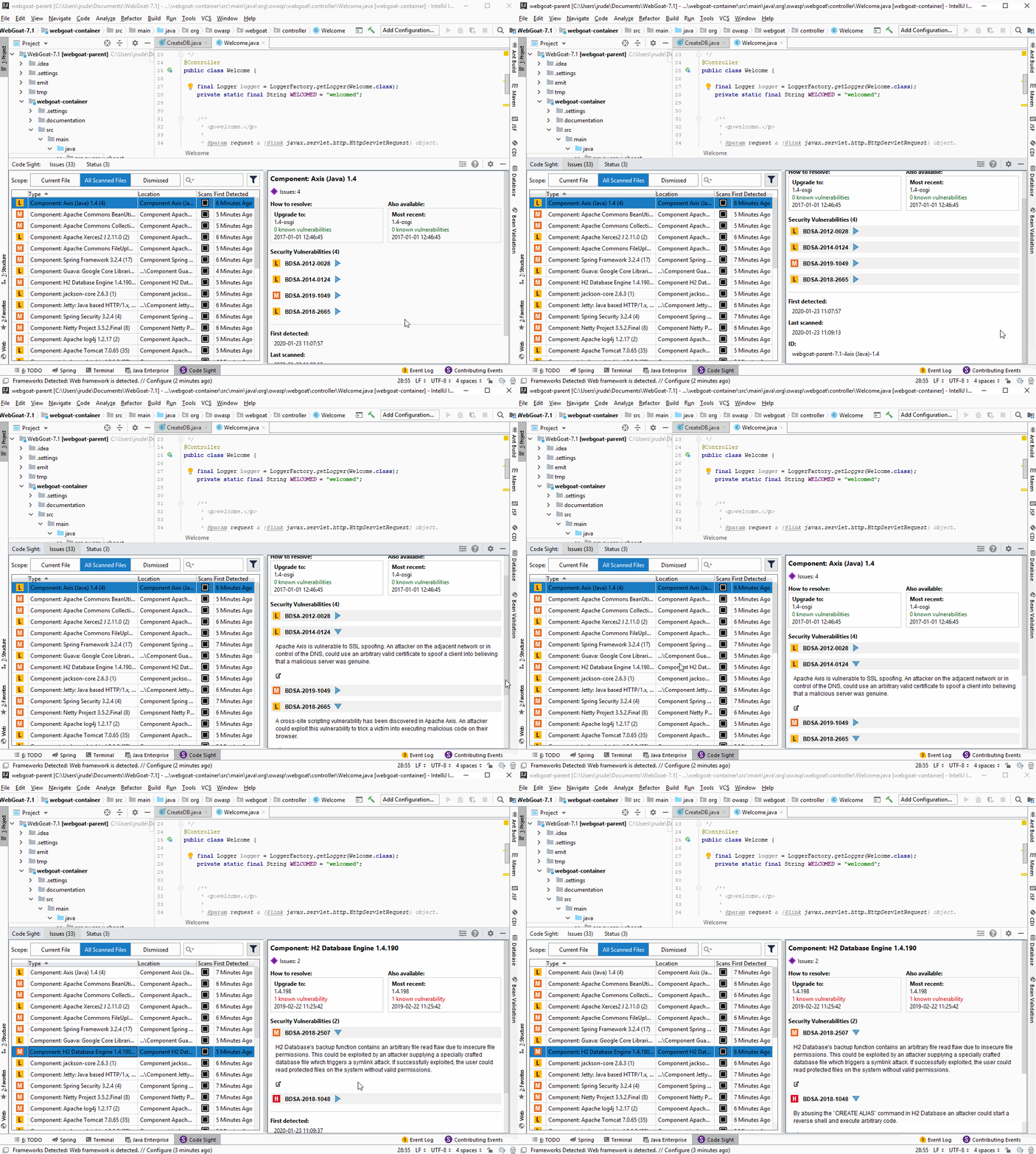
    Synopsys has extended the static application security testing (SAST) and software composition analysis (SCA) of the Code Sight plugin it makes available for integrated development environments (IDEs).

    The latest iteration of Code Sight adds the ability to analyze declared and transitive open source dependencies to identify components with known security issues alongside SAST findings without having to exit their IDE.

    Delivered vis the company’s Polaris Software Integrity Platform, the update enables developers to also review known vulnerabilities of flagged components to verify the risk and determine remediation options using vulnerability information from Black Duck Security Advisories (BDSAs). That information is based on data provided by both Synopsys and public CVE records gathered in the National Vulnerability Database (NVD).

    Patrick Carey, director of product marketing for the Software Integrity Group at Synopsys, said the Code Sight plugin enables developers to easily identify and select the best fix for vulnerabilities by providing detailed remediation guidance that directs them to more secure component versions.

    Code Sight also helps developers optimize component selection by including, for example, information regarding open source license risks and potential security and license compliance violations of an organization’s predefined set of open source policies.

    In general, Carey said Code Sight is designed to make it easier for developers to address a broad range of cybersecurity issues while an application is being developed instead of after it’s deployed. The goal is to make it easier for developers to discover and address cybersecurity issues on their own as part of the overall shift toward adoption of best DevSecOps practices, he said.

    The challenge, of course, is most developers have not been trained to identify potential cybersecurity issues in their code. Code Sight fills that gap by surfacing vulnerabilities as developers write code, said Carey. Synopsys plans to continue building on that capability by adding more analytics capabilities to the Code Sight plugin over time, he added. For example, Synopsys earlier this year acquired Tinfoil Security, a provider of dynamic application security testing (DAST) and application programming interface (API) security testing tools that will be employed to surface additional analytics in Code Sight.

    Eventually, the goal is to make identifying cybersecurity issues a natural extension of the quality assurance process within any application development and deployment life cycle, Carey said.

    It’s hard to say with certainty to what degree DevSecOps will be driven by a set of well-defined best practices versus simple evolution of how applications are developed. There’s no doubt cybersecurity professionals have a vested interest in making sure fewer vulnerabilities make it into production application environments. As such, communication between developers and cybersecurity professionals clearly needs to improve. However, the biggest DevSecOps strides any organization might make may simply come down to making the right tools available in the most frictionless way possible to developers.

    In the meantime, there’s no doubt application security has become a major area of focus in the age of digital business transformation. The challenge now is limiting the number of vulnerabilities that might be exploited as more code than ever is developed and deployed at increasingly faster rates.

    — Mike Vizard

  • What Is DevSecOps and How to Enable It on Your SDLC?

    What Is DevSecOps and How to Enable It on Your SDLC?

    For the past three to four years, all the companies around the IT world have adopted agile and different application development methodologies that leverage the work for different departments or areas and helps them to develop new products and release new features to improve their processes and infrastructure.

    In this new Agile and DevOps world where everybody on a team is involved in the rapid-changing and evolution of their application, we are promoting accountability for everybody in terms of security—this is when DevSecOps joins the party.

    What is DevSecOps?

    DevSecOps is a new model that provides accountability for the security implementation in the application; from the planning, design, development, QA/testing, to release and when operating on a production environment.

    When implementing DevSecOps on the Software Development Lifecycle (SDLC), an organization will experience the continuous integration and will notice that the costs for compliance are reduced, code is constantly being analyzed, tested, delivered and released properly.

    DevSecOps enables the process of implementing security to everybody and makes them accountable.

    Why Is It important?

    As I stated previously on this blog, on this rapid-changing era, everything is evolving at a very accelerated pace. We continue to discover vulnerabilities and breaches across platforms and operating systems, patches are released constantly but we—as part of the operating team of a company—cannot afford the risk of having a vulnerability on any side of our IT system/application.

    Main Benefits

    • Reduces vulnerabilities present on your code.
    • Reduces vulnerabilities present on your IaC technologies.
    • Reduces the number of ways to exploit your application
    • Reduces downtime.
    • Improves your application stability, availability and security.

    How Can I Enable DevSecOps on My Current DevOps Pipeline or SDLC?

    DevSecOps is a must-have methodology that needs to be integrated into your DevOps process/pipeline to help you improve your security on your SDLC.

    There are five important phases that need to be followed in order to enable DevSecOps on a current DevOps pipeline or in the SDLC. Here are the crucial phases to enable it:

    Phase 1: Secure Local Development. Start by implementing secure working-environments. When you are developing an application, in most cases you will use open source technologies. Docker is a great helper at this phase since it automates the infrastructure and services deployments on local machines. So when you are using this ready-to-go docker environment, make sure that you are using the most recent/updated versions of the Docker Images and scan them for vulnerabilities. Even the images from official providers have vulnerabilities that need to be patched.

    Phase 2: Version Control and Security Analysis. Enable Vulnerability while uploading your source code.  Having multiple hands or people working at a piece of code can lead to vulnerabilities, especially when they are remote. Git systems have been a great improvement for collaboration between team members and code. When a team member uploads a piece of code, I strongly suggest that you enable automated testing for security on your code dependencies and core. Some good alternatives to do it are Snyk or Sonatype’s Nexus.

    Phase 3: Continuous Integration and Build. When creating the development image/package, you’ll need to make sure that your build tool or system has the proper security in place. It uses https:// protocol, it’s properly hardened and secure, it’s available and protected for attack mitigation or even not accessible via the internet. The tools that you can use here are Jenkins, Circle CI, AWS CodeBuild, Google Cloud Functions, Azure DevOps.

    Phase 4: Promotion and Deployment. When deploying to an environment, insert the environment variables through your CI/CD tool and try to manage them as secrets. Proper encryption and management of these are recommended in order to enhance your security protocols.

    Phase 5: Infrastructure Security. When your app is deployed, make sure that you have an IDS (Intrusion Detection System). Tools such as OSSEC or Wazuh will help on this matter to protect all your hosts.

    Once your code gets to the production, it doesn’t mean that it will be 100% secure. New vulnerabilities are disclosed every day but this cycle will help you and your team to test your code against all the repository of known vulnerabilities, at the time of monitor, configure, reconfigure, adapt and deploy solutions to the environment.

    Tools and Processes

    These are the tools you will need to enable in your DevSecOps process:

    • CI/CD Tool.
    • Secrets Manager.
    • Version Control System.
    • Docker Orchestration tools.
    • Security Analysis tools.

    And these are the processes:

    • Automated regression testing.
    • Dynamic testing.
    • Automated Vulnerability Assessment.
    • Automated Integration.
    • Promotion.
    • Automated Deployment.

    What Is the Ideal Workflow for DevSecOps?

    1. A developer creates a new code and integrates it into the VCS.
    2. Members from the QA team retrieves the code to perform the static code analysis to identify security flaws or functional tasks.
    3. A test environment is created automatically using IaC such as Terraform, CloudFormation, Chef or Puppet and the security configurations are added to the system.
    4. The test automation suite is performed to the application with a tool usually Selenium or any other tool that performs backend, UI, integration, security and API tests.
    5. After the test suite is performed and successful the new changes are sent to the production environment.
    6. The new version of the code is now going to be monitored in the production environment using an APM or Cloud-native monitoring tool.

    Following these points you are ensuring that your application is following TDD practices improving the code quality, compliance, increasing the number of releases of code to production and reducing the time to market which is essential for any organization.

    What Are the Challenges When Enabling DevSecOps?

    • Enabling too Many Tools: Enabling too many tools can become a problem on your SDLC, especially when your team is not used to work and relate with DevOps/security tasks. The main recommendation here is to start slow. Start by enabling only the necessary tools to get your team familiar with the process and add more when you feel your team is prepared for it.
    • Getting Used to the Methodology: It will take some time for all the team to get used to the DevSecOps methodology/culture and also to keep following it in order to be compliant with the normative that your business demands. Try to always stay up-to-date and coaching your team for the newest technologies.
    • Chasing Perfection on the Process: Keep in mind that all the DevSecOps process won’t be perfect, but it will get mature over time. Teams always try to chase perfection and this only leads to more problems with even more integrations or dependencies.

    Conclusion

    In the end, I think every organization must make the effort to shift to a DevSecOps methodology or process and come up with a multidisciplinary team with a focus on security. That’s how an organization will transition from doing DevOps to DevSecOps. Allowing all their collaborators to have accountability on the part they are actively developing.

    — Guillermo Vélez