Category: DevOps Toolbox

  • Honeycomb Taps ChatGPT to Simplify Observability

    Honeycomb Taps ChatGPT to Simplify Observability

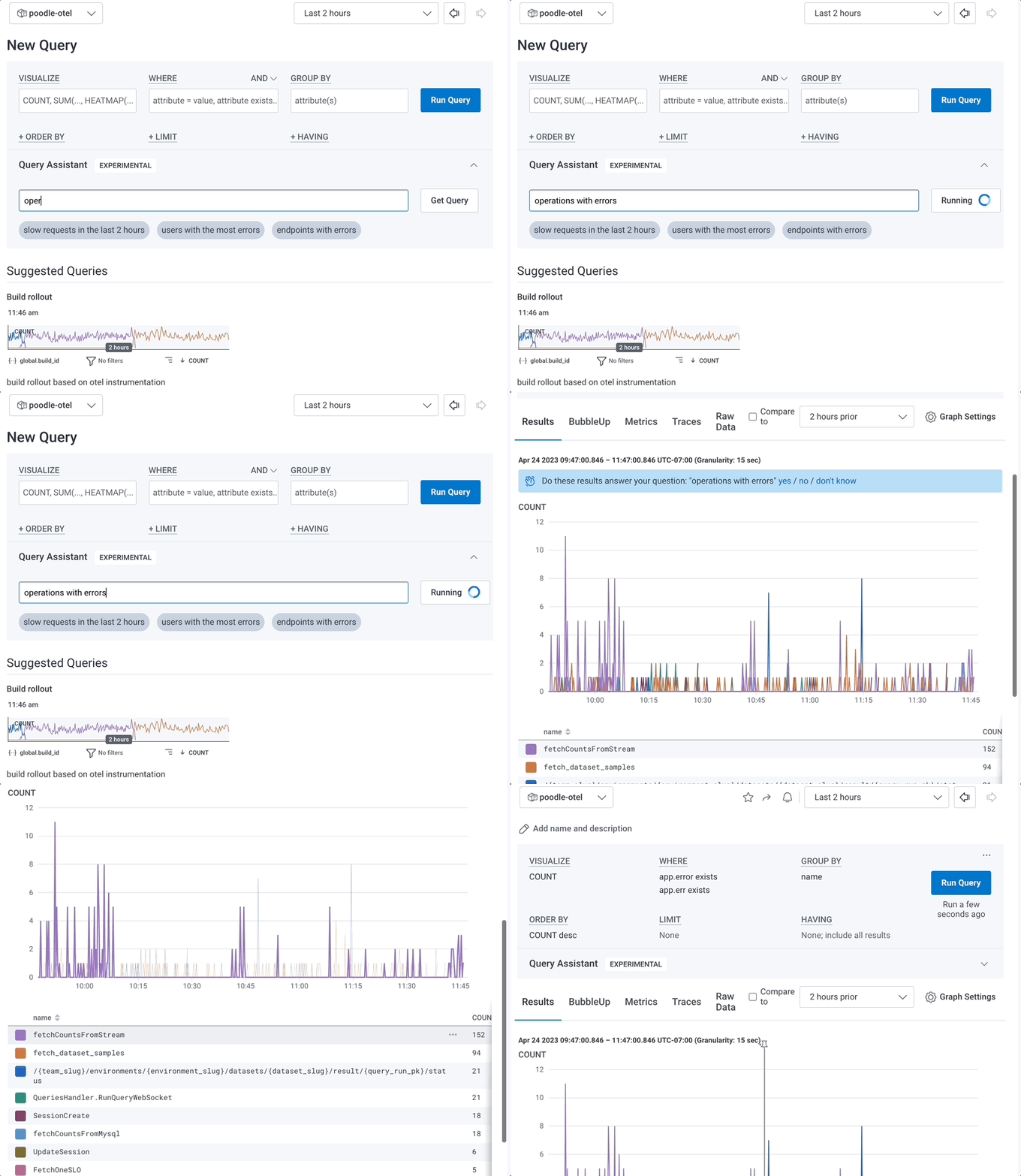
    Honeycomb today added a Query Assistant to its observability platform that uses OpenAI’s ChatGPT generative artificial intelligence (AI) platform to launch queries via a natural language interface rather than having to master a query language.

    That capability complements an existing tool based on machine learning algorithms, dubbed BubbleUP, that DevOps teams already use to debug code.

    Honeycomb CTO Charity Majors said both tools make the Honeycomb observability platform more accessible to IT teams that are tasked with managing complex application environments. Those teams are not going to be able to accomplish that goal without relying more heavily on AI to determine the root causes of an issue.

    Generative AI augments DevOps teams by making it possible to build a relevant, modifiable query that they can continuously iterate as IT staff investigate an issue. This approach means teams don’t necessarily need a deep understanding of code behavior and the underlying infrastructure it depends on, noted Majors.

    That’s critical, because not every IT professional immediately knows what query to launch. One of the challenges with adopting any observability platform is they require a a DevOps team member to frame a query to generate a result. If multiple queries are required, coding them in a query language becomes a cumbersome task.

    As AI continues to improve, algorithms should be able to automatically surface more issues. But given all the dependencies that exist in modern application environments, there will still be a need for a DevOps specialist to ensure application availability and optimize performance, at least for the foreseeable future.

    In general, generative AI represents a significant leap forward compared to AI for IT operations (AIOps) platforms that, in comparison, are not nearly as useful, noted Majors.

    It’s still early days as far as measuring the impact AI will have on DevOps workflows. But the AI genie is already out of the proverbial bottle. Many of the low-level tasks that tend to make DevOps jobs tedious will soon be automated. As a result, job roles within DevOps teams will need to evolve.

    Less clear is what impact the rise of generative AI might have on the adoption of observability platforms. While there is no shortage of observability platforms, adoption has been limited by the number of DevOps professionals that could master a specific query language created for that observability platform. The ability to rely on a natural language interface instead reduces the need to use a proprietary query tool.

    In the longer term, the simpler it becomes to use DevOps best practices, the more widely they will be adopted. AI platforms should enable more organizations to embrace DevOps in a way that reduces the level of cognitive load currently required.

    In the meantime, there’s no doubt that current DevOps professionals are cautiously watching the rise of generative AI, much like everyone else. The difference is that most DevOps professionals are not going to want to work for organizations that don’t provide access to AI-infused tools and platforms that make their jobs easier.

  • GitLab Allies With Google to Bring AI to DevOps

    GitLab Allies With Google to Bring AI to DevOps

    GitLab extended its alliance with Google as part of an effort to bring more generative artificial intelligence (AI) capabilities to DevOps workflows.

    The GitLab suite of software-as-a-service (SaaS) applications already reside on the Google cloud platform to provide GitLab with the foundation of data required to train those AI models. Over the course of the last two months, GitLab has already added numerous capabilities that rely on multiple types of AI technologies.

    For example, there is now an experimental Explain This Vulnerability capability that provides a natural language summary of an issue in a way developers and cybersecurity teams can easily comprehend.

    Taylor McCaslin, a product group manager for data science and AI/machine learning for GitLab, said going forward, most of the AI focus is going to be on leveraging generative AI capabilities. Those capability will be enabled by Google using a large language model (LLM) that GitLab developed for DevOps workflows. That approach enables GitLab to surface more accurate recommendations based on validated data compared to the general purpose LLM that was used to create the ChatGPT service.

    In addition, GitLab can continuously update the AI models it is running on the Google Vertex AI cloud service using the data from its SaaS application environment which is continuously monitored and updated, McCaslin noted.

    It’s not clear what impact AI may have DevOps workflows, but GitLab is forecasting a 10x improvement. That will be accomplished by, for example, surfacing code that can be used to remediate a vulnerability. Today, many vulnerabilities are not addressed simply because developers don’t have enough time to write a patch.

    A recent GitLab survey, however, suggested developers are already embracing AI to improve productivity, with 62% of developers using AI and machine learning algorithms to check code. More than a third (36%) also rely on AI and machine learning algorithms to review code.

    At this juncture, the one thing that is certain is AI and other associated technologies are going to make developers more productive. It’s not nearly as apparent what impact increased amounts of code moving simultaneously through DevOps pipelines is going to have on the software engineers that manage those processes. The expectation is that similar types of AI advances will also enable more code to flow through those pipelines without, hopefully, further exacerbating any existing bottlenecks that might exist.

    In the meantime, it’s clear the AI genie is out of the bottle. There will soon be more LLMs for all kinds of tasks. DevOps teams should start planning today based on the assumption that many manual tasks that conspire to make software engineering tedious are going to fade away. As such, the roles with a DevOps team are going to change and evolve. The assumption those DevOps teams should make is that these changes will be for the better. After all, the reason organizations embraced DevOps in the first place was to ruthlessly automate IT processes—AI is simply the latest iteration of that commitment.

  • New Relic Report Surfaces Spike in Amazon JDK Usage

    New Relic Report Surfaces Spike in Amazon JDK Usage

    An analysis of the Java applications observed by New Relic showed nearly one-third of organizations (31%) are using the Amazon Java development kit (JDK) compared to 28% using the Oracle JDK as more Java applications are built and deployed in the cloud.

    The report also found the number of Java applications running in containers is remaining steady year-over-year at 70%.

    Overall, the report published last week found more than 56% of applications are now using Java 11 in production, followed by Java 8 at nearly 33%. However, more than 9% of applications are now based on Java 17, representing a 430% growth rate.

    Jemiah Sius, director of developer relations for New Relic, said it’s clear that Java 17 is starting to gain traction in production environments. This is happening at a faster rate than previous releases of the venerable programming language as more cloud-native applications based on containers are being built and deployed, noted Sius.

    Regardless of the version of Java, it doesn’t appear developers are moving away from Java as they build cloud-native applications, noted Sius. Rather than requiring developers to learn a new programming language, it’s simply been more cost-effective to enable them to continue building applications using a programming language they already know.

    Java, meanwhile, has been experiencing a renaissance after more organizations began contributing to projects once the core platform became available under open source licenses. In fact, the Java community is now adopting many concepts pioneered in other programming languages to enable organizations to, for example, drive digital business transformation initiatives that are dependent on legacy applications being modernized. As a result, most organizations will continue to deploy Java applications everywhere from the network edge to the cloud.

    New Relic, of course, is betting that as more cloud-native applications are deployed, the need for an observability platform that addresses the needs of developers and IT operations teams alike will become more apparent.

    In general, most organizations are still in the early stages of achieving full-stack observability. A recent New Relic survey found only 27% of respondents have achieved full-stack observability and only 5% claimed they have a mature observability practice in place. A third (33%) of respondents also said they still primarily detect outages manually or based on complaints, the survey found.

    On the plus side, the survey also found nearly three-quarters of respondents said C-suite executives in their organization are advocates of observability and more than three-quarters of respondents (78%) saw observability as a key enabler for achieving core business goals. However, more than half (52%) of respondents said they experienced high-business-impact outages once per week or more and 29% said they take more than an hour to resolve those outages.

    The expectation is that that augmenting DevOps teams with observability tools and platforms that are increasingly being infused with artificial intelligence (AI) will reduce outages, even as cloud-native applications make IT environments even more complex than they already are. The issue is, however, those application environments are becoming more complex at a rate that is far exceeding the pace at which observability platforms are currently being adopted.

  • Codenotary Previews Secure SBOM Creation Service

    Codenotary Previews Secure SBOM Creation Service

    Codenotary today made available a preview of a centralized repository service for generating and storing software bills of materials (SBOMs) that makes it simpler to securely share them as necessary.

    Moshe Bar, Codenotary CEO, said SBOMCenter will make it easier for organizations to operationalize SBOMs that are being created with greater frequency as the need for increased focus on securing software supply chains grows.

    Currently available as a free trial, Codenotary’s SBOMCenter provides a way to create and store SBOMs in a way that ensures they have not been tampered with, noted Bar.

    Implementing SBOMs can be a cumbersome process that can require changes to existing software development and procurement practices. The SBOMCenter provides a service for accessing SBOMs that are continuously updated using an immutable open source database that supports multiple SBOM formats and a tool the company developed that automatically generates SBOMs by adding a single line of code. That approach should make it simpler to identify what software components are running in a production environment any time a new zero-day vulnerability is discovered.

    In a future update to SBOMCenter, the company said it plans to add vulnerability scanning, risk exposure scoring, alerts on newly discovered vulnerabilities and a policy enforcement engine that can be integrated with DevOps pipelines.

    Awareness of the need for SBOMs has increased dramatically since the Biden administration’s executive order made it clear that federal agencies would require them from any software provider starting next year. Many enterprise IT organizations are likely to follow suit as part of a larger effort to better secure software supply chains in the wake of a series of high-profile cybersecurity breaches.

    More recently, a National Cybersecurity Strategy paper published by the White House calls for increased liability for software developers that fail to exercise due cybersecurity diligence when building applications. It’s not clear if there will ever be a law on the books that would enable penalties to be applied, but the general mood is clearly shifting toward holding organizations that build software more accountable for cybersecurity issues that might arise.

    It’s not yet clear how far down the path organizations are toward operationalizing SBOMs. Gartner predicted that, by 2025, a full 60% of organizations will be employing SBOMs. In theory, those organizations should be able to prevent software with unverified components from being deployed in production environments and identify which applications currently running have significant flaws.

    On way or another, application providers will find themselves disclosing more about how their software is constructed. The issue now is finding a way to accomplish that goal in a way that respects intellectual property rights. As such, application providers need to find a secure way to share SBOMs with customers that will commit to making sure the contents of those SBOMs stay private. After all, a little cooperation from the coalition of the willing is likely to have a more positive impact than a law that is likely to be challenged.

  • ClickUp Adds Project Management Templates to Invoke ChatGPT

    ClickUp Adds Project Management Templates to Invoke ChatGPT

    ClickUp is adding templates and collaboration tools to make it easier to access generative artificial intelligence platforms such as ChatGPT from within its project management application.

    Haris Butt, head of product design for ClickUp, said ClickUp AI now includes pre-built department-specific prompts that any product managers, developers or designers can easily access rather than having to develop prompt engineering skills to engage a generative AI platform more effectively.

    The templates, for example, make it simpler to produce summaries of project timelines in addition to the ability to automatically generate a whiteboard that lists tasks that need to be finished to complete a project.

    In the longer term, ClickUp is also moving toward developing its own large language model (LLM) using its own data to provide a generative AI experience specifically optimized for project management, added Butt.

    ClickUp is embedding AI into project management applications as part of an effort to eliminate drudgery, added Butt. One of the primary issues that makes project management challenging is that navigating workflows can be challenging, especially for stakeholders that might not be as well versed in, for example, how a Gantt chart flows.

    It’s still early days as far as generative AI is concerned, but it’s already apparent that a wide range of templates are being developed to make it simpler to invoke these platforms. The need for project managers to become well-versed in all the nuances of prompt engineering techniques to optimize generative AI queries is likely to be limited.

    In fact, the general expectation is that every application will eventually include templates for invoking generative AI capabilities. Less clear is the impact that should have on productivity. In the case of DevOps teams, however, many tedious project management tasks should become increasingly automated.

    Generative AI will, of course, soon be employed across the entire DevOps workflow. Many of the tasks that have historically conspired to make DevOps processes tedious will be automated. In fact, many application developers are already using AI to test and review code. DevOps teams that have historically advocated ruthless approaches to automation are likely to be at the forefront of AI adoption.

    There are, of course, concerns about the accuracy of generative AI platforms such as ChatGPT that have been trained using data that hasn’t always been verified. As a result, it’s possible that some of the results being surfaced by these platforms should be reviewed by humans before being acted on. However, LLMs trained on narrower ranges of validated data will soon become commonplace. As those AI advances are made, the accuracy of generative AI platforms that are optimized for specific use cases will increase.

    In the meantime, DevOps teams should be more concerned about being left behind than about how generative AI impacts their employment prospects. There is no doubt generative AI will transform DevOps workflows along with a wide range of processes. The issue now is determining where DevOps teams can add value—and where machines can’t—in an era where IT environments are becoming more complex with each passing day.

  • Linux 6.3: What’s New ¦ AWS Layoffs are a Worry

    Linux 6.3: What’s New ¦ AWS Layoffs are a Worry

    Welcome to The Long View—where we peruse the news of the week and strip it to the essentials. Let’s work out what really matters.

    This week: A new Linux kernel drops and layoffs at Amazon Web Services point to trouble. (more…)

  • InfluxData Makes Processing Observability Data at Scale More Efficient

    InfluxData Makes Processing Observability Data at Scale More Efficient

    InfluxData today made available an update to its open source time series database that can now analyze metric, event and trace data in a single datastore with unlimited cardinality in terms of how they are aggregated.

    The company is now making available a single-tenant instance of InfluxDB as a managed service alongside its already-existing multi-tenant cloud service that is based on a serverless architecture.

    Finally, InfluxData also announced that later this year it will make available InfluxDB 3.0 Clustered and InfluxDB 3.0 Edge to provide a curated version of the database that organizations can deploy themselves where they best see fit.

    InfluxData CEO Evan Kaplan said InfluxDB has been developed to support a wide range of emerging applications that require access to time series data, including the observability platforms core to DevOps workflows that require visibility into metrics, events and trace data.

    Over the past three years, InfluxDB has been revamped to run on a columnar engine, dubbed IOx, that leverages the open source Apache Arrow memory format and written in the Rust programming language. Kaplan said that approach makes it possible to continuously ingest, transform and analyze hundreds of millions of time series data points per second without limitations.

    At the same time, InfluxDB takes advantage of high compression object storage to reduce the total cost of storing all that data. It also provides interoperability with Open Data Architecture (ODA) to integrate with data lakes based on open source platforms such as DataFusion, Flight SQL and Parquet that are being advanced by the Apache Software Foundation.

    The arrival of version 3.0 of InfluxDB comes as many DevOps teams are starting to struggle with the amount of observability data being generated. DevOps teams want to be able to move beyond monitoring a set of pre-defined metrics and query data in a way that enables them to surface anomalies indicative of a potential issue before there is a major disruption to an application service.

    One of the major challenges today is the tradeoff between how much data is collected and analyzed versus the cost of processing and storing it. InfluxDB provides a mechanism for analyzing high cardinality data involving metrics, events and traces cost-effectively.

    Observability is, of course, only one of several use cases for a time series database capable of processing data in near-real-time. As organizations embrace digital business transformation initiatives, they need to be able to process data in near-real-time at the point where it is being created and consumed. Those applications won’t necessarily replace existing applications based on batch-oriented processing but, over time, they create two distinct classes of applications that process data in fundamentally different ways. The challenge, as always, will be defining the DevOps workflows required to manage applications running on multiple distinct types of architectures.

  • Cycode Adds ASOC Module to Streamline DevSecOps Workflows

    Cycode Adds ASOC Module to Streamline DevSecOps Workflows

    Cycode has added a module to its platform for mapping metadata and events using graph technology that makes it simpler for application development and cybersecurity to consolidate alerts generated by their DevSevOps tools.

    Lotem Guy, vice president of product for Cycode, said the Cycode Application Security Orchestration and Correlation (ASOC) module will automatically discover all the tools that make up a DevSecOps workflow without requiring any integration effort.

    That capability makes it simpler to aggregate results in a way that enables development teams and cybersecurity professionals to identify the most critical issues that need to be addressed before applications are deployed in production environments, he added.

    In effect, Cycode is now providing a method for bridging the historic divide between cybersecurity professionals and application development teams. More cybersecurity professionals are embedded within DevOps teams, but in the absence of a platform for aggregating alerts, they often encounter communications issues. ASOC provides an agentless approach to aggregating the data that DevSecOps teams need to prioritize remediation efforts, said Guy.

    While a lot of progress has been made in terms of adopting DevSecOps best practices, many organizations still struggle with securing their software supply chains. Most of the members of a DevOps team have limited cybersecurity expertise, so they need the help of a cybersecurity professional to determine what specific actions are required to remediate a vulnerability. Cybersecurity professionals, conversely, don’t have a lot of application development expertise and generally would prefer not to be overwhelmed by multiple DevOps tools generating alerts about the same potential application security issue.

    As the number of regulations specifically focused on application security steadily increase, it’s now just a question of time before every organization that builds software will need to embrace DevSecOps. The challenge is that while everyone involved generally agrees software should be more secure before it’s deployed, the security tools made available to DevOps teams vary widely. In fact, it’s not uncommon for DevOps teams to find themselves spending significant amounts of time sorting through multiple conflicting alerts.

    Nor is every alert that gets generated relevant—in some cases, a specific module that generated an alert might not find its way into the final application. In addition, many of the alerts generated also tend to lack context about severity. Application developers can’t devote all their time to fixing bugs, so choices will need to be made based on the actual risk to the application.

    Cycode is betting that, as DevSecOps continues to evolve, organizations will look for tools and platforms that make it simpler to make sense of the current level of application security chaos that tends to pervade IT organizations. In the meantime, cybersecurity professionals and application developers will need to learn to trust one another. Developers have too often viewed cybersecurity as an obstacle to deployment while cybersecurity teams have historically considered developers to be one of the primary causes of the breaches they are expected to clean up. The first step toward achieving that goal is, of course, to realize that neither is really the enemy of the other.

  • Sendbird Adds API to Invoke ChatGPT From Mobile Apps

    Sendbird Adds API to Invoke ChatGPT From Mobile Apps

    Sendbird today added an application programming interface (API) to its low-code platform for building mobile applications that enables developers to add bots that communicate with OpenAI’s ChatGPT.

    Shailesh Nalawadi, head of product for Sendbird, said this API makes it possible to add the ability to communicate directly with the generative artificial intelligence (AI) platform from within both new and existing applications in just a few minutes.

    Most developers will add natural language processing (NLP) interfaces to complement the graphical user interfaces that most mobile applications today surface, added Nalawadi. It will be up to each development team to determine how best to employ that capability, but Sendbird envisions, for example, a health care application being able to invoke ChatGPT to answer queries, he noted.

    In the longer term, Sendbird will provide APIs to enable mobile app developers to invoke a wide range of large language models (LLMs). LLMs are increasingly being developed for generative AI platforms and are being optimized for a range of use cases.

    While OpenAI’s generative AI model is being widely used thanks mainly to Microsoft, there are already LLMs that are being created for a narrower range of use cases using much less data. DevOps teams should expect APIs invoking any number of generative AI platforms from within applications to become commonplace in the weeks and months ahead as more end user come to expect to be able to engage these platforms from within almost every application Sendbird’s chatbot API can now be invoked by more 1,300 existing mobile applications alone.

    In general, developers have tended to employ chatbots sparingly because they are often too scripted and inflexible. ChatGPT, conversely, provides a much more open-ended user experience. Organizations can also feed historical conversations or customer relationship management (CRM) data to ChatGPT to drive more personalized and accurate responses, given the veracity of some of the data used to train ChatGPT.

    A recent survey of digital quality testing professionals conducted by Applause, a provider of a platform for accessing a networking of independent testers, found nearly one-third (30%) of respondents are dissatisfied with their current chatbot, IVR and conversational assistant experiences, with wrong answers (29%) and a lack of understanding (24%) as the top two reasons cited. The results indicate there is plenty of opportunity for improvement.

    Nearly three-quarters (74%) said they had a positive experience with the ChatGPT generative artificial intelligence (AI) platform, with more than two-thirds (67%) reporting the platform provided helpful answers to questions. In terms of work-related tasks, most said ChatGPT would either be “very” (43%) or “somewhat” (37%) helpful.

    It’s apparent now that generative AI platforms are about to change the way humans engage with machines. Instead of always creating an abstraction to interface with a machine it’s now feasible for interactions to occur between them using language humans readily understand. As such, the way applications are built and employed is about to fundamentally change in ways that are difficult to predict.

  • DORA Report 2022: The Magnitude of Software Supply Chain Security  

    DORA Report 2022: The Magnitude of Software Supply Chain Security  

    The term ‘software supply chain security’ (SSC) can be interpreted in many ways. Following the White House executive order in May 2021 and the European Cyber Resilience Act (CRA) of 2022, both governments and corporations are taking a more active role in ensuring their software is secure. Fundamentals such as having a software bill of materials (SBOM) and being able to cross-reference it with known common vulnerabilities and exposures (CVEs) are now the standard, but supply chain security covers far more than just the software that builds your products.

    To create certainty and clarity, leading standardization bodies such as OWASP, OpenSSF and others have set up ongoing efforts to define and mitigate SSC threats. They have active working groups, SIGs and TACs all working in vendor-neutral ways to help define and solve parts of the SSC problem.

    A great example of this is the continuous work being done by Google Cloud’s DevOps Research and Assessment (DORA) initiative. More specifically, the subject was reflected in the September 2022 DORA report that focused on security in general and supply chain security in particular. Using the Supply-chain Levels for Secure Artifacts (SLSA) framework as well as the NIST’s Secure Software Development Framework (SSDF) as benchmarks for actively addressing supply chain security issues, the researchers assessed how organizations were successful in approaching and addressing threats at all levels of the organization.

    My view of the major findings of the DORA report are summarized below.

    Who Owns Software Supply Chain Security?

    The report stated that organizations should empower individual teams and developers to “own” security while administering a consistent security policy and posture across its products. While I agree with this, we need to examine both sides of the ‘ownership’ coin. By nature, this hybrid approach creates complexity—and even friction—between the security team that, by definition, is responsible for all facets of security and the developers that are being tasked to ‘fix’ security issues in addition to their daily tasks. There has to be common ground between developers, their tasks associated with security and the security team.

    Individuals in organizations that build software care about what they build; they have a stake in the overall success of the final product and this feeling of ownership strengthens that level of care. However, asking for such ownership while adding a security component to the mix without providing sufficient knowledge, tools, proofs, and “power” to make decisions could lead to  a lack of trust, confusion, execution problems and frustration. To alleviate this, the security team should provide developers the tools, education and resources they need to feel empowered to enhance security efforts at the source. Organizations that provide evidence in a scalable, digestible manner are successful in building trust and creating common ground between the developer, security and the security team.

    There’s also another dimension that could potentially create silos between developers and security teams rather than bringing the two together: There’s no one single security team or owner of SSC. SSC is tricky to define as a category; it involves shift left security, runtime security and everything in between. Some portions of it are being governed by the security office, some by AppSec, some by DevOps and some by the developer. The ownership of each isn’t well-defined and the entire effort is very difficult to consolidate as one process or methodology. In addition to upskilling the developer with tools and training, long-term education, thought leadership and access to good technology are the keys to gradually reduce these friction points..

    Security Processes Slow Down Development

    Defining the tools, methodologies and processes that should be employed in an organization to add sufficient security while not impacting development speed is not a trivial task.

    ­­The following are four principals I think correspond well with the SLSA framework and that help address the development slowdown challenge:

    Set preventive measures: Avoid using known vulnerable and malicious packages from the beginning of development. By eliminating vulnerabilities introduced in first-party code (due to bad coding practices) as well as misconfigurations, wrong encryption and secrets exposures, you are preventing known threats from entering your product.

    Examine proactively and continuously: The security state of software changes because the software itself always evolves and new vulnerabilities are continuously being introduced. It makes a software artifact that was just secured suddenly become susceptible to attack. This requires continuously rescanning and revisiting software artifacts as well as frequently recalculating any potential risk.

    Set preemptive measures: Create a plan that initiates a prompt response when a potential risk is discovered. Both development and security teams should create the plan for decision making and execution. The measures should include ways to identify vulnerable artifacts across development and production, how to understand exploitability and true impact and how to prioritize and remediate accordingly.

    Do it all in an automated manner: Create automated processes based on reliable data and scanning tools to dramatically reduce the effort needed by developers and DevOps teams.

    DORA report co-author Eric Maxwell said one of the main principles is to remain tool- and platform-agnostic while focusing on capabilities and practices. From that perspective, automation is essential and it is enabled by security-as-code. Having a common language–code–allows teams to communicate about security as well as collaborate. It drives the things we discussed earlier around democratizing the security process and helps break down silos.

    The DORA findings—alongside the topics described above—encourage community awareness and continued shared efforts to bring much-needed attention to software supply chain security. Gradually, SSC security will evolve, but as it does so, the only way to properly address it is by ensuring the developers and security teams are on the same page and both have ownership of responding to and resolving issues as they appear. For more in depth review of the DORA report I encourage you to view Leap Left for Security: The DORA Report Roundtable.