Category: DevOps Toolbox

  • Atlassian Advances DevSecOps via Jira Integrations

    Atlassian Advances DevSecOps via Jira Integrations

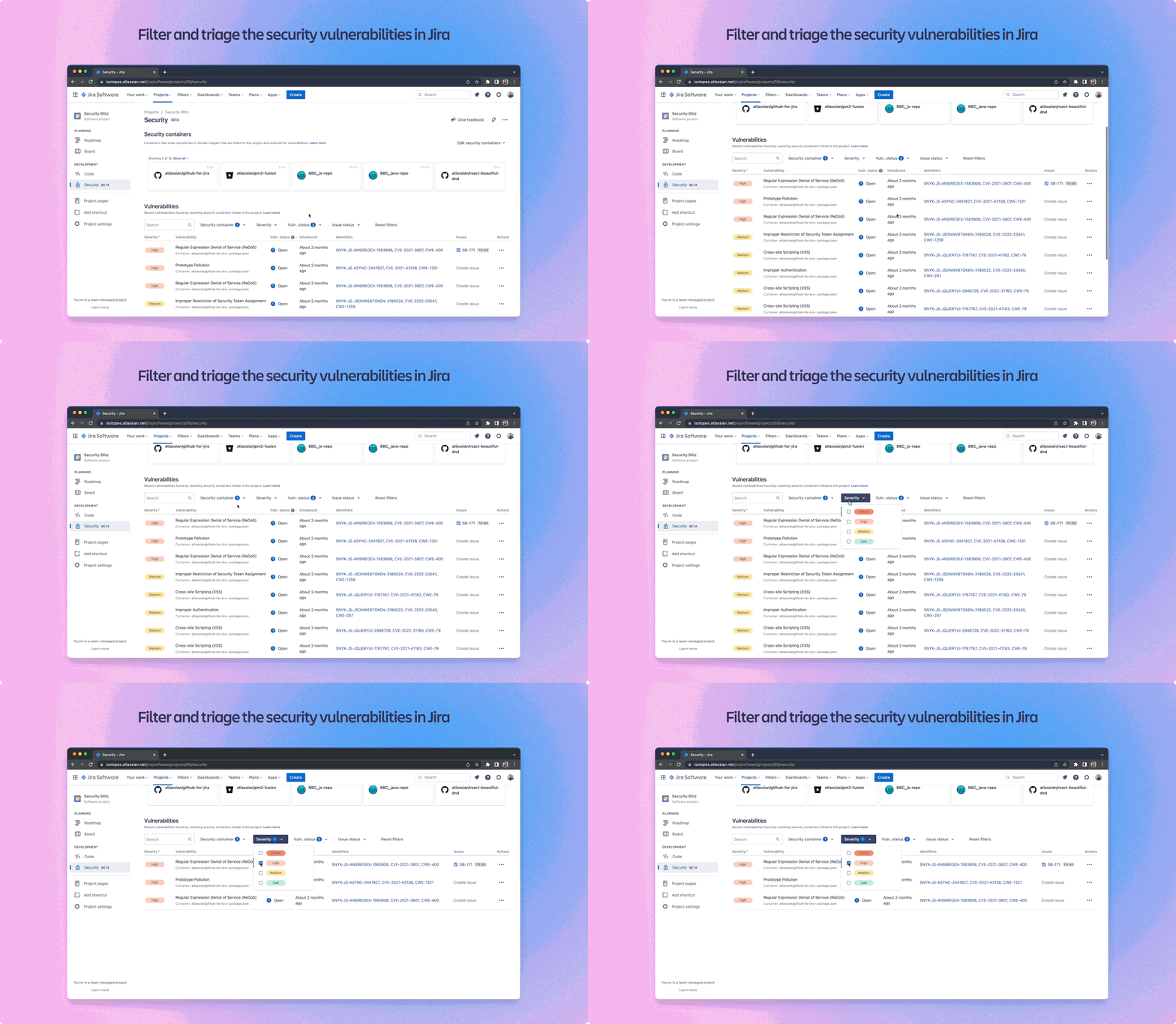
    Atlassian announced today it has allied with Snyk, Mend, Lacework, Stackhawk and JFrog to make it simpler to aggregate vulnerability data within the Jira project management software that many organizations rely on to manage application development and deployment efforts.

    Andrew Pankevicius, a senior product manager for Atlassian, said the collaborations will make it easier to prioritize a list of vulnerabilities that need to be addressed and for DevOps teams to automatically assign that work to a continuous integration/continuous delivery (CI/CD) pipeline. Atlassian provides those third-party integrations via an Open DevOps initiative.

    These capabilities, accessible via the Security Tab in Jira, will make it simpler for DevOps teams to manage output from the multiple application security tools that have become part of a larger DevSecOps workflow, noted Pankevicius.

    These additions to the Atlassian portfolio are arriving at a time when there is a lot more focus on securing software supply chains in the wake of a series of high-profile breaches. Those breaches have led to a wave of legislative proposals in the U.S. and Europe that will soon require organizations to embrace DevOps best practices to address increased potential liability that might stem from an application breach.

    For example, a proposed Cyber Resilience Act being negotiated by the member states of the European Union seeks to require organizations that sell internet-connected hardware platforms to ensure that their devices—and the software that runs on them—comply with cybersecurity best practices.

    In the U.S., meanwhile, a National Cybersecurity Strategy proposal put forward by the Biden administration seeks to hold organizations that collect data or build software more accountable for breaches.

    While both proposals are a long way from becoming the law of the land anytime soon, they are indicative of changing attitudes. Governments around the world are concluding the only way to ensure better cybersecurity is to require it. Previous suggestions made by government agencies are going to soon give way to actual mandates. As such, DevOps teams would be well-advised to get ahead of this sea change by implementing the tools and processes that inevitably will be required. As a result, many organizations are now embracing DevSecOps best practices that shift more responsibility for application security further left toward developers.

    The challenge is finding the right set of cybersecurity tools that surface vulnerabilities as code is being developed to make sure context isn’t lost, said Pankevicius. Historically, cybersecurity teams have discovered vulnerabilities long after an application has been deployed in a production environment. By then, however, most developers have moved on to other projects, so remembering how a specific piece of code was developed and by whom can be a significant challenge, he noted.

    There’s no doubt that when it comes to application security, a lot of progress has been made, but there is still much work to be done. The issue now is finding the best way to organize those efforts at a time when more applications are being simultaneously developed within organizations than ever.

  • PagerDuty Signals Commitment to Adding Generative AI Capabilities

    PagerDuty Signals Commitment to Adding Generative AI Capabilities

    PagerDuty has signaled its intention to add generative artificial intelligence (AI) capabilities to its cloud platform for managing IT operations via integrations with large language model (LLM) providers that it will disclose at a future date.

    These capabilities will make it possible to invoke natural language via PagerDuty Operations Cloud to automatically generate status updates, create drafts of incident postmortem reports and even co-author workflows in any programming language to automate remediation of an issue.

    Damon Edwards, senior director of product for PagerDuty, said as AI continues to evolve, the goal will be to minimize the need for human involvement as much as possible. That doesn’t mean there won’t be a need for humans to be involved, but it does mean that many rote tasks associated with managing an IT incident can be automated, he added.

    For example, the reports that are run to determine the root cause every time there is an incident can be automated, noted Edwards. In addition, summarizations of status reports or postmortems after incidents were resolved can be made readily available to any member of an IT team on demand, he added.

    Those capabilities will also make it easier to onboard new members to an incident management team as required, said Edwards. Today, it’s difficult to add new members to a team after an incident has unfolded because it takes time to bring them up to speed, he noted.

    In addition, generative AI also makes it easier to capture a lot of the tribal knowledge within an IT organization that would otherwise disappear when staff either leave the company or shift roles, said Edwards.

    The generative AI additions to the PagerDuty platform extend an artificial intelligence for IT operations (AIOps) capability that PagerDuty made available this spring. The PagerDuty AIOps platform leverages the data model embedded in its incident management software to reduce the amount of time required for an AI platform to learn how an IT environment operates and begin surfacing valid recommendations to optimize workflows.

    It’s not clear at what pace AI will be adopted within enterprise IT organizations, but it is rapidly becoming pervasive. Each DevOps team will need to decide the degree to which they can rely on AI to manage IT processes, but as IT processes become more complex, there is a clear need for AI to navigate all the dependencies that exist in an IT environment. As more routine tasks are automated, however, there will also inevitably be a realignment of roles and responsibilities within an IT organization. The overall goal is not so much to eliminate IT staff as much as it is to enable them to manage IT environments at a much higher level of scale.

    In the meantime, DevOps teams need to plan for not only what is possible using generative AI today but also tomorrow. After all, there’s not a lot of point in training someone to take on a new task if that task is automated a few months from now.

  • Friend or Foe? ChatGPT’s Impact on Open Source Software

    Friend or Foe? ChatGPT’s Impact on Open Source Software

    OpenAI’s ChatGPT took the world by storm, amassing 100 million users in the first two months after its public launch. The continued interest in the tool has created a buzz among developers, especially those in the open source community. But this begs the question: How will ChatGPT impact open source software?

    Amid the excitement and promise that ChatGPT holds, many wonder whether the open source community, just like any other organization, should fear or embrace the technology. Certain concerns for open source contributors and developers are sparking debate as questions surrounding the origin of generated source code surface, and the possible ethical and legal implications are discussed. While valid, developers should not fear or stray away from using ChatGPT but rather shift their focus to understanding how to embrace it for positive outcomes.

    The Top Three Open Source ChatGPT Concerns

    Collaboration between contributors is the cornerstone of open source projects, which some fear will be disrupted with the increased use of AI-based tools. However, the level of synergy within the community cannot be easily taken away or replaced by tools. Instead, ChatGPT or other AI-based tools, including GitHub Copilot, allow developers to produce code more quickly and more efficiently.

    As developers increasingly use AI tooling to assist with new or enhanced code, project collaboration and oversight will help improve the AI-generated code.

    Debunking and navigating the top concerns will be imperative to take full advantage of the technology’s promise and potential.

    Validity. While the creation of code by ChatGPT has generated excitement among developers, critics argue that—without context—the validity of code can be questioned. Some open source developers worry that teams will begin to rely entirely on ChatGPT to generate code, but this concern fails to consider the humans involved in the process—today and far into the future.

    Developers don’t take ChatGPT’s output as the final word; rather, they use it as a baseline and jumping-off point to streamline their code. In fact, code is rarely created from scratch anymore. Developers rely on others’ source code. For example, code from Stack Overflow, GitHub and thousands of open source libraries that are available on public registries like npm, Maven, Nuget and PyPI. Bringing ChatGPT into the fold will not significantly change how developers source their code, but will improve development velocity, saving valuable time and associated cost.

    Training Data. Machine learning (ML) and deep learning (DL) model training must be fair, robust and explainable to avoid biases. If the data is wrong, the results will be as well. Garbage in, garbage out. Coming from ML/DL models, the code ChatGPT returns in response to prompts could raise concerns surrounding its accuracy. Like any other source (Stack Overflow, GitHub, etc.), ChatGPT’s code outputs are not guaranteed to be perfect, and developers must be mindful of this.

    However, there are more benefits of ChatGPT-trained models concerning code outputs. ChatGPT can also explain new or existing code, it can also effectively provide unit tests for code, which will help with writing better software faster.

    Ownership. Questions of ownership have surfaced regarding the use and distribution of the code that the AI tool generates. While the code that ChatGPT generates is the result of ML/DL inference from many sources, it’s the developer’s responsibility to use that code ethically and safely. It should be treated as any other public data or open source software, as not a final product and must be used in the context of your requirements. It’s also important to carefully review any code generated by ChatGPT and ensure that it doesn’t introduce vulnerabilities.

    Similar to GitHub Copilot, ChatGPT is trained by millions of lines of open source software. Code posted in prompts is likely to make it to models, too. Unlike copyrighted pieces of art and writing, the code that ChatGPT outputs should not be considered in a final state and should not be used in a way that is subject to licensing restrictions or legal implications that have dominated the conversations around its use.

    Ownership closely relates to the ethical dilemma of using AI-generated text, code and more. To address that, there are new tools that help detect whether AI generated the content and how much, which will be useful for educators concerned with students overusing the tool. This emerging area of checks and balances exemplifies the constantly evolving and improving technologies that allow humans, and in the case of open source, contributing developers to improve their craft and produce better open source software.

    ChatGPT’s Impact on Open Source Talent

    Discussions about whether ChatGPT will require new skills for existing positions or new jobs with specialized experts are ongoing. While new and exciting, ChatGPT won’t immediately create new or different jobs. Like any new tool introduced to developers, it takes time for developers to become familiar with the technology and understand how to use it best. ChatGPT is no different. For example, consider the previous push to use low-code/no-code technology. While this great technology is used to speed up the creation of apps and improve the usability for non-developers, it has taken time for organizations to properly use low-code/no-code technology. A similar perspective and trajectory will extend to the use of ChatGPT for all software development, including open source projects.

    In the coming weeks and months, it will be essential to encourage the open source community to embrace ChatGPT and explore its possibilities. Technology has already proven to be an effective educational tool. Consider asking ChatGPT for book recommendations about programming languages and coding; it delivers short descriptions for each book. Or, prompt it for the top takeaways from one specific book. By doing this, individuals can make learning so much easier. By learning from other developers and sharing resources, including results from ChatGPT, the community roots of open source will keep thriving.

    Human Involvement is Always Needed

    The public’s reaction to ChatGPT may be novel, but the idea behind the tool’s relationship to open source is not. Analyzing how ChatGPT works within the open source community reveals that it will be useful because it enhances the capabilities of developers, it doesn’t replace them.

    Whether it’s reviewing code, pair programming or learning from fellow developers, humans will not be replaced by generative AI, only enhanced. Leveraging the tool will decrease the time and effort needed to complete tasks, increasing developer quality and efficiency. The use of ChatGPT does not create new positions or overhaul current skill sets; it makes them better and empowers developers to expand their opportunities and enhance their abilities.

    Soon, ChatGPT and other AI tools will be standard practice within the open source community—or until a new technology is created and shakes up software development once again.

  • VMware Streamlines IT Management via Cloud Foundation Update

    VMware Streamlines IT Management via Cloud Foundation Update

    VMware this week updated its Cloud Foundation platform and rolled up recent updates to the company’s virtualization portfolio all at once.

    Version 5.0 of VMware Cloud Foundation (VCF) encompasses the latest versions of VMware vSphere 8.0u1 for workload management, VMware vSAN 8.0u1 for scale-out storage, VMware NSX 4.1 for networking and VMware vRealize LifeCycle Manager 8.10 (Aria) for cloud management.

    In addition, VMware has added a single sign-on (SSO) capability, dubbed Isolated SSO Workload Domains, that enables administrators to configure new workload domains using SSO instances from different providers or platforms via NSX.

    Rick Walsworth, director of product marketing for the Cloud Infrastructure Business Group at VMware, said that as the management of IT continues to evolve in VMware environments, more organizations are opting to update their entire VMware software stack simultaneously rather than attempting to update components individually.

    The primary reason for that shift is that the company ensures that all the latest VCF component releases have been thoroughly stress-tested from an integration perspective, he noted.

    During uncertain economic times, VMware is seeing an increased focus on simplifying IT environments as IT teams are asked to do more with less, said Walsworth. As such, more organizations are looking to standardize on a stack of infrastructure software that can be managed more consistently, he added.

    More organizations are also looking to reduce the total cost of IT by employing the same stack of infrastructure software across hybrid cloud computing environments where workloads are deployed both in on-premises IT environments and public cloud, said Walsworth.

    The company is also seeing increased adoption of DevOps best practices to programmatically manage IT environments that need to respond to rapidly changing requirements, he noted. IT teams are looking to work more collaboratively rather than relying solely on specialists to manage specific functions, said Walsworth.

    Some of that shift is also being driven by Tanzu, a distribution of Kubernetes that the company makes available as part of VCF, he noted. Most application developers don’t have a preference for a specific Kubernetes distribution, so many organizations view Tanzu as an opportunity to extend their existing management framework to a de facto standard for building the next generation of cloud-native applications, said Walsworth.

    VMware is in the midst of being acquired by Broadcom. Nevertheless, VMware this week reported revenues for the first quarter 2023 of $3.28 billion, a 6% year-over-year increase. Subscription and software-as-a-service (SaaS) revenue for the first quarter was $1.22 billion, an increase of 35% year-over-year. That increase in revenue suggests any concerns about the future direction of the company are not impacting the willingness of IT organizations to continue to rely on VMware.

    It may be a while before all the dust settles around Broadcom’s acquisition of VMware. In the meantime, however, it’s clear that the way IT is managed in the cloud era is continuing to rapidly evolve regardless of who owns VMware.

  • CDF Marries Emporous Repository to Ortelius Management Platform

    CDF Marries Emporous Repository to Ortelius Management Platform

    The Continuous Delivery Foundation (CDF) has added the open source Emporous repository for software artifacts to an Ortelius platform for managing the software artifacts that make up a microservice.

    Ortelius was originally created by DeployHub and subsequently contributed to the CDF, which also oversees the development of the open source Jenkins continuous integration/continuous delivery (CI/CD) platform.

    Emporous is based on a Universal Object Reference (UOR) conceptual model that enables dynamic schema registration and decentralized content-addressable reference of a wide spectrum of software artifacts. Originally developed by Red Hat, Emporous will now be managed as a sub-project within the larger Ortelius incubation-level project by the CDF.

    DeployHub CTO Steve Taylor said this integration would make it simpler to store, organize and search metadata related to software artifacts, along with the artifacts themselves, within the context of the Ortelius platform for managing microservices.

    Ortelius provides insights into the relationships and dependencies between different software components and applications. It does this by collecting and aggregating pipeline data from multiple sources within a software supply chain. Emporous will be incorporated within Ortelius to enhance metadata search capabilities and provide a single repository to store any type of artifact, from containers to jar files. It will now also be able to store metadata and also the artifacts themselves within the same Emporous catalog.

    Those capabilities will significantly improve security and compliance reporting across a software supply chain, added Taylor. DevOps and cybersecurity teams will be able to automatically apply and enforce supply chain policies and procedures, he said.

    DevOps teams need a way to aggregate all the data from the various tools they use and the data must be easily searchable. Armed with those insights, it should become simpler to surface insights into, for example, which components of an application contain known vulnerabilities.

    In the longer term, IT organizations will be able to apply machine learning algorithms and other forms of artificial intelligence (AI) to automatically surface insights that will enable DevOps teams to automate workflows, said Taylor.

    Microservices-based applications are considerably harder to build and manage than monolithic applications, but they are also easier to maintain because individual microservices can be ripped and replaced.

    Most microservices today are built using containers, but there are also microservices that are written in Java, for example. In some cases, developers view monolithic applications as being a large, less flexible microservice that they invoke via an application programming interface (API).

    There’s no doubt that the rise of microservices made application environments a lot more complex. The tools needed to simplify the management of the next generation of applications are finally starting to become more widely accessible. In theory, the number of organizations that can successfully build and deploy these types of applications should steadily increase in the months and years ahead.

    In the meantime, there’s clearly still plenty of work that needs to be done to improve the overall state of software delivery. A recent CDF survey found only 22% of respondents were using continuous integration and continuous delivery (CD) to automate the building, testing and deployment of code in a production environment. As CD becomes more distinct from CI, however, the number of organizations that can achieve that goal when deploying microservices-based applications should steadily increase.

  • US DoJ Makes PyPI Give Up User Data ¦ Tape Storage: Not Dead

    US DoJ Makes PyPI Give Up User Data ¦ Tape Storage: Not Dead

    Welcome to The Long View—where we peruse the news of the week and strip it to the essentials. Let’s work out what really matters.

    This week: PyPI complies with a “string of subpoenas,” and LTO continues to grow, despite predictions of its demise. (more…)

  • Dell Looks to Expand Pool of Available DevOps Expertise

    Dell Looks to Expand Pool of Available DevOps Expertise

    Dell Technologies has quietly launched a training and education initiative to significantly expand the number of IT professionals that have DevOps skills.

    Brad Maltz, senior director for DevOps and developer relations ecosystems for Dell, said the next era of IT will require IT professionals that understand how to automate the management of application development and deployment. Given its long infrastructure history, Dell is especially interested in helping IT teams to use a mix of graphical tools and command line interfaces (CLIs) to programmatically deploy software at much faster rates and at scale, he added.

    Dell has already hired more than 200 specialists to provide that training as part of a DevOps Transformation Services consulting services engagement, said Maltz. The primary area of focus will be working with IT organizations that are embracing platform engineering to centralize the management of DevOps and GitOps workflows, he noted. Many of those teams are now relying on declarative automation tools that ultimately make DevOps more accessible to a wider range of IT professionals, added Maltz.

    The number of IT professionals that employ graphical tools based on IT management frameworks such as ITIL still far outnumber the number of IT professionals that have DevOps skills. The ongoing debate between these two camps essentially comes down to the need to be able to consistently manage IT at scale versus being able to adroitly keep pace with the needs of organizations that are increasingly dependent on software. In the digital transformation era, it’s become clear that more of the organizations that hire IT professionals are placing a higher value on agility, said Maltz.

    Bridging the divide between ITIL and DevOps to address that requirement is largely a psychological challenge that requires IT teams to address a range of cultural issues in addition to mastering different types of tooling, he added.

    Regardless of whether organizations continue to manage IT infrastructure internally or rely more heavily on managed services provided by Dell, the need to continuously deliver secure software faster has become a business issue. The trouble is the level of DevOps expertise within organizations tends to vary widely. A recent survey published by the Continuous Delivery (CD) Foundation found only 22% of respondents are using both continuous integration (CI) and continuous delivery (CD) to automate all building, testing and deployment of code in a production environment. Most organizations that have adopted DevOps make extensive use of CI to build applications, but CD has proven to be more challenging to master. In fact, the CD Foundation survey found only 7% of respondents described themselves as DevOps engineers or specialists.

    The bulk of the managed services that Dell provides are focused on managing infrastructure rather than deploying software, but the company does have a managed DevOps offering based on the application development and deployment platform that an internal Dell DevOps team built to construct and deploy applications. Naturally, Dell has a vested interest in accelerating the rate at which software can be deployed on IT infrastructure it provides and manages.

    It may be a while before the overall size of the DevOps community expands, but the training initiatives such as the one launched by Dell will help. However, it may become a lot easier to find and retain that talent in the months and years ahead. In the meantime, organizations would be well-advised to invest in upskilling their own IT teams. After all, it’s less expensive to train someone that already works within an IT organization than it is to compete against thousands of other organizations willing to pay top dollar for the best DevOps expertise money can buy.

  • Microsoft Adds Slew of Developer Tools to Azure

    Microsoft Adds Slew of Developer Tools to Azure

    At its Build 2023 conference this week, Microsoft announced general availability of an Azure Deployment Environment service that provides developers with a portal through which they can employ infrastructure-as-a-code (IaC) templates based on Terraform or Azure Resource Management files.

    In addition, Microsoft has enhanced Microsoft Dev Box, a workstation environment for developers that run Azure, to include a portal through which they can manage multiple environments.

    Scheduled to be generally available in July, Microsoft Dev Box is also previewing a capability that makes it possible to customize environments using configuration-as-code files stored in a Git repository. Microsoft is also previewing tighter integration between Dev Box and its Visual Studio integrated development environment (IDE) and Windows to further customize developers’ environments.

    Scott Guthrie, executive vice president of the cloud and artificial intelligence (AI) group at Microsoft, told conference attendees these and other tools for building cloud-native applications, along with GitHub Actions, make it simpler than ever to build applications in an Azure cloud service that includes an integrated continuous integration/continuous delivery (CI/CD) platform.

    Microsoft is also previewing GitHub Advanced Security for Azure DevOps that natively embeds automated security checks using scanning tools into the Azure DevOps platform.

    Other additions to the Azure environment include tools for centralizing the management of application programming interfaces (APIs) using an Azure API Center service that is available in preview.

    The Azure Event Grid has also been updated to enable it to use HTTP to pull delivery of discrete events in addition to pushing them.

    Finally, Microsoft is also previewing generative artificial intelligence (AI) capabilities to make it simpler to manage cloud costs by, for example, using prompts to summarize invoices or breakdown costs.

    Microsoft, along with its GitHub subsidiary, is at the forefront of applying generative AI to application development using tools like GitHub Copilot that developers can use to write better code faster. That copilot capability is now being disseminated across the portfolio of applications and services that Microsoft provides.

    It’s not yet clear what the downstream impact of such tools are just yet, but the overall quality of the applications being built should improve as, for example, fewer mistakes are made that can lead to vulnerabilities.

    Obviously, the way application software is built, constructed and secured is about to change in the generative AI era. Thanks to its alliance with OpenAI, Microsoft has a significant head start on rivals building generative AI platforms that can similarly be applied to improve developer productivity.

    In the meantime, DevOps teams should assume the volume of code simultaneously moving through pipelines is about to dramatically increase as developers become more productive. There will inevitably be more opportunities to apply multiple forms of AI to reduce any DevOps bottlenecks that might arise, but it’s clear most of the immediate benefits are being provided to developers.

    One way or another, however, the overall rate at which applications are built and deployed is about to change drastically. The issue is understanding how those advances will impact downstream DevOps workflows that were constructed for a different era of application development.

  • Red Hat Enhances Insights to Simplify RHEL Management

    Red Hat Enhances Insights to Simplify RHEL Management

    This week at its Red Hat Summit event, Red Hat introduced an expanded set of capabilities to Red Hat Insights that simplify management of Red Hat Enterprise Linux (RHEL).

    Managing Linux across the hybrid cloud is complex, and it’s made even more so because of current macroeconomic conditions and the challenge of finding and retaining highly skilled DevOps and IT professionals, said Gunnar Hellekson, vice president and general manager, Red Hat Enterprise Linux, Red Hat.

    The enhanced Insights capabilities add a layer of abstraction to help reduce enterprise Linux complexity across the hybrid cloud and make RHEL management easier by lowering skill level requirements for managing Linux server estates, the company said.

    Using a single UI, entry-level systems administrators and IT support teams can access Red Hat Insights’ predictive analytics to identify potential bugs, misconfigurations or security vulnerabilities and remediate them. Systems administrators of all skill levels can detect, assess and push fixes for potential problems without a deep understanding of Linux management systems like Red Hat Satellite Server and without having to interact with the command line, the company said.

    These enhancements help organizations maintain services and systems even in uncertain macroeconomic times when hiring is constrained. Red Hat research also claimed that these enhanced capabilities enabled IT organizations to find IT issues up to 90% faster and remediate them nearly 66% faster across the hybrid cloud.

    A Red Hat Insights image builder service also helps lower the skills level needed to manage Linux estates by enabling IT teams to build standardized, optimized operating system images, including the creation of their own ‘golden images’ that adhere to organization-specific needs for security and compliance. These images can be deployed across public clouds, hybrid clouds, data centers and the edge using the same console.

    As the economic downturn continues, organizations are looking to do more with less and identify ways to make the most of the resources, talent and skillsets they already have. Red Hat is making the case for adding a layer of abstraction to allow less-highly-skilled IT and DevOps team members to contribute to managing Linux estates across hybrid, multi-cloud and edge deployments.

    “The demands of managing Linux across the hybrid cloud are stretching the ability of resource-constrained IT departments to keep pace,” said Hellekson in a statement. “CIOs need to be able to extend existing skillsets and lower the skill barriers for overseeing Linux estates, which is exactly what the management capabilities of Red Hat Insights are designed to do.”

  • Red Hat Adds Generative AI and Event-Driven Capabilities to Ansible

    Red Hat Adds Generative AI and Event-Driven Capabilities to Ansible

    Red Hat today unveiled a technical preview of Ansible Lightspeed with IBM Watson Code Assistant, a generative artificial intelligence (AI) service specifically trained on domain-specific data collected via the Ansible automation platform.

    At the same time, Red Hat is also making available an event-driven capability within version 2.4 of the Ansible platform that enables runbooks and other tasks to automatically execute when received from a third-party tool or application.

    Both capabilities were announced at the Red Hat Summit and are part of an ongoing Red Hat effort to democratize IT automation.

    First previewed within the Project Wisdom initiative launched by Red Hat and IBM Research last year, Ansible Lightspeed IBM Watson Code Assistant is based on a large language model (LLM) that was developed using Ansible data. Watson Code Assistant, currently in technical preview, is a service that automatically generates suggestions to improve code as developers create an application. IBM promised to make IBM Watson Code Assistant available later this year.

    Red Hat is now applying that generative AI capability to the YAML code that DevOps teams need to create Ansible playbooks. IT teams can create a simple natural language prompt that will translate their domain expertise into YAML code for creating or editing Ansible Playbooks. Red Hat and IBM, however, will not automatically use the code from an organization to fine-tune their AI model without express consent.

    Rich Henshall, director of product management for Red Hat Ansible, said as IT environments become more complex, it’s clear many are hitting a ceiling in terms of what can be automated using legacy custom scripts. Ansible Lightspeed IBM Watson Code Assistant, along with an event-driven capability, will make it much simpler to automate the management of IT environments at scale using a declarative framework, he added.

    Ansible, for example, can now receive events from third-party tools, determine next steps and consistently initiate an automated response using Ansible playbooks. Ansible can also consume events from third-party monitoring, observability and IT analytics tools from providers such as Cisco ThousandEyes, CyberArk, Dynatrace, F5, IBM Instana, IBM Turbonomic, Palo Alto Networks and Zabbix with more to come, noted Henshall. Red Hat is also making available supplementary content for Red Hat OpenShift, Red Hat Insights, Amazon Web Services (AWS), Microsoft Azure, Google Cloud Platform and ServiceNow, in addition to enabling IT teams to create their own custom integrations.

    At this juncture, it’s not clear why more IT processes have not been automated using Ansible or other frameworks. Many DevOps teams continue to rely on custom scripts that typically don’t scale and are generally poorly documented. Any time the individual who wrote those scripts leaves an organization, it’s incredibly difficult—if not impossible—for the original scripts to be maintained, noted Henshall.

    One way or another, it’s clear that a more scalable approach to IT automation is required, especially with the rise of more complex cloud-native application environments. It’s no longer economically viable for most organizations to rely on legacy processes that require a small army of IT professionals to maintain.