Cisco Systems this week launched an IoT Dev Center as part of an effort to foster development of a new generation of applications that will be deployed at the network edge.
Announced at the Cisco Live EMEA event, the IoT Dev Center provides access to sandboxes and tutorials for building highly distributed IoT applications that Cisco envisions will be deployed directly on top of Cisco routers and switches. To facilitate that effort, Cisco also launched a series of ruggedized switches and routers, which, in addition to usingCisco ASICs for processing network traffic, can be configured to include x86 processors that enable low-latency applications to be deployed at the edge.
The Cisco IoT Dev Center also provides access to a DevNet Ecosystem Exchange, through which organizations will be able to discover IoT applications optimized for Cisco infrastructure.
Susie Wee, senior vice president for the DevNet community at Cisco, said the IoT Dev Center is an extension of the company’s ongoing efforts to build a DevOps community around Cisco infrastructure. From Cisco’s perspective, IoT represents an instance of edge computing.
Cisco is attempting to extend its current dominance over networking infrastructure to include both networking gear for IoT environments and two-node hyperconverged infrastructure (HCI) platforms intended to be deployed at the network edge. Each of those systems will be connected via the Cisco Application-Centric Infrastructure (ACI) software-defined network (SDN), which Cisco says enables intent-based networking when infused with advanced analytics.
Cisco claims it already has 40,000 customers using some element of its portfolio to drive an IoT application. As that ecosystem continues to evolve, Wee said it’s apparent that both operational technology (OT) teams, which historically have been responsible for embedded systems, and enterprise IT teams will need to embrace best DevOps practices to deploy, manage and update IoT applications. While embedded systems deployed by OT teams were not frequently updated, IoT applications will take advantage of containers and other microservices-based technologies to add new functionality more frequently and, when required, update systems to remediate potential vulnerabilities. By the end of the decade, many of those applications will be connected via 5G wireless networks that will provide enough bandwidth to make continuously updating edge applications much more practical than it is today.
Less clear going forward is the degree to which networking teams will become part of a larger DevOps teams. As more applications get deployed on switches and routers at the edge, it’s obvious networking teams will play a critical role. The issue is to what degree. In many cases, networking teams will attempt to provide developers with access to a defined set of resources they can access via a self-service portal. But there are also likely to be instances when developers will want programmatic control over network resources that can be invoked via application programming interfaces (APIs).
Naturally, Cisco is not the only networking vendor with similar edge computing ambitions. But while most IoT initiatives remain relative nascent, the next major battle for control over the network edge is more likely be determined by the sophistication of the processes enabled as it is the core underlying infrastructure.
Giving automation the power to detect crime and enforce punishment has ramifications, even for minor infractions
In November, I broke the law. I crossed over a solid white line to make a right turn at a traffic intersection. At the time I was unaware of my violation. I was on my way to a shopping mall in an unfamiliar part of town to buy my wife a gift for her birthday. My only defense is that I was following the instructions emitted from the map app on my cellphone. It told me to make a right turn. So I did. Little did I know I was being watched.
Automation enhances law enforcement capabilities
A few weeks later, I received a citation in the mail. The citation had photos of me, my car’s license plate and the car crossing the solid white line. Turns out, there were cameras at the intersection watching all traffic activity. I was busted. I was also a bit shocked: My experience getting a traffic ticket 10 years earlier involved a real police officer writing me up in real time. Now it was as if Big Brother was indeed watching.
In addition to the eerie feeling that goes with being charged with a crime anonymously well after the fact, I also felt baffled. The traffic citation did not list the amount of the fine I had to pay. The only information it provided was that I needed to go to the traffic court website to learn the details. So I did.
I logged into the website and entered my citation number. The site had no record of the ticket, but noted that it can take up to 30 days for an automated ticket to make it into the system. I felt powerless; I was charged with a crime, liable for a fine and yet didn’t know how much my transgression was going to cost me.
I decided to call the telephone number provided on the citation for more information. I dialed the number using the same cellphone that had gotten me into trouble in the first place. I was connected to an automated answering system. After navigating through various Yes/No and “enter the proper number” prompts, I learned that the system had no record of my citation. My only option was to wait 30 days for the systems to get their collective act together.
A month later, a formal citation did indeed arrive in the mail, noting the amount of my fine ($480) and options for payment. Also, the citation provided instructions to go online and pay the ~$500 required to attend traffic school, should I so desire. (Traffic school is an option in California in which you attend a one-day class about traffic safety and your violation is kept private from insurance companies. The result is, your automobile insurance rates don’t go up. Here in Los Angeles, a lot of professional actors teach traffic school as a side job. As you can imagine, traffic school can be quite entertaining. But, I digress.)
At this point, I was completely bewildered. I’d been busted for a crime I didn’t know I committed, by machines I didn’t even know were there. The only way I could get the details about my transgression was by interacting with other machines on the internet or on the phone. And, should I decide to plead guilty and settle matters, my first, best option is to do so via automation.
Still, the technology was failing me. I needed to talk to a person, any person. So I went down to the courthouse in Santa Monica. There I found a special window on the exterior of the courthouse building for processing traffic inquiries. (One of the nice things about living in sunny Southern California is that providing service outdoors throughout the year is a viable option.)
I waited in line. Finally, I got called forward to the window—which, by the way, was a pane of blackened glass. I had no way of knowing who or what I was talking to; all I saw was my reflection in the black mirror. A voice from the speaker at the bottom of the window asked me to state my business. I did. The conversation continued. The responses from the speaker seemed brusque, if not a bit preformulated. I started to wonder, Am I talking to a machine or a person? So I asked a random question, “How much is two plus two.” The voice in the speaker responded, “Sorry I am not programmed to respond to that information.”
Now I was really thrown. Was I confronting yet another piece of automation? After a minute or two, the voice in the speaker said, “I’m just messing with you. I get this all the time. They all think I’m a machine.”
It turns out that the voice did indeed belong to a human, and the human’s name is Dante Pipkins. Dante shared an interesting fact with me: Even though my violation was caught on camera, the actual OK to create the citation was issued by a human police officer behind the scenes. Go figure.
Thus, having been enlighted about the details of enforcing traffic law via camera, I finished my business by having Dante give me a date to appear in traffic court, before a human judge, to plead my case. I knew there was no way to proclaim my innocence. I had been caught red-handed. My intention was to throw myself on the mercy of the court to get a reduced fine.
The Power of Automation
Automation is a great thing. It empowers us. It saves us time and money. Without automation, there’s no AWS, Google, Azure, Digital Ocean, Netflix, Etsy, Shopify, Facebook, Instagram, Slack, Airbnb, New York Stock Exchange … the list goes on. Automation is more than a technological feature. It’s now a way of life. And, for those of us who work in DevOps, automation is fundamental—none of us want to go back to the days of manual deployment and guesswork system monitoring, to say the least.
Yet, we do walk a tightrope. As my recent travails with a very minor aspect of the legal system demonstrate, automation is becoming a key factor in everyday law enforcement. On face value, this might seem like no big deal, but consider this: Today, charging a citizen with a crime is still subject to some sort of human intervention. There are a lot of details to consider that go beyond the current capabilities of AI and machine automation. Human judgment is still the most reliable form of judgment. Yet, it’s time-consuming and expensive. Eliminating time-consuming, expensive tasks with cheap, fast, accurate machine-driven processes is a key motivator for using automation.
As automation becomes more familiar with the activities it is processing, it becomes an expert. And, as automation achieves expert status, it replaces human activity. Just think about detecting credit card fraud; these days, practically all of it is done using automation. While we still have a long way to go in terms of totally automated processes, automation is creeping its way into law enforcement. My recent experience is proof.
Now, imagine a world in which crimes such as tax evasion, financial fraud, embezzlement, regulatory non-compliance and yes, moving traffic violations are detected, reported and, most importantly, prosecuted using automation. Let’s go further: Let’s imagine that automation becomes the default method of prosecution. Imagine that the justice system becomes so automated that the defendant is presented with an offer to plead guilty to a sentence already predetermined according to an AI algorithm. Or, the defendant can choose to opt into a human interaction but will need to bear the burden of the increased court costs, very much in the same way that an automated audio transcription service charges extra for a human to do the work.
Is such a scenario possible? Well, think about this: My interactions around the traffic violation were conducted without me ever having once had to interact with a human being. I was guilty as charged and automation proved this beyond a reasonable doubt. Not only did the technology detect my transgression, but it also connected me to my car, thus making citation possible. Hence, there’s a good argument that, when it comes to automation-enabled law enforcement, the distance from catching misbehaving drivers in the act to actually going after real crooks is just not that far a leap.
So, what does this have to do with DevOps? When you scrape away all of the technological marvels, at some point there’s going to be someone in DevOps either creating, deploying or fixing the systems that make this all possible. It’s a big deal to give automation the power and technical wherewithal to enforce “the law.” As the feasibility of putting complex, comprehensive law enforcement systems into play increases, are we in DevOps going to consider such deployments as just another day in the CI/CD pipeline, or are we going to think through the game-changing impact of what we’re about to make?
This is the second in a series of articles highlighting speakers at SauceCon 2019. SauceCon brings together the global community of Sauce Labs users and continuous testing experts to learn from each other and level up their automated testing and continuous delivery skills. This year’s event will be held April 23-25 in Austin, Texas.
SauceCon speaker Melissa Benua loves horses and riding dressage. Derived from a French word that means “training,” dressage is all about creating strength, discipline and precision. It’s fitting, because she is also passionate about training and mentoring junior-level engineers and increasing developer efficiency—which she’ll be talking about in her presentation.
At SauceCon 2019, Melissa will present “Continuous Deployment for ‘Mature’ Codebases.” I asked her why this topic was important to her. “When starting a new project, it’s easy to take advantage of modern agile development practices, because you’re starting from scratch,” she said. “However, the reality is that isn’t the case for most projects. Our challenge then is how we can take code that may be many years old and transform it into a lean, mean, continuously-deploying machine.”
In her presentation, Melissa plans to deliver just that: a road map for getting to a release cycle that deploys on-demand from a one that may take weeks or months. She will leverage her personal experience in significantly re-architecting the deployment structure and offer practical advice to anyone managing a more mature codebase.
Melissa has worked in nearly every software development role there is—dev, test, DevOps and program management—at companies big and small and somewhere in-between. She has created and run high-availability, high-quality services for PlayFab, Bing, Cortana and Xbox One, and now at mParticle as a senior technical lead.
When she’s not poring over code or training newer engineers, Melissa enjoys spending time with her two small children—and of course, riding her horse. She travels extensively and presents at industry conferences worldwide.
You can hear from Melissa and more than 30 other expert speakers at SauceCon 2019, the third-annual Sauce Labs user conference. To see a full list of presentations or to register, visit the SauceCon website.
As always, there are interesting trends in DevOps, and I wanted to point out one that is starting to bother me: the “API economy,” and how it impacts DevOps decision-makers.
Traditional infrastructure—SAN, LAN, physical systems, etc.—were generally controlled the best from the command line. While there are a million of them, Cisco IOS is probably the one that you’ll remember best (or you stopped using to read this—just depends upon the shop). When large-scale automation started, these command lines became a bit problematic. After all, scripting was possible, but painful, and often had non-portable hardcoded values.
Virtualization, and later cloud—and even later SDN and NFV—all made this better, but on a layer over the top of (and normally not well integrated with) the physical layer. Years ago I bemoaned that we had doubled the workload of operations by re-implementing what was already implemented at the physical layer. So we were configuring the physical—even for cloud you have to get to the cloud—and then configuring the virtual.
Then “Software Devs as Kingmakers” came along, followed by “the API Economy,” and finally we started to see some serious attention paid to APIs by infrastructure vendors that should have done so long ago (some former employers of mine might belong in this group).
Here is the thing: There is a difference between having an API and having an API that is useful. When shopping for solutions, be they physical or software, don’t allow APIs to be a check box because it’s “the API Economy.” And don’t assume that an API useful to DEVops is what is needed to automate infrastructure. Monitoring APIs—particularly ones that provide you detailed information about an app as it runs—are useful to DEVops, and assuming you have tools that are or can be integrated, might provide value to devOPS.
But monitoring is not management. devOPS is increasingly automated, and increasingly needs viable APIs that can help them deploy/configure infrastructure. Vendors are responding, but the quality of APIs at this point in time varies widely. So make certain that evaluation looks at APIs available with an eye to suitability to task. devOPS needs management and might be able to use monitoring, while DEVops generally needs monitoring and has little use for management.
This is not 100% true of course, there are a billion different shops, most doing things in slightly different ways, but think of storage (because it can be done in few enough words to fit in a blog)… An app needs access to storage, ways to be notified of storage space limitations, and possibly to metadata. Operations needs to provision, migrate, backup, replicate… The list goes on. These all contribute to the availability and quality of the application, and are all DevOps, but the focus is different. And having a simple “number of blocks free” API will not help with the DevOPS needs even if it helps developers manage a piece of the application.
But we have more options than we ever did before! So fear not, just watch what your prospective vendors are doing, and check in with long-term vendors on occasion, too—because things are constantly changing, nearly always improving.
And keep rocking it. Presumably you are working this out already, knowingly or not, or you wouldn’t have time to read this blog.
This is the first in a series of articles highlighting speakers at SauceCon 2019. SauceCon brings together the global community of Sauce Labs users and continuous testing experts to learn from each other and level up their automated testing and continuous delivery skills. This year’s event will be held April 23-25 in Austin, Texas.
SauceCon 2019 speaker Dave Haeffner says he dabbles in Selenium—but it might be more accurate to say he eats, sleeps and breathes it. In fact, Dave is the writer of the Elemental Selenium tip newsletter, which is read by thousands of testing professionals, as well as the creator and maintainer of the-internet (an open source web app that’s perfect for writing automated tests against), author of “The Selenium Guidebook,” and an active member of the Selenium project.
Despite his background, believe it or not Dave stumbled into automated software testing circa 2009 with Selenium IDE. He was a network engineer who didn’t have a background in programming or software testing. He and his new teammates eventually evolved their automation practice into a test harness written in Ruby (in fact, they were Sauce Labs’ first Ruby customer!). Today Dave considers himself fortunate enough to be paid to work full-time on open source software—Selenium IDE in particular.
The Sauce Labs team is fortunate to have Dave present again at SauceCon 2019. At this year’s event, Dave is on a mission to break the stereotype that record and playback is a bad thing. He used to believe it, too, but wants to help squash the stigma. In this talk, Dave will show examples of how Selenium IDE can reliably augment and level-up your testing practice regardless of your team’s test automation maturity or your level of technical experience. “If people take away just one thing from my talk, it’s that record and playback with Selenium IDE is worth a shot,” he said of his planned presentation.
Outside of work, Dave spends time with his wife and daughter, exploring the new city they call home, Tel Aviv. He also enjoys learning and practicing Hebrew.
You can hear from Dave and more than 30 other expert speakers at SauceCon 2019, the third annual Sauce Labs user conference. To see a full list of presentations or to register, visit the SauceCon website.
Organizations today are focused on improving the IT delivery process and taking it to the next level. DevOps plays a key role in achieving this goal, if it’s done right. But while the concept of DevOps is not new—it’s more than a decade old—a significant percentage of organizations have not yet implemented or are facing challenges in leveraging DevOps to achieve the intended benefits. Why do some companies achieve success with their DevOps implementation and others struggle? Simple: Those making DevOps work for them started their journey with a clear and implementable strategy. In fact, a number of organizations have formed their business strategy around DevOps.
The relationship between DevOps and agile is complementary; however, DevOps implementation must be looked at differently than agile. It needs to be treated as a separate initiative other than the regular IT delivery scope until it’s established. It requires strategic thinking, significant focus and commitment make it successful.
Key Pillars of DevOps Strategy
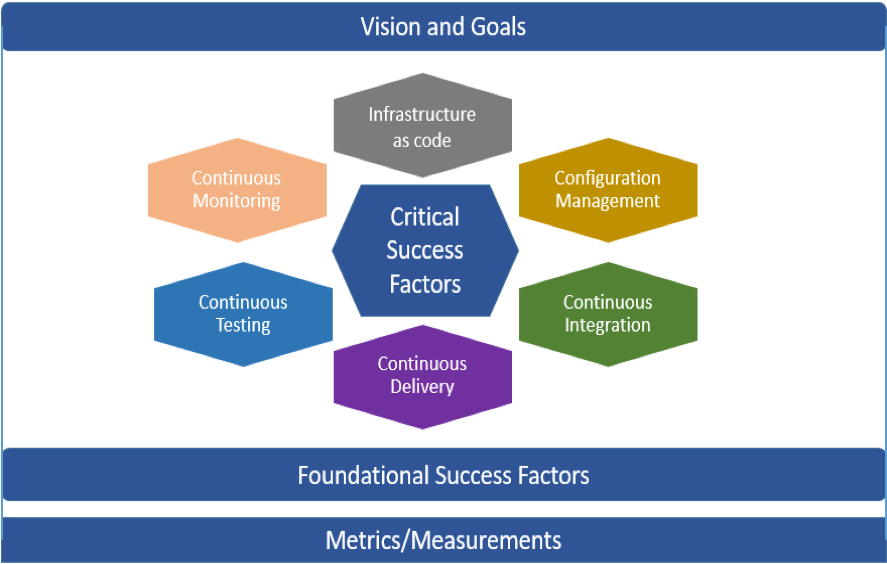
The four key pillars for DevOps strategy are:
Identifying the vision and goals.
Identifying foundational factors.
Critical success factors.
Basing the strategy on measurements to track the progress and realization of benefits.
Vision and Goals
Drivers and challenges form the basis for vision and goals. Before embarking on the path to DevOps, it is crucial to analyze the “as-is” situation and understand the current challenges and drivers for doing DevOps. Current challenges could include:
Too many production defects.
Business stakeholders demanding features that the team is unable to deliver.
Painful deployments.
Team burnout and frustration.
Deployments done as ceremonies with multiple teams on call.
If any of these sound familiar, that’s a sure sign your project needs DevOps.
Drivers for creating the vision and goals may be external or internal. External drivers may be improving customer satisfaction by meeting expectations around availability, reliability, usability, performance, features, value and time to market. Internal drivers may be improving operational efficiency (speed, throughput, quality) or improving employee loyalty, improving technical capabilities or simply making deployments less painful.
Critical Success Factors
Below are the key factors in implementing the DevOps pipeline which includes continuous integration, continuous delivery and deployment. The continuous integration aspects cover configuration management, code packaging, branch/trunk implementation, static code quality analysis, code reviews and static security scans. The objective of continuous delivery and deployment is to move the code from the lower environment to the production environment in an automated way. The key aspects as part of the continuous delivery are embedding continuous testing within the pipeline and automating the applicable tests—unit testing, system testing, API testing and/or browser testing, along with the non-functional testing (performance and security). Another key aspect is integrating continuous monitoring into the pipeline—infrastructure monitoring (application and database servers) and application end user monitoring, which provides key input and metrics on how users are using the application and can be leveraged to improve customer experience.
Key pillars of DevOps strategy
Foundational Success Factors
Foundational factors are critical for DevOps to be successful in an organization. Before embarking on the journey, ensure foundational factors are in place, such as management buy-in and support, maturity of the current agile process, conducive culture, collaboration among teams, CI/CD tools and availability of technical skill sets.
It can be difficult for agile project teams to focus on working on the DevOps items along with the sprint-specific “functional” requirements. One way to increase the priority is to include the DevOps-related items in the sprint. That said, it can be challenging to focus and achieve DevOps objectives, as they may take a back seat to functional requirements during the sprint. Another option is to form a DevOps-focused group from within the projects (based on technical skills and inclination for innovation) that is assigned with the task of building and implementing a CI/CD pipeline. If necessary, this group can get help or expertise through suppliers. Forming a DevOps-focused group has been shown to be helpful in terms of achieving DevOps objectives.
Metrics: Identify, Measure and Continuous Improvement
Tom DeMarco famously said, “You can’t control what you can’t measure.” In DevOps, metrics and measurement are critical for success, as implementations take time. Metrics, therefore, should be aligned with goals and vision to track progress. Also critical are identifying the effectiveness of the identified metrics and making any revisions to existing metrics, as well as identifying and adopting additional elements for success.
It is helpful to quantify the “as is” situation at the start of the implementation by measuring the metrics. That allows you to see the kind of progress being made on each of the aspects as you go along.
Customer perspective (e.g. time to market, number of defects per deployments).
Internal perspective (e.g. average deployments per sprint, number of successful deployments, average time per deployment, mean time to repair).
Innovation perspective (e.g. number of enhancements to pipeline).
Though there are multiple DevOps aspects that can be measured, it is better to start small to avoid being bogged down by measurements. For example, you can start by capturing the average time per deployment or time to market and add other metrics as you go along.
Conclusion
DevOps is a critical initiative and focus area for organizations today. To be successful, a DevOps strategy—a top-down approach which provides clarity and transparency within the organization—is necessary. The key pillars of DevOps strategy can help lay the foundation and prepare—and keep—organizations on track during their DevOps journey. The strategy can be part of the project plan for a single project or can be leveraged for scaling out a DevOps initiative throughout the enterprise.
We live in an increasingly “as-a-service” world. From software as a service (SaaS) and platform as a service (PaaS) to functions as a service (FaaS) and SaaS-delivered applications, service delivery has become paramount to business goals and practices.
In today’s DevOps landscape, microservices—the cloud-native approach to designing scalable, independently delivered services—allow teams to prioritize each individual service rather than many services simultaneously, enabling agility and continuous delivery. However, even with all their benefits, microservices come with their fair share of challenges, specifically with observability, monitoring and security. Service metrics are therefore more important now than ever before, as mitigating the challenges and seizing the opportunities introduced by microservices helps DevOps teams create a high-quality end user experience.
With service delivery so integrated into the overall business and customer experience, it’s crucial to ensure that service performance always remains at its peak. How can tech pros ensure that service-level agreements are met, services run smoothly and end user expectations are met and exceeded? The answer is simple: become hooked on service metrics.
Getting Hooked
In this piece, we’ll explore service metrics in respect to microservices. Due to the observability, monitoring and security challenges that microservices can introduce, managing and controlling microservices and their traffic requires an additional layer of tooling: a service mesh. Implementing a service mesh architecture helps facilitate traffic management, service identity and security, policy enforcement and more, which ultimately brings reliability, security and manageability to container and microservice management. Important metrics such as request volume, request duration, latency and request size can be gathered automatically across a service mesh, which helps facilitate successful microservice deployment.
However, despite service mesh tooling helping to mitigate risks, failures such as RPC timeouts and exception propagation can occur. Failures in the microservices space often occur during the interactions between services, so a clear view into those transactions enables DevOps teams to better manage architectures and avoid said failures. A service mesh provides observability, which enables DevOps teams to easily see what is happening when services interact with each other, making it easier to build a more resilient, secure and efficient microservice system. Additionally, service meshes provide a developer-driven, services-first network—a network that runs without application developers having to build network concerns into their application codes. Service meshes create a network that empowers operators with the ability to define network behavior, node identity and traffic flow through policy.
Tips for Success: What You Need to Know
So, how does a DevOps team implement a service mesh architecture for service metrics? Following a few best practices can help ensure success:
Know When to Implement: If a DevOps team does not plan to run an excess of microservices, a service mesh may not be necessary; fewer than 10 microservices likely could be managed with existing tools and security tools. But once a team starts running more than 10, a service mesh becomes essential.
Understand Your Use Case: After confirming the necessity of a service mesh architecture, you must understand how it will interact with the other types of infrastructure you’re running, as this will help determine what service mesh to leverage. For example, some work well with Kubernetes or Docker Swarm, but if you’re not running services inside containers, you would only benefit from the security or observability pieces of a service mesh. Depending on your use case, you might want to implement a highly capable service mesh such as Istio or a simpler tooling such as Linkerd 2.0.
Focus on the Network: With a service mesh architecture, you have several microservices that are communicating over a new network. As such, it’s important to understand the network’s criticality: What would you want out of a network that connects your microservices? You want your network to be as intelligent and resilient as possible; to route traffic away from failures to increase the aggregate reliability of your cluster; and to avoid unwanted overhead such as high-latency routes or servers with cold caches. You want your network to ensure that the traffic flowing between services is secure against trivial attack. And you want your network to provide insight by highlighting unexpected dependencies and root causes of service communication failure.
Conclusion
Becoming hooked on service metrics is key to ensuring successful delivery of services and meeting end user experiences. With the value service delivers to a business, it’s crucial to ensure that services are always running at their prime. For microservices, implementing a service mesh architecture and following corresponding best practices help ensure successful service delivery.
The testing landscape in DevOps is a big one, with lots of established players feeding the machine. SmartBear is one of those companies. The force behind Swagger, SoapUI and others is perhaps not as well-known as its brethren in the DevOps testing space, but it cuts a wide swath. And, with its recent acquisition of Zephyr, it’s about to get wider.
In this DevOps Chat, we speak via video with Ryan Lloyd, VP of Products at SmartBear, about the Zephyr acquisition and the DevOps testing and test management space in general. As usual, the streaming video is immediately below, followed by the transcript of our conversation.
Transcript
Alan Shimel: Hey, everyone, it’s Alan Shimel, devopsy.kinsta.cloud, Container Journal, Security Boulevard, and we’re here for a great interview, hopefully, with Ryan Lloyd, VP of products for testing and development at SmartBear. Ryan, welcome.
Ryan Lloyd: Thank you. Great to be here.
Shimel: Great to have you here. So, Ryan, before we jump into today’s news that we wanna discuss, I wanted to just quickly kinda do a level-set. SmartBear is a company I think most people have probably heard of it, but they may not be 100 percent sure of the full breadth of the SmartBear portfolio. So why don’t we talk a little bit about who is SmartBear and what are the kind of products and services you guys offer?
Lloyd: Yeah, absolutely. So SmartBear software is a company with a lot of history and if you don’t recognize the company brand, it’s very likely that you recognize one or more of our product brands, so we are the company behind some of the key product brands like Swagger, SoapUI, CrossBrowserTesting, TestComplete, so quite a diverse portfolio of products focused on helping our customers who’re building software. Help them build tests and monitor their software applications.
Shimel: Great. So, Ryan, big news out today is SmartBear had made another acquisition. You guys have acquired Zephyr. Is that correct?
Lloyd: That’s right. Yeah, we’ve announced our intent to acquire Zephyr, a company in a similar market space as us.
Shimel: So it’s a similar market space, but let’s get specific. What does Zephyr do?
Lloyd: Great. So Zephyr is a collection of tools for testing and specifically focused on the area of test management, managing the process of testing.
Shimel: Great. And you mentioned an intent to inquire – acquire, so I guess that means it hasn’t yet closed, but you’re both private companies and I would imagine it closes fairly quickly.
Lloyd: That’s right. We expect in the next 30 days, subject to the usual regulatory approvals.
Shimel: Yep. Fantastic. So, you know, Ryan, one of the things I read in the background around this one was that one of the big pluses here is Zephyr’s presence within the Atlassian, the Atlassian ecosystem, and SmartBear actually is already a big player in that Atlassian ecosystem. Well, aren’t they?
Lloyd: Yeah, so we have a couple of products that have plug-ins to the Atlassian ecosystem. I mean, the reality is 60, 70 percent of our customers are using Atlassian’s tools. They’re pretty dominant in the area of software teams, for managing some part of the software development process, so it’s a very strategic and important ecosystem for SmartBear as a company. And, certainly, Zephyr improves our ability to reach that ecosystem of users and make sure that they’re aware of all of the tools and capabilities that SmartBear can offer.
Shimel: Yep. And, Ryan, you know, 60 to 70 percent use Atlassian. I’m gonna imagine the overwhelming majority are using Jira and then maybe Jira Plus.
Lloyd: Jira –
Shimel: Correct?
Lloyd: Certainly, Jira is probably the most prevalent. Confluence gets tagged on with Jira quite a lot. And then BitBucket, actually, is also becoming quite popular as well. BitBucket, GitHub, GitLab – they’re sort of three of the same, in terms of enterprise solutions for developers.
Shimel: Got it. So I don’t wanna turn this into being about Atlassian and their products, but, obviously, they do have a big ecosystem. There are a lot of third parties, such as SmartBear and Zephyr, who move a lot of services and product via that marketplace. But let’s talk a little bit similar, but where’s the overlap? Or is there any overlap between what Zephyr and SmartBear’s offerings are about?
Lloyd: Yeah, so SmartBear offers a broad portfolio of products and, certainly, a couple of the products we have, pre-acquisition, were in this test-management space. What Zephyr brings to the table, though, is a solution that is natively built around Jira and delivered through the marketplace. So what that means, to be delivered through the marketplace, is it’s a native Jira solution that Jira administrators and customers can install directly from within their Jira instance. So it provides a very seamless extension of their workflows, within Jira, to handle some of these test-management scenarios, which we think is really important to teams that are trying to consolidate their processes and have a unified approach to that.
Shimel: Excellent. I guess one of the issues – and, with your title and your responsibilities around VP of products for test-and-dev, just in a number, how many products are there in test-and-dev now, within SmartBear and then if we add the Zephyr suite to the mix?
Lloyd: Yeah, so we had five products in that portfolio. Today, Zephyr brings three additional products into that portfolio, so we’re now up to eight products in our test and development business, as well as a range of products in our other business unit, around API.
Shimel: You know what? That’s a lot of products to be managing, huh?
Lloyd: It is. I mean, SmartBear has grown a lot over the years, through both acquisition of companies and building new organic products and bringing them to market. It’s pretty exciting time for us. We’re, pre-acquisition, at about 450 employees globally, so it’s an exciting time to be part of this company.
Shimel: Absolutely is, man. So, you know, another not necessarily unique but another kind of factor you have to play into the SmartBear – and I don’t know about Zephyr as much – is that some of your solutions have open source kind of versions out there that you guys help manage the open source communities around these, as well as the commercial versions of the products themselves. Correct?
Lloyd: Yeah, that’s right. I mean, core to our business is really a couple of philosophies. One is we wanna be open and interoperable with all the tools that are part of the ecosystems that software teams are using. And so, in some cases, that means commercial opportunities to partner with companies like Atlassian; in other cases, it means we want to be a part of an existing open-source ecosystem or help build up and nurture an open-source ecosystem. So, certainly, when we brought SoapUI and Swagger into our product portfolios, that was all about really taking that existing organic ecosystem, where developers and testers are going through tools, and helping build and nurture and develop that ecosystem.
Shimel: Excellent. So what kind of special challenges – you specifically, right? You own the products; you’re VP of products here. What challenges does that pose for you, having these open source kinda versions and tools and communities. I mean, you don’t wanna burn them, right? Because, ultimately, you kinda bite the hand that feeds you. So let’s talk about that. What does that – how does that manifest itself with you?
Lloyd: Yeah, certainly. I think there’s a brand and a culture that exists around open-source products and I guess it’s our responsibility, as stewards of those brands, to really continue to nurture that community. And that means we’ve gotta make balanced decisions about where we choose to add features to the open source products, versus where we commercialize some of those features, so there’s a constant balance there and kind of evaluating and making sure we’re engaging with the community.
And then, more broadly, beyond just our open-source products, I think one of the biggest challenges in the software tools space and market is the interoperability that’s required between tools these days. You know, developers and testers, they’re demanding practitioners. They want their tools to work together and there’s a huge diversity of tools out there in the market. So, as a product manager, that’s what keeps me up at night, is making sure all these tools are compatible and working to support these complex workflows.
Shimel: Absolutely. I mean, one way of looking at it is, if there wasn’t such a big market, there wouldn’t be all these tools.
Lloyd: That’s true.
Shimel: Another way of looking at it is also that it presents a tremendous opportunity for consolidation and for one or a few products to emerge as true market leaders. And then you’ll see it kinda – you know, you’ll see the amount of products in the market kinda consolidate. You know the old saying, “If you’re not – you’re either leading, following, or get out of the way,” right? If you’re not top-three, you gotta ask yourself, “Do you wanna stay in that market?” But, you know, when we talk about the testing market – and, in DevOps, we talk about continuous testing – it certainly is a huge, huge market here.
Lloyd: Yes, it is. And it’s one that’s continually evolving and shaping, right? So there’s traditional test tools that have been around for a decade or more, and then there’s sort of emerging products that are coming to market. And I think it’s how all these work together and evolve to support the change in workflows and, yeah, even just organizational changes within environments.
Shimel: Yep. So another area of the testing space, Ryan, that I’m interested in personally is security and security testing. And it’s really funny when I – you know, 20 years ago, when I was into security, when I first got into security, info-sec, QA was here and security was there and never the twain shall meet, right? But now we’re starting to see security become synonymous with quality – that’s the “Q” in QA.
Lloyd: Yeah.
Shimel: And so security testing and other kinds of testings are starting to merge. What do you guys see with that at SmartBear?
Lloyd: Yeah, I think what’s driving a lot of that is the Agile workflows that teams are adopting, so, as they increase the pace of trying to deliver and release software, they’re being forced to evaluate quality and security earlier in the life cycle and more from the context of the development team, rather than having a separate, isolated team that deals with that downstream or after the fact.
Shimel: Correct.
Lloyd: So I think that’s the driver, so definitely a lot of demand for your Agile workflows to support testing by design and security by design. From our perspective, I think that opens up some unique opportunities for adjacencies and areas that SmartBear can continue to expand to in the future.
Shimel: Yeah. I mean, so, you know, what you’re describing is almost the classic “shift left.” Right? As we start shifting testing, security and security testing, left early into the development life cycle. But it’s also the reality of it’s been called the “modern software factory.” Right? It’s an assembly line and is a production line, for software, and where traditional QA, traditional testing, security testing, where they fit into that life cycle has shifted left.
But also is – you know, where we used to think, oh, QA was going away and security people were gonna give up control of security. Not the case. They’ve become more important, right? But also highly automated where they can be and clearly defined as part of this factory, if you will.
Lloyd: Yeah, it’s really just about reshaping the responsibilities and improving the collaboration across the whole unit or team that’s now responsible for delivering iterations of software.
Shimel: So, Ryan, then – so that begs the question then, “What does that mean for you as a product manager?” Right? Where you used to sell to a QA engineer or security testing sold to a security person, but now your audience includes the guys using Jira and BitBucket and a bunch of other tools. It’s not just Atlassian, obviously. So you have new customers to serve and to service. Now how do –
Lloyd: Yeah, that’s absolutely right. Yeah, so, over the last several years, we’ve been focusing on how to modernize our portfolio to support those sort of emerging needs, both the process change that’s going on with our customers and the persona change that’s happening in many instances. So the acquisition of Swagger is a great example of us providing tools that help developers earlier in the life cycle, so, where we had SoapUI to help with API testing from a QA perspective, Swagger aims to solve some of that further upstream by enabling more collaboration around the definition of those APIs to begin with. And, oh, by the way, making sure that interoperates with SoapUI, so you get leverage out of that API definition to generate some of those tests, automate it, and it triggers sort of a seamless workflow and thread.
And so we’re continuing down this path of modernizing our portfolio. We acquired CrossBrowserTesting about two years ago, to help companies address some of the modern types of applications that they’re looking to test, integrated more deeply with Selenium, which has become hugely popular in sort of the developer organizations, to drive automated Web and mobile testing. And then, with Hiptest and Zephyr, again, it’s furthering our relevance for those software teams that are on that journey.
Shimel: Excellent. Ryan, last kind of issue I – or not issue – it’s not an issue at all – but the last area I wanted to talk to you about was so you’ve got five. There’s three more coming in. And that’s just test-and-dev; you have an AP kind of silo as well within SmartBear. How do you – I mean, I’ve been in the boat not quite as many as you, but, when you have so many different products and then a company name, how do you brand? Right? Do you continue branding the individual products? Do you throw SmartBear in front of all of them, but some of ’em already have names that may be, in fact, bigger than SmartBear, as you said in the beginning? Again, as a product manager, you have to think about that a bit. You know, what’s the right answer there, if there is –
Lloyd: Yeah, so I think SmartBear is going through a bit of a transformation, in that regard. You know, as I said and as you pointed out, we’ve had very strong product brands up to this point. We wanna continue to nurture those product brands, so no intent for those to go away because we love the high-velocity, try-buy model we have around our products, where developers and the practitioners can find the right tool for the job and get started.
But we’ve gone through an exercise on how we can integrate our products in the right way, so like the Swagger, SoapUI example I provided, to create those sort of interesting workflows. And we’re building up the SmartBear Academy, our SmartBear community, our big user conference, to help elevate the SmartBear brand and create more awareness of the portfolio of products we have – how they work together, how they fit into the ecosystem. And I think we’re just at the start of that journey right now. We’ll see a lot more, as we launch into the year next year, around what we’re doing from a brand perspective to galvanize the company and all of the great products we have.
Shimel: Excellent. Well, Ryan, we’re about out of time, but, first of all, congratulations on the Zephyr announcement and anticipated acquisition here. It’ll make for some good times. And continued success with SmartBear and everything you guys have going on.
Lloyd: I appreciate it. All right. Great talking to you, Alan.
Shimel: All right. Ryan Lloyd, VP products, test and development, for SmartBear, on SmartBear’s acquisition of Zephyr, here on devopsy.kinsta.cloud. And we’ll talk to you soon, everyone. Have a great day.
Achieving hyperscale is a work of technical art for any business. As companies grow and customers begin to rely more heavily on your service, ensuring reliability during peak business times is mission-critical. An enormous amount of work goes on behind the scenes to ensure scalability, and oftentimes it becomes necessary to redesign or rethink processes and systems to improve them as they face increased pressure.
When customer demand reaches its apex, it’s the ultimate test for any organization’s systems and processes; therefore, it’s important to prepare a comprehensive strategy that focuses on scalability, reliability and hypergrowth in a targeted, calculated and data driven methodology.
The first step on your path to hyperscale is forecasting and gathering data analytics around business and growth patterns for a full year to make smarter forecasts. Set aside time each day throughout the year to go over the allocation of your data and analytics, measuring them for accuracy to see how they stack up to your current predictions for that specific day. This may seem taxing and cumbersome when engineers have other priorities to work on, but devoting time to this in the early months of the year will help you be that much more accurate when it comes to predicting the needs of your customers and how you should go about scaling to meet those needs.
Especially during the holiday season, it’s important to have a minute-by-minute projection of how much traffic you expect and need. That’s where forecasting and an advanced data science model come into play. A common mistake made when it comes to scalability is not getting granular enough about the real pressure points for your systems. Having accurate projections and forecasts in place that feed into your data science model means you can better test your systems and production limits while gaining greater insight into meeting your scaling points. If you find fragilities ahead of time through this, you can assign your engineering team to fix them well in advance.
Another way to truly bolster your scalability efforts is by introducing an operability development model. This entails constantly deploying some controlled chaos into your systems to see how they really stack up and function under pressure, with the goal of up-leveling the capacity of both your operations and system growth. The operability development model allows you to really test the grit of your systems by squeezing the most out of them, prepares you to respond quickly and methodically should the worst case scenario occur and sets you down the path toward continued performance growth and scale.
From here, you’ll want to institute a preventative maintenance model. Think of it like getting an oil change for your car. Instead of waiting until the very moment you need your software to perform exceptionally, start taking a look at the little things that could or are causing problems ahead of time and fix them on a monthly or quarterly basis. A preventative maintenance model helps you inspect, adapt and solve these little nuisances before they become serious problems, granting you the cleanest operating environment possible.
Scalability is king, but availability and reliability are arguably just as critical. Improving availability means reducing latency and getting as close as you can to where your customers utilize your services. This can be achieved by deploying locations around the world to make connections much faster and services more independent. To maintain reliability, you should have processes in place that can quickly respond and offer support to customers 24/7 to maximize consistency and performance.
Another strategy to consider—if it makes sense for your business or if you’re evaluating cloud providers as a growth option—is to double down on your efforts by re-architecting your platform and systems as cloud native from the ground up to support greater levels of scalability and cost efficiency. By going cloud-native, you can achieve independently scalable services so that you don’t have to scale all of your services together. This means your engineers and developers don’t have to spend way too much time figuring out where issues and fragilities occur.
A platform architected as cloud-native allows you to leverage microservices and containerization, creating an environment with more reliable, self-healing, high-tenancy and auto-scaling features that take the most advantage of your hardware and services. An added benefit of a cloud native platform is that you can use your data to find the most opportune times to both scale in advance and descale based on performance and customer expectations. The efficiencies that come from re-architecting as cloud native enable engineers to spend more time on automating software and the delivery pipeline, which is a huge boon for scalability.
At the end of the day, a well-thought-out preparation strategy for mass scalability makes the whole process much more exciting and obtainable. It also greatly reduces lead-up anxiety by getting a head start on planning so that you have more time to sit back and enjoy the fruits of your labor. Lastly, a yearlong scalability strategy enables you to experiment and try new things without the fear of failure. Testing new approaches ahead of time to see what does or doesn’t work will only help you learn and make your scalability efforts that much more effective for the future as your company continues down the path of hypergrowth and hyperscale.
It is a truth which should be universally acknowledged that the most important skill for a customer-facing job in what we laughingly call “information technology” is a cast-iron ability to say no—and make it stick.
The misguided desire to please other humans by attempting to deliver on their every request has sunk more projects than any units mismatch or catastrophic misconfiguration—even more than the justly feared Friday afternoon deployment.
The key to success is an agreed definition of what success is, and how we will all know and measure whether we have achieved it. Let’s take the car as an example.
French Cars Have Always Been Weird
These days, we would consider a car to be woefully unfinished if it were lacking upholstered seating for at least four adults, a roof and windows to keep the elements out and some form of in-car entertainment—an FM radio as a bare minimum, probably a CD slot or USB socket as well. This is on top of seat belts, airbags, anti-lock brakes that are probably power-assisted and more lights and safety features than you can shake a stick at.
Nicolas Cugnot did not bother with any of these features. His design didn’t even have four wheels. It not only didn’t have an airbag in the steering wheel, it didn’t even have a steering wheel. It was controlled with a ridiculous tiller arrangement that unsurprisingly completely failed to catch on. And yet, his vehicle was a success by the stated criteria of the project: It made it much easier for the French army to haul ammunition around.
Nicolas Cugnot’s steam dray from 1769
Admittedly, he was also lucky enough to be constrained by the technology available to him. Even Louis XIV might have balked at adding a four-piece chamber ensemble to provide an appropriate musical soundtrack for the driver. But the key point is this: Monsieur Cugnot stuck to his brief, and concentrated all his efforts on the features necessary to achieve it.
Bringing Apple Into It
In somewhat more recent times, we have Steve Jobs (emphasis mine):
People think focus means saying yes to the thing you’ve got to focus on. But that’s not what it means at all. It means saying no to the hundred other good ideas that there are. You have to pick carefully. I’m actually as proud of the things we haven’t done as the things I have done. Innovation is saying no to 1,000 things.
One reason why Steve Jobs is so famous is that he actually said those thousand nos—often loudly, rudely and profanely. Steve stands out in IT because most technologists have an irrepressible instinct when faced with a question to start to speculate about it, bikeshed possible solutions, build a quick minimum viable prototype and, before you know it, you are armpit-deep in feeping creatures, all of which you are now somehow responsible to nurture and feed. Not being a technologist himself but more of an ideas person, Steve was perhaps better able to take a step back and focus on the end goal.
Let’s Get Concrete
Now, this should not be taken as a license to adopt all of Steve Jobs’ methods (Lesson One: Be a complete arsehole to absolutely everyone in your life), if for no other reason that even Steve got fired for it, and from the company he founded at that. When someone comes to you with a request for just one leeeeetle feature, you and I probably can’t get away with screaming “NO!” and slamming the door in the requester’s face. The polite and career-prolonging way to deal with the problem is to ask, “Why?”
Ideally, in the process of explaining the rationale for whatever the request is, some other solution to the problem will be identified. A good way to improve the odds of this happening is to involve other people in the discussion. Extending the audience in this way creates opportunities for someone to interject helpfully with something along the lines of, “but Carol, we have a perfectly good hammer over there; why are you trying to use a screwdriver to batter a nail in?”
Sometimes, you may need to adopt an iterative approach, which sounds impressive, but simply means waiting until the end of the first explanation, nodding thoughtfully, and then asking, “Yes, but why?” Among people who watch more television than me, this is known as the Columbo approach: “Help me understand, what is it you are trying to do here?” and just keep doggedly repeating the question. Eventually enlightenment will arrive—or the requester will get tired and go away, which is also a perfectly valid win condition.
This method will also help with the tricky situation where the most important question is the one which is not being asked. There is often an implicit question behind that one, where the solution is not to give a glib answer, but to think critically about the proposed or effective solution and ask the questions yourself: “Why are we trying to solve for this?” Or, “What is this thing you are proposing actually meant to do?” And finally, “What was the original problem, anyway?”
People have a tendency to focus on the issue that is right in front of them, even when the real problem is in an upstream step of the process. They observe or experience something about X as the identified problem, and so default to solving for X directly without considering the broader landscape. This leads to convoluted, inefficient and often high-friction solutions—Rube Goldberg/Heath Robinson machines (delete as appropriate to whichever side of the Atlantic you are on), where a simple connecting pipe is all that is required. An artillery piece will make holes in the ground, but there are a couple of collateral impacts you may want to consider—and maybe offer a spade instead.
All I needed was somewhere to plant some flowers!
Unfortunately even the Columbo Method is not entirely guaranteed to work, because on some rare occasions the underlying request is actually valid and cannot be summarily dismissed. This is when you bring out the big guns and start ranking the urgency of what was already agreed as the scope of the project (a nail hammered into the wall sturdily enough to support that lovely picture) as opposed to what is being requested (a fully motorized picture rail, capable of supporting up to 10 paintings on the scale of Guernica and turning them to optimize lighting conditions throughout the day while also keeping them out of direct sunlight). Nobody is saying that the second option would not be nice, but it certainly won’t be done in time for supper.
And that, children, is how you say No. Go forth, and do ye likewise, and may all your projects be huge successes. And, most importantly, not require me to come in and clean up after you.