Category: Doin’ DevOps

  • The Role of AI, ML-Powered DevOps in Digital Transformation

    The Role of AI, ML-Powered DevOps in Digital Transformation

    Global businesses are in the midst of an enormous digital transformation wave. As we step into the realm of industry 4.0, exponential technologies are becoming a fundamental segment of traditional business settings.

    Despite having access to transformative technologies, however, many organizations fail to embrace disruption and harness their potential to stay ahead of the curve. Much of this stems from their inability to foster a collaborative environment wherein myriad teams and operating IT systems work in unison to achieve their goals. Without a strong foundation of infrastructure automation and well-chosen team collaborations, embarking on the digital transformation journey is difficult. And to do that, adopting a DevOps mindset is necessary. In essence, organizations need to incorporate DevOps practices to transform, compete and protect their new value pools without sacrificing quality, stability and productivity.

    Digital Transformation and DevOps

    DevOps helps enterprises succeed with digital transformation by triggering a paradigm shift in the cultural mindset of the business, breaking down silos and driving continuous change and rapid experimentation.

    There are multiple benefits of merging DevOps with a digital transformation strategy. First, this methodology breaks down the silos between IT and business operations, thereby ensuring consistent levels of productivity, efficiency and service delivery. This has a direct impact on companies’ time-to-market. Second, bug fixes are much easier due to the automation of toolchains. Third, the automation that DevOps introduces improves developer/IT productivity as they can focus more on innovation rather than being caught in a cycle of bug-fixing and firefighting.

    Despite DevOps’ contribution to digital transformation, its adoption in many industries is still slow due mainly to scarcity of skills and the right toolset. Complete automation remains elusive. Additionally, patchy adoption has given rise to a two-paced overall technology environment—one part is fully integrated with DevOps and the other part is users still mulling over the “how” of tightly integrating it in the overall process.

    Advanced technologies such as artificial intelligence and machine learning could resolve these issues. They can alleviate operational complexities in DevOps to help organizations transform at a faster pace. The following are some of the benefits offered by these technologies.

    Better Automation

    The need to rely on manual processes can be reduced with AI- and ML-based technologies, which has an enormous impact on data analysis. Organizations can use powerful AI data mapping techniques to automate data transformation processes with ease and speed. They can make use of the predictive ability to accelerate the process, increasing accuracy by leaps and bounds. This transformed data can be easily integrated using another solution AI integration, and so it becomes easier for users to work on data for extracting business intelligence and streamlining decision-making. This entire process takes only a few minutes to complete. Plus, since the need for manual intervention is curtailed, developers who previously were mired in handling transformation operations can move on to more strategic tasks such as governance, control and resource planning.

    Better Security Through Intelligent Anomaly Detection

    AI and ML-powered technologies, with their highly precise features, augment system security to deliver better performance. With a centralized logging architecture, users can record and root out suspicious activity on the network. These technologies togehter with DevOps can help mitigate the impact of threats and hacker attacks to help companies drive their digital transformation initiatives with precision.

    Better Team Collaboration

    In any organization, two teams function in parallel: the developer team, which has the responsibility to code fast, and the operations team, which ensures minimal disruption. While maintaining this balance can be difficult, transformative technologies such as AI and ML can help these two teams work in unison, improving collaboration by helping them have a single, unified view into system issues across the business ecosystem.

    Better Customer Experience

    AI-based technologies can have a direct impact on organizational productivity and performance. They can develop and launch their products faster (keeping customer expectations in mind) with lower TCO. Plus, DevOps-inspired service teams are able to provide a higher level of service, resulting in more satisfied customers

    AI-powered technologies are critical to kickstart DevOps performance and ultimately drive digital transformation initiatives. Infusion of AI not only improves enabling faster development and deployment cycles through automation, but also enables better collaboration and uncovers and remediates key issues, helping businesses unlock digital transformation value.

  • GitLab Extends Scope, Reach of CI/CD Platform

    GitLab Extends Scope, Reach of CI/CD Platform

    The latest update to the GitLab continuous integration/continuous delivery (CI/CD) platform adds a bevy of additional capabilities spanning multiple capabilities, from being able to manage application development and deployment projects in smaller chunks to allowing remote teams to work more efficiently.

    Brendan O’Leary, senior developer evangelist for GitLab, said a Minimal Viable Change (MVC) capability in version 13.2 enables DevOps teams to break down work into smaller, more manageable chunks that are less disruptive. At the same time, GitLab is further reducing disruption by enabling deeper integration with Jira project management software from Atlassian. DevOps teams can provide bulk updates to projects using Jira in addition to creating confidential “epics” that only a limited number of users can access, said O’Leary.

    GitLab Geo has also been updated to improve replication performance to ensure local content is fresh. That capability has become especially crucial for DevOps teams that now routinely have large numbers of members who are working from home to help combat the spread of COVID-19. Many DevOps teams were already often working remotely prior to the pandemic; now large organizations are moving to extend those efforts at scale because it’s not clear when, if ever, DevOps teams might be heading back into an office, noted O’Leary.

    Other new capabilities include CI test results within a Release Evidence module for tacking compliance data; a global search tool for GitLab.com; tools for tracking designs stored in GitLab; and the ability to run custom load tests as part of a CI/CD pipeline more easily.

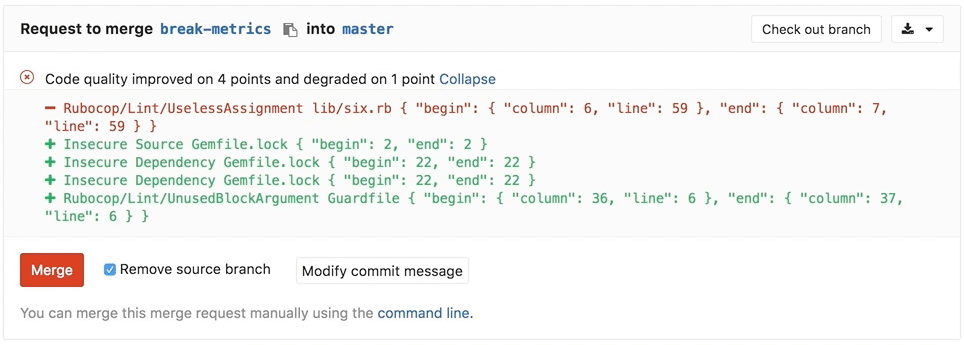
    DevOps teams can now associate Feature Flags with related issues; invoke container host monitoring and blocking; track changes to wiki pages; drive feedback into web-based integrated development environments (IDEs) in real-time; enable PHP developers to access a Composer Repository to discover dependencies; and employ a Code Quality Merge Request widget.

    Finally, DevOps teams can run the GitLab Runner tool to launch jobs on instances of z/OS running on IBM mainframes. O’Leary said that capability is especially critical as more organizations that have mainframes embrace best DevOps practices to drive digital transformation initiatives.

    In general, digital business transformation initiatives are fueling adoption for DevOps as organizations look to accelerate these initiatives to reduce overall costs and potentially increase revenue. As part of those efforts, O’Leary said organizations are looking for a highly integrated DevOps platform that minimizes the amount of time and effort DevOps teams need to spend integrating components and managing the platform. That urgency is also driving more organizations to embrace the software-as-a-service (SaaS) edition of GitLab, he added.

    In the meantime, competition among CI/CD platform providers continues to intensify in the wake of an ongoing wave of consolidation. The paradox is that consolidation is not being driven by declining demand; rather, many IT organizations are looking to streamline DevOps processes by standardizing on a single platform. As such, the race to add as many capabilities to a CI/CD platform as possible has never been more heated.

  • Survey Finds SRE Role Remains Largely Aspirational

    Survey Finds SRE Role Remains Largely Aspirational

    Monitoring tools provider Catchpoint, in collaboration with the DevOps Institute, has published a survey that finds there is a significant gap between the tasks and duties that define the role of what a site reliability engineer (SRE) should be versus what is actually occurring within IT organizations that have hired SREs.

    Based on a survey of 600 IT professionals who have SRE titles or individuals that identify themselves as performing SRE-like tasks, the “Catchpoint SRE 2020 Report” finds the bulk of respondents are still squarely focused on managing IT infrastructure.

    Google, which is widely credited with defining the SRE role, maintains SREs should be spending as much time managing applications as they do infrastructure. Survey respondents on average are spending 75% of their time on operations. Only 14% of respondents said they are spending 50% or more of their time on application development processes. More than have of respondents (53%) also noted they are becoming involved too late in the application life cycle.

    The Catchpoint survey finds the top three tasks survey respondents associated with their roles were monitoring and alerting (93%), dashboarding (73%) and managing infrastructure as code (71%).

    Catchpoint CEO Mehdi Daoudi said one of the most telling aspects of the survey is only 53% of respondents identify observability as a task associated with their role, even though that’s a core tenet for best DevOps practices. Further down the list of DevOps tasks were testing (41%), telemetry (38%) and chaos engineering (26%).

    Daoudi said it’s probable many IT organizations are adding SREs in anticipation of furthering their DevOps ambitions. Not every SRE has all the skills required, but as more of them gain hands-on experience it’s likely many will grow into those roles. In fact, 41% of respondents said half or more of their work revolves around mostly manual, repetitive tasks that could be automated. More than half of respondents (52%) said they spend too much time on debugging-related tasks.

    Part of the challenges many IT organizations face derives from not putting enough focus on automating the management of legacy IT infrastructure, said Daoudi. Every time a new platform is adopted there’s a rush to operationalize it. However, IT teams frequently overlook the need to automate the management of rote tasks to free up more time to learn how to manage new platforms such as Kubernetes.

    Going forward, the survey finds nearly 50% of respondents said they believe they will be working remotely post COVID-19. More than half of respondents also said personal challenges included staying focused and having a good work/life balance while working from home.

    The degree to which SRE titles are being adopted to enable IT professionals to justify a raise or simply pad their resumes is unknown. However, the focus on the SRE role is likely to increase in the wake of the economic downturn brought on by the COVID-19 pandemic. In theory, a single SRE should be able to manage all the tasks that previously might have required as many as 10 IT administrators. At a time when many organizations are looking to reduce the total cost of IT, the number of full-time employees required to manage IT environments has clearly become a major concern.

  • Code Quality Doesn’t Have to Be Like the Weather

    Code Quality Doesn’t Have to Be Like the Weather

    Sometimes code quality feels like the weather: everyone talks about it, but no one ever does anything. Of course, that’s not from a lack of good will; most folks would love to have a week or two set aside to just clean things up. Unfortunately, that’s not how the world works. The best course of action is to sneak in a little clean up here, and a little there as part of normal work. Fortunately, that’s actually the best way to go about it. At SonarSource, we call it the Clean as You Code methodology, and we’ve found that this behavioral approach to code quality is as important as the tools developers use to track it. 

    The idea behind Clean as You Code is to ignore the quality of old code and focus exclusively on the quality of new changes. This may sound radical, but bear with me. Why focus exclusively on today’s changes? Because dredging up legacy code for the sole purpose of addressing code quality likely requires layers of approvals and perhaps business testing that may be difficult to get. But developers have absolute control over the quality of the code they’re writing now, and they’ll take pride in setting and enforcing high standards for that code. Focusing exclusively on the quality of new code works in both legacy and greenfield projects, and for all quality axes. 

    Let’s take test coverage as an example. Many developers are on projects that have lower test coverage than they would like. But stealing an hour here and there to add tests for random methods is generally a frustrating and ultimately futile endeavor. Instead, start with today’s changes. Make sure they’re fully covered and don’t release until they are. That’s it, that’s all that’s required. Covering those one or two methods — or even one or two lines — may feel like a drop in the bucket, but over time it will have a real impact. In fact, that’s been exactly our experience.

    Since the early days of my company’s flagship product, we’ve had an internal standard of 80% unit test coverage. And yet in those early days, we routinely released with coverage in the ’60s. There was always the intent to write unit tests, but inevitably it was left to just before release. And then it became a scramble to find the biggest uncovered files and slog through their unfamiliar code to write tests. Among the problems with this approach was the fact that the developer who wrote the code often wasn’t the one who wrote its tests, and thus could never be quite sure of testing the right behavior. And of course, no one likes cleaning up after someone else.

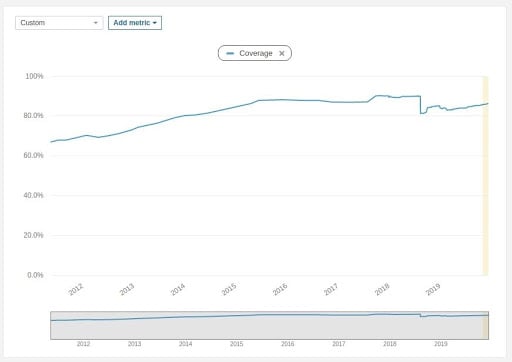
    In the end, it was a painful and ultimately ineffective routine; coverage didn’t break 80% until July 2014 — approximately seven years after the project started, and about a year and a half after we first formulated and adopted Clean as You code. You can see the October 2012 inflection point in this graph of project coverage (yes, the first few years of data are missing; victim of an early structural refactoring):

    On November 9, 2011 test coverage was at 66.9%. After rising to 70.3% on July 23, 2012 it fell to 69.3% by that October. From that October 2012 inflection point, it climbed steadily for more than three years, crossing the 80% threshold in July 2014. Coverage today is at 86.2%, comfortably above the 80% goal.

    Today, we’re at 86% coverage and rising. The formula for getting there was simple: 

    • Set standards on the quality of New Code. Here “new” means anything added or updated in the New Code period.
    • Define the New Code period. This is the scope of concern, i.e., how far back to go for the purposes of applying your New Code standards. We set it to since the last release. 
    • Don’t release unless your standards are met.

    Of course, the first two steps are a lot easier than the last one, especially if meeting the standards is left to just before release. Every developer has likely felt pressure to push business changes into production sooner rather than later. That’s why this strategy is most effective when it’s applied as granularly as possible. Meeting the standards before release is the bare minimum, but it should also be a non-event.

    We’ve found Clean as You Code to be most effective when applied:

    • At the individual level — Good developers want to write good code. When developers take personal responsibility for the code they write today, it saves time in the long run and no one has to clean up after anyone else.
    • At the pull request — If each individual PR meets your standards, sub-standard code will never be merged. That means no one will ever be pressed by management to release sub-standard code, because it simply won’t exist in the main code base.

    But what about the crufty old code that exists in every project? You’re probably thinking that it doesn’t just magically disappear. But actually — gradually — it does. The graph above is the graph of overall code coverage on the project. By focusing on the coverage of New Code, we organically and automatically raised coverage on all code. This is not a one-off; your results will be the same. Over the course of a few years, normal change requests will lead you throughout the code base. Make sure the code you write for those changes is clean, and the rest will take care of itself.

  • Upcoming Event: Time Series Virtual Summit

    Upcoming Event: Time Series Virtual Summit

    The Time Series Virtual Summit will bring together InfluxData community members for a unique learning experience focused on the impact of time series data. Presented in a virtual reality environment, the event will take place on July 16, from 10 a.m. to 4 p.m. EDT.

    This virtual event will focus on the impact of time series data and how it can be used to help build and optimize solutions for real-time visibility into stacks, sensors and systems.

    Here’s a preview of some of the speakers:

    • James Governor, analyst and co-founder at RedMonk
    • Al Sargent, senior director of product marketing at InfluxData
    • John Gleeson, VP of operations at Tardigrade.io
    • Jon Herlocker, president and CEO at Tignis
    • Michael Ellis, community manager at InfluxData

    Plus, speakers from companies such as AWS, Google, Microsoft and more.

    The industry leaders will share their thoughts on time series data, discuss the benefits of a time series database and the challenges of data management.

    At the Time Series Virtual Summit you will learn:

    • How to use a time series database to improve their competitive advantage and accelerate their go-to-market strategy.
    • How to manage risk in decentralized networks with time series.
    • How IoT can help manufacturers reduce downtime.
    • How to use observability to derive deep insights into system performance and user experience.

    The online environment features a lobby, an expo hall lined with booths full of downloadable resources, and an auditorium where attendees can watch the sessions. You can interact directly with time series experts and network with other attendees by joining the chat rooms.

    Discover what’s next from the InfluxData community and learn how you can get involved. To check out the agenda, the full lineup of speakers and to register (for free), visit the Time Series Virtual Summit website.

  • Participate in the Checkmarx 2020 Survey

    Participate in the Checkmarx 2020 Survey

    Checkmarx, the global leader in software security solutions for modern enterprise software development, and DevOps.com are conducting a survey about the implementation of DevOps and related automation and security tools.

    The purpose of the survey is to help organizations evaluate their DevOps maturity, find out what are the most used DevOps tools and the most common challenges organizations are facing with their current DevSecOps model.

    The survey consists of 16 short multiple-choice questions. The results will depend on several factors including:

    • The organization’s progress on their DevOps adoption journey.
    • The role of the respondents in their organization and their responsibilities for DevOps transformation.
    • Automation and security tooling capabilities respondents are using for DevOps and cloud-native applications.
    • The respondents’ ability to overcome challenges and obstacles standing in the way to successfully implementing DevOps.

    We urge everyone in the DevOps space to participate in this survey. The more data we can gather, the more we’ll find out about the adoption of DevOps and AppSec tools. We’re counting on you to make this report even more valuable. Invite your friends and colleagues to contribute to the survey, too — the more the merrier.

    Click on this link to complete the survey.

    We will make an announcement when the report is ready. Stay tuned!

  • Pega Low-Code Platform on Display at PegaWorld iNspire

    Pega Low-Code Platform on Display at PegaWorld iNspire

    Low code enables developers to create applications using visual tools and models. Developers looking for resources to improve their productivity might find Pega’s low-code platform quite helpful.

    Jennifer Gill, senior director of technical product marketing at Pega, joined ASG’s Mitch Ashley for an interview on the benefits of low-code in designing applications.

    During the pandemic, Pega has helped customers develop apps such as a COVID-19 tracker for a large healthcare organization, which was built in less than a week. And in just five days, Pega worked alongside the Bavarian Ministry of Economic Affairs and T-Systems to build a new app that provides COVID-19 financial aid to self-employed workers and small to medium-sized businesses.

    Pega has its own DevOps tool, Deployment Manager, which enables organizations to execute their own unit testing.

    Also built into the Pega platform is the Pega Express Methodology, which guides users step by step from smaller implementations to complex transformations, laying the foundation to easily add new app functionality as business needs change.

    As for the future of Pega, Gill said we can expect more automation and more intelligence built into the platform.

    Meanwhile, you can join her at PegaWorld iNspire, an interactive virtual event taking place Tuesday, June 2, at 9 a.m. EDT, to learn more about the technology behind Pega.

    The event will also feature a live demo on low code, during which attendees will learn how to define core app components and what tools they can use to manage and govern low code at enterprise scale.

    Check out Jenn’s interview for TechStrong TV below to learn more about Pega’s low-code platform.

  • 6 Virtual DevOps Conferences You Can’t Afford to Miss in June 2020

    6 Virtual DevOps Conferences You Can’t Afford to Miss in June 2020

    Conferences and events make up to a trillion-dollar industry and have been playing a major role in connecting people from different parts of the world and exchange ideas. Because of the COVID-19 outbreak, the first major tech conference that got canceled due to health and safety concerns was the Mobile World Congress (MWC), the annual gathering of electronics makers.

    Along the way, similarly, Facebook also canceled all physical conferences and events through June 2021, including the major F8 Developer Conference and the most awaited Oculus Connect 7 virtual reality event that was supposed to be held in San Jose, CA.

    Even Microsoft, the giant, has announced all of its events are going digital-only until July 2021, including its flagship Microsoft Build and the prestigious Microsoft Ignite 2020.

    At the beginning of April, more than 30,000 people were expected to attend the prestigious Google Cloud Next ’20 conference, all set to happen in San Francisco. But, as the coronavirus crisis intensified all over the world, keeping the attendees’ and employees’ safety in mind, Google decided to move the entire event online.

    Today, we will see six virtual DevOps conferences you can’t afford to miss in June.

    TechStrong Con

    Date: June 4

    Cost: Free

    TechStrong Con is a virtual summit dedicated to and celebrating all things tech. The event, hosted by MediaOps, brings together some of the most prestigious industry leaders for 12 hours of immersive learning and networking. The sessions are divided into three tracks: Emerging Technologies, Security/DevSecOps and Digital Transformation. Attendees will have access to downloadable resources and will have the chance to interact with tech leaders and fellow DevOps practitioners.

    You can also be a part of the #TechStrongCon Challenge, which consists in sharing a photo of your work-from-home space during COVID-19 on LinkedIn for a chance to win either an iPad Pro or a DJI Maxic Drone.

    A portion of the proceeds raised from the event will be donated to charities dedicated to fighting COVID-19. For more information on the event and the challenge visit the TechStrong Con website.

    Agile + DevOps

    Date: June 8–11

    Free Pass: $0

    Conference Pass: $499

    All-Access Pass: $999

    The theme of the event is “accelerating software delivery with the power of Agile and DevOps.” This is an event by TechWell, and this time it is happening fully virtual. From the comfort of your own digital device, sitting at your home, or wherever you are, you will have access to all of the great content and experts the Agile + DevOps conference is known for. This time, the event will be streaming over 90+ talks—including five keynotes, 25 tutorials, more than 50 sessions and 14+ Industry Technical Presentations. All this is happening over an engaging and interactive premium virtual atmosphere. You can select the conference package that fits your needs and your budget.

    DevSecCon 24 

    Date: June 15 -16

    Cost: Free

    This virtual conference focuses mainly on the security aspect in development and operations and tackles the impact of development operations and security “run by practitioners, for practitioners.” 

    The aim here is to show attendees how DevOps and security can work together seamlessly to make continuously secure development a reality.

    This virtual expo allows for interaction with different vendors and companies. Check their website for updated details.

    swampUP

    Date: June 23-24

    Cost: $20 (all goes to charity)

    swampUP is JFrog’s annual DevOps conference, and this time it is happening in a virtual format with two full days of action-packed DevOps talks and training. The conference has a remarkable set of visionary keynotes and thought‑provoking DevOps sessions delivered by industry experts. 

    Leap into DevOps, DevSecOps and cloud-native best practices with practical training by experts delivered virtually. Sessions are experimented and thoroughly designed for developers, administrators and managers. This is regarded as one of the industry-recognized conferences of all time.

    DevOps Enterprise Summit London

    Date: June 23-25

    Cost: $240 – $480

    Gene Kim’s IT Revolution hosts this event. DevOps Enterprise Summit has great speakers and exciting courses provided by experts. It is a place for exchanging DevOps success stories and best practices. 

    Some of the big brands such as Adidas, Walmart, John Deere, Capital One and many others are participating. Attendees will get three days of immersive learning and interaction with fellow technology leaders.

    Cloud Foundry Summit

    June 24-25

    Attendee Registration: $50

    Academic Registration: $35

    Cloud Foundry Summit is where developers, architects, operators, CIOs and other IT professionals meet to share the best software and IT practices and innovate together. Simplifying developer experience is the theme of the conference where both days are filled with interesting sessions and hands-on labs. 

    This is where you will learn how to automate, scale, and manage cloud apps throughout their lifecycle. 

    It looks like virtual is the new normal for the events industry and for the companies looking to host future events. The upsides of the virtual format of the conferences are many: It is easy to attend, saves a lot of money we used to spend on travel, stay, food, etc. and eliminates the effort and fatigue that used to happen while attending a physical conference happening in some other city or country. Well, thinking positively about any situation makes you feel good, and I hope we will get out of this COVID pandemic as soon as possible.

  • How FaaS Is Disrupting Workflows: New CSP vs. CDN Services

    How FaaS Is Disrupting Workflows: New CSP vs. CDN Services

    Function as a Service (FaaS), the popular incarnation of serverless computing, along with containers, has played an important role in the migration from monolithic application architectures to those based on microservices. Its introduction has changed the way developers think about infrastructure and application development. While at the same time, it has also driven evolution in the consumption-based infrastructure models we saw introduced with the advent of elastic computing.

    FaaS has simplified broad adoption of value-add platform services from the major cloud service providers (CSPs) such as database and authentication services. It has quickly grown to become a viable infrastructure option for developers and IT professionals alike, serving as another tool in the chest – perfect for short-lived or ephemeral tasks. In recent months, we’ve seen announcements from content delivery network (CDN) providers touting a new breed of FaaS offerings promising low latency, workflow customization and cost containment. 

    CSP FaaS vs. CDN FaaS

    CSP FaaS resides in regional hyper scale data centers with the number of data centers in a region typically in the low single digits. These are the same data centers where the myriad of infrastructure and platform services are offered. Enterprises spin up their applications in virtual private clouds in a single region, sometimes they configure a backup region but even with today’s tools it is still complicated to manage data replication/consistency and ensure environments are kept in lockstep.

    In contrast to CSP FaaS, CDN FaaS solutions are highly distributed with various PoP locations. These CDN FaaS architectures are typically integrated with the providers’ edge delivery locations. Depending on vendor architecture, there could be hundreds of edge locations. Whereas CSP FaaS benefits from being collocated with platform services, CDN FaaS benefits from being closest to CDN action, where end-user requests/responses are received and processed. This is where edge computing comes into play because it minimizes latency while allowing for custom content delivery workflows.

    Empowering Innovation by Enabling Customization

    Developers use functions to customize content delivery workflows to create more compelling user experiences. Up to this point, CDNs provided limited capability for developers to define custom workflows via their own code. Flexibility has been limited to predefined “rewrite rules” and custom behaviors are the product of professional services-led engagements, which is not exactly developer friendly. CDN FaaS changed this, handing power to developers to deploy code and create unique, differentiated user experiences.

    The Make Or Break Element: Latency

    It is important to minimize latency between application services that rely on FaaS to avoid program timeouts. CSP FaaS options typically offer a broad range of event-triggers and run-times/programming languages to support developer preferences and align with the other elements of the development environment. 

    CDN FaaS has request triggers that are integrated with end-user or origin server request/response flows. FaaS invocations are typically a result of an end-user requesting content or an origin server providing a response that needs to be customized on a per end-user basis to reflect their preferences. The scale and latency expectations are so demanding that the run-time options are often limited to those that provide the lowest memory footprints and highest performance. CDN FaaS can also take advantage of the caching technologies further improving latency to complete functions – especially when remote service or network calls are involved. 

    How Do the Costs Stack Up?

    For CSP FaaS, the pricing model is two dimensional. It is based on the number of requests combined with the allocated memory and the elapsed time of function execution. Some of the CSPs are offering generous free tiers to entice customer adoption – and remember, Function as a Service drives adoption of many of the CSP’s higher value platform services.

    When it comes to CDN FaaS, the pricing models are similar, some organizations are charging for requests only but they limit memory foot and the time a given function is allowed to run. However, there is typically a premium to run FaaS in those highly distributed edge locations. Which is no surprise because cost models are higher for distributed/global build outs than centralized models. Also, due to the nature and demands of web and video services, request volumes are likely to be an order of magnitude higher than CSP FaaS requests. 

    Not All Faas Services Are Created Equal

    Function as a Service is an important part of our infrastructure as a service (IaaS) choice but it’s unlikely enterprises make a CSP solely on the FaaS offering. Typically, the decision is based on what value-add platform servers are available to build and support the application, and how seamless can those services be integrated with FaaS.

    For CSP FaaS, it is all about the bigger picture, the infrastructure and platform choices. This is also true with CDN FaaS because it is unlikely a CDN purchasing decision will be made on that CDN’s FaaS capabilities in isolation. The selection criteria will include FaaS but the larger weighting factors will include the content delivery capabilities, such as global reach, capacity, origin offload, feature support and so on.

    Overall, CSP FaaS are optimized for flexibility, multiple run-times, broad range of request triggers and tight coupling with CSPs’ higher-value platform services. Latency is important but the focus is within the CSP region or customer’s VPC and the use cases are often enterprise applications for B2B technology companies. Meanwhile CDN FaaS is all about performance, run-time efficiency and latency. It’s about running the functions in conjunction with the CDN – closest to where end-user requests originate and media responses are delivered. CDN FaaS requires enormous scale – on a global scale versus a single, centralized region.

  • CTO.ai Launches SlackOps Tool for DevOps

    CTO.ai Launches SlackOps Tool for DevOps

    CTO.ai has launched SlackOps, a platform for managing DevOps workflows in real-time via the Slack communications and collaboration service.

    Company CEO Kyle Campbell said many DevOps teams are embracing Slack to share updates with one another. SlackOps takes that preference for DevOps a step further to enable complex DevOps processes, also known as ChatOps, to be launched from the Slack command line.

    That approach allows any member of the DevOps team to write a workflow once and securely share it regardless of what language is employed, added Campbell.

    SlackOps also provides access to a public registry that CTO.ai already makes available for sharing developer shortcuts within a specific community.

    Beyond streamlining communications processes across DevOps teams, Campbell said DevOps teams will be able to surface additional insights into workflows using DevOps research and assessment metrics to make them more efficient. SlackOps also makes it easier to onboard new members of a DevOps team, he noted.

    SlackOps is deployed as a container on the Slack platform and can be downloaded via the Slack marketplace in a couple of minutes.

    The goal is to enable organizations to embrace a lean approach to DevOps that enables them to quickly adjust processes as required, said Campbell. Rather than having to commit to a single tool or platform, developers should be able to advance the overall state of DevOps within their organizations without having to be concerned whether a new tool or platform will disrupt communications across the DevOps team.

    It’s too early to say to what degree Slack might emerge as a control plane for managing DevOps processes. It is, however, becoming more popular as a way to communicate across members who employ a broad range of tools. Rather than attempting to force DevOps teams to standardize on a single set of tools and platforms, Slack provides a more flexible means of communicating in real-time that is delivered as a cloud service.

    Of course, there are now plenty of alternatives to Slack. It will be up to each DevOps team to decide which communications medium best suits them. However, embedding a DevOps workflow application within a communications platform could serve to make Slack a more compelling option for many DevOps teams. Regardless of the communications medium, DevOps teams should expect to be more continuously engaged with one another. That may prove to be a critical requirement with most members of a DevOps team working from home for the foreseeable future in the wake of the COVID-19 pandemic.

    As workflows built around asynchronous email messages increasingly are giving way to real-time communications, the challenge many DevOps teams face is finding a way to embrace that higher level of interactivity without members of the DevOps team becoming overwhelmed by the volume of messages being shared. Making the transition to DevOps was enough of a cultural challenge for many organizations. Inundating DevOps teams with real-time messages, not all of which may be pertinent to a DevOps workflow, needs to be tempered by tools that help identify the DevOps signal within all the noise.