Category: DevOps in the Cloud

  • JFrog Tightens Integration with Cloud Edition of Jira

    JFrog Tightens Integration with Cloud Edition of Jira

    JFrog this week announced that its DevOps platform, delivered as a software-as-a-service (SaaS), can now be integrated with the Jira project tracking and management application, delivered as a cloud service, from Atlassian.

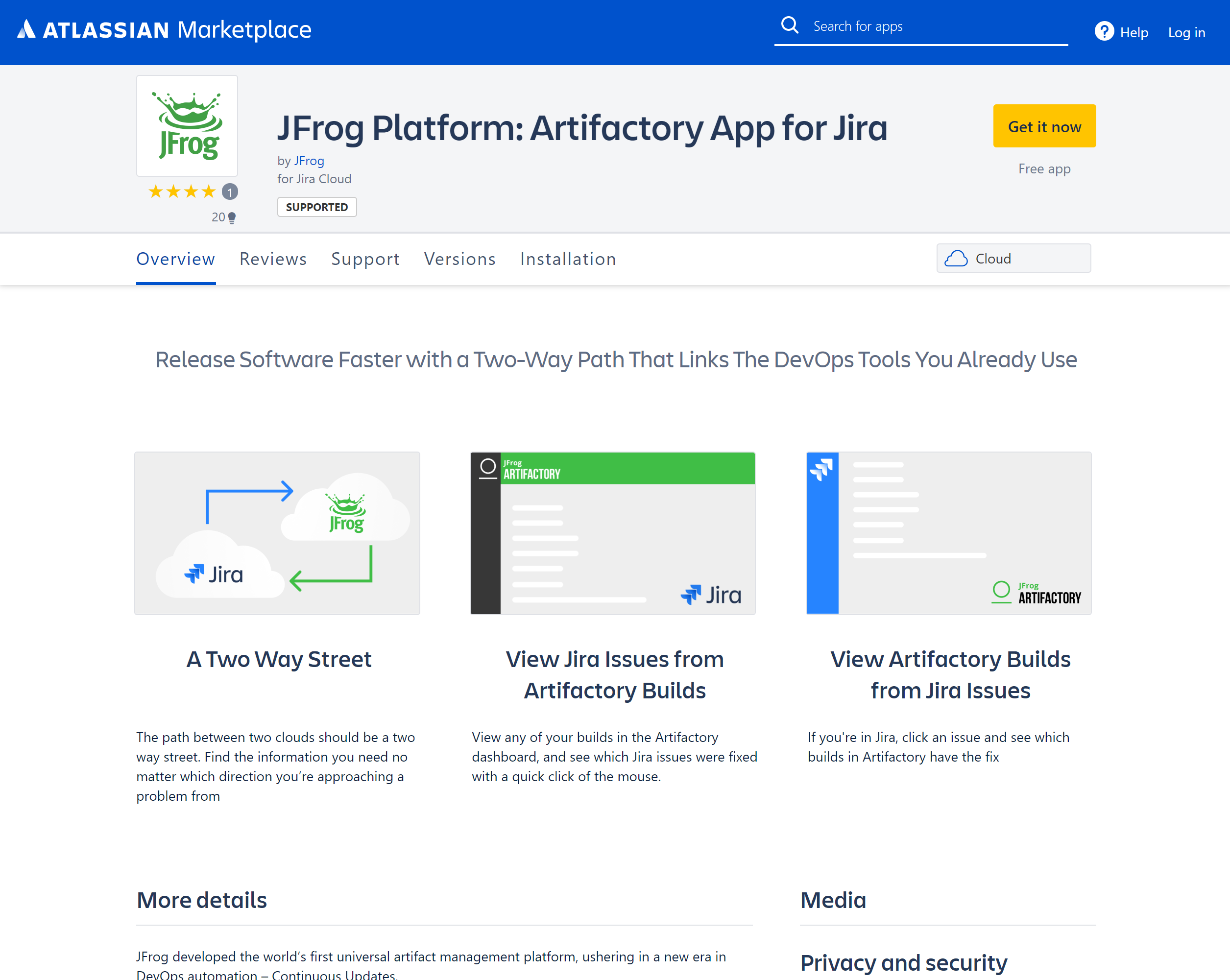
    Casey O’Mara, vice president of worldwide business development for JFrog, said this bidirectional integration makes it possible to link a Jira issue, such as a bug fix, to the binary or build residing in the JFrog Artifactory repository that is part of the JFrog DevOps Platform.

    Available via an application that can be downloaded from the Atlassian Marketplace, this integration extends an existing alliance between the two companies, said O’Mara. There is, for example, already an integration between Atlassian Bitbucket Cloud for continuous integration and JFrog Artifactory repository.

    Creating a link with a Jira issue will make it easier to collaborate by, for example, making it easier to understand why a specific version of an artifact, such as a container image, was created, added O’Mara.

    Artifactory is already able to collect issue key messages from Git that logged alongside builds. The Artifactory dashboard for build information displays a link to each of the referenced Jira issues in the Issues tab. Now, users of Jira can link to the builds in Artifactory.

    Jira remains the dominant project tracking and management application for software development. As more organizations appreciate the degree to which they now depend on software, O’Mara noted the number of stakeholders in an organization using Jira is starting to increase, as application development schedules are tracked more closely. Atlassian is now making Jira more accessible as a cloud service to help foster that increased adoption, noted O’Mara.

    Atlassian is now making a case for transitioning its customer base to the cloud. In the third quarter of this year, it plans to discontinue new server license sales in addition to increasing prices for on-premises products. Ironically, the company reported preliminary results for its most recent third quarter that indicate revenues of between $566 million to $572 million. That’s $85 million more than originally forecasted, because demand for on-premises products has increased in anticipation of their unavailability later this year.

    In general, both Atlassian and JFrog are strong proponents of a best-of-breed approach to DevOps. JFrog, in its most recent quarter, reported $42.7 million in revenue, representing a 39% gain. Cloud revenue in that quarter grew 69% to $9.8 million, representing 23% of total revenue.

    It’s unclear at what rate organizations are shifting to the cloud. The number of workloads moving into the cloud has certainly accelerated in the wake of the economic downturn brought on by the COVID-19 pandemic. However, the bulk of data continues to reside in on-premises environments, and many organizations, because of performance, security and compliance concerns, don’t have any immediate plans to migrate all their applications to the cloud.

    Regardless of where DevOps platforms reside, there will always be a need to integrate them. It just may be easier to achieve that goal when all the tools that make up that workflow are running in the cloud.

  • IBM Unifies Cloud Services to Simplify App Dev

    IBM Unifies Cloud Services to Simplify App Dev

    IBM announced today that an IBM Cloud Code Engine service that unifies the cloud platforms on which applications are built and deployed is now generally available.

    Built on top of a serverless computing platform, IBM Cloud Code Engine is a managed service that unifies access to a platform-as-a-service (PaaS) environment, a container-as-a-service (CaaS) environment and batch workloads, that run on traditional virtual machines, to a single platform.

    At the core of that managed service is an instance of Kubernetes running Knative middleware for invoking an open source serverless computing framework, the Istio service mesh and Tekton pipelines for building DevOps workflows.

    Jason McGee, CTO and vice president for IBM Cloud Platform, said the goal is to eliminate the artificial constructs that developers are forced to navigate in the cloud today that can each trace their lineage to a different era of software development. The IBM Cloud Code Engine unifies the developer experience in a way that makes it simpler to build and deploy applications on the type of cloud service that best makes sense for a specific application workload, McGee said. Developers no longer need to configure code for a specific type of infrastructure; they can simply describe how they want source code or a container image to behave, and IBM Cloud Code Engine automates deployments accordingly.

    The serverless computing framework that IBM Cloud Code Engine is built on also makes it possible for IBM to only charge organizations when code is actually running, versus requiring them to commit to a specific amount of infrastructure to run a set of virtual machines, McGee added. Charges are based on the memory and vCPU consumed and incoming HTTP calls. That approach will, over time, substantially reduce the total cost of cloud computing, said McGee.

    It should also accelerate the rate at which applications are migrating to the cloud, added McGee. Today roughly 20% of application workloads run in the cloud. Getting the next 40% of workloads shifted into the cloud will require providing a simplified application developer experience, noted McGee.

    The challenge organizations are wrestling with today is that they are deploying a mix of monolithic and microservices-based applications in the cloud that, to varying degrees, rely on batch-oriented and real-time platforms. IBM Cloud Code Engine represents an effort to provide a layer of abstraction over a wide range of cloud services that they can flexibly invoke via an event-driven platform, as required.

    The DevOps implications of IBM Cloud Code Engine are potentially profound. DevOps teams today spend an inordinate amount of time provisioning cloud infrastructure on behalf of developers. IBM is now making a case for a platform that automates that process in few seconds. In effect, control over cloud infrastructure will shift even further left to application developers. DevOps teams, in theory, will spend more of their time optimizing cloud environments after an application has been deployed.

    It’s not clear to what degree platforms such as IBM Cloud Code Engine might force cloud service providers to consolidate distinct cloud services they provide to developers today based on the type of application being built. However, it’s already apparent that the writing on the wall heralding that consolidation have now been indelibly inscribed.

  • Oracle Extends Capabilities of Enterprise Manager Platform

    Oracle Extends Capabilities of Enterprise Manager Platform

    Oracle today announced it has updated its core management platform to provide capabilities that make it easier to manage a hybrid cloud computing environment spanning millions of endpoints.

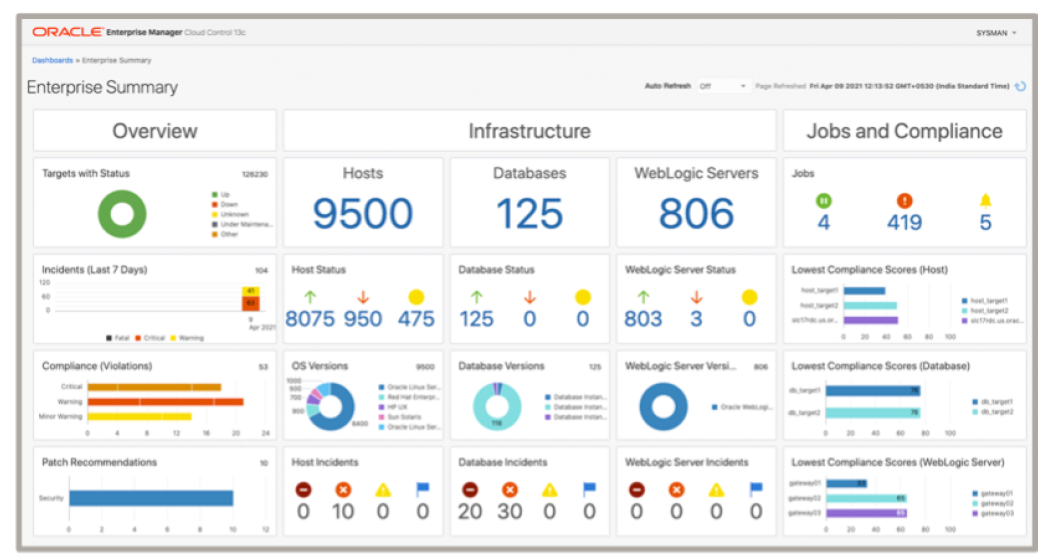
    The latest release of Oracle Enterprise Manager (EM) 13c, in addition to greater scalability, also provides support for dynamic groups, dynamic runbooks, automated workload analysis, monitoring templates, event compression and other capabilities that make it easier to manage IT operations at scale.

    Oracle Enterprise Manager (EM) 13c Release 5 also extends the reach of the management platform further into the realm of packaged Oracle applications and integrated hardware and software platforms such as Oracle Exadata, Oracle Database Appliance (ODA), Zero Data Loss Recovery Appliance (ZDLRA) and Private Cloud Appliance (PCA).

    Oracle has also updated the compliance framework it includes with Oracle Enterprise EM to support additional regulatory requirements and refreshed the user interface for the fleet management tool provided.

    Finally, the company is adding a tool that makes it easier to copy data stored within Oracle EM 13c to the Oracle Cloud Infrastructure (OCI) service. Dubbed OCI bridge, this tool copies data to an OCI object store where it is accessed by OCI services such as logging analytics and operations insights.

    Mughees Minhas, vice president of product management for enterprise and cloud manageability at Oracle, said as hybrid cloud computing continues to evolve, the need for a single management platform that spans infrastructure, databases and applications is becoming more apparent.

    Minhas said Oracle EM 13c is part of larger observability initiative that Oracle has embraced to provide more context across disparate services in a way that reduces the total number of tools an IT team needs to deploy and master. That effort complements a series of autonomous computing initiatives Oracle has previously launched that eliminates the need for database administrators (DBAs) to manage lower level systems administration tasks such as performance tuning. In general, Oracle is making a case for an IT world where platforms are co-managed by Oracle and internal IT teams that are focused on higher-level tasks.

    As IT environments become more distributed it’s clear IT is becoming more complex to manage. The issue that IT teams need to come to terms with is to what degree can they automate management tasks that today conspire to limit the size of the IT environment any given IT team can effectively manage. DevOps teams, of course, have been ruthlessly automating application development and deployment tasks for years. That philosophy is now being extended to include a broader range of IT operations tasks being automated by vendors themselves.

    Each IT team will ultimately need to decide just how many automation platforms it requires. In many cases, IT teams are now struggling to unite various islands of automation that have now emerged within their organization. Regardless of approach, however, rote tasks that once consumed hours, sometimes days to complete, are now no longer required which, theoretically at least, should leave more time to focus on more complex challenges that are getting thornier by the day.

  • Red Hat Extends Reach and Scope of Insights Analytics Service

    Red Hat Extends Reach and Scope of Insights Analytics Service

    During its online Red Hat Summit event, Red Hat today announced it has extended the Red Hat Insights predictive analytics cloud platform for managing IT to now include support for editions of Red Hat OpenShift based on Kubernetes and the Red Hat Ansible Automation Platform.

    In addition, Red Hat has extended Red Hat Insights for Red Hat Enterprise Linux (RHEL) to include the ability to prioritize security alerts, streamline notifications and track Red Hat subscription consumption.

    In total, since launching Red Hat Insights in 2019, Red Hat claims there are now more than 600,000 RHEL hosts analyzed per day.

    Joe Fitzgerald, vice president and general manager for the management business unit at Red Hat, said Red Hat Insights provides IT teams with the equivalent of a co-pilot for managing IT environments. In general, advances in automation and artificial intelligence (AI) are making it easier to manage complex IT environments at scale, noted Fitzgerald. However, it’s not likely IT environments will be automated to the point where lights-out management without human intervention is likely to be achieved any time soon, added Fitzgerald.

    However, it’s also becoming apparent that it’s not possible for IT teams to manage complex IT environments without help in the form of advanced analytics tools. In fact, while many IT professionals are leery of automation tools because of the perceived threat to their jobs, it’s also becoming apparent that IT teams will not be able to manage modern IT environments without these tools. Organizations can’t afford to hire small armies of IT personnel. In addition, finding and retaining IT professionals that have, for example, Red Hat OpenShift skills remains a significant challenge.

    Red Hat Insights provides IT teams with additional levels of context required to manage these environments that goes beyond simple monitoring, noted Fitzgerald. That’s critical, as the IT environment becomes more extended in the age of hybrid cloud and the rate at which platforms are updated steadily increases, added Fitzgerald. Platforms such as Red Hat OpenShift, for example, are now typically updated every three to four months.

    DevOps, of course, has always been about ruthlessly applying automation whenever possible. As analytics applications become more robust, IT teams gain the visibility required to automate a wider range of complex tasks, noted Fitzgerald. In fact, in the absence of that visibility, automation can be a dangerous thing when mistakes caused by a lack of visibility and insight are made, added Fitzgerald.

    In the longer term, Red Hat expects to see continued convergence of job functions and roles as IT teams become more cross-functional, said Fitzgerald. Platforms such as Red Hat Insights will provide a single console around which these teams can collaborate, added Fitzgerald.

    Going forward, there won’t be a handful of administrators with augmented capabilities. Rather, IT specialists that have a particular set of skills will be able to collaborate more easily in a way that both creates a better outcome and ultimately keeps a lid on the total cost of IT.

  • Fast Object Storage Key to Backup and DR Strategy

    Fast Object Storage Key to Backup and DR Strategy

    The massive shift to remote work necessitated by the COVID-19 pandemic kickstarted many companies’ digital transformation. While this transition had already begun for most organizations, the pandemic sped up the timeline. These events also had an impact on how storage and backup is done. Let’s look at why the right storage solution is key to your backup and disaster recovery strategy, especially when it comes to today’s work-from-home and hybrid scenarios.

    Hybrid Cloud and Storage

    While most companies have moved to the cloud in some form or another, many are relying on a hybrid approach. Enterprises may want to maintain their primary data storage on-premises for performance, security and compliance reasons. The public cloud, though, offers compelling services that can enhance this on-premises data.

    Using both the public cloud and on-premises storage allows for hybrid cloud use cases that are changing the way enterprise IT leaders think about data management and data protection. Enterprises are implementing hybrid cloud architectures to take advantage of cloud archive services, to maintain full copies of their on-premises data for disaster recovery, to protect against ransomware attacks, to take advantage of cloud service bursting and more.

    Businesses retain greater control over their private data by using hybrid cloud services. An organization can store sensitive data on a private cloud or local data center and, at the same time, make use of the robust computational resources of a managed public cloud. A hybrid cloud relies on a single plane of management, unlike a multi-cloud strategy that forces administrators to manage each cloud environment separately.

    Remote Work has Changed the Backup and Recovery Game

    Companies risk losing their most valuable assets – their data – if they lack strong backup and recovery infrastructure. Data loss affects businesses directly, when assets can no longer be leveraged, or indirectly, via loss of customer confidence and regulatory fines and penalties.

    The shift to remote work means that the way storage and backup is done has also changed. If the majority of a workforce is remote now, how do you back up laptops? How do you back up phones? Previously, employees would go to an office and their laptop and other devices would get backed up there – but now, that’s not the case. And with remote work in place for the long haul for many companies, backup methods have to change and adapt.

    Remote work opens up greater risks of information being stolen or lost. If an employee is at home, for instance, and they lose a file on their computer – and they’re used to having their computer backed up by the company – how do they restart that backup? If they have to go through IT, that seemingly simple act can take weeks.

    Self-Service Backup and Recovery

    Organizations need to have more flexibility – a way for individuals to perform backups in a self-service way without having to deal with centralized IT. In this way, people can protect their data themselves.

    With the right storage solution, authentication is built in; storage and backup are designed with security and data protection in mind. Unlike other storage solutions, object storage gives you your own keys and your own passwords, and you only see what you should. It’s very well protected. It’s also very siloed, so that employees can only do what the company wants them to be able to do, and they only have the minimum access they need. So, object storage can help organizations adopt a more fine-grained authentication and security posture; more so than with a typical file storage solution.

    In addition, having this kind of solution in place opens opportunities to provide your employees with the kind of self-service backup and recovery they need in a remote world where speed is of the essence and efficiency is front-and-center.

    Success in a Hybrid World

    The shift to the cloud is in full swing for many organizations, brought on by a variety of business factors and accelerated, in many instances, by the pandemic. It makes sense that the hybrid storage approach would become popular, as organizations naturally want to keep certain kinds of data close to the vest for security and/or compliance reasons. Performance is another consideration when it comes to where data should be stored.

    This gives organizations a lot to think and strategize about – including how to handle backup and recovery in a WFH world. Remote work increases security threats, so organizations need the option to empower employees to protect their own data. Object storage makes this possible with both speed and efficiency. There are many options available today for both cloud and storage configurations, so consider the above points when making decisions that will affect the security, compliance and performance needs of your organization.

  • Pulumi Moves to Automate Cloud Infrastructure Provisioning

    Pulumi Moves to Automate Cloud Infrastructure Provisioning

    Pulumi announced today it is expanding the scope of its automation ambitions to make it easier to securely provision cloud infrastructure-as-code.

    Joe Duffy, Pulumi CEO, said the Cloud Engineering Platform enables DevOps teams to use Pulumi Packages to create reusable components for automating IT infrastructure provisioning in a way that can be embedded within workflows and applications using an application programming interface (API) that Pulumi has exposed. IT teams can define a Pulumi Package in the programing language of their choice, Duffy noted.

    The Cloud Engineering Platform is now generally available on the Microsoft Azure cloud, while a preview edition of the offering is available on Google Cloud Platform. Support for Amazon Web Services (AWS) is planned for later this year.

    The platform itself is based on version 3.0 of Pulumi, an open source tool that developers have previously employed to manage infrastructure-as-code. Pulumi is also making generally available a tool for integrating its tools with more than a dozen continuous integration/continuously delivery (CI/ CD) platforms.

    That capability, coupled with existing support for integrated testing capabilities and the tools for managing compliance-as-code based on identities, provides IT teams with a more comprehensive approach to managing infrastructure-as-code, said Duffy.

    Most cloud resources today are directly provisioned by developers using open source tools such as Terraform. The issue that organizations have encountered is that developers are prone to making configuration mistakes that cybercriminals then exploit. Pulumi is making a case for an alternative approach to provisioning infrastructure-as-code that makes it easier to validate configurations using testing tools, while at the same time limiting who can access infrastructure resources by including support for the secure access markup language (SAML) and single sign-on (SSO) capabilities.

    It’s not clear at what rate enterprise IT organizations will be shifting toward platforms that enable infrastructure to be managed as code in a more robust fashion. Developers that don’t always have the greatest appreciation for cloud security issues routinely employ tools such as Terraform to provision infrastructure-as-code with little to no supervision. Cloud resource misconfigurations often result in ports left wide open, and cybercriminals now make use of tools to scan for those types of misconfigurations.

    Pulumi Packages provides a means for IT teams to exercise more control over the provisioning process, using vetted reusable components in a way that doesn’t compromise the rate at which developers can spin up cloud resources, noted Duffy.

    As organizations focus more on software supply chains in the wake of some recent high-profile breaches, it’s only a matter of time before more questions arise about how cloud infrastructure is being provisioned. Much of the concerns organizations already have about cloud security doesn’t stem from the platforms themselves. Rather, it’s the processes employed to provision infrastructure under a shared cloud security responsibility model that results in so many vulnerabilities. Many developers assume the cloud service provider is securing configurations, only to discover later that it was their responsibility to validate those configurations. Security teams, meanwhile, can’t keep pace with the rate at which cloud infrastructure resources are being provisioned.

    Hopefully, there will come a day when DevSecOps best practices leverage automation to resolve this issue once and for all. The challenge is finding the best way to achieve that goal in a way the average developer will accept and embrace.

  • Perforce Adds Synchronization Tool for Cross-Functional Teams

    Perforce Adds Synchronization Tool for Cross-Functional Teams

    Perforce Software has added a graphical tool, dubbed Helix Sync, that enables individuals, such as artists, to take advantage of the version control capabilities provided by its software development life cycle (SDLC) platform.

    Gerhard Krüger, cloud architect and product manager at Perforce, said that as DevOps workflows continue to evolve in the gaming and automotive industries, the need to manage artifacts such as drawings, for example, alongside software artifacts is becoming more pronounced among cross-functional teams.

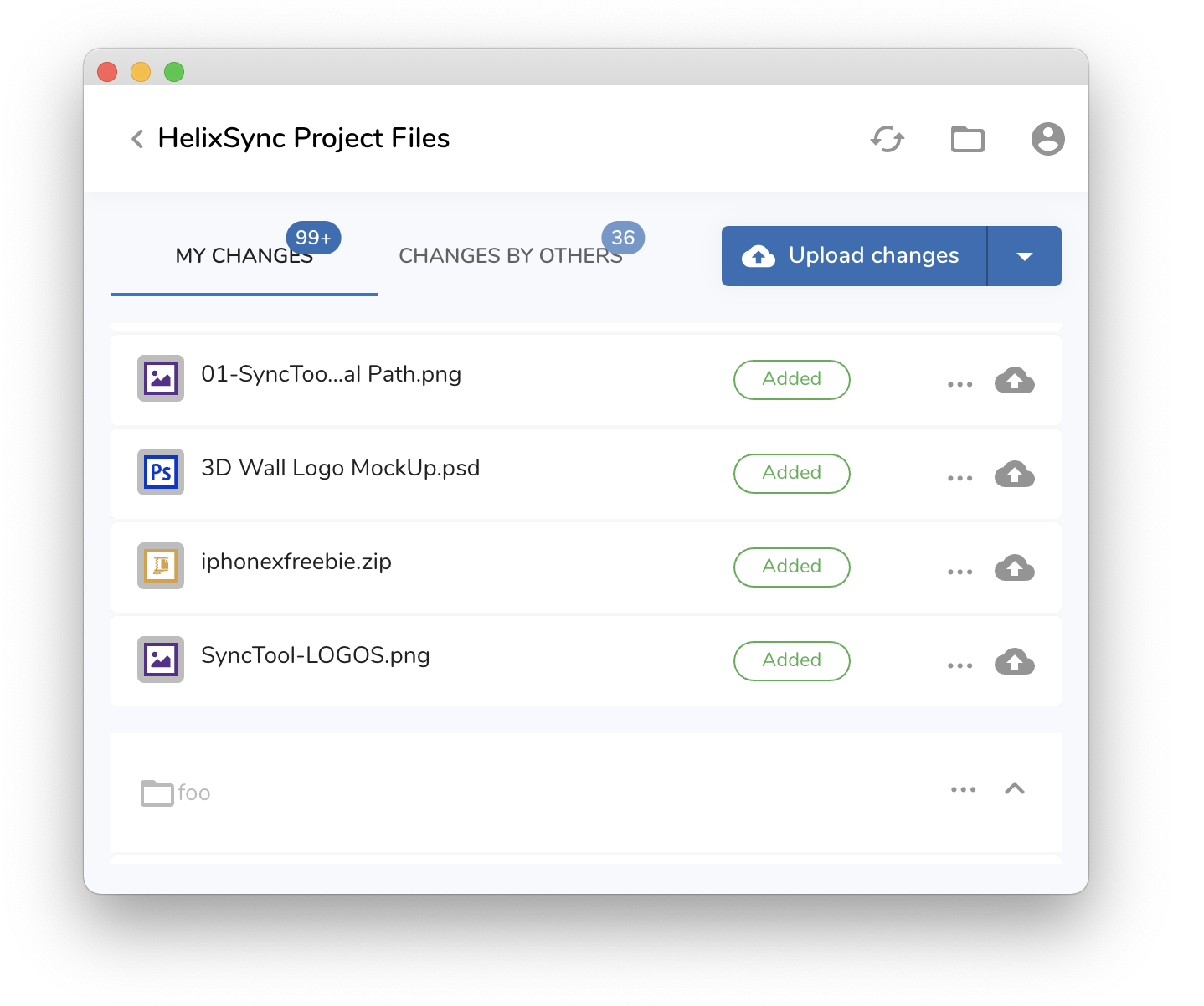
    Helix Sync gives those end users access to a desktop client that enables any individual to upload artifacts into a system by dragging and dropping them into the Perforce Helix Core SDLC platform.

    Previously, end users that lacked coding skills would need to share files with developers via cloud services such as Dropbox. The Perforce approach removes the inherent friction development teams would otherwise encounter, while at the same time making sure the artifacts being shared are more secure, said Krüger. In addition, end users don’t have to be concerned about file size limitations imposed by file sharing services accessed via the cloud, noted Krüger.

    It’s not clear how many organizations are looking to centralize digital asset management within the context of an application development process, but the fewer places that artifacts reside, the more productive IT teams tend to be. At a time when the number of application development projects within many organizations has accelerated, there’s a lot more interest in reducing the number of steps any developer has to monitor and track.

    Diagrams and other types of artwork are not the only kinds of artifacts that are finding their way into software development processes. Data scientists are building massive artificial intelligence (AI) models that need to be incorporated into application development and deployment processes. The challenge organizations face is the individuals that create many of these types of artifacts lack the programming skills required to share them via version control platforms typically employed by developers.

    With the launch of Helix Sync, IT teams should assume that, going forward, Perforce will be expanding its overall content management capabilities, Krüger added.

    It’s not clear to what degree workflows will converge as application development continues to evolve. Organizations are starting to appreciate just how dependent they are on software. As that awareness increases, it’s only a matter of time before workflows start to converge around the software development process that are employed to drive multiple digital business transformation initiatives.

    With more of the creators of those artifacts working remotely, the security of those software supply chains has also become more critical. Cybercriminals are becoming more adept at compromising the credentials end users create to access a cloud file service. Software development teams are more likely to employ more rigorous forms of authentication.

    Arguably, there’s never been more artifacts to track during the history of application development than there are today. The thing that makes managing all those artifacts even more challenging is, just like every other piece of software, they are also being continuously updated in ways that aren’t easy to discern.

  • Solving Cloud-Native Challenges in the Rush to the Cloud

    Solving Cloud-Native Challenges in the Rush to the Cloud

    The shift to cloud-native environments away from traditional data center infrastructures continues unabated, but security and complexity challenges remain a struggle for DevOps teams.

    These were two of the main takeaways in a survey and analyst report published by the IT consultancy firm Flexera. 

    The survey, based on the responses of 750 IT professionals, revealed that 92% of the organizations represented in the survey have a multi-cloud strategy, 80% have a hybrid cloud strategy and only a minority (45%) have integrated data between cloud environments.

    The top challenges, according to the survey results, are:

    • security (81%)
    • managing cloud spending (79%)
    • governance, lack of resources/expertise and compliance (75%)
    • comprehending cost implications of software licenses (55%).

    The solution for these challenges largely involves — in addition to implementing the right DevOps culture and practices — adoption of the right tools and platforms, especially for security. However, first-generation cloud-cost management tools “simply are not cutting it” for modern architectures, said Asim Razzaq, CEO of Yotascale, which offers a cloud resource optimization platform.

    “Today’s modern architectures are dynamic, and ownership is transient and not always well-defined. The greatest strength of containers and Kubernetes is the ability to scale on-demand and share cloud resources among multiple applications,” said Razzaq. “Tracking cloud costs in modern architecture requires a strong ability to automate cost attribution — or tag management — for those dynamic resources, and the ability to understand usage at the application level, even for containers that are sharing resource instances.”

    First-generation cloud management tools are, in this way, unable to provide the information DevOps teams require to understand how to automate cost attribution for modern architectures, said Razzaq.

    “[DevOps teams] can’t break down costs into any level of meaningful detail for engineering and finance teams to digest and act upon,” said Razzaq. “Conversely, newer approaches that are focused on Kubernetes cost management lack the ability to understand and break down the costs of non-cloud-native workloads.”

    Indeed, tools are often frustrating to engineering teams because of their static custom reporting, broad and generalized recommendations and no effective workflow for effective collaboration between finance and engineering, Razzaq said.

    “The biggest source of frustration is the inability to drill down and manage costs in a way that matches the way that these teams do business. There may be 10 teams, each with five production applications running in the cloud, for a particular account,” Razzaq said. “Engineers need to see, at the application level, what their resource utilization, costs and cost anomalies are in order to make the best cost/performance decisions for their applications. Without that, they’re flying blind; having to defend their cloud usage without any supporting data.”

    As an example, a misconfigured Kubernetes cluster can “cause a massive spike in costs,” Razzaq explained. “Without detailed cost and utilization reporting at the team and application level, an engineer can spend weeks digging through spreadsheets and logs trying to track down the source of the anomaly. That’s weeks of their time that they aren’t [using to] be productive on new features.”

    cloud-native

    Razzaq said there are a number of solutions DevOps teams can adopt to address these issues, including automated cost attribution and tag management, actionable recommendations and comprehensive observability capabilities.

    Automated cost attribution and tag management “is the foundation of accurate and detailed cloud cost management,” said Razzaq. “Engineers need tools to help them set tag management policies, identify untagged instances and update tags quickly and easily in their cloud environment,” he said. “With this in place, cloud-native workloads can be automatically tagged as they are dynamically created, ensuring that cloud costs are always clearly attributed to the right teams and applications.”

    Actionable recommendations at the cloud-instance level with closed-loop feedback also are an important process “so that engineers can see exactly why the recommendation is being made, and what the cost impact will be of taking that action,” Razzaq said. “The ability to provide feedback on the recommendation and dismiss recommendations that don’t align with business needs ensures that new recommendations are relevant,” Razzaq added.

    Finally, tools that provide a unified view of both cloud-native and traditional workloads that have been shifted to the cloud help to ensure “that engineering and finance have a single source of truth for their cloud costs that enables them to make smarter decisions for their business,” Razzaq said. 


  • Web Isolation and Secure Web Gateways with Menlo Security

    Web Isolation and Secure Web Gateways with Menlo Security

    Since the COVID-19 outbreak, many enterprises have implemented remote work policies to monitor network traffic and protect sensitive data. Organizations have been adjusting and adopting new practices and technologies to improve data security across cloud-based environments.

    In this episode of TechStrong TV, Nick Edwards, vice president of product management at Menlo Security, joins Mitch Ashley to discuss the move from network and application firewalls to creating web isolation, using secure web gateways for updated, contemporary cloud security.

    The video is immediately below, followed by the transcript of the conversation. Enjoy!

    Transcript

    Mitch Ashley: I have the distinct pleasure of being joined by Nick Edwards. Nick is VP of product management at Menlo Security. Welcome, Nick—good to be talking to you.

    Nick Edwards: Hey, Mitch, thank you. Glad to be here.

    Ashley: Excellent. Well, tell us a little bit about yourself, and tell us a little bit about Menlo Security for folks who may not know much about Menlo.

    Edwards: Sure, yeah. So, I am VP of product management at Menlo Security. So, my team is responsible for kind of product direction and definition of our company and where we’re taking our product line. 

    I came from somewhat of a circuitous background. I spent time in the Navy, I was a Submarine Officer, so I kinda feel like I’ve been, you know, in the good guys versus bad guys world for a while. And, you know, cyber security has always been something that’s kind of near and dear to my hart, just because, as a society, I think technology can bring on so many positive changes, but it’s unfortunate that we have to deal with this overall drag of embracing it because people are capitalizing on it.

    Ashley: Mm-hmm.

    Edwards: And Menlo was started with the fundamental notion that how we’ve been going around fighting security is just not keeping pace with kind of where the bad guys are and where the threats are. You know, in the traditional world, it’s around letting traffic in and then inspecting it. You know, you basically put the traffic stream underneath the magnifying glass, you have the Petri dish, “Is this a virus, is this malware, is this phishing?” or whatever it may be. And the industry has gotten a lot better at detection, but the bad guys only have to be right once.

    And so, our fundamental approach is different, which is—you know what? We’re gonna not let anything in, and instead, we’re gonna give you a clean stream that is reconstructed via our technology called isolation. And so, you’ve probably heard this term of web isolation—that’s what the company was founded on, and that’s what we do. And it’s been primarily made more simple to adopt and execute on by the advent of cloud computing and the capabilities that are continuing to expand kind of on that front. So, we’re excited to be here, excited to talk to you more about it, and let me know what you think about, what you wanna talk about.

    Ashley: Cool. Well, you know, as more and more of the network stack has been virtualized and turned into software, it makes sense that you’d see innovations like what Menlo Security is doing, right? Because you can do things very quickly and innovate very quickly in that space. And it’s kind of interesting to me that—you know, we hear about network isolation in WiFi and other technologies, because the pipes are just getting bigger, of course.

    Edwards: Mm-hmm.

    Ashley: And just, that much more of trying to inspect as it’s coming in in real time, it makes sense that—I can see how reconstructing that web stream, as you’re talking about.

    I’d love to get your perspective of what’s the thing that somebody goes, “You know what, we need a secure web gateway instead of what we have”—what is the impetus, or impetuses, if that’s a word, to say, “I need to get to the next thing, because this ain’t workin’ for me”?

    Edwards: So, I think a couple of factors. I think one, and we saw COVID and the work-from-home dynamic of the past year expedite this, is just that when you and I were growing up in the office of 20 or 30 years ago, everyone got in their car, they drove to the parking lot, they walked in, their computer was waiting for them, and everything was in one location. And that made it easy to apply security and controls. 

    I remember my first spam message that I got, you know, in 2001 and I thought that was really weird. And I remember not being able to go to certain websites, and it was very easy to do that because everyone was in one location or, okay, maybe a big multi-national had three different locations, but it was all connected to the same network and it was easy to provide policy, and kind of what proxies merged from that environment.

    Now, you fast forward even to 2019, you know, roughly 20% of the workforce worked remotely. Then, during COVID, it quickly became 75% or greater. And so, with that, it meant that everyone is everywhere. You know, you might be at home, at a coffee shop, in the old days at a WeWork or something. And in that environment, it was very difficult to apply security based off of different devices they were accessing the Internet with, what they were doing, where they were coming from, and COVID just made that worse.

    So, I think what we’re seeing in our customer base, the people we’re talking to is, they realize that they’ve been kind of using Band-Aids to hold the old notion together, but they realize that the cloud offers a new way to think about things. And it isn’t just taking the old widgets and just dumping it in a VM, it’s about—hey, is there a way to fundamentally rethink how we can leverage this technology to advance our business needs?

    And I think all that combination of factors, you know, different users coming from different places, different devices, what they’re trying to do, applying policy based off the context of the user—all those factors have combined to really, I think, kind of introduce this tipping point of new ways of thinking about leveraging technology. I think web gateways delivered via cloud form factor is one of the primary kind of locomotives for people to rethink about their architecture.

    Ashley: It’s interesting you say that. I’ve had several discussions in the last month or so about, as people are thinking about a hybrid office or something about returning to the office, it’s really easy to kinda fall back into, “Well, let’s do what we’ve been doing, right, and make some adjustments.” And I had to go through this transition, actually, a few years before this of thinking about it as just a work anywhere strategy, whether they’re sitting in Starbuck’s or sitting in the United Club, they’re in London or Denver or South Florida—wherever they are, or in an office, or at home, or on the beach or whatever, you just have to think about it.

    And I think that was one of the choke points we ran into with COVID was, the natural tendency was, “Well, okay, swing all the traffic onto the corporate VPN, push it all through our existing pipes” and sometimes, that can fall apart on you, right?

    Edwards: Yeah.

    Ashley: It’s just so much of a big swing. How do people need to rethink this, you know, thinking in a secure gateway, web gateway mode?

    Edwards: Yeah, so, I think that whole trend that we described of, “Put everyone on the VPN” and then—uh oh, VPNs can’t keep up, call up our VPN vendor, give us 50 more boxes. 

    I think what we’re seeing customers re-evaluate is, instead of giving everyone access to everything, let’s flip it on the head and say, “Let’s give them access to only what they need.” And this notion of zero trust is what is kind of capturing this movement, you know? “Okay, we know this is who you are, this is your role. You may be a salesperson—you don’t need to have access to Jira or Jenkins or these development tools, but maybe you need to have access to our CRM system, our customer application for managing pricing and quotes and all this kinda stuff.”

    So, zero trust [Video freezes].

    Ashley: Oh, we lost Nick, there. Let’s see if he comes back—oh, there, you’re back.

    Edwards: Okay.

    Ashley: Okay, so, just, why don’t you re-start with, you were talking about Salesforce and getting access to the applications, you don’t need Jenkins and Jira and stuff. So, you can just pick up on—so, zero trust in a secure gateway, web gateway means this.

    Edwards: Yeah. So, zero trust in a secure gateway mans that, instead of giving users the ability to go wherever they want just because they’ve authenticated, you give them the ability to access the content that they need associated with who they are and their job. You know, a sales rep might need access to certain applications that an engineer might not need access to.

    The VPN model allows anyone who gets connected to have access to whatever, and cyber criminals realize that and they can move around laterally and they can exploit that. And a similar type of construct applies when you’re facing the Internet side of the network. Get people access to what they need and secured gateways via the cloud have much more granular capabilities to do that with tools like CASB, DLP inspection. 

    I think cloud gives the ability to do things at scale that on premise proxies can’t. So, for example, something as seemingly mature and pedestrian as SSL inspection, you know, that’s been around a while, but I remember in the old days, having to scale X number of proxies to be able to address the traffic. Now, almost any website that is being used in a professional manner has SSL and cloud allows you to inspect that very easily and very seamlessly. 

    And on a Menlo perspective, zero trust says, “Hey, look, for Internet related applications, deploy the same type of mentality,” except you flip it on its head and say—don’t trust any of this content from these websites. Okay, maybe you wanna trust O365 for Microsoft, dedicated IP space, domains, you may wanna do that. Or Zoom, for example. But other than that, you might wanna say, “Let’s just allow a clean stream to come in.” And that’s what Menlo does with our isolation by kinda stripping away all the active content, rewriting the web traffic, and giving this native experience to users in a way that doesn’t disrupt their flow or doesn’t require another agent to be deployed on their endpoint.

    Ashley: Plus you have the scalability of the cloud, right? So, you’re not looking to add another box, right, to do this.

    Edwards: Yeah.

    Ashley: It’s, “Okay, great, traffic doubles, we’ve got the resources right there to handle it.”

    Edwards: Yeah. Yeah, that’s right. And, you know, there are some vendors out there, I think, in the cloud web gateway world who have done a lot to mature the industry’s understanding of it. But there’s, again, I mentioned this earlier that properly capitalizing on the benefits of the cloud doesn’t mean taking what you were doing on premise and then just dumping it in a cloud data center. 

    It gives the opportunity to think about things anew and potentially consider new architectures, and leverage the autoscaling of public cloud infrastructure where it makes sense, leverage the near infinite compute and all these things where it makes sense, but still be able to deliver the same type of capabilities. And that was kind of the approach that Menlo took, being kind of more of a cloud native security company delivering these capabilities to our customers.

    Ashley: Mm-hmm. I wonder, too, if—you know, we have different software architectures that can tend to be more porous, you know, with microservices, service mesh, et cetera. We have hybrid, multi-cloud—so, we’ve got a much more, in some ways, complex environment than we had in our on premise data center if that, I don’t know if you wouldn’t say it was complex, it was. But it’s a different world, and the pace at which it can change is so much faster. I mean, you can have an application pop up in a week or a day or an hour that wasn’t there, and now you have to be able to respond to, “Oh, sorry, we didn’t enter a ticket for security to configure us,” right?

    Edwards: Yeah.

    Ashley: You need to be able to react quickly. What do you think are some kinda new applications that are pushing the boundaries of security that make it easier to do it in the cloud?

    Edwards: So, I mean, I think in general, there’s a proliferation of engineering teams inside organizations that are adopting the same type of model of just rapid iteration and agile development for their own products that they’re releasing to their customers. And so, the companies that we’ve seen are some that, they may actually use a combination of AWS or Azure or Google, but they’ll also probably use some of their own data center infrastructure that they’ve already leveraged in a model that is very similar to AWS.

    So, I think this notion of customers going through this migration path, of going from all on prem, maybe with a target of landing with nearly all SaaS, there will be this period of kind of hybrid modes where multi-clouds exist, their own or a public cloud. And I think what we see is customers kind of chipping away at this over time, and an application that was on prem, they say, “Okay, let’s run it in our own kind of cloud data center type of thing” and then slowly migrate that over to AWS or whatever.

    So, we see a lot of this kind of sequenced staging of applications and assets, and with that, it means that the data ends up living in these different places as the application evolves. So, from our perspective, this requires of our customers a rethinking not only of the technology assets, but also the team structure and the profile of the teams. All these teams have to have some level of application understanding, scripting, automation capabilities, whether you’re the application developers or the networking teams, or the SOC teams. 

    And I think the vendors who will end up winning in this world from a security perspective will build security tools that play well in that environment. So, we’re talking about having APIs that will work with their SOC teams, have APIs that will work with, come to their networking teams, so if they need to make network changes quickly, then the cloud applications will be able to respond accordingly.

    And so, in that world, it helps kind of being API friendly and kind of cloud native, because hopefully, that will easily extend to the environments that we’re deploying in from a customer point of view.

    Ashley: There we go. I keep hitting my mute button. You’d think I’d be used to this by now. [Laughter] You mentioned several things I thought were really interesting, and one of them is that, we’re using many, many more SaaS applications, as you referred to, Office 365 as well as SaaS applications, but think how much more Slack and Team and other online non-premise applications that are being used in the cloud. And a lot of times, those things don’t go through IT, and maybe the Finance Department does their own conversion from what they’re using to some cloud financial system or adding other apps to what they’re doing.

    It seems like that ability to be able to isolate some of those environments, make sure that SSL is being used across all of that, and making sure that it’s not a bigger pipe into a bigger world that’s opening up the rest of the network through somebody else’s service is a huge value, and having that visibility is super important.

    Edwards: Yeah, I completely agree. And I think one of the things, when we talk about isolation as a technology construct, not only do we essentially kind of rewrite the web stream that lands on your browser, we also have a similar capability of doing that for documents.

    So, for example, a good application is exactly what you mentioned with SaaS services, and let’s say you’re posting something on Dropbox or maybe you’re accessing something from webmail. Well, what we see customers wanting to do with our CASB solution is say, “Hey, look, we know there’s all these SaaS apps. There’s a world that we know are sanctioned by our company based off policy. So, we’re gonna let people do what they need to do there, maybe insert security for file scanning and all that kinda stuff. But if it’s an unsanctioned application, maybe we want our employees to still be able to go to webmail, but we don’t want them to necessarily download documents and potentially infect our environment.”

    So, what they can use Menlo’s approach for is to basically use isolation of the document. In this case, the document gets kind of rendered as a safe .pdf, so someone can actually still access it. You know, because IT Departments don’t want to be Dr. No and just say you can’t do anything, because in today’s environment, you know, younger employees, Millennials, that doesn’t work for them. But I think people realize that there is a balance between security and still being able to do your job and maintain your own kind of life.

    So, with unsanctioned applications, we’ll give people the ability to actually still go to these applications, but then use isolation to render documents in a secure fashion, or render the content in a secure fashion to give kinda the IT teams maximum flexibility based off policy and the use cases of the users. And I think that’s something that kinda gives the users the ability to strike the right balance based off their employee base and their business needs.

    Ashley: Mm-hmm. I think that’s a really good point. Where do people typically make this transition to a secure web gateway? Is it, “I’m in the process of moving to cloud, I’m setting up my infrastructure, getting ready to move my apps and interconnect with third party apps that I’m using, let me set it up then” or is it oftentimes, “No, I’m in the cloud, I’ve gotta figure out a better way to do security. Let me add a secure web gateway to it”?

    Edwards: Yeah, so, I would say there are kinda two types of customers, as you alluded to. There’s next gen companies who were born in the cloud and they’ve only ever known the cloud, you know? Like, consider any of your contemporary startups that are now successful public companies. They were predominantly born in the cloud, they might have added some on prem stuff for a variety of use cases, but predominantly, they’re cloud first, and they’re a different type of sell and they get it, and they understand it. And, as they have their workforce more broadly deployed, it just makes sense for them to have a way to instrument policy and security across their workforce.

    The customers who are coming from an on-prem environment, maybe traditional large financial institutions, health care, maybe military and defense environments—for them, I think, we’ve seen an acceleration of their adoption over the past several years, and really culminating with COVID as they realized, “Hey, look, this is just very problematic and costly and the TCO associated with maintaining this is problematic.” Main drivers that are the tipping point—remote us, SSL inspection and just having to deploy another box to do CPU intensive scanning. And I think just this overall notion that they realize that the SaaS adoption of all these applications, it’s here to stay, you’re not getting that genie back in the bottle. Oh, and by the way, it is making the company more effective, efficient, and in a more cost friendly manner—so, how can we find a way to embrace that trend and make our business more successful during this march toward digital transformation, but do it in a way that aligns with our own cadence of adoption?

    And I think those trends kinda culminate, and we’ll see a lot of customers start with the kind of CASB use case of securing these applications and doing it in a way that makes sense for their policy, DLP, and security related reasons, and that’s one of the main drivers we’ll see for a lot of our customer engagements when they’re coming from on prem.

    Ashley: Interesting, too. I can totally see that evolution that people have to go through.

    Edwards: Yeah.

    Ashley: Are there any operational considerations that folks need to make in thinking about security differently? Is it different from an operational world making it easier, less false alarms, those kinda things? Because we’re adding more stuff, right? I had a CISO tell me once, “Every product, I evaluate whether it adds any work. If it adds any extra work, I don’t look at it, because I just, we don’t have resources to do it. I can’t add more stuff to my team.”

    Edwards: Yeah, yeah. I think that’s a very valid concern from buyers, and we hear that a lot. They don’t want more loads for the SOC team, they pretty much don’t want another pane of glass to manage, configure and look at reporting.

    So, I think that all of these products need to think about it through the lens of, you know, not only who’s gonna be typing away setting policy, but also, the CIO, CISO, the people who are gonna be consuming the reporting and where they can get access to the information they need to evaluate their purchase decisions and that sort of thing.

    So, I think, on that level, having an API friendly platform that can integrate seamlessly with security orchestration tools, that might be a place in the Security Operations Center that can integrate with other networking devices. All that stuff helps alleviate that friction and that pain. And I think, you know, one of the things that we’ve seen for customers who deploy Menlo is that, with isolation, we actually reduce the number of spurious alerts. Because, you know, you’re not getting all this gray area vendors who rely on detection saying, “Hey, we don’t know enough to say this is bad, but we don’t know enough to say it’s good, so we’re gonna just flag this as an orange” or, you know, whatever. [Cross talk] But hey, you’ll have a human being who can look at it and they’ll decide.

    All that stuff goes away with Menlo, you know? So, what we’re able to do is just deliver this clean stream and we’ve seen multiple customers who, you know, their alerts dropped 80, 90% because of the fact that the data that they’re seeing of their users is no longer being triggered by their endpoint detection tools, these other tools that were kinda living in this gray area. And that means a lot to our customers and kinda their SOC teams.

    Ashley: Cool. What does it take to set up something like this? What’s the implementation process?

    Edwards: Yeah, so, there are a couple different ways. It depends on where the customers are coming from. I mean, I think the most fundamental, simple approach since it is SaaS is that they don’t need to deploy any hardware. There’s the PAC file that lives on all their endpoints, which basically will point traffic from their computers, laptops, et cetera to our cloud form factor, and that’s easily disseminated. Or in some cases, they might want to route traffic from their firewalls or other upstream network devices to us.

    All those things typically take less than one business day, you know, to get up and running. And we’ve had customers, one of our biggest accounts is the Defense Information Security Agency, and they’ve entered into a long-term business relationship with Menlo, and they have all these different teams who are deploying our technology. You know, different military groups, different defense agencies. And it’s basically, “Hey, Menlo, we need to get up and running on this particular agency” and it usually can happen within a matter of several days at a maximum. We’ve had customers scale to tens of thousands of users in a matter of hours. 

    And that’s, again, leveraging the benefits of cloud computing. You know, in the old days, it would be, “Okay, let’s have a pilot for a couple users, and let’s get one or two boxes—okay, great. Let’s do the math. Okay, we have 10,000 users, we need 5 more boxes.” And then if they need to scale quickly, then they’ve gotta make a phone call, I’ll have the box get shipped and all that kinda stuff—cloud takes all that headache, all that thrash away, and you can just leverage the autoscaling that’s inherent in cloud computing. And I think that’s something that really will help expedite the adoption of this as customers become more and more comfortable with security and the compliance associated with it.

    Ashley: I’m glad to hear that. You gave me a few flashbacks to the, “Where is it? It’s in shipping? Okay. Who’s gonna rack and stack it? Okay. Who’s configuring it? Okay. Who’s putting testing and putting in for”—you know? Whoa.

    Edwards: Yeah, yeah, the weekend change requests, you know, [Cross talk] by the IT guy coming in on Saturday night, you know? All that stuff, a lot of that pain has gone away by the new form factors.

    Ashley: Mm-hmm. Cool. How do folks get ahold of this, get access, try it out? Where do they go?

    Edwards: Yeah so, come to MenloSecurity.com, we have a Contact Us, you can try now. We have ways where you can kind of go down the self-service path to play around with it and see that, you know, try menlo.com. Or just feel free to shoot me an e-mail directly, you know, Nick.Edwards@menlosecurity, happy to help point you in the right direction and to cut through all the red tape. You know, we have customers who call up on a Monday with a security issue, we can be out and deployed within that week to get them the security they need, and we’re happy to help customers meet them where they are.

    Ashley: Excellent. Cool. Well, it was really fun talking to you, Nick. Thanks for joining me today and haring more about secure web gateway technology and services that you guys offer from Menlo Security.

    Edwards: Alright. Thanks a lot, Mitch. I appreciate you having me. I appreciate it. See ya.

    Ashley:  You bet. Look forward to talking with you again. Join me in thanking Nick Edwards for joining us today, VP of product management with Menlo Security.

    Edwards: Thanks.

  • Do You Need a Cloud AI Engineer?

    Do You Need a Cloud AI Engineer?

    For all the technological advancements we are witnessing in AI and machine learning, the practical benefits remain elusive in the non-tech business world, frustrating decision-makers as AI investment climbs. For example, over the past several years, many Fortune 500 companies have invested in strong data science teams and AI labs, but still struggle when it comes to producing and scaling their models. Moreover, a recent report by Algorithmia found that, while enterprise budgets for AI and ML are rapidly increasing for 83% of organizations studied, deployment challenges persist.

    These deployment issues often begin when leadership fails to exert enough upfront engineering focus to ensure their proof of concepts (POCs) are “real-world ready.” The challenges are compounded when businesses put these models into action using insufficient, outdated or cobbled-together IT infrastructures. This combination results in POCs that either fall apart under real-world conditions or are rife with inefficiencies. Fortunately, cloud tech today provides the opportunity to overcome these challenges.

    Businesses can enable development, experimentation and scaling of data science and AI solutions with more flexibility and speed than ever through cloud platforms. A design-led AI project that uses the tools available in the cloud can help organizations create business impact and realize ROI much faster.  So while the role of data scientist may have been the ‘sexiest job’ in recent years, we may be seeing a new ‘sexiest job’ title emerging: the cloud AI engineer.

    Why do we need a Cloud AI Engineer?

    Traditionally, a successful AI project in the cloud requires a team with different skills and titles, including data scientists, big data engineers, cloud engineers and full stack developers. This has led businesses to look at ways to merge these specialties into one specific title. Enter the cloud AI engineer who, theoretically, would be able to cover all these duties — including knowledge of and experience with the tools and accelerators that cloud platforms now offer, as well as demonstrated aptitude for fast-paced development in AutoML. These are skills and tasks previously spread out across other areas and roles within the organization.

    What is the Job Description?

    So what would this job actually look like? The cloud AI engineers of the future will focus on the deployment of AI and ML models at scale in the cloud, and on integrating them with existing products and IT systems. Additionally, cloud AI engineers would need knowledge of the different types of machine-learning algorithms; familiarity with frameworks like Tensorflow and PyTorch; hands-on experience with data processing; analysis and feature selection using analytic tools and ETL/ELT frameworks (Apache Spark, Hive, Amazon, Athena, etc.); and model deployment experience on cloud platforms like AWS, Azure or Google Cloud.

    Obviously, tackling all of these would be a huge undertaking for one individual; given the vast workloads on both the cloud and engineering fronts, it isn’t possible to replace these workers and their skills with just a handful of cloud AI engineers. Instead, cloud AI engineers will sit between the two disciplines and the workforces and will serve as a key bridge to easily deploy models and integrate them with enterprise systems and tools for consumption.

    Where are We Going to Find Cloud AI Engineers?

    Given that cloud AI engineers will have a robust level of responsibility, they will quickly become some of the most sought-after team members — but that also means talent for the role will likely be in short supply.

    Additionally, individuals with this broad skill set will not appear overnight — at least not en masse. Therefore, to build the cloud architecture capable of delivering the real-world AI results that businesses need today, tech companies need to find ways to break down the internal divides between data scientists and cloud engineers so that they can cross-train, learn and develop skills in each area. If this is done correctly, not only will tech companies have a more well-rounded workforce, but they will be able to deliver the practical AI success that non-tech businesses are looking for today.

    Despite excitement about AI and its benefits, operational challenges remain. By focusing on the cloud and building up specialists in this space, AI can begin to drive the practical results the business world needs far more quickly.