Category: DevOps Culture

  • The Ultimate Guide to Hiring a DevOps Engineer

    The Ultimate Guide to Hiring a DevOps Engineer

    The economic downturn, pandemic management challenges, supply constraints and the ongoing Russian-Ukraine war have led to layoffs in many industries. While these events also impact the technology industry, it does not necessarily have to mean disaster for DevOps professionals who find themselves looking for a new role.

    Tech recruiters are looking for candidates with the right skills and experience to establish or enhance their digital presence to reach customers and clients without compromising security.

    In this article, we will explore the role of a DevOps engineer in more detail, including the skills and knowledge necessary to succeed in this field. We will also discuss how to hire a good DevOps engineer and the skills you should focus on while hiring someone for this role.

    Understanding the DevOps Engineer Role

    Continuous Integration and Continuous Delivery (CI/CD)

    DevOps engineers are responsible for creating, designing and maintaining a CI/CD pipeline using tools such as Jenkins, Gitlab, CircleCI or AWS Code Pipeline. One of their main goals is to streamline the deployment process and reduce the time it takes to deploy software, potentially cutting deployment time from a lengthy process to a quick one.

    Automation of Repetitive Tasks

    DevOps engineers apply their Bash and Python scripting skills to automate various tasks like configuring infrastructure, servers, containers and cron jobs.

    Security

    As part of their responsibilities, DevOps engineers are charged with implementing security best practices and ensuring code, applications and systems are secure. This involves responding to attacks, performing security audits, hardening servers and implementing user security controls like managing AWS accounts, SSH keys, Linux/Unix privileges and permissions, SSL certificates and encrypting data like API keys using tools like Amazon KMS.

    Application Troubleshooting

    DevOps professionals are also responsible for troubleshooting issues that arise in the software development process, deployed applications and web applications and identifying opportunities for improvement.

    Administering and maintaining databases

    Some DevOps professionals are also responsible for an organization’s data; building and troubleshooting database clusters to meet business needs, managing streaming data and more. DevOps teams ensure that systems are configured correctly and are scalable to handle increasing workloads and support business growth.

    Here are some soft skills that can be beneficial for a DevOps engineer to have:

    • Excellent communication skills: DevOps engineers often work closely with developers, IT staff and management across an entire organization, so they should communicate technical concepts and ideas effectively.
    • Collaboration: DevOps is all about teamwork and working closely with other team members, so working well with others is crucial.
    • Problem-solving: DevOps engineers need to be able to troubleshoot problems and find creative solutions to challenges that may arise.
    • Adaptability: The field of technology is constantly evolving, so DevOps engineers must adapt to new tools, technologies and processes.
    • Time management: DevOps work can be fast-paced and involve multiple projects, so managing time effectively is important.
    • Continuous learning: To keep up with the rapid pace of change in the tech industry, DevOps engineers need to be committed to constant learning and staying up-to-date with new developments in their field.

    Hiring Process

    The hiring process for a DevOps role can vary depending on the specific needs and goals of the organization as well as the availability and skill level of candidates.

    However, some general steps are common to many DevOps hiring processes:

    1. Define the role and responsibilities: Identify the skills and experience required for the DevOps role and the specific tasks and projects for which the individual will be responsible.

    2. Source candidates: Use various methods to find potential candidates, including job boards, current employee referrals and professional networking sites.

    3. Review resumes and cover letters: Look for candidates with the relevant technical skills and experience and the ability to communicate effectively and work well in a team.

    4. Conduct initial phone screens: Use this opportunity to learn more about the candidate’s background, skills and interests and to assess their fit for the role.

    5. Administer technical assessments: Depending on the specific needs of the role, you may want to give candidates a technical assessment to evaluate their knowledge and skills. This could include a coding challenge, a written test or a hands-on technical project.

    6. Schedule in-person interviews: Use this opportunity to learn more about the candidate’s personality, communication skills and work style. You may also want them to meet with other team members to understand how well they would fit in with the company culture.

    7. Check references: Contact the candidate’s past employers and colleagues to get a sense of their work history and performance.

    8. Make an offer: If the candidate is a good fit for the role and the company, extend a job offer and negotiate terms.

    9. Onboard the new hire: Once the candidate has accepted the offer, provide them with the necessary training and resources to get up to speed in their new role.

    By following these steps, you can effectively hire a DevOps engineer who will contribute to the success of your organization.

    Onboarding and Training

    Onboarding and training are essential components of the employee experience and can significantly impact the success and retention of new hires.

    This is especially true for DevOps roles which often require a broad range of technical skills and knowledge and the ability to work effectively with other teams and departments.

    Here are a few reasons why comprehensive onboarding and training are crucial for DevOps roles:

    1. Because DevOps roles often involve working with complex technical systems and processes, a comprehensive onboarding and training process is crucial to help new hires quickly learn the tools, technologies and techniques they need to use in their role, enabling them to begin making contributions sooner.

    2. In DevOps roles, it is common to work closely with other teams and departments. An onboarding process that helps new hires understand the company’s culture and values as well as the roles and responsibilities of other team members can facilitate the building of strong working relationships and effective collaboration.

    3. In DevOps roles, the ability to adapt to rapidly changing environments is often necessary. An onboarding and training process that helps new hires understand the company’s goals and objectives and its direction can enable them to see how their role fits into the larger context and how they can contribute to the organization’s success.

    4. Onboarding and training can help new hires feel welcome and supported in their new role. In addition, a positive onboarding experience can help new hires feel more engaged and motivated, leading to better retention and performance.

    By investing in an effective onboarding and training process, organizations can set new hires up for success and ensure they can contribute to the company’s success from the start.

    The Bottom Line

    Hiring a DevOps engineer is a critical decision for any organization looking to optimize its development and operations processes. A skilled DevOps engineer can help your organization improve efficiency, speed up application deployments and reduce downtime. To hire the best DevOps engineer for your company, it is essential to define the role and responsibilities, source a diverse pool of candidates and assess their technical skills, communication abilities and fit with your company culture.

  • The Strategic Product Backlog: Lead, Follow, Watch and Explore

    The Strategic Product Backlog: Lead, Follow, Watch and Explore

    The economic outlook for 2023 suggests many organizations will be leading through a period of resource scarcity as IT budgets are scrutinized and organizational priorities are re-evaluated. For the product manager, smaller budgets and fewer resources place even greater emphasis on ensuring alignment between enterprise priorities and the product backlog.

    Many tools are available to help product managers prioritize individual work items at a tactical level for DevOps teams. These models generally seek to quantify some combination of internal stakeholder value and level-of-effort required for developers and DevOps teams to complete. Higher-value lower-effort items rise to the top.

    Other strategic factors are just as important in the prioritization process, particularly for products living within a larger enterprise product portfolio and competing for scarce resources. For these, a product manager must understand why a given work item or capability should be given priority and how it should be pursued. This involves asking questions such as: On what basis should an item come into the product consideration set? How much should DevOps and developers seek to innovate in delivering a specific capability or feature? What is the product and the portfolio-level opportunity cost of pursuing a given piece of work?

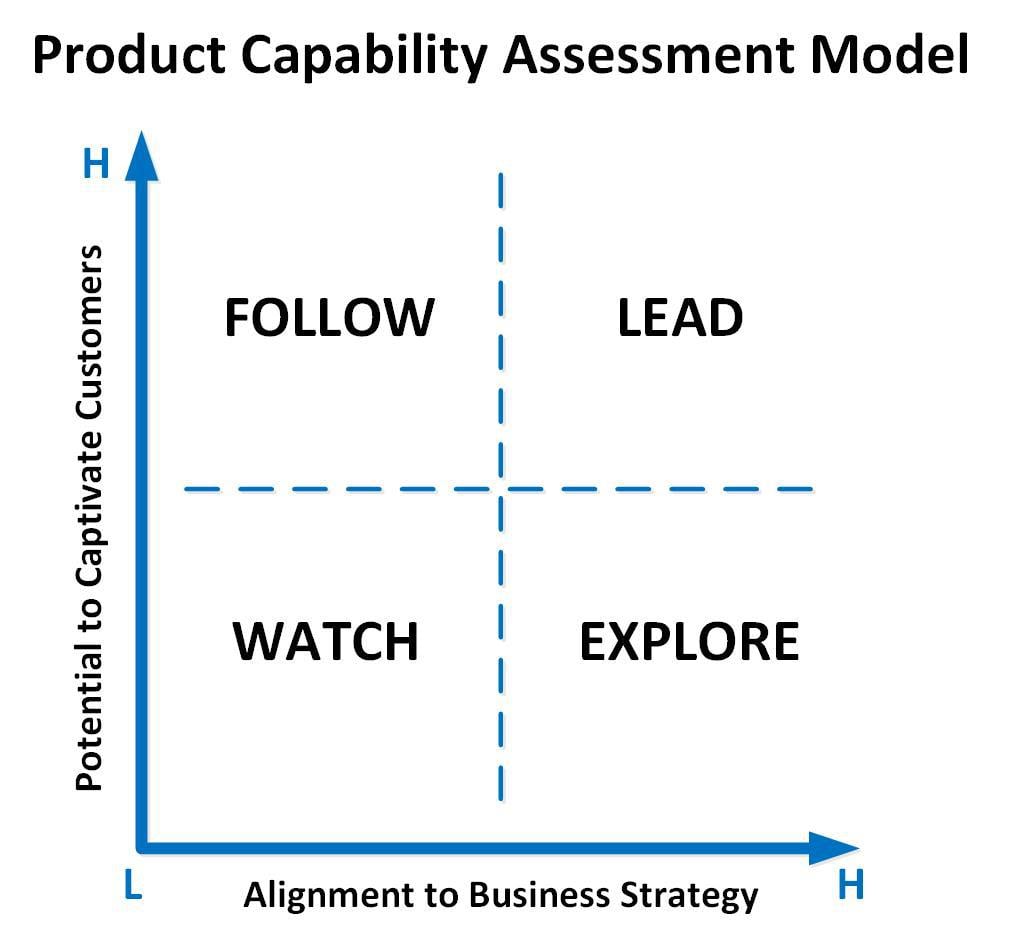
    A strategic model for backlog evaluation helps to set expectations with DevOps, developers and other internal stakeholders and ensure customer needs are front and center in prioritization decisions. It establishes a common language for collaboration. Two dimensions should emerge in evaluating capabilities at higher product and portfolio levels: Capability alignment to business-level strategy and the potential for a capability or feature to not just satisfy but captivate customers with a novel or compelling experience.

    The intersection of business strategy and customer experience factors can serve as a useful model for a product manager to think strategically about their backlog. The model helps to inform not only the question ‘Should we do this?’ but also ‘How should we proceed?’ and make things clearer for DevOps teams.

    Lead

    Items in this quadrant are the unicorns of the backlog and have the greatest potential to both strategically differentiate a product or enterprise and captivate customers. Product focus in this quadrant should be to invest in innovative, industry-leading approaches to satisfying customer needs in a manner that is consistent with business strategy and unique selling proposition. These items should receive the highest strategic priority on the product backlog.

    Follow

    Potential work items in this quadrant have a high potential to delight customers if handled well and irritate them if not. However, these elements are unlikely to be competitively differentiating given the current business strategy. Product focus in this quadrant should be to continually assess competitor treatment of these elements and adopt proven best-in-class experiences within the industry and adjacent industries. The product should focus moderate priority on competitive intelligence for elements in this quadrant and follow existing competitor approaches that enhance the customer experience.

    Watch

    Items in this quadrant are generally not problematic for customers. They are unlikely to differentiate the product or enterprise from competitors given the current business strategy and should be given low priority. The product should monitor proposed solutions in this quadrant to ensure no unnecessary customer effort is being introduced by other backlog items.

    Explore

    Product functionality in this quadrant is either not problematic for the customer experience or represents capabilities that are still emerging in the marketplace. These elements have a likelihood of developing into competitive levers, provided they can be developed in a manner that enhances the customer end-to-end journey. The product should place a high priority on product discovery for elements in this quadrant. It should explore capability innovation through design thinking or similar customer-centered ideation approaches.

    Mapping a product backlog to these four quadrants is as much art as science. It requires a deep understanding of business strategy, intended outcomes and customer needs. As with any strategic model, its value comes from the quality of discussions it produces and its role in surfacing implicit assumptions from the product’s stakeholder group, including DevOps teams and developers. Whatever model is used, having a mechanism to drive strategic product discussions is a critical tool in the product management toolbox and an important step to product management maturity.      

  • Microsoft Outage Outrage: Was it BGP or DNS?

    Microsoft Outage Outrage: Was it BGP or DNS?

    Welcome to The Long View—where we peruse the news of the week and strip it to the essentials. Let’s work out what really matters.

    This week: All of Microsoft’s cloud services go down, everywhere except China. Redmond’s IaaS, PaaS and SaaS—including GitHub—were dead for several hours, and are still running unreliably—despite Microsoft saying it’s fixed the problem. (more…)

  • Five Great DevOps Job Opportunities

    Five Great DevOps Job Opportunities

    DevOps.com is now providing a weekly DevOps jobs report through which opportunities for DevOps professionals will be highlighted as part of an effort to better serve our audience.

    Our goal in these challenging economic times is to make it easier for DevOps professionals to advance their careers.

    Of course, the pool of available DevOps talent is still relatively constrained, so when one DevOps professional takes on a new role it tends to create an opportunity for others.

    The five job postings shared this week are selected based on the company looking to hire, the vertical industry segment and, naturally, the pay scale being offered.

    We’re also committed to providing additional insights into the state of the DevOps job market. In the meantime, for your consideration:

    LinkedIn

    Major League Baseball
    New York, New York
    Senior DevOps Engineer
    $150,000 to $190,000

    SimplyHired.com

    JP Morgan Chase
    Senior DevOps Engineer
    New York, New York
    $137,750 to $225,000

    Indeed.com

    MORI Associates
    Pasadena, California
    Senior DevOps Engineer
    $118,000 to $150,000

    Monster.com

    United Nations Federal Credit Union
    Queens, New York
    DevOps Engineer
    $88,170 to $140,000

    ZipRecruiter

    Blue Rock Software
    Carlsbad, California
    DevOps Engineer – AWS
    $80,000 to $100,000

    Image Source: Photo by Mike Bowman on Unsplash 

  • 6 Ways To Empower Developers and Increase Productivity

    6 Ways To Empower Developers and Increase Productivity

    A big goal of DevOps is to increase productivity. Yet many organizations still struggle with the efficiency of their software release processes. In fact, 54% of engineers stated they have too many manual steps within their deployment process, according to an Armory survey. And with the pervasiveness of multi-cloud, developers now face an escalating number of deployment environments, each carrying their own nuances.

    Development teams want to move as quickly as possible without barriers. Yet, there are often hurdles to seamless deployments. For example, the code might be 100% ready to deploy, yet someone still must validate it before it reaches production. Manual bottlenecks like this in the CI/CD process can make developers feel like their code isn’t worthy of deploying and may even amplify feelings of burnout.

    I recently met with Anna Daugherty, senior product marketing manager at Armory, to see what technology leaders can do to remove barriers within their software release cycles and increase productivity. According to Daugherty, many of these strategies boil down to having empathy for developers and their needs. “Developers aren’t machines; they’re people, and people deserve to have a quality of life when they’re doing their jobs.” Below, we’ll highlight tips and tricks to keep in mind to improve release fluidity.

    1. Identify Where Your Manual Checks Are

    The first step to speeding up CI/CD is identifying where manual steps exist within the development workflow. The DevOps life cycle, often visually depicted as an infinity loop, includes many states, such as design, build, test, deploy, assess and monitor. But if each step has one or more manual steps, you accrue a lot of manual debt, said Daugherty.

    Therefore, engineering leads should seek to remove manual checks whenever possible. Of course, this may not be realistic within certain situations, such as financial institutions that require manual approvals at the last mile. However, everything should be smoothed out and automated up to that point, said Daughtery.

    2. Shift From Continuous Delivery to Deployment

    Depending on who you ask, the ‘CD’ in ‘CI/CD’ may stand for continuous delivery or continuous deployment. As part of reducing friction in the software release process, Daughtery encourages teams to begin to embrace the latter whenever possible. If deployment remains inhibited by unnecessary manual steps, it can decrease scalability and interoperability.

    3. Increase Confidence With Testing

    Of course, if we introduce more automation into the CI/CD pipeline, we must ensure the software is rigorously tested for errors and vulnerabilities. Daugherty encourages development to embrace automated, continuous testing approaches at every juncture, whether pre-production, inter-production, or throughout the application lifecycle. There are also advanced deployment strategies to consider, such as canary testing, which rolls out new changes only to a small subset of users or blue-green deployment can deploy to different places at different times.

    These deployment strategies can help build confidence while reducing the risk of disrupting a majority of your user base with untested production updates. “The more you can integrate testing into your process, the more confident your process will become,” said Daughtery.

    4. Chose The Right Toolsets

    So, how do we implement more automation into the DevOps cycle? And what sort of tools should we look for? According to Daugherty, when scouting for DevOps tools, technology leaders should prioritize open solutions that aren’t closed-off environments. Instead, they should offer flexibility and the ability to integrate with the tools you already use every day. “You can have all the tools in the world, but if they don’t fit together, that can drag down the process.”

    5. Consider Open Source Software (OSS)

    On that note, consider open source software (OSS) where possible. OSS like Argo or Spinnaker has the potential to empower developers and bridge gaps in the CI/CD process. Other projects from the Cloud-Native Cloud Native Computing Foundation (CNCF) and Continuous Delivery Foundation (CDF) are mature with proven stable adoptions.

    And although there is some weariness around OSS, particularly around unknown vulnerabilities and project maintenance concerns, “you can still be successful, secure, and scalable with open source,” said Daugherty. Open source also delivers community benefits and helps engineers feel like they are part of a bigger picture. “[OSS] is the opposite of burnout. It brings people together. It’s a community builder.”

    6. Become Developer-First

    Transitioning into a developer-first organization is another way to increase developer satisfaction and efficiency. But to become a developer-first organization, developers will need more say in the processes—this will involve balancing top-down requirements with total developer control. For example, leaders should suggest tools to enhance productivity but accept feedback on an ongoing basis to see what works best.

    To support these efforts, the concept of developer experience (DX) has entered the lexicon in recent years. Building with developer empathy can result in more usable, frictionless software that increases productivity. DX is crucial within the burgeoning area of platform engineering, as the goal is to create reusable, internal self-service platforms for developers to leverage.

    Interestingly, Netflix extolls what it calls full-cycle development, in which a developer oversees the building and operational aspects of a single component throughout its entire life cycle. “It’s an interesting way of addressing burnout because you feel more connected to what you create,” said Daugherty.

    Final Thoughts: DevOps Isn’t Dead

    Above, we’ve highlighted some potential strategies to increase developer productivity. By replacing manual bottlenecks with more automation, you can increase deployment fluidity. Considering how tools are acquired and iterating upon feedback from engineers can also help improve consistency while retaining quality talent.

    Looking to the future, Daughtery hopes that similar roles such as DevOps, site reliability engineering and platform engineering can come together and join forces. Because, at the end of the day, they share many goals. And contrary to some grabby headlines, DevOps is far from becoming obsolete. DevOps is not dead. It’s very much alive and increasingly important.

  • 8-Bit Floating Point for AI/ML? | Amazon and Microsoft Shed Tech Jobs

    8-Bit Floating Point for AI/ML? | Amazon and Microsoft Shed Tech Jobs

    Welcome to The Long View—where we peruse the news of the week and strip it to the essentials. Let’s work out what really matters.

    This week: New ideas bring low-power ML inference, and more big-tech jobs are going. (more…)

  • Optimizing the Developer Experience in 2023

    Optimizing the Developer Experience in 2023

    2022 was a banner year for innovation, but not only in the traditional “churning out new features” way. Many organizations started thinking about their processes and how to amplify them to maximize efficiency and employee retention. And when they started digging, companies realized that the developer experience was a major pain point that could be rectified–and a ripple effect of positive gains would result.

    Companies started looking more closely at how the tools and processes developers use support and enhance their work. Great tools and thoughtful processes boost developer happiness and satisfaction. And when those levels rise, guess what else increased? Productivity, efficiency and employee retention rates.

    We saw this trend of developer support take hold last year, but with more work to be done across many companies, we’ll see it continue in 2023 and beyond, impacting just about every facet of tech in new ways. Many companies have realized what does work by trying what doesn’t work and are making big changes from there.

    Shifting Results

    A major player in the changing developer experience has been the shift left approach that’s taken hold in recent years. About 80% of organizations have said they are adopting this idea of moving more of the responsibility for security and compliance to the front of the pipeline to avoid a compliance scramble at the point of delivery. The result, however, is a compliance process that ends up being more complex and less efficient, putting additional burdens on developers.

    Involving more people creates more opportunities for security breaches and slows down the entire software delivery life cycle. It also shifts security responsibilities to developers and requires them to do significantly more than is listed in their job description. In fact, 60% of those shifting left said their development team is bearing the burden of the change. Rather than focusing on writing code, developers have been called on to understand regulatory policies, build regulatory controls into their applications or pipelines, inspect massive log files generated by more and more diagnostic tools for security info and spend more time in meetings to discuss audits. That’s not a recipe for fulfilled developers; it’s the path to a loss of innovation.

    Stop Paying the Compliance Tax

    When developers–or anyone on your team–are tied up in compliance tasks, they aren’t spending that time in profit-earning efforts. This “compliance tax” costs companies an estimated 15% each year–that’s 15% of their time spent managing compliance instead of innovating or providing services that add value. That’s not to say that compliance isn’t important–it’s essential, in fact–but limiting the burden of compliance improves the overall experience of developers.

    When developers aren’t innovating, they’re not happy. They want to be writing great code, not translating regulatory governance policies. In today’s culture of quiet quitting, companies simply can’t afford to turn over compliance tasks to developers. It’s a waste of their talent and a surefire way to lose great developers and the chance to attract new ones.

    Shift Left, but Do it Right

    The good news is the compliance tax is largely avoidable. Instead of shifting responsibilities left, shift compliance everywhere. No one person or group, including developers, should be in charge of these tasks–that approach just isn’t comprehensive enough to ensure security and compliance throughout the software delivery life cycle.

    Instead, security and compliance should be moved away from a point-in-time part of the cycle to a continuous process built into every step of the life cycle. CI/CD reduces the burden on any one person or group and is proven to be more efficient at catching anything that is non-compliant. When the tools are doing the heavy lifting, the people aren’t making as many mistakes and non-compliant code isn’t slipping through.

    Baking in compliance allows developers to spend more time doing what they do best: Creating amazing features. This, more than anything, will boost the developer experience. Developers want to create and, when they experience the right environment and the right resources, innovation tends to happen.

    Beyond the Developer Experience

    Focusing on the developer experience pays off in more ways than just creating happy employees (though that alone is reason enough to make a change). Innovative developers are the backbone of leading tech companies. When they’re churning out new features that are getting public recognition and are touting a culture with a positive developer experience, companies attract more talented developers and the innovation loop continues.

    So, if you’re looking for more innovation in 2023, start where you’ve always started: Your developers. Set them up for success by automating what can be automated and baking in the mundane – yet essential – tasks to truly optimize the developer experience. Then sit back and watch what incredible capabilities your developers can generate.

  • Why Can’t We Be Friends? Improving Developer-Tester Alignment

    Why Can’t We Be Friends? Improving Developer-Tester Alignment

    Sometimes coding can be such an art form that it deserves to be a masterpiece in a museum. Developers are proud of their code—at least until the so-called art critics (aka testers) step in with their critiques. And then the rapport can swiftly become as messy as a painter’s palette. You have probably seen this scenario play out time and again at your organization. In the mad dash of a software release, the relationship between developers and testers can quickly become stressful and strained. And while your teams know about helpful tools that can streamline collaboration, you may not be aware of other steps you can take that go beyond the screen to ensure an even better developer-tester relationship.

    Full disclosure: At my organization, we’re in the software testing business and we’re not playing favorites when it comes to testers versus developers. We’ve just learned a thing or two about what makes a happy collaboration for all the parties involved. And we’ve seen that organizations that improved their developer-tester alignment not only accelerate a smoother release cycle but also leave no hard feelings on the table for the next time.

    Leave the Keyboard, Take the Cannoli

    Developers and testers will find that if they move their interactions away from the keyboard, they’ll discover that sweet spot of improved communication and transparency. Whether at your daily standup, over a cup of coffee or by simply picking up the phone, spending a few minutes chatting can address miscommunications before they become major problems that can delay your release.

    If something seems off, bring it up as early as possible. Take, for example, the classic case of missed requirements. One of our customers recently shared a story with us that really hit home. At the top of the sprint, a particular user story included only seven acceptance criteria–which caught the attention of one of the developers. He pointed it out in a conversation with the testers and business analysts on the project. Together, the group identified four additional acceptance criteria missed during the initial scoping.

    Without that conversation, the team would have assumed those seven acceptance criteria were the only ones that tests needed to be written against. A number of defects would have slipped into production, and it wouldn’t have been the software developers’ or the testers’ fault. Instead, the testing team realized significant gaps in test coverage and their test plan grew from seven to 40 test cases.

    The takeaway? Make sure that developers, testers and business owners are clear on how business requirements align with what software developers plan to build, as well as how testers plan to test against them. Have this conversation before the sprint begins—and don’t forget the cannoli.

    You Complete Me: In-App Test Management

    “I love documenting test plans in spreadsheets!” said no one, ever. All that manual work just takes time, introduces errors and leads to frustrations among developers and testers who have to go digging for the information they need. Adding a Jira app, for example, for test management can be the key to completing the alignment between teams.

    In-app test management gives both teams real-time data for decision-making and collaboration with built-in reporting on testing. That means that software testers can fully plan, design, track, and analyze testing activity within the same workflows that developers and testers are already using. For developers, there’s no need to ask testers for status updates or results. And testers can quickly see how tests align to requirements, which helps them brainstorm additional tests and provides developers better context and information to develop around.

    The cherry on top? The entire team can maintain true traceability between requirements and test coverage, which both minimizes finger-pointing and ensures that everyone has a clear picture of what’s required before the release is ready to ship.

    There’s an Awful Lot you can Tell About a Person by Their Software

    As Mama always said, shoes tell where someone is going and where they’ve been (mic drop, Forrest). By talking the talk and walking the walk in a counterpart’s shoes, developers and testers can better understand each other’s worlds. In-app test management can give developers a window into the tester’s thought process, because it shows them not only test status but also how a tester arrived at a particular defect. After gaining this familiarity, developers may be more open to inviting testers to sit in on traditionally dev-focused activities.

    Take unit testing or code reviews, for example. Most QA teams tend to steer clear. But by joining in, testers can ask questions and grasp which pieces will be validated at the unit, integration, and functional levels. A bonus is that testers get an inside look at the codebase, helping them develop more technical knowledge, as well as collaborate with developers on how the unit tests they plan to run–gasp!–fit into the overall picture of quality and release readiness.

    Remember, the true purpose of QA is to provide information that verifies that the application works well enough to be put in front of customers. By understanding the testing that’s going on at the unit level, QA can be more efficient by focusing on what’s not being covered in unit tests.

    The result? A more cohesive, effective test plan and a release that the whole team–developers, testers and business owners–can be proud of. In other words, a release masterpiece.

  • Five Great DevOps Job Opportunities

    Five Great DevOps Job Opportunities

    DevOps.com is now providing a weekly DevOps jobs report through which opportunities for DevOps professionals will be highlighted to better serve our audience.

    Our goal in these challenging economic times is to make it easier for DevOps professionals to advance their careers. Of course, the pool of available DevOps talent is still relatively constrained, so when one DevOps professional takes on a new role, it creates an opportunity for others.

    The five job postings shared this week are selected based on the company looking to hire, the vertical industry segment and, naturally, the pay scale offered.

    We’re also committed to providing additional insights into the state of the DevOps job market. In the meantime, for your consideration:

    Indeed.com

    Virtuoso
    Fort Worth, Texas
    Senior Cloud Infrastructure Engineer
    $140,000 to $160,000

    Monster.com

    Ness USA
    Stony Brook, New York
    Lead DevOps Engineer (AWS)
    $130,000

    LinkedIn

    Deloitte
    Phoenix, Arizona
    DevOps Specialist Senior
    $125,000 to $209,000

    SimplyHired

    Hewlett-Packard Enterprise
    Remote
    DevOps Engineer
    $110,000 to $150,000

    ZipRecruiter

    USAA
    Multiple Locations
    Public Cloud Infrastructure Engineer – Midlevel
    $89,200 to $160,600

  • FAA Ground Stop due to Technical Debt? | Don’t Do DIY Crypto!

    FAA Ground Stop due to Technical Debt? | Don’t Do DIY Crypto!

    Welcome to The Long View—where we peruse the news of the week and strip it to the essentials. Let’s work out what really matters.

    This week: The FAA’s NOTAM database gets corrupted, and Threema shows why DIY cryptography is bad. (more…)