Category: Continuous Testing

Continuous testing is the process of executing automated tests as part of the software delivery pipeline to obtain immediate feedback on the business risks associated with a software release candidate.

  • DevOps Unbound: How DevOps has Changed Testing Forever

    DevOps Unbound: How DevOps has Changed Testing Forever

    DevOps has changed the game in almost every aspect of testing: who, what, when, where and even why. What’s working, what needs to change immediately, and what challenges—and opportunities—lie ahead? Hosts Alan Shimel and Mitch Ashley are joined by Abel Wang from Microsoft, Tracy Miranda from CDF, Caroline Wong from Cobalt, Kurt Chase and Ben Simo from Tricentis to share a variety of perspectives on how testing fits into the ever-evolving world of DevOps. The video is below, followed by a transcript.

    DevOps Unbound is sponsored by Tricentis, the world wide leader in automated testing. DevOps Unbound airs biweekly on TechStrong TV, with all episodes available on Digital Anarchist. There is also a live monthly roundtable open to audience participation.

    Alan Shimel: Hey, everyone. Thanks for joining us on this special edition of DevOps Unbound. You’re watching this, probably, at the Tricentis Virtual Event and we are happy to have you join us, happy that you’re attending the event, and we’ve got what we think is gonna be a great discussion on testing and all of its various facets and what does the future – or near future – hold. We’ve got a great lineup of speakers that I’d like to introduce you to who are on our panel today. Let me first start with – she’s on the top of my screen – is Caroline Wong. Caroline, why don’t you say, “Hello” and introduce yourself?

    Caroline Wong: Hello. My name is Caroline Wong. I’m the Chief Strategy Officer at Cobalt. So, at Cobalt, what we do is pen testing as a service. We build a security software platform – like a lot of DevOps companies.

    We have data-driven product-based teams. We have – we really value automation and failing fast. I’ve spent 15 years in the information security industry. I wrote a book called Security Metrics. I host a podcast called Humans of InfoSec, and I teach the OWASP Top 10 Learning Path on LinkedIn Learning, and super excited to be here with this group today. Thanks for having me.

    Shimel: Thank you, Caroline. Next up, we have Kurt Chase.

    Kurt Chase: Hey, everyone. I’m Kurt Chase. I’m currently Head of Release Management and Engineering Services at Tricentis. Engineering Services is a group that supports the engineering function so, we do our own type of testing – testing all the processes and everything we use – to deliver our software at Tricentis. So, prior to Tricentis, I spent some years at Splunk and at AutoDesk. It’s great to be here with all of you today.

    Shimel: Fantastic.

    Chase: Be here today with all of you.

    Shimel: We got what you meant, Kurt. It’s okay. Next up, we have Ben Simo. Ben, why don’t you introduce yourself?

    Ben Simo: Hi. I’m Ben Simo. I’m a software tester of 30 years and past president of the Association for Software Testing who has recently stepped into a product management and product research role at Tricentis trying to discover and develop our testing platform of the future and bring new things to Tricentis customers and hopefully introduce new people to Tricentis with new products that enable new ways of testing.

    Shimel: Okay. Happy to have you here. Next up, Tracy Miranda. Tracy – well, I’m gonna let you introduce yourself. Go ahead.

    Tracy Miranda: Hi, everybody. I’m Tracy Miranda. I’m the executive director at the Continuous Delivery Foundation. It’s an open source organization that’s part of the Linux Foundation, and also home to projects to like Jenkins and Spinnaker, and our members include companies like Netflix and Google. And I have over 20 years of experience in open source so, I love open source and I’ve worked in it as a developer – also in QA and all different facets. So, yeah. Big fan.

    Shimel: Thank you, Tracy. Last, but not least, is my co-host on DevOps Unbound – my partner in crime here, Mitchell Ashley. Mitchell, why don’t you introduce yourself?

    Mitch Ashley: Thanks, Alan. Yes. I’m CEO of Accelerated Strategies Group, which is an analyst firm that focuses on, in addition to cyber security, digitial transformation, DevOps, and cloud-native kinds of applications, which really matches my background very well. I’ve been both a product creator CEO/CTO as well as running IT, CIO, CSO – that kind of thing. So, currently, I’m also CTO with MediaOps – I guess CSO at MediaOps, too, so, I’m trying to collect as many three or four-letter titles as I can. So far so good.

    Shimel: Alrighty. So, first of all, thank you all for coming on today. Secondly, testing – what a wild, mixed-up world we have in testing, right? Just from looking at the folks on our panel today, we have security testing – pen testing, in particular. We have the world of open source and what a factor that is in testing.

    We have product testing, right? We have sort of new product testing – taking testing to new heights. And you know, that variety is sort of a double-edged sword, right? Because it’s like jack of all trades, master of none type of thing. There’s so many aspects of testing, right?

    Even in our audience here at this virtual event, we have testers who come from, you know, what’s called old line QA testing, right, to DevOps enabled testing to visual testing – testers who, if it’s not an open source testing platform, they won’t use it, to proprietary systems. Through it all, though, a lot of times, all of this testing becomes sort of a red-headed stepchild or a whipping boy, if you will, right, to the whole application development system operations teams. It’s like, at the same time, their best friend and their worst enemy, right? They want everything tested, but they don’t want to give you the time, the budget, or the resources to do it, and then, when something doesn’t work, they said, “Well, we should have tested more, right?” So, how – first of all, do we agree that testing has been sort of the whipping boy of a lot of what we’ve seen go down in app dev and operations? Anybody want to jump on that?

    Chase: Well, I think it’s certainly gotten a bad name. I think some of that comes from prior to the digital transformation. A lot of the engineering was waterfall, and testing was always that last stop before the software went out live, you know? Nowadays, I think everyone’s come to realize the speed and scale at which we develop things, you have to do the testing up front at the very beginning. You can’t wait till the end, you know?

    You’re gonna be too slow. So, I think, from that perspective, absolutely. I think that’s why testing has really, I think, gotten a bad name, because they’re kind of the blockers to getting anything out into the public domain, whereas nowadays, you have to enable that up front because you want to get it into the public domain yesterday.

    Shimel: Yeah. And so, in many ways, to me, that sounds like, well, DevOps has been the best thing that ever happened to testing, right? In many ways, DevOps has been the best thing that’s happened to security testing, right? We’ve certainly seen that shift left, if you will. But has that shift left helped – has that rising tide lifted all boats?

    Miranda: I still see –

    Shimel: Oh, okay, Tracy. Go ahead.

    Miranda: I’m gonna jump in and say one thing that strikes me as funny. Like, we have, in our industry, everybody has embraced the DevOps terms, and then, you start to see all these spinoffs to put emphasis on things like, for security, we have DevSecOps, and you’ve got every variant of something with ops. But when it comes to testing, you know, there’s no TestOps. There’s no new buzzwords and it kind of speaks to how much it’s being neglected. Like, we had a conference on continuous delivery, and we asked for talks of everything in the life cycle, and we got lots and lots of submissions except for testing.

    So, again, I think it still is really under-appreciated and just not given the due credit for what it stands for.

    Shimel: Very –

    Simo: Yeah. And I think some of this comes from, as Alan mentioned, that testing is a very broad and diverse subject, and I’ve often watched people argue about testing that each interpret it to their piece of what they do with testing. And things like CI and some of the DevOps practices have helped us improve with the checking that our software can work – you know, demonstrating that it can work – and there’s a lot of people – if you primarily wear a developer hat, you’d look at that’s what testing is. And we’ve automated that.

    There’s been huge improvements in tooling and technology to do that, but sometimes, along with that is we throw out that we need someone involved that’s looking at things from a critical perspective that’s concerned about the safety and efficacy of what we’re delivering that is the, I guess, the one questioning and searching for information that they raise issues that we need to deal with that are reasons to not push things out to production now – so that we can make informed decisions. So, often, I think just that critical side gets thrown out as we improve the other side of testing, which is being able to demonstrate that things can work.

    Shimel: Anyone else?

    Ashley: You know, Alan, one of the ways you can tell who drew a diagram is to look at what’s in the center. And so, if we think about CICD, we kind of surround testing, but we don’t talk about testing. So, in some ways, it’s elevated, and some ways, it still sort of abstracts it out of DevOps. But my experience has been not really, because most teams know that testing has to get automated as part of that process, ’cause you can’t have this automated checking and automated deployment, then let’s kind of let a bunch of manual things happen. And not that testing hasn’t been automated – it has been – but I think it has elevated, at least in part, I think a good deal.

    My experience has been. I haven’t worked in every environment, maybe, where test still isn’t thought of very highly. By the way, the thing that the – it isn’t the last thing in the chain. Documentation is the last thing.

    Chase: That’s true. That’s true.

    Ashley: Let’s give documentation –

    Chase: And release notes. It’s true. I have tech doc’s team, too. You’re right. [Laughs]

    Shimel: And that hasn’t really changed much either, though testing has. No. No. But you know what? Caroline, I’d like you to focus in specifically.

    I mean, I think about – you know, Mitchell and I co-founded a security company, and we came out with a product in 2003 of just a vulnerability assessment and manager – “VAM”, we called it – and at that point, look, we used to beg people to scan their infrastructure at least once a year, right, if not quarterly. We were really pushing for quarterly. And you know, the idea of scanning and testing applications before you deployed them – unheard of. It was unheard of, right? We didn’t have the security tools or people.

    We did that after the fact. Now, that’s not normal anymore, right? Today, at least 85 percent of applications are tested prior to deployment. I don’t know who those other 15 percent are, but that’s a whole nother story. But talk to us.

    You’ve lived through this, Caroline. What do you think?

    Wong: Sure. So, you know, I think there needs to be an acknowledgment. There’s sort of these like, first order priorities and these second order priorities. When I think about security – and I think some of these concepts apply to testing more broadly – there’s a saying that, “You don’t take a $200.00 fence to protect a $5.00 asset.” I think security is about you have something of value and so, you want to test it – rather, so, you want to secure it.

    Testing, I think, is like you made something new and so, you want to test it. You’re not gonna test something unless you have something new. You’re not gonna secure something unless you have something of value. So, it’s okay that security and testing are not sort of the number one thing, you know? Inherently, by their definition, it’s sort of a second order attribute, if you will.

    Now, I think, you know, each of us has been through a version of annual organizational budgeting. You know, each organization says, “Okay. Here are the goals for the years. We’ve got limited resources and budget to accomplish those goals. How are we gonna allocated those resources?”

    And there are some things that, for a lot of organizations, are very clear. You know, even if I take a step way back and I say, “Okay. Most organizations might think about budget allocations in three buckets. Number one – general and accounting; number two – sales and marketing; number three – research and development.” You know, nowhere in those words is either security or testing.

    And that’s okay, you know? I think, Alan, when you share your story about VAM, you know, Vulnerability Assessment and Management, I agree that over the last, I would say, decade-two decades – so, when I started my security career 15 years ago, we were almost trying to convince folks that breaches really happened – that this was really a thing to be worried about. You know, today, everyone knows because it’s on the media headlines every day. This is real. And so, that has been a shift in the perception, I think, in our industry.

    There’s also been a big compliance driver. So, the – in the area that I’m very familiar with, security pen testing, a lot of that pen testing is actually driven by external compliance requirements – things that say, “Because of compliance framework A, B, C, you must actually conduct manual pentest on your application, for example, once a year.” You know, doing it more often than that is often because of perhaps what a lot of this group might think of as a really good thing – trying to actually secure your software, trying to actually test your software to ensure it does what you think and what you intend for it to do, but that’s not necessarily the first thing that comes to an executive’s mind when they’re thinking about budgeting, and there’s a variety of reasons for that, right? There’s an external perception thing. I think there’s also a lot of learning, certainly, that the security industry can do to be more approachable and to really understand better what is the software development methodology that we’re engaging with.

    What is the specific methodology and behaviors of these individuals? And how can we actually collaborate with them most effectively?

    Shimel: Fair enough. I mean, look, I don’t want to be the pessimist in the group or the bluebird of happiness here, but we have had success over the last 5-10 years, Caroline. You’re right. Especially in security, but not just security. We’ve had success in testing across the board.

    Tracy, to your point, the fact that we don’t have DevTestOps, I think, is, you know, testament to the fact that we’ve recognized that testing is so critical to the CICD process that it’s part of it. I mean, you can’t have DevOps, you can’t have CICD without a level of continuous automated testing in there – in my mind, anyway. I mean, prove me wrong. But, you know, I think that has been probably one of the biggest successes that the DevOps movement has brought – has been responsible for.

    Miranda: Yeah. And I really like Caroline’s analogy with security because, you know, that’s something else we think of as fundamental to DevOps, but it’s sort of elevated itself and, in a relatively short space of time, went from being ignored to being, you know, headline news. And I think there’s a lot of lessons there. And I – like, I will say, I do think testing is going through that journey and we’re probably on the cusp of it kind of really exploding and watching a few players in the industry and companies starting to do really interesting work in testing. I think that’s gonna turn around very shortly.

    So, yeah, there’s an exciting space that I think its moment is coming – just like securities has.

    Chase: Yeah. I think it’s all about the testing now, quite honestly. I mean, when you look at the future with low-code/no-code, it all becomes question-question mark ops, you know? Any function in a company could actually put something together and run it, and they’re gonna have to test it, you know, and it becomes less about all the engineering and more about the test patterns and things like that that are needed as you get to these future states. So – and speed and scale is gonna continue, I think.

    That’s driven everything with the digital transformation. It’s speed and scale. Everything needs to come faster, and we want more of it, you know? And so, I think that really pushes the envelope, and that’s what DevOps has responded to and, I think, addressed very, very well, but it’s not over. We’re gonna continue to scale up and go even faster.

    So, we have to be prepared for that, and I think it becomes more about testing in the future, and less about, you know, we’re gonna have these pre-built components – APIs you can piece together however you want – then, testing becomes, I think, almost first order, to Caroline’s point. And security, especially. I think security, we’re seeing that change now. If you’re a SAS company especially, security has to be top in line, ’cause you just can’t put something out there and not have it tested from a security perspective. And, furthermore, with compliance, it’s not just ISO and GovCloud and those programs, but large corporations now are saying, “Hey, if you want software in my ecosystem, these are my rules and I want to see your pentest reports and I want to see this.”

    So, I think more and more people are realizing that if the software’s not tested, it’s not worth it. And so…

    Simo: And, in my experience, part of adopting a DevOps culture and not just tool set is putting testing at the forefront. Some of the most productive teams that I’ve worked with that deliver some of the highest quality software I’ve seen – testing was center to absolutely everything that everyone on those development teams did.

    Ashley: Hm-hmm.

    Chase: Yep.

    Shimel: Yeah.

    Miranda: Yeah. We think – go ahead.

    Ashley: I’m just gonna jump in and say – there’s another factor that actually works to our benefit and that is not only to speed through automation and DevOps process, but contemporary software architectures, containerized micro-services, service mesh – we’re releasing smaller bits of code in encapsulated forms, which means, you know, we’re not testing monolithic applications all the time anymore so, we’re not having to run two weeks’ worth of tests just to get one pass through.

    Chase: Yeah.

    Simo: Right. _____ container solved the “It works on my machine” problem because we can ship the developer’s machine.

    Chase: Yep.

    Shimel: Yeah. That was always a big problem, right? Tracy, you were gonna say something though.

    Miranda: Yeah. No. I think the direction we see it heading is we’ll start breaking the testing monolith to talk about what is unit test, what is system test, and appreciate that is a specialization in itself. And the other things I’m starting to see from some of the end user teams we talk to is this real focus on culture – you know, a continuous quality culture – and seeing that hand in hand as part of the testing movement and again, _____ back to security – you know, the security first culture went hand in hand with that whole emphasis on security so, similarly, the continuous quality culture is starting to be something that – like, the really high performing teas we see pay a lot of attention to.

    Shimel: Absolutely. You know, Kurt, you said something there about low-code/no-code and how that could be a game changer. You know, some people refer to that as the rise of the citizen developer, and I’m wondering if maybe what we need is the rise of the citizen tester, right? Is testing too hard?

    Chase: Yes. I waste gonna say – the one thing we haven’t touched upon – I think Caroline did – is testing is hard. Security testing is super hard. And when you look at today’s modern environment and a lot of the ISVs – at least the ones I’ve seen and been associated with – you have a legacy of monolithic applications that you have to support that are bringing in a ton of revenue, and, at the same time, you’re transitioning – you know, going through your own digital transformation. So, that adds complexity after complexity in testing, and I do think, in the future, testing – you know, a lot of us, like Ben said, to his point, we have to push testing up – you know, shift left, move it far left as we can.

    And that’s gonna continue. I think that has to be the norm. To Caroline’s point, it has to become first order. And I think it’s starting to right now. I really do. Especially the – all the SAS solutions that are out there – you know, shipping code daily, hourly. You need excellent testing to do that and do it with competence.

    Shimel: Yeah. I think you do. But we do have to – and it’s funny that we’re talking about making testing easier because – not security testing, right? Security testing, pentesters – they were always sort of the hired guns of the security space, right? There were SAS or – there weren’t companies like Cobalt, right?

    The pentesters that I knew growing up – growing up – you know, that I knew coming up in the security space were gun slingers. These were, you know, white hat/gray hat folks who would come in and they’d do a little social engineering and pen testing using some open source tools, and you know, they give you a report. But you know, these were folks who traveled around the world doing that kind of thing. You know, we didn’t have a company like Cobalt that did this as a service, so to speak. So, it’s very different.

    But here’s the underlying thing with like, QA kind of testing – and, you know, I don’t mean any disrespect to anyone in our audience today, but for too long, a lot of folks in testing were viewed as failed developers or people who couldn’t be really good developers did testing or maybe testing was a weigh station on the way to becoming a real developer – like a Pinocchio stop or something, right, where you’re not a real boy yet. But that’s not true. There’s also – there’s a whole cadre of professional testers. And you know, in their capable hands, you could do great things. But I guess the question is – does testing have to be so hard that we need professional testing – professional testers to do testing?

    Or can we make testing automated enough that you – I’m not saying it has to be the dunces who don’t become developers. That’s ridiculous. But can we broaden the base of people who do testing? And that includes security testing? I’ll throw it out. Ben, you were a big-time guy in the testing industry. Tell us – what do you think?

    Simo: So, I think we can expand who’s involved in testing and that more people than those currently doing testing can learn to do testing. I don’t know _____ developers learning to become better testers and test their stuff. But I will say that ultimately, the part of the work that is the testing cannot be automated. Tasks that we do in testing can be automated. So, whether – not matter what hat someone primarily wears, if it’s a developer, you know, writing tests to demonstrate their code works or someone’s using TDD and they’re building some tests and then, building some code that matches it, the testing is the critical evaluation that’s going on in their mind of solving the problem and demonstrating that it’s solved – or evaluating how something might go wrong and coming up with some approach to demonstrate that it may go wrong and check for that.

    So, those things, whether you’re doing it automated or the execution is automated or done manually, the actually testing work, I’d argue, is the cognitive work that people are doing. And there is some – that we can never automate away. There are some ways that I think AI can help us. There’s also some ways that may lead us astray. But ultimately, I think we need people to learn to be critical thinkers to understand the technology, to understand the domain of the users and the problems that are being solved, and applying that critical thinking is the testing.

    Of course, then, we want to use tools to help us with some of our tests so, when we come into DevOps and CI, executing those demonstrations of the software working is a key part of that. Now, whether we do it as part of our, you know, building to those tests or we create them afterwards, then they can, at the very minimum, act as changed detectors going forward. But there was some testing in people’s minds that was going on that created those.

    Shimel: Caroline, what about – okay.

    Wong: I agree with quite a lot that Ben is saying. You know, I can’t help but think to myself that – I actually have this sort of visual in my mind, and it’s actually at a circus of a trapeze artists, you know? I think about these people, and they’re sort of like, whirling in the air and they’re doing these like, really incredible feats, you know, and they just do whatever they do, you know? But there’s like, a safety net to catch them if something goes wrong. It also reminds me of a metaphor that is often used in security that says, “We put brakes on a car so that you can go fast.”

    You know, when Mitch said earlier, you know, “These days, we’re releasing smaller pieces of code, modules of code” and there’s a way in which, yes, each small piece of code – each module – can be tested and some of that can be automated. We should automate performance testing. We should automate unit testing. But, to Ben’s point, there’s a lot that can’t be automated. There’s a lot of testing that actually depends on things like human judgment and opinion and it actually requires a person’s decision, you know?

    So, I think there’s – I think there’s a couple of frameworks for us to consider, right? If the first order is about creating value and making something new and the second order is about testing to make sure it does what you wanted it to do and protecting the value created, there’s also this spectrum that says there’s smaller bite-size stuff that may be a good candidate for automated testing, but, I think it’s super important to recognize that these small pieces of code – these modules that Mitch was talking about – it’s also super important to test what happens when they come together. So, to the extent that security folks need to be able to test chained exploits and business logic flaws, you know, those are exactly the types of things that will never be automated – is what I think, anyway.

    Shimel: I don’t disagree. I think security in particular is just there’s some things you’re just not gonna automate. I don’t care what you say. But that’s okay. Anyone else?

    Chase: I do want to make a comment on something you said. This was a long time ago now, when I was a dev manager, that I used to sense that when my developers – you know, if you were on my team, if you wanted to really get me mad, treat your tester badly. Treat them, you know, a bit, like you said, like they’re not quite at the level you are. I would be incensed as a manager. You know, that was a long time ago.

    Fortunately, I don’t see that as much nowadays. I think that role has been elevated where I don’t feel that at all on my teams, and if I do, that is, again, to this day, I’ll get super mad about that because I think it takes all kinds to develop software today and ship software. Testing role is just as critical as an engineering role, just as critical as the ops’ role, the security role. So, yeah, that was one thing that would drive me nuts ’cause I did sense that and go through that, and this back in, you know, the late ’80s-’90s, if you will, before the year 2000 – I’m dating myself – but it definitely was palpable in some of the large ISVs, you know? And as a manager, that was something that would drive me nuts.

    Shimel: Agreed. Agreed. Tracy, open source – look, testing has been inexplicably wound up with open source for as long as I’ve been around, right? Whether it’s security – open source security testing and you know, things like Metasploit and Nessus and Nmap or you know, in QA testing kind of stuff, it’s a rich history of open source testing tools. How do – and part of your mission at CICD is – at the CICD Foundation – is to nurture that, I’m going to assume, correct?

    So, how do you guys nurture that? What are you – what do we do to maintain that rich, open source tradition here?

    Miranda: Yeah. No. Absolutely. And, as I say, we at the Continuous Delivery Foundation, we want to look across the entire software delivery life cycle, and I think it is safe to say, you know, that testing hasn’t risen to the top. We’re actively – like the board wants it to be a more focused-on topic, the technical committee wants to encourage folks to bring us more projects in open source and with testing, but we’re still having to kind of fight through all the noise around other projects.

    And one of the ways we’re approaching it is, for example, our technical oversight committee wants to set out a landscape of the types of projects in each kind of bucket and say, “Okay, look. We need to have something in security. We need to have something in testing that covers these different aspects.” Almost like a call to action to say, “Bring us your testing projects and –” like my favorite saying about testing is, “There’s two key problems in testing – not enough tests and too many tests.” And yeah, I think we’re starting to see some really good frameworks around test generation.

    I’d love to see more open source options for that. And Kohsuke Kawaguchi, the famous creator of Jenkins, move on to focus on testing so, that says a lot about the importance of this area getting more open source focused. So, yeah, I’m excited to see what could come out, but we do have to actively encourage folks to come join us and have those conversations and not to, you know, have it assumed it’s all focused on delivery of pipelines for delivering software.

    Chase: I think another thing you’re seeing today is a lot of people, when they start developing an app, when they start creating something new, that’s the question they ask up front. “How are we gonna test this? How are we gonna automate it? How are we gonna pentest it?” I think those things, at least, are starting to bubble up a lot stronger in the cycle – you know, early on. ‘Cause I know that’s something we recommend highly – is that if you’re developing something new or need to head down a digital transformation, think about the testing. How are you gonna test that up front, you know? And products are actually being developed with that mindset now.

    Simo: And with short iterations, it’s how are we going to test this tomorrow, next week? It can’t be left off for months later to be someone else’s problem. So, people, I think, are learning to deal with those questions about testing from the start of their discussions about what the requirements are.

    Chase: The other thing I love – and in Caroline’s world, has been very successful – I know it is specialized skill set, but trying to teach that throughout your troops – you know, throughout the engineering team. Show them what, you know, across _____ scripting errors. What does it look like in code? That’s super successful. That really, really helps make – ’cause security is difficult, you know, no matter how you slice it.

    Even when you’re looking at product development – if you want to invest in fixing security defects or add a cool new thing for your users, you know, a lot of times, the cool new thing is gonna win out. But that’s starting to change as well, too. I think people are starting to value security – especially in today’s modern world, you know? It has to be up front, really.

    Ashley: Yeah. It’s all about AppSec at the moment. That’s one of the hot topics as well. You know, someone mentioned AI earlier. I just want to offer a perspective about that because we always seem to focus on the shiny new object.

    I know I have. I often do. But I think what we’ll see with AI is select applications when it comes to testing. The sort of vertical place is where it’s really well suited. When we say, “Yeah, AI”, we really mean machine learning in most cases, which is machine learning algorithms, and there’s two types – there’s supervised/unsupervised.

    Supervised is, “That’s a car. That’s a car. That’s not a car, right? That’s a bug. That’s a bug.”

    And unsupervised takes massive amounts of data and intellectual patterns and learnings from that. So, I think that as we’re taking our test automation and our test tools, there may be some of that, and it might be really useful for AI. I wouldn’t get worried about people being replaced as testers. Not in my lifetime, that’s for sure. It is still a – there’s very much a craft to it, just like there is software design.

    There is a craft to testing and a skill and a mentality about it that’s unique, just like with security.

    Shimel: No doubt. Caroline – oh, go ahead, Ben. I’m sorry. No, no, Ben. Go.

    Simo: Yeah. I was gonna say – and with any other sorts of automation – even you know, not learning automation that’s come before AI and machine learning based things, is that it not only has potential, in some cases, to replace some of the mundane work we do, but to enable to the skilled people to focus their work and apply their brain power to the things that really matter. So, I think there’s great potential for AI to help direct people’s attention to the things that maybe should be of concern and help deal with that big question of testing out of infinite possibilities of PaaS and data variations. Which one’s gonna show me the problem? And I think there’s huge potential for AI to help us find that if we’re also aware it may guide our eyes away from something that we do want to see.

    Shimel: Caroline, how does that relate to security, though? I mean, is AI helping Cobalt with pen testing? Be honest.

    Caroline Wong: So, the type of software that we’re building today is actually workflow and collaboration software. So, what we’re trying to do, is we’re trying to bring security folks and developers and penetration testers all together sort of in one place where they can collaborate. The technology piece, for us, is not about automating defect discovery. It’s not – I mean, if we’re gonna us ML or AI in the future, honestly, what we’re gonna do is we’re gonna use it to say, “What are the characteristics of this organization that wants us to do a test on this particular type of asset? What are the attributes of that asset and how might we match that to our talent pool – something that we do totally manually today?”

    I think that’s the opportunity. I don’t think that we’re gonna get to a point where we’re using the AI and the ML for automating the defect discovery itself. Frankly, I think that even if I take a step away from pen testing and I look at the security scans that are in existence today, I think, you know, whether or not they’re referred to as using AI or ML techniques, they’re just simply imperfect, you know? And there’s a super important place for them, but there’s a lot of false positives. There’s a lot of interpretation of data.

    And I think that’s always gonna be the case. I think that no matter what, when it comes to humans and machines, the machines can add a lot of value, but I don’t know that when it comes to software development testing and security in particular that there’s every gonna be a complete substitution. I don’t think that – I don’t think that makes sense.

    Shimel: Absolutely. So, guys, we’re coming up on the end of our time. I need to wrap up. Tracy, let me say this for you, if you don’t mind – and if I’m wrong, correct me. For you testers out there, the CICD Foundation – or CD Foundation, actually; I keep – we always say “CI” like it’s attached at the hip – but the CD Foundation is looking to hear from the testing community.

    Probably some companies – including Tricentis – may want to look into becoming involved with CD Foundation because if you don’t have a seat at the table, you don’t have a right to complain about not being heard. And so, you know, when we look at foundations like Linux Foundation and the CD Foundation, CNCF, we need the testing community – vendors, professionals, folks in it, you know – to be involved and get involved. Be heard and be part of it. So, I’m gonna extend that out there to everyone. But, short of that, though, Caroline, Tracy, Kurt, Ben, and, of course, Mitch, thank you so much for joining us on this special edition of DevOps Unbound.

    We hope everyone enjoys the rest of their Tricentis Virtual Summit. This is Alan Shimel for MediaOps, devopsy.kinsta.cloud, Security Boulevard, Container Journal, Tech Strong TV. Have a great day, everyone, and thanks for joining us.

    [Musical outro]

    [End of Audio]

  • DevOps Places Software Testing in the Crosshairs

    DevOps Places Software Testing in the Crosshairs

    To keep up with the pace of innovation, testing must play a larger role in the software development life cycle

    The speed of digital transformation is already staggering, and it’s only going to increase. To put this into some very concrete terms, consider that:

    • There are 7.7 billion people in the world.
    • 5 billion have regular access to a toilet.
    • 5 billion own a mobile phone.

    All of a sudden, a huge number of people jumped from a very provincial lifestyle straight into digital times—creating a tremendous demand for more, and more innovative, software.

    The traditional ways of developing and delivering software aren’t adequate for meeting this new demand. Not long ago, most companies were releasing software annually or bi-annually. Now, iterations commonly last two weeks or less. While delivery cycle time is decreasing, the technical complexity required to deliver a positive user experience and maintain a competitive edge is increasing.

    testing

    In terms of software testing, this brings us to an inflection point. In most organizations, testers were already racing to keep pace when delivery cycles were longer and application complexity was lower. Every quarter or so, the development team would pass a release candidate over the wall to QA, who would then scramble to validate it as thoroughly as possible in the allotted time—largely with manual testing.

    Now, digital transformation initiatives such as Agile and DevOps are pushing traditional methods to their breaking point. Organizations are releasing much more frequently—from monthly on the low end to multiple times per hour on the high end. And as organizations increasingly edge toward continuous delivery with automated delivery pipelines, intermediary quality gates and the ultimate go/no-go decisions will all hinge upon test results.

    Is your organization’s testing process up to the task?

    We Have a Testing Problem (Two, Actually)

    In most organizations, testing delays application delivery while providing limited insight into whether the applications are meeting stakeholder expectations. It’s not fast enough to help teams find and fix defects when it’s optimal to do so. And it’s reporting on low-level failures (e.g., 78% of our tests passed) rather than providing the business-focused perspective needed to make fast release decisions (e.g., Only 38% of our business risk was tested … and 25% of that didn’t work properly).

    Let’s take a quick look at each of these problems in turn.

    The Speed Problem

    DevOps is all about removing the barriers to delivering innovative software faster. Yet, while other aspects of the delivery process are streamlined and accelerated, testing consistently emerges as the greatest limiting factor.

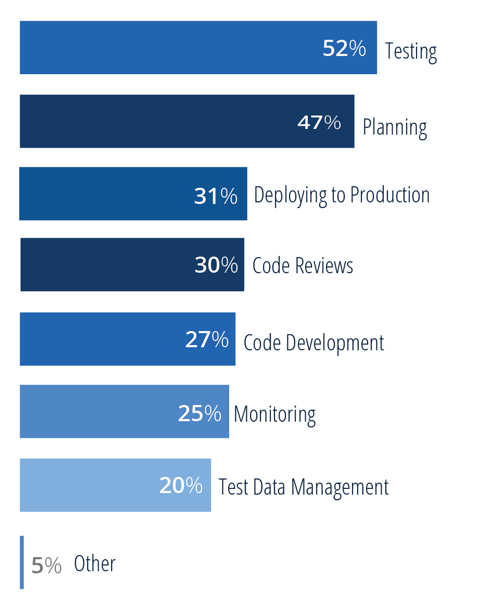
    A recent GitLab survey that targeted developers and engineers found that testing is responsible for more delays than any other part of the development process.

    Where in the development process do you encounter the most delays?

    testing 2

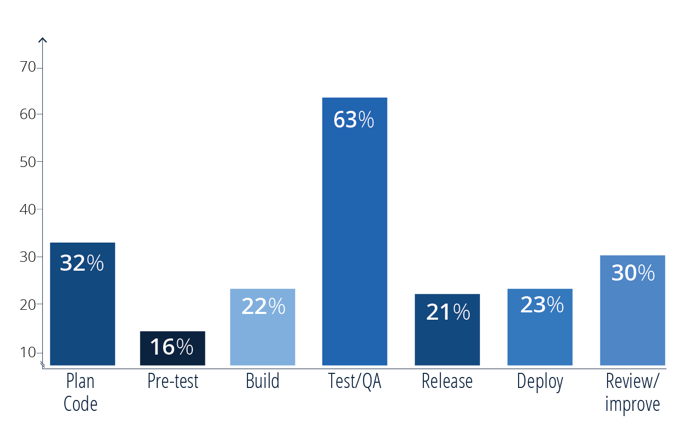
    The same conclusion was reached by a DevOps Review survey that polled a broader set of IT leaders across organizations practicing DevOps. Again, testing was cited as the No. 1 source of holdups in the software delivery process. In fact, it “won” by a rather wide margin here—63% reported that testing was a major source of delays, while the second-highest source of delays (planning) was cited by only 32% of the respondents.

    Where are the main holdups in the software production process?

    testing 3

    Why is testing such a formidable bottleneck? That could be the topic of an entire book. For now, let’s summarize some key points:

    • The vast majority of testing (over 80%) is still performed manually—even more at large enterprise organizations.
    • Approximately 67% of the test cases being built, maintained and executed are redundant and add no value to the effort.
    • At organizations that have significant test automation, testers spend 17% of their time dealing with false positives and another 14% on additional maintenance tasks.
    • Over half of testers spend five to 15 hours per week dealing with test data (average wait time for data = 2 weeks).
    • 84% are routinely delayed by limited test environment access (average wait time for test environments = 32 days).
    • The average regression test suite takes 16.5 days to execute, but the average Agile sprint is two weeks, from start to finish—including planning, implementation and testing.
    • The average application under test now interacts with 52 dependent systems—which means that a single end-to-end transaction could cross everything from microservices and APIs to a variety of mobile and browser interfaces, packaged apps (SAP, Salesforce, Oracle, ServiceNow…), custom/legacy applications and mainframes.

    The software testing process wasn’t working perfectly even before the advent of Agile and DevOps. Now we’re asking teams to “just speed it up” at the same time that modern application architectures are making the process even more complex. Given that, it’s hardly surprising that speed expectations aren’t being met.

    The Insight Problem

    Only 9% of companies perform formal risk assessments on their requirements/user stories. Most attempt to cover their top risks intuitively, and this results in an average business risk coverage of 40%. Would you feel comfortable driving a race car with blinders on? That’s essentially what you’re doing if you’re rapidly delivering software with insight into less than half of your total business risk.

    Moreover, most organizations can’t immediately differentiate between a test failure for a trivial issue and a business-critical failure that must be addressed immediately. Most results look something like this:

    testing 4

    What insight does that really provide? It’s clear that …

    • There’s a total of 53,274 test cases.
    • Almost 80% (42,278) passed.
    • Over 19% failed.
    • About 1% did not execute.

    Maybe the test failures are related to some trivial functionality. Maybe they stem from the most critical functionality: the “engine” of your system. Or, maybe the most critical functionality was not even tested at all. Trying to track down this information would require tons of manual investigative work that yields delayed, often-inaccurate answers.

    Today’s go/no-go decisions need to be made rapidly—even automatically and instantaneously. Results that focus on the number of test cases leave you with a huge blind spot that becomes absolutely critical—and incredibly dangerous—when you’re moving at the speed of digital business.

    Closing the Gap

    How do you evolve from the slow, burdensome testing that delivers questionable results to the lean, streamlined testing that provides the fast feedback required to accelerate innovation and delivery?  That’s what I aim to explain in my new book, “Enterprise Continuous Testing: Transforming Testing for Agile and DevOps.” This book is targeted to senior quality managers and business executives who need to achieve the optimal balance between speed and quality when delivering the software that drives the modern business. It provides a road map for how to accelerate delivery with high confidence and low business risk.

    — Wolfgang Platz

  • DevOps Chats: Enterprise Continuous Testing With a Shift-Right Mindset

    DevOps Chats: Enterprise Continuous Testing With a Shift-Right Mindset

    Test automation and CI/CD are evolving very rapidly to achieve great speed and impactful results by DevOps teams and Agile organizations. Our DevOps Chats guest, Tricentis Chief Product Officer Wolfgang Platz, contributes his experiences to the state of the art with his newly released book, “Enterprise Continuous Testing.”

    Automating software testing just for the sake of automation is “doing the mess for less.” What is the business value of each software element you are testing, and what is the right strategy for testing these software implemented functions? Automation certainly brings with it speed, but are we ultimately making incremental improvements to testing which doesn’t tap into the full power and benefits of automated software testing.

    Our discussion with Wolfgang focuses on the need for expanding dev-testing with higher-level integration, system, and end-to-end user experience testing, which are often performed well by shared testing and operations teams. Now, think Shift Right. While Agile and dev teams often focus on the progression of creating new and exciting capabilities for the business and our customers, we still require that regression mindset that consistently validates unit tests, valuable business functionality, system integrity, performance, and operational needs.

    Transcript

    Mitch Ashley: Hi, everyone. This is Mitch Ashley with devopsy.kinsta.cloud and you’re listening to another DevOps Chats podcast. Today, I’m joined by Wolfgang Platz, who is Chief Product Officer and Founder at Tricentis. Our topic today is a new book that he has just released, “Enterprise Continuous Testing.” It’s a great topic, talking about agile and DevOps and how we transform testing within that environment. So, Wolfgang—welcome to DevOps Chats.

    Wolfgang Platz: Thanks, Mitch. Appreciate it. Thanks, everybody for listening to this podcast. I’m actually on it to be with you and have the chance to introduce a bit of what Tricentis is about and what this book is about, and thanks for having me.

    Ashley: Absolutely. Well, let’s jump right—and we’re honored to have you. Thanks for joining us. Why don’t you jump into, just tell us a little bit about yourself, maybe why you founded Tricentis, and then we can get into the book.

    Platz: [Laughter] Actually, that’s a great question. If you look us up on the Internet, you’re gonna see our official founding date, which is 2008, but the journey actually and the story, the history starts a bit earlier.

    I founded Tricentis as a services company first in 1997, and bringing some software QA services to the world, but I had to acknowledge, frankly, that all the tooling out there just wasn’t sufficient when it came to test automation. When you do test automation, I always call it, you run into kind of a honeymoon phenomenon. Meaning, you record your first test cases and everything looks bright, but when you try to replay them and when you want to have them up and running even when changes happen, then you fail and things break.

    So, the only way out was to come up with my own tool there, and that was the birth date of our software product offering. Then, in 2008, it was mature enough to switch into a product company, and from there on, it has been a fantastic journey upwards. Now, we are, as you may know, placed as a leader in Gartner’s magic quadrants now for the fourth time in a row, so.

    Ashley: Mm-hmm. Congratulations, yeah.

    Platz: We are about to take it all over, that’s great.

    Ashley: Well, fantastic. You know, it’s a familiar model that’s kinda transitioning, pivoting from that services into a product company—and congrats on that successful transition. It’s not always a successful one. [Laughter]

    Platz: Yeah, that’s true.

    Ashley: So, if you started in 2008, that was probably around the area of agile. DevOps wasn’t really kinda taking off quite yet. I think that’s about when it kinda started. So, you were already, I’m sure, thinking about how teams are starting to work differently in agile methodology, maybe kinda leaning, starting towards a lean kind of an approach.

    Platz: Absolutely.

    Ashley: Yeah, interesting. Well, tell us about why did you write this book. I know continuous testing, CI/CD—all of that stuff is certainly at the heart and center of DevOps and everything kinda starts there. Automated testing is, of course, a key part of that. So, certainly there is a need for this topic. Why did you decide to write a book?

    Platz: So, what I had to acknowledge in talking to customers and coming up with this product was, software testing is treated in a lot of organizations like a stepchild. And I mean, everybody is aware of the relevance of development, don’t get me wrong, and everybody is aware of the good things that IT can bring to use.

    But software testing is kind of living in the shadows, and that was one experience. And when I then talked to customers, I found out that their ask and their intuitive need is always kinda the same. They see that software testing is here, they to some degree accept that there is a need for software testing, but all of a sudden, they say, “Well, I mean, it’s a lot of effort, so we wanna have this automated.”

    Ashley: Mm-hmm.

    Platz: And the first reaction to dealing with software testing in a more professional way is, “Let’s automate that thing.” And automation is a super element aspect of an improved software testing, don’t get me wrong. However, bringing large enterprise customers up to speed on software testing is actually more like a transformation journey. It is a change agenda you need to go through.

    Because it’s not just about automation. A friend of mine said automation is just doing the mess for less, right?

    Ashley: Mm-hmm.

    Platz: But there is so much more potential in optimizing software testing when you have a more comprehensive look at it, when you have a clear understanding what is the business value of each and every functionality you wanna cover with tests. What is the concrete need for test cases in order to address the business risk that may be within certain functionality, and then what is the right strategy of executing these tests? Are you gonna run them through user interfaces? Are you gonna run them through APIs? Are you gonna run them with the use of decoupling, which service virtualization enables you to?

    Only if you have that comprehensive perspective, then you can make continuous testing really work. Otherwise, it’s just gonna be little things, little improvements that certainly help, but don’t untap the full power of a better software testing world, and that is why I’ve been coming up with this book. I think it is overdue to make people aware—“Wait a minute, it’s not just jumping about onto the automation train. This is not gonna be the full story.” And you’re gonna leave a lot of stuff behind if you just think that way. Does that make sense, Mitch?

    Ashley: It totally does, and I think if I kinda pull a couple things out of what you described, one is—automation is part of it, but continuous is also another aspect of changing the kinda whole paradigm of how you think about testing. Because I remember it wasn’t that long ago where you had a QA team and a development team.

    Platz: Correct.

    Ashley: And of course, that created automatic tension because the QA team tried to find every problem and what has to be fixed before it gets released and change control meetings and all that kinda stuff. It was highly manual, even if some of the testing was scripted. But now, in this world of continuous integration, continuous testing that’s automated you know, it’s less an argument between teams and people and that kinda friction and more about how do we make sure we’re automating the right things? How do we make sure that we escalate when problems need to be fixed, when builds break and tests fail and make sure that we’re testing the right kind of functionality?

    So, it’s engaged the developers—and tell me if you agree with this—it’s really engaged the developers much more heavily in the creation and embracing that testing rather than being a separate function someone else does. True?

    Platz: Yeah, absolutely. I mean, you pointed it out already, Mitch. In former days, it was like Dev, Test, and Ops providing different teams to software development life cycle. And what has happened, though, is that these big, we call them test centers of excellence where you would have a large number of manual testers, usually concentrated with some management capability, a little bit of automation maybe, even.

    This piece, these large TCOEs, these test centers of excellence actually, they have either vanished or they are—or everybody’s questioning themselves if they should keep going with this model. And fully right so. Because what we now see with the need for speed in development is that the cooperation between Dev and Test needs to be so much closer, needs to be so much more fluent.

    So, what we see is that these test centers of excellence are torn apart. And what we call out there as a recommendation is that you, if you have a very slim, so to say, team, a best practice team or we call it digital TCOE, that on one hand has this tight connection between Dev and Test, but on the other hand, provides some guidance on how to do testing in the best way.

    Ashley: Mm-hmm.

    Platz: And we see a lot of companies switching into Dev Testers where you have this hybrid form of developers and testers established directly within the agile teams.

    Ashley: Mm-hmm.

    Platz: And I think that’s certainly the right way to do. However, on the other hand, we wanna be very much aware that complex system landscapes require higher levels of integration testing and some flavor of an E2E user acceptance test, which tends now to be forgotten when people go into an agile and DevOps practice.

    So, I think—yes, we see the TCOEs erode. They got into Dev testers, which makes a lot of sense, but please, guys, be aware that there is a need for higher levels of testing which has not vanished overnight, and someone needs to take care of that. What we see is that these needs tend to shift more towards the operations team towards a kind of shared services team now in large enterprises, but it is a, what I would say contra streaming, like the shift left pushing testers into development. We now see kind of a shift right movement also, which makes sure that some higher levels of test are still covered in these shared services organizations.

    Ashley: Yeah, it’s interesting you pointed that out that way, because you know, you do hear a little bit about shift right and you think about the world that we’re operating and it’s much more complex, because we’re operating in cloud environments, maybe doing cloud native, maybe not, but we’re working maybe in multiclouds, private data centers, private clouds, et cetera.

    All these combinations of environments—and, you know, some apps might be in one place, some might be in multiple. There’s a lot of permutations of that environment that an Operations team is going to say, “How do I know this stuff is gonna work, and when it breaks, how do I know you’re gonna be able to fix it quickly? Diagnose it, test it, and apply the fix quickly.

    Platz: Absolutely.

    Ashley: And that automation is also the automation of—yes, unit and functional tests, but also getting into being able to do some performance regression testing, those kinda, that may be specific to that environment, maybe even specific to an iteration release or kinda backing up and reapplying changes or backing out changes.

    So, it’s in this complex environment that relying on manual processes seems like almost an impossible task. You have to have automation, you have to have a philosophy about doing testing. I hate to wax on here. Maybe I’m singing your song here, [Laughter] but that seems to be the environment we live in and that we have to figure out the best ways to do it. Am I on track here?

    Platz: No, no—that’s cool. And I’m glad that you mentioned regression, because what we have to acknowledge is that the entire mindset of agile development, per definition, is progression rather than regression. And that is good, because agile development is about pushing out new releases, pushing out new capabilities, new features, new functionality faster than ever.

    But what that mindset means is that all the agile Dev teams and the Dev testers that are within the agile teams, they also have this progressive mindset. It means that yes, if you work with them, they will accept the need for unit tests, and some of them will create great unit tests. We have seen this within our customer base. But at a certain point of time, when this is shifting towards regression, then you might find out that having unit tests set up once is one thing, but keeping unit tests up and running is a different game. And what we see is that as soon as you shift from progression into regression, you need to have people with a different mindset that really accept regression as the key aspect of their software testing behavior. If you don’t do that, you, time over time, are gonna run into issues in complex system landscapes.

    And we see that, actually, I call it the evaporation of unit tests over time, which we have done a great survey with some Swiss banks, and we found out that having unit tests set up is something you rather easily can do. But over time, with more releases, you’re gonna see that their coverage, their potential, their power is eroding. And people are then referring more to the higher levels of integration to also catch these kinds of errors going forward, which makes a lot of sense.

    But I just want to make you aware—don’t see agile development and Dev testers as the sole instance of your software testing. If you do that, you’re gonna run into issues in a complex, multi-system landscape with a high extent of regression with a heavy backbone with a true enterprise system landscape.

    Ashley: So, Wolfgang are you saying that—you know, we used to say that you had to have separate QA teams, so it was people who didn’t create the software that could more fully test it and not kinda, you know, testing your own software is hard because you assume things.

    Are you saying that, even in this automated world, continuous testing world, we still need folks who have that sort of systemic thoroughness QA kind of approach to testing, even though we’re automating it, don’t strictly rely on developers to create a self-created unit and system kinda test. Is that what you’re saying?

    Platz: Exactly. That’s what I wanna get to.

    Ashley: Good. Well, tell us a little bit about your book. You know, there are a lot of ways to approach a technical book about a technical subject. Is this a prescriptive how to? Is this kind of a strategy guide to lay out how you put together a full program of continuous enterprise testing in agile and DevOps? Tell us a little bit about the approach of how you went about this book.

    Platz: The intent of the book is to provide a comprehensive overview of what you need to think about when you go for continuous testing. As I pointed out at the very beginning of our conversation is that just going for an automation of your software tests is not gonna be the solution. You need to have a way more comprehensive look onto the subject.

    And so, what the book really is gonna do, it’s gonna introduce the perspective of a value-slash-risk based testing to you, which is the foundation. Before we wanna do a software test, we wanna make sure that it’s worthwhile doing the test, right? If this is just a functionality with very, very minor relevance to the business, you might be good with just one test case, you know what I mean?

    Ashley: Mm-hmm.

    Platz: However, if it’s an absolutely mission critical capability of your software, then you want to make sure that all the different flavors of use cases and all the different procedures that may be within this specific use case are really covered, otherwise it’s, from a risk perspective, not bearable.

    So, having a clear understanding about the business risks-slash-the business value that is associated with each and every functionality that your software provides is the foundation. If you understand that clearly, you will be able to present kind of a map, your map of where you wanna put your dollars into. And guess what? This map is not gonna be just for your budget allocation, but it’s also gonna be relevant for your reporting, because your reporting should go towards business risk covered and not just for counting test cases.

    And guess what? Your management is gonna love it. All of a sudden, they see that somebody has a plan on how budget is allocated in the software testing space. So, it’s real cool stuff.

    As soon as you know that, you wanna make sure you have the right test cases at hand. We’re gonna give you an overview about different techniques of how to create the most meaningful test cases—meaningful in terms of what is the extent of additional business risks that I can cover with the specific test case, right? And when we have done that, we’re gonna make you aware that there’s different approaches to go towards automation. You can go through a user interface, you can go through an API. When you go through this, make sure you decouple systems so that you always know exactly what is the cause of a failure.

    Ashley: Mm-hmm.

    Platz: And when you have come up with that, you wanna make sure that you keep your test data stable, meaning that the system always has a reliable set on basic data at hand so that you’re not gonna be surprised by failures of tests which are just a matter of inconsistent or incorrect test data.

    So, all these things are gonna be introduced in the book. Of course, not into the very, very level of detail, but I think at least in a way that you know what it is about and you have a good basis from where you can start digging further into stuff. But ideally, you take the book and you walk home with it and say, “Uh huh. Now I understand what it is all about.” And I’m not gonna just go out there and jump on the next open source framework for test automation and say, “This is gonna be the holy grail of my whole journey,” you know? It depends on what you wanna achieve.

    Ashley: It’s about kinda creating a systemic, prescriptive framework for how to do this kind of work, because testing is, it sounds like such an understandable word, but it’s also so overloaded, because, as you talked about, there’s lots of ways to test, whether it’s through the API, the interface, there’s security testing, there’s black box testing, and you brought up the whole topic if test data. It’s hard to acquire in the first place and you have to main that, you know, evolve it with the functionality and the application—

    Platz: Oh, yeah.

    Ashley: – part of the regression, also. It’s really a very complex topic, and you get into performance testing, load testing, sort of chaos monkey-style resilience testing, all kinds of things that can happen. And then behind the scenes, now that we’re automating so much, we have this data that’s super valuable that we can communicate to the business. We plugged in code in here and it made it into production, and here’s how we know it was thoroughly tested and made sure that it’s gonna be reliable when we get it out in production.

    Platz: Yes, and this is actually where the journey is gonna go looking forward. What we’re gonna see happening is that more and more tracing information, logging information from production will be fed back into the testing loop, right?

    Ashley: Mm-hmm.

    Platz: I’ve pointed out the business risk courage. I mean, how do you get to a clear understanding of business risk? You get through that by knowing how often systems are used and what is the potential damage. These things—and nowadays, if you have a proper logging out there—can be obtained from production logs. And these production logs can be fed into, back into the loop by now influencing your test awareness on specific functionality from the very beginning, from the development perspective already, into the higher levels of testing.

    So, what we’re gonna see is that data, the use of data, even with some artificial intelligence involved, is gonna be a tremendous source for driving the further efficiency of the testing cycle. So, we’re gonna see, actually, the ideas of the value based testing in conjunction with having the right test cases at hand being even more optimized and speeded up by this data loop that we’re gonna get into the future.

    Ashley: Mm-hmm. So, your book is available, I assume, through normal channels like, you know, an Amazon and other places like that?

    Platz: Yes, correct. Just type it in, “continuous testing,” and you may wanna put my name in there also, and then you’re gonna be good to go.

    Ashley: Awesome. Excellent. Well, congratulations on the launch of the book. That’s exciting. I appreciate all the work. I haven’t written a book, but I’ve talked to many people that have, and I know it is a painstaking love of passion for the topic that kind of sees you through to the end and getting the book published. And I know you had some help with Cynthia Dunlop, so shout out to her for helping you on the book.

    Platz: Yes, yes, yes. It actually, that was a dramatic understatement, Mitch. Cynthia has not been of just some help. I would say she is the true author of the book. I was the one laying out the concepts, and it was stunningly how little time I had to provide to give all the basic information for her to come up with it. All the kudos actually need to go to Cynthia. I’m super excited to have my name on the book, but I feel a bit ashamed because it should be her name more prominent than mine, frankly.

    Ashley: Well, it sounds like both are well deserved, and your appreciation is certainly transparent to Cynthia.

    Platz:[Laughter] I hope so.

    Ashley: And, you know, we never go alone, right? We never get there alone, so it’s through working with other that always—it gets all of us there together, so. Well, congratulations on the book and thanks for being on DevOps Chat with us today.

    Platz: It was my pleasure. Thanks, Mitch.

    Ashley: It was my honor to have you. I’d like to thank Wolfgang Platz, who is Chief Product Officer and Founder at Tricentis, and of course, wishing him the best of luck with the book. Thanks to you, all of our listeners, for joining us today. This is Mitch Ashley with devopsy.kinsta.cloud. Have a great day and be careful out there.

    — Mitchell Ashley

  • Investing in a Mobile Device Testing Lab

    Investing in a Mobile Device Testing Lab

    It will likely come as no surprise that app downloads are on the rise, with no signs of slowing down. Today’s consumers use apps for everything from ordering food, to shopping for clothes, to managing money and more.

    In fact, according to a recent report by App Annie, consumers downloaded a total of 194 billion apps in 2018, up from 178 billion apps in 2017. 

    Yet, the same report shows that app retention rates after 90 days are low–ranging from 32% to a meager 4%.

    Reasons for app deletion vary, but far too many apps, in a burgeoning sea of apps, are either hastily and incompletely tested or aren’t even tested at all. This can lead to poor consumer experience, deleted apps and even negative feelings about a brand itself.

    Therefore, it’s critical for mobile app developers and practitioners to button up their testing practices before release. Otherwise, you run the risk that all the work you put into your app will only lead to the dreaded and overcrowded app graveyard.

    Overcoming Today’s App Testing Limitations

    The primary challenge prohibiting companies from properly testing their apps is access to real-time devices in the same instantaneous, maintainable and scalable infrastructure. The expectations around continuous testing in desktop, web and packaged applications is difficult to achieve in mobile testing without a device cloud, which delivers seamless access to real devices in an on-demand infrastructure and brings order to the chaos of managing multiple mobile devices in a test lab.

    A cloud-based mobile testing lab provides a comprehensive solution that solves issues around mobile app testing, including too many device types and operating systems to test, as well as a lack of people and time to test. It offers real-time, continuous access to real devices for all mobile testing needs, resulting in higher quality apps and increased customer satisfaction and retention.   

    An added bonus is a cloud-based mobile testing lab frees app testers from initiating and monitoring automated tests. Basically, testers can automate their automation. This, in turn, allows them to perform other significant tasks that can increase user acceptance, engagement and experience.

    Failure Looms with Little or No Testing

    That being said, some organizations, in a rush to go to market, release an app with little to no mobile testing at all. They believe testing is too difficult, too time-intensive or too costly to be worth their while. Some think minimal web testing will keep them out of trouble when it comes to mobile. And although we all like to think that we write bug-free code, unfortunately this isn’t always the case.

    Furthermore, there are those who will test their app and then release it before fixing all the bugs, thinking they can test and improve along the way. However, that way of thinking can be detrimental to a company and its brand. Localytics found technical failure as simple as an image not loading can lead to a 29% loss of customers.

    Mobile App Testing Helps Ensure a Thumbs Up 

    The average U.S. adult, according to an eMarketer study, spends 3.75 hours on mobile devices each day, with nearly three of those hours using apps. Further, Statista estimates app downloads to grow to 258.2 billion in 2022. Clearly, the app market is thriving, but so is the competition. You’ll have a better chance of standing out in the crowd if your app works–flawlessly.

    A mobile device testing lab could be one of the key solutions that will help separate the proverbial app wheat from the chaff. By testing apps in real time, you understand which types of devices are most affected should a crash occur. Analytics show what app features are used most, allowing you to prioritize what should be fixed first during the testing process. 

    The future of apps is in mobile, which is why mobile testing will continue converging with legacy applications such as web and desktop. Forward-looking companies need an approach that allows top-of-line technologies to work together as if provided by a single solution provider.

    A mobile device testing lab helps you break through the barriers of app development. In doing so, your app has a better chance of doing what you say it will do–without crashes–hopefully earning your app a coveted spot on users’ home screens instead of the trash.

    — Dan McFall

  • IBN’s Success is Driven by Formulating the Right Test Validation Strategy

    IBN’s Success is Driven by Formulating the Right Test Validation Strategy

    Intent-Based Networking (IBN) is widely considered to be the next big innovation in networking industry. IBN is all about simplifying the process of implementing new upgrades and changes in any networking environment to ensure the results match the original intent. IBN can be considered a successor to software-defined networking (SDN) as it seeks to automate networking operations while better aligning networks with business intent.

    IBN helps to automate operations that were traditionally performed by network analysts or network support engineers through an intent based model. This is achieved by creating a level of abstraction that through certain orders, points out the service or application to be added, which automates all network configuration and management activities.

    The Challenges Posed by SDN and NFV Based Networks

    A number of organizations are making long-term investments in the cloud and are just beginning to realize the benefits of NFV and SDN. As a result, we’re still in a transitionary phase until the transformation is complete. As businesses continue to make this transition, there are a few key considerations from an INB architecture point of view that need to be considered before embarking on this journey:

    • Analyze each networking program in your roadmap and define if intent-based networking can be added to these projects well before integrating IBN into the network architecture.
    • Ensure robust and thorough monitoring and assurance systems are in place.
    • Identify and examine the application programming interfaces (APIs) in the network architecture to determine if they will work with IBN. For instance, Nemo API in ODL/ONOS Controller.
    • IT network teams should have a single pane of view across architectures, data centers, campuses, branches and cloud platforms.
    • Ensure the network architecture has considered the necessary security elements required.

    How IBN Ensures a Holistic Approach to Network Intelligent Verification

    Unlike the traditional interpretation of network verification, the intelligent network verification I’m alluding to is able to consider network design, configurations and prevailing or existing network states to accurately assess network activity. It does not consider live traffic flows and pre-defined testing scenarios hence aiding in the verification of a negative scenario–something traditional testing can seldom accomplish.

    As IBN possess the ability to consider the complete network as a single entity, it facilitates a comprehensive approach to network verification. As a result, organizations are more effectively able to validate the behavior of the network, based on its configuration and state, with the higher-level intent.

    IBN Necessitates a Fundamental Shift in Network Design and Testing

    IBN is shifting the network IT model from a reactive approach to a more proactive software-driven approach where an automated analysis of current network designs can virtually eliminate human errors and misconfigurations. The automation verification enables is helping to replicate and augment the network expertise of the IT staff in troubleshooting and triaging issues during outages, verifying fixes provided by vendors and documenting procedures and workflows.

    There are newer testing challenges popping up due to factors arising from multi-vendor software platforms, protocols and APIs operating together in this environment.

    One good practice to be adopted before designing a new testing approach would be to look deeply at the critical dependencies in designing an IBN Solution. However, while migrating from an existing network to a virtual network, both networks must be re-validated thoroughly.

    Designing a Testing Validation Strategy that Delivers Value

    To tap into the full benefits, it is clear SDN and IBN must be integrated together to exploit their potential. Hence, it is critical to have a testing approach focused on five important areas.

    These areas along with the relevant tests that need to be considered are highlighted below:

    1. Business Policy: Policy conversion to technology and map test, service design and logical topology test, username to host mapping test and REST API functionality test.
    2. Automation: Service placement test, service functional test, service performance test, policy validation test (user intent and policy change validation).
    3. Assurance: End-to-end monitoring test, performance of user intent and usage of resources test, performance of SLAs and service profiles test (traffic throughput, latency, jitter).
    4. Programmable Network Infrastructure: Southbound API test (NEMO API), OpenFlow test, Ovsdb test, network management test.
    5. Security: Service convergence test, conformance test (IBN customer specs conformance, Intent vulnerabilities reporting).

    Testing is Critical to Ensuring the Success of IBN Automation

    With constant transformation of the network and associated technical complexities faced by network engineers, verification becomes an important step for enabling IBN to achieve its objectives in an SDN-based IBN network architecture. While companies are still allowing software to drive their IT upgrades completely, a focus on a well-defined testing approach is critical to provide the much-needed predictability and assurance required for a successful IBN implementation.

    Adopting a layered and integrated approach provides significant benefits related to early detection of bugs, improved test cycles through automation, predictability of outcomes, increase in confidence levels, enhanced scalability, improved security guidelines and adequate testing to ensure smooth delivery.

    After all, when the Intent is right and more importantly validated, all the pieces come together to drive business agility.

    — Jason Chandralal

  • 5 Steps to Ensuring Validity of Your Business-Critical Data

    5 Steps to Ensuring Validity of Your Business-Critical Data

    Bad data can lead organizations to make mistakes. If your organization isn’t continuously ensuring data is accurate, you can never be sure the business decisions you’re making are smart.

    So, how do you continuously validate your business data without consuming excessive resources? The answer starts with your data professionals, who are entrusted with massive volumes of internal, customer and partner data. A breakdown in database performance can consume valuable time finding a fix. Also, data that’s not properly tested and validated can lead to poor business decisions. IBM estimates poor quality data costs the U.S. economy $3 trillion per year.

    Understanding where to implement data validation tests is a vital step to ensuring accurate data. Data testing is traditionally a development-focused initiative that involves testing smaller units of functionality and asserting what the expected results will be within a development or test database environment. Data validation, on the other hand, focuses on production databases and involves validating larger processes. These processes can include Extract, Load, Transform (ELT) and Extract, Transform and Load (ETL) batches, data and application integration, vendor data feeds and data exports for partners.

    While data validation appears to be a massive undertaking, making small but important changes now will set you up for future success. Consider these approaches to incorporate testing and validation into standard database platform operations.

    Conduct Unit Testing

    Test small units of functionality in isolation from other parts of the system. Your database management team will be able to offer temporary or mock-up data stores that will allow data professionals to test smaller subsets of data.

    Conduct Integration Testing

    Verify units of functionality combine to produce useful results. This will mean taking a careful look to make sure data gets from point A to point B with the intended transformations. Breaking down these processes into bite-sized pieces is the key to testing business rules throughout integration processes.

    Automate Testing

    The keys to building quality test plans include being able to standardize tests, repeat them on a schedule or within a continuous integration/continuous delivery (CI/CD) pipeline and make testing results transparent to stakeholders. Developing an automated process is fundamental to taking a proactive approach as you incorporate testing and validation into regular processes.

    Monitor Production Databases

    Don’t stop at testing and validating data only when updates are deployed. Validating that data is correct should be an integral, ongoing process and will ensure confidence in the data.

    Validate Movement

    Validate counts, balances and totals anywhere data is transferred from one system to another. Monitor that values fall into expected ranges, domain values are adhered to and data heuristics are met. Also, evaluate validation results over time to determine overall data health. Is the data optimized for business needs? Are there holes in the efficiency process that should be addressed immediately? Leverage historical validation results for baselines to identify exceptions and determine a path forward for continuous monitoring processes. Make sure you have the needed capabilities for ongoing testing, validation and monitoring processes for your database environments.

    The journey to a proactive approach to database testing—and away from a traditional reactive or ad-hoc approach—will come with its challenges. Bad data affects companies of all sizes in all industries. Once you understand where to implement data validation tests and start following these best practices for testing and validation, you’ll be well on your way to stopping bad data from compromising your organization’s ability to make sound business decisions.

    — John Welch

  • Agile and DevOps Success Needs Continuous Testing

    Agile and DevOps Success Needs Continuous Testing

    One of the central ways to progress an agile transformation is to introduce continuous testing. With all such changes, it is cultural as much as technical. The expected outcomes are less broken builds and reduced time from break to fix, as well as a yardstick for measuring the team’s ambition for improvement.

    The Testing Bit and the Continuous Bit: Testing should be part of any agile developer’s skillset; the shift is to apply it to the whole build pipeline. Continuous implies automation, with the build featuring as a living thing whose state is always changing. The infrastructure options have expanded with the advent of cloud computing and virtual containers.

    Let’s say your teams’ developers work on components, independently buildable and testable chunks of the whole app or service. They receive stories and tasks to improve a customer journey and then add functionality to implement these. And when done, they check their work into your team’s code repository.

    Starting with One Developer, One Laptop and One Test

    The initial testing focus for a single developer (or pair) working on code will be the unit test and the coverage test. Whether writing the test first or code first, the unit test pokes the bounds of the new code and the coverage test checks that all code paths are exercised.

    As an example, maybe the developer has implemented the “customer wants to deposit money” story on an accounts component of a banking system. The tests should check what happens if a user deposits zero, negative or fractional money and the coverage confirms the tests have wandered down all possible the code paths of the new feature. In this way, coverage tests also prevent a developer from adding code without introducing the corresponding tests.

    At this point, it is worthwhile making sure tests are run as part of the build so every time the developer builds the code all the unit tests are run. This is a fairly standard thing for most build systems to do. The bottom line is the chance of checking-in breaking code is greatly reduced.

    Now the Bigger Picture

    The new code worked on your developer’s laptop, the tests passed and they checked-in the code. But in a busy enterprise team, other developers are also working on the same component, maybe even on the same file. This is no different from working on a book chapter with several authors. Your developer worked with a stable snapshot of the code. It is quite possible changes were made by others that conflict with the changes your developer just made. So how do we proceed?

    This is the purpose of the central build. The job of the central build is to check out all code for that component, build it and run all associated tests whenever new code is checked in. In today’s world, the likely path would be to create a container on a cloud server, where the component can be built from scratch, and then all the tests run against it. Traditionally, a tool such as Jenkins would watch for git check-ins and kick off a build. The result is the team always knows if the overall build is green (working) or red (broken). A developer must understand the central build is the true source of truth, not what is happening on their laptop. So, the latest check-in leads to a correctly built component. What next?

    There are three general types of testing needed to develop a software system. Tests that make sure new features work correctly and don’t break the component, tests that make sure the components still work with each other and those confirming the customer journeys your component participates in all work as expected. There would be no point in making a deposit function without a customer journey test that proves a customer can deposit cash with the system.

    The second type of testing, usually referred to as integration testing, needs an environment where all current successfully built components can communicate with each other. Today, that may mean some form of container orchestration with the system’s components placed and managed in their containers. Tests of a customer journey may involve emulating the customer’s manipulation of a website or mobile app, depending on how the application or service is accessed. These are the tests stakeholders are most interested in as they confirm what has been requested in the stories actually work. As with integration testing, these tests may be run less often.

    I Mock Thee

    Mock (or fake) services and data are a necessary part of the testing process, and usually, must be maintained and extended as part of the testing. A feature story may require a developer to spend more time developing or extending a mock service than writing the code it helps test. For example, a mock account with some transaction history is needed to test a new deposit function.

    Live environments can never be entirely simulated in test environments. Sometimes a live service uses a paid for third-party service, and it would be too expensive to use in testing. It is usually the case that the development staff are not permitted to work with live customer data.

    The Build Is Alive

    All the structures mentioned are just products of one simple attitude: “How do I know if this works?” For continuous testing to thrive, engineers should always question whether every part of the system is being tested and whether the tests are being evolved at the same pace as feature development. When tests or mocks are missing, an agile team refers to technical debt. This is as it implies, something that must be paid for later.

    When team members realize they cannot just check-in code and go to lunch without checking the central build, that is a good sign. Information radiators such as large screen displays of the build state should be used to get the extended team to understand the state of the build is everyone’s concern, throughout the lifecycle.

    — David Eastman

  • How Continuous Testing Advances Your Business Goals

    How Continuous Testing Advances Your Business Goals

    The goals of any successful business fit into two broad categories: driving higher revenue and greater operational efficiency. Finding solutions to achieve both of these is an organization’s goldmine.

    Considering the ease of access to new, alternate products from developers across the globe, competition continues to grow. In the software industry, customer expectations magnify cut-throat competition. Users expect newer features, faster releases and ever-improving optimal performance.

    To achieve these core business goals, DevOps teams now develop software with a mindset of continuous delivery. This practice helps organizations achieve faster release cycles while delivering newer features to meet customer demand.

    For most teams, there remains a major ongoing challenge: effective testing within this high-speed delivery cycle. Traditional (non-automated) testing methods became a bottleneck in the CI/CD pipeline mindset, forcing organizations to choose between quality and speed to market.

    Continuous testing helps overcome this problem by weaving testing throughout the delivery cycle by leveraging automation. But what tests should be automated?

    In late 2018, KMS surveyed 135 professionals who successfully implemented continuous testing, for their insights on the process. Of the organizations surveyed, the following tests were always automated:

    • Unit tests (47.4%)
    • Component tests (46.7%)
    • Integration tests (45.9%)
    • UI tests (38.5%)
    • Performance and load tests (57%)
    • Security tests (52.6%)
    • User acceptance tests (34.1%)

    We also found the top three focus areas of test coverage for continuous testing were:

    • Integration tests (55.6%)
    • Security tests (48.1%)
    • UI tests (43.7%)

    As a bottom line, businesses must successfully adopt continuous testing to keep their delivery pipelines in sync with development.

    Despite several benefits arising from continuous testing, KMS found a few challenges for organizations that have adopted this methodology. Seventy-eight percent reported that continuous testing would have been easier to adopt with a directive from their executive leadership.

    What’s more, 78% indicated they would have liked more team ownership of the initiative and 86% would have liked better team collaboration.

    So, how do organizations get executive buy-in and rally the team to adopt the practice? By understanding and communicating how continuous testing directly contributes to achieving the two key business goals of increased revenue and operational efficiency.

    Let’s drill down into increased revenue generation. After all, money is what keeps any business in motion. Businesses drive revenue by:

    1. Solving a pain point for customers.
    2. Encouraging users to adopt their solution.
    3. Having the agility to shift and meet changing consumer needs, with speed.

    To achieve operational efficiencies, businesses focus on:

    1. Achieving shorter release cycles.
    2. Receiving feedback and ability to respond with agility.
    3. A more effective team, without increasing headcount.

    With these goals in mind, there are three core business cases for adopting continuous testing:

    Increased Agility and Confidence in Quality

    Agile is the ideal delivery model for all software companies. True agility means organizations can shift focus quickly and respond rapidly to customer feedback or changes in the market. It also gives teams the freedom to explore new opportunities/solutions. Continuous testing enables this agility by supporting a shift-left philosophy that uses test automation in the earlier stages of the development cycle. Shifting left enables a continuous feedback loop that allows teams to respond to defects and establish better team communication.

    By adopting continuous testing, 80% of professionals found fewer defects escaping to production. Reacting to feedback quickly allows companies to give customers the products they want. An organization can increase revenue by delivering market-disrupting features.

    Automation tools also encourage a testing mindset in developers—80.7% of companies adopting continuous testing have found their developers doing more testing. This mindset shift is critical to achieving agility with better collaboration. It makes the quality of the software the responsibility of the entire team, truly aligning with the Agile Manifesto. As a result, product quality and user experience benefit, and happy customers increase revenue.

    Faster Overall Speed

    Keeping up in today’s market requires shorter release cycles. As I mentioned earlier, adopting continuous testing enables faster sprints by eliminating the testing bottleneck at the end of the delivery life cycle. In fact, 83.7% of companies have achieved shorter release cycles by adopting continuous testing.

    Speeding up the software development life cycle pushes products to market faster. Getting features in the hands of customers before your competition gives your company a huge competitive edge. By adopting continuous testing, companies are not slowed down by antiquated testing initiatives. Speed enables them to compete on a global scale and disrupt the market.

    Lower Operational Expenses

    How do you balance speed and cost? Automation. Continuous testing automates routine tests. By using open source tools such as Katalon, teams can automate with minimal extra expense. This not only helps you test faster, but your team can be more productive—84.4% of companies have achieved better test coverage with the same team size and 67.4% were able to test with smaller teams. Either way, you get more done without investing in additional overhead.

    However, automation is not here to replace testers. Automation in pre-production environments gives your resources the bandwidth to work more strategically: 53.3% of companies that have implemented continuous testing don’t test manually in pre-production environments. Seventy-four percent now have the bandwidth for exploratory testing in production. Use your team and resources where they are most effective, doing the work automation can’t. Ultimately, smart use of resources achieves a sought-after balance of speed and cost.

    By exploring the business cases for continuous testing, companies achieve true agility. The methodology seamlessly aligns with fundamental business goals. Enabling continuous delivery, continuous testing will support revenue growth and operational success for your organization.

    — Mush Honda

  • CloudBees’ Acquisition of Rollout: The CEOs’ View

    CloudBees’ Acquisition of Rollout: The CEOs’ View

    As Mike Vizard reported yesterday, CloudBees, as part of its mission to build “the world’s first end-to-end automated software delivery system,” announced another acquisition: Rollout, a developer of a feature flag application that allows for simplified testing of new modules within an application.

    Not to repeat the gist of Vizard’s article; you can read it for yourself. But this continues what has become something of an acquisition tear by CloudBees. The company has acquired CodeShip and Electric Cloud, among others, while becoming one of the founding members of the new Continuous Delivery Foundation (CDF), under the Linux Foundation and a sister foundation to the Cloud Native Computing Foundation (CNCF) and the Cloud Foundry Foundation. The CDF is now managing the Jenkins project, as well as Jenkins X, Spinnaker and Tekton.

    CloudBees’ Mission

    Make no mistake: These acquisitions, along with the CDF formation, represent a major change for CloudBees. The team there is clearly trying to separate from the pack of “end-to-end” DevOps contenders. CloudBees CEO Sacha Labourey is pushing hard to raise CloudBees above the noise and the rest of the market. The company announced a $62 million round of financing about a year ago.

    You don’t have to be Warren Buffet to see that CloudBees sees an opportunity here. The company is driving toward achieving scale in product and revenue on the path to some sort of liquidity event (perhaps an IPO?) or market leading opportunity.

    For now, though, back to the Rollout acquisition. I had the chance to sit down with Labourey and the CEO and founder of Rollout, Erez Rusovsky. We discussed what Rollout does, its history and how it will fit into the CloudBees product portfolio.

    It is always great to interview a founder about his company being acquired. What a tremendous feeling of accomplishment to found and build a company, and have another entity value it so much that you are willing to sell it to them. This goes so far beyond validation.

    Congrats to Erez and the whole Rollout team and, of course, congratulations to Sacha, KK and the rest of the CloudBees team. This seems like a perfect fit.

    In the meantime, here is my conversation with Sacha and Erez on the acquisition and more. Enjoy!


    — Alan Shimel

  • The Human Value in Automation-Driven DevOps Testing

    The Human Value in Automation-Driven DevOps Testing

    Enterprises are embracing DevOps underpinned by automation to ensure the quality of software across all digital touchpoints. In fact, automation has become the crux of continuous integration and delivery, the vital DevOps testing goals. Without automation, DevOps would become a distant dream, and businesses would struggle to keep pace with seamless delivery and integration. However, DevOps entails more than the implementation of the latest automation tool and demands a more holistic approach. It does so by bringing together processes, people and technologies under a shared vision. As defined by Microsoft, DevOps is the coalition of products, people and processes to facilitate the seamless delivery of value to the end customers.

    DevOps is considered to be the latest advancement of the agile movement. It includes a greater number of stakeholders in the process of delivering value by linking the silo-based teams. It may not be the best practice, but it’s a discipline of people-centric management. Continuous delivery is the technical foundation of DevOps automation, which extends to the agile foundation as well. The close collaboration between the operations and development teams is known as DevOps, which is used to automate the delivery pipeline.

    Role of Automation in DevOps to Increase Productivity

    Since digital transformation has taken over the current business model, more and more companies are embracing the DevOps practice to drive the automated deployment of software. We are shifting toward an organizational culture in which development and testing take place simultaneously, quickly and more often. This helps maintain consistently high ratings on the quality of software with faster turnaround time. The main agenda of DevOps testing is to derive quality outcomes all along the software development life cycle (SDLC) and beyond. So, with the help of DevOps culture, a new code of development, testing and delivery is introduced in the overall SDLC.

    The automation in DevOps empowers companies to:

    • Enhance the reliability, re-usability and quality of all components.
    • Save costs of upgrades and maintenance.
    • Improve the rate of success for standardized processes to ensure the rapid delivery of applications.

    Automate Everything — Is It Even Possible?

    With the help of the DevOps approach, developers automate and accommodate operational activities, from the source code commit to operational productivity. The primary goal of DevOps automation is to remove bottlenecks in the pipeline by implementing automation in a single level of development. However, DevOps is not a fully automated process and is not operational without human intervention. It is the DevOps testing specialists who are responsible for the process to run flawlessly. Governance at every stage of DevOps testing is still indispensable in various processes undergoing automation. Importantly, human administration is still crucial in handling exceptions to complete the tasks of automation.

    The Strategic Role of Humans in DevOps to Ensure a Continuous Pipeline

    Remove the Boundaries of Roles

    The primary feature of DevOps automation culture is about an enhanced collaboration between the operations and development teams. It has led to a cultural transformation at the organization’s level and inside the teams as well, to encourage continuous delivery. Since shared collaboration is an important aspect of the DevOps culture, it strengthens the collaboration within teams. Before the DevOps approach, the perceived lack of interest by the development team regarding maintenance and operations used to affect DevOps testing and business goals. However, this scenario has since changed due to an organizational shift toward automation and DevOps testing.

    The gap between the silos of operations and development no longer exists with the arrival of DevOps. It has removed the boundaries of several organizational roles. Teams are required to focus on the shared goals of DevOps to enhance the end user experience, so the team members need to rethink every investment and decision around this shared goal, which requires human intervention. Automation cannot substitute the decision-making process of humans, for the latter has become vital across the organizational ecosystem as, and when, needed.

    Omit One-Size-Fits-All Approach in DevOps Testing

    Automation cannot be viewed as the eliminator of roles. The organization still requires expert knowledge and skill set inside your team. The focus should be on developing agile and cross-functional teams that are recognized for removing long-established stumbling blocks between the operations and development teams, and for facilitating collaboration. Developing efficient and functional teams would ensure the delivery of superior quality products.

    Continuous Monitoring, Testing and Improvement

    One of the key agendas of DevOps testing is to carry out a deeper level of monitoring. Since rigorous monitoring is needed at every layer of the testing process, from integration to infrastructure and transactions to components, it has become a crucial part of the road map of the DevOps approach. In this digitally connected world, monitoring and testing are no longer distinguishable. Continuous monitoring by testers offers a positive response to the user experience while eradicating pre- and post-production obstacles.

    Conclusion

    With the impetus in the growth of DevOps and agile practices in the past few years, testing has taken a new structure and form. It has evolved into a crucial discipline, and it’s not restricted to a phase of the development cycle anymore. It has become an essential part of the operational activities of production. So, is the role of a tester transformed radically from only a checkpoint to a crucial active participant in the DevOps testing? Teams need to cooperate based on the shared vision of enhancing augmented user experience. We need to understand the fact that automation is not an elixir to deliver on DevOps goals, but merely a part of the DevOps strategy.

    — Komal Lopez