Category: Continuous Testing

Continuous testing is the process of executing automated tests as part of the software delivery pipeline to obtain immediate feedback on the business risks associated with a software release candidate.

  • Application Modernization: A Catalyst for Fixing Sub-Optimal UX

    Application Modernization: A Catalyst for Fixing Sub-Optimal UX

    Today, some of the biggest government programs in existence are Medicare and Medicaid with the two health care insurance providers serving over 43% of the U.S. population. The Centers for Medicare and Medicaid (CMS) spent $1.6 trillion in 2021 and continue to grow in both size and cost on an annual basis. With this type of investment and permeation into the American populace, one would assume that this program would be running on the most up-to-date applications available. However, both public and private health care insurance carriers continue to operate on legacy systems.

    Recently, Andrea Fletcher, the digital services director of the CMS, described their system as operating on technology from the 1960s, which is alarming considering the responsibilities of the program. In fact, the Biden administration has only recently announced plans to modernize their organ matching system. This announcement came from a study conducted in February, which showed that only 26% of organs were procured from donors on average. This is just one example of how efforts to improve legacy systems, which are currently being used by over 40% of the population, allow both public and private organizations to operate in a more efficient manner as well as satisfy user needs. Further exploration will show how modernization improves other areas of business, such as creating user experiences that are both easier to navigate and more personalized as well as the ability to incorporate the latest cybersecurity updates.

    Modernizing as a Means to Improve User Accessibility and Personalization

    Given the size and diversity of the United States population, a modern flexible system is necessary for creating a smooth user experience for every individual. Today, users connect with insurance carriers using a variety of different devices while communicating using different languages and possessing different levels of technical expertise. The ability to create a personalized user experience for each individual will require a level of modernization that legacy systems were not built for. The importance of this flexibility is accentuated when considering that the purpose of Medicare and Medicaid, in particular, is to serve the elderly and underprivileged.

    Prioritizing the modernization of the consumer experience is not limited to just government organizations. In an independent survey conducted by Evolveware, 46% of private organizations measure the success of their application modernization efforts through an expected improvement in customer experience. As health care insurers continue to rely more heavily on analytics and the population continues to adopt digital technologies, the process of creating a streamlined and targeted approach to purchasing and managing health care becomes essential to staying competitive. For a multitude of companies in the marketplace, having an agile system that can be customized to each individual user can be a major differentiator, especially given the variety of factors that each individual has when it comes to making decisions about their health. Moreover, by prioritizing the user experience, organizations can improve their brand loyalty and customer retention, which are key factors when dealing with a competitive marketplace with a lot of players. Insurers have recognized this, as a recent survey of CIOs by Gartner showed that improving the customer experience and application modernization were listed as the highest priorities in the insurance industry. As customers become more judicious with their money due to current macroeconomic trends, providers will need to make sure their platforms’ user experiences are on par with their competitors.

    Modernization to Mitigate the Impact of Hidden Costs and Security Vulnerabilities

    The costs of not updating legacy systems should also be taken into consideration when making the decision to modernize. While the expense and process of moving away from legacy systems can seem like a significant obstacle, these systems, due to on-site maintenance and operational costs, are already expensive to maintain on a continuous basis. In fact, health care IT teams spend around 60% of their time trying to maintain and manage legacy systems. Furthermore, the opportunity cost of IT teams focusing on maintenance over innovation is significant, especially given the potential of the latest technologies to deliver a more intuitive user experience. There is also an understated but pressing labor cost with legacy systems, as members of the workforce who are familiar with these systems are aging and retiring, and the replacement workforce is not well-versed in legacy languages and technologies.

    Finally, legacy systems can also contain blind spots that are prime targets for cybersecurity breaches and hacks today. Legacy applications were built at a time when these types of attacks were not common and, therefore, don’t have the most up-to-date security capabilities embedded. Many of these systems also do not have up-to-date documentation, resulting in a high potential for hidden vulnerabilities. For health care organizations that have access to sensitive data, understanding and then shoring up these vulnerabilities using modern security features is critical.

    Health Care Modernization Example: Chatbots

    One prominent example of how application modernization can lead to organizational success is the integration of chatbots. As technology expands and businesses identify new ways to reach consumers, the addition of chatbots has become more prominent on platforms across industries. For the health care insurance industry, the bots provide both a cost-efficient way to process insurance claims as well as an enhanced user experience through ease of use. Recent estimations show that bots can handle the workload of two to five claims processors and can deliver 20 times the production relative to cost, allowing industry employees to focus on less tedious and more innovative tasks. Using generative AI models, chatbots will continue to become more sophisticated and varied in their responses to user input. As a result, modernizing legacy systems to optimize the integration of these bots becomes integral to remaining competitive in the marketplace.

    Legacy Systems and the Future

    As we look to the future, both government and private insurance carriers have plenty of internal and external factors that incentivize application modernization. As Medicare and Medicaid continue to grow due to the increasing number of eligible users, an agile system is integral for user accessibility. Meanwhile, macroeconomic factors such as high costs and an increasingly competitive marketplace will force private organizations to adopt systems that can integrate and adapt to the newest technologies for a better and more secure customer experience. With serious challenges facing both the public and private sectors of healthcare insurance, the necessity to modernize has never been greater.

  • FAQs for Software Testing: All the Background You Need

    FAQs for Software Testing: All the Background You Need

    No matter what type of application you and your team are building, testing is a critical step in the software development life cycle (SDLC) that can not be overlooked. In this article, I’ll answer frequently asked questions about software testing, why software testing matters and suggest best practices to help ensure your application is ready to delight customers by the time it is deployed.

    Why Do We Need Testing?

    Software testing involves evaluating an application to see if it meets the requirements and functions it was built for. The process includes identifying defects, errors and bugs, along with flaws in user experience. Software testing is so critical because finding and fixing these bugs and issues in the development process means the end product reaching customers works properly and reliably and delivers a high-quality user experience. Additionally, testing during the development process makes bugs easier and less expensive to fix as opposed to making fixes after an application has been deployed.

    Overview of Testing Types

    Let’s quickly define the common types of software testing:

    ● Unit Testing: This process evaluates individual components of software to ensure they are working properly.
    ● System Testing: This involves ensuring an entire application or system meets requirements and functions as it should, end to end.
    ● Integration Testing: This looks at whether or not different modules of an application or system work properly together.
    ● Regression Testing: This process revisits previously tested components of software to make sure they work correctly after a change has been made.
    ● Acceptance Testing: This process determines whether an application meets the needs of end users and is ready to be deployed.
    ● Usability Testing: This process assesses how user-friendly a customer will find the product.

    Creating the Plan

    Any solid software testing plan is going to incorporate multiple testing approaches, including manual, automated, user experience, exploratory and non-functional testing. You’ll start by defining the scope for what parts of your application, integrations and functionality you need to test for. Then, you can decide what type of testing methods are needed for each and document these to ensure consistency.

    You’ll want to combine code coverage and test coverage to ensure the code for your application is tested thoroughly. The type of tests you prioritize will vary based on different products, and your testing strategy will certainly evolve and grow over time.

    Measuring Your Strategy for Thoroughness and Effectiveness

    To ensure your testing strategy is thorough and effective, you will need to make sure to test for code, device coverage and all aspects of user experience. The bottom line for the program should be delivering value to the business by making sure the application works as intended for users. To be effective, testing should take place before an application reaches end users, so issues and bugs can be identified and fixed before deployment. To be thorough, testing strategies must be balanced, end-to-end, and look at functionality, usability, accessibility and more.

    Effective software testing can be measured in a few ways, including:

    ● Code Coverage: The percentage of code that is tested.
    ● Test Case Effectiveness: The percentage of test cases that found defects or bugs.
    ● Time to Detect and Fix Defects: The time it takes to find and fix issues in an application.
    ● Defect Density: The number of defects found per unit of code.

    Improving Your Testing Approach

    Your software testing program should be evolving and improving over time and can improve by:
    ● Including test-driven development
    ● Leveraging a shift-left approach
    ● Using automation where possible
    ● Benchmarking QA for current projects versus previous ones
    ● Conducting a cost-benefit analysis

    Testing Best Practices

    While the below list is not exhaustive, here are some top best practices to keep in mind as you build out a software testing practice at your organization:
    ● Incorporate the voice and feedback of your customer into product design
    ● Make accessibility a priority
    ● Test throughout the entire SDLC, including in pre-production, after changes are made to code, and in-sprint testing
    ● Maintain a matrix for the different devices using your application
    ● Prioritize high-quality user experience
    ● Automate repetitive tests where possible
    ● Review and adjust testing processes regularly, as needed
    ● Track and report results to analyze trends and identify areas for improvement
    ● Balance between leveraging different testing types

    Your organization’s software testing strategy directly impacts the quality of the end application you deliver to your customers. Poor usability, accessibility, and reliability of an application can frustrate users and send them to competitors, while high-quality user experiences and application performance can boost adoption and keep customers happy and loyal to your brand. With so much competition, taking the time to build out, adjust and prioritize software testing is critical for modern businesses.

  • OpsMX Adds Deployment Firewall to Ensure Compliance

    OpsMX Adds Deployment Firewall to Ensure Compliance

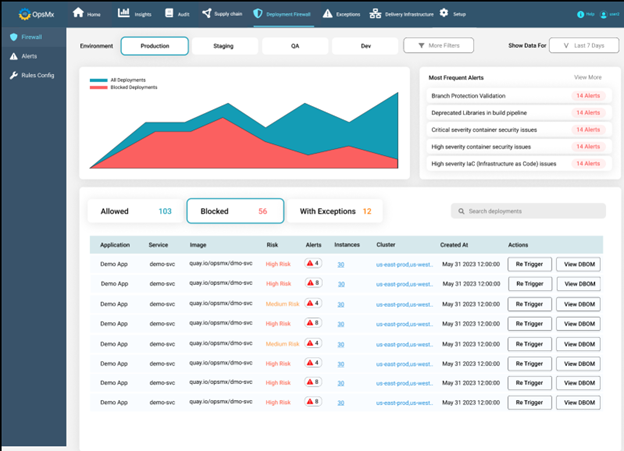
    OpsMx today added a deployment firewall to its Deploy Shield portfolio for securing continuous integration/continuous delivery (CI/CD) platforms.

    The deployment firewall automatically applies rules to ensure DevOps teams comply with mandates such as the payment card industry data security standard (PCI DSS) or the Health Insurance Portability and Accountability Act (HIPAA). It then evaluates a release against a checklist of policies and blocks any deployments into a production environment unless a specific exception has been defined. In those instances, DevOps teams can also set an alert to address that issue at a later date.

    In addition, DevOps teams can extend those rules defined by OpsMX to address specific compliance requirements.

    The checklist includes making sure vulnerability scams have been run, tracking when the manifest was last updated, confirming that operational controls are being followed, checking whether images have been modified and evaluating the infrastructure being employed and performing an analysis of the performance impact.

    A simulation feature also allows developers to check their release for compliance before it is time to deploy.

    OpsMx CEO Gopal Dommety said the goal is to streamline the effort that is required to meet multiple compliance mandates as the pace at which applications are being developed and deployed continues to increase.

    Today there are simply too many data silos for DevOps teams to manage, with each one presenting yet another opportunity to run afoul of a compliance mandate, he added. The overall goal is to reduce the cognitive load being placed on developers as more responsibility for compliance is shifted left, noted Dommety.

    The deployment firewall currently supports DevOps platforms such as Jenkins, Argo and Spinnaker, with support for GitHub Actions and GitLab to follow.

    OpsMX claims its overall customer base has increased by more than 60% in the first half of this year, with customers including Google, Cisco and Western Union. In addition to Deploy Shield, the company provides a Delivery Bill of Materials (DeliveryBOM) tool to capture a consolidated record of every step in the application software delivery and deployment process. Security checks, approvals, policy enforcement and audits are tracked via one tool. In addition, the company provides tools for managing the deployments of software via either the Argo or Spinnaker CD platforms.

    It’s now only a matter of time before various regulations that apply to the building and deploying applications become more stringent. Tolerance for sloppy application development processes is dropping as legislative bodies increasingly determine that software development practices are a big cybersecurity problem that threatens national security and the global economy.

    Organizations that fail to comply with those regulations will be subject to even heftier fines than the ones that already exist. In many cases, that may slow down the rate at which applications are deployed unless DevOps teams find ways to manage compliance-as-code more effectively as part of a larger DevSecOps workflow.

    When it comes to DevSecOps, progress tends to be slow in most organizations, but as more tools become available to automate various tasks, it’s now only a matter of time before software supply chains are more tightly secured. Hopefully, the pace at which those advances are being made will occur faster than cybercriminals can exploit the vulnerabilities that today are too numerous to manually track.