Category: Containers

  • DevOps Predictions for 2018

    DevOps Predictions for 2018

    The new year is upon us, and that can only mean one thing: outrageous tech predictions! This year, we have a few that are easy to believe and a few that are completely off-the-wall. See if you can pick them out.

    Serverless Overtakes Containers

    Serverless is the future and containers are dead. Some (or maybe even a majority) of the industry will come to realize this. Serverless is largely defined as using functions as a service (FaaS) as the backbone of your architecture. These services are a layer on top of containers that provide an opinionated way to run code that scales with demand and ties true compute usage to costs at sub-second billing increments. Much like virtualization in the data center was dwarfed by cloud providers doing opinionated virtualization a decade ago, serverless offerings will overtake the container market.

    DevOps Backlash Gets Loud

    DevOps has been happily spreading through the industry as an extension of Agile to the rest of IT. But in 2018, the pushback comes. In the early days of DevOps, there was a movement called “No-Ops.” It was championed by some, but then later, reversed back to DevOps. This year, we will see stories of failed digital transformations and DevOps attempts at conferences across the globe. At first, they will be marked as “not doing DevOps right,” but as more and more happen, they will be branded with the old-new stigma of No-Ops—and they won’t come back.

    Chaos Engineering Overtakes the Airwaves

    You remember the Chaos Monkey Netflix released to the IT world that captured the hearts and minds of software engineers everywhere? Well, this is the year when chaos reigns! We’ve already had a taste of it through the new open-source project ChaoSlingr on the Modern Security Series show at Signal Sciences, but my guess is that we are far from done. With the release of Nassim Taleb’s book “Antifragile” in 2014, this has been brewing for a few years. Expect to see more chaos-themed engineering books, conference talks and podcasts in the coming year.

    Software Flaws Mean Prison Time

    Unit testing used to seem like such a good idea, but this year it’s going to become illegal to release software without testing rigor applied. Congress has been on the edge of threatening software accountability legislation for years now, but at this point it looks unavoidable. Will this be the year that a landmark legal battle happens and an engineer who didn’t do proper testing gets thrown in jail? Don’t laugh. We have already seen the first signs of this with the VW diesel scandal; just imagine if it was a pacemaker failure. In 2018, lawyers make the new rules for software engineering.

    Promise Theory Finds New Adoption

    Mark Burgess brought physics to IT through his groundbreaking book on Promise Theory and its implications for the way our applications and infrastructure will be built over the coming years. Instead of making assertions of obligation from machine to machine, networks will be composed of voluntary agents making promises. At the time it was released, Promise Theory received a lukewarm reception. But with the new services-based architectures such as serverless and even the rise of container orchestration platforms, the industry is now ready to adopt Promise Theory thinking. Networks, applications and systems are already functioning as voluntary agents working together through promises. This year, we will see more and more mainstream adoption of the concepts and more examples of how to get it right. Get ready to learn how systems can be self-organizing.

    Application Security Becomes More About the Application

    The perennial web application security checklist is to avoid XSS, SQLi and all the rest of the OWASP Top 10. Application security will finally shift from language and framework vulnerabilities to more conversations around how applications are getting attacked. In the new year, the conversation hinges on account takeovers, fraud detection and abuse inside the application. This is good for the industry because we will move past fighting automatic scanning by adding real instrumentation to detect bad actors.

    Happy New Year!

    The next 12 months are certainly going to be an adventure, and I hope you have a happy new year.

    P.S. Please don’t get thrown in jail!
    — James Wickett

  • Axway Extends API Management Reach

    Axway Extends API Management Reach

    With application programming interfaces playing a larger role in the DevOps environment, Axway has added to its API toolkit for developers. The company expanded its AMPLIFY API management platform to include a visual tool for composing and integrating APIs and enhanced its API Manager tool so that it now can be invoked to scale resources up or down as needed. In addition, Axway unveiled API Central Service that makes it easier to integrate APIs across an ecosystem of organizations that make their services available via the AMPLIFY marketplace.

    Other new capabilities include an open-source MQTT connector for building internet of things (IoT) applications, a connector to the Microsoft Azure Cloud and tighter integration between Axway’s MFT file transfer software and the Syncplicity file synchronization software it acquired earlier this year.

    Axway also merged the Titantium SDK for building native mobile applications using JavaScript into the Core SDK for developers and is previewing the Query Builder Analytics tool, which enables users to do ad hoc query of mobile statistics. The Titanium code is based on technology developed by Appcelerator, which Axway acquired early last year.

    The announcements were made at the recent Axway SPARK 2017 conference. Vince Padua, vice president of platform and products for Axway, says these and other enhancements to the Axway API portfolio are intended to make it easier for organizations to craft microservices spanning multiple platforms. In some instances, those microservices will be crafted by developers, but Axway believes more advanced users will be stitching together microservices on their own using visual tools, says Padua.

    While most early use of APIs was driven by web-based applications facing external users, using APIs to interconnect services inside the enterprise now dwarfs the number of instances of published external APIs, he notes. The proliferation of those APIs has created a significant DevOps challenge for organizations and requires an API management platform to streamline the management of various back-end service. At the same time, Padua notes that DevOps teams working in collaboration with line-of-business units have taken over much of the API management, which previously was left up to individual developers. Now, IT organizations are trying to strike a balance between maintaining control and developer productivity, he says.

    The shift in API management responsibilities has also driven a wave of mergers and acquisitions over the last two years as API management has become embedded in mainstream application development platforms. But there’s also a fierce debate over the degree to which legacy API management platforms can support microservices. As microservices based on emerging technologies such as containers or more mature Java programming tools continue to evolve, API management is becoming more critically important. Each microservice generates its own API that needs to be maintained as each microservice gets continually updated. That requires an API management platform that can support all levels of API call activity that once would have been assumed to be unimaginable.

    — Mike Vizard

  • Core Factors Influencing Java Memory Consumption

    Core Factors Influencing Java Memory Consumption

    Java is known for having an insatiable appetite for resources, requiring strict controls to not exceed budget limits. However, the latest JDK updates and other developments have helped to make Java runtime extremely flexible in terms of memory usage. When configured smartly, Java can be cost-effective for different types of applications—cloud-native or legacy, microservice or monoliths. Today, it’s possible to make Java very slim from the start and scale it up gradually without consuming unnecessary resources.

    Here we’ll take a closer look at the factors influencing resource usage inside JVMs, see what tools can help and how processes can be tuned to gain more elasticity and scalability, ultimately reducing TCO.

    Scaling Possibilities: Virtualization vs. Containerization

    Within JVMs there are several scaling options: vertical, horizontal and a combination of both. To maximize results, it is important to start with a vertical scaling configuration that optimizes RAM and CPU usage inside every instance, based on current load levels. As a next step, these settings will be replicated across all instances while scaling horizontally.

    VMs Scaling

    While starting to run a project inside a VM, it is important to pick the right size machine, as too small an instance can lead to performance issues or even downtimes during load spikes. However, over-allocating will result in wasted unused resources during normal load or idle periods that still must be paid for. This can be a tough choice.

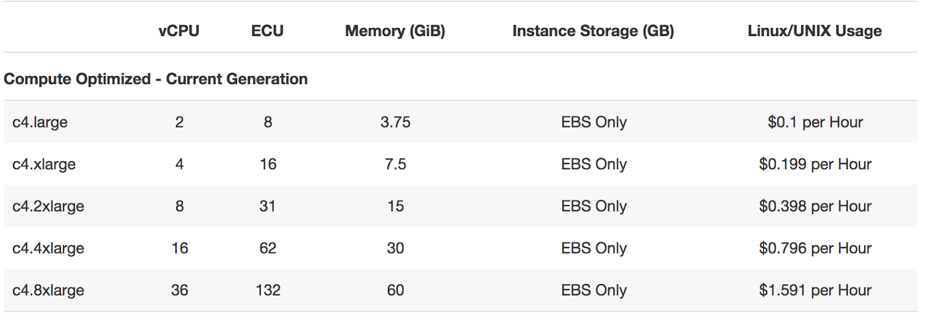
    Start with a smaller VM and scale it as the project grows. When just a bit more resources are required, the cloud vendor can offer you to double the size, as this is the most commonly used scaling step (e.g. see AWS offer below).

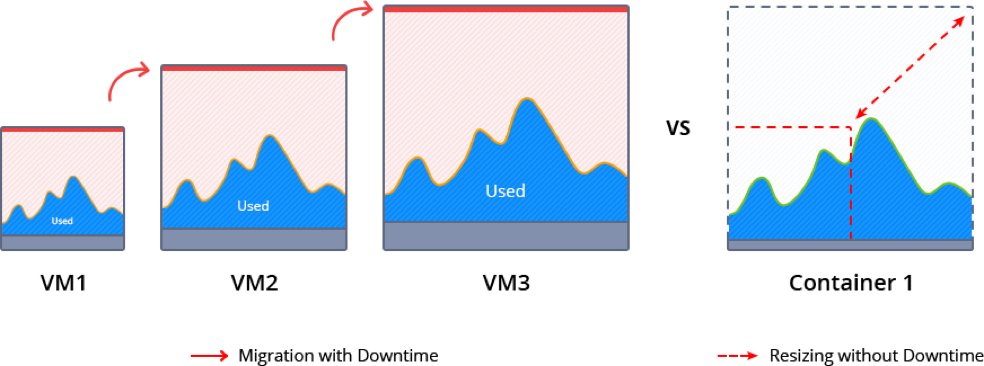
    During such scaling, the current VM normally is paused to migrate and redeploy the application. This inevitably causes some downtime and requires manual intervention.

    Memory ballooning provides a possible way (although rather complicated) to modify the amount of resources inside VMs on the fly without incurring downtime. However, this process is not fully automated and requires special tools to monitor the memory pressure in the host and guest OS and then activate vertical scaling based on the needs. As a result, memory ballooning doesn’t work well in practice, as the memory sharing should be automatic to present the expected advantages.

    Unfortunately, lack of VM elasticity and efficiency in terms of resource usage often leads to overpaying.

    Containers Scaling

    Containerization presents a new way of application packaging that makes resource consumption more granular and flexible, by automatic resource sharing among containers on the same host using cgroups. Unlike VMs, containers’ boundaries can be easily scaled up and down without the need to pause and reboot running instances.

    There are two types of containers: application and system containers. Both use the same scaling approach but they are intended for different purposes. An application container (such as Docker or rkt) typically is more lightweight, runs a single process and is used mainly for creating new projects, as it is easy to build them from pre-existing Docker image templates.

    A system container (LXD, OpenVZ) behaves like a full OS and can run full-featured init systems. This type of container is preferable for monolithic and legacy applications, as it can reuse the originally created design and important “old school” settings.

    Even system containers are much thinner compared to virtual machines, so scaling up and down takes much less time. And the horizontal scaling process is very granular and smooth, as a container can be easily provisioned from scratch or cloned.

    Garbage Collector Choice

    To maximize the efficiency of the above mentioned vertical scaling inside a Java-based container, it is important to select the appropriate garbage collector (GC) and tune it according to the project needs.

    Let’s review five widely used garbage collector solutions:

    • G1: From JDK 9, this modern shrinking garbage collector is enabled by default. One of its main benefits is the ability to compact free memory space without lengthy pause times and uncommit unused heaps. This GC is considered the best production-ready option for vertical scaling.
    • Parallel: A default GC in JDK8, it is a good option for low pauses but not for memory shrinking. This makes it inappropriate for flexible vertical scaling.
    • Serial, ConcMarkSweep (CMS): Both of these are shrinking garbage collectors with the ability to scale memory usage in JVMs vertically. But in comparison to G1, they require four Full GC cycles to release all unused resources. A new JVM option (-XX:-ShrinkHeapInSteps) in JDK 9 can  speed up memory release by bringing down committed RAM right after the first Full GC cycle.
    • Shenandoah: Shenandoah is a rising star among garbage collectors which promises to be the best solution for JVM vertical scaling. Its main benefit over the others is the ability to shrink in live mode without necessity to call Full GC, which helps eliminate significant performance degradation.

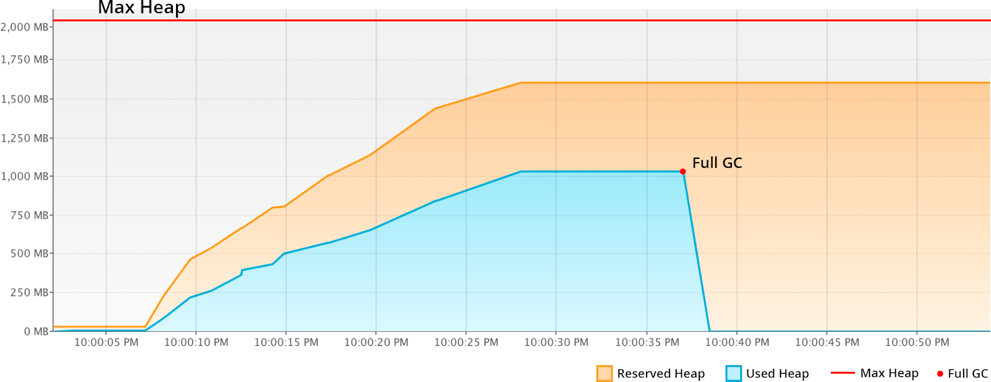
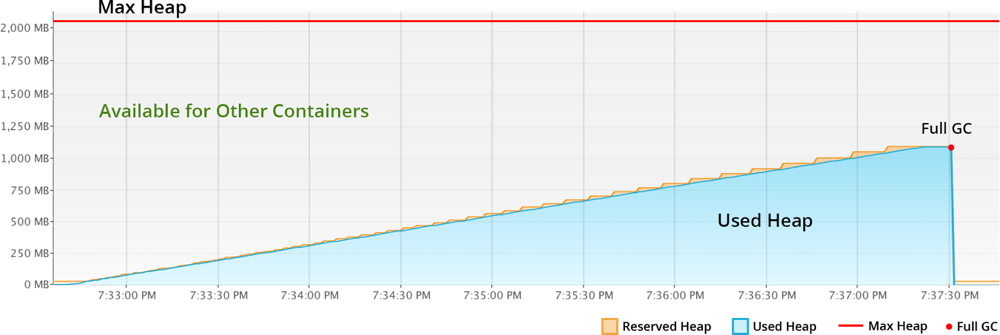
    Let’s compare memory behavior with shrinking G1 and non-shrinking Parallel:

    With Parallel, the unused RAM is not released back to OS. JVM keeps it forever, even disregarding the explicit Full GC calls. So even if your application has low RAM consumption, the unused resources cannot be shared with other processes or other containers as it’s fully allocated to the JVM.

    The modern shrinking G1 garbage collector significantly improves resource utilization compared to the previous example. The reserved RAM increases slowly according to the real usage growth. And all unused resources within the Max Heap limits are not wasted by standing idle, but made available to other containers or processes running in the same host.

    To summarize, Java applications with non-shrinking GC or non-optimal JVM start options hold all allocated RAM. For scaling Java vertically, the garbage collector should provide memory shrinking in runtime. In other words, it has to package all the live objects together, remove garbage objects, uncommit and release unused memory back to the operation system.

    Charging Model of Cloud Providers

    Nowadays, most of the cloud vendors offer a “pay as you go” billing model. This means that it is possible to start with a smaller machine and then add more servers or migrate to a twice-bigger instance as the project grows. But as described above, usually you reserve more than the application actually consumes to avoid the risk of downtime during the load spikes. As a result, many organizations overpay because the account is charged per VM but not based on the consumed resources inside.

    At the same time, there are providers offering  “pay as you use” billing approaches that became possible with the help of containerization, resource granularity and automatic vertical scaling. The payment is based on the resource units inside container. And the required capacity is provided and reclaimed on the fly in accordance with the load at the current moment. As a result, you are charged based on actual consumption and are not required to make complex reconfigurations to scale up or down.

    Taking into consideration all these factors and implementing the right settings can significantly reduce the costs for Java hosting resources, as well as positively influence application performance as a whole. Cloud and container technologies continue eliminating barriers and offering new opportunities for projects with different architectures and budgets.

    About the Author / Ruslan Synytsky

    Ruslan Synytsky is CEO and co-founder of Jelastic. He designed the core technology of the multilingual cloud platform that runs thousands of containers in a wide range of data centers worldwide. Ruslan worked on building highly available clustered solutions, as well as enhancements of automatic vertical scaling and horizontal scaling methods for legacy and microservice applications in the cloud. Ruslan is actively involved in various conferences for developers, hosting providers, integrators and enterprises. Follow him on Twitter.


  • IBM Brings Cloud-native Environment to Private Clouds

    New IBM Cloud Private software – based on containers, microservices and APIs –bridges Public Cloud and traditional IT environments

    ARMONK, N.Y. – 01 Nov 2017: IBM (NYSE: IBM) today announced a new IBM Cloud Private software platform to help companies unlock billions of dollars in technology investment in core data and applications and extend cloud-native tools across public and private clouds.

    IBM Cloud Private software is designed to enable companies to create on-premises cloud capabilities similar to public clouds to accelerate app development. The new platform is built on the open source Kubernetes-based container architecture and supports both Docker containers and Cloud Foundry. This facilitates integration and portability of workloads as they evolve to any cloud environment, including the public IBM Cloud.IBM also announced new container-optimized versions of core enterprise software, such as IBM WebSphere Liberty, Db2 and MQ – widely used to run and help secure the world’s most business-critical applications and data. This makes it easier to share data and evolve applications as needed across IBM Cloud private and public clouds and other cloud environments with a consistent experience.

    An airline, for example, could use IBM Cloud Private to bring a core application that tracks frequent flyer miles into a private cloud environment and connect it to a new mobile app in the public cloud. A financial services firm could use it to keep customer data in-house as it works to meet its security and regulatory requirements while taking advantage of new analytic tools and machine learning in the public cloud to quickly identify investment trends and opportunities.

    Enterprises to Spend More Than $50 Billion a Year on Private Clouds

    While public cloud adoption continues to grow at a rapid pace, organizations, especially in regulated industries such as finance and health care, are continuing to leverage private clouds as part of their journey to public cloud environments to quickly launch and update applications. IBM estimates companies will spend more than $50 billion globally starting in 2017 to create and evolve private clouds with growth rates of 15 to 20 percent a year through 2020, according to IBM market projections.

    “Innovation and adoption of public cloud services has been constrained by the challenge of transitioning complex enterprise systems and applications into a true cloud-native environment,” said Arvind Krishna, Senior Vice President for IBM Hybrid Cloud and Director of IBM Research. “IBM Cloud Private brings rapid application development and modernization to existing IT infrastructure and positions it to be combined with the services and experience of a public cloud platform.”

    Hertz, Ilmarinen Transforming IT with Private Cloud

    The Hertz Corporation, one of the top car rental companies in the world, believes both public and private cloud is critical to achieving its technology objectives.

    “Private cloud is a must for many enterprises such as ours working to reduce or eliminate their dependence on internal data centers,” said Tyler Best, Hertz Chief Information Officer. “A strategy consisting of public, private and hybrid cloud are essential for large enterprises to effectively make the transition from legacy systems to cloud. Hertz is an early adopter of both public and private IBM cloud and we could not accomplish our technology goals without private cloud as part of our overall cloud portfolio.”

    Ilmarinen, a Finland firm responsible for the pensions covering approximately 900,000 Finns, has started a pilot project with IBM Cloud Private and plans to be in production in early 2018.  “Ilmarinen is excited about the capabilities in IBM Cloud Private as a flexible, compliant cloud-native platform that it can deploy and manage behind our firewall for creating new applications and modernizing traditional workloads,” said Jani Itkonen, Production Manager, Ilmarinen.

    IBM Cloud Private Provides Flexible Platform with Support for Enterprise Developers

    Innovations used in IBM Cloud Private are designed to simplify cloud management, accelerate app develop and maintain security across cloud environments. Key features include:

    • Cloud Management Automation – Streamlined management across cloud environments to help launch, monitor and manage services and help ensure consistent security protocols.
    • Security & Data Encryption – Security Vulnerability Advisor to scan containers across the cloud to surface potentially serious issues and weaknesses; Ability to encrypt all data in flight and provide for strict access control by users within a cluster.
    • Core Cloud Platform – Includes a container engine, Kubernetes orchestration, Cloud Foundry and essential management tools surrounding developer runtimes, which are fully integrated and automated.
    • Infrastructure Choice – Compatible with systems from leading manufacturers including Cisco, Dell EMC, Intel, Lenovo and NetApp, as well as IBM Systems, including IBM Power Systems, IBM Z and IBM Hyperconverged Systems powered by Nutanix software.
    • Data and Analytics – Integrations with database services, such as IBM Db2, PostgreSQL and MongoDB, to leverage data and gain business insights.
    • Application Support & DevOps Tools – Containerized versions of software and development frameworks, including IBM WebSphere Liberty, Open Liberty, MQ and Microservice Builder, as part of software bundles; Optimized management and DevOps tools, including APM, Netcool and UrbanCode, which can be added for a separate fee.

    IBM also offers cloud deployment, management, brokerage and storage services to help clients manage multiple clouds and can help clients with migration of applications to IBM Cloud Private. More details on Cloud Private can be found in the product overview.

    IBM Cloud Private Reinforces IBM Commitment to Open Source

    IBM Cloud Private is another significant step in IBM’s support for organizations to create, deploy and manage apps in the cloud environment of their choice. IBM and Google recently announced an effort to create and open source the Grafeas project to help developers with security of containers. Last month, IBM released Open Liberty, a new lightweight, open-source version of its WebSphere Liberty Java application server, to make it easier for developers to get apps up and running in any cloud environment.

    IBM also is a founding member of the Cloud Native Computing Foundation, which hosts Kubernetes and Cloud Private is in compliance with its interoperability conformance tests. To get started with IBM Developer Journeys as they relate to Kubernetes, please visit: https://developer.ibm.com/code/journey/

    For more about IBM Cloud Private, visit here.

    For more about IBM Cloud, visit here.

    Contact(s) information

    Joe Guy Collier
    IBM Media Relations
    1 (248) 990-4707
    jgcollie@us.ibm.com

  • The Need for Speed Demands New-Era APM

    The Need for Speed Demands New-Era APM

    Applications have become the primary conduit by which customers experience a brand, making the application experience critical to business success. As such, continuous delivery and highly available systems that deliver optimal end user experiences at lightning speed have become top priorities for organizations. Modern IT is all about speed, efficiency and customer experience. Simply put, companies that develop new applications and services the fastest will win.

    That’s where containers and microservices come in. Containerized microservice applications enable organizations of all sizes to approach the ultimate goal of continuous integration and continuous delivery. This accelerates everything within the application life cycle, from initial development to component updates and new functionality.

    To match the development speed that microservices and containers enable, Ops teams need tools that can also operate hyper-fast, providing an immediate understanding of the impact of changes made, real-time analysis of vast amounts of data across applications and technologies, visibility across a range of languages and infrastructures, and knowledge of how the application is performing for end users.

    In fact, we are at a critical inflection point in application performance management (APM), where a generational shift is needed to keep pace with the new hyper-dynamic application architectures consisting of microservices, containers and hybrid cloud environments. To fully understand the impact of this shift, we can examine the genealogy of APM.

    APM Evolution

    The first generation of APM, established at the end of the last century, collected statistics and metrics out of system and application components, providing a first generation of user-defined transaction profiling by using instrumentation technology. APM 1.0 required a lot of effort to implement and maintain, but helped to monitor and analyze the performance of newly developed 3-tier applications.

    The second generation of APM was driven by more distributed, service-oriented architectures (SOA) and the rise of more elastic, virtualized or cloud-based infrastructure. APM 2.0 added application topology discovery and could analyze distributed applications. User experience monitoring of web and mobile apps quickly became part of APM 2.0 as more businesses depended on the service quality of their applications. With a primary focus on application monitoring, not management, APM 2.0 required an even broader set of subject matter experts to configure and interpret monitoring data from dashboards and reports. Similar to APM 1.0, the second generation still required way too much human analysis and setup to fully understand application problems and derive actions.

    The continuous change in today’s modern dynamic applications makes it difficult, if not impossible, for those older tools to keep up. Throw in additional architectural challenges such as hybrid clouds, containers and orchestration (such as Kubernetes and Mesosphere) and the picture gets murkier, all in the name of high-speed delivery. Meanwhile, the microservice architecture and development strategy spawns wide technology diversity—each engineer can choose the programing language, middleware and databases best suited to code their individual microservice. Scale, complexity and constant change is the new reality for today’s dynamic applications.

    Wanted: A New Breed of APM

    In this environment, traditional IT monitoring tools won’t work. These new applications use a vastly larger set of technologies, must scale dynamically and are in a constant state of flux.

    In this effort to engineer for speed and efficiency, complexity and scalability have increased exponentially, requiring continuous monitoring and more visibility than ever before. As organizations embrace agile methodologies for development and containerized microservices for deployment, developers have shifted their thinking in technology choices. Developers now continually select the most optimal technology for their individual goals regardless of DevOps’s ability to configure, deploy and manage the specific technology.

    With several teams across the enterprise constantly publishing new software releases, understanding the impact of these new releases and changes to the overall environment has become a significant challenge. Today there is no single source of truth assisting communication between various organizations, resulting in what seems a wild west–like environment for IT. With so many groups and technologies in play, everybody seems to be speaking a different language, especially when it comes to delivering high-quality applications. In this environment, a new breed of APM  is needed that can provide a “Truth Machine”—complete with deep visibility across all application components in the technology stack.

    This new breed of APM must be automatic and dynamic to deal with the ever-changing world of applications running in containerized microservices. To deliver these critical capabilities, the tool must provide real-time visibility into dynamic, containerized, microservice applications, regardless of language or infrastructure. New thinking is required to meet the challenges of these complex, large and dynamic application environments; a new monitoring and management approach that can handle dynamism by:

    • Delivering real-time analysis of vast amounts of data across all applications and technologies.
    • Conducting continuous discovery and automatically mapping every component, host and container, (hosted on-prem, private cloud, public cloud), to the exact architecture of complete technology stack.
    • Visualizing the application architecture and delivering actionable suggestions that assure the operational health of systems and applications.
    • Providing real-time accuracy to visualize, structure and identify problems immediately.
    • Monitoring the complete set of diverse technologies that run in microservice environments.
    • Operating in a heterogeneous environment and automating deployment across nearly all programming languages.

    Artificial Intelligence for Next-Generation APM

    DevOps and IT organizations are struggling to match the speed of agile development, and this is creating exponentially more challenges around new application architectures. The only constant in these modern application environments is change. Whether change is due to microservice architectures, container orchestration or simply more agile delivery execution to effectively manage microservice applications, DevOps needs up-to-date visibility, a precise picture of the application’s structure and an immediate understanding of its health. To accomplish that, DevOps must be able to apply artificial intelligence to the act of monitoring modern dynamic applications.

    Rather than spending time configuring and reconfiguring monitoring tools, organizations must automate management steps with as little human setup and configuration as possible. To have complete control and visibility of their environments, regardless of language and infrastructure, organizations must use a modern application management solution that is automatic and AI-powered to deal with the ever-changing world of dynamic containerized microservice applications.

    About the Author / Pete Abrams

    Pete Abrams is a co-founder and the chief operating officer at Instana, the leader in application performance management for containerized microservices applications. Formerly vice president of customer centric innovation at AppDynamics, Pete has spent more than two decades in the technology industry focused on introducing new products to market and ensuring customer feedback and desired capabilities are incorporated into future product innovation. Connect with him on LinkedIn.


  • Finishing the Pipeline: Monitoring, Tools, Automation and …

    Finishing the Pipeline: Monitoring, Tools, Automation and …

    It is true that DevOps has grown to be the beast in the room. I’ll co-opt the “cloudwashing” term to call it “DevOps-washing” because it seems every tool you’ve ever used to develop and deploy applications now has a DevOps angle to it. For example, the Jenkins update center is kind of overwhelming. While I can’t be certain, there’s a chance that our new coffee maker has a plugin for Jenkins.

    But it’s also true that DevOps really is coming of age. The success of Jenkins is largely based on CI/CD, and the tools built both up and downstream from it are folding in more and more of the DevOps process, making life easier—if not exactly easy—for IT.

    Even with platforms, the choices are growing and the automation is, too. Whether one of the major cloud vendors, where deployment can be fully automated or hyperconverged infrastructure and where deployment can be fully automated, we’re moving toward a future of not caring about physical infrastructure but rather, “Can I get a connection to it?” Of course, it’s not that simple, but running Docker or Kubernetes on hyperconverged infrastructure means we have on-demand deployment, and the cloud does much the same.

    Tooling for monitoring is also getting better, whether you are monitoring user experience or a particular API’s CPU usage. For the most part, we are not yet to the point where automation can deal with the majority of alerts from monitoring, but that boundary is being pushed daily. We certainly can tool our systems—both the infrastructure and the app sides—to offer us more data about application health than we’ve been able to get in the past. From physical hardware all the way up through containers we have a wealth of options for monitoring, and application monitoring is getting even more attention than infrastructure monitoring.

    Heading Down the Trail: Monitoring and More

    Which leaves one wondering where this is bound. Let’s assume that the areas that are a bit behind—like over-arching network configuration from ARA tools—catch up. They will, and that’s pretty obvious, so I’m trying to remove the short-term roadblocks to talk about what we might be planning for and facing moving forward.

    If we can assume a place to deploy that has reasonably unlimited capacity—such as the cloud, where cost is the limit, or hyper-converged, where capacity is a limit but expandable in chunks—and we can assume that ARA is running the Dev/Test side, then pairing it to a preferred server configuration (be that VM or container, depending on app, group, company, etc), and pushing out the deploy, then we’re left with the monitoring piece, and automating the responses to monitoring issues. That is growing, too.

    Right now, the standard in the DevOps world for a server that is malfunctioning in some way is to kill it and start a new instance. This often masks real-world problems, and if it appears to “fix” the problem, reduces the priority of resolving what went wrong. This is, in a nutshell, the real error for Cloudbleed. They were seeing servers spew errors, when one appeared to core, they simply started another. It allowed a simple programming error to persist over months and become a security issue.

    So the next great leap will be to find a quick way for monitoring to determine exactly where problems are occurring, and force a developer to fix it. There are tools that can auto-generate bug reports, but they’re rudimentary at this point in time, and we need them to be more advanced. There will also always be the trade-off of how much in resources you use for monitoring when the point of the app has nothing to do with monitoring. And like so many things, the hidden cost of keeping that monitoring up to date will be a technical debt—one of many that the DevOps community seems slow to acknowledge.

    There Always Seems to be More

    On the “time we waste” side, the fight over internal/external needs to end. The fact is that internal cloud isn’t going anywhere anytime soon, and if you’re running in containers, you don’t have to care. My company is currently looking at a tool that can run hundreds of containers in a very (physically) small space. We can deploy to the cloud or deploy there, as long as we have container templates. It doesn’t matter what the business need forces us to use; containers really will run pretty much everywhere. It does no one any good, harping about internal/external. A deployed app is a deployed app.

    Now, talking about the differences in networking between internal/cloud, external/cloud, and container manager (regardless of where it sits): That is a discussion worth having.

    — Don Macvittie

  • With Distelli Technology, Puppet Expands DevOps Portfolio

    With Distelli Technology, Puppet Expands DevOps Portfolio

    At its PuppetConf 2017 conference, Puppet made it clear its ambitions now extend well beyond its namesake IT automation framework for IT infrastructure. On the heels of acquiring Distelli in September, the company announced it is adding several products to its portfolio based on technologies developed by Distelli.

    The new offerings include Puppet Pipelines for Apps, to automate commits; Puppet Pipelines for Containers, to automate the building of Build Docker Images from a source repository and then deploying them on a Kubernetes cluster; and Puppet Container Registry, to host Docker images and unify views of them regardless of whether the repositories are local or remote.

    At the same time, the Blueshift platform developed to automate deployments of container platforms such as Kubernetes, Docker Swam and Mesos is also being enhanced. The Kubernetes module now installs the container cluster in a more secure way that is also highly available. The Docker module adds support for Puppet Code Manager, Docker Swarm mode and Docker Secrets. A Kream tool makes it easier to deploy Kubernetes and Helm, a package manager for Kubernetes, at the same time. Helm also now can manage applications deployed on Kubernetes.

    In addition, the company announced Puppet Discovery, a tool that makes it simpler to identify infrastructure distributed across a hybrid computing environment, and Puppet Tasks, which employs new open-source agentless software dubbed Puppet Bolt to automate entry-level IT tasks. Bolt is capable of running existing scripts written in any framework and executing them on any platform that Puppet supports.

    The company is also adding a Task Manager to Puppet Enterprise that makes it easier to manage ad hoc tasks and executing them across hundreds of Puppet nodes. The latest release of Puppet Enterprise includes tools for inspecting packages deployed on and a tool to simplify configurations of those nodes.

    Puppet has also expanded its alliance with Splunk to tighten integration between the two IT operations’ platforms, and formed new alliances with Baracuda Networks, CloudPassage, Conjur/CyberArk, Cumulus Networks, Electric Cloud, F5, Intelliment Security, Onyx Point, Praecipio Consulting and Sensu. In addition, the Puppet module for the Microsoft Azure cloud has been updated to provide access to more disk storage, expanded networking support and support for Azure tags.

    Tim Zonca, vice president of marketing and business development, says with these products Puppet should no longer be considered a one-product company. It is now committed to developing a full range of DevOps management capabilities. That’s significant, notes Zonca, because today there is too much tension between IT operations teams and developers caused by silos of automation across various DevOps processes. As part of that effort, the company is also committing to start to synchronize the release cycles of the various elements of its portfolio.

    As DevOps continues to mature, the line between how infrastructure, applications and security are managed continues to blur. Many IT organizations prefer to acquire a set of DevOps tools from one vendor because it simplifies purchasing and support. Over time, those vendors combine those tools into an integrated suite that aims to unify the management of infrastructures, applications and security. Most vendors today are a long way from unifying those functions, but a wave of consolidation across the DevOps sector suggests the race is on to provide a unified DevOp stack capable of being employed across multiple platforms.

    The percentage of IT organizations that make extensive use of IT automation frameworks such as Puppet is relatively small. Much of the resistance to IT automation frameworks can be attributed now to simple inertia. But as the size and scope of IT environments exceed the capabilities of an internal IT team to manage manually, it’s now only a matter of time before reliance on IT automation increases.

    Puppet and other vendors also have infused their platforms with machine learning algorithms to expand the scope of what can be automated within an IT environment. In general, Zonca says reliance on those capabilities tends to increase in time once the DevOps teams gains confidence in the algorithms’ abilities to make the right decision. Until such time, Zonca says most IT professionals employ those algorithms to either present them with a series of suggested options based on the most recent events that have occurred. Given the nearly infinite number of possibilities that can be inferred from those events, most DevOps teams already are going to need all the machine learning algorithm help they can get.

    — Mike Vizard

  • Cloud Foundry Study Confirms Accelerated App Development

    Cloud Foundry Study Confirms Accelerated App Development

    When it comes to accelerating the development of applications, having a standard set of runtimes can make all the difference. A new study of 753 IT professionals conducted by ClearPath Strategies on behalf of the Cloud Foundry Foundation (CFF) finds a marked decrease in the time it takes organizations using the Cloud Foundry platform-as-a-service (PaaS) environment to develop code—just 18 percent need three months or longer, compared with 51 percent of respondents that don’t use the Cloud Foundry Application Runtime. And, according to the study, the 46 percent of responding companies that use the Cloud Foundry Application Runtime see application development times of less than a week, compared with only 16 percent of non-users.

    Abby Kearns, executive director for CFF, says use of Cloud Foundry Application Runtime has expanded considerably in the last year. Nearly half (45 percent) of the respondent have been using the PaaS environment in the last year. The survey also finds that more than half (51 percent) now have more than 10 developers employing Cloud Foundry Application Runtime, while 28 percent now have more than 50 developers.

    Kearns says those results are noteworthy because it shows that CF is now being used for a lot more than simple proof-of-concept projects. In fact, Kearns notes use of CF to develop a broader range of cloud-native application is increasing. The study finds half of Cloud Foundry users currently use containers, with another 35 percent evaluating or deploying containers.

    Kearns says there’s a high correlation between implementations of CF and adoption of DevOps processes. He notes that often organizations decide to implement CF to force the DevOps issue—a PaaS environment the size and scale of CF requires every process and function within an IT environment to participate in what has become a large-scale continuous application/continuous integration (CI/CD) platform operating at scale. Confronted with that requirement, Kearns says it’s not too long before the IT culture adjusts to that new reality by implementing a new organizational structure.

    CF is not the only PaaS game in town. But via CF distributions from Pivotal, IBM, SAP and others, use of CF has steadily grown, especially among larger enterprises that have the skills required to implement CF at scale. The survey finds that enterprise IT organizations with more than $1 billion in revenue account about half (49 percent) of all CF users. As deployments of the various elements of a PaaS environment becomes more automated, adoption of CF in small-to-medium enterprises should increase.

    In the meantime, IT organizations need think through the amount of time and money developers are wasting using alternative approaches. Not every IT organization appreciates the opinionated workflows that are baked into a PaaS environment. But given the length of time it takes to build applications using other platforms—as well the total cost of maintaining those environments—building and deploying applications at a higher level of PaaS abstraction is difficult to ignore. In fact, managing IT at a higher level of abstraction may eventually prove to be the difference between thriving and merely surviving.

    — Mike Vizard

  • Platform9 Brings Workflows to Serverless Computing

    Platform9 Brings Workflows to Serverless Computing

    Serverless computing frameworks are widely regarded as the next big thing in enterprise IT because they are based on an event-driven architecture that makes servers, storage and networking resources dynamically available as needed using a programming construct known as functions. But DevOps teams are challenged in finding a way to orchestrate all those functions in concert with one another.

    To enable the orchestration of those functions, Platform9 has added support for Fission Workflows to its instance of a serverless computing framework. Platform9 CEO Sirish Raghuram says Fission Wokflows will make it possible for IT organizations to craft complex applications made up of thousands of functions.

    On the one hand, serverless computing frameworks promise to make DevOps easier by eliminating the need to provision infrastructure every time a workload exceeds whatever amount of capacity that has been assigned to it. On the other hand, attempting to manage what could easily become thousands of functions in an IT environment is likely to make DevOps even more challenging than it is today. While not a new concept, Raghuram says Fission Workflows provides IT organizations with a familiar construct for managing functions.

    Benefits of Fission Workflows include an ability to reuse functions as well as being able to upgrade entire related sets of functions all at once. There are also fault-tolerant capabilities that make possible to recover and restart a workflow in the event of an infrastructure failure.

    Platform9 is specifically making the case for a serverless computing framework based on Kubernetes clusters that can be deployed on-premises or in the cloud. Platform9 also provides support for containers on an instance of Kubernetes, and Raguham says the company expects that IT organizations will mix and match containers and serverless computing frameworks as they see fit. For example, a container might invoke a function via an API call to run a stateless process while Docker containers are employed for all the stateful processes that require access to primary storage, he says.

    Raguham notes the trouble with serverless computing frameworks put forward by cloud service providers such as Amazon Web Services (AWS) is that they lock an IT organization into a specific platform instead of taking advantage of a portable cluster technology such as Kubernetes, which is backed by the Cloud Native Computing Foundation (CNCF). Kubernetes also provides the added benefit of a common platform for both containers and serverless computing, he says.

    It’s still early days for the use of serverless computing frameworks in the enterprise. Nevertheless, it’s clear they will need to be managed from a DevOps perspective alongside cloud-native applications running on containers and platform-as-a-service (PaaS) environments and legacy applications running on virtual machines and bare-metal servers. Given the fact that none of these architectures is likely to supersede any of the others anytime soon, IT organizations would be well-advised to start crafting a DevOps strategy now on the assumption that the overall IT environment is about to become even more complex.

    — Mike Vizard

  • Continuous Deployment and Monitoring of Microservices

    Continuous Deployment and Monitoring of Microservices

    Continuous deployment and continuous monitoring have grown up in DevOps, and microservices have grown up as a delivery platform. While all are relatively stable concepts at this point, there are still a fair number of practitioners that are struggling with the merging of these concepts to create a holistic environment that allows for deep understanding and easy deployments.

    So I thought we could take a look at what’s out there, how it’s going, and even mention a resource or two for you.

    Continuous Deployment

    While continuous delivery (CD) and continuous integration (CI) are well in hand, continuous deployment has lagged a bit behind. There are reasons—both good and bad—why this is true, but true it is. Continuous deployment is the act of actually deploying the results of the CI/CD cycle. The whole point of continuous deployment is to speed the release of new features to market by releasing them as soon as they pass the CI/CD muster, or soon after, or for some industries, on demand. Continuous delivery is a little different from CI/CD in that the rest of the organization—sales, support, marketing, accounting, etc.—have to be ready for the release, so in the slowest case, the point is that IT is not the hold-up to releasing new features under the continuous deployment model.

    Microservices

    Simply put, microservices are decomposition of an application into smaller parts that can be run independently. There are a lot of different ideas for what “smaller parts” means, with some shops breaking their application down to the functional level similar to serverless functions, so an API named calculateSalesTax would do that and only that, given location and dollar information, while others prefer a more broad definition that includes entire groupings of APIs. In this scenario, one company split all database work into a single microservice that was scalable. Either way, you will have more instances (normally containers, but sometimes VMs or even physical servers) running to build the application than historically would be the case.

    Why Containers

    As mentioned above, normally a microservices architecture is built on containers. The portability of a container definition is one of the major reasons why companies lean this direction. The ability to say, “This container can run on our hardware, on our private cloud, on a public cloud, in a public cloud VPC or on a VM,” is a way to ensure that you can target the system to the environment most suited to the organization’s needs.

    Containers are also far lighter than VMs, meaning faster spin-up times, and an easier time expanding the microservices architecture to meet changing user needs.

    Container Management

    Speaking of containers, container management systems are used to make certain that containers are alive and responding. In advanced cases, they can be made to check that a container is doing what it is supposed to do also. While I am a fan of Apache Mesos, the world seems to have gone for Kubernetes, so we’ll focus on it, without further reference to the others out there.

    On top of making certain the correct number of a given container are running, and taking steps to spin up new ones if one disappears, Kubernetes does things such as manage secrets for containers, perform load balancing between instances in a group (these groups are generally called a service in container management speak), scaling up/down of instances as directed, and provide rolling updates to services so the service is not down while being updated.

    This makes a container management tool an important part of any continuous delivery and continuous monitoring effort.

    Taken together

    That gives us tools including Jenkins for CI and CD, and often for release management, though other tools specialize in the release portion, too. Combine Jenkins with an infrastructure-as-code solution such as Teraform or any of the others we’ve discussed in the past. Add in a tool such as Prometheus for gathering monitoring data, and a tool such as Grafana for visualizing the data, and you’re on the road to continuous delivery and continuous monitoring.

    Of course, it isn’t that simple, I’m overviewing here. While researching this blog, the people at Infostretch shared some information with me, and they too would see this as the 50,000-foot view. But that’s where we start. For a more complete picture, here is a simple diagram of continuous deployment that Infostretch shared with me:

    And as long as we’re discussing the information that Infostretch shared with me, let’s also look at a sample of what the company monitors. You’ll see it isn’t “everything under the sun,” but focused points that give them actionable intelligence. A few application-specific monitoring points from within the application, and this turns into an application performance gold mine.

    Classification Metrics
    Cluster Metrics Overall Cluster Memory Utilization
    Overall Cluster CPU Utilization
    Overall Cluster FS Utilization
    Multi-series graph for individual service CPU Utilization
    Multi-series graph for individual service Memory Utilization
    Multi-series graph for individual service FS Utilization
    Application Metrics


    Service Request rate
    Service Error rate
    Service latency

    There is so much more

    There really simply isn’t enough room in a single blog to cover all that is required and possible in continuous delivery and continuous monitoring. I’ll continue to try continuous blogging to help you out, and the other authors here on devopsy.kinsta.cloud have good things to share on the topics also.

    — Don Macvittie