Category: AI

  • Digibee Adds AI Tool to Accelerate Migration to Integration Platform

    Digibee Adds AI Tool to Accelerate Migration to Integration Platform

    Digibee is leveraging artificial intelligence (AI) to make it simpler to migrate to its integrated platform-as-a-service (iPaaS) environment by converting code into a JavaScript Object Notation (JSON) format.

    A translator tool created by Digibee invokes large language models (LLM) to convert that code into a JSON file that can then run on the Digibee Integration Platform.

    Initially, that capability is being made available to facilitate migrations from the Mulesoft integration platform made available by Salesforce, with support for other legacy integration platforms planned for 2024.

    Digibee CTO Peter Kreslins Junior said this approach reduced the level of time and effort required to switch platforms by using generative AI to map and refactor legacy integration code. That refactoring process doesn’t completely automate the reverse engineering of workflows, but it does substantially reduce the total cost of switching platforms by, for example, automating data migration and simplifying the transfer of configurations, he noted.

    Generative AI also eliminates the need to rely on documentation or maps that either may be limited or non-existent, added Kreslins. Instead, all the integration patterns used can now be automatically discovered by an LLM, he added.

    IT teams will still need to vet and test the code created by the translator tool, but overall, the speed at which any migration effort is made should be accelerated, thanks to the rise of generative AI, in 2024. Many organizations are locked into various platforms today simply because the effort required to rework the code that has been created to extend them has required either too much effort on their part or the contracting of expensive consultants. A migration project that might have taken a year or more can now be accomplished in a few days, said Kreslins. The overall goal is to reduce the current level of pain IT teams experience when migrating between platforms, he added.

    It’s not clear if the rise of generative AI platforms that make converting code into other formats and languages simpler will drive a wave of migrations, but there are many organizations relying on legacy platforms that are not nearly as easy to use as more modern alternatives. As the time and effort required to make those transitions is reduced, more IT teams will be, at the very least, more open to considering their platform options. The providers of those legacy platforms will naturally have to invest in new capabilities much faster to discourage customers from migrating to another platform.

    In the meantime, the amount of code that will need to be integrated is about to exponentially increase as developers rely more on LLMs to generate code. The downstream implications of that increased pace of application development for DevOps teams are profound. It’s not clear to what degree those teams can increase the level of scale at which they today manage application deployments.

    The one thing that is clear is there is no going back because, so far as application development and deployment are concerned, the proverbial AI genie is out of the bottle.

  • KubeCon: DevSecOps and Generative AI

    KubeCon: DevSecOps and Generative AI

    Speaker 1: This is Techstrong TV.

    Alan Shimel: Hi, everyone. Alan Shimel back here at Chicago KubeCon, North America 2023. If you’ve watched our coverage of past KubeCons or RSA or even sometimes on Techstrong TV, you know this fellow right here, he’s my friend, David DeSanto. David, is the… Is it Chief Product Officer?

    David DeSanto: Chief Product Officer.

    Alan Shimel: Yep, at GitLab. And GitLab always has something doing, especially if it’s the 22nd of the month, right?

    David DeSanto: Correct.

    Alan Shimel: How many consecutive 22nd of the month releases are we up to now? Do you know?

    David DeSanto: Over 150. I know that.

    Alan Shimel: Over 150.

    David DeSanto: Yeah.

    Alan Shimel: But GitLab is also a big community member of CNCF, as well as a bunch of the other Linux Foundation-

    David DeSanto: Absolutely.

    Alan Shimel: Foundations as well. And David’s always a wealth of information. So David, I hope I didn’t put too much pressure on you, but welcome.

    David DeSanto: It’s fine. Thank you for having me.

    Alan Shimel: Always a pleasure. So let’s first talk a little bit about the show.

    David DeSanto: Yeah, absolutely.

    Alan Shimel: GitLab is here. What are you seeing, hearing? What are you thinking about?

    David DeSanto: Yeah, so I would say this probably is no surprise to everyone who’s watching, but this year it’s all about security and AI. And sure enough, at GitLab’s booth here, we’re booth M1, it’s also about…

    Alan Shimel: Security and AI.

    David DeSanto: Security, AI, and visibility.

    Alan Shimel: So we’ve been talking a little bit about security and AI too. Surprise. And one of the… We actually, just a quick plug. We actually have a great virtual event coming up in December on AI, and it’s sort of where does AI meet, rubber meet the road. And I want to turn that around to you, David. Look, AI has tremendous potential to help, I think, with security.

    David DeSanto: It does.

    Alan Shimel: I don’t know how much of it is real today. I think a lot of it will be real, certainly. But what’s real today? No holds barred. What’s your take?

    David DeSanto: Yeah, so maybe we’ll start with the AI part of that and then tie it into security. So I always look at new technology through the lens of my parents. They’re both much older than I am. And to them, when I showed them AI, it was magic because to them-

    Alan Shimel: It really was.

    David DeSanto: How is that happening, right? But then I also had to help ground that in reality for them to say, “Well, this is generative AI. It works by predicting the next word based off the series, right?”

    Alan Shimel: Putting one foot in front of the other, right. It’s not sentient.

    David DeSanto: When you look at it though, some people have thought it’s sentient.

    Alan Shimel: No, your parents, I go by my wife’s sister, she’s 74, and yeah, she thought there was a little person in there, but yeah.

    David DeSanto: Yeah, and actually just as a quick note, and the viewers will love this, but I introduced them to it at my sister’s wedding earlier this year. I needed to do a toast. So I had Bard generate the toast for me. And they were like, “How is this happening?” Right?

    Alan Shimel: They’re beautiful, I hear you.

    David DeSanto: But to kind of ground in reality and you realize how generative AI works, you have to then ask yourself what are the best use cases to apply it to? It’s not going to be able to tell you how many pages there are in a book, how many words are in a book. Those aren’t things that are questions it can build, right? But it can help you with tasks that can sometimes be mundane. It can help you with understanding something better. And that’s how I kind of tie it back to AI. So when GitLab started applying AI to our platform, we started in 2021 with code review because that was a huge pain point helping customers get through code review. The next area we looked at was actually security.

    Alan Shimel: Really?

    David DeSanto: And the reason why we did that is that GitLab is, in essence was a developer platform when we started, we’re an enterprise DevSecOps platform today.

    But it was about helping developers be more effective. And developers don’t start their day off by saying, “You know what? I want to write a zero day vulnerability in the application today. I want to make it super vulnerable.” Right? They want to write really good code. And so we said, “We’ve helped shift security left. How do we help now those developers understand that security they’re seeing?” And so we launched at RSA this year, explained this vulnerability where it actually explains the vulnerability, natural language using AI gives them an example of how that vulnerability is exploitable. And it gives them an example of how to resolve it. And those code snippets it shows are in the language the developer’s writing it. And so when I think about AI and security, I think about it making security truly approachable. And if you can do that, then everyone starts to win.

    Alan Shimel: So I would give you guys the Oscar for best use of AI, right? Because I think that’s where it shines. I had a very similar experience with me. So I’m not a coder.

    David DeSanto: And I claim to be one, but it’s been a decade plus since I’ve run any code.

    Alan Shimel: But you know what? Try putting a little code into your generative AI chatbot and say, “Explain this,” or, “What does this mean?” And it goes through line by line and tells you, “That’s what this is for. This is what it’s calling, this is what it’s doing.” And you can be a complete neophyte around let’s say Python or name your language, wherever you want to do it in. And it really teaches you how to code.

    David DeSanto: It does. It does.

    Alan Shimel: Line by line, syntax by syntax. So to me, that’s a great use of AI. That’s what we should be using it for. It’s not Google search. A lot of people I know, they think it’s Google. It’s not Google search.

    David DeSanto: No.

    Alan Shimel: But those kind, and it’s good for writing toasts for a best man or whatever, or an anniversary as someone in my office I know used it and his wife called him on it. But anyway, it’s really great for learning tool. Now, when we talk about AI and security, though, there’s an evil dark side to it.

    David DeSanto: There is.

    Alan Shimel: Which is how do you secure AI?

    David DeSanto: Yeah. And so I love that question. So the first time we spoke, which now is four or five years ago, the question you asked me is, “GitLab and security, explain that.” And we talked about why we’re taking that journey. And today, GitLab is recognized as a security player in the space.

    Alan Shimel: Absolutely.

    David DeSanto: And it’s one of those things that we are very proud about because we helped define what shift left actually meant. And so if you bring this back to AI, the one thing I always tell people is that, yeah, code generation can be scary. You’re not sure, is it writing good code? Is it writing functional code? But if you’re using GitLab, that code gets committed back into your CICD pipeline and the GitLab security scanners run. And now you know that vulnerability has been resolved and nothing new has been introduced. And so if you pair AI with the right things around it, it can be truly powerful. But you’re right, if you’re not doing that and you’re thinking it is the person living inside the machine, you give a little too much trust to it today. AI is not a hundred percent there yet.

    Alan Shimel: Absolutely. Well, so that’s the next segue. Don’t give up any secrets. Let’s not get in trouble. You’re a public company now, but where do you see AI going with GitLab specifically over the next, let’s say between now and RSA in May or something like that?

    David DeSanto: Yeah, great question. So fortunately, we’re a very transparent company, so I can talk about roadmap and not get in trouble, but thank you for making sure that I don’t get myself in trouble with legal.

    Alan Shimel: Or me.

    David DeSanto: So where we see AI going with GitLab is there’s really two paths that we’re exploring. The first is GitLab Duo Chat. We released it back in June, it continues to mature. We’re seeing people gravitate towards wanting to talk to chat and not necessarily click a button in the UI or engage with AI that way. And it makes sense. If you think about it, we’re humans, you and I are talking, we’re having a conversation. That’s how we’d want to engage with it. And that’s why the chatbots are so popular.

    And so what we’re looking to do is continue to take what we’ve released. We have 14 AI features today.

    Alan Shimel: Really?

    David DeSanto: Yeah. Everything from, GitLab is for the entire SDLC. So we have AI assistance in planning, coding, securing, deploying, the whole way across. And so we’re slowly moving those features into chat. An example that explained this vulnerability is a great example. So that’ll be available in chat here shortly. And the reason why we’re doing that is the natural thing is, “Well, help me resolve it. Here’s my code.” And so we want to help AI be not just a pair programmer for the developer, but be that trusted partner that can help write more secure codes. So I would say over the coming several months going into RSA, you’ll see a lot of AI and security and our Duo Chat feature coming together.

    Alan Shimel: I love it.

    David DeSanto: The other area is our-

    Alan Shimel: Wait, hold on one second.

    David DeSanto: Oh, sorry. Yeah, go ahead.

    Alan Shimel: I want to make sure Duo Chat, not everyone out here is going to know Duo Chat.

    David DeSanto: Yeah, so perfect. Yeah. So GitLab Duo is the name of our AI workflows within the GitLab platform.

    Alan Shimel: Got it.

    David DeSanto: The name is based off the fact that it’s you as a user, plus AI makes the AI dynamic duo.

    Alan Shimel: A duo. Okay.

    David DeSanto: It also helps that I’m a huge Batman fan and dynamic duo has that in it.

    Alan Shimel: All right. I love it. I love it.

    David DeSanto: I didn’t tell marketing that though.

    Alan Shimel: No, no, no.

    David DeSanto: No, no. No. Hopefully they don’t watch this. They’ll now know my secret.

    Alan Shimel: What does marketing ever? I’m only kidding. I’m only kidding. I love my marketing people.

    David DeSanto: So that’s the name of the suite of those AI workflows. And so there are things like explain this vulnerability. You’re explaining of codes for, we actually haven’t explained this code.

    Alan Shimel: I love it.

    David DeSanto: We’ll explain the code. We have our code suggestions, which is going to generate either code completion, your cursors in the file, it’s reading what’s before and after the file’s open and recommending code.

    Alan Shimel: I love that.

    David DeSanto: Or code generation where you can actually do comment decode, that’s actually the most popular for our users. As well as things in helping you do your planning, summarizing conversations, helping with CI configurations and beyond. So that’s what GitLab Duo is, and Duo Chat is part of that. And so that’s the chatbot you can launch within GitLab’s UI.

    Alan Shimel: Now, is there a way to kind of implant this into your IDE, or?

    David DeSanto: And that’s the last thing I was going to mention that we’re working on. Yeah. So the other thing-

    Alan Shimel: You didn’t pay me to say that.

    David DeSanto: I did not.

    Alan Shimel: Okay.

    David DeSanto: I did not.

    Alan Shimel: Go ahead.

    David DeSanto: It’s almost like you read our GitLab issues and read our roadmap.

    Alan Shimel: We may not coordinate our wardrobes. But we do-

    David DeSanto: We didn’t. I do wish I would’ve worn the fall shirt today.

    Alan Shimel: Next time.

    David DeSanto: We will. Next time we’ll do that.

    Alan Shimel: All right.

    David DeSanto: But anyway, we’re going to be bringing Duo Chat to the IDEs. So today we have it as an experimental feature and we’re trying it at GitLab today to make sure it works. But it’ll be available in all the IDEs that we support today, including the JetBrains Suite, Visual Studio, VS Code, Neovim, and the GitLab IDE.

    Alan Shimel: I love it. I love that. Fantastic.

    David DeSanto: But by the way, that’ll also then bring those same actions that are in the GitLab UI into chat in your IDE, so you can actually explain the vulnerability, explain the code, all those things directly where you’re working. You don’t have to leave your IDE to get that.

    Alan Shimel: While we’re on this subject. A lot of people out here, look, there’s so much, there’s so much controversy around AI. Is it going to kill off humanity? Is it going to take everyone’s jobs away? Is it going… My feeling is, it’s not… Will it do some jobs? Yeah, but for the most part, it’s going to make a lot of people who do these jobs 10x more effective. How do you view it, and how does GitLab view this, in a world where chat and Duo Chat is built in and AI is built into the entire GitLab SDLC pipeline.

    David DeSanto: Yeah.

    Alan Shimel: Does it really 10x these people?

    David DeSanto: So that’s our target. And to give a little context for everyone, GitLab Ultimate, which is our top tier, includes every future GitLab has including AI. We did a survey of our customers. We had an independent company do that. They found that people using GitLab Ultimate get a 7x boost in efficiency for their organization.

    Alan Shimel: So you’re over halfway there.

    David DeSanto: Yeah. And an ROI within six months of what they paid for it. And so when we asked ourselves, “How does AI help?” We set ourselves a 10x goal. So continuing to accelerate that efficiency. And our customers using GitLab today and GitLab Duo are talking about that. They’re talking about getting through code review faster. They’re talking about resolving vulnerabilities faster. And to the first part of your comment, we don’t see AI as a replacement for your team members. We see it as helping them be more effective, removing some of the mundane tasks that can slow them down and unlocking their true potential.

    Imagine a world where your developers don’t have to worry about doing things like creating the template for the code and now they can just go in and write the actual strategic parts. And same thing across the entire software development lifecycle. I personally benefit from Duo almost on a daily basis, in that as the CPO of the company, I get pinged on our GitLab issues or GitLab Epic or whatever, and someone will say, “What are your thoughts on this?” And I’ll look at it and I go, “How long is this?” And I’ll go up and say, “PDF it.” And it’s like it’s a hundred pages, the issue’s been open eight months.

    Alan Shimel: Summarize.

    David DeSanto: Customers are coming, yeah. So I say-

    Alan Shimel: I do the same thing.

    David DeSanto: “Summarize the discussion,” right?

    Alan Shimel: We’re connected. I do the same thing.

    David DeSanto: And so that’s where I see it. That made me more efficient. I now didn’t spend two hours doing that.

    Alan Shimel: I’m doing the same exact… As CEO at Techstrong, I’m inundated. Inundated with content. “Should we publish this? Is this the right tone? Here’s the abstracts.” And a lot of times, and I don’t mean to sound callous, but I just don’t have the time to go through it all. But a summary, man, just give it to me in five bullets.

    David DeSanto: Right. And by the way, the other part of that that I use is that it could also help generate descriptions and tasks. And so-

    Alan Shimel: A bot.

    David DeSanto: Right? So I’ll just say, “I read all that. I have an action, remind me to do this. Help me create the task for it,” and so forth. But you are the great example, right? Same thing with the developer, a security person. There are other things that your brainpower should be used for and why spend the time doing those things that-

    Alan Shimel: I agree.

    David DeSanto: Truly are not moving Techstrong forward or that company’s application for it.

    Alan Shimel: We’ll come up with a, we have a theme for given event, a virtual or in-person event. We need the abstract. I can have other people write the abstract, but it doesn’t really capture my vision for it. I find just putting that into bot, into a chat, it nails it. But here’s another thing that I think is, and again, for those of you out there who don’t use generative AI yet, you should. Don’t be afraid to give it a nice long prompt or give it a lot of back. Because the more info you give it, the better it kicks back to you.

    David DeSanto: It does. It actually goes off feedback and you can like something or thumbs it down.

    Alan Shimel: That was another kind of revelation. And I think it’d probably work the same way with code.

    David DeSanto: It actually does. So the backend of GitLab Duo is monitoring for the amount of code you keep. So do you accept the recommendation? Do you not? It also measures retention. So is that code still there after you move on? And same thing with the chat. So I’ve actually had to say to it, and there’s a joke on the internet about you have to be polite back to the chatbot. I actually just recommend it because I’ve seen that documentary Terminator with Skynet. I’m just afraid-

    Alan Shimel: One day they might come for you.

    David DeSanto: You want to suck up to them now, so when they take over, they remember you.

    Alan Shimel: They’ll remember it.

    David DeSanto: But no, I’ll actually say back, “That’s interesting, but have you thought about this? And here’s why.” And then I see that it actually learns from it because we constantly fine tune models based off that feedback. Right?

    Alan Shimel: I agree.

    David DeSanto: So, absolutely. Please be kind to the chatbots. GitLab Duo will always be chat to you.

    Alan Shimel: Be kind to your chatbots. And be kind to everyone else, right?

    David DeSanto: If it is-

    Alan Shimel: Especially in this day with everything in our world going on.

    David DeSanto: If it’s anything, you should be polite. There you go.

    Alan Shimel: If you can be anything, be polite. Non-AI stuff, what’s your impressions of the show this year?

    David DeSanto: I’ve enjoyed it so far. RSA conference used to be my favorite conference to go to. I think KubeCon is now tied for first and might sometimes edge it out. And the main reason why is that here is one of the few times I feel like it reminds me of the Black Hat Conference back in the day.

    Alan Shimel: Back in the day.

    David DeSanto: You’ve got all the, it is not meant to sound negative, but the doers here, right?

    Alan Shimel: Yeah.

    David DeSanto: You’re having real conversations with developers who are trying to understand operations better, security professionals who are here trying to make sure they’re supporting developers’, operations. Same thing with operations. So you get this really good mix of people and it just reminds me of almost like a large startup, if that’s a good way to look at it.

    Alan Shimel: Yeah, no, there’s an energy that’s palpable, that I think works.

    David DeSanto: But I do want to just make sure RSA, I still love you.

    Alan Shimel: We’ll be there, May 6th-

    David DeSanto: I’ll be there as well.

    Alan Shimel: Is our DevSecOps. It’s going to be all about AI in the future of security, our event as well as the larger AI event all week. Or the larger RSA event all week. What about re:Invent? You guys are going to be at re:Invent?

    David DeSanto: We will be at re:Invent. I will personally not be there.

    Alan Shimel: No?

    David DeSanto: No. I actually, I hit the point where this is my last whole week of the year. I’ve been gone three weeks a month for this entire year. I want to stay married.

    Alan Shimel: I hear you.

    David DeSanto: I want to spend some time with my dogs. And so I’m taking December and most of January off from travel.

    Alan Shimel: Good for you.

    David DeSanto: Yeah.

    Alan Shimel: I’m getting a new dog Friday.

    David DeSanto: What kind of dog are you getting?

    Alan Shimel: I guess I could share it. So we’ve had bulldogs for about almost 30 years.

    David DeSanto: Okay.

    Alan Shimel: Our last one passed away in May. She was 14 and a half.

    David DeSanto: Actually, I think you and I talked about that.

    Alan Shimel: Yeah. So it took a little while for us to get back in the, I need a dog, but I need a dog. So it’s a new bulldog puppy. Her name is Kaia, K-A-I-A, which means sea in Hawaiian. Her father’s name is Ocean.

    David DeSanto: Oh, wow.

    Alan Shimel: And yeah, I’ll post pictures.

    David DeSanto: Okay. I think I’ve shared this to you before, but we have two rescues. They’re both Chihuahua mixes.

    Alan Shimel: Oh, yeah. Yeah.

    David DeSanto: One’s really dumb and the other one’s really smart, so [inaudible 00:18:47].

    Alan Shimel: It’s good mix. Yeah.

    David DeSanto: I will tell you, when I get home, they’re so excited to see me and they get really sad when I’m packing, so.

    Alan Shimel: There’s nothing like the love of a dog.

    David DeSanto: I completely agree.

    Alan Shimel: No doubt.

    David DeSanto: But about the conference.

    Alan Shimel: Yeah, we went off there, but go ahead.

    David DeSanto: Completely derailed us.

    Alan Shimel: Yes.

    David DeSanto: So for GitLab, a couple things. So if people are watching and they’re here, they want to see it. If not, check it out after the conference on our website. We brought our product analytics feature to market. We already have some customers adopting it and we’re demoing it. And I wanted to share it here because KubeCon’s also about visibility and you can’t close the SDLC without user feedback. And so similar to how we have observability, just about the application running in production, the value stream analytics and value stream management. This is now user feedback. So as part of GitLab CICD, we can embed telemetry into the application. So when it’s deployed, it can connect back to GitLab and start giving you data about your monthly active, daily active usage, the return rate of those users.

    Alan Shimel: This is available now?

    David DeSanto: It is available now.

    Alan Shimel: Or you’re just demoing?

    David DeSanto: No, it’s available. It is available.

    Alan Shimel: What do you call that?

    David DeSanto: Well, we love our boring names at GitLab, it’s one of our values. So it’s just called GitLab Analytics.

    Alan Shimel: GitLab Analytics. Okay.

    David DeSanto: Yeah, GitLab Product Analytics to be specific.

    Alan Shimel: All right.

    David DeSanto: But yeah, we started using it earlier this year for our handbook and we’re able to learn about how our users use the handbook, our employees and team members. And so I’m excited how make this available because other people want to understand how their apps are being used. Long term, we’ll be able to pull in things like retention rate, user adoption journey metrics. But today it’s just those raw metrics like the active usage, return rate, the graphs of how the usage is going. But we’re very excited to be demoing it here. It’s really cool.

    Alan Shimel: Absolutely. Very cool. GitLab user analytics.

    David DeSanto: Yep.

    Alan Shimel: David, it’s always a pleasure, my friend.

    David DeSanto: Love our chats.

    Alan Shimel: You know what? I spoke to you. We’re going to do another chat with David before you leave for two months with the dogs.

    David DeSanto: Yeah. I will be working, for everyone. I’m not taking time, I’m just staying home. I’ll be-

    Alan Shimel: Okay. You’re just not on the road.

    David DeSanto: Yeah, I’ll be working from home that entire time.

    Alan Shimel: I was going to say that’s a lot of vacation time.

    David DeSanto: No, no, no. I did have my first big vacation since the pandemic though.

    Alan Shimel: Really?

    David DeSanto: Yeah, we went to Bar Harbor for two weeks and hiked Acadia National Park.

    Alan Shimel: Oh, that’s beautiful.

    David DeSanto: Yeah.

    Alan Shimel: And when was this?

    David DeSanto: End of August. Last two weeks of August.

    Alan Shimel: Oh, so it’s still nice there.

    David DeSanto: It was very beautiful, but-

    Alan Shimel: Not really peak color season there yet. But beautiful time, summer.

    David DeSanto: But we’ll definitely can connect because I’m working. I’m just not on the road.

    Alan Shimel: But we’re going to have you on Techstrong TV because you guys have more news.

    David DeSanto: We do.

    Alan Shimel: That we can’t talk about yet.

    David DeSanto: Yeah, that’s a good teaser. Everyone tune in.

    Alan Shimel: That was my, that’s what we call it.

    David DeSanto: For the big news. It’s the hook.

    Alan Shimel: That’s what we call it in the industry. My hook.

    David DeSanto: Going back to our marketing friends. That’s the hook.

    Alan Shimel: All right. Hey, we better take a break here. We’re getting a little loony. We’ll be back. We’re live in Chicago at KubeCon with our friends at GitLab. We’ll be right back.

  • From Machine Learning to DevSecOps: Six DevOps Trends for 2024

    From Machine Learning to DevSecOps: Six DevOps Trends for 2024

    The DevOps market is set to grow by 25% annually between 2024 and 2032, fueled by the growing demand for faster software delivery and higher-quality output. Emerging technologies like AI-driven development and serverless architectures have introduced new products in the space, while traditional processes like version control and CI/CD will be further refined. But amongst this innovation, security and quality should remain as organizations’ highest concerns. Looking into the coming year, it’s hard not to see where the DevOps industry is going based on the past year. As such, we have endeavored to provide six distinct DevOps trends we think will be particularly influential in the new year.

    The Integration of AI and Machine Learning

    One of the most notable trends in the future of DevOps is the increasing incorporation of artificial intelligence (AI) and machine learning (ML) into the software development life cycle. The explosion of AI technology in 2023 has set the stage for more predictive analytics in code development, automated testing and intelligent monitoring in the operations phase.

    As Google’s 2023 State of DevOps Report highlighted, DevOps teams feel that AI will contribute most to analyzing data and security, alongside identifying bugs. However, a solid use case has yet to materialize for most teams, and the report shows that early adopters of AI have experienced a minor decrease in their software delivery performance and a significant decrease in their operational performance. So, it’s possible that at this stage teams are implementing AI without considering what problems they’re trying to solve, or without paying full attention to the security and quality implications.

    Emphasis on Increased Productivity

    While AI adoption will be driven by the underlying push for increased productivity in DevOps tools and practices, DevOps teams should focus on drawing maximum value from the existing tools that automate mundane and repetitive tasks, allowing them to focus on more critical aspects of development and operations. This will be made possible by DevOps vendors that provide enhancements to collaborative tools, simplified interfaces and more intuitive workflows, reducing the cognitive load on developers and operations professionals.

    Culturally, the continuing trend towards remote and hybrid work environments is influencing productivity strategies in DevOps, with tools and practices that support remote collaboration and communication becoming vital. Cloud-based DevOps tools are facilitating seamless collaboration, allowing teams to work efficiently irrespective of their physical locations.

    Alignment to Existing Cloud and Microservices Architecture

    We can expect the new alignment of DevOps with cloud and microservices architectures to continue into 2024. This integration is about more than just adopting new technologies — it’s about creating efficiencies that enhance agility and revenue growth.

    The combination of DevOps practices with cloud and microservices enables organizations to leverage the inherent benefits of these platforms. Cloud infrastructure is scalable and flexible, reducing overhead costs associated with physical servers. Microservices allow for rapid development, testing and deployment of independent components without disrupting the whole system. Together with DevOps automation and continuous practices, these architectures accelerate innovation and time-to-market.

    This alignment of DevOps with cloud and microservices will lead to enhanced scalability, resilience, collaboration and customer experiences. By being able to quickly scale, update, and respond to demands, organizations can better satisfy customers and meet market needs, and this, in turn, will drive revenue growth and productivity.

    The Drive for Higher Quality

    While increased productivity and revenue generation will be a key priority in 2024, it’ll be matched by an unwavering commitment to quality. With the rising complexity of software and the increasing dependency of businesses on digital platforms, the margin for error is slimming. Quality assurance practices will become more integrated into the DevOps workflow, ensuring that each release meets the highest standards of performance, security, and user experience.

    Continuous integration/continuous deployment (CI/CD) practices are evolving to include more rigorous and automated testing protocols. These protocols are designed not just to catch bugs but to assess performance under diverse and real-world scenarios. Real-time monitoring tools are being integrated more deeply into DevOps workflows, providing ongoing insights into application performance and user experience. This continuous feedback loop ensures that any issues are identified and addressed promptly, thereby maintaining high standards of quality post-deployment.

    DevSecOps Maturity

    In the same vein, cybersecurity will continue to be a primary concern in 2024, with core DevOps tooling and processes stepping up by incorporating advanced security features. Version control systems will take the lead here by introducing robust access controls, encryption of code repositories and integration with security testing tools to ensure that the code is not only efficient but also secure from vulnerabilities.

    Security integrations in version control will become more advanced, possibly incorporating real-time scanning for security vulnerabilities, tighter integrations with identity management platforms and pattern analysis to predict and prevent potential security breaches in code.

    And as AI is pioneered throughout DevOps tooling, organizations will need to consider the security implications. The Open Worldwide Application Security Project (OWASP) has predicted that data leaks, permission issues and insecure plugins could pose serious security vulnerabilities for software. Teams that can harness growth with AI in 2024 while building sufficient security through DevSecOps practices like backup and monitoring will future-proof themselves.

    Speed and Security

    The speed of DevOps growth, innovation and adoption is only set to increase in 2024. We’ll see teams pioneer new technologies to meet business priorities and revenue targets. In doing so, it’s very easy to jump on the AI or serverless bandwagon and assume that sprinkling it on every technical discipline will make for a bright and shiny future. While some key opportunities in the DevOps space will benefit from the acceleration and tighter integration that new technology brings, organizations looking for lasting growth will need to prioritize quality and security practices.

    The key trend we’ll see in 2024 is teams getting smarter and more focused on how they apply new technology to their DevOps trajectory, delivering faster, more accurate releases that free up time to deliver ever greater value to their customers and business. So, the DevOps winners of 2024 will be the organizations that manage to balance the speed of new technology adoption with robust security.

  • Opsera Leverages AI to Simplify DevOps Platform Migrations

    Opsera Leverages AI to Simplify DevOps Platform Migrations

    Opsera is leveraging a generative artificial intelligence (AI) model it built to enable DevOps teams to migrate from one platform to another.

    Gregg Holtzrichter, chief marketing officer for Opsera, said the Hummingbird AI model makes it simpler to migrate source code from, for example, a Bitbucket on-premises continuous integration/continuous development (CI/CD) platform to GitHub.

    Opsera originally developed Hummingbird as an orchestration engine that integrates DevOps workflows spanning multiple tools and platforms. The primary goal is to make it possible for DevOps teams to unify their workflows, said Holtzrichter.

    At the same time, Opsera is now making it possible to leverage a generative AI model to reverse engineer the source code a DevOps team may have developed to extend the capabilities of a specific platform. That new code then makes it possible to significantly reduce the total cost of switching DevOps platforms, said Holtzrichter. As part of such an effort, Opsera is also now providing support for organizations looking to specifically migrate to GitHub Copilot and GitHub Actions.

    It’s not clear how many DevOps teams might be looking to switch platforms, but with the rise of generative AI capabilities for writing code, interest in platforms such as GitHub has increased, noted Holtzrichter. In addition, support for platforms such as the on-premises edition of Bitbucket is being sunsetted by Atlassian as part of an effort to drive more customers toward the cloud edition of the CI/CD platform.

    Regardless of the underlying platforms involved, generative AI promises to reduce the ability of any vendor to lock customers into a specific platform. As DevOps teams extended DevOps platforms over the past decade, many of them have discovered that the integrations they created and maintained made it all but impossible to switch platforms. With the ability to refactor much of that code based on the insights surfaced by the Opsera platform using generative AI, the time and effort required to switch platforms has been substantially reduced, noted Holtzrichter.

    At its core, Opsera makes it possible to apply analytics to DevOps workflows as they become more complex. The number of dependencies that exist between various application modules, for example, makes it exceedingly difficult for DevOps teams to manually identify the impact a delay in one project might have on any number of other downstream projects.

    The Opsera platform surfaces that intelligence by scanning all repositories and branches, including commit history and generating alerts and notifications whenever KPI thresholds or compliance requirements are exceeded. DevOps teams can also use the platform to assess their overall DevOps maturity using, for example, the DevOps Research and Assessment (DORA) metrics defined by Google. In addition, many organizations are keen to discover what best practices should be adopted by other application development teams.

    Now that AI is being applied to that analytics capability, it’s become possible to extend the reach of the Ospera platform beyond analytics to include source code migration. Each organization will still need to determine whether such an effort is worth the remaining time and effort still required, but at the very least, most DevOps teams can take comfort in the fact they can now keep their options a lot more open.

  • What Will DevOps Look Like in 2024?

    What Will DevOps Look Like in 2024?

    The last two years have been marked by significant downsizing in technology companies. As large layoffs at companies like Amazon, Meta and Google make major headlines, there is a general shift away from the “spending cash and growing fast” mindset that free capital and strong growth during the pandemic launched in the tech industry. The name of the game is to be more conservative with spending, and that mindset will drive a lot of investments in the next year. While these cost pressures may feel challenging to technology organizations, there are a few key opportunities as well. Many trends are starting, sustaining and ending, so let’s focus on the top six likely to drive changes in the industry in 2024 and beyond.

    1. AI—Specifically Generative AI—Move Right on the Hype Cycle

    While AI is not new, OpenAI and ChatGPT have created an amazingly accessible and powerful tool that is positioned to drive a lot of value. The hype cycle is still in full swing as dozens of new uses of the technology hit the market daily, and if you’re not trying to build a generative AI-enabled product, you’re getting asked when you will start. In 2024, we will likely see LLMs move into the trough of disillusionment as inflated expectations and projects don’t all play out. However, those organizations with generative AI products that truly deliver value to users should expect to see massive growth. Technology organizations will need to make hard decisions about AI products. You will either find traction in the next year and see huge growth or quickly find it doesn’t work and shift focus back to non-AI products.

    2. Developer Experience Gains Momentum

    While DX has been talked about for years, we’re seeing new investments in tools that empower developers. This trend is partially born out of a need to reduce tool and system sprawl for engineering teams, to empower teams and allow them to move faster and to improve efficiency. While you may not build or buy a DX platform, you will likely start a DX team or committee that better represents the folks building your software. This will lead to some great internal changes and key efficiencies getting attention that may have been previously overlooked. The wonderful thing about this trend is that it both brings efficiencies to the organization and makes developers’ lives easier. It’s a win-win!

    3. Increased Pressure to Reduce Costs

    Even for organizations that have avoided layoffs, most are seeing pressure to shift into a leaner existence. This often means critically looking at all sources of spending and taking on new projects to optimize them. Maybe a cloud re-platform can reduce hosting spend by 20%, or maybe you start looking to remove or combine SaaS tools to reduce seats. You may even see hiring freezes for critical teams. Organizations will have to embrace other trends to increase the efficiencies of their teams to meet business demands here. Don’t be surprised to hear “do more with less” become a mantra around the office.

    4. Increased Accountability Through Data

    While data platforms for technology organizations continue to grow, teams are finding that it’s not enough to just measure a few metrics. Organizations will be required increasingly to use the data they have to show they are delivering value. Partially due to increased pressures mentioned above, teams will need to become more predictable, and better at identifying and handling risk at every stage of development. It’s no longer enough to just build a great development engine, teams must ensure that the engine can power them to their destination.

    5. ESG in Technology

    Focus on DEI in technology continues to require significant investment, however, organizations are starting to consider a broader umbrella of social responsibility. This can range from considering the environmental impacts or carbon production of your servers to changing your software supply chain to avoid supporting particular organizations. These types of requirements are appearing sooner and more overtly in the software development process, and may significantly impact how teams choose to build or implement software.

    6. DevSecOps Continues to Grow

    There has been a renewed focus on security in recent years after some critical attacks exposed vulnerabilities in the software supply chain. It’s not surprising that security is now written into the fabric of how we build and deliver software. Teams are now expected to consider security at all stages of development from product planning to operation in production, and require additional experts, training and resources to both monitor and ensure compliance. Requirements for SaaS products continue to evolve as the last remnants of on-premises solutions evaporate, and teams should be prepared to move quickly as new threats are discovered and need to be patched.

    As the technology industry prepares for 2024, it’s clear that innovation and adaptation will be the keys to success. From the continued evolution of AI and the growing focus on the developer experience to the imperative to reduce costs, increase accountability through data, embrace ESG practices  and fortify security through DevSecOps, technology organizations face an exciting future.

  • What Is the Future Workforce and How Will it Impact DevOps Teams?

    What Is the Future Workforce and How Will it Impact DevOps Teams?

    The rapid changes in technology, work patterns and demographics are ushering in a new era for the labor market known as the future workforce. In this context, DevOps teams—tasked with developing and delivering software quickly and efficiently—are facing novel challenges and opportunities. 

    This article will explore the key characteristics of the future workforce, from remote working to the gig economy, and explores how these changes will impact the roles, practices, and skill sets of DevOps teams. Understanding these dynamics is crucial for both staying competitive and fostering innovation in an ever-evolving professional landscape.

    What Is the Future Workforce?

    The future workforce refers to the evolving nature of the labor market, shaped by factors such as rapid technological advancements, demographic shifts, and changes in work patterns and organization. It’s a concept that’s important to understand given its profound implications for businesses, employees, and society at large.

    The future workforce is already here, and it’s changing the way we work. With every passing day, traditional work models are being challenged and redefined, leading to a professional landscape that’s increasingly diverse and dynamic.

    By exploring the future workforce, you’re not just preparing for changes that may affect your career or business. You’re also discovering opportunities for growth and innovation. Whether you’re an employee looking to future-proof your career, a business owner seeking to attract and retain top talent, or a policymaker aiming to foster economic development, understanding the future workforce is crucial.

    The Composition of the Future Workforce

    Remote Workers

    One of the most significant shifts in the future workforce is the rise of remote workers. As technology continues to evolve, more and more people are choosing to work from home or any location of their choice. This trend is driven by many factors, including the desire for a better work-life balance, the need to save time and money on commuting, and the opportunity to work in a more comfortable and personalized environment.

    Remote working isn’t just good for employees; it’s also beneficial for businesses. Companies that embrace remote work can tap into a global talent pool, reduce overhead costs and increase productivity. 

    However, managing a remote workforce requires a different set of skills and strategies. For instance, businesses must invest in technology to facilitate communication and collaboration, establish clear expectations and performance metrics and foster a culture of trust and accountability.

    Gig Economy

    Another key feature of the future workforce is the gig economy, characterized by temporary, flexible jobs often facilitated by digital platforms. The gig economy includes a wide range of work arrangements, from freelance work and contract-based projects to short-term jobs and on-demand services. In the gig economy, you’re not tied to a single employer or a rigid work schedule, giving you greater flexibility and control over your work.

    The gig economy offers many benefits, such as the ability to earn additional income, the flexibility to work when and where you want, and the opportunity to pursue a variety of work experiences. However, it also comes with challenges. Gig workers often face job insecurity, lack of benefits, and financial instability. Therefore, navigating the gig economy requires careful planning and management.

    Diverse Demographics

    The future workforce is also marked by increasing diversity. This includes not just racial and ethnic diversity but also diversity in terms of age, sexual orientation, disability status and other characteristics. As society becomes more diverse, so does the workplace. This trend reflects not just demographic shifts but also changes in societal attitudes and legal frameworks.

    Diversity in the workforce is not just a matter of fairness and equality, it’s also a business imperative. Numerous studies have shown that diverse teams are more innovative, creative, and effective. Companies need to foster an inclusive culture, implement fair recruitment and promotion practices, and address unconscious bias and discrimination.

    Future Workforce and the Implications for DevOps Teams

    As the nature of the workforce evolves, DevOps teams, traditionally centered on rapid and efficient software development, are increasingly distributed across various locations and time zones. This shift towards a distributed workforce presents unique challenges and opportunities for DevOps practices.

    Distributed Team Dynamics in DevOps

    The essence of DevOps lies in a continuous cycle of collaboration and improvement. In a distributed setting, this requires enhanced communication strategies to ensure that team members are consistently aligned with project goals and timelines. Utilizing collaborative tools and platforms becomes crucial in bridging the geographical gaps. Regular virtual meetings and real-time collaborative environments are pivotal for maintaining team cohesiveness.

    Continuous Integration and Deployment (CI/CD) in a Distributed Setting

    Managing a CI/CD pipeline in a distributed team demands meticulous planning and coordination. DevOps must adapt to different time zones and work schedules, ensuring that the pipeline remains efficient and uninterrupted. This involves automating as many processes as possible and establishing clear protocols for code integration, testing, and deployment, thus reducing bottlenecks and ensuring continuous delivery.

    Infrastructure Management Across Borders

    In distributed teams, infrastructure management must focus on clarity and accessibility. This means maintaining comprehensive documentation ensuring all team members, regardless of location, have a clear understanding of the entire infrastructure. Emphasizing cloud-based solutions can offer a centralized and accessible platform for all team members, thus simplifying remote infrastructure management.

    Emphasizing Security in a Distributed Environment

    Security challenges are amplified in a distributed setup, as team members may access company resources from various, potentially unsecured networks. DevOps teams must implement stringent security protocols and regular training to mitigate these risks. This includes the use of VPNs, regular security audits, and ensuring that all team members are up-to-date with the latest security practices.

    Nurturing a Unified Culture

    Despite physical distances, cultivating a strong, unified team culture is vital. This involves not just the regular technical sync-ups but also creating opportunities for informal interactions and team building. Encouraging open communication and transparency can help in building trust and a sense of community among team members.

    Skill Sets for DevOps in a Future Workforce

    As DevOps teams navigate the future workforce, there are several key skill sets that will become increasingly important.

    Security Skills

    As mentioned earlier, security will be a major concern in the future workforce. DevOps teams will need to have strong security skills, including understanding of security principles, knowledge of security tools and technologies, and the ability to implement secure coding practices.

    It will also be important to stay up-to-date with the latest security threats and trends, as the landscape is constantly evolving.

    Soft Skills

    While technical skills are undoubtedly important, the value of soft skills in the future workforce should not be underestimated. Skills such as communication, teamwork, problem-solving, and adaptability will be essential for success.

    As teams become more distributed and work becomes more complex, the ability to effectively communicate and collaborate will be key. Additionally, the fast-paced nature of technology means that adaptability and the ability to learn quickly will be highly valued.

    Collaboration and Project Management

    In the future workforce, collaboration and project management skills will be crucial. DevOps teams will need to be able to work effectively with a diverse range of stakeholders, from developers and operations staff to business leaders and customers.

    This involves being able to manage projects effectively, from planning and execution to monitoring and controlling. Knowledge of project management methodologies, tools, and techniques will be highly beneficial.

    Conclusion

    In conclusion, the future workforce will bring about significant changes to the professional landscape. As we navigate this new terrain, it’s important for DevOps teams to be aware of these changes and to develop the necessary skills to thrive. By focusing on continuous integration and deployment, infrastructure management, unified communication, and security, DevOps teams can stay ahead of the curve and continue to deliver high-quality software products.

  • ScienceLogic Unveils Revamped AIOps Platform

    ScienceLogic Unveils Revamped AIOps Platform

    Via an early access program, ScienceLogic this week made available a Hollywood update to its artificial intelligence for IT operations (AIOps) platform that, among other capabilities, provides root cause analysis capabilities that can be invoked via a natural language interface.

    For the first time, this release of the ScienceLogic SL1 platform incorporates predictive and generative AI technologies the company gained with the acquisition of Zebrium in 2022.

    Michael Nappi, chief product officer for ScienceLogic, said Zebrium provided ScienceLogic with an AI model that surfaces insights in a way that is simpler for IT teams to understand and act on. In addition to recommending automated workflows to run, the platform gives IT teams the option to automatically run them when, for example, there is an IT incident that an existing workflow has been defined to address, he added. Each organization will need to determine its level of comfort in automating those processes based on the level of potential risk to the business, noted Nappi.

    In addition, the SL1 user interface displays IT operational information at the business service level to provide IT teams with a guided experience that makes it simpler to prioritize tasks based on their relevance to the business, noted Nappi. There is also now an SL1 toolkit that DevOps teams can use to build or customize PowerPacks templates for monitoring specific processes and services.

    Finally, SL1 is now integrated with Slack and WebEx to streamline collaboration across IT teams. Previously, the platform only supported Microsoft Teams.

    In effect, SL1 now provides IT teams with a cockpit through which they can invoke AI to autonomously manage a wide range of tasks, said Nappi.

    It’s not clear how much advances in AI might one day soon democratize the management of IT, but it is clear the level of expertise required to manage complex IT environments is declining. The overall goal is to reduce dependency on IT professionals, such as software engineers, who are hard to find and retain.

    The rate of change being made to complex IT environments is now also occurring faster than IT teams can track without the aid of AI, noted Nappi. ScienceLogic, in the longer term, is working toward making it possible to interact with a chatbot in real-time to enable IT teams to meet that challenge, he noted.

    Each IT organization will need to decide for itself how heavily to rely on AI to manage IT functions, but in time, many IT professionals are not going to want to work for organizations that don’t provide some level of AI to reduce the level of toil they regularly encounter today. Rather than having to manually perform a series of monotonous tasks, AI should enable IT professionals to act more like supervisors in an IT environment.

    It may be a while before that aspiration is fully realized, but in the meantime, IT teams would be well-advised to start identifying which tasks will soon be automated using AI because roles and responsibilities will evolve. The challenge and the opportunity now is determining how IT teams can add more value to the business as those transitions occur.

  • Platform Engineering is a ‘Golden Path’ to FinOps

    Platform Engineering is a ‘Golden Path’ to FinOps

    Cloud costs. This simple reality has given rise to all manner of toolsets now being focused on modern IT stacks to shore up resources, reduce waste, optimize identified efficiencies and to monitor system wellbeing at the highest, widest and broadest level.

    Across cloud computing landscapes now being reinvented for generative AI functions, the rise of machine learning operations (MLOps) practices is aiming to bring software engineering in line with operations engineering and—perhaps above all—cost engineering.

    Before MLOps, There Was FinOps

    But before we tread too deep into MLOps territory, perhaps we should remind ourselves that FinOps (operations aligned to consider the financial impact of all systems architecture and software engineering decisions) is really the foundational practice that should oversee all matters in this field.

    CloudBolt is one organization that’s been very vocal in its desire to help businesses optimize, automate and control hybrid cloud and multi-cloud environments by providing cloud financial management, automation, orchestration and governance solutions for global enterprises. The firm runs several industry reports around various aspects of multi-cloud complexity. 

    Institutionalized Platform Engineering

    CloudBolt’s Kyle Campos, chief product & technology officer (CPTO), suggests that as businesses continue to sharpen their focus on efficiency–scrutinizing every expenditure and tool–by December 2024, most forward-thinking CIOs will ‘institutionalize’ platform engineering and establish corresponding teams. These teams will not only manage technology assets but also prioritize them to accelerate business value. This strategic shift aligns with the broader industry trend of optimizing technology stacks for agility and efficiency, offering a multi-dimensional approach to business.

    “FinOps silos that drive friction and [the presence of] unrealized optimization promises will reach a breakthrough as the conversation and solutions shift from ‘motivation’ to ‘facilitation’ in the coming year,” said Campos. “With platform engineering fully adopted as a technology approach by the majority of forward-thinking IT organizations by the end of next year, FinOps practices will become a native part of the journey to ‘golden paths,’ on par with security and observability, as the trifecta of defaults in the delivery process.”

    The Ultimate Performance Metric

    After decades of profligate spending on hardware, software and services, Campos said he thinks that 2024 will become the year that the cost to run an application becomes the ultimate performance metric. Why does he make this assertion? Because the traditional metrics that are focused on commodities (CPU, memory, disk, network) will actually become less important, he said. 

    As digitally transformed organizations continue their advance to the cloud, the cost-of-goods-sold will get linked intrinsically with operational and services measured at a finer-grained level; looking at specific tools, services and algorithms for cost savings.

    “As organizations grapple with intricate financial challenges in 2024, consumers will increasingly demand flexibility, compelling cloud providers to offer more consumer-centric pricing and services,” said Campos. “The FinOps FOCUS initiative instituted this year is just the beginning. The collective voice of the user community will continue to be a game-changer in leveling the playing field between cloud providers and consumers.”

    AI/ML Disrupts Linear FinOps

    Campos concluded by saying that currently, there is a direct correlation between user complexity/friction and capabilities/cost granularity in the FinOps solution ecosystem. 

    “Increases in the latter make the former that much more complex,” he argued. “But advances in AI/ML will continue to disrupt the status quo, lowering the barrier and time to value for users. What used to take hours of custom configuration, trial and error, will be a low-friction conversation. Additionally, AI/ML will facilitate unit cost solution inversion such that unit cost is provided to the user, not from the user.”

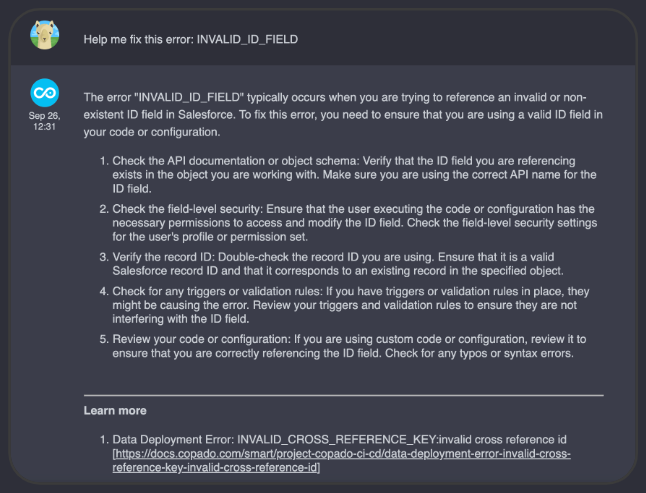
  • Copado Expands Beta of Generative AI Tools for Salesforce DevOps Platform

    Copado Expands Beta of Generative AI Tools for Salesforce DevOps Platform

    Copado today announced it has expanded a beta program through which it provides application development teams building applications for the Salesforce software-as-a-service (SaaS) platform access to generative artificial intelligence (AI) capabilities enabled by ChatGPT.

    David Brooks, SVP of Evangelism for Copado, said the company, via the usage of vector databases, has exposed instances of ChatGPT to everything in its knowledge base that has been collected over the last 10 years. That approach enables Copado to extend the large language model (LLM) used to train ChatGPT without exposing any data that might be used to one day train the next version of the generative AI platform.

    The goal is to enable DevOps teams to generate code and tests faster while simultaneously reducing the time required to handle support calls, said Brooks.

    In addition, Copado is using ChatGPT to enable impact analysis and conflict detection to reduce the level of friction encountered when deploying applications in a production environment. That latter capability is critical because, in many instances today, DevOps teams don’t have a firm understanding of how code needs to be deployed, resulting in unnecessary rollbacks of application deployments, noted Brooks.

    Generative AI will also automate the creation of documentation, such as release notes for every application deployed, to reduce the overall level of toil DevOps teams experience, noted Brooks.

    Copado also plans to provide governance tools that will enable DevOps teams to ensure the code written by an LLM is not based on a hallucination that results when trying to reconcile conflicting data, added Brooks. There will, of course, always be a need for a human to review code before it is deployed in a production environment, he added.

    In the longer term, Copado will make it possible for organizations to invoke multiple LLMs to address various functions as they best see fit, said Brooks. In fact, DevOps teams should expect to soon be employing multiple copilots trained to address specific tasks such as writing code, deploying applications, assessing cybersecurity and addressing compliance mandates, he added.
    Ultimately, application development and deployment efforts that today require weeks to complete will soon be accomplished within the same day, said Brooks.

    At the same time, organizations will also be able to better manage application environments that today operate at levels of scale few IT teams can manually track. Generative AI capabilities, in effect, will make it simpler for DevOps teams to effectively manage application environments at much higher levels of scale, said Brooks.

    Each organization will naturally need to determine to what degree they are prepared to absorb that level of innovation, but it’s clear the pace at which applications are built and deployed is about to exponentially increase. The issue organizations will increasingly encounter is that business processes will not be able to absorb the rate at which software can be built and updated.

    It’s not clear just yet to what extent generative AI will transform DevOps, but as advances continue to be made, many of the manual tasks and bottlenecks that today conspire to slow down application development and deployment are about to be eliminated in ways that few would have thought possible a little more than a year ago.