Author: Mike Vizard

  • Datadog Adds Additional Generative AI Capabilities to Platform

    Datadog Adds Additional Generative AI Capabilities to Platform

    At its DASH 2023 conference, Datadog today launched Bits, a digital assistant that uses generative artificial intelligence (AI) from OpenAI’s ChatGPT platform to provide real-time recommendations to resolve issues surfaced by the company’s observability platform.

    At the same time, the company announced it is extending the reach of that platform to enable IT organizations to monitor the large language models (LLMs) many are now embedding within custom applications.

    Datadog also released an LLM Observability platform in beta, which brings together data from applications, models and various integrations to help engineers discover and resolve AI issues in applications such as performance degradations, drift and hallucinations in real-time.

    Those extensions complement an existing ability to monitor the usage patterns of application programming interfaces (APIs) making calls to the OpenAI ChatGPT platform.

    Yrieix Garnier, vice president of product at Datadog, said the generative AI capabilities in beta are enabled by data the company used to extend the core capabilities of OpenAI’s ChatGPT platform.

    Bits AI learns from both customer data and other sources to answer queries via a natural language interface that makes the Datadog platform more accessible to a much wider range of IT professionals, noted Garnier.

    The overall goal is to reduce the mean-time-to-resolution for issues by, for example, explaining errors and suggesting code fixes that can be easily shared with developers via a Slack communication channel.
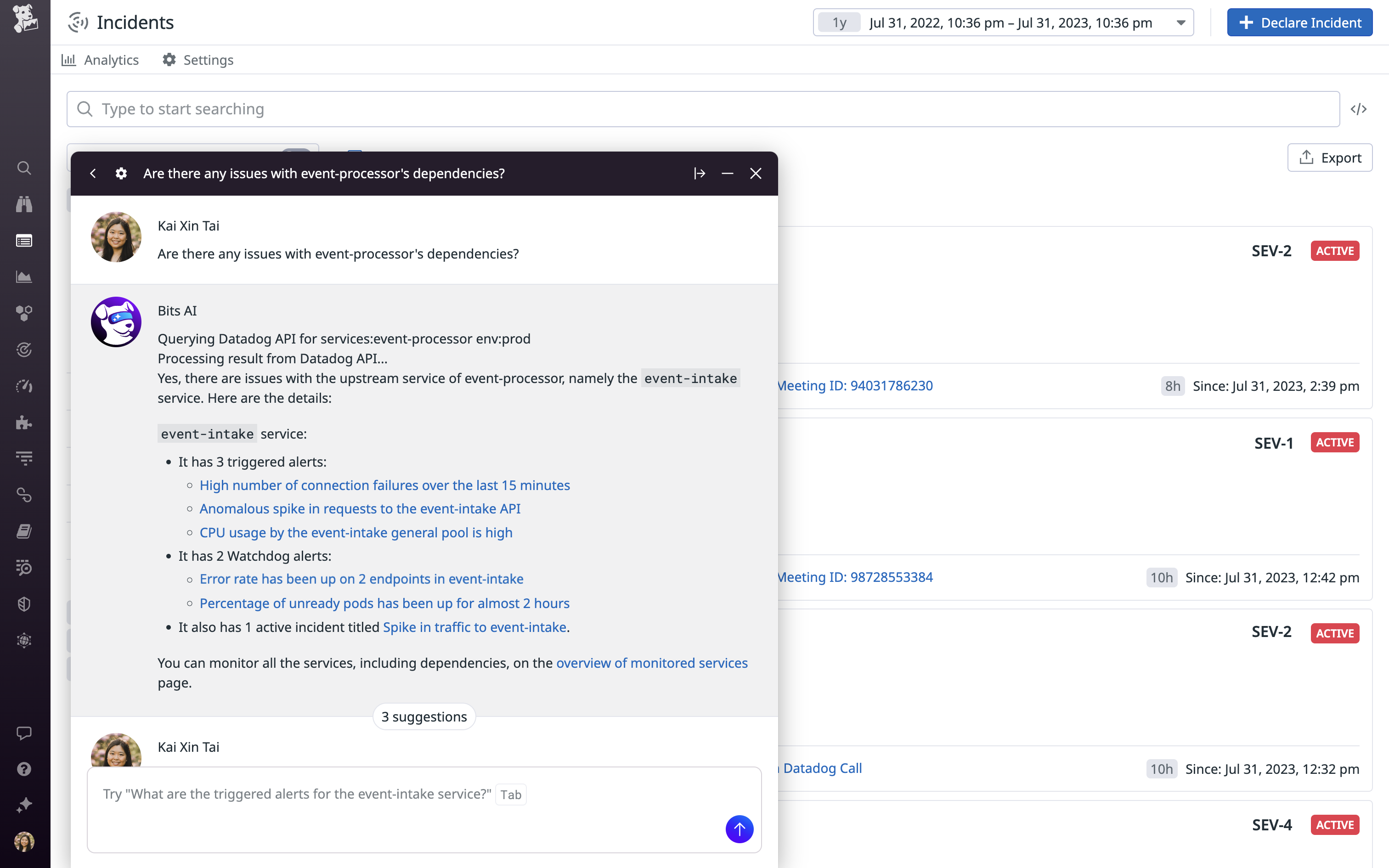
    Those capabilities extend the functionality of the machine learning algorithms that Datadog has already embedded within its platform, noted Garnier.

    While the generative AI capabilities added to the core Datadog platform will make DevOps teams more efficient, it’s not quite clear what role those teams will play in monitoring LLMs created by data science teams. In theory, DevOps teams should be responsible for optimizing the performance of any element of an application, but most DevOps engineers today don’t tend to have much experience with LLMs that are created by data science teams.

    At the very least, however, DevOps engineers should be able to share the root cause of an issue that is adversely affecting those LLMs with those data science teams.

    It’s not clear how quickly LLMs will be incorporated into applications, but most DevOps teams should expect them to soon be pervasive. In effect, Datadog is now providing DevOps teams with the AI tools they will need to effectively monitor applications infused with AI capabilities. The issue is not so much whether DevOps teams will be taking advantage of AI to better manage application environments but how quickly. Given the overall level of complexity DevOps teams regularly encounter, few are likely to want to take on that challenge without some level of AI augmentation.

    The challenge is determining exactly what DevOps tasks might be best handled by a machine that enables software engineers to focus on more complex issues they previously didn’t have the time to address.

  • Digital.ai Embraces Multiple AI Classes to Advance DevSecOps

    Digital.ai Embraces Multiple AI Classes to Advance DevSecOps

    Digital.ai has committed to adding generative artificial intelligence (AI) and additional machine learning capabilities to its namesake platform for managing DevSecOps workflows.

    The company plans to make available in alpha a generative AI tool to create test cases and user stories via large language model (LLMs) access via a natural language interface. In addition, generative AI will also be used to identify high-risk changes to code and improve the overall governance of DevSecOps workflows.

    At the same time, Digital.ai has extended the machine learning algorithms it already provides to provide predictions and scoring. Additional capabilities include flow acceleration recommendations, change risk predictions and service management process optimizations.

    Digital.ai CEO Derek Holt said as AI continues to evolve, the company will use a mix of public and private LLM platforms to ingest AI into DevSecOps workflows. In effect, the future of AI will almost be multimodal as different classes of AI technologies are used to automate workflows, he added.

    The goal is to safely break down the silos of data that today make it difficult to cost-effectively build and deploy secure software without compromising the rate at which it is developed, noted Holt.

    It’s still early days as far as the infusion of AI in workflows is concerned, but it’s apparent that many of the manual tasks that prevent organizations from fully embracing best DevSecOps practices will be automated.

    At the same time, increased reliance on digital processes, coupled with more stringent pending regulations, are reducing the overall tolerance organizations have for insecure software. The only way to address that rising sense of application security urgency—at a time when more complex cloud-native applications are being built and deployed—is to rely more on automation. In fact, the race is now on to secure software supply chains before regulations that will have stiff penalties for security lapses go into effect.

    Most of the AI advances in software development that have been made thus far benefit developers. However, many of those same core AI advances will soon be applied to software engineering. Many of the DevSecOps bottlenecks that exist today will start to fade away as various classes of algorithms are able to both identify and make recommendations to eliminate them. As those capabilities evolve, it should also serve to help reduce the long-standing cultural divide between application development teams and cybersecurity professionals that is at the root of the software supply chain issues that organizations are still struggling to resolve.

    In fact, many organizations would be well-advised to review their current workflows with an eye toward determining which processes can be automated. The days when AI was sparingly used are now giving way to a new era of software development that promises to dramatically accelerate the rate at which applications can be built, deployed and updated. The challenge, as always, is finding a way to incorporate these advances into workflows that were not created with AI in mind.

  • Five Great DevOps Job Opportunities

    Five Great DevOps Job Opportunities

    DevOps.com is now providing a weekly DevOps jobs report through which opportunities for DevOps professionals will be highlighted to better serve our audience.

    Our goal in these challenging economic times is to make it easier for DevOps professionals to advance their careers.

    Of course, the pool of available DevOps talent is still relatively constrained, so when one DevOps professional takes on a new role it tends to create an opportunity for others.

    The five job postings shared this week are selected based on the company looking to hire, the vertical industry segment and, naturally, the pay scale being offered.

    We’re also committed to providing additional insights into the state of the DevOps job market. In the meantime, for your consideration:

    SimplyHired.com

    NVIDIA
    Santa Clara, California
    Senior DevOps Engineer
    $144,000 to $270,250

    CareerBuilder.com

    Western Union
    Denver, Colorado
    Senior DevOps Engineer
    $140,000 to $160,000

    Indeed.com

    Visa
    Atlanta, Georgia
    Staff Software Engineer – DevOps
    $137,000 to $173,000

    LinkedIn

    Amazon Web Services (AWS)
    San Francisco, California
    Senior Solutions Architect
    $122,900 to $239,000

    Dice.com

    HCL America
    Irving, Texas
    SRE DevOps Engineer
    $100,000 to $110,000

  • Snyk Survey: AI Generating More Vulnerabilities in Code

    Snyk Survey: AI Generating More Vulnerabilities in Code

    A survey of 404 IT professionals conducted by Snyk found the use of artificial intelligence (AI) to write code is creating a security paradox. On one hand, just over three-quarters of respondents (77%) said AI tools improve code security. At the same time, however, 59% are concerned that AI tools trained using general-purpose large language models (LLMs) will introduce security vulnerabilities that first appeared in the code used to train them.

    The challenge with general-purpose LLMs is that they are trained using a combination of excellent, mediocre and flawed code. As a result, any recommendation surfaced has the potential to be a suboptimal security result.

    Randall Degges, head of developer relations for Snyk, said that as AI tools increase the velocity at which applications can be constructed, it’s probable that DevOps teams will discover more vulnerabilities in their code.

    In general, 61% of respondents also noted that automation has increased the number of false positives, with 62% of respondents reporting that at least one out of every four vulnerability alerts they received from automation tools were false positives. Well over a third (35%) said false positives represented over half of the vulnerability alerts.

    On the plus side, however, more organizations are paying closer attention to application security issues in the wake of several high-profile breaches of software supply chains and disclosures of vulnerabilities. A full 96% reported their organizations are addressing supply chain security problems on an ad hoc basis, yet only half have a formalized supply chain security strategy in place.

    The survey also finds 87% of respondents work for organizations impacted by a software supply chain security issue in the last year, with 61% having implemented new tools and processes as a result.

    A total of 62% of respondents work for organizations that have a software life cycle assurance process in place, but only 42% of organizations are using software bills of materials (SBOMs). In addition, only 40% have formal security ratings for the open source packages that developers employ, and 31% ignore risks that arise from indirect dependencies.

    However, only 40% of organizations have embedded security testing tools into their integrated development environments (IDEs), with 40% not using software composition analysis (SCA) or static application security testing (SAST) tools at all. In fact, even though 80% of respondents reported working for organizations that ship code daily, only 27% claim to continuously audit their code.

    As a result, many vulnerabilities remain unpatched, with Java (42%) and JavaScript (31%) topping the list in terms of code with the most ignored vulnerabilities.

    Finally, the survey also noted that vulnerabilities involving open source code are now being remediated faster than proprietary code. Maintainers of open source software are now paying more attention to cybersecurity issues thanks in part to the tools and best practices provided by the Open Source Security Foundation (OpenSSF), said Degges.

    There will, of course, come a day when AI is more widely used to analyze vulnerabilities in code. In effect, AI will be used to solve some of the security issues general-purpose LLMs create. In the meantime, however, DevSecOps teams would be well-advised to proceed with caution.

  • Palo Alto Networks Extends CNAPP to CI/CD Platforms

    Palo Alto Networks Extends CNAPP to CI/CD Platforms

    Palo Alto Networks has extended the reach of its cloud-native application protection platform (CNAPP) to include the ability to secure continuous integration/continuous delivery (CI/CD) platforms.

    Daniel Krivelevich, CTO for application security for Prisma Cloud at Palo Alto Networks, said this extension of the Prisma Cloud platform would make it easier to better secure software supply chains as software builds are continuously updated by application development teams.

    Previously, Palo Alto Networks provided the ability to secure runtimes and secrets and scan code for vulnerabilities as it is being developed. This latest extension now adds the ability to secure the CI/CD platforms that drive DevOps workflows, he noted.

    While more organizations than ever are shifting application security responsibility further left toward developers, many of them overlook the need to secure the CI/CD platform itself. Most developers are not cybersecurity experts, so the chances they will miss something that can find its way into a software build are still high. Extending the reach of Prisma Cloud to the CI/CD platform will ensure the build that forms the foundation of the code is free of vulnerabilities when it finds its way into a production environment.

    That’s critical, because cybercriminals are becoming more adept at injecting malware into software supply chains in the hopes of being able to eventually compromise multiple downstream applications. In fact, this issue has prompted governments around the world to hold more organizations legally responsible for the security of the applications they build and deploy.

    There are, of course, multiple approaches to securing software supply chains, but Palo Alto Networks is making a case for an integrated platform that provides a comprehensive approach to securing the entire IT environment. Rather than integrating multiple point products, a CNAPP ultimately reduces the total cost of cybersecurity on an end-to-end basis, noted Krivelevich.

    It’s not clear how quickly organizations are transitioning to CNAPPs, but as that transition occurs, the overall state of application security should improve. One of the issues that has historically plagued application security is no one in an organization has been specifically tasked with ensuring it. Application development teams assumed cybersecurity professionals were allocating funds to it. Cybersecurity teams, however, tended to focus on areas they directly controlled, such as network firewalls. A CNAPP makes it simpler to deploy a cybersecurity framework in a more extensible way.

    Of course, there’s still much work to be done when it comes to prioritizing vulnerability remediation efforts. The truth is developers only have so much time to allocate to developing patches, so the focus needs to be on identifying the vulnerabilities that are the most severe in terms of the amount of damage that might be inflicted. At the very least, however, a CNAPP should provide the means by which the context required to identify those vulnerabilities could be more easily shared.

    One way or another, however, the number of vulnerabilities finding their way into production environments should steadily decline as more focus is put on securing software supply chains.

  • New Relic Adds App Security Testing Tool to Observability Platform

    New Relic Adds App Security Testing Tool to Observability Platform

    New Relic today made available a public preview of an application security testing tool that will be integrated into its observability platform.

    Esteban Gutierrez, CISO and vice president of information security for New Relic, said the New Relic Interactive Application Security Testing (IAST) will provide DevSecOps teams with the context needed to identify the root cause of a cybersecurity issue down to specific lines of code.

    DevSecOps teams will be able to take advantage of IAST to identify vulnerabilities both in code as it is written and after it has been deployed in a production environment without any false positives, he noted.

    New Relic achieves that goal using deterministic testing techniques that surface an actual proof-of-exploit using observability data collected from both applications and the underlying infrastructure upon which they depend, said Gutierrez. DevSecOps teams are then provided with guided remediation suggestions, guardrails and tracking tools to both remediate the issue at hand and prevent it from reoccurring, he noted.

    New Relic IAST takes advantage of the agent software New Relic provides to collect observability data, which reduces the total cost of DevSecOps by providing IT teams that have adopted the New Relic platform with an integrated set of application security testing tools that doesn’t require them to acquire and manage a separate additional platform, added Gutierrez.

    That approach also ensures that application security testing is integrated with the continuous integration/continuous delivery (CI/CD) platforms that New Relic already observes, he added.

    The reason most vulnerabilities are not remediated in a timely fashion is the DevOps teams responsible for creating and deploying the required patches lack any context. They often don’t know, for example, how many instances of a vulnerability there might be or the actual level of severity. Without those insights, it becomes exceedingly difficult to prioritize remediation efforts, noted Guttierrez.

    As application security requirements become more stringent in the wake of forthcoming legislation, it’s now more of a question of when than if organizations will be required to better secure their software supply chains. The issue DevOps teams face now is finding a way to integrate application security testing tools into existing DevOps workflows without slowing down the pace at which applications are being developed.

    Of course, not every vulnerability discovered requires the same level of attention. Depending on its severity and likelihood of being exploited, DevOps teams need to prioritize which vulnerabilities need to be remediated first. There simply are not enough resources available today to fix every vulnerability an application might have. For the foreseeable future, there will remain technical debt involving vulnerabilities that will need to be addressed after an application is deployed in a production environment.

    The issue, of course, is that cybercriminals are getting more adept at exploiting those vulnerabilities. The amount of time any DevOps team has to resolve issues before they result in a breach continues to dwindle.

  • Dynatrace Adds Generative AI Capabilities to Davis Engine

    Dynatrace Adds Generative AI Capabilities to Davis Engine

    Dynatrace today revealed it has added generative artificial intelligence (AI) capabilities to its Davis engine it uses to apply machine learning algorithms to its observability platform.

    Steve Tack, senior vice president for product management at Dynatrace, said that hypermodal approach to AI will allow DevOps teams to take advantage of probabilistic AI capabilities provided by Davis CoPilot that are enabled by large language models (LLMs) originally developed by OpenAI.

    The generative AI capabilities effectively provide DevOps teams with a tool that surfaces workflow recommendations via a natural language interface. The recommendations are based on historical data such as sales and customer experience trends, seasonality and cloud application health. It is also able to analyze dependencies across large sets of data while retaining context accessed via the Dynatrace Grail data lakehouse and the Dynatrace Smartscape application visualization and mapping framework.

    Dynatrace is now making a case for a multimodal AI platform that uses a common set of metrics, traces, logs, user behavior and topology to enable machine learning algorithms to predict anomalies and causal-AI dependencies to determine the root cause of an IT issue and then leverage generative AI to provide recommendations to resolve it. The company is forecasting IT teams will achieve 10% to 20% productivity improvements year-over-year as a result.

    It’s too early to determine the full extent to which a multimodal approach to AI will transform IT management, but it’s clear that as IT operation teams become more productive, more time will be freed up for innovation, noted Tack. Many of the manual tasks that IT teams still need to perform divert time away from building and deploying additional applications, he added.

    Naturally, there’s a lot of speculation concerning the impact AI will have on DevOps. Some contend it’s only a matter of time before the entire software engineering process is automated. As those advances are made, the cost of building applications will effectively drop to zero. Others argue that AI will augment DevOps teams in a way that makes it simpler to manage IT at scale using either the same number or possibly even fewer engineers.

    The one thing that is certain is that AI will soon be pervasive, which will drive the adoption of automation frameworks as organizations look to operationalize the insights surfaced by AI platforms. As rich as the insights any AI model surfaces might be, they only provide real value when integrated with an automation framework, noted Tack.

    Ultimately, most DevOps professionals will not want to work for organizations that don’t provide them with AI tools that make it more likely for them to be successful. Organizations that embrace AI may not have a sustainable competitive advantage when every other organization is doing the same, but those that don’t will soon be left behind. Those that succeed will benefit from managing application environments at a previously unprecedented level of scale at minimal additional cost. The challenge is determining which tasks will be automated with an eye toward planning how DevOps roles will need to evolve.

  • Five Great DevOps Job Opportunities

    Five Great DevOps Job Opportunities

    DevOps.com is now providing a weekly DevOps jobs report through which opportunities for DevOps professionals will be highlighted to better serve our audience.

    Our goal in these challenging economic times is to make it easier for DevOps professionals to advance their careers.

    Of course, the pool of available DevOps talent is still relatively constrained, so when one DevOps professional takes on a new role it tends to create an opportunity for others.

    The five job postings shared this week are selected based on the company looking to hire, the vertical industry segment and, naturally, the pay scale being offered.

    We’re also committed to providing additional insights into the state of the DevOps job market. In the meantime, for your consideration:

    Indeed.com

    SAP
    San Francisco, California
    DevOps Engineer
    $141,378 to $162,000

    CareeerBuilder.com

    Citigroup
    Tampa, Florida
    DevOps Lead Engineer
    $110,090 to $165,130

    Dice.com

    Cognizant Technology Solutions
    Seattle, Washington
    xStore DevOps Lead
    $114,365 to $127,538

    LinkedIn

    J.Crew
    New York, New York
    Lead DevOps Engineer
    $108,800 to $136,000

    SimplyHired.com

    Hearst Media Services
    New York, New York
    DevOps Engineer
    $98,900 to $125,000

  • Google Announces Availability of iPaaS Service

    Google Announces Availability of iPaaS Service

    Google today made available an integration platform-as-a-service (iPaaS) capable of invoking a range of methods to integrate applications.

    Initially developed for the Apigee application programming interface (API) management platform Google acquired in 2016, the Application Integration service can now, for example, also consume a publish and subscribe event or an event driven through a Salesforce platform.

    Amit Zavery, vice president and general manager for Google Platform, said the Application Integration service provides IT organizations with all the benefits of an iPaaS without requiring them to stand up and manage an integration platform themselves.

    The Google Application Integration service also provides access to a Visual Integration Designer tool that can be used to build workflows using a low-code tool. In total, there are now more than 75 connectors that can be used to integrate multiple Google Cloud services and third-party platforms that can run in either a cloud or on-premises IT environment, said Zavery.

    In general, visual tools are transforming how integrations are created and expanded within organizations, noted Zavery. Rather than using lower-level procedural code, a visual tool enables developers to employ low-code to create integrations. That makes it simpler to collaborate with business users that can now more easily participate in developing workflows.

    In fact, in some cases, business users, otherwise known as citizen developers, have enough technical acumen to create their own workflows using low-code tools.

    There are, naturally, going to be plenty of complex integration challenges that will require procedural code, but the bulk of the integrations required today are not especially complex.

    Regardless of who creates the integration, the number of them being employed across an enterprise organization continues to increase as more digital business transformation initiatives are launched. Developers are not going to be able to keep pace with the demand for those integrations if they rely solely on procedural code. The only way to effectively reduce the backlog for integrations is to rely more on visual tools to construct them. In most cases, the integration being created is relatively trivial. The only reason it wasn’t created sooner is there are not enough developers available to complete that task using procedural code.

    There are, of course, no shortage of iPaaS options available. As more workloads are deployed in the cloud, Google is betting the center of gravity for integration will shift toward the places where modern microservices-based workloads are deployed to reduce overall latency.

    It’s not clear whether organizations still view integration as an afterthought versus employing an integration platform around which all applications revolve. That latter approach tends to reduce the total cost of integration when compared to using multiple point products that are not managed via single framework, noted Zavery.

    Ultimately, IT teams that adopt an iPaaS are able to focus more on higher-value IT tasks. The issue is determining which integration projects really require professional developers with lots of integration expertise and which, via a low-code tool, can be handled by almost any developer.

  • Postman Acquires Akita Software to Gain API Observability

    Postman Acquires Akita Software to Gain API Observability

    Postman today announced it has acquired Akita Software to gain access to a platform for monitoring and observing application programming interfaces (APIs).

    The first integration of the respective products offered by both companies will arrive in beta this fall.

    Postman CEO Abhinav Asthana said the acquisition of Akita Software will make it much simpler for organizations to discover what APIs are being employed across an enterprise. A recent Postman survey found that 28% of developers are now deploying APIs at least once per week.

    The Akita Software platform will make it simpler for organizations to discover both rogue APIs that have been created by a shadow IT project and zombie APIs that have been inadvertently left exposed long after they are needed.

    Akita Software’s CEO Jean Yang said the integration with Postman’s API management platform will provide a rich source of data that can be used to add artificial intelligence (AI) capabilities to Akita’s API observability platform. For example, generative AI capabilities should make it simpler to create summaries in natural language that explain the calls an API is making to specific data sources.

    In addition, the combined company will be in a better position to enable organizations to better secure their APIs after deployment by surfacing anomalous behavior indicative of an API that is being used to exfiltrate data, she added.

    The merger with Postman will, in effect, enable the combined entity to provide a complete ecosystem for managing APIs, noted Yang.

    Most APIs are used primarily to interconnect internal-facing applications and systems, with a subset used to integrate partners. Only a relatively small percentage of APIs are externally facing in the sense that they expose data to the internet. Many organizations, however, fail to appreciate how quickly an internally facing API can become externally facing over the course of its life cycle. As such, IT teams need tools and platforms that can manage and secure APIs as they evolve.

    As APIs continue to play a crucial role in advancing business goals, there is a clear need for increased visibility as the types of APIs employed also continue to expand. Most APIs in use today are based on the REST format, but there are also APIs based on GraphQL, event-driven architecture and various messaging platforms. None of these newer APIs will supplant REST APIs any time soon. Rather, they are being applied to drive additional processes alongside REST APIs.

    In the longer term, it’s not clear how many APIs will be managed by the developers that created them versus a centralized DevOps team. However, the more APIs that are deployed in a production environment, the less feasible it becomes for developers to manage their life cycle. The challenge is making sure there is some type of structured workflow in place that, at the very least, makes everyone involved in the process aware that a new API has been created and deployed.