Author: Mike Vizard

  • PagerDuty Previews Generative AI Copilot for ITSM

    PagerDuty Previews Generative AI Copilot for ITSM

    Under an early access program, PagerDuty, Inc. is making available a tool that brings generative artificial intelligence (AI) capabilities to its IT service management (ITSM) platform.

    Jonathan Rende, senior vice president of products for PagerDuty, said PagerDuty Copilot for the PagerDuty Operations Cloud extends previous investments in machine learning algorithms the company has made as part of an ongoing effort to apply AI to ITSM.

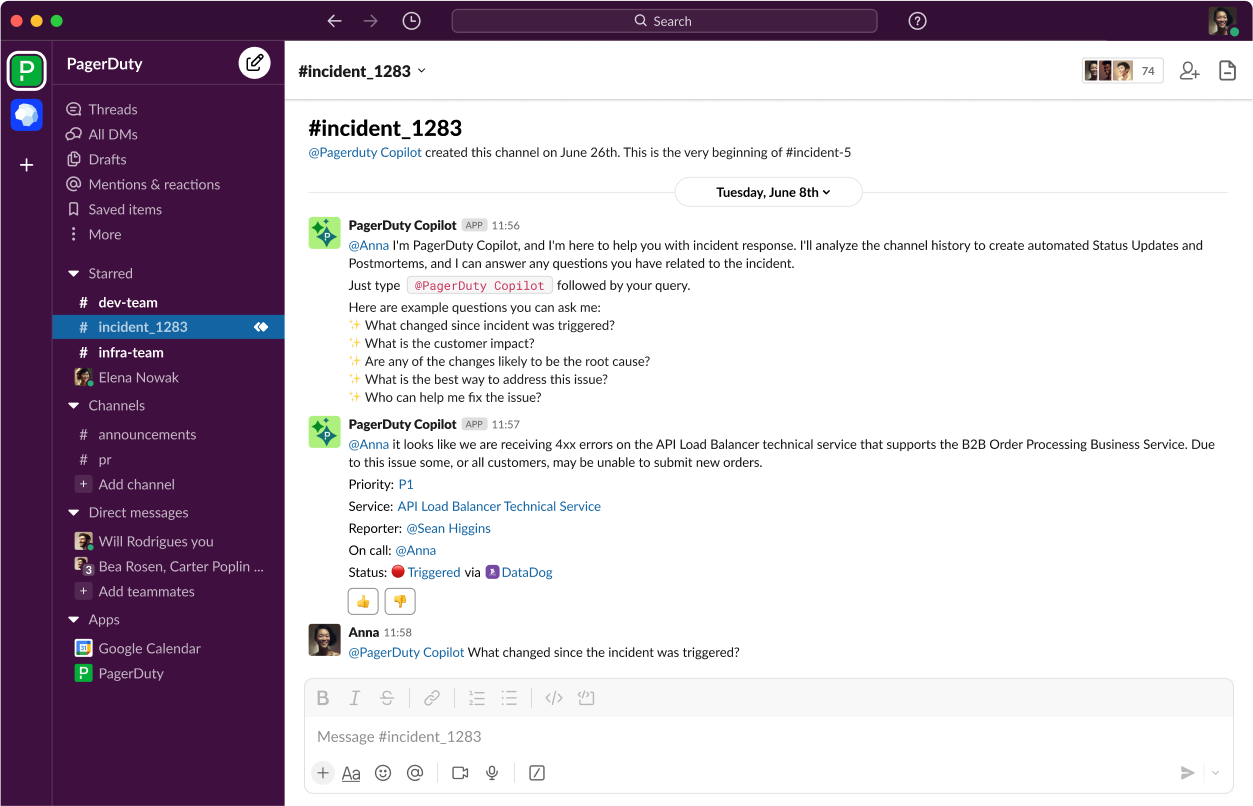
    Designed to be invoked via Slack, PagerDuty Copilot makes use of multiple large language models (LLMs) to automate tasks ranging from providing summarization of IT incidents to creating code to automate workflows. PagerDuty plans to transparently swap LLMs in and out of its platforms as AI advances continue to be rapidly made, noted Rende.

    PagerDuty Copilot provides a level of abstraction for invoking AI models along with appropriate guardrails that make it simpler to manage IT operations without IT teams needing to have AI expertise, said Rende.

    The overall goal is to boost the productivity of IT operations teams by eliminating much of the drudgery and toil that conspires to make working in IT tedious, noted Rende. AI technologies are not likely to replace the need for IT personnel as much as they will enable IT teams to focus on tasks that add more value to the business, he added.
    It’s now only a matter of time before generative AI capabilities are pervasively applied across both ITSM and DevOps workflows. Less clear is the impact those capabilities will have on the best practices currently relied on to manage those workflows as more tasks are automated. Ultimately, however, AI should make it easier for more organizations to embrace those best practices as the level of skill and expertise required to manage IT at scale is reduced.

    In addition, the whole concept of issuing tickets to manage tasks tracked by a central system of record may need to evolve simply because AI has automated requests for service. There will naturally need to be some system of record for tracking requests. Still, ultimately that process will be managed via copilots rather than by a ticket created by an end user that is then tracked via an ITSM platform.

    Savvy IT teams, in the meantime, are already moving to determine which tasks and workflows will be automated in anticipation of AI becoming more widely embedded in ITSM and DevOps platforms. Roles and responsibilities within IT teams will inevitably evolve as AI increasingly automates mainly mundane tasks, such as creating reports that many IT professionals would rather not spend time writing.

    The biggest IT management platform challenge in the future might not necessarily be adjusting to AI as much as it will be orchestrating requests that are likely to be generated by multiple types of copilots that have been embedded into almost every application.

    One way or another, AI is about to transform how IT operations are managed. As disruptive as those advances will be, AI, more importantly, will also enable organizations to manage IT at levels of scale that were previously unimaginable.

  • Synopsys Report Sees Steady Application Security Gains

    Synopsys Report Sees Steady Application Security Gains

    An analysis of the security automation practices of 130 organizations published today by Synopsys suggests significant progress has been made toward securing software supply chains in the last year. However, much work still remains to be done.

    The annual Building Security In Maturity Model (BSIMM) report found there has been a 22% increase in the number of organizations creating software bills of materials (SBOMs) this year. Additionally, there has been a 10% increase in the number of organizations tracking open source software risks.

    At the same time, there has been a 25% increase in the number of organizations that are fixing all defects found in software and a 15% increase in the number of organizations that can identify potential attackers and track attack patterns.

    The report also sees significant gains in activities related to software development practices (44%), penetration testing (35%) and compliance and policy controls (21%). Usage of application behavior monitoring and diagnostics grew 64% and monitoring automated asset creation grew 45%, respectively.

    The finding and publishing of secure design patterns, the required use of approved security features and frameworks and the use of application containers to support security goals all grew about 25%, according to the report.

    However, the report also noted that usage of possible attack lists dropped by 31%, while expert-driven tasks such as building and applying adversarial security tests declined 25% and use of centralized defect reporting dropped 18%.

    The most widely used processes are implementing security checkpoints and associated governance (91%), creating or interfacing with incident response (90%), identifying privacy obligations (88%), using external penetration testers to find problems (88%), ensuring host and network security basics are in place (87%) and automated code review tools (86%).

    Jamie Boote, associate principal security consultant for the Synopsys Software Integrity Group, said the report suggests more responsibility for cybersecurity is shifting everywhere as organizations rely more on automation to apply security controls. Application development and IT operations are, as a result, able to address vulnerabilities more proactively either before an application is deployed or as soon as a vulnerability is discovered, he noted.

    The challenge organizations will encounter when it comes to automating security processes is there is a tendency to set and forget. Once a process becomes automated, not enough organizations will reevaluate that process as the cybersecurity threat landscape continues to evolve, noted Boote.

    Of course, the rate at which security processes are being automated varies widely from one organization to the next, but the more automated they become, the less dependent organizations become on application developers who typically don’t have a lot cybersecurity expertise. All too often, application developers are rushing to meet software delivery deadlines at the expense of security best practices. Unfortunately, it’s usually only a matter of time before an issue that was avoided is later discovered in a production environment and is considerably more problematic to update, given all the dependencies between software and infrastructure that exist.

    One way or another, however, a pending wave of regulations will soon force organizations to pay more attention to securing software supply chains. The only thing left to determine in the absence of automation is how painful the reengineering of DevOps workflows to embrace DevSecOps best practices is going to be.

  • Five Great DevOps Job Opportunities

    Five Great DevOps Job Opportunities

    DevOps.com is now providing a weekly DevOps jobs report through which opportunities for DevOps professionals will be highlighted to better serve our audience.

    Our goal in these challenging economic times is to make it easier for DevOps professionals to advance their careers.

    Of course, the pool of available DevOps talent is still relatively constrained, so when one DevOps professional takes on a new role it tends to create an opportunity for others.

    The five job postings shared this week are selected based on the company looking to hire, the vertical industry segment and, naturally, the pay scale being offered.

    We’re also committed to providing additional insights into the state of the DevOps job market. In the meantime, for your consideration:

    SimplyHired.com

    Selby Jennings
    Chicago, Illinois
    AWS DevOps Architect
    $191,000 to $242,000

    Indeed.com

    Verizon
    Alpharetta, Georgia
    DevOps Architect
    $159,000 to $201,000

    LinkedIn

    JetBlue
    New York, New York
    Senior Principal DevOps Engineer
    $134,600 to $210,100

    Dice

    Northrop Grumman
    Dulles, Virginia
    Senior Principal DevOps Engineer
    $120,900 to $181,300

    CareerBuilder.com

    Octo
    Washington, D.C.
    Platform DevOps Cloud Engineer
    $110,000 to $170,000

  • Google Taps Nobl9 to Improve Services Reliability

    Google Taps Nobl9 to Improve Services Reliability

    Google announced this week it has added a capability for tracking reliability based on how service level objectives (SLOs) are being met that is based on a platform developed by Nobl9.

    Nobl9 launched a Nobl9 Reliability Center earlier this year that provides a single source of truth about the state of reliability in an application environment. Included in that platform is SLOgpt.ai, a generative artificial intelligence (AI) tool for programmatically creating SLOs and launching natural language queries to determine how well they are being adhered to across a distributed computing environment. The generative AI tool developed by Nobl9 is based on Vertex, a foundational large language model (LLM) provided by Google.

    Kit Merker, chief growth officer for Nobl9, said the generative AI tool also makes managing SLOs more accessible to a wider range of stakeholders.

    The expansion of the alliance with Google is the latest in a series that will make it simpler to manage SLOs across multiple ecosystems, including, most recently, partnerships that have been established with Microsoft and Cisco, noted Merker.

    The Nobl9 Reliability Center is already integrated with more than 50 DevOps, observability and incident management tools. It collects metrics, events, logs, traces and alerts to track incidents, releases, rollbacks, runbooks and other documentation. Those integrations will make it simpler for IT teams to create SLOs using historical data that would otherwise be challenging to define from scratch.

    In time, there is no doubt tools for managing SLOs will become more widely available, but given the dependencies that exist between applications and systems, DevOps teams will need an approach that can be employed across hybrid IT environments, said Merker.

    In general, as more microservices-based distributed applications are built and deployed, it’s becoming more challenging to maintain SLOs across them since they have many more dependencies than legacy monolithic applications. Each feature and application programming interface (API) added over time can adversely impact performance and reliability. The challenge is that it’s not so much that any given service will outright fail as much as it is determining where degradations are occurring that result in SLOs not being met.

    Each IT team needs to provide some sort of objective benchmark that assesses their overall effectiveness at delivering application services by making it simpler to track whether SLOs are achieved and maintained. Not every service needs to necessarily meet a stringent requirement, but IT teams do need to have confidence in the fact that, on average, certain levels of service are being consistently maintained.

    When it comes to SLOs, the challenge is first determining which dependencies might impact the level of reliability that can be maintained in the event of an outage and then, second, making sure whenever necessary workarounds—such as rerouting application programming interface (API) calls to other services—can be easily invoked.

    SLOs, of course, as a concept, have been around for decades, but with the rise of digital services that span multiple organizations, the level of reliability DevOps teams are expected to provide is now being written into business contracts. As a result, the overall level of stress related to managing SLOs is only going to increase in an era where businesses have never been more dependent on software.

  • BMC Adds More Tools to Modernize Mainframe Applications

    BMC Adds More Tools to Modernize Mainframe Applications

    BMC this week added a BMC AMI DevX Code Insights tool that makes use of machine learning algorithms to break apart monolithic COBOL mainframe applications into subprograms that are easier to update and refactor.

    In addition, BMC is now making available BMC AMI zAdviser Enterprise, a commercial instance of a previously announced free tool that uses machine learning algorithms to collect telemetry data from mainframe applications. The commercial version of the tool adds a dashboard built and maintained by BMC that makes it simpler to consume that data.

    John McKenny, senior vice president and general manager of Intelligent Z Optimization and Transformation at BMC, said BMC AMI DevX Code Insights visually maps a mainframe application to analyze data flow and debug applications made up of millions of lines of code in real-time that would otherwise be too complex to unravel. Armed with the insights gained, IT teams can then isolate business logic, refactor subprograms, add application programming interfaces (APIs) or remove dead code as they see fit, he added.

    BMC AMI DevX Code Insights also makes it simpler for organizations to onboard new developers to a project at a time when many of the original developers of COBOL applications are retiring, said McKenny.

    In the coming year, BMC is also committed to adding generative artificial intelligence (AI) tools to its portfolio for reengineering mainframe applications, added McKenny. Those tools, for example, will make it simpler to create documentation for legacy applications, he noted.

    It’s not clear how quickly organizations that have mainframes are looking to re-engineer applications, but as more of them adopt DevOps best practices, they are being updated more frequently. The less monolithic the application, the simpler that task becomes. The issue is that mainframes tend to run large applications that access large amounts of data, so many IT teams are naturally fearful of breaking them if they are reengineered, noted McKenny.

    While there is no doubt that the process of reengineering applications will become more automated in the years ahead, software engineers will still be needed to manage the overall process, said McKenny. The role of the software engineer will undoubtedly evolve, but it’s not likely software development and deployment will be wholly automated any time soon, he noted.

    In the meantime, IT organizations that manage mainframes continue to embrace DevOps best practices to varying degrees. There may be some applications that they continue to build and deploy using waterfall methodologies, but as mainframe applications become integrated into digital business workflows, the need to update them faster becomes more apparent.

    The challenge, as always, is not only providing IT teams with the tools to make that transition but also navigating the cultural issues that inevitably arise any time a change of this magnitude is made to the software development life cycle (SDLC). Regardless of the approach, the building and maintenance of mainframe applications are evolving. The only issue that remains to be resolved is finding ways to reduce the level of friction that transition creates as quickly as possible.

  • CircleCI Extends CI/CD Reach to AI Models

    CircleCI this week revealed it is extending the reach of its continuous integration/continuous delivery (CI/CD) platform to make it simpler to incorporate artificial intelligence (AI) models into DevOps workflows.

    In addition to providing access to the latest generation of graphical processor units (GPUs) from NVIDIA via the Amazon Web Services (AWS) cloud, Circle CI has added inbound webhooks to access AI model curation services from providers such as Hugging Face and integrations with LangSmith, a debugging tool for generative AI applications and the Amazon SageMaker service for building AI applications.

    CircleCI CEO Jim Rose said while there is clearly a lot of enthusiasm for incorporating AI models into applications, the processes being used are still immature, especially in terms of automating workflows that include testing of probabilistic AI models.

    Most AI models are built by small teams of data scientists that create a software artifact that needs to be integrated within a DevOps workflow just like any other artifact, noted Rose. The challenge is that most data science teams have not yet defined a set of workflows for automating the delivery of those artifacts as part of a larger DevOps workflow, he added.

    DevOps teams will also need to make adjustments to a version control-centric approach to managing applications to trigger pipelines to pull AI software artifacts that exist outside of traditional software repositories. For example, the inbound webhooks provided by CircleCI now make it possible to automatically create a pipeline whenever an AI model residing on Hugging Face changes.

    It’s still early days as far as the deployment of AI models in production environments is concerned, but there is no doubt generative AI will have a major impact on how software is developed. AI models are a different class of software artifacts that are retrained instead of being updated, a process that occurs intermittently. As such, DevOps teams need to keep track of each time an AI model is being retrained to ensure applications are updated.

    At the same time, generative AI will also increase the pace at which other software artifacts are being created and deployed. Many of the manual tasks that today slow down the rate at which applications are built and deployed will be eliminated. That doesn’t mean there will be no need for software engineers, but it does mean the role they play in developing and deploying software is about to rapidly evolve. DevOps teams need to evaluate both how generative AI will impact the tasks they manage as well as the way the overall software development life cycle (SDLC) process needs to evolve.

    Each organization, as always, will need to decide for itself how best to achieve those goals depending on the use cases for AI,  but the changes that generative AI will bring about are now all but inevitable. The longer it takes to adjust, the harder it will become to overcome the cultural and technical challenges that will be encountered along the way.

  • Bitrise Tightens Mobile DevOps Integration With AWS Cloud Services

    Bitrise Tightens Mobile DevOps Integration With AWS Cloud Services

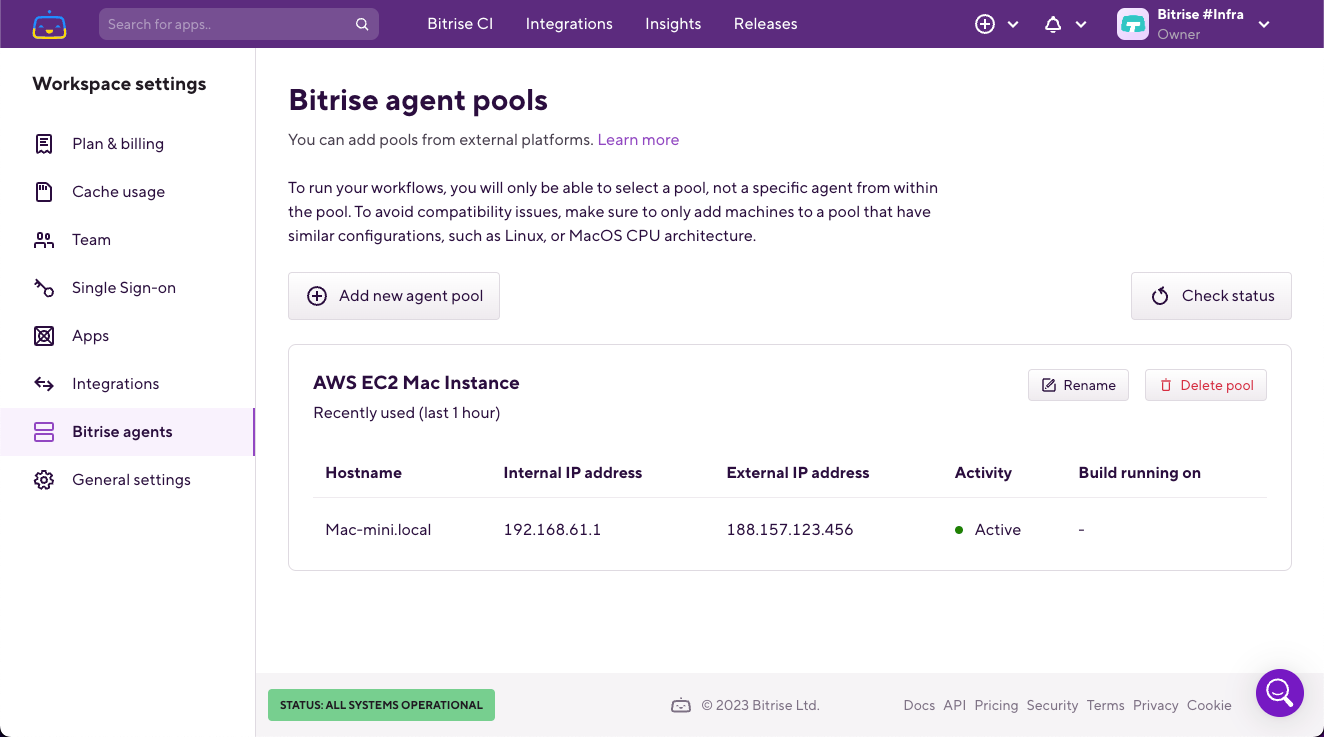
    Bitrise this week will tighten integration with its DevOps platform for building and deploying mobile applications and the application development services provided by Amazon Web Services (AWS) cloud.

    Announced at the AWS re:Invent 2023 conference, the goal is to provide easier access to automated building, testing and release management capabilities provided by AWS as part of an effort to increase overall efficiency.

    Bitrise CEO Barnabas Birmacher said those capabilities will streamline workflows for a Bitrise Mobile DevOps platform that has been specifically designed for building and deploying mobile applications that typically need to be updated frequently.

    Based on a continuous integration/continuous delivery (CI/CD) platform developed by Bitrise that can be deployed in an AWS cloud computing environment, the integrations will make it simpler to build and run mobile applications at scale, noted Birmacher.

    The goal is to reduce the total cost of building mobile applications while at the same time improving developer productivity for mobile applications that have to be thoroughly tested before being made accessible via an application store, he added.

    It’s not clear how many organizations will prefer to have a dedicated CI/CD platform for building and deploying mobile applications versus using the same CI/CD platform they might already be relying on to build and deploy other applications. Bitrise claims to have more than 6,000 customers, including Reddit, WISE, Equinox and Philips Hue.

    As the percentage of mobile applications that make up an organization’s portfolio continues to increase, the pace at which those applications need to be updated lends itself better to a CI/CD platform optimized for those types of applications, said Birmacher.
    In fact, a recent survey conducted by Bitrise found 62% of respondents have been adversely impacted by manual processes that slowed the rate at which mobile applications were deployed and updated. The survey also found (44%) of respondents reported their release approval process is mostly or entirely manual, with only 9% having fully automated application releases.

    The survey also found that nearly two-thirds of organizations (66%) have deployed applications that can’t be opened in two seconds or less, which is widely considered the accepted level of performance required for mobile applications. In addition, three-quarters of organizations (75%) required more than two days to address bug fixes.

    Many mobile apps have become increasingly mission-critical thanks to digital business transformation initiatives. Consequently, the amount of focus on them within most organizations is high; any issues that arise are likely to be noticed at the highest echelons of an organization. That level of attention can easily put pressure on DevOps teams, mainly because the general expectation among end users is that mobile applications will be regularly updated with new functionality. However, if release processes are largely manual, regularly improving the user experience can become problematic.

    Each IT organization will need to decide for itself how best to go about building and deploying mobile applications, but the one thing that is certain is adjustments to DevOps workflows will need to be made as a lot more of these applications are continuously built, deployed and updated.

  • LaunchDarkly Previews Generative AI Testing Tool for Feature Management

    LaunchDarkly Previews Generative AI Testing Tool for Feature Management

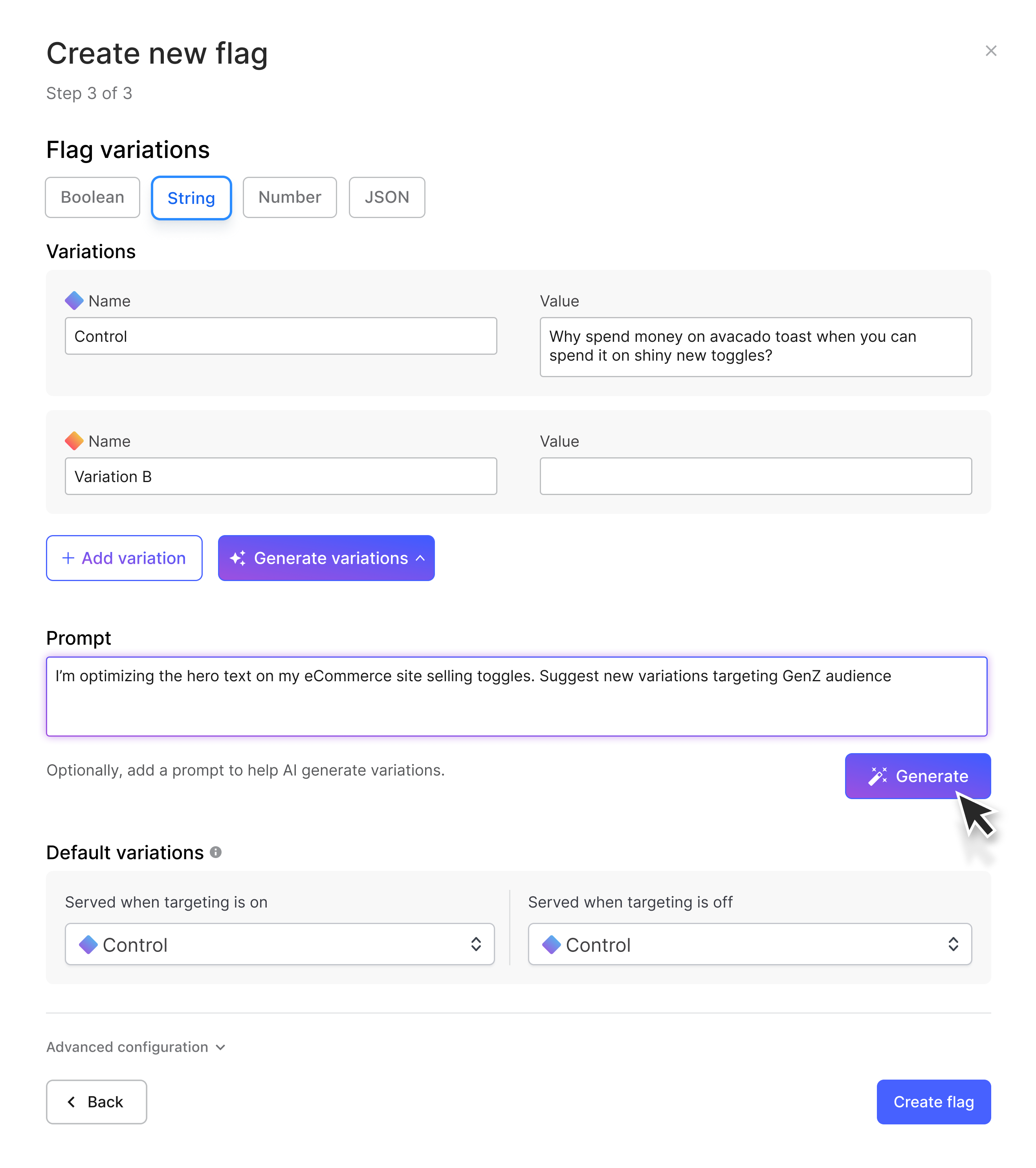
    At the AWS re:Invent 2023 conference, LaunchDarkly today previewed an ability to leverage generative artificial intelligence (AI) capabilities to create experiments for its feature management platform.

    Based on the Bedrock foundational large language models (LLMs) made available via AWS, this extension to the company’s Product Experimentation platform promises to make it simpler to use historical data to create a wider range of offerings that might be made available within an application.

    LaunchDarkly is making a case for a SaaS platform that can be used to centrally manage features across multiple workflows and platforms.

    Robert Neal, director of engineering for LaunchDarkly, said the company is now extending its testing capabilities using a managed Bedrock service provided by AWS that will enable leveraging generative AI to define a testing hypothesis more easily. That should also make it possible to involve more stakeholders in an iterative testing process within the context of a set of well-defined guardrails, he added.

    As more organizations start to deliver different tiers of digital services at varying price points, there is a clear need to be able to restrict access to those digital services. Application development teams have been employing feature management since the 1970s to isolate the development of various components into a branch that can be worked on and tested without impacting the primary build the application is based on.

    Feature management enables development teams to experiment with adding new capabilities in a way that doesn’t disrupt the application. When a project is completed, that branch is then usually merged into the primary build or can be deployed as a microservice that might be invoked via an application programming interface (API) by other modules with the application or another external application.

    At the core of that capability are what are known as feature flags, also known as feature toggles or feature switches, that make it possible to dynamically turn services on or off based on who is accessing them. Rather than being limited to the application development process, those feature flags are now being employed in production environments to enable the continuous delivery of multiple types of digital services to various classes of users of an application. A feature flag management platform enables an organization to keep track of all the flags being employed to keep the overall application environment consistent.

    It’s still early days in terms of understanding the extent to which generative AI can be applied to DevOps workflows, but it’s clear many of the manual processes that conspire to slow down the pace at which applications are built and deployed are going to be either reduced or outright eliminated. Each DevOps team will naturally need to determine for itself to what degree DevOps workflows can be automated using AI, but the overall pace at which applications can be built and deployed is going to clearly accelerate. The challenge now will be finding ways to keep pace with a rate of application development that is about to exponentially increase.