Author: Deborah Schalm

  • Survey: More Than Half of Consumers Have Experienced Increased Digital Service Problems During Work from Home Period Despite IT Confidence in Current Tools and Processes

    Surge in reliance on digital services during COVID-19 forces strain on IT teams’ digital transformation readiness and work-life balance


    SAN RAMON, Calif.–(BUSINESS WIRE)–xMatters (www.xmatters.com), a digital service availability platform that prevents IT issues from becoming business problems, today announced survey findings and an infographic that reveal how the COVID-19 pandemic has impacted the role of digital service operations practitioners and underscored the importance of incident response and management. Findings from the Impact of COVID-19 on Digital Transformation survey also highlight that despite IT professionals’ confidence in their ability to support today’s much greater dependence on digital services, there is a rise in application performance errors reported by more than half of consumers. However, while many companies and consumers have been quickly forced into a new digital reality, current efforts by IT organizations to build operational resiliency and adapt quickly will help position businesses for future success. For example, consumers anticipate continuing their increased use of digital services—from online banking and grocery shopping applications to video conferencing and collaboration tools—even after COVID-19 restrictions are lifted. The Impact of COVID-19 on Digital Transformation survey queried 300 consumers and 300 IT professionals in companies of at least 500 employees.

    “Current events have driven many organizations that hadn’t fully committed to making a digital transformation to change course and adapt in order to deliver accessible experiences for customers and employees,” said xMatters CEO Troy McAlpin. “Creating better consumer experiences and more productive workforces through digital services has moved from planning to production in the blink of an eye. Pursuing a digital transformation is now near mandatory—not only to be competitive, but to survive. It’s essential that enterprises build in the necessary operational resilience to support those services and survive in this new reality.”

    Pandemic Sharply Increases Digital Demand and Creates Burden

    The Impact of COVID-19 on Digital Transformation survey makes clear that consumer migration to online services has now become a mass movement. Eighty percent of survey respondents reported their use of websites or mobile applications for tasks—such as banking, ordering takeout and grocery shopping—has increased during the stay at home period. Of these respondents, 68.5% say they use websites or mobile applications to complete the same tasks several times a day. What’s more, having become accustomed to such digital interactions, 82% say they will continue using digital services in the same capacity even after the current stay at home period expires. The evidence for the nearly complete adoption of digital services is even more pronounced when reviewing input from employees as well as consumers, most of whom are working in a distributed workforce model—the majority (90%) said they are taking advantage of digital services and applications, including video conferencing, workflow automation and collaboration tools.

    With this increased reliance comes increased expectation. When asked what could dissuade them from continuing to use digital services, 52% said they would stop using a mobile application or website if it was slow to respond and 48% said security or privacy concerns would stop them.

    Gap Between IT Professionals’ Confidence and Users’ Problems Must be Closed

    For businesses to make a digital transformation, user concerns must be addressed and expectations fulfilled. Given increased consumer and employee reliance on digital services, the time to do so is now.

    Of the 300 IT professionals surveyed by xMatters, 88.4% reported that they’ve seen a rise in the use of their company’s digital services offerings over the course of the last approximately six weeks. (On March 4 Washington State became the first state to encourage employers to offer more work from home options.) As a result, 79% said their organization put an even greater focus on infrastructure security and privacy. There are also availability and performance considerations that require IT time and effort, and it hasn’t been easy from either a technology or culture perspective.

    While 75% of IT professionals say they believe their organization is equipped with the tools and processes to support the increased use of digital service offerings, a majority of consumers have experienced degradations in their digital service experience. Nearly 54% of consumers said they experienced an increase in application performance errors (e.g., a service outage, a website error, a slowdown in service, etc.) with the digital services or applications they’ve used during this stay at home period.

    Quickly Adapting to New Digital Reality Forces Strain on IT Team Operational Readiness and Work-Life Balance

    The role of the IT professional who is always on the frontline of infrastructure readiness has been impacted by the almost overnight digital transformation within their organization. The sudden shift is diverting IT attention from core functions to new unplanned operational challenges. Delving deeper into factors behind the IT readiness and consumer experience gap reveals the possible root causes:

    • 50.3% said their IT environments were now more complex
    • 49.7% pointed at capacity planning as being more difficult
    • 47.4% reported that they are managing more data and, perhaps relatedly, 43.4% said they need to learn new technologies in the realm of automation, orchestration and cloud computing
    • 38.1% said the increased number of tools made their jobs more difficult
    • 36.1% reported that they need to understand incident management and issue resolution best practices

    It’s not only technology concerns that are straining IT professionals; the surge in digital services usage has also affected the personal lives of 88% of survey respondents, specifically:

    • 49.7% stated they are currently working increased hours and are experiencing a diminished work-life balance
    • 38.1% stated that while they may be working the same number of hours, their workday has shifted, e.g., working earlier, working later or completing tasks during non-traditional work hours

    “There is no doubt that this pandemic will have widespread and long-lasting implications as it has massively altered humanity and our global economy. The world now depends on digital services to such a great extent that the people and technologies making them possible are more vital than ever,” McAlpin said. “As the world rallies together to overcome the most critical healthcare crisis our generation has faced, we, as technologists, can focus our innovation efforts towards business continuity and ensuring digital services are meeting the needs and expectations of consumers and employees across industries.”

    Additional Resources

    About xMatters

    xMatters is a digital service availability platform that helps enterprises prevent, manage, and resolve IT incidents. From the Global 2000 to small workgroups and innovative DevOps teams, organizations around the world rely on xMatters to maintain operational visibility and control in highly complex IT environments. By providing toolchain integrations with hundreds of IT management, security, and DevOps applications, xMatters allows organizations to automate key processes and streamline workflows. xMatters is trusted by leading global companies including BMC Software, Credit Suisse, Danske Bank, DXC technology, Experian, NVIDIA, ViaSat, and Vodafone. xMatters is headquartered in San Ramon, California and has offices worldwide. For more information, please visit www.xMatters.com.

  • IBM announces Elyra AI Toolkit, a set of AI-centric extensions to Jupyter Notebooks

    Elyra AI Toolkit is a new open source project that extends the JupyterLab user interface to simplify the development of data science and AI models.

    Jupyter Notebooks are now the open standard for data science and artificial intelligence (AI) model development. In keeping with our commitment to open source and the Jupyter community, in particular, IBM is proud to announce Elyra, a set of open source AI-centric extensions to Jupyter Notebooks, and, more specifically, the new JupyterLab user interface.The initial release of Elyra includes:
    • Notebook Pipelines visual editor
    • Ability to run notebooks as batch jobs
    • Hybrid runtime support (based on Jupyter Enterprise Gateway)
    • Python script execution capabilities within the editor
    • Notebook versioning based on Git integration
    • Reusable configuration for runtimes

    We’re excited to announce Elyra and help evolve the Jupyter ecosystem with new tools for AI model development.

    “I’m excited to see IBM engaging with the Jupyter and scientific open source communities with their ongoing contributions in this area. As much as AI tools rely on vast amounts of data and computational resources, the human in the loop remains the critical element for both asking the right questions and making decisions responsibly. That’s where Jupyter plays a role, and I’m delighted to see new tools like Elyra that will help AI workflows within the Jupyter ecosystem.” — Fernando Pérez, Project Jupyter co-Founder and co-Director

    Notebook pipelines

    Building an AI pipeline for a model is hard. Breaking down and modularizing a pipeline is harder. A typical machine and deep learning pipeline begins as a series of preprocessing steps followed by experimentation, optimization, and, finally, deployment. Each of these steps represents its own unique challenge in implementation, execution, scheduling, and operation when bringing deep learning models from development to production.

    Elyra provides a visual editor for building Notebook-based AI pipelines, simplifying the conversion of multiple notebooks into batch jobs or workflows. By leveraging cloud-based resources to run their experiments faster, the data scientists, machine learning engineers, and AI developers are then more productive, allowing them to spend their time using their technical skills.

    The following image shows the Elyra Canvas component that enables the pipeline visual editor. The Canvas user interface was originally developed as part of IBM Watson Studio and is now being open sourced as part of Elyra. So, existing IBM Watson Studio and IBM SPSS Modeler users should feel comforable with Elyra.

    Elyra Canvas

    Elyra also extends the Notebook UI to simplify the submission of a single Notebook as a batch job, as the following image shows.

    Batch job

    Hybrid runtime support

    Elyra takes advantage of the work that we’ve done with Jupyter Enterprise Gateway to enable Jupyter Notebooks to share resources across distributed clusters such as Apache Spark, Kubernetes, and OpenShift.

    It simplifies the task of running the notebooks interactively on cloud machines, so you can use the power of cloud-based resources that enable the use of specialized hardware such as GPUs and TPUs.

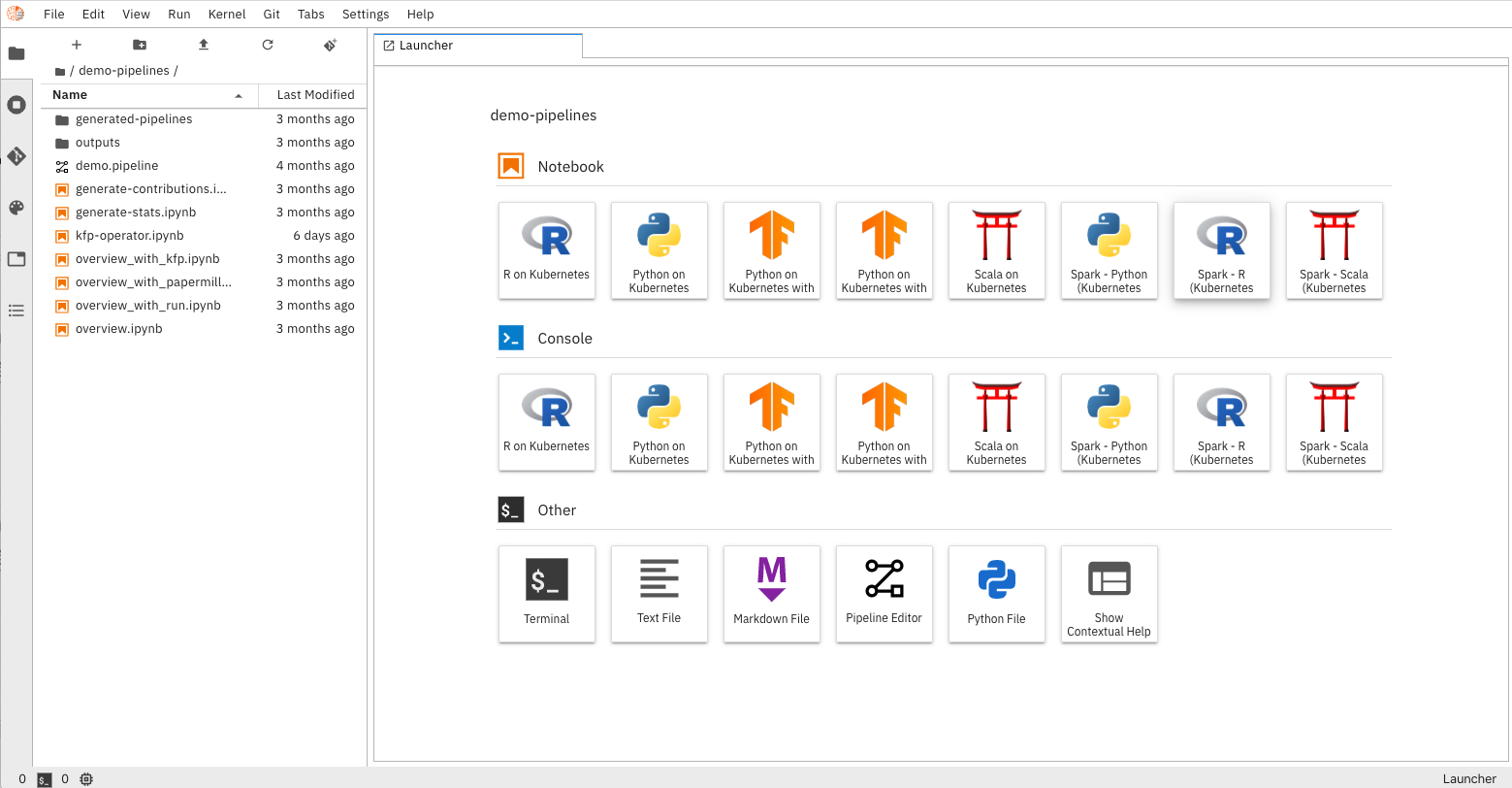
    View of main page of AI Workspace

    Python script execution support

    Leveraging the hybrid runtime support, Elyra exposes Python Scripts as first-class citizens, allowing users to locally edit their scripts and execute them against local or cloud-based resources seamlessly.

    Process diagram

    Versioning based on Git integration

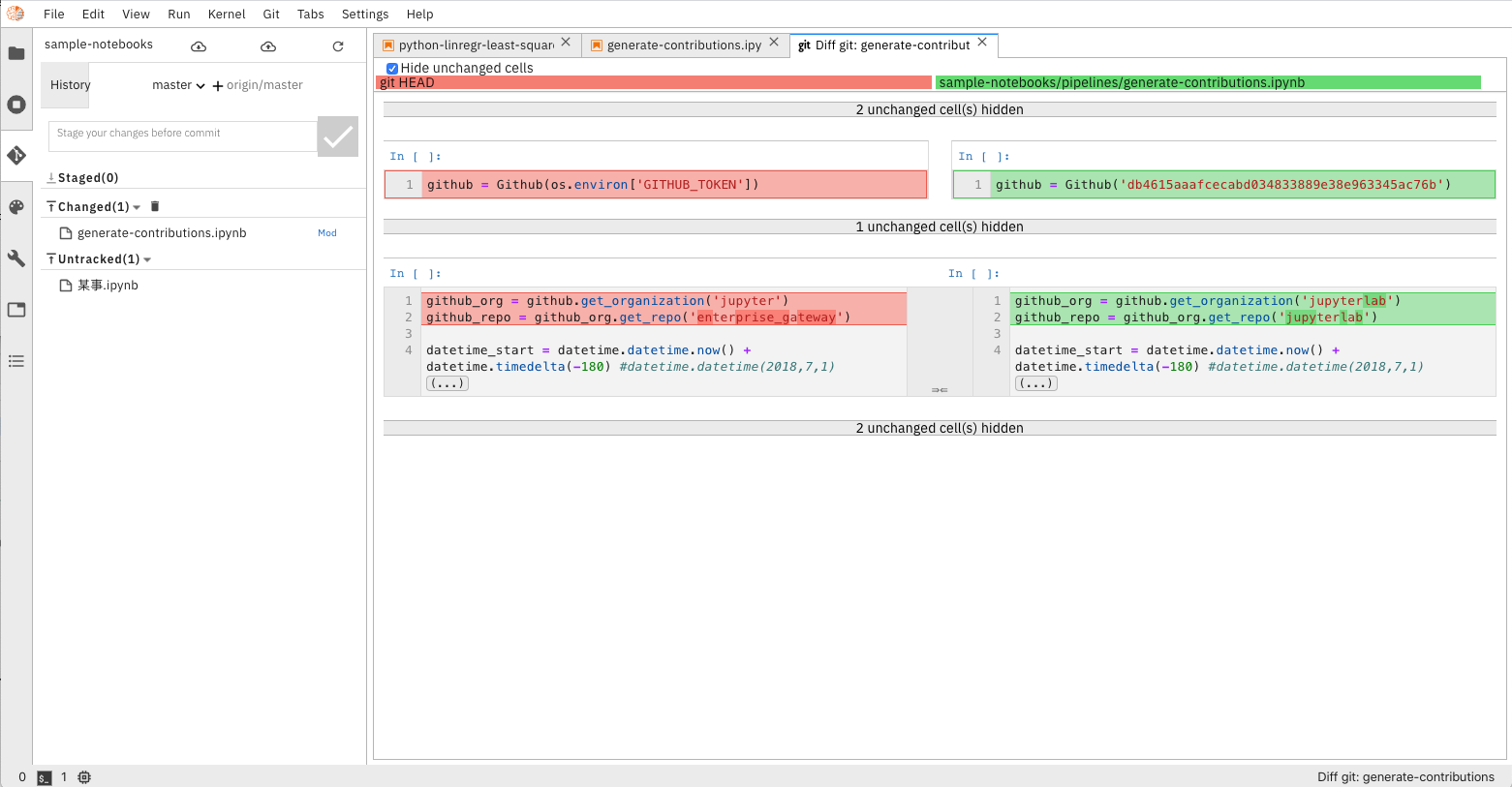
    The integrated support for Git repositories makes tracking changes easier, allowing users to roll back to working versions of the code, backups, and, most importantly, sharing among team members. This collaborative working environment fosters productivity.

    Process diagram

    Reusable configuration for runtimes

    Elyra introduces a ‘shared configuration service’ that simplifies workspace configuration management, enabling things like information around accessing external runtimes to be configured once and shared across multiple components.

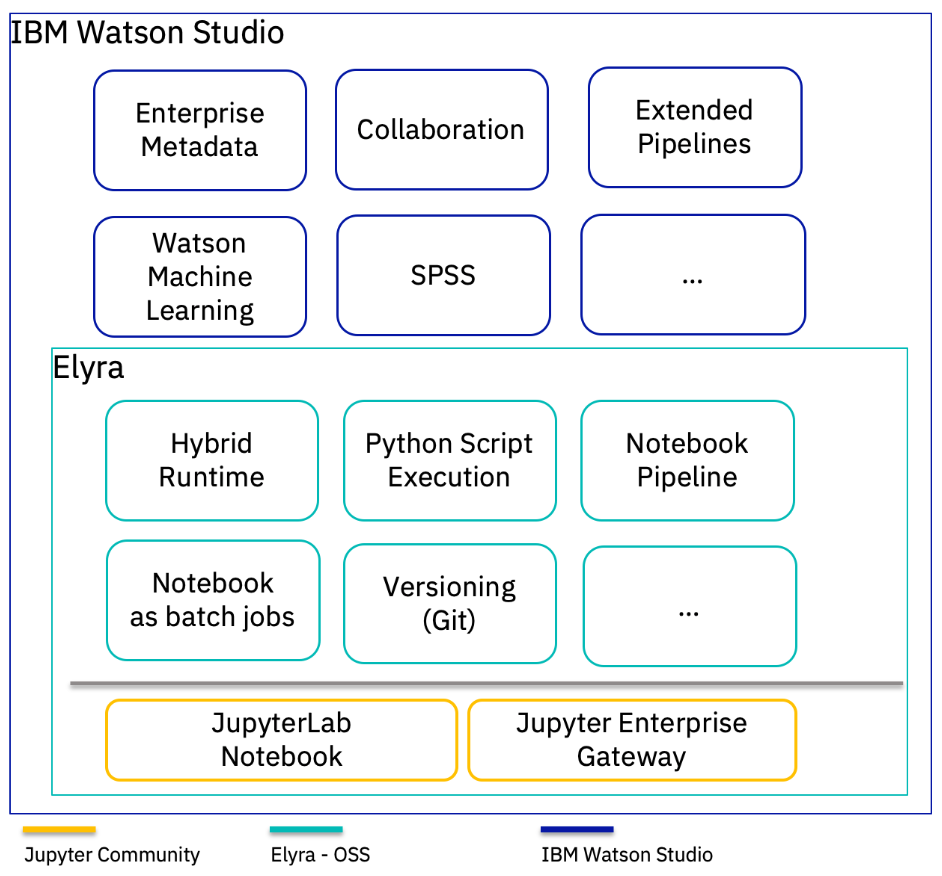
    Elyra and IBM Watson Studio

    IBM recently announced new releases of IBM Cloud Pak for Data and Watson Studio which added JupyterLab as a richer way to work with Notebooks, in addition to classic Jupyter Notebooks. The current version of Watson Studio already provides versioning based on Git integration and is continuing to work with the open source community to incorporate other Elyra extensions.

    Process diagram

    Summary

    Building on a Jupyter Notebooks foundation, the de facto tool for data scientists, machine learning engineers and AI developers, Elyra provides a toolkit designed to help around model development tasks complexity.

    Previously, the work on Jupyter Enterprise Gateway addressed the challenges around scaling enterprise workloads, and now Elyra addresses the challenges of making workload development easier. In addition, IBM is contributing to TensorFlow, PyTorch, Spark, KubeFlow, KubeFlow Pipelines, ONXX, and Egeria to address an even broader set of enterprise data and AI development challenges.

    We would love for you to get involved with the project. Read our contributing guidelines, create new issues if you have questions, suggestions for new features or in case of any problems. We also welcome contributions via GitHub pull requests.

  • Former Jive CEO, Netflix’s CHRO and Five9’s CFO Join JFrog’s Board of Directors

    JFrog appoints industry leaders as board members and leaps forward with continued growth momentum in the DevOps market

    SAN FRANCISCO, April 29, 2020 (GLOBE NEWSWIRE) — JFrog, the Universal DevOps technology leader known for enabling Liquid Software via continuous software release flows, today announced it has added three independent members to its Board of Directors. The new Board members, Jessica Neal, Elisa Steele and Barry Zwarenstein, have all supported fast-growing companies scale through significant corporate milestones and are key additions to the JFrog team, helping advise the company’s leadership on its continued path of growth.

    Thus far in 2020, JFrog has continued to build strong momentum as a leader in the DevOps software market. The company boosts the world’s Digital Transformation efforts by providing DevOps solutions to over 5,600 customers and millions of developers around the globe.

    “We’re excited to join pioneers and leaders from the tech industry and proud to welcome Elisa, Jessica, and Barry to JFrog’s Board of Directors,” said Shlomi Ben Haim, JFrog’s co-founder and CEO. “Their strong experience, especially in building global SaaS businesses across software emerging markets, will be extremely valuable as JFrog continues to grow and support the world’s digital transformation through DevOps.”

    Jessica Neal currently serves as the CHRO of Netflix (NASDAQ: NFLX), and previously served on the Board of the Association for Talent Development. She has also worked as head of human resources at the online learning platform Coursera, and as Chief People Officer for the mobile gaming company Scopely.

    Joining the Board of JFrog is an immense honor,” said Jessica Neal. “Bridging the gap between technology and people is key to the future of all industries, and JFrog is positioned well for immediate and ongoing success. I look forward to participating in that journey.”

    Elisa Steele served as CEO of Namely and Jive Software, and currently is the chair of the board of directors for Cornerstone OnDemand (NASDAQ:CSOD) and Namely; and also serves on the boards of ProCore Technologies and Splunk (NASDAQ:SPLK). She has also held executive positions for Microsoft, Skype, Yahoo! and NetApp.

    “I strongly believe in the future of JFrog and their innovative universal, end-to-end DevOps platform,” said Elisa Steele. “I am thrilled to serve on the Board of this amazing company and support the global employees who are incredibly committed to the company and the success of our customers.”

    Barry Zwarenstein is the Chief Financial Officer of Five9 (NASDAQ: FIVN), a publicly-traded leader of cloud-based contact center technology. Mr. Zwarenstein managed the company’s successful IPO in 2014 and served as interim CEO from the end of 2017 to May 2018. Zwarenstein, a veteran CFO  and leader in the financial industry also served as CFO at VeriFone, SMART Modular Technologies and Logitech and guided the companies through successful IPOs. Mr. Zwarenstein has also served as the Audit Committee Chair on the board of DealerTrack Technologies.

    “JFrog is an excellent company with innovative tools that drive the DevOps industry, and I am excited to be a part of the Board,” said Barry Zwarenstein. “I believe between the Board and the management team, we are committed to achieving outstanding performance for the foreseeable future.”

    Ben Haim added: “We conducted an exhaustive search for proven leaders with a wealth of operational field experience in public companies who would further strengthen our Board, and I’m delighted to have identified such outstanding individuals that not only fit the caliber we were after but also align with JFrog’s DNA. The DevOps market will benefit from their experience as we fulfill our Liquid Software vision.”

    About JFrog

    The interactive, digital experience of the modern world is constantly improved through software updates. Software updates are constantly delivered by JFrog. We’re on a Liquid Software mission to power all the software updates in the world by enabling developers to code applications that flow – like liquid – to end-users securely and without downtime. As a leading universal, highly available enterprise DevOps platform, the JFrog Platform empowers customers with trusted and expedited software releases from code-to-production. Growing rapidly, JFrog is trusted by more than 5,600 enterprises across all industries, and top global brands depend on JFrog to revolutionize their software build-to-delivery processes. Some JFrog products are available as open-source, with all commercial subscriptions available both self-managed and in the cloud on AWS, Microsoft Azure, and Google Cloud Platform. JFrog is privately held with offices across North America, Europe, and Asia. Learn more at jfrog.com.

  • Puppet Names Abby Kearns CTO

    Kearns to Oversee Next Phase of Enterprise Platform Development, Expand Commercial Offerings

    PORTLAND, Ore., April 29, 2020 (GLOBE NEWSWIRE) — Puppet, the standard for automating the delivery and operation of the software that powers everything around us, today announced Abby Kearns as its CTO. Kearns brings 20 years of deep expertise in cloud computing and growing open source communities, having held key leadership and product management positions at Cloud Foundry Foundation, Pivotal Software and Verizon. Under Kearns’ leadership, Puppet will continue to grow and evolve its product portfolio to deliver on the promise of helping enterprises modernize and manage their infrastructure to remain efficient, secure and compliant, and quickly deliver better software and services faster.

    “Puppet is a pioneer of the DevOps movement, ushered in the concept of Infrastructure as Code (IaC), and drives efficiency through infrastructure automation for 80 percent of the Fortune 5000. I couldn’t be more excited to join such an amazing team and to further the potential we have in a market that is changing quickly,” said Kearns. “As Puppet’s CTO, I look forward to working with leading enterprises to effectively shift how they are managing and scaling their infrastructure in an increasingly hybrid world; something never more important than now with COVID-19 fundamentally changing how we need to work and run our operations.”

    “As we continue to drive accelerated impact in the marketplace, we need the right people at the table to bring our vision to life. This is why I’m thrilled to welcome Abby Kearns as our Chief Technology Officer. I’ve been lucky enough to call Abby a peer and have been following her career for many years,” said Yvonne Wassenaar, CEO at Puppet. “Abby is keenly aware of Puppet’s mission, having served on our Product Advisory Board for the last year, and is a technologist at heart. She brings a great balance to this position for us – she has deep experience in the enterprise and understands how to solve problems at massive scale.”

    Kearns is a veteran of the technology industry, with a career spanning product marketing, product management and consulting across Fortune 500 companies and startups alike. Most recently, Kearns served as the Executive Director of the Cloud Foundry Foundation where she focused on driving the Foundation’s vision and growing the open source project. Prior to Cloud Foundry, she drove the adoption of Pivotal Cloud Foundry, and at Verizon, she led the Product Management teams dedicated to the early days of cloud services. Her background also includes operations spanning companies such as Totality, EDS, and Sabre.

    At Puppet, Kearns will lead the vision and direction of the company’s current and future product portfolio, ensuring customers have the right tools and platform they need to be successful through Puppet’s commercial offerings.

    Additional Resources

    About Puppet
    Puppet is driving the movement to a world of unconstrained software change. Its revolutionary platform is the industry standard for automating the delivery and operation of the software that powers everything around us. More than 40,000 companies — including more than 80 percent of the Fortune 5000 — use Puppet’s open source and commercial solutions to adopt DevOps practices, achieve situational awareness and drive software change with confidence. Headquartered in Portland, Oregon, Puppet is a privately held company with more than 500 employees around the world. Learn more at puppet.com.

  • Kong Inc. Open Sources Insomnia Designer – a Collaborative Design Editor for APIs

    Kong Inc. Brings the Insomnia Community New Software to Accelerate the Creation of High-Performing, Stable APIs, While Fueling Innovation of Kong Studio

    SAN FRANCISCO, April 29, 2020 /PRNewswire/ — Kong Inc., the leading cloud connectivity company, today announced the release of a new open source tool called Insomnia Designer. Building on Insomnia Core, which Kong acquired in 2019, Insomnia Designer provides a collaborative API design editor that makes it easier for developers and DevOps teams to create and edit API specifications. The software works natively with Insomnia’s testing capabilities to accelerate the development, performance and stability of REST and GraphQL services, the communications backbone of the modern applications and services people rely on each day. Insomnia Designer is available now at https://insomnia.rest/download or can be downloaded by Kong Enterprise customers as part of Kong Studio.

    “With Insomnia Designer, we’re building on Insomnia’s open source foundation to provide a single, collaborative workflow for teams to design APIs,” said Greg Schier, tech lead at Kong Inc. and creator of Insomnia. “Insomnia is the most popular open source tool for exploring and debugging GraphQL and REST APIs, and we’re looking to have Insomnia Designer follow the same principles.”

    The need for stable, high-performing APIs has never been greater. With digital transformation initiatives in full swing at companies of all sizes and industries, applications are becoming increasingly distributed. Market research shows that the vast majority of companies (84 percent) are already using microservices, and a growing number have moved entirely to distributed architectures. Functioning as the nerve endings connecting decentralized applications and systems, APIs enable and govern how microservices communicate and exchange information. Insomnia Designer makes it simple to design APIs and use them across different repositories.

    “In the new era of API-driven applications and architectures, the importance of clean and extensible API design is essential to enable both API consumption and API innovation, and it has long been our goal at Kong to provide open source tools for designing APIs and microservices at scale,” said Marco Palladino, CTO and co-founder of Kong Inc. “We are thrilled to share Insomnia Designer with our community.”

    Insomnia Designer: Wakes Up API Design for All Types of Application Interfaces

    Unlike other API design tools that enforce one-size-fits-all processes, Insomnia Designer brings a spec-first development approach that allows users to create workflows that mirror the way their teams communicate to foster better collaboration. The new Insomnia Designer empowers developers to more easily design REST and GraphQL APIs by using Git repository as a single source of truth. By enabling GitOps best practices, Insomnia Designer facilitates collaboration, increases release velocity, and allows developers to track changes from multiple people and ensure code is up to standards through pull request reviews.

    To expand on the GitOps capabilities offered within Insomnia Designer, Kong is also releasing plugins that enable Insomnia Designer users to automatically embed Kong Gateway policies directly into their API specification files. In line with GitOps best practices, this allows all configurations for the Kong Gateway and API to be stored in the same Git repository. Within the Insomnia Designer UI, users can select Kong Plugins for capabilities such as authentication or rate-limiting to govern their API’s behavior, and input it directly into their code.

    Key features include:

    • Provides a single, collaborative space for developer teams to browse, explore and collaborate on API specs for both REST and GraphQL endpoints
    • Automatically generates configurations for both Kubernetes and Kong for Kubernetes within the individual API spec file
    • Allows users to easily search for API design and view critical details, including Git Status, Git Branch and more via the Insomnia Document Listing
    • Increases the automation of developer workflows via plugin integrations with Kong Gateway and the Kong Enterprise platform
    • Includes all features in Insomnia Core within an UI/UX optimized for API design workflows

    Availability

    Download open source Insomnia Designer at: https://insomnia.rest/download

    Resources

    About Kong Inc.

    Kong creates software that connects APIs and microservices natively across and within clouds, Kubernetes, data centers and more using intelligent automation. Built on an open source core, Kong’s solutions enable digital innovation by allowing organizations to reliably and securely manage the full lifecycle of APIs and services for modern architectures including microservices, serverless and service mesh. By providing developer teams with unprecedented architectural freedom, Kong accelerates innovation cycles, increases productivity, and seamlessly bridges legacy and modern systems and applications. For more information about Kong, please visit konghq.com or follow @thekonginc on Twitter.

  • InfluxData expands into Asia Pacific region with Digital China and Hyundai BS&C partnerships

    New distribution partnerships will support increased demand for InfluxDB across the region


    SAN FRANCISCO — April 29, 2020 — InfluxData, creator of the time series database InfluxDB, today announced its expansion into the Asia Pacific (APAC) region through new strategic partnerships. Digital China and Hyundai BS&C will be the exclusive value-added distributors of InfluxDB in China and South Korea, respectively. The company also teamed up with Intellify, a reseller in Australia. There will be dedicated sales and support teams in each country to empower local users and customers to leverage time series data for faster, more scalable monitoring, analytics, and IoT applications.


    Driven largely by instrumentation of systems and applications and the proliferation of IoT devices, data volumes are expected to grow exponentially over the next several years, and most of that data is time-stamped. InfluxDB is purpose-built for time series data and is capable of efficiently ingesting millions of metrics per second, downsampling, and compressing large volumes of data. It provides users with real-time observability into their systems, delivering granular insights that can optimize operations and improve customer experience. InfluxDB supports a wide range of user applications, including real-time analytics, network and infrastructure monitoring, and SLA-related monitoring.


    The new partnerships with APAC distributors will support the growing demand for InfluxDB in the region. Over the last two years, the number of InfluxDB open source users in APAC has increased organically by more than 400 percent, and InfluxData has already signed several prominent customers, including SoftBank, LINE Mobile, Hyundai Heavy Industries and the Australian Bureau of Meteorology.


    “Our expansion into the Asia-Pacific region represents a huge opportunity for InfluxData,” said Evan Kaplan, CEO of InfluxData. “We have selected excellent organizations to support our enterprise entry into these markets, and we’re making it easier than ever to harness the power of InfluxDB for this rapidly growing user base. With local dedicated support and sales teams, we’ll be able to create a better experience for customers. By expanding availability and support for InfluxDB around the world, we’re giving developers the tools they need to get more value from their data, more efficiently.”


    APAC represents a vast and untapped opportunity for InfluxData. A majority (52 percent) of organizations in APAC are already using open source software for databases (Illuminas/Red Hat), and by 2023, organizations in the region are expected to spend $2.3 trillion on digital transformation spending, with infrastructure software as the fastest-growing category (IDC).


    Digital China is a leading IT solutions distributor in China. The company works with thousands of domestic and international vendors and has a proven track record of successfully bringing U.S.-based technology companies into the Chinese market. More information on this partnership is available at www.dcclouds.com/productMarket/category/Database/detail/database.

    “The InfluxDB open source community is strong in China, and we are thrilled to support its continued growth and to bring this innovative technology to customers in an enterprise capacity,” said Hao Junsheng, CTO of Digital China Group. “We have extensive experience in the Chinese market, with over 20 years of business and 30,000 channel partners, so we are ready to introduce the leading time series database to Chinese customers across different industries that want to leverage their massive volumes of time-stamped data. Digital China and InfluxData will work together closely to accelerate our clients’ digital transformation, and we are confident that our partnership will be a technology and marketing success in China’s open source market.”


    Hyundai BS&C is a Korean leading provider of IT solutions, including distribution, outsourcing and consultancy services. More information on this partnership is available at www.hd-bsnc.com/business/service.do#tab05.


    “This groundbreaking agreement will satisfy Korean demand for enterprise time series database solutions,” said Choi Joong Ho, CIO of Hyundai BS&C. “We expect that analyzing large volumes of time-stamped data will significantly improve corporate productivity for organizations in a wide range of industries. It will not only help customers reduce their operational costs for processing huge amounts of time series data, but will also serve as an efficient solution for business application development.”


    InfluxDB is built for builders who appreciate its versatility for a wide range of use cases that involve time series data. InfluxDB is deployed by organizations of all sizes and across industry segments — from financial services and manufacturing to government and healthcare.


    These new partnerships are part of the company’s aggressive global growth strategy. Over the last 12 months, InfluxData added nearly 200 new enterprise customers to the growing list of organizations using InfluxDB around the world, including McLaren, Visa, Yoox and Airbus. In 2019, it expanded into Europe with sales and engineering support. The company also hired Richard Ting as managing director for APAC. Ting is responsible for developing channel sales and strategic partnerships in the region to propel InfluxData’s expansion.


    About InfluxData

    InfluxData is the creator of InfluxDB, the open source time series database. Our technology is purpose-built to handle the massive volumes of time-stamped data produced by IoT devices, applications, networks, containers and computers. We are on a mission to help developers and organizations, such as IBM, Visa, Siemens, Tesla and NASA, store and analyze real-time data, empowering them to build transformative monitoring, analytics, and IoT applications quicker and to scale. InfluxData is headquartered in San Francisco with a workforce distributed throughout the U.S. and across Europe. For more information, visit www.influxdata.com and follow us @InfluxDB.


    ###

  • ConnectALL Announces Release of Version 2.10 and ValueStreamManagement.com, Significantly Extending Their Value Stream Management Offerings

    Enhancements include an interactive Value Stream Visualizer, which enables users to generate a complete map of their value stream, extended lean metrics, and a new user interface.

    ATLANTA – April 28, 2020 – ConnectALL, a software value stream management company, today announced its latest release, ConnectALL 2.10. With the release, ConnectALL rolled out an exclusive value stream empowerment tool, the ConnectALL Value Stream Visualizer, along with enhanced lean metrics to provide actionable data for better decision-making. This latest release, paired with ConnectALL’s patent-pending Universal Adapter, endows teams with functionality and project visibility never before available in the value stream management (VSM) space.

    The complete ConnectALL value stream management platform enables companies to achieve greater business value in their software value streams through its unique components:

    • The Value Stream Visualizer generates an interactive diagram that traces the path of each integration mapped within ConnectALL, as well as additional elements and connections – such as manual steps, paper/physical artifacts, customers, and suppliers – to fully map and provide real-time visibility of the entire software value stream.
    • ConnectALL Value Stream Insights captures all observable activities and computes lean metrics out of the box – including process time, cycle time, lead time, flow time, wait time, value added time, MTTR, escaped defect ratio, WIP, blocker data, queues, throughput and production impact – to provide teams with actionable data about the health of their value stream.
    • The Database Adapter allows ConnectALL to aggregate data in any database, extending lean metrics reporting capabilities to the user’s BI tool of choice.
    • The ConnectALL Integration Platform’s built-in vendor adapters enable users to integrate the applications used to collaborate, drive decisions and manage artifacts used during the software delivery process, including ALM, Agile and DevOps.
    • The Universal Adapter extends ConnectALL’s native capabilities, enabling users to establish an unlimited number of integrations with any third-party tool and experience the same bi-directional synchronization of project-related data and actions available in existing ConnectALL vendor adapters.

    “With this latest release, ConnectALL is empowering the real drivers of VSM – humans – to automate their entire value stream, as well as gain unprecedented visibility with granular insight into activities at every level and stage of the process,” said ConnectALL COO Lance Knight. “The Universal Adapter and Visualizer, in tandem with the lean metrics that flow from the ConnectALL solution, enable companies to radically streamline the efficiency of their software delivery pipeline.”

    In addition to its new Visualizer and enhanced lean metrics capabilities, ConnectALL allows teams to orchestrate multiple automated workflows between disparate systems, as well as streamline and optimize frequently occurring processes and workflows to deploy applications more efficiently. ConnectALL also can enforce governance rules, requiring that specific criteria be met before synchronizing changes and triggering events, providing greater automated control of the software development process.

    ConnectALL also has created valuestreammanagement.com, a free online platform for value stream mapping and delivery. On the site, users can access the Value Stream Visualizer to configure and map their value stream, including future state plans. Users can then download that map to drive more efficient and agile value stream integration within their organization and provide a structure for tracking improvement.

    About ConnectALL
    ConnectALL helps companies achieve value stream management and create business value by bringing software innovation to market faster. The company’s integration platform, which was recognized as Best in Show in the Value Stream Management category of the 2019 SD Times 100, unifies applications, tools, people and processes, connecting dozens of software delivery tools and facilitating powerful cross-team collaboration. In short, it empowers the true value drivers of software development — humans — to achieve project goals. Paired with its Universal Adapter, ConnectALL can unite an unlimited number of tools for seamless collaboration, bi-directional information capture and exchange, automated event triggering, and much more. For more information, visit https://www.connectall.com and https://valuestreammanagement.com.


  • Cloudbees Commissions State of Software Delivery Management Survey

    ASG Research commissioned to investigate the impact that enterprise software delivery efficiency is having on the business  

    April 28, 2020 – CloudBees, Inc., the enterprise software delivery company, today announced that it has commissioned a survey with Accelerated Strategies Group, the analyst company whose mission is to democratize access to industry expert knowledge. The survey, authored by Principal Analyst Sanjeev Sharma, will explore the current state of maturity of Software Delivery Management (SDM) in the enterprise.

    The ability to effectively deliver software is vital to disruptive and digital transformation business strategies. However, many organizations today are facing significant challenges in managing multiple interdependent supply chains to deliver software. Overcoming these challenges is important to achieving business agility. With agility, businesses are able to pivot and adapt quickly to changing conditions – an important trait in the current chaotic business environment due to the COVID-19 pandemic. This research will examine the current state of SDM across enterprises and will focus on their ability to achieve impactful business results by efficiently delivering software. The results will enable organizations to benefit from the research, in effect using them as a benchmark to compare with their own current software delivery results.

    “We know that software delivery is a vital aspect of business today and one that continues to grow in importance. The data gathered in this survey will help us study business impact through effective software delivery management,” said Mitch Ashley, CEO of Accelerated Strategies Group. “We will examine aspects of culture, metrics and technology that influence software delivery. The research will also capture the root causes of the challenges organizations are facing – and our goal is to have the results ultimately help to inform improved business processes for organizations.”

    “To become truly software-first, organizations need to eliminate silos, unify information across tools and embrace full visibility into the software delivery process,” said Andre Pino, vice-president of marketing, CloudBees. “We hope that this research will provide a deeper understanding of the impact that Software Delivery Management has, and will continue to have, on business success. The ability to assess the current state of end-to-end delivery pipelines, efficiency and collaboration empowers us to be better positioned in supporting the needs of organizations and their customers.”

    Take the survey between now and May 29th, 2020.

    Additional Resources:

    About Accelerated Strategies Group

    Disruption is occurring across every aspect of IT. Open source, cloud services, DevOps and cloud-native software architectures are democratizing IT and radically transforming how business is done in every industry and in organizations large and small. The old ways of creating software and “doing IT” are being replaced with agile, flexible, faster and cheaper methods, benefitting vendors and users alike.

    Accelerated Strategies Group is out to democratize access of industry expertise and knowledge. Our experts don’t just regurgitate what others tell us; we use our expertise and experience to offer insightful, intelligent, useful information in a variety of formats relevant to the IT community: digital events, videos, reports, assessments, workshops and implementation projects with tech vendors, IT organizations and business leaders. And, similar to the open core model of open source companies, we widely and openly share our work products, often for free. Follow Accelerated Strategies Group on Twitter and LinkedIn.

    About CloudBees

    CloudBees, the enterprise software delivery company, provides the industry’s leading DevOps technology platform. CloudBees enables developers to focus on what they do best: Build stuff that matters, while providing peace of mind to management with powerful risk mitigation, compliance and governance tools. Used by 50% of the Fortune 100, CloudBees is helping thousands of companies harness the power of continuous everything and gets them on the fastest path from great idea, to great software, to amazing customer experiences, to being a business that changes lives.

    Backed by Matrix Partners, Lightspeed Venture Partners, Verizon Ventures, Delta-v Capital, Golub Capital and Unusual Ventures, CloudBees was founded in 2010 by former JBoss CTO Sacha Labourey and an elite team of continuous integration, continuous delivery and DevOps professionals. Follow CloudBees on Twitter, Facebook and LinkedIn.

  • Applitools Announces A/B Testing Support and Slack Integration to Help Teams Manage Quality More Effectively

    Simplify visual validations for multiple variations of a web or mobile app and seamlessly share test results with your team via Slack or email


    SAN MATEO, Calif., April 28, 2020 – Applitools, the leading provider of Visual AI powered test automation, today announced enhancements to its flagship product, Applitools Eyes. Applitools Eyes now offers customers the ability to A/B test up to 20 variations of dynamic content and collaborate like never before via Slack or email.

    Sign up for a free Applitools account and start using Visual AI today at (https://applitools.com/users/register).

    “A/B testing is a business imperative at GoodRx – it helps our product team deliver the absolute best user experience to our valued customers,” said Priyanka Halder, Sr. Manager, Quality Engineering at GoodRx. “Until now, our quality team struggled to automate tests for pages with A/B tests – we’d encounter false positives and by the time we wrote complex conditional test logic, the A/B test would be over. Applitools implementation of A/B testing is incredibly easy to set up and accurate. It has allowed our quality team to align and rally behind the business needs and guarantee the best experience for our end-users.”

    A/B Testing to Validate Multiple Variations of an Application

    In order to optimize engagement and increase customer conversion, online businesses offer multiple customized variations of web and mobile screens to their customers. This requirement creates a significant challenge for test engineers to automate the testing process.

    A/B testing and more specifically, multivariate testing (MVT), is a technique used to compare multiple variations of the same application to determine which version is more effective with users. The problem is that many teams don’t automate tests to validate multiple variations because it’s expensive, “throwaway” code with endless conditional logic attempting to cover every variation.

    With Applitools Eyes and its new A/B Testing feature, developers and QA professionals can automatically test multiple variations with a single line of code instead of writing complicated testing scripts that cover all the potential options. If any of the variations come up and there are no bugs, the test will pass. By being able to quickly support A/B variations, QA teams are no longer a roadblock to business optimization.

    For additional detail on how to automate A/B variations with Applitools Eyes, visit Angie Jones’ recent article: (https://applitools.com/blog/validating-multiple-variations).

    Slack Integration Improves Collaboration amongst Distributed QA & Dev Teams

    Users can now integrate the visual test results from Applitools Eyes into any Slack channel in order to share and notify any bug immediately after being detected. It is possible to achieve this integration in any programming language as the TestResults object is accessible in Java, JavaScript, Python, Ruby, C#, and PHP.

    Here is a step-by-step tutorial on how to integrate automated test results from Applitools Eyes into Slack, visit: (https://applitools.com/blog/integrate-test-results-slack).

    “Applitools is built to test all the elements that appear on a screen with just one line of code,” said Adam Carmi, co-founder and CTO of Applitools. “Our A/B testing capability takes Visual AI one step further and solves for another significant bottleneck for modern automated testing. With the new Slack integration, our customers can share their test results with the entire team making the release process faster than ever before.”

    About Applitools

    Applitools enables Visual AI powered test automation to help teams release high-quality web and mobile apps faster and more efficiently.


    Applitools Visual AI modernizes important test automation use cases — Functional Testing, Visual Testing, Web and Mobile UI/UX Testing, Cross Browser Testing, Responsive Web Design Testing, Cross Device Testing, PDF Testing, Accessibility Testing and Compliance Testing — to transform the way organizations deliver innovation at the speed of CI/CD at a significantly lower Total Cost of Ownership (TCO).


    Hundreds of companies from verticals such as Software, Banking, Insurance, Retail, Pharmaceuticals, and Publishing — including 50 of the Fortune 100 — use Applitools to deliver the best possible digital experiences to millions of customers on any device and browser, and across every screen size and operating system.


    Applitools is headquartered in San Mateo, California, with an R&D center in Tel Aviv, Israel. For more information, please visit applitools.com.


  • Alluxio Launches Enhanced Hybrid Cloud Solution based on Intel Optane Persistent Memory

    Intel Optane persistent memory with Alluxio sees 2.1x performance boost over disaggregated S3 object storage

    SAN MATEO, CA – April 28, 2020 – Alluxio, the developer of open source cloud data orchestration software, today announced a go-to-market solution in collaboration with Intel to offer an in-memory acceleration layer with 2nd Gen Intel Xeon Scalable processors and Intel Optane persistent memory (PMem). The solution eliminates performance degradation of analytics clusters that are increasingly built on disaggregated compute and storage architecture.

    “Today’s disaggregated cloud storage lacks efficient file system semantics support like ‘rename’. Additionally, disaggregated cloud storage typically can’t leverage compute side storage media such as DRAM and SSD for use as buffers and page caches,” said Haoyuan Li, founder and CEO, Alluxio. “Adding Alluxio Data Orchestration System and Intel’s Optane persistent memory solves both issues, enabling maximum benefit for cloud storage and achieving competitive and even better performance than traditional on-premises configurations. This is particularly helpful for hybrid cloud environments when data is remote.”

    Benchmarking results show 2.1x faster completion for decision support queries when adding Alluxio and PMem compared to only using disaggregated S3 object storage. Using Storage over App Direct, a feature of PMem App Direct mode, allows Alluxio to access high-performance block storage without the latency of moving data across the I/O bus to provide the data acceleration and reduction in query runtime. With Alluxio and Intel Xeon Scalable processors, an I/O intensive benchmark delivers a 3.4x speedup over disaggregated S3 object storage and a 1.3x speedup over a co-located compute and storage architecture.

    In addition, Alluxio has joined into a strategic collaboration with Intel aimed at improving their joint customers’ experience with managing and processing their data, such as optimizations for Intel Deep Learning Boost, the AI acceleration technology built –into Intel Xeon Scalable processors. Together, Alluxio and Intel will bring solutions to market to help fuel next-generation data, analytics and AI applications and use cases.

    “With this new collaboration we bring to market a solution that enables enterprise-grade shared storage and faster time to insights to solve for the challenges we see around bounded storage and compute resources on Hadoop,” said Rowan Scranage, Chief Business Officer, Alluxio. “Together with Intel, we plan to disrupt the advanced analytics and AI status quo with an in-memory data accelerator layer to accelerate intermediate data access and ease data bottlenecks that many of our customers are highlighting as key challenges with their increasing big data requirements.”

    “We are thrilled to work with Alluxio and help bring this compelling solution to market,” said Arijit Bandyopadhyay, CTO of enterprise analytics & AI within Intel’s data platform group. “As we see more companies building advanced analytics and AI applications that are faced with performance challenges, the Alluxio-based in-memory data accelerator coupled with Intel’s Optane persistent memory will bring data locality, data accessibility, and data elasticity back into the environment. Based on the performance gains we are seeing with this joint solution, we are looking forward to bringing it to the market at scale.”

    To learn more or get started with the Intel and Alluxio joint solution, please contact sales@alluxio.com

    Resources

    Tweet this:  .@Alluxio launches enhanced hybrid cloud solution based on #Intel Optane technology with major performance boost #DataOrchestration https://bit.ly/3bulmPB