Tag: value stream management

  • Survey Shows Increased Focus on Modernizing IT, Retiring Apps

    Survey Shows Increased Focus on Modernizing IT, Retiring Apps

    A survey of 140 enterprise architects and IT leaders published today suggested that, while moving applications to the cloud remains a priority, more attention is being paid to reducing technical debt by retiring applications.

    Conducted by LeanIX, a provider of a platform for managing enterprise architecture and managing value stream management (VSM), the survey found 40% of respondents identified reducing technical debt created by legacy applications and modernizing legacy systems as their top IT priorities. A full 96% said their company has at least one project planned for this year aimed at reducing technical debt with more than half (52%) noting that retiring IT applications is the primary means they will employ to reduce technical debt.

    Nearly 60% considered migrating applications to the cloud to be a high priority, as well. However, less than a quarter of respondents (24%) identified cloud initiatives as a top IT priority. The second most important cloud initiative, identified by 41% of respondents, is to increase the number of SaaS applications being employed.

    Regardless of the approach to the cloud, nearly three-quarters (73%) of respondents said enterprise architects should form a closer connection with software development teams, with an almost equal percentage agreeing on the importance of tracking the business impact of software development.

    However, only 16% of those surveyed considered the evolution and improvement of their security posture a top priority, even though more than two-thirds considered security initiatives—such as improving risk assessment capabilities and adopting more zero-trust IT offerings—as important or highly important.

    Dominik Rose, vice president of product management for LeanIX, said enterprise architects—or someone within IT who assumes responsibility for enterprise architecture—are trying to minimize disruptions to the business as IT environments continue to expand and evolve. The challenge they encounter is there is usually a divide between software development teams and the rest of the business. The size of that divide will vary by organization; in general, though, digital business transformation initiatives should help bridge the gap—assuming enterprise architects can establish and maintain close connections with software development teams, noted Rose.

    LeanIX is making a case for an enterprise architecture management (EAM) platform that provides visibility into IT environments. The company also makes a VSM offering available on top of that platform that provides visibility into software delivery processes. The number of organizations that have adopted VSM platforms remains relatively small, but as organizations depend more on software to drive digital processes, the need for senior business and IT leaders to have more visibility into software delivery schedules is expected to increase.

    In the meantime, it remains to be seen just how aligned DevOps teams are with the strategic goals of the business. The ability to build and deploy software faster does not automatically equate to gaining a deeper understanding of the needs of the business. In fact, there may come a day when software is built and deployed faster than most organizations can effectively absorb unless they have some equivalent of a VSM platform in place.


  • Tasktop Joins Forces with Broadcom to Connect Data for Value Stream Management

    Broadcom ValueOps Connectors Powered by Tasktop Unites Data and Eliminates Silos, Helping Organizations Better Measure Business Value During Software Development

    VANCOUVER, BC., Mar 8, 2022 — Tasktop, the leading value stream management (VSM) insights provider, today announced a collaboration with Broadcom® to provide the technology that powers Broadcom’s ValueOps Connectors, a solution that delivers bidirectional synchronization of data between Broadcom’s ValueOps Value Stream Management Solution and the software development tools used by data-driven enterprises. This solution has been adopted by dozens of shared Broadcom and Tasktop customers.

    Despite the investments businesses make on Agile and DevOps, most enterprises are still not adequately responsive or adaptive—according to Forrester® only 16% can release more than once a month. Tasktop’s VSM platform helps businesses bridge the gap between software delivery and business outcomes by breaking down the silos, identifying and removing bottlenecks, eliminating waste, and accelerating software delivery.

    Additionally, data used to make business decisions is often unreliable, hard to find, and stuck in silos. Broadcom’s ValueOps Connectors, powered by Tasktop, gives enterprises the ability to collect and unify data across values streams; remove data from silos throughout the enterprise to create complete data sets across all tools and teams; increase collaboration between teams that are using different tools in distributed environments; and eliminate errors related to manual data collection.

    “Every business is a software business and accessible, reliable data is needed to derive value during the software delivery process. This requires solutions to connect technology and the business with the right metrics to enable more effective enterprise digital transformation,” said Dr. Mik Kersten, CEO at Tasktop. “Broadcom’s ValueOps Connectors powered by Tasktop help uncover data lost in silos, the key to unlocking all information needed for effective value stream management.”

    “Data in isolation does not tell the full picture. Eliminating data silos is the first step towards making informed business decisions to better align product development and support overall business strategy,” said Jean-Louis Vignaud, Head of ValueOps Product Group. “Our leading VSM solution leverages these ValueOps Connectors to bring data together to reveal new stories and power value streams.”

    To learn more about ValueOps Connectors, visit broadcom.com/valueops-connectors

    About Tasktop

    Tasktop’s value stream management platform enables enterprises to master software at scale. Leading brands, including half of the Fortune 100, use Tasktop to provide real-time visibility into the health of product value streams, allowing them to make better decisions and align with business goals. Tasktop connects with existing tools and overlays the end-to-end value stream to provide the abstractions, automations, visualizations and forensics needed to practice value stream management on a daily basis. Learn more about Tasktop at tasktop.com and follow us on Twitter @tasktop.

  • Digital Transformation Driving VSM Adoption

    Digital Transformation Driving VSM Adoption

    The number of organizations using value stream management (VSM) to bridge the divide between DevOps and the rest of the business is expected to dramatically increase over the next two years. The shift is due, in part, to investments in digital business transformation initiatives.

    A survey of more than 500 executives, IT and business leaders conducted by Dimensional Research on behalf of Broadcom, a VSM platform provider, finds the percentage of organizations employing VSM will rise from 42% today to 70% in the next two years. Nearly three-quarters of organizations (72%) that are not currently using VSM plan to do so in the next 18 months or more.

    The survey also finds that 85% of organizations are collecting some subset of value stream metrics today as part of an effort to deliver solutions faster (56%), improve decision making (55%) and increase transparency (54%).

    Laureen Knudsen, chief transformation officer at Broadcom, said that as organizations embrace DevOps best practices more broadly to drive digital business transformation initiatives, they need more visibility into the application development process. VSM surfaces the insights required to not only identify bottlenecks but also track how changes in application delivery timetables will impact key performance indicators (KPIs).

    VSM traces its lineage back to lean manufacturing methods, which called for each step of a manufacturing process to be continuously measured. As software development has evolved from being a craft to an automated process using DevOps best practices—and as organizations realize just how dependent they are on software—an appreciation for the value of monitoring the impact of missed software development deadlines on the business is growing steadily. VSM platforms automatically collect technical metrics from DevOps tools that are then correlated against the KPIs the organization decides to track.

    The Broadcom survey found more than 96% of respondents’ companies are already in the process of adopting digital transformation. Strategic objectives include increasing efficiencies (70%), improving product quality (67%) and improving customer value (63%).

    Most respondents (92%), however, are anticipating product development challenges for 2022. The biggest product development challenge cited is a lack of visibility throughout the product life cycle (45%) followed by inefficient processes (44%), lack of resources (42%) and enterprise-wide lack of understanding of how products deliver customer value (42%). A full 89% of the business leaders surveyed also noted they continue to struggle with organizational silos between strategic development and operations; 93% noted that better alignment between teams would improve their organization’s overall return on investment (ROI) in software development. A total of 95% said they believed VSM would optimize their product life cycle processes.

    Knudsen said that, in time, artificial intelligence (AI) technologies will increasingly be infused into VSM platforms to enable automated feedback loops between the business and DevOps teams. In the meantime, DevOps teams should be prepared to adjust project priorities based on the needs of the business and to endure a higher level of scrutiny as business stakeholders become more involved in setting the software development agenda.

  • Plutora Enhances VSM Platform with Release Insights

    Plutora Enhances VSM Platform with Release Insights

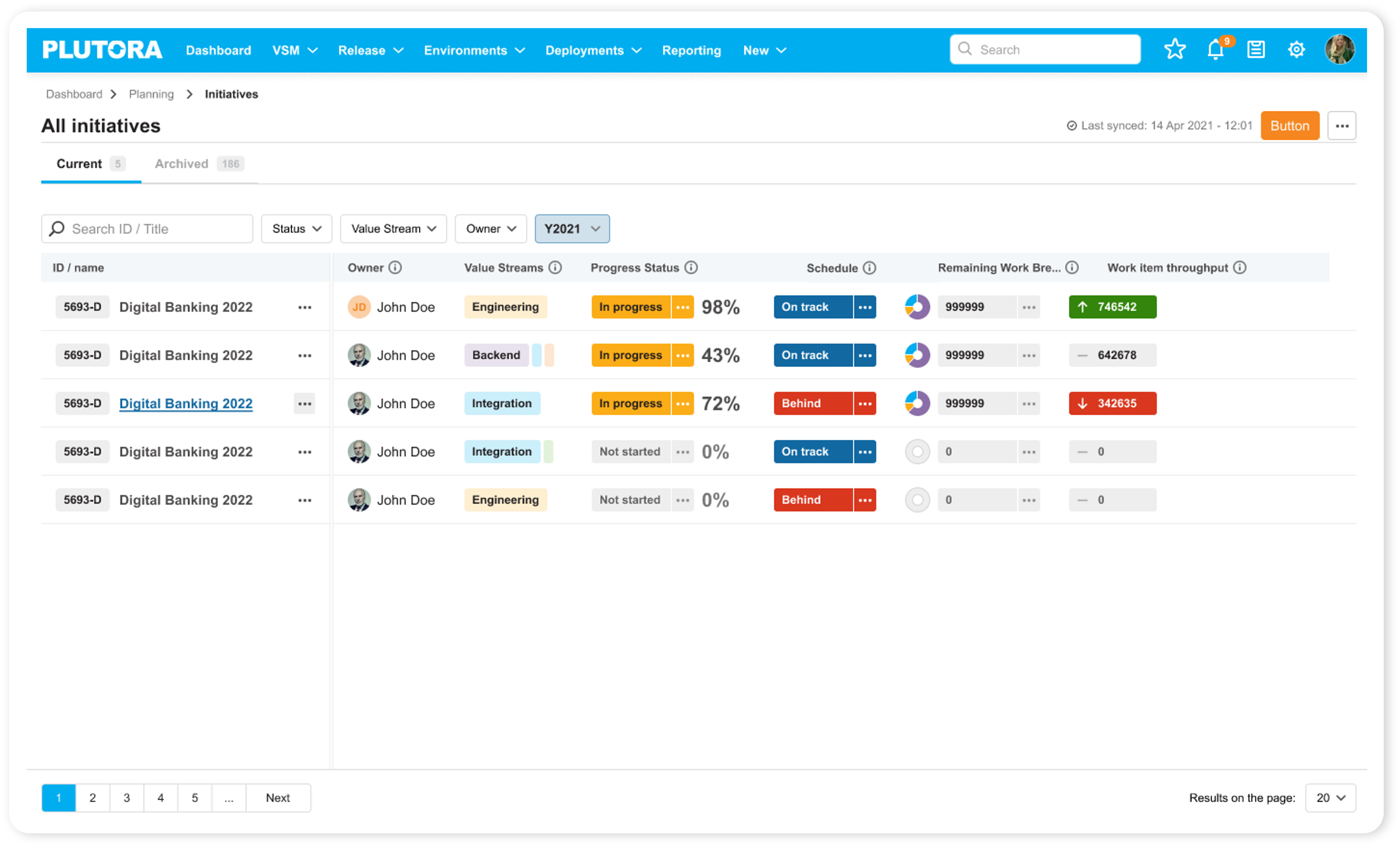
    Plutora has enhanced its value stream management (VSM) platform to provide dashboards that enable DevOps teams to better optimize application delivery.

    Jeff Keyes, vice president of product marketing and strategy for Plutora, said dashboards added to the platform will make it possible for application release managers to leverage predictive analytics to manage application delivery in a more progressive way rather than always having to react to an unexpected event.

    To enable that approach, Plutora has revamped its release insights dashboard that surfaces problem areas and hot spots in addition to adding analytics that track both software builds and larger project initiatives.

    That latter capability is especially critical for executives that currently find it challenging to keep track of multiple software development initiatives, especially those that may have fallen behind schedule without senior leaders being aware of the implications, said Keyes.

    While VSM platforms are typically used by senior IT and business leaders to keep track of how software deadlines are impacting key performance indicators (KPIs) for the business, Keyes said it’s become apparent that application release managers need access to more advanced analytics to optimize application deployment schedules. The Progressive Release Management capability surfaces insights via dashboards in the Plutora platform; that makes it simpler for application delivery managers to optimally orchestrate allocation of resources.

    Release managers, of course, already have access to a wide range of platforms for automating the application delivery process. However, Keyes said, those platforms don’t provide enough insights into how to optimize application delivery across a DevOps workflow made up of disparate tools and platforms. Plutora enables release managers to employ value stream flow metrics and more traditional DevOps metrics to reduce cycle times and improve overall DevOps throughput.

    Keyes said once organizations are provided with that insight, they should also be able to reduce the overall fatigue level many DevOps teams currently experience by removing friction within those workflows. In fact, that fatigue level is a major reason why there is so much turnover in many DevOps teams, he noted.

    It’s not clear how many organizations have a dedicated application release team, but optimizing the software delivery process is a major challenge for almost every DevOps team. While many organizations routinely make use of continuous integration (CI) tools to build applications faster, continuous delivery of applications has proven to be a more elusive goal. This is largely because each platform on which applications are deployed tends to be unique. As a result, many DevOps teams still rely on spreadsheets to manually manage application deployments.

    However, as the pace at which applications are being built continues to accelerate, it’s clear that application delivery is becoming a bottleneck. VSM platforms provide a means of applying analytics to optimize a process that can then be used to make better-informed decisions that might convince more organizations to automate application delivery. That assumes, of course, that the organization had the foresight to invest in a VSM platform capable of surfacing those insights in the first place.

  • Allstacks Adds Free Dashboard to Track Software Dev Benchmarks

    Allstacks Adds Free Dashboard to Track Software Dev Benchmarks

    Value stream intelligence platform provider Allstacks today added a free live dashboard populated with anonymized data that DevOps teams can use to benchmark their own progress.

    Hersh Tapadia, Allstacks co-founder and CEO, said the company is making this data available to make it easier for DevOps teams to uncover bottlenecks in their software development processes.

    As part of that effort, the dashboard includes pre-configured benchmarks for the following:

    How many days per week do benchmark teams write code?
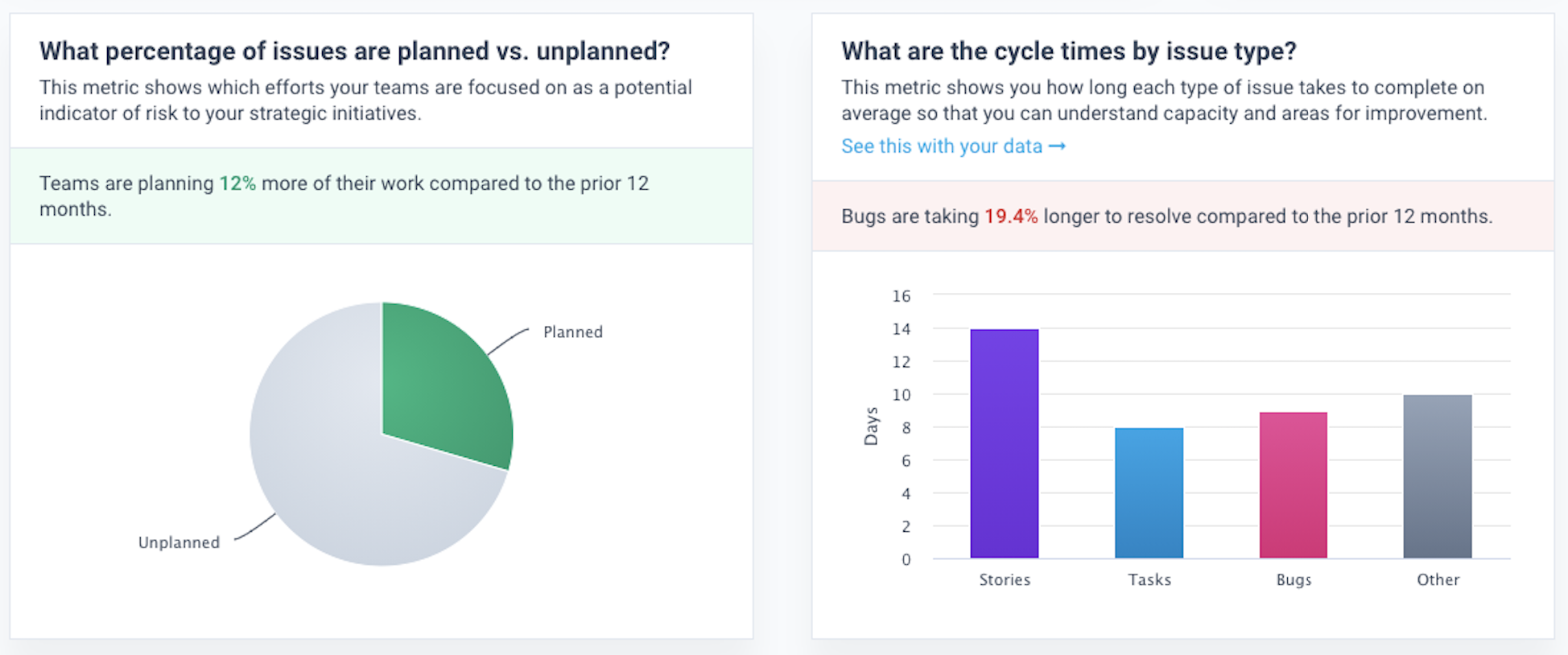
    What percentage of issues are planned versus unplanned for benchmark teams?
    What are the cycle times per issue type for benchmark teams?
    What types of code do benchmark companies produce?
    What is the average commit size for benchmark customers?

    Allstacks

    Allstacks has committed to making 12 months of data publicly available on the dashboard and said it will update that data on an ongoing basis. Allstacks customers, however, can also access five years of data to compare historical trends.

    Tapadia said Allstacks plans to add additional benchmarks to a dashboard that can collect data via the various application programming interfaces (APIs) that most DevOps tools now routinely provide. The overall goal is to increase transparency into software development processes, he said.

    Allstacks’ value stream intelligence platform uses machine learning algorithms and artificial intelligence (AI) models to identify projects that are at risk of not meeting delivery goals. That data is then used to analyze the impact those missed deadlines are likely to have on various business objectives.

    Value stream management platforms automatically take technical metrics, gathered via a DevOps process, and match them to a set of key performance indicators (KPIs) defined by business leaders. The challenge many organizations still face is making sure they have the tools in place to collect the appropriate technical metrics and then define the KPIs that truly matter to the business. Once those metrics are gathered and KPIs established, organizations are then able to apply advanced analytics to the massive amounts of DevOps data they collect.

    The concept of value stream management traces its lineage back to lean manufacturing methods, which called for each step of a manufacturing process to be continuously measured. As software development has evolved from being a craft to a process that is highly automated using DevOps best practices, an appreciation for the value of monitoring the impact of missed software development deadlines on the business has grown as organizations realize how dependent they are on software.

    As a result, more organizations realize there is a clear disconnect between their business goals and development processes, noted Tapadia. Business leaders are especially anxious to understand how a software development project delay might impact future revenue projections. Rather than being a set of tools employed mainly by IT leaders to track software development projects, value stream management platforms make it possible for other stakeholders to track KPIs spanning multiple software development projects. It then becomes easier to make informed decisions about how to reassign resources across various projects as different bottlenecks are encountered.

    It may be a while before organizations achieve that level of transparency into their software development processes, but as software continues to ‘eat the world,’ it’s only a matter of time before value stream management becomes a required set of DevOps tools for every organization.

  • Why You Need a Value Stream Delivery Platform

    Why You Need a Value Stream Delivery Platform

    While the pandemic was significantly challenging for businesses, it exposed the need to quickly adapt and change. Software products for internal or client use continue to provide an opportunity for a competitive edge in nearly any industry. Businesses will immerse themselves and compete in the digital economy by consistently producing better software products at an ever-increasing pace.

    In the past year, two new solutions with similar names have been gaining attention: value stream management platforms and value stream delivery platforms. Both are designed to help firms improve their software development process. The end goal for both is also similar—speed up development—but how each accomplishes this goal is important to differentiate the two.

    So which one should you use? We’ll cut to the chase—the value stream delivery platform provides more strategic long-term value. Here’s why.

    First: Value Stream Mapping

    To understand the need, you first need to understand value stream mapping. This involves visualizing the value stream processes and events from conception and creation to testing, production and, finally, release. By mapping the value stream, you can get a better understanding of the workflow and identify dependencies between the different activities, which will help you identify any blockages or impediments to delay delivering customer value.

    Staying abreast of your value stream is essential to delivering value to the customer as it connects all the multiple teams, tools and applications along the way. By gaining clearer visibility into the entire software delivery process, you can then scale your enterprise by bringing other teams on board for greater collaboration. Additionally, tracking your value streams can help reduce any risks to performance, as you can easily see the throughput and stability of your products.

    Value Stream Management Platforms (VSMP) Explained

    Simply put, value stream management helps solve poor visibility across the software delivery life cycle. You can measure and manage the performance of your software delivery team, identify any areas for improvement and leverage best practices that support collaboration through teams. Additionally, a value stream management platform helps connect applications, teams and tools through the collection of static data used to improve ongoing delivery performance.

    One benefit to using a value stream management platform is that existing toolchains remain undisturbed. The VSMP simply integrates with the different datasets across the existing process and provides the desired visibility and analytics to the different product value stream(s) across the organization.

    An Underlying Problem: Toolchains

    The lure of easy visibility that a value stream management platform provides is somewhat deceptive. The constant pressure to create and deliver better software faster using multiple tools and manually built toolchains has reached its breaking point:

    • Poor interoperability, manual handoffs and disparate data have created DevOps automation silos
    • The multiple test environments used through the process and the need for multi-cloud and hybrid deployments add tons of unnecessary complexity
    • Increased policy and security requirements simply cannot scale and remain manual

    Developers are caught in the middle—they must understand both a complex development and deployment process plus build a complex product for their customers—but being an expert in both is nearly impossible.

    The use of internal platform teams has been recognized as a way to solve this problem. The platform team is responsible for providing an easy-to-use solution; essentially treating developers as customers. In turn, the developers can focus their efforts on the software products they’re responsible for and on satisfying client needs.

    How is a Value Stream Delivery Platform Different?

    Many firms have learned the hard way that building an internal platform is risky, time-consuming and expensive. A value stream delivery platform replaces the traditional, manually built toolchains used today and sidesteps the risk, cost and development time involved in building a platform in-house.

    A VSDP should:

    • Cover the entire process of planning and creation, integration and verification, deployment and operations and, finally, monitoring and improvement
    •  Have both security and compliance capabilities built into the platform foundation
    •  Integrate DevOps point solutions, plus easily add or change tools over time
    •  Provide a centralized data model that creates one source of truth for the development process
    • Provide metrics and reports to accelerate process and value stream improvements
    • Improve software quality through continued enhancements based on best practices

    A value stream delivery platform cuts the administrative burden on DevOps teams, allowing them to refocus their efforts on providing significantly higher value. Instead of maintaining toolchains, they can now help identify process bottlenecks, expand automation and work directly with application teams to drive standards.

    Value stream management platforms provide value in understanding the process and where it can be improved. But they don’t fix the underlying toolchain problem. Instead, the improved visibility may tempt some to squeeze more productivity from developers over the short term without addressing the underlying toolchain problem. However, replacing toolchains with a value stream delivery platform can help address all these issues, and may prompt you to retire your value stream management platform.


    To hear more about cloud-native topics, join the Cloud Native Computing Foundation and the cloud-native community at KubeCon+CloudNativeCon North America 2021 – October 11-15, 2021

  • Empowering Teams to Make Mission: Impossible Possible

    Empowering Teams to Make Mission: Impossible Possible

    “Your mission, should you choose to accept it….”

    That’s the way the original Mission: Impossible TV show and, later, the movie series drew us in. The bad guy’s operation was explained. The goal was clearly defined; infiltrate and destroy. And although the task at hand was extremely difficult and fraught with unknowns, the team of good guys was briefed and everyone understood what they were doing and why. Cut to the good guys succeeding despite the odds being stacked against them.

    For most of us in product development, I think we’ve all faced—or are facing—our own impossible mission. We’re all working on “urgent” projects against some pretty tough odds. Except, unlike the old TV show, we often lack a clear goal. Sure, we’ve got our best team members on it—but does everyone understand why we’re doing what we’re doing? What, exactly, is our mission?

    No Dossier, No Chance

    In the frantic rush to “digitally transform” by churning out new products and features, the mission (if there ever was one) is often lost. Without context, developers can feel like order takers instead of outcome producers. This dynamic is a ticking time bomb; not just in terms of value delivery and business success, but for developer happiness, too. With a worldwide developer shortage and, more importantly, the fact that 80% of developers are reporting burnout, something needs to change. And fast.

    Improving the software developer experience must be a priority. And a clear mission is a great place to start. When we’re not mission-driven, our chances of being innovative, experimenting with new ways of work and empowering ourselves to be at our best are severely limited. 

    Liberated Mercenaries 

    By adopting a mission-oriented approach, development teams gain purpose. Bringing them in on the business problem that needs solving can motivate them and stimulate their creative thinking. And the cherry on top? We can even help reduce their workloads by removing meaningless blackhole tasks. We begin cultivating a work environment that helps realize the “joy;” part of one of Gene Kim’s Five Ideals. 

    For those overseeing DevOps or other continuous improvement initiatives, we can improve our odds by creating our own Mission: Impossible-like teams. To cite John Doer, venture capitalist, we can build teams of missionaries instead of mercenaries. Folks who are motivated, passionate and outcome-driven. Those galvanized by the excitement of knowing that their efforts will impact the business in a big way will inspire greatness. 

    It is the leader’s role to articulate the mission. When practitioners are empowered to use their creativity for problem-solving, innovation is unleashed and there is little room for misguided, wasteful activities.

    Preparing your Mission Dossier

    You are not alone if your answers to the following are no better now than they were five years ago:

    • Are we prioritizing our customers’ problems first?
    • Are we enabling customers to pull value rather than pushing what we believe is value?
    • Are we providing abundant opportunities for customer feedback and pivoting with learnings from failures?
    • Are we routinely surprising and delighting our customers with exceptional value?

    These are the kinds of questions that indicate how well we understand our mission. If we are aligned with customers, then, by definition, we are aligned with the business since businesses only exist to serve customers.

    So then, how do we articulate the mission so our teams clearly understand their purpose? Here are three steps to get you started.

    Step One—OKRs

    We must emphasize our focus on solving problems for our customers, both internal and external. The objectives must be clearly stated, as they were for Mr. Phelps. And, likewise, we must communicate the sense of urgency that this mission encompasses for the fleeting window of opportunity that exists before customers seek alternative solutions. 

    One highly effective approach is to employ objectives and key results (OKRs) and an OKR tree so that everyone, from the trenches to executive leadership can have line-of-sight to the purpose of their work and their role in the mission. Since DevOps Enterprise Summit 2020 in Europe, OKRs have emerged as a hot topic as leaders seek to translate urgent corporate objectives into meaningful goals for their business and technology teams.

    Step Two—Focus on Flow of Customer Value

    We must set the stage for the successful delivery of customer value. Our processes must be aligned with real customer needs while simultaneously capable of delivery excellence. The best way to do so has been proven out for over 40 years now, i.e.: adopting a continuous improvement approach to the activities which make up the value stream from customer request to fulfillment. 

    That means capturing customer needs via our OKRs and accelerating the flow of work across the value stream against those OKRs. To do that, we must have a means to systematically and continuously remove impediments to flow across all key stages, before and after development

    This approach encourages everyone—top-down, bottom-up—to become single-minded and obsessive about our mission.

    Step Three—Tracking The Mission

    With the mission clear and the teams aligned, we must also be prepared to react and preempt uncertainty. No mission runs perfectly. But we can put literal measures in place to identify danger ahead. Combining team performance metrics, such as DORA, with higher-level value stream management (VSM) metrics that focus on the flow of business value across the whole system can help everyone in the field and in the control room communicate effectively. For instance, if work upstream is holding our developers back from cracking the code, VSM metrics can help direct leadership to send support into the business analysis room.

    With mission alignment and means of communication, accepting a mission becomes enticing for everyone involved and the chances of success improve dramatically. 

  • How CIOs Can Measure Digital Transformation ROI

    How CIOs Can Measure Digital Transformation ROI

    To fully grasp how to measure success and gauge progress toward goals in any digital transformation, it’s important to understand the shifting expectations of CIOs who must report these objectives and outcomes. The pandemic has substantially changed the role of the CIO, giving them heftier goals and a shift away from IT.

    Today’s CIO is no longer solely responsible for the IT department. Instead, the expectation is for them to have a greater influence in solving strategic business challenges. CIOs are now held to higher standards and have great responsibilities, with the assumption that they excel at communication and facilitation. Today’s CIO role also includes business planning and monitoring, transformational development, testing and security and compliance.

    Gartner states that, in a technology-driven workplace, 41% of tech producers are within other business units, not in IT. Solutions are being created from those in charge of the bottom line, who make organizational and business decisions. Further, the rise of low-code platforms has accelerated the shift from IT to the business. Finally, as Generation Z moves into the workforce, there will be a significant shift in what this workforce wants and needs to be their most productive and fulfilled. Typically, this generation of workers are masters of autonomy and they strive to impact everything they touch and have greater control over what they handle and take on.

    Within this shifting landscape, it can be difficult to understand how to measure and set goals.

    Acquire the Right Tools and Frameworks

    The first thing CIOs need to provide to this decentralized organization is the right tools and frameworks. These tools, such as value stream delivery platforms (inclusive of CI/CD, testing, artifact management, etc.) coupled with agile frameworks like SAFe provide a consistent method to deliver apps within the organization.

    CIOs need platforms that allow them to visualize, manage and monitor progress on an ongoing basis. While this was largely a manual process before, solutions have vastly improved and, luckily, we no longer need to sit in a room and manually whiteboard progress.

    Leverage Value Stream Management

    This is often new territory for CIOs and can be daunting. CIOs need to be able to protect the organization, facilitate the quality of its solutions and take accountability for the tools being used and sold to its customers. Fortunately, this new power and influence can be managed with value stream management. It is what allows CIOs to keep track and monitor the bottlenecks in the development process. Further, the CIO can provide collaboration tools to help connect users around common processes.

    Value stream management can be a powerful improvement tool for organizations. It can serve as a material and information flow map that helps workers and executives continually view their performance and improvements. “Value” emphasizes that the purpose of the work process can prove the value and worth to the customer, while the term “stream” means that the flow of this value is being measured throughout the process.

    Set Business Goals, Not Just IT Goals

    Digital transformation success for the CIO not only means that technology works, but that it works for the business. That means the goals CIOs set for technology need to meet whatever bottom-line goals are set for the business, too.

    Define KPI objectives that align specifically with the business’ goals and focus on relevant metrics that matter. There are a number of types of metrics that CIOs should consider, but each organization will have to choose which are most relevant to their unique business, industry and their business goals: User engagement, customer experience, reliability, availability, active usage (think: Conversion rates, repeat customers/users, daily active users) are all examples.

    When choosing your metrics, find those that you can accurately benchmark against past performance. A baseline will prove your worth; without it, it’s difficult to understand value gained. Ultimately, the CIO must ensure that these metrics are valuable to everyone, and stakeholder buy-in is critical. Finally, everyone in the organization needs to be on board with these goals and metrics.

  • Measuring Value Streams by Analyzing Flow Metrics

    Measuring Value Streams by Analyzing Flow Metrics

    There is increasing pressure and demand for IT administrators to bring software to market quickly and cost-effectively. To achieve that goal, IT departments frequently compile various metrics that measure specific development processes.

    Data and metrics are important tools, but administrators sometimes don’t think to look at projects through a wider lens—by measuring total production workflows. This can curb production and adversely affect business outcomes as inefficiencies go undetected across the value stream.

    In other words, total visibility across the entire value chain is needed to accomplish lean project management and optimize DevOps workflows.

    Let’s talk about the different kinds of flow metrics, why they matter and how to begin measuring them.

    Flow Metrics: What do They Mean?

    Flow metrics indicate the rate of value delivery with regard to desired business outcomes. This allows organizations visibility into production at a macro level so that they can make more effective decisions. Flow metrics can also produce an analysis of historical performance over time, which can be valuable for businesses that focus on continued growth.

    IT leaders now widely use flow metric analysis to bridge the gap between business teams and technology, because it can uncover a variety of problems that affect critical objectives. For instance, teams can identify prioritization challenges, why projects take longer than expected, pinpoint technical debt and more.

    When evaluating flow metrics, IT departments measure individual work units—also known as flow items—that clients or product teams hand over to their colleagues. This may be a request for a new software feature, a security flaw or something that needs a fix.

    What Are the Different Kinds of Flow Metrics?

    With a better understanding of flow metrics, we can now delve deeper into the five flow metrics that organizations should assess throughout the development process.

    1. Throughput

    Throughput measures the rate at which total number of flow items are completed. By measuring this, throughput can determine the total amount of value attained and distributed during a specific project.

    Throughput is generally measured week-over-week. Measuring and evaluating throughput on a historical basis also helps work out how clashes in priorities affect value overall.

    Optimizing throughput results in greater end user experiences and customer satisfaction, which naturally drives revenue and growth.

    2. Cycle Time

    Cycle time is the speed at which an IT team can deliver value. This means timing how long it takes for flow items to progress from work start to work complete, taking into account active and wait times.

    Cycle time is just as important as throughput when it comes to driving revenue and growth. Measuring cycle time can streamline the process of determining project estimates and allocating resources, resulting in stronger workflows and enhanced efficiency.

    3. Flow Efficiency

    Flow efficiency is the proportion of active time to wait time. Measuring flow efficiency uncovers where roadblocks are happening and whether process waste is rising or falling. The desired flow efficiency rate should be higher than 15%.

    Most flow time comes from waiting, resulting in roadblocks and increased production costs. Measuring flow efficiency can enable teams to pinpoint when workflows are taking too much time, and they can then take active measures to accelerate individual processes.

    4. Work in Progress

    Work in progress involves measuring demand. Teams achieve this by measuring the amount of flow items either pending or in active development within a value stream. Measuring work in progress generally enables IT leaders to identify whether value streams are overused or underused.

    Nobody’s perfect. That’s why leaders have to be conscious of how each employee’s time is being used. By doing so, they can systematically assign workloads and enhance quality where required. This, in turn, lowers burnout and turnover while also cutting down on mistakes that need to be reworked.

    5. Work Profile

    Measuring work profile is important when determining priority alignment. It’s analyzed as a ratio of the four other flow items completed in a specific time period.

    Assessing work profile allows for optimal quality and productivity. This raises customer experience (CX), which results in better retention and reviews.

    Why Should I Track Flow Metrics?

    In the past, DevOps professionals largely went without the necessary tools for tracking and enhancing flow metrics, but recent improvements in tracking these metrics have made the process much more efficient and easy.

    There are three key reasons for flow tracking:

    1. Boost Communication

    A lack of communication can be a common issue between business and software teams. Flow tracking enables IT administrators to delve into flow metrics and gain insight into the value stream. This helps teams provide accurate project estimates along with real-time updates, which makes communication with stakeholders much easier.

    2. Determine Desired Business Outcomes

    Having total visibility across a value stream helps IT and business leaders cooperate on identifying and prioritizing key projects and establishing goals.

    Improving software quality could be a goal, for example. Teams can examine various flow metrics to determine what is causing issues in software quality, how to fix those issues and how prioritizing adjustments to software quality could affect other workflows.

    3. Act on Intelligence

    Software organizations spend a lot of time and money attempting to expedite software development. They hold meeting after meeting, hire consultants or even bring on new team members, but the solutions they need to streamline workflows can be simple. They just need to be discovered.

    Organizations can gain total and real-time visibility into the value stream with flow tracking. This makes it quick and simple to act on intelligence and enhance development, leading to accurate, data-driven decisions that don’t require guessing.

    Elevate Your Value Stream With Flow Metrics

    Achieving optimal efficiency in workflows requires end-to-end visibility, which is made easy by analyzing flow metrics.

    Using flow metrics to maximize the value stream improves visibility, accelerates development and cuts software production costs.

  • Maximizing Capabilities and the Importance of Value Stream Management

    Maximizing Capabilities and the Importance of Value Stream Management

    Even if we don’t use them  to the full extent, applications shape our entire lives. And more than half the time we have no idea what our applications are capable of. On a daily basis, the average person uses seven to eight apps on their mobile phone. Throughout the week, the average person uses 30 applications. But, how many of those applications do we thoroughly know how to use? That’s where Eric Robertson, SVP strategic advisor and Tim Stiling, manager of product marketing from ConnectALL come in. Both are speakers and will be holding sessions at TechStrong Con 2021.

    Tell us more about ConnectALL and what you’ve been up to lately.

    Tim: We really want to try to figure out how we can best deliver value to our customers’ businesses. On a very basic level, ConnectALL helps customers connect their tools! Now once your tools are connected—what you do with it—that’s where the fun can begin. I know Lance Knight, our president and COO, he has a fun saying where he talks about how it’s almost like electricity. So the electricity itself—kind of like the connecting of tools—it’s cool, but in and of itself doesn’t do anything. It’s what you can do with the electricity.

    To answer the second part of your question about what we’re up to lately, it’s really trying to find and figure out all those possibilities (synchronizing records, facilitating communication, triggering different actions, etc.) and making sure that our customers in the market are aware of it.

    Digital transformation is at the top of the mind for every organization and as consumer consumer demands are changing, in what ways has this affected the value stream management (VSM) industry?

    Eric: Companies are organizing their entire businesses around delivery of business goals that are essential to customers and are leveraging value streams as an essential part of their digital transformation mission. Basically this allows them to improve business IT integration and better manage changing priorities across different organizations. This is happening because we are seeing that organizational teams, the processes, the tools and tech platforms are constantly changing because they need to adapt to different conditions in the marketplace. As a result, value stream management is quickly being seen as essential for building, transforming, and optimizing those organizations’ technology enabled business models and that’s why it’s critical right now.

    Value stream management has kind of been a buzz word in the tech industry recently. Can you share the true business value behind utilizing value stream management?

    Tim: Ultimately with value stream management, it’s hard to say that this will lead to business value because business value could be different for every company. When it comes to value stream management, it’s more about the methodology and the mindset behind it. It’s all about this idea of continuous improvement. It helps you and your organization constantly drive toward your business goal by continuously improving and being better today than you were yesterday and better tomorrow than you are today. 

    Is VSM for every business? And if so, how can these businesses effectively start incorporating this solution into their overall business strategy and operations?

    Tim: Value stream management is absolutely for every business because whether they know it or not, every business has value streams. In fact, everything we do has a value stream, even something as simple as making a cup of coffee.

    One of the prevailing myths when it comes to value stream management is that it’s synonymous with DevOps or that you have to be in a DevOps transformation in order to be able to do it. Some organizations might be in an agile transformation or DevOps transformation—which is great, we aren’t saying don’t do that and do value stream management instead—VSM is a way to make that transformation more effective.

    You might already have all you need on your desktop right now, but there’s a chance you’re missing that link between your applications. It’s important to understand your applications—how they can maximize your workflow and cut down on time. So if you’re feeling disconnected, reach out to ConnectALL to connect all of your apps and don’t miss TechStrong Con 2021.

    Register today and tune in to Eric and Tim’s sessions on value stream management happening Wednesday, July 14 and Thursday, July 15. The clock is ticking!