Tag: trends

  • Three DevOps Trends to Watch in 2024

    Three DevOps Trends to Watch in 2024

    The world of DevOps has evolved at an unprecedented rate in the last few years, yet it continues to be a primary driver of efficiency, innovation, and digital transformation for many organizations. Google’s 2023 Accelerate State of DevOps Report shows that a company’s software delivery performance quality predicts organizational performance, team performance and employee well-being.

    In 2024, there are several trends that practitioners can expect to have a major impact on the industry. Forward-thinking tech companies will take advantage of the convergence of these trends as the year progresses. Opportunities exist for leaders in the cloud and virtualization arenas to increase operational flexibility, improve disaster recovery measures and leverage the rapid advancement of new technologies to give their company a competitive edge.

    As the year rolls on, here are a few key DevOps trends to watch for in 2024:

    1.  Apple Silicon Release Cycles 

    The era of Apple Silicon is now in full force. With Apple now creating its own chips, the company can have complete control over its product development timeline. Additionally, each release is increasingly nuanced in how the hardware/software stack is built. In 2023 alone, we saw the introduction of the new M3 chip series, the completion of Mac’s transition to Apple Silicon among many other new capabilities and innovations. As the use of Apple technology in the enterprise continues to expand, companies that can quickly adapt to the faster release cycles of Apple’s new chipsets will see significant performance improvements.

    2.  Hybrid and Multi-Cloud Adoption 

    To compete in today’s dynamic business landscape, harnessing the power of cloud technologies is essential. The industry can expect to see a major surge in hybrid and multi-cloud adoption. In addition to the cost-efficient nature of the cloud, enterprises are increasingly moving towards hybrid and multi-cloud models to enhance operational flexibility and improve disaster recovery measures. In fact, global spending on cloud adoption is projected to top $1 trillion in 2024. As the cloud continues to be a key driver of innovation across industries, the ability to serve and integrate solutions across cloud providers or on-premises is increasingly becoming table stakes. Platforms that can operate seamlessly across these diverse cloud environments will offer a significant competitive advantage.

    3.  Securing Remote Work and Virtualization Environments

    As virtual desktop infrastructure (VDI) continues to take the world by storm, security and compliance across complex environments is crucial. The continued advancement of cyberthreats makes the challenge of securing virtual identities more pertinent than ever. Especially as companies look to mitigate the risks of device and intellectual property theft in offshoring and consulting scenarios, the demand for secure remote desktop technologies has never been higher.

    Additionally, security and compliance regulations are becoming increasingly robust. And providers should leave no stone unturned to ensure that their platforms are compliant with all security regulations and consistently audited to address any vulnerabilities that may pop up. Ensuring that the solution provided is living up to its promise especially as it relates to security and compliance is crucial to the public’s perception of your business. Solutions that offer robust security features while also enabling scalability and flexibility in operations will have a competitive edge as we enter the new year.

    To hear more about cloud-native topics, join the Cloud Native Computing Foundation, Techstrong Group and the entire cloud-native community in Paris, France at KubeCon+CloudNativeCon EU 2024 – March 19-22, 2024.

  • From Machine Learning to DevSecOps: Six DevOps Trends for 2024

    From Machine Learning to DevSecOps: Six DevOps Trends for 2024

    The DevOps market is set to grow by 25% annually between 2024 and 2032, fueled by the growing demand for faster software delivery and higher-quality output. Emerging technologies like AI-driven development and serverless architectures have introduced new products in the space, while traditional processes like version control and CI/CD will be further refined. But amongst this innovation, security and quality should remain as organizations’ highest concerns. Looking into the coming year, it’s hard not to see where the DevOps industry is going based on the past year. As such, we have endeavored to provide six distinct DevOps trends we think will be particularly influential in the new year.

    The Integration of AI and Machine Learning

    One of the most notable trends in the future of DevOps is the increasing incorporation of artificial intelligence (AI) and machine learning (ML) into the software development life cycle. The explosion of AI technology in 2023 has set the stage for more predictive analytics in code development, automated testing and intelligent monitoring in the operations phase.

    As Google’s 2023 State of DevOps Report highlighted, DevOps teams feel that AI will contribute most to analyzing data and security, alongside identifying bugs. However, a solid use case has yet to materialize for most teams, and the report shows that early adopters of AI have experienced a minor decrease in their software delivery performance and a significant decrease in their operational performance. So, it’s possible that at this stage teams are implementing AI without considering what problems they’re trying to solve, or without paying full attention to the security and quality implications.

    Emphasis on Increased Productivity

    While AI adoption will be driven by the underlying push for increased productivity in DevOps tools and practices, DevOps teams should focus on drawing maximum value from the existing tools that automate mundane and repetitive tasks, allowing them to focus on more critical aspects of development and operations. This will be made possible by DevOps vendors that provide enhancements to collaborative tools, simplified interfaces and more intuitive workflows, reducing the cognitive load on developers and operations professionals.

    Culturally, the continuing trend towards remote and hybrid work environments is influencing productivity strategies in DevOps, with tools and practices that support remote collaboration and communication becoming vital. Cloud-based DevOps tools are facilitating seamless collaboration, allowing teams to work efficiently irrespective of their physical locations.

    Alignment to Existing Cloud and Microservices Architecture

    We can expect the new alignment of DevOps with cloud and microservices architectures to continue into 2024. This integration is about more than just adopting new technologies — it’s about creating efficiencies that enhance agility and revenue growth.

    The combination of DevOps practices with cloud and microservices enables organizations to leverage the inherent benefits of these platforms. Cloud infrastructure is scalable and flexible, reducing overhead costs associated with physical servers. Microservices allow for rapid development, testing and deployment of independent components without disrupting the whole system. Together with DevOps automation and continuous practices, these architectures accelerate innovation and time-to-market.

    This alignment of DevOps with cloud and microservices will lead to enhanced scalability, resilience, collaboration and customer experiences. By being able to quickly scale, update, and respond to demands, organizations can better satisfy customers and meet market needs, and this, in turn, will drive revenue growth and productivity.

    The Drive for Higher Quality

    While increased productivity and revenue generation will be a key priority in 2024, it’ll be matched by an unwavering commitment to quality. With the rising complexity of software and the increasing dependency of businesses on digital platforms, the margin for error is slimming. Quality assurance practices will become more integrated into the DevOps workflow, ensuring that each release meets the highest standards of performance, security, and user experience.

    Continuous integration/continuous deployment (CI/CD) practices are evolving to include more rigorous and automated testing protocols. These protocols are designed not just to catch bugs but to assess performance under diverse and real-world scenarios. Real-time monitoring tools are being integrated more deeply into DevOps workflows, providing ongoing insights into application performance and user experience. This continuous feedback loop ensures that any issues are identified and addressed promptly, thereby maintaining high standards of quality post-deployment.

    DevSecOps Maturity

    In the same vein, cybersecurity will continue to be a primary concern in 2024, with core DevOps tooling and processes stepping up by incorporating advanced security features. Version control systems will take the lead here by introducing robust access controls, encryption of code repositories and integration with security testing tools to ensure that the code is not only efficient but also secure from vulnerabilities.

    Security integrations in version control will become more advanced, possibly incorporating real-time scanning for security vulnerabilities, tighter integrations with identity management platforms and pattern analysis to predict and prevent potential security breaches in code.

    And as AI is pioneered throughout DevOps tooling, organizations will need to consider the security implications. The Open Worldwide Application Security Project (OWASP) has predicted that data leaks, permission issues and insecure plugins could pose serious security vulnerabilities for software. Teams that can harness growth with AI in 2024 while building sufficient security through DevSecOps practices like backup and monitoring will future-proof themselves.

    Speed and Security

    The speed of DevOps growth, innovation and adoption is only set to increase in 2024. We’ll see teams pioneer new technologies to meet business priorities and revenue targets. In doing so, it’s very easy to jump on the AI or serverless bandwagon and assume that sprinkling it on every technical discipline will make for a bright and shiny future. While some key opportunities in the DevOps space will benefit from the acceleration and tighter integration that new technology brings, organizations looking for lasting growth will need to prioritize quality and security practices.

    The key trend we’ll see in 2024 is teams getting smarter and more focused on how they apply new technology to their DevOps trajectory, delivering faster, more accurate releases that free up time to deliver ever greater value to their customers and business. So, the DevOps winners of 2024 will be the organizations that manage to balance the speed of new technology adoption with robust security.

  • Coming Soon: AutoOps

    Coming Soon: AutoOps

    I’ve spent a lot of time looking at products in the DevOps toolchain and paying attention to where they are going, what they are doing that is new and how they are differentiated. That has led me to one inescapable conclusion: AutoOps is on the way.

    What is AutoOps?

    AutoOps is full robotic automation; the continuing progression of what has been building for the last couple of years. We have DevOps, GitOps, DevSecOps, IaC, CloudOps, AIOps … and the list is still growing. But they all move toward one thing: AutoOps.

    Now that development has been fully integrated into DevOps, the market is moving to do the same for operations. It is harder with operations because DevOps had Agile, but it is coming. And it is coming to your org.

    That is a good thing, in my opinion. Compliance almost demands it; what we currently call AI enables it and staffing in hard macroeconomic times will make it appealing.

    The questions that you should start asking now are what does the organization need to enable rapid deployment, management and upgrades while leaving humans in control for the majority of decisions?

    Some of you are living this. I have a friend that is in a GitOps shop with automated CloudOps where they are implementing AIOps to handle minor day-to-day things and monitoring for drift … but they’re the exception; most of us are nowhere near there.

    Knowing that is where we are heading means you can plan – and it is glaringly obvious this is where we are heading. Vendors are branching from their current subset of XOps to take us there and eventually, we will have a full end-to-end vendor that can do everything from GitOps to fully automated rollout, green/blue deployment, monitoring and drift correction with human intervention only where the organization wants it. Some vendors are already very close to this environment and I expect that several will get there in the next year or two via acquisitions or partnerships.

    We just don’t think of the overall DevOps/concept to retirement SDLC process in the absolute terms that AutoOps requires, but we’re going to want to because the environment is changing. The changes are for the better, but they will be massive and cause disruptions. However, they’ll make everything better in the end by eliminating error-producing bits while leaving us in control of the flow and process.

    Start Planning for AutoOps

    So start planning, understand what your organization wants and needs from the coming full-robotic automation I call AutoOps, and keep kicking rear. Eventually, we’ll have systems that can do a lot of Dev and Ops work, but that day is a ways off, and will require people to manage the systems that manage the systems… Funny but true.

    *I’ve never seen AutoOps used anywhere with regards to IT, I just thought it describes where we’re headed pretty well. Let me know if you’ve seen a better term coined by a smarter person. Or a not-smarter person that has a cooler name for it.

  • Four Technologies Transforming Data and Driving Change

    Four Technologies Transforming Data and Driving Change

    Data is getting a facelift in 2023 courtesy of event-driven architecture (EDA). These four technologies are set to transform DevOps and IT operations over the next year–whether it be how companies make use of data or the customer experience they offer.

    1. Applied Observability: A Powerful Source of Decision-Making

    Applied observability has been recognized by Gartner as a key 2023 strategic tech trend at its most recent Orlando Symposium. It ensures that the right data is delivered at the right time for rapid action based on confirmed stakeholder actions rather than intentions. “Observable” data include key digitized artifacts that appear when any stakeholder takes any kind of action. Applied observability feeds these observable artifacts back in a highly orchestrated and integrated approach to accelerate organizational decision-making and allows the business owner to track how long an action took to fully process at every point in the workflow.

    But unearthing these insights requires an event-driven approach to software architecture. Distributed tracing, for example, is a method of tracking application requests as they flow from front-end devices to back-end services and databases. By definition, and in contrast to traditional tracing, distributed tracing can be visualized to show a searchable, graphical picture of when, where and how a single event flowed through an enterprise, regardless of the number of hops the workflow took to fully process.

    Consider the potential traceability and end-to-end observability benefits across a payment ecosystem underpinned by EDA. Embedding distributed tracing into an event mesh emits trace events in OpenTelemetry format so banks can collect, visualize and analyze them in any compatible tool. This empowers them to not only confirm that a given message was published but easily understand exactly when and by whom, where it went, down to individual hops, who received it and when … or why not.

    2. Hyper and Intelligent Automation: Taking Automation to the Next Level

    Gartner and IDC identified both hyper and intelligent automation in their yearly technology trends for 2023. Hyperautomation moves automation up a level, adding more intelligence to automation and using a broader set of tools so that previously un-automatable tasks can be automated. Hyperautomation initiatives come in many different shapes and sizes and are being seen across a wide range of industries, from banking and insurance to manufacturing and health care.

    But hyperautomation requires an organization to be underpinned by an EDA and–more specifically, an event mesh–to maximize success. An event mesh is an interconnected network of event brokers that allows data to be pushed in real-time to parts of the organization where the data is needed. It does this dynamically, meaning that new event types can be added at any time and interest in events can be registered to allow a seamless interchange of data for the applications that are interested in using it.

    Take the aviation industry as an example. An event mesh streams information such as flight routes, delays, cancellations and mileage accruals between applications, connected devices and people anywhere in the world, instantly. With an event mesh, information about events can be continuously streamed to multiple systems; filtered so each system only receives the data it needs. This ultimately enhances the customer experience as passengers, pilots and crews are notified in real-time when something relevant occurs on each and every flight.

    3. The Acceleration of the Event-Driven API Economy

    The API economy has exploded. Research from MIT Initiative on the Digital Economy showed that over a four-year period, businesses using APIs saw 12.7% more growth in market capitalization compared to those that did not adopt APIs.

    But the API economy is changing as event-driven architecture and asynchronous event-driven APIs become increasingly important to companies striving to operate in real-time. Using both synchronous and asynchronous methods can result in an application environment in which system resources are most effectively used.

    AsyncAPI and RESTful APIs will be the next evolution of the API economy. API management platforms will need to adapt quickly to this new reality. As a prime example, Forrester recently spotlighted a global biotech company that is blazing a trail in the API-driven area. As the case study demonstrates, the organization understood that EDA is a complement to RESTful APIs–another tool in their digital business toolbox, filling in the gaps of a REST-only approach.

    As a result, they planned a unified event + REST approach from the outset. Both APIs and events are managed as enabling digital products, with the governance and life cycle of both unified as one process. A platform team builds a unified API + event platform for app dev teams rather than building each as a separate siloed platform. The results include faster speed to market and new business opportunities. The company also embraces FAIR data principles: Data that is findable, accessible, interoperable and reusable. A digital marketplace consisting of both events and APIs makes the data findable and machine-readable via Open API Spec (OAS) and AsyncAPI metadata. Data can then be accessed on demand via APIs and events push data in real-time.

    4. The Metaverse Continues at Pace

    Driven by technologies including digital twins, augmented reality and virtual reality, McKinsey estimates the metaverse will be worth $5 trillion by 2030. Data in real-time will be the vital common denominator to link the digital and physical divide and optimize the Metaverse. McKinsey lists real-time data as a vital element to facilitate adoption of the metaverse in several key industries including retail, banking/financial services and transportation.

    The metaverse cannot be static. It needs to be in real-time, in motion. It needs an EDA and a real-time event mesh to support it.

    For example, if an avatar visits a retailer in the metaverse, the retailer will need to keep track of countless user actions such as how long someone spent looking at a particular product, which products got the most interest, etc. The metaverse will produce a significant amount of data that companies will be interested in analyzing in real-time. This data can be used to make decisions from real-time adjustments to inventory to incentivizing commerce through real-time offers/discounts/coupons and even dynamically pricing products.

    Designing a Data-Driven Future With new Tech

    Together, these four predictions have the potential to revolutionize company operations, communications and decision-making–but to take advantage of their full potential and reap success, these four trends will need EDA by their side.

  • Three Trends That Will Transform DevOps in 2023

    Three Trends That Will Transform DevOps in 2023

    The onset of COVID-19 accelerated digital transformation-related initiatives like cloud migration, microservices, observability and CI/CD, giving long-delayed projects the budget and staffing they needed to build momentum. After almost three years of increased investment and accelerating progress, CTOs and software development teams are navigating how to enable the improvements in time-to-market and customer experience that they set out to achieve. In 2023, we’ll see enterprise DevOps mature and expand its business impact by placing a central focus on quality, delivering improved time-to-market, customer satisfaction and productivity.

    DevOps Matures as a DX Enabler

    The past three years have seen massive growth in cloud computing, observability and pipeline automation as enterprises raced to deliver new, high-quality digital experiences to consumers. Cloud spending alone increased from $270 billion in 2020 to 397.5 billion in 2022, according to Gartner. With new technologies in place, the focus shifts to processes that deliver business agility and efficiency.

    Under increased pressure to deliver faster, businesses need to revisit, evolve—and, in some cases, undo—decades of risk and change management practices built around brick-and-mortar experiences and long software release cycles.

    As digital engagement increases, so will expectations for software quality and scalability. We’ll need to invest in new tools and practices—from testing to observability and beyond—to ensure that we’re meeting or exceeding those expectations.

    The economic uncertainty will compel us to look for ways to improve productivity and decrease waste. Quality practices are central to both. We’ll continue to look for ways to shift left and catch defects early in our pipeline when they are the least expensive to fix. We’ll want to optimize our build, integration, testing and deployment processes to identify bottlenecks and causes of rework that drain the productivity of so many teams daily.

    DevOps, with its emphasis on automation and collaboration, will connect the dots between operational goals, technological investments and improved software. Established frameworks like DORA give software development organizations concrete ways to measure the efficiency and effectiveness of delivery pipelines. The key metrics outlined by DORA—deployment frequency, lead time for changes, change failure rate and time to restore service—enable teams to align on where they can improve development practices and quality practices.

    DevOps Will be Measured by Business Success

    The value of digital transformation and DevOps will also extend even further across the enterprise as CTOs evaluate DevOps practices with structured assessments such as DORA. With several years of accelerated digital transformation under our belts, the software development industry can build out a broader definition of DevOps performance over time. The DORA framework sets the stage for understanding how engineering practices impact the customer experience and, in turn, company growth. In one example, Liberty Mutual, a company prides itself on exemplary customer service, is already seeing how DevOps performance connects to business success.

    Architect Justin Robinson notes in their roundtable on data-driven decision-making and DORA metrics: “For organizations, this is improved organizational performance. If we want to keep investing in great tech and serving our customers as best as possible, [we need] behaviors and practices that we can adopt to continuously get better and hit on every front here. Happier engineers, a better culture and a better bottom line for our company.”

    In 2023, more enterprises will harness DORA to measure DevOps performance and its impact on company growth.

    Customers Will Reap DevOps Benefits

    We’re already seeing how metrics like deployment frequency can support an organization’s ability to attract and retain users. According to the 2022 Testing in DevOps Report, teams that increased deployments by 50%-100% were two-and-a-half times more likely to report high user satisfaction. The ability to innovate—without introducing defects to users—is the next frontier in DevOps success. Quality engineering will serve as a safeguard for DevOps teams so they can deliver new features faster and with confidence.

    The Testing in DevOps Report also illustrated the growing connection between digital transformation, DevOps and quality engineering. A full 88% of teams with highly automated pipelines and mature DevOps practices reported high test coverage, which in turn is connected to high customer satisfaction. Test coverage, a core metric for quality assurance teams, is becoming the connection between code and customers throughout development. Quality teams will expand their testing strategies to cover more aspects of the customer experience, including non-functional attributes like performance and accessibility. Automation, particularly automated testing embedded in CI/CD pipelines, will allow teams to adopt these additional quality factors without slowing deployments.

    Connecting Engineering Transformation to Business Success

    2023 is shaping up to be an unpredictable year in technology. But with the momentum propelling digital transformation to an enterprise-level priority, engineering leaders have the data and the tools to shift focus from DevOps processes to transformative outcomes. DevOps maturity, measured and improved with DORA, will help organizations extract more value from their digital transformations by supporting greater innovation and better customer experiences. Quality engineering, augmented with new testing strategies that measure more of the customer experience, will play a critical role in this evolution by enabling development teams to move faster with confidence.

  • 5 Trends Transforming Digital and IT Operations Management

    5 Trends Transforming Digital and IT Operations Management

    In 2018, digital transformation ushered in a radical shift in how enterprises harness customer insights, technology capabilities and rapid experimentation to drive revenue growth, profitability and market leadership. Enterprises spent $1.3 trillion in 2018 on digital transformation technologies such as public cloud platforms, microservices and containers, edge computing, machine learning and artificial intelligence to improve customer experiences, business agility and employee engagement.

    Heading into 2019, digitalization will accelerate business model innovation and drive the adoption of these emerging technologies for sustainable competitive advantage. Here’s a closer look at five technology trends that will change the way enterprises approach digital operations management in 2019:

    Multi-Cloud Adoption Goes Mainstream

    In FY18 Q3, the three leading cloud platforms (Amazon Web Services, Microsoft Azure and Google Cloud Platform) accounted for 65 percent of the market share of public cloud infrastructure and platform services. Enterprises are increasingly relying on multiple cloud providers to avoid lock-in and harness innovative product offerings, global presence and flexible pricing strategies. When it comes to multi-cloud adoption in 2019:

    • Lift-and-Shift Will Give Way to Rebuilding. In the initial phase of enterprise cloud adoption, CIOs preferred “lift-and-shift” strategies for migrating complex, legacy applications to public cloud services. In 2019, enterprises will rebuild legacy portfolios to truly take advantage of the cloud’s elasticity, security and utility pricing. Rebuilding is not only the right approach to modernize legacy systems, but also a viable solution for reducing technical debt and unleashing enterprise agility.
    • The Rise Of Managed Private Cloud for On-Premises Requirements. While analyst firm Gartner predicts that 28 percent of enterprise spending will shift to public cloud offerings by 2022, the reality is that the vast majority of enterprise workloads still run inside the corporate firewall. Public cloud providers are taking aggressive measures to conquer the final bastion of data center gravity with private cloud offerings. Managed private cloud infrastructure will become essential for enterprise services that will need data sovereignty, latency or compliance, yet still want the flexibility and agility of cloud. Some recent managed private cloud announcements from the big three cloud platforms show how these providers are taking a pragmatic approach to meet customer demand:
      • In 2016, Andy Jassy, CEO of Amazon Web Services, declared, “Whether it’s 10 years or 20 years, very few companies will own their own data centers, and those that do will have a smaller footprint than they have now.” During his 2018 re:Invent keynote, Jassy sang a different tune by launching AWS Outposts to bring the power of cloud-native services to enterprise data centers for hybrid interoperability and seamless management.
      • During the 2018 Cloud Next conference, Google introduced its Google Kubernetes Engine (GKE) On-Premises that delivers an abstraction layer for running container clusters either on the public cloud or in a corporate data center.
      • In 2017, Microsoft announced the general availability of Azure Stack, which offers the same programmable interface and deployment tooling of Microsoft Azure in a private cloud environment for a consistent hybrid cloud experience.

    The Cloud-Native Skills Gap Widens

    Software containers have fast emerged as the standard deployment vehicle for agile, reliable, scalable and highly available enterprise services. The transition from virtual machine management to container orchestration and monolithic development patterns to agile microservices will transform the way enterprises build, deploy and optimize cloud-based applications. IT operations teams will need to develop a new set of competencies to manage the health and performance of containerized services. IT practitioners can longer rely on manual scripts to manage large, distributed systems but will need to embrace infrastructure as code to provision, deploy, monitor, alert and auto-scale cloud-native services.

    Commodity Monitoring Evolves to Strategic Observability

    DevOps teams will use multiple data sources (metrics, logs, and traces) to understand, verify and debug cloud-native systems. Modern observability requires the ability to consolidate and extract relevant insights from observability pipelines using tools such as Prometheus for monitoring, Jaeger for distributed tracing and Fluentd for logging. While IT teams will need new tools to manage autonomous cloud-native services, it is still critical to understand relationships between individual components and the overall system to effectively troubleshoot microservices in production.

    AIOps Emerges as the Way to Tame Alert Storms

    Artificial intelligence for IT operations (AIOps) is a clear necessity for modern IT infrastructure teams to keep up with the diversity, velocity and volume of IT operational and event data. IT teams can proactively prevent service outages, analyze real-time incidents using contextual knowledge and remediate problems using AIOps tools. Here’s how AIOps will help enterprises run and optimize mission-critical systems:

    • Improve Response Time For Digital Interactions. AIOps has the power to boost key metrics for incident management including mean-time-to-detection, mean-time-to-response, mean-time-to-restoration and incident volume handled within a service window. The combination of machine learning and data science techniques in AIOps not only delivers faster incident coordination and response, but also reduces the human time spent per alert with advanced analytics and probabilistic root cause analysis.
    • Eliminate Siloed/Redundant Processes. AIOps offers the ability to consolidate event and incident insights from different IT management tools across on-premises and public cloud environments. A shared AIOps platform offers centralized visibility, faster impact analysis and improved collaboration for a diverse set of stakeholders, including application owners, infrastructure teams and business sponsors.

    Business-Aware, Service-Centric Delivery Can Optimize Customer Experiences

    To help the business remain competitive, IT teams simply must transition from managing hybrid IT infrastructure assets to prioritizing and supporting business-critical services. Service-centric operations management combines business insights, customer knowledge and relevant metrics to improve digital performance, enhance customer interactions and support business goals. IT teams will need to focus on the business value of IT services while offering holistic infrastructure visibility and control at the business process level.

    Clear strategy and focused execution will separate the digital winners from losers in 2019. How enterprises embrace and respond to these key trends will be key to unlocking disruptive innovation, operational transformation and business value.

    — Deepak Jannu

  • The State of DevOps Adoption and Trends in 2017

    The State of DevOps Adoption and Trends in 2017

    DevOps has come a long way, and we see a tremendous increase in adoption in the recent years. To outrank your competition and be ahead in the growth curve, it has become an essential element for software-powered organizations. DevOps has taken a center stage in the software development field with no signs of leaving.

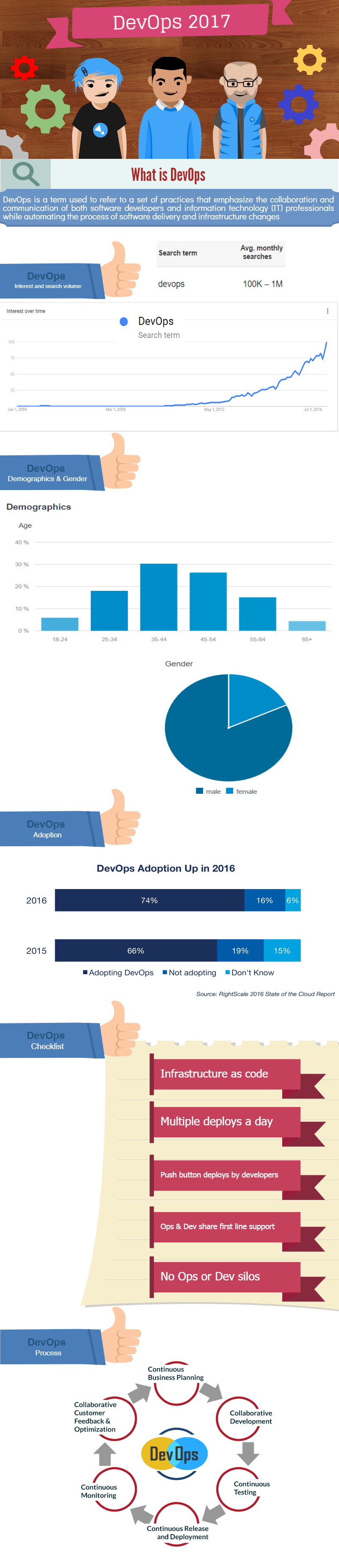
    Below is an infographic of DevOps and some of the trends we see happening this year in DevOps:

    DevOps trends in 2017

    Sources:

    http://www.rightscale.com/blog/cloud-industry-insights/new-devops-trends-2016-state-cloud-survey

    https://www.storybase.com

    slideshare.net

    https://en.wikipedia.org/wiki/DevOps

    Google.com

    7 DevOps Trends

    1. DevOps will be the mainstream and garner a lot of attention; hence, 2017 is going to be the “Year of DevOps.”
    2. Along with DevOps, the three C’s—Continuous Integration, Continuous Deployment, and Continuous Delivery—are going to gain a huge momentum.
    3. A number of new DevOps automation tools will be released that change the way we do software development.
    4. “Containerization” also will be in the limelight.
    5. Many software firms will move to a microservices architecture.
    6. Automation and continuous testing will become more popular—and more important.
    7. Must-have tools and platforms including Docker, AWS, GitHub and JIRA will become even more popular within developer zones.

    The Names to Know

    Below are the names of the top DevOps experts you need to follow:

    Name Twitter Profile Who is He/She Klout Score Website
    patrickdebois https://twitter.com/patrickdebois bridging the gap between creativity and technology with a #devops mindset; eternal researcher and pragmatic implementor; cto @townheroes; started @devopsdays 50 http://www.jedi.be/blog/
    Avi Cavale https://twitter.com/avinci ceo @beshippable, wildlife photographer, scotch lover 50 https://app.shippable.com/
    Kris Buytaert https://twitter.com/krisbuytaert Everything is a Freaky #Devops Needs Sushi Problem, Open Source, Infrastructure as Code, Consultant, Speaker, Author, Organiser of #devopsdays, #cfgmgmtcamp 53 https://about.me/krisbuytaert
    Gene Kim https://twitter.com/realgenekim DevOps enthusiast, The Phoenix Project co-author, Tripwire founder, Visible Ops co-author, IT Ops/Security Researcher, Theory of Constraints Jonah, rabid UX fan 64 http://www.realgenekim.me/
    Jez Humble https://twitter.com/jezhumble Co-author of Continuous Delivery, Lean Enterprise, DevOps Handbook; CTO devops-research.com, lecturer @BerkeleyISchool. PGP: https://keybase.io/jezhumble 63 https://continuousdelivery.com/
    Gareth Rushgrove https://twitter.com/garethr Software developer, occasional sysadmin, general web, programming and technology geek and curator of Devops Weekly. Engineer at @puppetize. @gdsteam alumnus 56 https://www.morethanseven.net/
    Denise Dubie https://twitter.com/ddubie Strategic Content Creator @CAInc, editor/writer/techie focused on App Economy, DevOps, Mobility, ITSec.& Mgmt., Cloud; former Network World/IDG tech journo. 50 https://www.ca.com/us/rewrite.html
    Sanjeev Sharma https://twitter.com/sd_architect #DevOps #Agile #Cloud #TechSales #CTO #Architect #Author – #DevOpsForDummies #Blogger #Inventor #Disruptor #IBM #DistinguishedEngineer. 52 https://sdarchitect.blog/
    Donnie Berkholz https://twitter.com/dberkholz Research director for development, DevOps & IT ops @451Research. PhD biophysicist. Open-source OG. Emerging tech, craft beer, and zeroth-world problems 59 https://451research.com/analyst-team/analyst/Donnie+Berkholz
    Nathen Harvey https://twitter.com/nathenharvey VP, Community Development at Chef 57 http://nathenharvey.com/
    Damon Edwards https://twitter.com/damonedwards DevOps, IT operations, and improving how businesses operate is my thing. Rundeck is where I work. 49 https://www.rundeck.com/

    We hope DevOps will be a rock star in 2017 and continue to rule the software industry.

    — TeamShippable

  • The Big Digital Transformation Trends Through 2017

    The Big Digital Transformation Trends Through 2017

    For a number of years now, the enterprise has been well underway in their digital transformation efforts, as they use data analytics, mobile, cloud services, IoT and other technologies to transform their organizations. But while some companies have embraced digital transformation, others have lagged. They’ll be playing catch-up in 2017, while their counterparts will be busy improving and accelerating processes where they can and building upon what has been achieved.

    Based on my interviews in recent months with CIOs, chief digital marketers and chief digital officers, here are a number of big trends in digital transformation that I see in the year ahead:

    Some CIOs continue to struggle to shake role as IT plumbers

    As enterprise digital transformation continues, even accelerates, those CIOs who focused on keeping the lights on through ensuring the infrastructure and services were in place to keep data available rather that on driving digital initiatives forward will continue to see their relevance diminish.

    Those who will lead forward with increased relevance will be the CIOs who focus on new ways for their organization to better support the business with the technologies they need to succeed and partner with the business units, rather than just provide the technological infrastructure for them to do it themselves.

    Business alignment with IT remains a challenge

    If you are a reader of devopsy.kinsta.cloud, you know alignment between the business and DevOps is crucial for enterprise success. In other words, IT leadership must deliver the technology the business actually needs and wants. Seems obvious and straightforward. And it is. It’s just proven to be a not very easy thing to accomplish.

    According to the Deloitte 2016 – 2017 Global CIO Survey, the “business expectations of IT and IT capabilities are out of sync in several areas, including customer focus, technology-enabled business growth, and business innovation. For example, even though 57 percent of the CIOs surveyed said that customers were their organization’s top business priority, less than half were involved in delivering customer experience (45 percent) or working on customer acquisition, retention and loyalty (44 percent).”

    That’s interesting enough. But the survey results got even more dismal: “Even though 78 percent of CIOs said that strategic alignment of IT activities with business strategy was critical to their success, only 5 percent said it was a leading-class capability in their IT organization.”

    CIOs that want to not only thrive but—at the very least—survive are going to need to close this alignment gap.

    Bimodal IT gains more traction

    The concept of bimodal IT is a controversial one. Essentially, bimodal IT is a descriptor from the research firm Gartner that remarks how IT organizations have a need for both agile delivery of technology services and traditional delivery modes. In the Gartner model, so-called Mode 2 teams are focused on DevOps and agile delivery methods, while Mode 1 teams focus on delivering the more established applications in traditional and more predictable ways. A brief explanation of these terms from Gartner is available here.

    Also, according to Gartner, nearly 40 percent of CIOs are currently practicing bimodal, with the majority of CIOs saying they will embrace bimodal sometime in the next three years. This signals to me that the proof of bimodal success is coming in and more enterprises will continue to follow.

    The trend toward Citizen Developers increases

    More enterprises in the year ahead will embrace the so-called citizen developer to provide some of the apps enterprises need. According to the QuickBase State of Citizen Development Report, 75 percent of those enterprises surveyed said that they develop more than three-fourths of the app and leave the “last mile” to the citizen developer. And, not surprisingly, most (65 percent) are building apps to get work done, while 42 percent build apps to run the business and 27 percent build apps targeting customers.

    “These citizen developers can go a long way to help clear the application backlog. Per the report, 29 percent have seen a 2X or more increase in application development speeds. Over three-quarters or 76 percent of respondents cited operational efficiencies as the primary reason for using the platform. And a whopping 62 percent of Citizen Developers responded that it takes less than two weeks for them to complete an application, on average,” QuickBase’s John Carione wrote in this blog.

    With increased demand for more mobile and web-based apps, and the ease with which many of these apps can be started using low-code and even no-code platforms, I fully expect more enterprises to find ways to encourage citizen development within their organizations.

    CMOs, others outside traditional IT, continue to drive more IT budget

    This trend has been underway for some time now, and I fully expect it to not just continue but accelerate. As was discussed in Sarah White’s story, “As CMOs Start to Outspend CIOs, Collaboration Remains Key,” “marketing has a growing influence on technology spending, with CMOs slated to spend more than CIOs by the year 2017. In fact, companies reported that 25 percent of their annual budget was spent on digital marketing efforts in 2014; and out of those companies, 51 percent plan to increase digital marketing budgets in 2015.”

    As that continues, that means marketing is going to have a larger say in what technology services and platforms get investment in the year ahead. CIOs in organizations where the chief marketing officer is getting more and more budget will need to partner to stay relevant.

    Digital transformation accelerates

    According to this Digital Transformation Survey, a surprising 70 percent of c-suite respondents believe they are ahead, or way ahead, of others in their digital transformation initiatives. Compare that to only 30 percent of those in the line-of-business and other employees who believe the same.

    For whatever reason, those in the c-suite are suffering from some form of cognitive disconnect when it comes to their digital transformation efforts. In the year ahead I think more c-level executives will see the reality of their digital transformation efforts and get to work on mobile and IoT and putting data analytics to better work.

    — George V. Hulme