Tag: software development

  • AI, the New Hero of Software Development … or Anti-Hero?

    AI, the New Hero of Software Development … or Anti-Hero?

    Artificial intelligence (AI) can be a hero or an anti-hero in software development, depending on your implementation approach. According to the 2024 DORA Accelerate State of DevOps Report, AI adoption shows promise with 75% of respondents reporting positive productivity gains, but also reveals unexpected challenges, including a 7.2% reduction in software delivery stability.

    The key is to position AI as a supportive partner. AI should be utilized to enhance human expertise rather than replace it.

    AI Is Promising, but Let’s Stay Suspicious

    AI has been rapidly infiltrating software development for almost two years now. Coding assistants, automated testing tools, and AI-powered analytics promise to transform how we build applications, and some early adopters have shown impressive results. When AI first entered development workflows, it tackled well-defined problems such as code completion, simple test generation, commenting, and draft documentation with reasonable success.

    But that initial enthusiasm has given way to more complex realities. Modern software development involves intricate systems, multi-cloud deployments, complex security requirements, and accelerating delivery expectations. AI has shown both remarkable capabilities and concerning limitations in this environment.

    After hearing customer stories about dozens of AI implementations, I’ve found the story isn’t as binary as “hero” versus “villain”—it’s more like “hero” versus “erratically-troubled-if-ultimately-victorious anti-hero.” The reality of AI is nuanced—and much more interesting, depending very much on the implementation approach, governance scheme, and where organizations choose to apply AI technologies.

    The Toil Problem Is Real and Measurable

    Every developer knows the frustration of “toil”—those manual, repetitive tasks that consume time without adding much value. Toil isn’t just a minor annoyance. The 2024 DORA report confirms that this challenge remains persistent, with developers continuing to struggle with time allocation between valuable work and repetitive tasks.

    Recently, I had the chance to discuss AI heroism and anti-heroism with the Chief Product Officer of CloudBees, Shawn Ahmed. CloudBees is an enterprise DevOps solutions provider and was co-founded by Jenkins creator Kohsuke Kawaguchi, so it has been in a good position to observe the thousand ways AI has been injected into software development. Their internal research indicates developers spend about half of their time triaging test failures, waiting on build times or addressing security issues—and as little as 20–30% of their time writing code. As Ahmed pointed out to me, this inefficiency seems like it wouldn’t be tolerated in most other industries; it is like accepting a manufacturing line that’s only 20–30% effective.

    An example of CloudBees’ approach to incorporating AI productively and helpfully is their continuous integration (CI) capability. It analyzes historical pipeline data to identify patterns in successful deployments and uses AI to provide suggestions for future deployments. This eliminates hours of configuration work, thanks to AI’s ability to base pattern recognition on thousands, if not millions, of data points.

    From CloudBees’ perspective, AI in software development isn’t a replacement technology in dev but rather what Ahmed characterizes as a “companion.” AI’s best role is handling routine tasks to preserve and expand the human developer’s time performing creative and strategic work.

    Three Implementation Models, Three Different Outcomes

    It’s clear that not all AI implementations are created equal. I see three distinct approaches emerging, each with dramatically different results:

    1. The Replacers: Some organizations approach AI to reduce headcount by automating development tasks. This model typically delivers poor results, fundamentally misunderstanding both AI capabilities and the creative nature of software development. The DORA research supports this concern, showing that while AI adoption is widespread, 39.2% of respondents reported having little or no trust in AI-generated code, indicating that successful implementations require human oversight. 
    2. Tools First!: These organizations adopt individual AI tools without a cohesive strategy or governance framework. This approach delivers mixed results—productivity improves in specific areas, but in many cases at the cost of quality, security, or long-term maintainability. The DORA findings highlight this challenge, showing that despite AI’s positive impact on individual productivity and code quality, it can lead to decreased software delivery performance.
    3. The Augmenters: The most successful approach treats AI as an amplifier of human capabilities rather than a replacement. The DORA research validates this model, showing that AI adoption leads to meaningful improvements: when AI adoption increases by 25%, individual productivity increases by 2.1%, flow improves by 2.6%, and job satisfaction rises by 2.2%.

    CloudBees is built on this augmentation philosophy. According to Ahmed, AI handles pattern recognition and repetitive tasks while humans make decisions on strategic matters. Their DevSecOps solution demonstrates this approach by using AI to identify security vulnerabilities while preserving human authority over remediation strategies. CloudBees’ Value Stream Analytics uses AI to spot workflow inefficiencies while leaving process improvement decisions to the teams who understand the organizational context.

    Making AI the Hero of Your App Dev Story

    Here are five critical success factors that determine whether AI becomes a hero or an anti-hero for you:

    1. Target high-toil activities first. Successful implementations start with well-defined, repetitive tasks where AI can deliver immediate value. CloudBees’ recommended targets include test generation, pipeline optimization, and code reviews, including areas where AI can significantly reduce manual effort.
    2. Establish governance first, deploy AI second. Organizations seeing positive results implement governance frameworks before widespread AI adoption, defining, for example, appropriate use cases, verification requirements, or clear boundaries for AI autonomy.
    3. Invest in developer education. Contrary to some narratives, successful AI implementation requires more skilled developers. Top-performing organizations invest in training programs that help developers understand both AI capabilities and limitations.
    4. Integrate rather than isolate. Rather than adopting disconnected point solutions, effective organizations implement AI capabilities that integrate throughout their delivery pipeline. CloudBees’ platform takes this approach, connecting AI capabilities from requirements analysis through production monitoring.
    5. Measure meaningful outcomes. The most effective implementations have moved beyond measuring code generation metrics. Instead, they focus on quality improvements, security posture enhancements, and business impact indicators that reflect the true value of AI adoption.

    AI Is Your Enthusiastic Partner, Not Your Replacement

    Successful AI implementations in app dev seem to share the common characteristic of using it as a complementary force instead of as a replacement. AI is adept at the mundane, repetitive tasks that drain motivation and attention among developers and increase their toil. It lets humans focus on innovation, customer experience, and ultimately, business value.

    According to Ahmed, CloudBees envisions a future where AI becomes increasingly personalized to individual developers. He predicts that within two years, developers will likely work with multiple AI companions tailored to their specific preferences and working styles. This personalization aspect represents an important evolution beyond today’s more standardized AI tools. 

    A particularly noteworthy perspective I got from research and vendor discussions is the relationship between AI adoption and team scaling. While some organizations initially approach AI to reduce headcount, the data suggests the opposite effect. As Ahmed noted in our discussion, the more effective approach isn’t using AI to reduce a 10-person team to 5, but rather leveraging AI to assist that 10-person team in achieving what would have previously required 15 people. This is the proactive, business-building “scale up, not down” perspective that can help propel an organization to its goals.

    I’ve concluded that today, the hero of software development isn’t AI. Not AI alone, but it is no longer purely human expertise either. The true hero is the partnership between them, working in concert to create outcomes neither could achieve independently.


  • How AI Is Transforming the Future of Software Development with Wing To

    How AI Is Transforming the Future of Software Development with Wing To

    Digital.ai CTO Wing To delves into how the way code is written, deployed and managed will fundamentally change in the artificial intelligence (AI) era.

    Cutting through the extremes, AI won’t erase entry-level dev jobs, nor will it fully replace senior developers. Instead, it’s changing what both groups focus on. Entry-level devs will need to learn how to effectively prompt, evaluate and refine AI-generated code, while senior devs may shift toward mentoring, reviewing AI-assisted output, and ensuring software quality. The fundamental knowledge of how systems work still matters—AI doesn’t remove the need for strong foundational skills.

    But AI does change the coding landscape. Developers are writing less and reading more. Reviewing AI-generated code—often verbose, not elegant—has become part of the job. And while some fear that the code is harder to debug, it may just be different: more mechanical, less idiosyncratic.

    From a DevOps perspective, AI introduces new challenges and opportunities. DevOps engineers are facing a surge in code volume and speed—often without a corresponding bump in quality. Automation, golden paths and better processes are essential to handle the influx of AI-assisted code. AI can also help streamline repetitive work: writing scripts, maintaining configurations, generating tests or spotting compliance risks.

    Eventually, DevOps teams may evolve into ecosystems of human engineers and collaborative AI agents. That vision’s still emerging, but orchestration between tools and agents is the next hurdle. The goal? To let developers and engineers focus more on creative, value-adding tasks—and less on toil.

    Still, AI must be used thoughtfully. It’s not a magic fix. It’s a power tool—one that needs skill, discipline and a good understanding of when (and how) to use it.

  • DevEx Got You This Far: What’s Next for True DevSecOps Maturity?

    DevEx Got You This Far: What’s Next for True DevSecOps Maturity?

    The journey toward integrating security into the fast-paced world of DevOps has seen significant strides, largely thanks to a much-needed focus on the developer experience (DevEx). 

    Collectively, the AppSec community and industry have moved mountains in making security tools less intrusive, integrating them into developer workflows, and acknowledging that developers need security as a help, not a hindrance. A focus on DevEx has been crucial, acting as the bridge to bring security considerations earlier into the development lifecycle while simultaneously enhancing the developers’ daily work.  

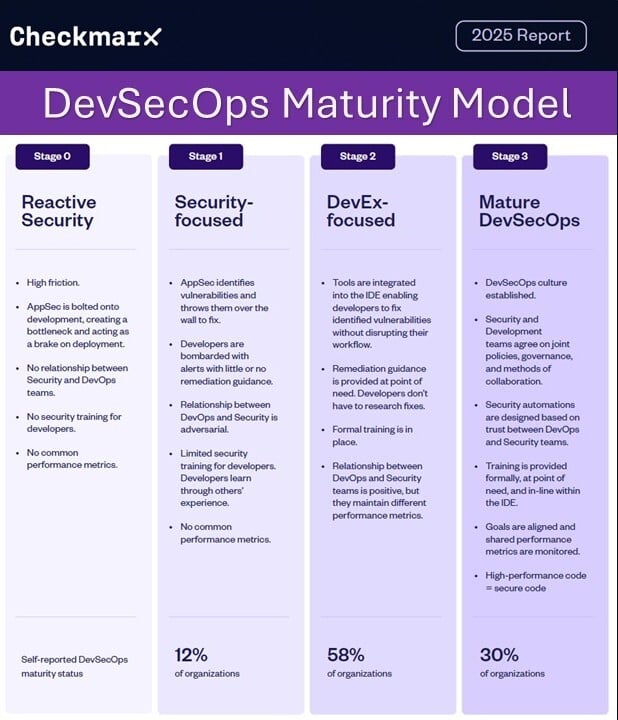
    The numbers don’t lie: Checkmarx’ recent DevSecOps Evolution 2025 report reveals that a majority of the organizations we surveyed—58% to be exact—are at Stage 2 maturity, a transition stage primarily focused on DevEx: They’ve integrated tools into IDEs, offer formal training, and the relationship between security and development teams is generally positive. While these developments signify important progress, this DevEx-focused stage represents a critical foundation rather than the ultimate destination in achieving mature DevSecOps.

    DevEx Isn’t the Destination

    Organizations haven’t yet achieved true DevSecOps maturity. They haven’t yet embedded security through shared culture, governance and aligned goals.

    And while developer experience is essential, it’s just one brick of the DevSecOps foundation. To achieve the ultimate goal—high-performing, secure code delivered at the pace of business—organizations need to move beyond DevEx to a true culture of shared responsibility and trust.

    Despite better tools and training, developers still report spending a significant chunk of their week—often over 17 hours—on security tasks. Trust in tool results is often hampered by false positives impacting velocity, and a lack of shared goals that align development and AppSec priorities means security can still feel like a separate concern rather than a shared objective. We’ve improved the experience; but haven’t fully embedded security seamlessly and at scale.

    The Scale – and Stakes – Are Growing

    The need to mature beyond DevEx is especially urgent given the accelerating complexity and scale of modern application development. Enterprises are managing sprawling codebases and adopting tools that increase both speed and risk. Checkmarx alone scans over 450 billion lines of code every month, and that figure is only rising. 

    At the same time, the software supply chain is expanding at an unprecedented pace: approximately 700,000 new NPM package versions are introduced monthly, each one a potential point of exposure.

    Add to this the growing adoption of AI-assisted coding tools and agentic AI systems that generate or modify code autonomously, and the attack surface multiplies further. 

    On the other hand, development productivity requirements have never been higher, with organizations tracking DORA metrics and looking for AppSec solutions like Checkmarx’ that deliver on security while optimizing MTTR and other DORA metrics.

    Achieving truly mature DevSecOps—Stage 3, where only 30% of organizations currently reside—requires moving beyond just making security palatable for developers. It demands a deeper, more strategic integration built on shared culture, robust governance, trusted automation, and aligned success metrics.  

    Checkmarx’ Five Pillars of DevSecOps Maturity

    At its heart, DevSecOps is a cultural evolution. It’s about merging the “move fast” ethos of development with the “protect everything” mandate of security to achieve a common goal of delivering secure, high-performance code at the speed the business requires. To progress from Stage 2 (DevEx-focused) to Stage 3 (Mature DevSecOps), organizations need to build on their DevEx foundation with five key elements:

    1. Shared Metrics

    You can’t improve what you don’t measure, yet our research shows a surprising lack of consensus on DevSecOps metrics. While many organizations we surveyed track top vulnerable applications (52.1%) and mean time to detect vulnerabilities (51%), only 28.3% measure mean time to remediate—arguably the most critical metric for balancing security and velocity.

    True DevSecOps maturity requires security and development teams to align shared metrics that measure how effectively they work together, not just how many vulnerabilities they find.

    2. Collaborative Governance

    In mature DevSecOps, security and development teams jointly establish policies, standards and processes. Our data shows this remains rare—when asked to describe the relationship between security and development in one word, respondents most frequently chose “trust,” “policy,” and “risk,” indicating an evolving but not yet fully collaborative relationship.

    For 88% of organizations, the absence of shared metrics, policies and governance suggests security and development teams are aligning but are still struggling to form a fully collaborative governance.

    3. Advanced Security Education

    While essentially all developers have access to training according to our study, the model needs to evolve. Traditional formal training programs still have value, but the premium on developer time makes standalone training challenging.

    Mature DevSecOps organizations are pivoting toward just-in-time training that delivers contextual guidance when and where developers need it. Providing a step further is in-the-moment training with inline feedback from within the IDE, allowing developers to learn while maintaining their workflow.

    4. Trusted Automation

    Our study showed that one in five (20%) of the organizations we surveyed have no AppSec automation in place. Even among the remaining 80%, adoption of key automation capabilities remains low—only 32% have automated security testing during change management, and just 30% auto-populate security tickets with remediation guidance.

    The far-from-optimal adoption rate of automation cannot be attributed to a lack of technological solutions but rather appears as a matter of trust and culture gaps between security and development teams. Without shared governance and metrics, attempts to “automate everything” typically fail because there’s no foundation of trust on which to build automations that both teams will embrace.

    5. Velocity-Security Balance

    The ultimate goal of DevSecOps is to deliver high-performing, secure code quickly. Yet 66% of developers report that false positives impede their velocity, and 28% say their AppSec teams lack the tools or resources to help them fix security issues efficiently.

    Mature DevSecOps organizations recognize that speed isn’t just about how quickly tools scan—it’s about how quickly developers can remediate issues without disrupting their workflow. This requires prioritized, actionable results with clear remediation guidance, not just faster scanning. 

    The Role of Leadership

    Making the transition to DevSecOps takes more than just good tooling—it requires strong leadership. Security leaders must be willing to trade control for collaboration and build systems based on partnership, not policing. Engineering leaders must recognize that security is essential to velocity, not an obstacle.

    This shift requires executive buy-in and strategic commitment. It means moving beyond budget conversations centered on compliance and instead investing in the long-term health of your codebase and your teams.

    The Road Ahead

    As the DevSecOps Evolution 2025 report shows, most organizations are still in the middle of the journey. That’s not a failure. It’s an opportunity. DevEx helped bridge the gap between developers and security, and now it’s time to build the foundation that inspires them to run together. By moving beyond DevEx as the sole focus and embracing these pillars of mature DevSecOps, we can finally embed security seamlessly at scale, achieving the ultimate objective of delivering high-performing, secure code without compromising speed.  

    The transformation won’t happen overnight. It requires sustained investment in building trust between security and development teams. But organizations that successfully make this journey will gain the significant competitive advantage of more secure and advanced applications built with less friction and lower costs.

    As we look to 2026 and beyond, the most successful organizations will be those that move beyond seeing security as just another feature of the development process. Instead, they’ll embrace it as an integral, collaborative aspect of delivering high-quality software in a digital world with ever-rising security risks.

    At Checkmarx, we believe the future of software development is secure by design—and it starts with mature DevSecOps. Let’s keep moving forward.

  • GenAI in Software Development with Nathen Harvey

    GenAI in Software Development with Nathen Harvey

    Nathen Harvey, DORA Lead at Google Cloud, delves into how generative AI is rapidly reshaping the software development landscape, presenting both exciting opportunities and complex challenges.

    Harvey reflects on his own journey, from early web operations and his time at Chef to leading the DORA program after its acquisition by Google. DORA (DevOps Research and Assessment), now in its 10th year, continues to be a definitive source for understanding how technical teams improve performance and value delivery. The program’s annual reports, especially its latest focused on generative AI, offer research-backed insights that are widely used across the industry.

    The conversation dives deep into this year’s findings, starting with the rapid and widespread adoption of AI. Nearly 90% of organizations surveyed are prioritizing AI from a top-down perspective, while over 76% of practitioners report already using AI tools daily. This simultaneous push from leadership and uptake by developers indicates that AI isn’t a passing trend—it’s a permanent shift.

    But the data reveals nuance. While AI tools are helping improve areas like documentation, productivity and developer satisfaction, there’s also a measurable decrease in software delivery stability and throughput. Harvey suggests that this may be due to larger and more complex change sets generated by AI tools, which clash with workflows optimized for smaller, more iterative updates. In essence, we’re accelerating one part of the pipeline while other parts can’t yet keep up.

    Harvey emphasizes the importance of interpreting DORA findings in context—using them as hypotheses to test within each unique organization. He also raises critical questions about workforce development, particularly how AI might reduce opportunities for junior developers to gain real-world experience and grow into senior roles. The future, he notes, will require balance: leveraging AI as an amplifier while still investing in people and process.

    The takeaway? AI is transforming DevOps, but not without growing pains. To navigate this shift, organizations need to blend data-driven research with community collaboration, continuous experimentation, and a commitment to developing talent at every level.