Tag: SBoM

  • WhiteSource Offers Free Spring4Shell Vulnerability Tool

    WhiteSource Offers Free Spring4Shell Vulnerability Tool

    WhiteSource has launched a free command-line interface (CLI) tool that detects vulnerable open source Spring4Shell vulnerabilities (CVE-2022-22965) that are impacting Java applications built using the Spring development framework.

    Susan St. Clair, director of product management for WhiteSource, said the WhiteSource Spring4Shell Detect tool is similar to the tool the company made available earlier this year to detect Log4Shell vulnerabilities in Java applications. It provides an exact path to direct and indirect dependencies along with how to find a fixed version of the Spring framework to accelerate remediation efforts.

    Spring4Shell is yet another zero-day vulnerability that has been given a 9.8 severity score. As a result, DevOps and cybersecurity teams are now racing to update applications impacted by this vulnerability before cybercriminals can exploit it. The Spring4Shell vulnerability enables remote code execution (RCE), and the Java applications impacted employ versions 5.3.17 or 5.2.19 of the Spring framework and version 9 or higher of the Java Development Kit (JDK).

    The vulnerability allows an attacker to remotely execute arbitrary code on the target server. It allows attackers to abuse a RequestMapping annotation that maps incoming HTTP requests into their appropriate handler functions. The vulnerable condition occurs when RequestMapping is used in conjunction with traditional Java objects as the handler parameter. Such an attack might allow access to all website internal data, including any database. It might also allow access to additional internal resources to gain more permissions or to pivot to other parts of the internal network.

    It’s not clear how pervasively Spring4Shell might impact Java applications compared to Log4Shell vulnerability that affected a logging tool, but more security researchers are looking for RCE vulnerabilities within Java application environments. Organizations now will need to determine whether to maintain legacy applications that might be subject to more zero-day vulnerability discoveries or replace them with newer applications that are developed in a programming language that might be more secure. There is, of course, no guarantee a new application will be more secure than a legacy application, but the chances are good a modern application will have fewer vulnerabilities than a legacy application simply because the underlying programming tools and platforms are more advanced from a security perspective.

    In the meantime, DevOps teams likely will be looking for instances of Spring4Shell vulnerabilities for months to come. DevOps teams that have access to a software bill of materials (SBOM) naturally will be able to find those instances more easily than organizations that don’t. However, the percentage of organizations that have SBOMs is still comparatively low. However, as zero-day vulnerabilities become a larger security issue, SBOMs are being implemented more widely as organizations review their software supply chains.

    Whatever the path toward ensuring application security ends up being the level of scrutiny being applied to application development and deployment, processes will in the months ahead accelerate the adoption of best DevSecOps practices across organizations large and small, whether they like it or not.

  • GitLab Allies With Rezilion to Add Workload Analysis Tool

    GitLab Allies With Rezilion to Add Workload Analysis Tool

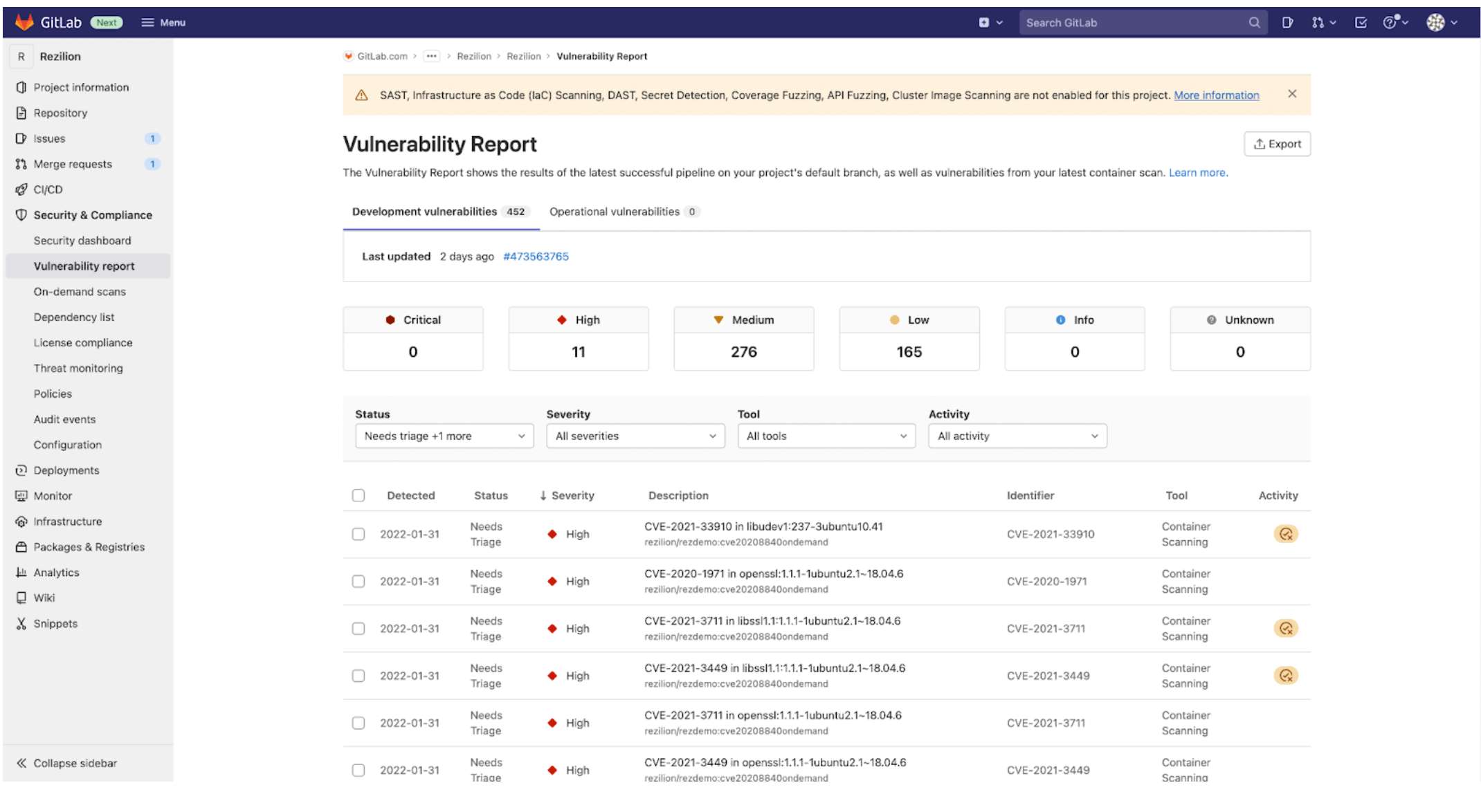
    Rezilion has integrated its workload analysis tool with the continuous integration (CI) framework provided by GitLab. The move is part of an effort to make it simpler for developers to discover issues such as vulnerabilities before they upload code into a repository.

    Sam White, a senior product manager for GitLab, said this integration will provide developers with an instant feedback loop that will enable them to address a wide range of issues before their code is ever reviewed. Rather than experiencing the shame of, for example, missing a vulnerability, the Rezilion platform enables developers to quickly write code while relying on a code analytics tool to surface common mistakes that they can remediate as they see fit, he added.

    Rezilion CEO Liran Tancman added that the proprietary workload composition analysis engine, dubbed Unison, on which the Rezilion platform is based makes it feasible to shift more responsibility for application security further left without requiring developers to become cybersecurity experts.

    Unison automatically creates a model of all the applications that include the underlying infrastructure and runtime environments. It reverse-engineers and maps that environment in memory to dynamically track the inventory, provenance, runtime execution, exposure and interdependencies between each piece of code and can generate a software bill of materials (SBOM).

    The code that is most in need of immediate attention is also surfaced directly with the GitLab user interface, said Tancman. That capability can reduce remediation time of the vulnerability backlog an organization might be working through by as much as 70% over time, he added. Rezilion enables organizations to achieve that goal because non-exploitable vulnerabilities are marked as “false positives” that shouldn’t hold back a release.

    Tancman said that without this level of automation it would be extremely challenging for an organization to implement a set of DevSecOps best practices. It might take developers years to attain the level of cybersecurity training that would be required in the absence of the automation enabled by the Unison engine, he noted.

    Historically, the relationship between application developers and cybersecurity teams has been tense. Cybersecurity teams tend to put off code review until it’s about to be deployed in a production environment. It’s not uncommon for an application to be pulled at the last minute because of a vulnerability discovered by a cybersecurity team. In some instances, that vulnerability is a legitimate concern but in others, it turns out to be a false positive because the flagged piece of code isn’t actually included in the application.

    By providing developers with a workload composition analysis tool within the context of a CI framework, GitLab is trying to reduce the level of friction that the process tends to create between developers and cybersecurity teams.

    It may be some time before most organizations fully master DevSecOps, but it’s clear that merely telling developers they will be held accountable for application security without providing the appropriate tools isn’t going to make applications any more secure.

  • Secure Software Summit: Behold the SBOM

    Secure Software Summit: Behold the SBOM

    With supply chain security becoming more of a focus, the SBOM is now viewed as a critical element in shoring up supply chain security. SBOM stands for software bill of materials. At a very elementary level, an SBOM is a list of ingredients. Think about how every food product in the supermarket lists ingredients so, for example, people who are allergic to nuts can avoid nuts. An SBOM does the same thing for software applications. 

    If you want to do business with the U.S. government, SBOMs are no longer optional. Executive order 14028 requires an SBOM for all U.S. federal software procurements. Why the push for SBOMs now? Software companies generally do not list all the components included in the software they produce. Knowing what components are included in applications is essential for proactive vulnerability management. That said, the government mandate for SBOMs only requires a minimal amount of included information—supplier name, the component name and version, dependency relationships, time stamps for versions or modification and information about who authored the SBOM itself. 

    What to Look For in an SBOM

    This minimum required data yields minimal benefit for cybersecurity risk reduction and vulnerability management. SBOMs can actually include many other types of information. What information should you include in SBOMs for software applications produced, purchased or consumed by your organization? Here is a list. 

    Authenticity —Authenticity asks and verifies that someone actually created a listed component. Ideally, this requires a digital signature of some sort. Authenticity can be particularly important in the case of nested components where the supplier of an application includes multiple other components, as is common with JavaScript and Java libraries used for common functionalities. 

    Integrity —This addresses whether a component has been tampered with or modified without authorization. An SBOM should include some measure of integrity. Equally important is proving the integrity of the SBOM itself. Just as CheckSum can tell you whether software you are loading matches what the source of that software indicates, integrity checks should allow you to verify that components on an SBOM (and the SBOM itself) are exactly what you are expecting. 

    Services —An inventory of services called by an application is critical. Modern software does not live in a vacuum. It calls out to the Internet to perform all sorts of tasks and communication with other systems. Those services that extend beyond your application are part of the inventory because they can be an indication of vulnerability or indicate a larger problem.

    Vulnerability Remediation Status —Development teams are constantly balancing the need to remediate vulnerabilities against the risk that remediation will break the application. Some open source projects, for example, have a history of not backporting security fixes. The latest version of the project may break applications. Organizations are forced to choose between breaking an application or taking the risk of introducing a high-severity vulnerability that might be exploited. Responsible organizations that opt to keep the older version and not break their software will backport their own fixes. An SBOM should describe these variations and any other vulnerability remediation activity. 

    Inventory of component security advisories —An SBOM should describe security advisories pending against all components. This is likely to be a dynamic list that you will need to automatically update using one of the accepted vulnerability advisory formats (CSAF and CycloneDX, to name two). In fact, this is one of the strengths of SBOMs—they are designed for automation and to act programmatically. 

    Completeness —It is not always possible to ship complete SBOMs, either for technical or intellectual property reasons. An SBOM should indicate whether it is complete and whether it contains a comprehensive inventory of dependencies and services. 

    Pedigree —This information describes the DNA of the SBOM and the original makeup and changelog of each particular component. An SBOM should describe the original component, exactly what changes were made, who committed the changes and why, what the differences were between different versions and what security issues were fixed with each variation and version. 

    Provenance —This relates to the origin of a component or service. It can describe a repository that the component was downloaded from, a country of origin, the name of a software manufacturer or open source project or other information indicating the component or service’s source of origin. 

    License type —License information is relevant for compliance and to ensure that your organization is not consuming or producing software in a manner that violates licensing terms. Moreso than for security and vulnerability, this information is for risk management, compliance enforcement and auditing. 

    Customizing SBOMs to Meet Your Needs

    The SBOM is a flexible and highly adaptable approach that can be easily customized to fit specific use cases. You can design SBOMs to meet the specific needs of your use case, either as a software provider or consumer. You also may need to modify your SBOM fields and data design as your needs evolve. Fortunately, it is rapidly becoming easier to automatically generate SBOMs using software security tools such as software composition analysis (SCA) and interactive application security testing (IAST) solutions. SBOMs can also be created or read automatically at other points during the build life cycle along the continuous integration/continuous deployment (CI/CD) process. Just as you would not buy a box of cereal that did not list the ingredients, in the future you will not want to consume software that does not have a detailed SBOM. What you don’t know about the software you run can hurt you, and SBOMs will be a crucial tool in providing greater transparency and observability into the software supply chain. 


    About Secure Software Summit
    The Secure Software Summit brought together the world’s leading innovators, practitioners and academics of secure software development to share and teach the latest methods and breakthroughs on secure coding and deployment practices. If you are about developing, releasing and securing software, delivering new features fast and building things right from the start, click on the link below to get access to all of the sessions from this summit.

    https://go.shiftleft.io/secure-software-summit-2022-replay

  • 4 Reasons Software Developers Need a Bill of Materials

    4 Reasons Software Developers Need a Bill of Materials

    The recent Log4j/Log4Shell vulnerability was a wake-up call that threats aren’t going to wait until the industry gets up to speed on software supply chain security. While the Log4j open source component vulnerability caught us all off guard, it did highlight the need for software vendors to be more proactive in disclosing the composition of their products. It’s become painfully clear that analyzing open source libraries and third-party code should become standard practice to understand their makeup and the potential risks they introduce in commercial software applications.

    Unfortunately, relying on open source projects to provide visibility into security vulnerabilities isn’t going to work. In most cases, these projects are grossly underfunded. At the time of the Heartbleed vulnerability, for example, OpenSSL received very little funding. Yet, open source usage increases each year. It’s imperative that commercial software organizations contribute to open source projects they use and share responsibility for the security of these products.

    In addition to open source libraries, most vendors source third-party code from contractors or for-hire development organizations. Without documentation of the composition of the code developed by third parties, it’s impossible for commercial software vendors to proactively identify and manage risk before it’s implemented in their development cycle.

    Using Software Composition Analysis (SCA) Tools

    Where a software bill of materials (SBOM) is not provided, the onus should be on commercial software vendors to create one. This can be accomplished using software composition analysis (SCA) tools that analyze binaries and do not require access to source code. They can generate SBOMs to identify open source or third-party components in use, as well as track and manage security risks in the software supply chain.

    Creating a comprehensive SBOM provides other benefits, since most open-source projects and contract developers are only likely to publish direct dependencies (if at all) and not look further into the dependencies of dependencies, and so on.

    Four Benefits to Consider

    Meanwhile, commercial software vendors can expect their customers to soon start demanding SBOMs since this will be a requirement under the cybersecurity executive order. Given this evolving landscape, commercial software vendors should consider the following four benefits for proactively implementing an SBOM program to govern the products they build:

    • Gain visibility into software supply chain risk to identify, reduce and remove vulnerabilities in reused software (i.e. open source and third-party). SBOMs provide data for business decisions on the software you have reused and purchased. It’s better to discover these risks before your customers do.
    • Preemptive supply chain qualification to ensure compliance with future requirements. SBOMs will soon be a requirement for doing business with the U.S. federal government. Suppliers that meet the SBOM requirements during procurement will be given preferential treatment.
    • Improved security and downstream benefits that come with risk management and mitigation. Avoiding, detecting and remediating security risks before they become embedded in a product pays huge dividends during development and deployment. You’ll be better prepared for the next security event.
    • Common understanding of software assets that comes with a standardized SBOM shared amongst developers, suppliers and open source projects. An SBOM becomes a way to communicate software contents and dependencies within and outside an organization.

    Taking a proactive approach to the software supply chain by creating SBOMs and demanding the same from suppliers will enable commercial developers to be better prepared for the next Log4j/Log4Shell vulnerability. It will also allow them to improve the software supply chain security posture of their end customers.

  • Linux Foundation Survey Sees Rise in SBOM Use

    Linux Foundation Survey Sees Rise in SBOM Use

    A global survey of 412 organizations published today by the Linux Foundation found nearly half of respondents (47%) producing or consuming software bills of material (SBOMs), and more than three-quarters said they expected to produce or consume them in 2022.

    SBOMs have become a bigger area of focus in the wake of a series of high-profile software supply chain-related breaches. The breaches involved application components compromised by malware that had been surreptitiously inserted during the application development life cycle. The Biden administration has gone so far as to issue an executive order requiring all agencies to provide SBOMs for all the commercial and custom software they use, but as of yet a deadline for compliance with that order hasn’t been set.

    In general, the Linux Foundation survey found that a large percentage of respondents (82%) are already familiar with the term SBOM. Respondents cited various benefits of having an SBOM, including making it easier for developers to understand dependencies across components in an application (51%), making it easier to monitor components for vulnerabilities (49%) and making it easier to manage license compliance (44%).

    However, the survey also makes it clear there is much SBOM work to be done. A full 62% of respondents, for example, are looking for better industry consensus on how to integrate the production/consumption of SBOMs into their DevOps practices. Respondents also cited a need for consensus on the integration of SBOMs into their risk and compliance processes (58%).

    More than half (53%) also said there is a need for better industry consensus concerning how SBOMs will evolve and improve.

    The survey also makes it apparent that organizations are more aware of the role SBOMs play in securing supply chains. A full 80% of organizations are aware of the White House’s executive order on improving cybersecurity, with more than three quarters (76%) considering making changes as a direct consequence of the order. Overall, the survey found the top consideration organizations focus on when evaluating open source software is security.

    Stephen Hendrick, vice president of research at the Linux Foundation, said 2022 is likely to be remembered as the year of the SBOM. There are several standards for building SBOMs, including an open source software package data exchange (SPDX) specification backed by The Linux Foundation and the Joint Development Foundation that is now recognized as the ISO/IEC 5962:2021 international standard. There is also CycloneDX, a lightweight SBOM standard based on an open source project that originated via the Open Web Application Security Project (OWASP) community and a software identification (SWID) standard for tags that some organizations use to create SBOMs.

    SBOMs are, essentially, a tool for listing the components that make up an application and are used inconsistently. However, when a critical vulnerability is discovered, they can sharply reduce the amount of time required to discover all the software components that need to be remediated. The challenge is, with the rise of containers, it has become much simpler to rip and replace software components in a way that may not always be reflected in the SBOM. Hendrick said in time, advances in technologies such as machine learning algorithms should make it easier to instantly reflect those changes in an SBOM.

    Regardless of approach, it’s apparent DevOps teams, like it or not, are about to be held more accountable for the provenance of every component employed across their entire application portfolio.

  • GrammaTech Adds SBOM Analysis Capability to CodeSentry

    GrammaTech Adds SBOM Analysis Capability to CodeSentry

    GrammaTech today updated its CodeSentry code inspection platform to include the ability to create a software bill of materials (SBOM) by analyzing application binaries.

    Walter Capitani, director of technical product management for GrammaTech, said version 3.0 of CodeSentry leverages the algorithms the company uses for binary software composition analysis to enable organizations to better address software supply chain concerns in the wake of a series of high-profile vulnerabilities.

    The tool can be applied to both commercial software and open source components via integration with Risk Based Security’s VulnDB database, created to track security issues.

    GrammaTech

    There is more focus than ever on creating SBOMs in the wake of the Biden administration’s recent executive order that will require federal agencies to only use software that comes with an SBOM. However, most organizations are not provided with access to the source code used within the applications they employ. GrammaTech enables organizations to address that issue by analyzing the binary code within an application to generate an SBOM.

    That report not only identifies all the components in an application, it also lists all known vulnerabilities associated with the version of the components being employed, said Capitani. CodeSentry will also list other common software products and the versions that may be impacted by the same vulnerabilities, along with versions of the software that have remediated the issue or versions of a component that have not been impacted by those vulnerabilities.

    Almost all software applications include third-party and open source components that create blind spots within software supply chains. In fact, that issue is what makes remediating zero-day application vulnerabilities so challenging; especially when they are discovered in, for example, a log management tool like Log4j that is widely used in Java applications.

    GrammaTech is making a case for a binary software composition analysis (SCA) tool that enables DevOps teams to address vulnerability issues prior to an application being deployed in a production environment. At the same time, however, security and compliance teams can now use the same tool to determine the level of risk an organization might be incurring once an application is deployed in production. That latter capability is especially critical because zero-day vulnerabilities are often not discovered until long after an application is deployed in a production environment, noted Capitani.

    Regardless of approach, the need to better secure software supply chains is now a major IT issue that should ultimately encourage more organizations to adopt DevSecOps best practices to better secure applications. The challenge, of course, is not just espousing the need for those practices but also providing developers with tools they will actually use to implement those practices. The success or failure of those efforts comes down to not just the efficacy of the tool but also how well it fits within the overall developer experience. After all, the greatest tool in the world will still languish if it’s too difficult for the average developer to employ.

  • How Log4j Becomes a Serious DevOps Problem

    How Log4j Becomes a Serious DevOps Problem

    The recent discovery of the Apache Log4j vulnerability has wide-ranging implications for anyone who develops software, especially for those in the DevOps realm. What’s most troubling about the vulnerability (CVE-2021-44228) is how prevalent the use of Log4j is. The vulnerability is reported in a vast array of applications and directly impacts numerous Apache projects, including Druid, Dubbo, Flink, Flume, Hadoop, Kafka, Solr, Spark and Struts. There are also numerous Cisco programs impacted by the vulnerability. The list of impacted applications and libraries seems to be almost infinite, extending to Elastic LogStash, GrayLog2, Neo4J, Steam, Twitter and even the VMware Tanzu family of programs. 

    Simply put, any application that uses Log4J for logging and tracing is subject to the identified family of attacks known as Log4Shell. Those attacks prove easy to exploit and can be used to take control of vulnerable servers.

    Why DevOps Practitioners Should be Concerned

    The world of DevOps is all about reiteration, where features and improvements to applications are slipstreamed into production environments. To accelerate development, the QA process is usually limited to the most recent changes.

    In other words, developers, via their pipelines, can often establish a baseline of quality and then speed up their CI/CD pipelines by testing only what has changed since the last iteration of the application. This process ensures an acceptable level of quality without introducing what are perceived to be unnecessary steps.

    However, those processes do not take into account newly discovered flaws in older APIs and libraries, meaning that those flaws could telegraph into deployed applications and leave DevOps teams completely unaware of the impact and possible disruption. Detecting flaws after an application is deployed is like putting the cart in front of the horse.

    Further complicating the situation is that many developers lack a well-defined and well-maintained software bill of materials (SBOM), which means developers may be unaware of the components and/or libraries being used in a deployed application.

    Without an SBOM, it becomes increasingly difficult to remediate an issue with an application—especially if developers are unaware of the issue to begin with.

    Where Should Responsibility Lie?

    More often than not, vulnerabilities introduced into applications become a game of finger-pointing, where developers blame library suppliers or infosec staffers, and infosec blames developers for not performing due diligence on the components they are selecting to incorporate into their applications.

    Of course, finger-pointing only adds to the angst and delays the process of remediation and does nothing to determine where the responsibility for detecting and remediating vulnerabilities lies. DevOps teams need to put these squabbles aside and establish a process that deals with unintentionally introduced vulnerabilities. What’s more, DevOps teams need to invest in DevSecOps to make sure that vulnerabilities are detected and remediated as quickly as possible.

    To avoid the potentially massive disruption that a vulnerability like Log4Shell can cause, those running DevOps should consider:

    • Creating and maintaining an SBOM 
    • Deploying automated tools that scan for discovered vulnerabilities
    • Automatically comparing the SBOM against vulnerabilities
    • Including DevSecOps processes within their CI/CD pipelines
    • Frequently testing applications for flaws
    • Coordinating with cybersecurity personnel when a flaw is discovered
    • Patching frequently

    With more and more vulnerabilities discovered on an almost daily basis, DevOps teams must be ever vigilant about what components are incorporated into their applications. What’s more, with the increased use of low-code/no-code tools and integrated development environments (IDEs), DevOps will also need to consider if those tools use other libraries that can become compromised.


  • AWS Outage Exposes Weaknesses of DevOps Resilience

    AWS Outage Exposes Weaknesses of DevOps Resilience

    The December 7, 2021 Amazon Web Services (AWS) outage severely disrupted services from a wide range of businesses for more than five hours and highlighted just how reliant businesses have become on internet-delivered services. The outage mostly impacted web services in the eastern U.S., yet the implications are universal: It’s a reminder that many businesses blindly ignored the old axiom about putting all your eggs in one basket and instead are relying on a provider with a single point of failure.

    Services ranging from airline booking systems to streaming video to e-commerce were disrupted during the outage, causing millions of dollars in lost revenue and countless hours in productivity. One of the more interesting aspects of the outage is the impact it had on services from collaboration vendors such as Slack, Trello, Asana and Smartsheet—tools that many development and DevOps teams have come to rely on.

    Furthermore, core AWS services, such as the company’s Elastic Compute and DynamoDB cloud tools were also impacted, disrupting many third-party services and severely hampering business processes that use those services. While the obvious victims of the outage are well known, like Amazon’s own e-commerce operation, there is a troubling undercurrent: The disruption to DevOps frameworks and those using them.

    AWS has been rather tight-lipped about the root cause of the outage thus far; however, there are still many lessons to be learned for the DevOps community and questions that must be asked such as “Can the DevOps process survive during IaaS/SaaS disruptions?” and “Can multi-cloud failover solutions be baked into the applications DevOps builds?”

    There are no simple answers to those questions, but the outage highlights the need to understand the underlying architecture and framework of a deployed DevOps system. Take, for example, how many developers in the DevOps community have embraced SaaS tools to accelerate the development process and to feed CI/CD pipelines. SaaS applications such as code scanners, pipeline orchestration and even IDEs have become common in the world of DevOps. But has anyone bothered to ask what happens if a single one of those tools fails?

    What’s more, the reliance on SaaS tools in the development process has led to the creation of potential liabilities in the applications created by DevOps developers. DevOps applications have come to rely on APIs, are often driven by microservices and are frequently deployed into containers that run on SaaS. If any of those elements become non-functional, numerous applications could fail, ultimately putting the onus on developers to explain why they are creating applications with a single point of failure.

    Moving forward, the DevOps community needs to take a serious look at the components of their frameworks and determine if there are any single points of failure—including their IaaS/SaaS providers. While it may be impossible to remediate every single one, there is a lesson to be learned about how fragile the development process can become if no one bothers to build an inventory of the tools used and take into account how a failure of any one of those tools could impact workflow. There are numerous examples of how an external failure of a single component impacted the functionality of an application, while the discovery process of the root cause has taken days or even weeks. This can be mostly attributed to not only a lack of knowledge, but a lack of visibility into the components used.

    Those lessons can be extended to the development process itself, where the best practice of rooting out single points of failure can be extended to the applications themselves. Leveraging that intelligence starts with understanding the concept of a software bill of materials (SBoM), a piece of supporting documentation that is becoming increasingly important to the purveyors of applications. A properly-defined SBoM reveals all of the components (libraries, APIs, etc.) that are baked into an application and can be used as a map to define where weaknesses may lie.

    For the DevOps community, the recent AWS outage has become a clarion call to look inward and discover how the applications they are building may be part of the problem. With continuity and resiliency becoming major topics in the IT and business realm, it’s about time that DevOps practitioners start to look at how they can support both of those business-critical needs. The days of finger-pointing to shift blame must come to an end, and if businesses that rely on software want to grow, someone needs to take responsibility for providing answers when outages occur and learn from those outages to create applications that are more resilient.

  • Securing the Software Supply Chain with Behavioral Analysis

    Securing the Software Supply Chain with Behavioral Analysis

    Lately, software supply chains find themselves in a very interesting and uncomfortable position—the industry spotlight—and not in a good way. While significant and costly breaches such as  SolarWinds or Kaseya make front-page news, supply chain attack tactics (e.g. typosquatting or dependency confusion) that target package managers such as npm, PyPI or WinGet can poison downstream applications or compromise developer credentials.  

    The software engineering community has been steadily increasing its use of third-party and open source solutions to help create new offerings. In fact, over the last five years, there has been a 259% increase in the use of open source.

    One reason for this is the simple fact that creating new applications takes time and can strain budgets that are already tight. With open source code, software engineers gain fast access to pre-existing code that’s already demonstrated a proven ability to address the very unique challenge they are looking to solve. By removing the need to reinvent the wheel, the development timeframe is accelerated, the costs are lowered and teams are freed to focus on the creation of new and unique features that the customers demand.

    At this point, turning to third-party code may seem like a no-brainer. However, it can also open the door to potential risks. This is especially true with engineers who, rather than checking software to ensure it is secure and compliant, take the providers’ assurances as gospel. 

    They are not alone. Other groups will try to conduct their initial due diligence at the onset if that’s possible. Soon after they then ease into a “set it and forget it” approach, where they fail to update the code over time. As a result, while the code may appear secure initially, vulnerabilities can emerge over time, and if the software is not continually updated, bad actors can leverage an unprotected window of opportunity. In fact, according to Enterprise Security Group’s “Modern Application Development Security” eBook, 48% of organizations regularly push vulnerable code. The same research also found that 60 percent of organizations have had production application vulnerabilities exploited.

    Organizations conduct static application security testing (SAST) and dynamic application security testing (DAST) to assess pre-production code vulnerabilities. They will also scan with AV before releasing software, examine signing certificates, and code quality. Yet, despite these efforts, they remain challenged by gaps in security processes and the ability to sufficiently inspect large, complex and multi-layered software packages. What’s missing is the ability to conduct in-depth analysis to pinpoint behavioral differences between compiled software versions.  

    Malicious tampering can often involve changing how the software interacts with the system on which it is deployed.  Differential behavior analysis highlighted below makes it easier to detect those unusual changes. For example, having an application suddenly add a pre-install script that downloads files via certutil is highly unusual. If the addition was planned, reasons for the change would be well documented and it would be associated with a significant new feature. For this type of change to happen in any other scenario is suspicious and deserves further investigation before the software is released. In this case, such action would have caught ua-parser-js developer’s account compromise.

    supply chain

    With the software supply chain at risk and with shared code the new normal, what’s needed is software assurance. 

    Software assurance allows teams to inspect every application layer within an installation package for the presence of software tampering, malware and other indicators of software supply chain attacks.   

    Begin the software assurance process with the deep inspection step through recursive package decomposition. The resulting software bill of materials (SBOM) becomes so much more than a build manifest (a list of components that should be in the final build). It becomes the means to determine exactly which components have unacceptable build quality or those that contain unwanted software behaviors. This enables developers to verify the code they are working with and take appropriate action to protect their customers and partners from the majority of software risks. These assessments include:

    • Software grading: The software package and every included component can be graded based on the types and severity of security issues found. Using a grading system makes it easy for software buyers to gauge the level of risk posed by a software package and determine whether additional deployment measures can be taken to mitigate those risks. For developers, component grading makes it easier to prioritize their remediation efforts and aids in the selection of higher-quality third-party components.  
    • Application hardening: Activating specific build or compiler options can mitigate vulnerabilities and protect applications against attack—but only if they are implemented correctly. Assessing whether these mitigations are correctly implemented ensures that these protection mechanisms will work as expected. 
    • Binary behavior analysis: This allows teams to fully understand how each software component interacts with the system on which it will run. The ability to understand third-party component behaviors, even when developers have no access to the source code, delivers a more comprehensive understanding of supply chain risks. Checking for unusual software behaviors or unexpected behavioral changes between one version and the next is often the only way to identify software tampering by a malicious actor. The ability to have this final check before distribution enables software developers to validate that the software being released is trustworthy.

    For companies that are using software to create business value or producing software that is mission-critical for their customers, turning a blind eye or making software assurance assumptions can no longer be tolerated. In today’s climate where increasingly sophisticated threats loom, inspecting software and monitoring updates for signs of tampering, malicious or unwanted additions is essential and must become a part of standard software development practice. 

  • WhiteSource Adds SBOM Tool That Lists Vulnerabilities

    WhiteSource Adds SBOM Tool That Lists Vulnerabilities

    WhiteSource has added a software bill of materials (SBOM) tool to its portfolio that, in addition to capturing the components of an application, also surfaces vulnerabilities that should be addressed.

    Many organizations are becoming more rigorous about making sure SBOM are attached to every software development initiative in the wake of an executive order issued by the Biden administration that requires federal agencies to employ them. While not every organization builds applications for federal agencies, the fact that the federal government is requiring them in the wake of a series of high-profile breaches has led other organizations to review their software supply chain processes.

    An SBOM facilitates those reviews by making available a formal, machine-readable inventory of software components and dependencies that can be used to track their supply chain relationships and identify dependencies and hierarchical relationships.

    Ori Bach, executive vice president for product at WhiteSource, said WhiteSource SBOM takes the concept a step further by also identifying open source libraries. It will also automatically update the SBOM when changes are made to make it easier to identify unintentional or malicious content being installed during application builds.

    Finally, WhiteSource SBOM also provides remediation guidance that ensures updates won’t break the build.

    Bach said it’s already apparent cybercriminals have significantly increased their effort to compromise supply chains as part of an effort to compromise as many downstream applications as possible. In many cases, cybercriminals are now specifically targeting open source projects that create software that tends to be employed across a wide range of use cases.

    An SBOM in and of itself doesn’t make applications more secure. However, it can provide visibility into the components of an application that can then be used to inform DevSecOps best practices, which organizations are implementing more broadly as responsibility for application security continues to shift left toward developers.

    There are two primary specifications that organizations can use to create an SBOM. The Software Package Data Exchange (SPDX) specification is an open standard for communicating SBOM information including components, licenses, copyrights, and security references. Defined by the Linux Foundation, SPDX is now recognized as the ISO/IEC 5962:2021 international standard. The second is the Software Identification (SWID) format that is today widely used by publishers of commercial software.

    Regardless of the format used to construct the SBOM, Bach said there’s an opportunity to more closely align the increased visibility it enables with the application security goals of the organization building the application.

    The primary reason SBOMs are not as widely used as they might be by now has as much to do with inertia as it does with technology. However, as organizations start to expect an SBOM to be made available, it’s clear application developers and builders will need to find a way to automate the SBOM process as applications are continuously updated. The challenge, of course, is that applications are now being updated with greater frequency—thanks mainly to widespread adoption of DevOps best practices—that now need to be integrated with any tool for creating and maintaining an SBOM.