Apollo GraphQL has announced the general availability of a free Development Graphs cloud service to simplify management of GraphQL application programming interfaces (APIs) at scale.
GraphQL APIs have been gaining traction as an alternative to REST APIs because they provide developers with more control over who can access data via an API and are easier to build and maintain.
Apollo GraphQL CTO Matt DeBergalis said that approach makes it possible to build APIs using the Agile development methodology versus the waterfall processes that typically are employed today to construct REST APIs.
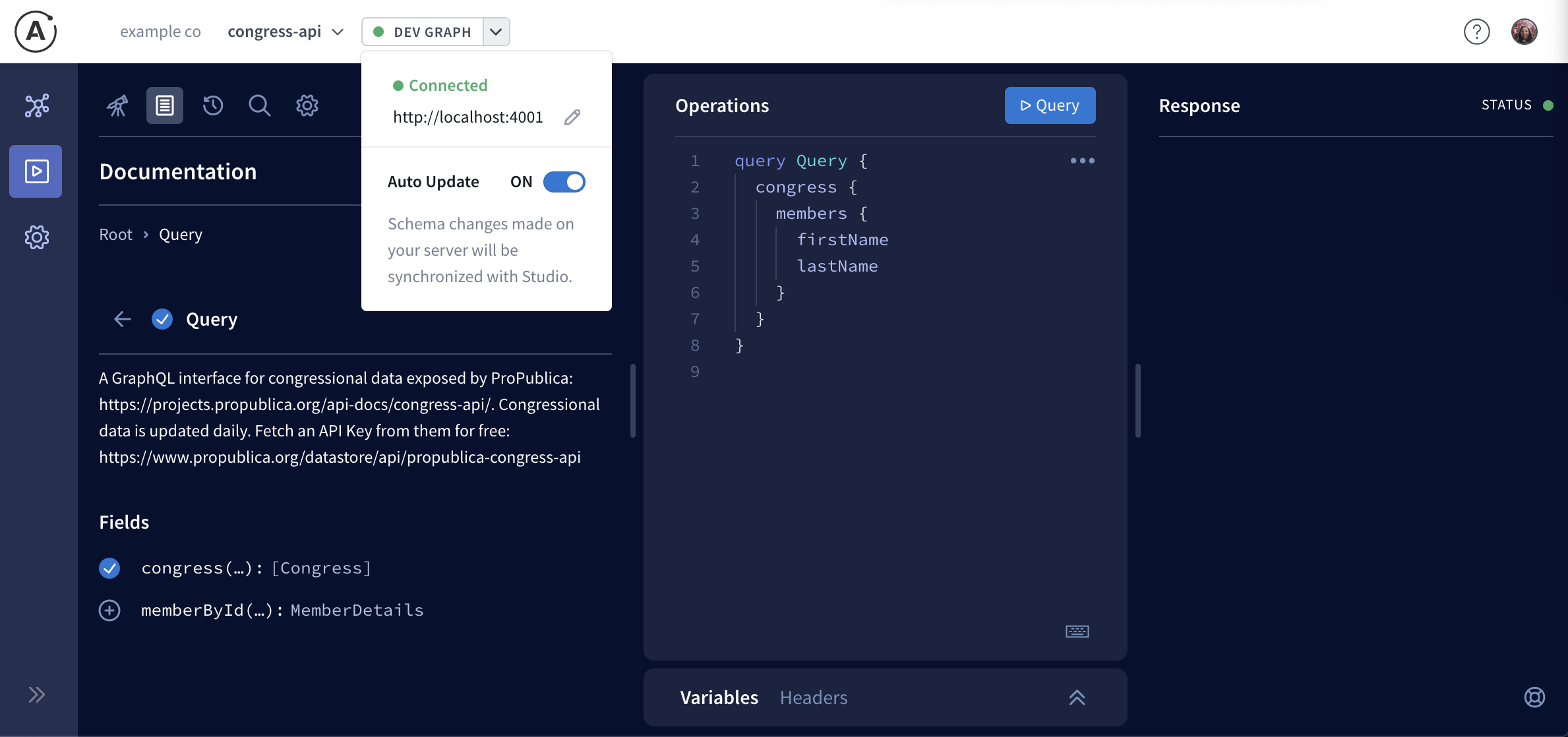
Originally developed by Facebook, GraphQL APIs are being extended by Apollo GraphQL via a set of Studio tools based on a graph that makes it easier to discover those APIs and search GraphQL schemas. IT teams can also use the tools to launch queries against those APIs using an integrated development environment (IDE) dubbed Explorer. Developers are not required to have a deep knowledge of GraphQL syntax or the shape of a schema to launch a query. They can also copy links to share their queries with other users to copy a version of a query that can be run in the terminal as a CURL command.
DevOps teams can also search for types and fields in a schema using tools that guide them through the process of querying any field in their schema. They also can find and add fields to a query without needing to know in advance where those schemas are actually running.
The tools also make it possible to view samples of results to better gauge what data will be returned by a query, along with latency rates for each field in a query to better understand the overall cost of a query.
DevOps teams can also view response data from their queries as JSON or as tables and create mock responses to queries to test operations, Finally, each request and view of every query can be viewed alongside the data returned.
Connections to a private sandbox in the cloud for each local GraphQL server or any development environment are enabled using the Development Graphs tool.
DeBergalis said he doesn’t expect most DevOps teams will rip and replace the REST APIs that are already strewn across most extended enterprise. Instead, most new applications will make use of GraphQL APIs that over time will become the de facto standard for building APIs. However, developers are clearly voting with their feet to abandon REST APIs in favor of a more agile approach, he said.
Apollo GraphQL is looking to become the software development lifecycle (SDLC) platform for managing GraphQL APIs at scale, DeBergalis added.
The challenge organizations face now is finding a way to integrate the management of those GraphQL APIs within the context of a larger set of DevOps workflows. Of course, that may wind up being more challenging than initially anticipated when they consider REST and GraphQL APIs could be employed alongside one another for years to come.
42Crunch this week announced it has extended an existing alliance with Microsoft to now include support for Microsoft Azure Pipelines for its REST API Static Security Testing Tool. Previously, 42Crunch only provided support for the Microsoft Visual Studio integrated development environment (IDE).
Dmitry Sotnikov, chief product and marketing officer for 42Crunch, said support for the Microsoft IDE assumes that developers will run security tests themselves. By integrating its API security testing tool with the Microsoft continuous integration/continuous delivery (CI/CD) platform, it now becomes possible to make testing APIs for security vulnerabilities part of a DevOps process, he said.
That approach means organizations don’t have to rely on developers to remember to run a security test on their APIs. Instead, security testing of APIs becomes just another gate in the CI/CD process that gets automatically conducted, he noted.
The company has already integrated its API security testing tool with other CI/CD platforms at the request of individual customers. 42Crunch will be moving to make those integrations commercially available in the months ahead, said Sotnikov.
As IT organizations have become more adept at thwarting attacks aimed at end users, cybercriminals are now increasingly focusing their efforts on APIs. Akamai, a provider of content delivery networks, recently reported that from December 2017 through November 2019 it observed 85,422,079,109 credential abuse attacks across its customer base. Nearly 20%, or 16,557,875,875, of those attacks were against hostnames that were clearly identified as API endpoints. Many of those attacks involve, for example, unexpected injections of values to a call made to an API, noted Sotnikov.
The REST API Static Security Testing Tool can locate API contract files in the repository and run more than 200 security checks based on OpenAPI standard requirements, authentication, authorization and data validation. This makes sure that no new or changed API be deployed in production without meeting those standards.
Issues discovered are also prioritized by impact and each issue is accompanied by a knowledge base article explaining the issue, its severity, exploit scenario and suggested ways to fix it.
Sotnikov said the REST API Static Security Testing Tool provides a tangible means for DevOps teams to embrace best DevSecOps processes. Too much of what passes for DevSecOps today amounts to little more than attempting to blame developers for cybersecurity issues, he noted, adding organizations that want to embrace DevSecOps in a meaningful way need to put tools into the hands of DevOps teams that enable them to address vulnerabilities once they are discovered and prioritized.
It’s also critical to provide those tools within the context of existing DevOps processes; otherwise, developers are likely to resist changes to their existing workflow processes, Sotnikov said.
It remains to be seen how DevOps and cybersecurity teams will meld their respective cultures to drive DevSecOps. It is likely cybersecurity teams will continue to define controls and discover vulnerabilities. However, as DevOps teams continue to make security a natural extension of the quality assurance process associated with building any application, the number of vulnerabilities being discovered after an application is deployed in production should decline steadily.
One of the biggest problems in modern distributed computing is data management. These days data are spread out all over the place. As a result, getting the data you need, exactly when you need it, becomes a problem. Wider distribution creates more network latency. If you have a system in which some machines are in California and others are in New York, logic dictates it’s going to take more time for data to travel coast to coast than from within the same geolocation. It’s a matter of common sense.
The data management problems created by distributed systems became more pronounced with the growth of the internet, which is, by nature, highly distributed. Eric Brewer, a computer scientist at the University of California, Berkeley, published a paper in 1999 that describes the dynamics of data management in a distributed system as a set of immutable constraints. Brewer published the work as the CAP principal. Three years later Seth Gilbert and Nancy Lynch at MIT proved the principal to be a theorem. Today, the CAP theorem is a central consideration when designing and implementing applications at web-scale.
Simply put, the CAP theorem asserts that when your data is distributed over a variety of machines and geolocations, if you want the latest, most accurate data, you’re going to have to wait. And, if you don’t want to wait, the data you get will probably be stale. However, if data resides on a single machine, then everything changes. In such a case, you can have the latest data on demand, at any time.
Of course, having a single data source implies having a machine that supports the demands of web-scale. Sadly, the x86 machine has yet to be made that can fit the bill. But a mainframe can. And, not only can it handle an enormous operational load, under the right set of circumstances it also can be a cost-effective way to meet the need at hand.
Allow me to elaborate.
The CAP Theorem Explained
Before we go into the details as to why a mainframe computer such as an IBM Z or LinuxONE can make the problems presented by the CAP theorem go away at a reasonable price, let’s look at the theorem itself.
Essentially, the CAP theorem asserts that of the three aspects of data management in a distributed system—consistency (C), availability (A) and partition tolerance (P)—you can have only two at any point in time.
Figure 1: The CAP theorem dictates that of the three aspects of data management in a distributed system, only two are available at any point in time.
In other words, if you want the latest information (consistency) from your data source immediately (availability), that information needs to be stored in a single, fail-safe location (partition tolerance). If you want to spread the data out over many machines (partition tolerance), either the data will be accurate at some point in time but not immediately (consistency) or you can have data immediately but it might be stale, awaiting an update to the most recent state (availability).
The CAP theorem is more than theoretical. It has an actual operational impact on companies. A telling example is a problem that Netflix experienced when implementing its Monet system.
Netflix Gets CAP-Ped
Back around 2018, Netflix decided to implement an internal ad management tool under design using GraphQL, an open source API specification originated at Facebook that was becoming popular in many companies that operate at web-scale. In fact, GraphQL is still growing in popularity. So Netflix decided to take the plunge toward adopting GraphQL with an internal project named Monet.
The way Netflix decided to implement Monet was to have the GraphQL API server act as a facade for existing RESTful APIs. The thinking was to reap the benefits provided by GraphQL, yet reuse as much existing code as possible. The idea was good, the actual deployment fell short. Once Monet was put into production, it ran dog slow.
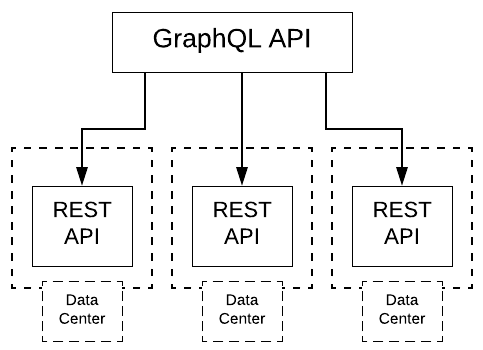
It turns out the REST APIs were distributed among a variety of data centers (see Figure 2). Network latency was killing them.
Figure 2: Initially Netflix’s Monet system queried data from a variety of data centers.
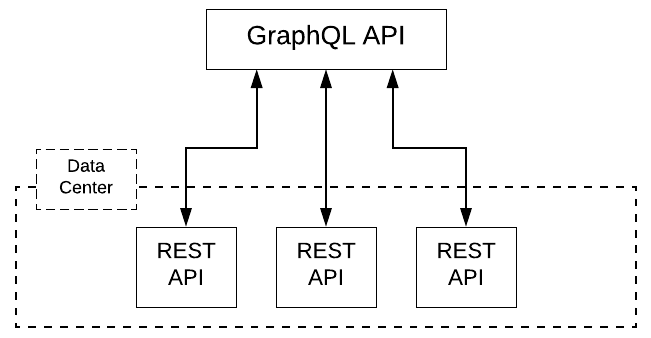
The company’s solution was to bring all the REST APIs into a single data center (see Figure 3).
Figure 3: Netflix improved Monet’s performance by moving all RESTful APIs into a single data center.
The result? Once all data resided in the same data center, performance improved dramatically. It makes sense. Shorter distance to travel means less latency in the system overall.
Now, how this relates to the CAP theorem is interesting. Remember, according to CAP, as partitioning goes down (P), consistency (C) and availability (A) go up. So, while it’s true that Netflix was not using a single machine as a data source, moving everything into a single data center created what one could consider a single virtual data source. Yes, there might be latency issues within the data center. But, rack-to-rack latency is nowhere near as high as the latency between geolocations. We’re talking the difference of 1 to 10 milliseconds as opposed to hundreds, if not thousands, of milliseconds.
In Netflix’s case, the company addressed the constraints imposed by the CAP theorem by reducing the breadth of partition at the geolocation level. All the data lived in the same data center. Imagine if partition size could be reduced at the machine level. What if instead of having data distributed among many machines within the same data center, data actually resided within a single machine? Partition size would be reduced to one. Then, applications could have the latest data immediately. All that’s needed is a single machine that can handle the load. This is where using a mainframe comes into play.
Mainframes Are Built for Big Data and Agile DevOps
Mainframes since their inception were intended to be able to store and process enormous amounts of data. Today 80% of the world’s data still resides on mainframes. As mentioned in a previous article about this topic, one mainframe can process 2.5 billion transactions daily. That’s the equivalent of 100 Cyber Mondays in a single day. That’s a lot of computing power easily equivalent to more than a few racks of commodity hardware in a data center. In fact, in some situations, one mainframe can provide the computing power found in an entire data center.
So, let’s go back to the Netflix problem. What if instead refactoring those distributed RESTful APIs into a single data center, the time and money spent was used to refactor those RESTful APIs into a single mainframe? Yes, there are some technical hurdle to overcome, but considering the running Linux on a mainframe is standard these days, it’s not as if we’re talking transforming a bunch of Python code into COBOL. Databases from standard RDBMS such as DB2,Oracle to the NoSQL MongoDB can run perfectly well on a mainframe. There’s work to be done, but reinventing the wheel is not one of the tasks. Using a mainframe is a viable solution except for one sticky little problem: The conventional thinking is that using a mainframe is prohibitively expensive. Thus, the bias toward racks of commodity hardware or simply going with a cloud service.
Mainframes as a Cost-Effective Solution
The general perception in most IT shops is only big banks, insurance companies, governments and large-scale manufacturers use mainframe computers. They’re just too expensive for small to medium-size business. While many mainframes come with a price tag that can exceed $1 million, there are still surprisingly affordable models. For example, an entry-level IBM z114 will run about $75,000.
If you’re a company spending $50,000 a month on AWS or Google Cloud computing resources, then for the $600,000 a year cost you’re spending on a cloud provider and the latency that comes with it, your company can well afford not only an entry-level IBM Z system to handle a production load, but also a second one to serve as backup, should failure occur.
In terms of system administration, just about all the tools commonly used to support modern CI/CD processes today in the DevOps world have corresponding equivalents for mainframe implementation. As with any adoption of unfamiliar technology, there is a learning curve. But, again, we’re not reinventing the wheel. The tools, resources and expertise exist. Adoption is just a matter of following standard change management practices typical in medium-to-large-size companies that are well-positioned and use a mainframe to take advantage of implementing a cost-effective, no-partition data source strategy.
Integrating Mainframe Technology into a DevOps-Driven Ecosystem
Mainframes are capable of doing DevOps in an open, agile and collaborative fashion. The tools, resources and expertise required to support a mainframe’s participation in CI/CD processes exist today. For example, Zowe is an open source software framework that provides solutions that allow development and operations teams to securely manage, control and develop on the mainframe like any other platform. DB2 DevOps Experience for z/OS is one of the first commercial products built on Zowe. It allows IT the control over the mainframe database, its business rules and standards, while allowing development teams the ability to work independently using self-services and integration with modern CI/CD tools to speed their application release time with better quality and development practices.
When you think about it, in certain mission-critical situations, using a mainframe to have the latest data at any time not only makes sense from a technological point of view, but it’s also attractive in terms of return on investment. The trick is to be able to identify the right use case. Of course, if you have a situation in which 90% of your users are in California and you have a mainframe situated in Bangalore, the laws of physics will apply. Moving the bits from the mainframe to user will take time. But, if you have situations in which user and data are in continental proximity, using a mainframe as a standard data source begins to look very attractive.
Again, having the right use case is key. But, everything else being equal, using a mainframe for sensitive, data-driven applications warrants significant consideration.
Putting It All Together
The constraints on distributed computing imposed by the CAP theorem remain a challenge to those who design and implement large applications at web-scale. The “pick two” limitation CAP imposes can be an annoyance for simpler websites that provide content intended for the general consumer. But, for large scale, data-intensive applications, having accurate data immediately is not optional, it’s essential. Thus, using mainframe technology to create a no-partition data infrastructure becomes a viable way to address the limitations imposed by the CAP theorem. Under the right conditions, making a mainframe the central repository for your application’s data provides a significant return on investment hard to match when compared to commodity-based cloud providers.
The nice thing about using a mainframe is when it comes to the CAP theorem, you still only get to pick two, but the two you get to pick are consistency and availability. In the scheme of things, those are the two that count.