Tag: release management

  • Release Management, a catalyst for DevOps

    Release Management, a catalyst for DevOps

    We have discussed in my last post “DEVOPS and Continuous Change” on the benefits of doing shorter and swifter runs instead of managing a few ‘Dinosaur’ releases. We have also touched upon the way to go about multiple releases by identifying component /functional dependencies without impacting functionality and the expected savings of time, resources and cost, reaching the goal of rapid delivery of software.

    It’s common to find a formal Release Management (RM) team in large organization, with a lot more of medium and some small ones following suite. We will not touch upon the benefits of having a core RM team helping plan and manage the complex journey of change from the handover of code by the Application teams, packaging and deploying across testing environments by Operations, validating testing signoffs, risk analysis, impact assessment and ultimately ensuring a successful Production deployment.

    Rather, let’s delve deeper to understand how this Confounding or the Third variable called RM fits into DEVOPS. In my opinion a very important actor which neither belongs to DEV nor OPS!

    I would call Release Management a catalyst in true sense, which enables change without itself undergoing such change, a neutral team dedicated in managing the change by brokering a formal hand-off between DEV and OPS.

    RM teams traditionally have been the most underrated, with the DEV and OPS hogging the credit of every successful run to production. They converge the business understanding of new features or fixing a functionality break with the Development team’s new version of code release or the Operations expectation of infrastructure upgrades which will also provide an enhanced user experience advantageous to business and development.

    So, back to my question, where does RM team fits in the cozy DEVOPS selfie?

    Wouldn’t it be incorrect to ignore RM from the DEVOPS equation?

    I would take the liberty of stating that the DEVOPS movement in an organization should be owned, driven and determined by RM, adding Change/Configuration and Release management expertise to the existing cross-functional mix of the DEVOPS team.

    RM should be driving this collaborative approach to rapid delivery, bringing together the right mix of people from both sides and ensuring efficient use of resources, empowered and with executive oversight supporting hard decisions.

    They would be able to add value in this rapid delivery process, by not just tasking them with managing a release cycle but empowering and enhancing their capabilities. RM team under the DEVOPS banner should also be involved in these broad points below:

    • Prioritizing the book of work, creating trade-off between Business needs and Development delivery.
    • Understanding complex business requirements along with adhering to geographical and geopolitical needs and rules.
    • Distributed Set of applications, architectural complexities, interdependent and independent components and dependencies,
    • Complete awareness of the infrastructure landscape, scalability, capacity planning, migrations.
    • Release planning, calendar management, process adherence, true agile sprints, optimal resource utilization, Contingency or Rollback strategy planning.
    • Post deployment/release lessons learnt, retrospection, streamline or integrate processes after every run.
    • Ensuring consistent message is sent across that the DEV and OPS are not adversaries rather, partners in this collaborative approach of software delivery.
    • Management reporting along with any risks assessed or highlights deficiencies.

    This take is based on the many DEVOPS discussions which I have come across where there is no mention of RM or is being assumed as ‘part of DEV and works with OPS’.

    My disagreement on this thought process is not about to which group it essentially belongs or will be part of, but in assigning an inconsequential role to RM in the whole release journey when in fact they should be the drivers!

    Thank you for your time.

    Visit my blog for earlier posts http://askhurram.com/

    Read On, Live On.
     

  • Continuous Delivery and Continuous Deployment

    Continuous Delivery and Continuous Deployment

    A question comes to mind in what exactly do we need to do to move forward with Continuous Delivery and Continuous deployment, How should we start or rather where we should start from. Many times teams may not have achieved the continuous integration properly, maybe due to lack of proper tools, workflow or historical process.

    What we need to do before even thinking of CI/CD, what are our prerequisites:

    • Source code
    • Builds System
    • Deployments
    • QA Automation

    We need to understand release != deployment

    Lets assume with the help of right source control tool, build system and QA, automation team has achieved the continuous integration which means developers integrate code into a shared repository several times a day and each check-in can be verified by an automated build, allowing teams to detect problems early.

    The next step: From CI to Continuous Delivery deployment

    What exactly is Continuous Delivery, Its attitude to make software safe and to go fast
    Lets begin with basics, How much time does it take to deploy one line change or a small bug fix in to the production? Exactly, our goal should be to achieve this as fast as we can.

    Why We Need Continuous Delivery?

    • Yes, its Speed which is needed in current fast paced software industry.
    • Stop waiting around on each other to provide go ahead and open the gate.
    • Quality – It raises the overall quality of your application – No surprises.
    • Capacity and Clarity – Get every team on one tool – Eliminate manual error

    How are we going to do this…..

    Key Areas:-

    • Speed is essential because there is an opportunity and cost associated with not delivering Software
    • Frequent Releases, How frequent is frequent? Why do developers need to wait after writing code?
    • Every build can be potential release candidate.

    Bottom Line

    Remove Manual Work/Steps.
    Move towards complete automation

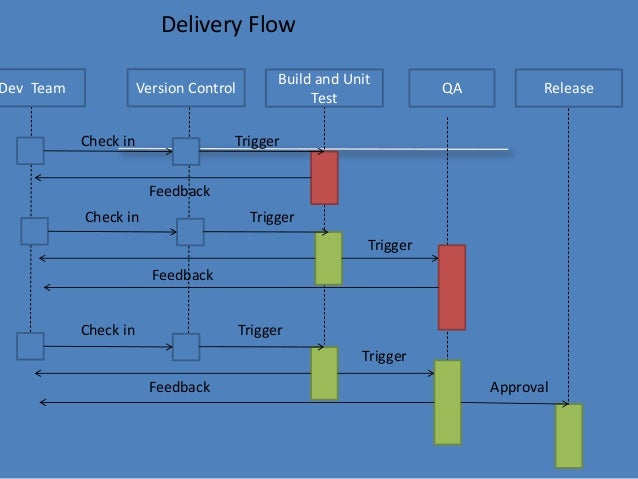
    Delivery Flow

    Here is the Delivery Flow.

    Ingredients:-

    Configuration Management
    continuous integration/ Automated Build
    Automated Deployment
    Automated Testing

    Obviously no single team in a company alone can achieve CD without the help of other teams. It needs collaboration and team work to implement it, Lets take a look at what do we need from various teams

    Dev Team

    • Collaboration – Integration is no longer an event
    • Check in regularly
    • Make small frequent releases because Big Change -> Big risk –> Big effort and Small Change –> Small risk –> Small effort

    QA team

    • Should have complete automation or whatever max is possible. More manual testing leads to more delay.
    • Keep the Build and Test Process Short
    • Break the QA automation into small pieces so that they can run simultaneously and do the QA frequently.
    • Publish the report

    Environment

    • Should have complete Environment to test everything.
    • Flexible and scalable so that multiple env can be spawn any time and can be extended.
    • Managed as prod or at least similar to prod

    This increases Confidence in build’s production readiness reducing release risk.

    Main blocker to achieve CD

    1. manual work
    2. Lengthy Process
    3. ticket system
    4. approval

    Now, How do we deal with blockers

    Do not add gates, add only checks. Adding gates to prevent issues from creeping into prod is not so smart. There are many more issues hiding, you just don’t know them

    Approval!!! Why do we need CAB?

    Dev Sign off
    QA sign off
    Ops and Dependency sign off
    Infra sign off

    Dev Sign off -> Use proper project mgmt tool to track everything that goes in to software with adequate workflow. Get everyone together at the beginning so that these will not be surprises at the last moment. Keep meeting across the team during entire development. This way you don’t need any approval since you have already taken care of all necessary elements during the entire development process.

    QA Sign off -> Publish consolidated QA report with each and every build which should be visible to everyone. You should have proper definition of “Go Ahead” instead of just random checks, Nobody has to ask QA for a thumbs up for the go. • Minimum criteria for Q has to be set.

    Ops, Dependency and Infra Sign off -> Include them at the beginning of the project. Have capacity and change planning during requirement gathering, This gives enough time for ops and infra to get ready for the release.

    Role of SCM/ Release Mgmt

    SCM/ Release Mgmt provide the workflow, tools and necessary filler to enable all teams to interact and automate their part.
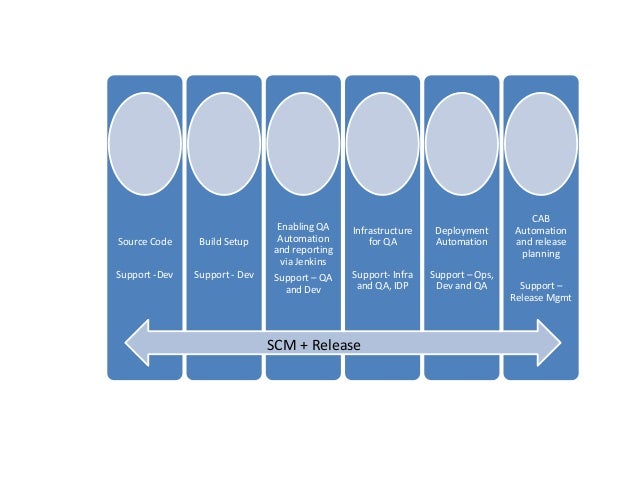
    The picture below shows How SCM and Release Management help each team.

    Source code support for Dev by defining branching policy, Build Setup Support for Dev team to provide continuous build with predefined configuration and in managed environment which includes static code analysis like unit test, code coverage, checkstyle etc..

    Enabling QA Automation and reporting via build tools (Like Jenkins) to support QA and Dev to run their automation and aggregate report on central location. which include QA automation/regression, functional code coverage etc..
    Infrastructure for QA Support like managing integrating environment, Deployment Automation etc.

    Ops, Dev and QA CAB Automation and release planning support.

    It’s clearly visible that CI and CD is not a one man show. Planning, collaboration and teamwork are essential parts of the execution.

    Tools can be chosen by the org/team whichever are suitable for them, but the main part is automation and integration of the tool with each other to make flow smooth and free.