Tag: red hat

  • Red Hat Takes Virtualization Aim at VMware

    Red Hat Takes Virtualization Aim at VMware

    Red Hat, as part of on going drive to wean enterprise IT organizations off proprietary virtualization technologies, today launched a set of Red Hat infrastructure migration tools and services.

    Joe Fernandes, vice president of cloud platforms products at Red Hat, said that as organizations move to modernize their application environments by lifting and shifting them to the cloud, they are simultaneously looking to take greater advantage of open source virtual machines and containers specifically as an alternative to VMware.

    The Red Hat initiative includes a consulting engagement as well as a pilot project that enables legacy application workloads to be deployed on kernel-based virtual machines (KVMs), an instance of OpenStack or the Red Hat OpenShift platform based on the open source Kubernetes container orchestration software. The core tool used to migrate those workloads is the Red Hat Ansible Automation, Fernandes said.

    As management software stack the company now provides on top of those foundations has matured, Red Hat is finding more customers willing to consider transitioning away from commercial virtualization software, he noted. At the same time, he added, wider adoption of KVM by cloud service providers (CSPs) is making open source technologies a much more attractive option to foster deployment of application workloads across a hybrid cloud computing environment without having to refactor them.

    Those two trends in combination, Fernandes said, are making it easier for Red Hat to make a case for organizations to move way from VMware.

    Red Hat may have lost the virtual machine wars to VMware early on, but it’s clear the company is gearing up for a new phase. Many organizations have adopted an open source-first philosophy that Red Hat clearly is trying to exploit at VMware’s expense. At the same time, rising interest in alternative approaches to virtualization in the form of Docker containers and Kubernetes is creating another wedge that Red Hat is looking to exploit. For example, the company is testing Kube-Virt, an open source project that makes it possible to run KMVs within a container. Red Hat has already signaled its intention to apply that technology to other hypervisors as well.

    It’s unclear to what degree containers and Kubernetes will be deployed on virtual machines and used in place of virtual machines altogether. Red Hat is prepared for either eventually, but Fernandes said virtual machines will continue to remain relevant in enterprise IT environments for many years to come. Reliance on container and virtual machines will come down to both the nature of the application workload and the relative cloud-native maturity of the organization deploying them, he said.

    It also remains to be seen the degree to which VMware can stave off a new virtualization challenge from Red Hat. VMware has allied with Amazon Web Services and IBM in the public cloud, while partnering with sister company Pivotal to embrace Kubernetes running on top of VMware. The issue, of course, will be how much enterprise IT organizations are willing to pay for commercial virtual machine licenses in support of the initiatives.


    — Mike Vizard

  • Red Hat Positions PaaS as Cure to Heal DevOps Divide

    Red Hat Positions PaaS as Cure to Heal DevOps Divide

    Red Hat is making a strategic bet that IT organizations increasingly will rely on platform-as-a-service (PaaS) environments to make a broad range of distributed services available to developers, which would eliminate friction without enabling IT operations teams to maintain control.

    Paul Cormier, president of products and technologies for Red Hat, said IT organizations are realizing PaaS environments such as OpenShift have evolved into a platform through which a broad range of curated distributed services can be exposed to developers by IT operations teams. That capability is critical because, otherwise, developers simply go around the IT operations team to download libraries. IT operations teams before too long are asked to support applications of uncertain provenance that in many cases wind up duplicating functions.

    As appreciation of the role PaaS environments play in enterprise IT, Cormier said Red Hat is increasingly having conversations with CIOs and other senior IT leaders who are trying to bridge the historic divide between developers and IT operations teams by exposing a broad range of curated distributed services via well-defined application programming interfaces (APIs).

    Red Hat is expanding the types of applications that can run on OpenShift alongside traditional 12-factor applications. In fact, by embracing Kubernetes container orchestration software, Red Hat is effectively obliterating the line between a PaaS and container-as-a-service (CaaS) environment, Cormier said, adding OpenShift makes it possible to build and deploy those applications on-premises or in the cloud as IT organizations deem best, based on cost, data gravity and regulatory requirements. Serverless computing frameworks will make it possible to bridge those environments by invoking an event-driven framework to take advantage of, for example, cloud bursting in a heterogeneous hybrid cloud, he said.

    In fact, Cormier noted more IT organizations will mix and match internal and external services, as each platform tends to run different classes of application workloads better. For example, IT organizations may want to be able to invoke one type of artificial intelligence (AI) service on one cloud over another based on their performance attributes.

    Traditional enterprise IT organizations are not looking to eliminate the need for IT operations teams, he said. Rather than have developers take over IT operations, most organizations would prefer to maximize the amount of time developers spend building and testing applications. The need to build more applications faster than ever will force IT leaders to separate those concerns to eliminate much of the internal friction that results when developers throw application code over the proverbial IT operations wall, Cormier said.

    Most IT organizations have yet to embrace a PaaS environment broadly. There tend to be pockets of adoption. But most applications today are still built and deployed without employing a PaaS environment, mostly because PaaS environments are viewed by many as being too prescriptive in terms of dictating application development workflow. Red Hat is betting that with the rise of microservices-based applications based on containers, many IT organizations will finally decide to trade a little less control in exchange or for much less IT infrastructure complexity.

    — Mike Vizard

  • NeuVector Extends Red Hat OpenShift Availability with Role-Based Access Controls for Automated Run-Time Container Security

    The container firewall leader also adds Red Hat Container Registry scanning and a Jenkins plugin to automate vulnerability scanning during development

    SAN FRANCISCO – RED HAT SUMMIT – May 8, 2018 – NeuVector, the leader in Kubernetes security delivering the first and only multi-vector container firewall, today announced an expansion to its support for Red Hat OpenShift Container Platform by adding availability for role-based access controls (RBACs). The new capability can instantly enable developers, architects, DevOps personnel, and security teams to achieve more complete security visibility and management for Red Hat OpenShift-deployed containers. Enterprises can now deploy Red Hat OpenShift Container Platform with added confidence knowing that the same access controls created for Red Hat OpenShift Container Platform can also be applied to the management of the NeuVector multi-vector firewall. NeuVector is among the first Red Hat Certified firewall containers available for Red Hat OpenShift Container Platform and it is listed in the Red Hat Container Catalog.

    A sponsor of Red Hat Summit 2018, NeuVector will demo its new Red Hat OpenShift Container Platform capabilities at booth #333, where Red Hat OpenShift customers can also receive a free container security visualization tool to discover network connections and run-time container vulnerabilities.

    NeuVector provides a highly integrated and automated security solution for safeguarding Kubernetes environments against container threats, violations, and vulnerabilities throughout the entire application lifecycle – including protections against sophisticated insider attacks. Proper controls for limiting access to Red Hat OpenShift and NeuVector resources are a critical requirement for preventing insiders with bad intentions from executing unauthorized operations. With this extension of its capabilities for Red Hat OpenShift, NeuVector now fully utilizes Red Hat OpenShift RBACs to help defend container tools from insider threats.

    Additionally, the NeuVector capabilities now enable Red Hat Container Registry images to be easily scanned for vulnerabilities using NeuVector’s container security solution. With this new capability, enterprises can have automated image scanning integrated into their CI/CD processes from day one. NeuVector is also making a Jenkins plugin available that introduces automated scanning in the image build process. Customers using Jenkins in their integration and build processes can set policies for allowing or failing builds based on whether vulnerabilities are detected in the images. The automated registry and image build-time scanning is designed to ensure that known vulnerabilities are not introduced into the application development and deployment lifecycle. The NeuVector multi-vector container firewall is designed to further protect Red Hat OpenShift containers during run-time, guarding against zero-day attacks and even exploits of yet unknown vulnerabilities.

    “Red Hat OpenShift Container Platform is an enterprise Kubernetes platform designed to bridge the needs of developers and IT operations teams and provide a consistent application and service experience across hybrid cloud infrastructures,” said Chris Morgan, global technical director, OpenShift Partner Ecosystem at Red Hat. “We are happy to collaborate with NeuVector to offer these users more confidence and more choice for added container security as they deploy container-based apps in production with OpenShift.”

    “Organizations developing and deploying applications through the OpenShift container management platform require thorough and automated container security,” said Gary Duan, CTO, NeuVector. “With these enhancements to the NeuVector for Red Hat OpenShift Container Platform, we’re proud to strengthen security automation by leveraging role-based access and by incorporating image scanning which helps safeguard the integrity of container-based applications throughout the entirety of their lifecycles.”

    About NeuVector

    NeuVector is the leader in Kubernetes security and delivers the first and only multi-vector container firewall – which enables the confident deployment of enterprise-wide container strategies across multi-cloud and on-premise environments. NeuVector provides east-west container traffic visibility, container protection, and host security in a highly integrated, automated security solution. Customers include global leaders in financial services, healthcare and publishing. Founded by industry veterans from Fortinet, VMware, and Trend Micro, NeuVector has developed patent-pending behavioral learning for container security.

  • Red Hat Rises to Data Management Challenges

    Red Hat Rises to Data Management Challenges

    Red Hat is moving to reduce or eliminate many of the manual tasks DevOps teams routinely encounter via a beta release of an update to Red Hat Enterprise Linux (RHEL) that addresses multiple data management issues related to DevSecOps and DataOps.

    Steve Almy, principal product manager for RHEL, said version 7.5 of RHEL adds support for integration between the Ansible IT automation framework that Red Hat now bundles in the RHEL operating system and OpenSCAP, a security auditing tool originally developed by the National Institute of Standards and Technology (NIST). OpenSCAP provides IT administrators with a baseline of security settings to compare with the current state of their Linux deployment. They then can invoke the declarative Ansible framework to automatically resolve any of those issues raised by the OpenSCAP audit, said Almy.

    In a similar vein, Red Hat is also making it easier to securely unlock Network Bound Disk Encrypted devices at boot-time while adding time-stamping and synchronization needs with the addition of failover with bonding interfaces for Precision Time Protocol (PTP) and Network Time Protocol (NTP).

    Additionally, to reduce data management headaches, Red Hat is now embedding support for data deduplication and compression software based on technology it gained by acquiring Permabit last year. The goal is to enable IT organizations to perform those tasks on data running on the server before it is ever stored on a disk, said Alby. In many cases, that may eliminate the need to acquire, deploy and manage separate data deduplication and compression software for the storage system. That approach also serves to indirectly benefit DataOps, an emerging discipline through which many organizations are trying to modernize the management of data and the pipelines employed to feed that data into applications.

    Other additional management capabilities being added to RHEL 7.5 include an easier-to-use cockpit administrator console for managing storage, networking, containers and other services, and a “known-good” bootable snapshot to help speed recovery and rollback after patching software.

    Almy said Red Hat is focusing more on eliminating much of the friction that gets in the way of enabling IT administrators to accomplish more tasks in a specific amount of time. The goal is not to eliminate the need for IT administrators, but rather to eliminate tasks that conspire to make managing IT more time-consuming than it need be. Much of that Red Hat strategy is anchored around an Ansible automation framework that doesn’t require IT administrators to know how to program to automate the management of underlying IT environment.

    It’s not clear just how much ease of data management impacts IT decisions. All things being relatively equal, however, IT administrators in the agile programming age are trying to manage more workloads than ever. Most organizations are not adding additional IT operations staff mainly because it’s hard to find and retain them. That means make sure existing IT administrators are more efficient than ever by embracing IT automation whenever and wherever possible to streamline DevOps processes.

    — Mike Vizard

  • Red Hat Delivers Advanced Network Automation with Latest Version of Ansible

    RALEIGH, N.C. — —

    Red Hat, Inc. (NYSE: RHT), the world’s leading provider of open source solutions, today announced the general availability of Ansible 2.3, the latest version of the leading simple, powerful, and agentless open source IT automation framework. Ansible 2.3 provides performance enhancements and advanced networking capabilities, including adding connection methods designed to increase flexibility and improve performance.

    “With Ansible 2.3 the total number of networking modules has grown to 267, and we have expanded from networking enablement to a focus on increasing performance and providing better support for network environments, making Ansible a key component of networking deployments in production.”

    TIM CRAMERENGINEERING DIRECTOR, ANSIBLE, RED HAT

    The upstream Ansible project is one of the most popular open source automation projects on GitHub with an active and engaged community. Ansible’s modular code base is powerful enough to manage today’s infrastructure, but also easily adapts to new IT needs and DevOps workflows. With Ansible, developers and IT operations teams can more quickly automate the entire application lifecycle – from physical and virtual servers to cloud computing deployments to Linux containers.

    Ansible 2.3 retains a focus on networking infrastructure enablement through new features as well as providing overall performance enhancements, including:

    Enhanced networking capabilities such as a persistent connections framework. Persistent connections allow for one SSH connection to stay active across multiple Ansible tasks – reducing the total time for completion and delivering up to a 10 times networking performance improvement in tests conducted by Red Hat and various partners. For Playbooks to take advantage of persistent connections in Ansible 2.3, two connection methods have been enabled: 1) the existing command line interface (CLI) connection method and 2) the newly added NETCONF connection method.

    Additionally, Ansible 2.3 includes new networking platform support or modules from Apstra, Arista Networks, Avi Networks, Big Switch Networks, Cumulus Networks, Fortinet, Huawei, Lenovo, Ordnance, and Palo Alto Networks. The number of supported networking platforms has grown to 29 and the total networking module count is now 267.

    Broader support for Microsoft Windows with many new and enhanced modules that make automating Windows with Ansible easier. Ansible 2.3 also offers pipelining support to boost performance.

    Simplified integration of community contributions with the introduction of a metadata-based system for modules. There now is one centralized repository for contributions, tickets, submissions and more – making it easier for both the community and the Ansible Core team to manage and drive further community involvement.

    Availability
    Ansible 2.3 is now available in the following stable branch via GitHub.

    Supporting Quotes
    Tim Cramer, engineering director, Ansible, Red Hat
    “Since first introducing networking modules into Ansible, we have aimed to help users better orchestrate entire application infrastructures, including network devices, with one automation tool. With Ansible 2.3 the total number of networking modules has grown to 267, and we have expanded from networking enablement to a focus on increasing performance and providing better support for network environments, making Ansible a key component of networking deployments in production.”

    Jeremy Schulman, head of customer enablement, Apstra, Inc.
    “We are excited to have the Apstra Operating System® (AOS) as a supported networking platform starting in the Ansible 2.3 release. This allows Ansible to leverage AOS’ open APIs and enables you to more seamlessly integrate AOS within your existing DevOps methodology.”

    Dave Thelen, extensibility engineer, Arista Networks
    “Ansible has quickly become one of the most important tools in the network operating tool belt. Whether it be automating the deployment of an entire data center or using play books to more efficiently troubleshoot issues, Ansible allows tasks that used to take significant time to be automated quickly with a very low learning curve. The enhancements that are included in 2.3 will allow for automating even more tasks for networks of any size and complexity.”

    Edward Sharp, chief strategy officer, Avi Networks
    “Automation is at the center of cloud IT, and Ansible is emerging as the standard to convert complex configurations into simple, scalable, automatable rules. With release 2.3, Ansible is extending this lead, with the addition of modules for application networking and more.”

    Prashant Gandhi, chief product officer, Big Switch Networks
    “Ansible has become a simple, yet powerful framework for automation of networks, containers, and security infrastructure. The networking modules we are contributing to Ansible enable our customers system-wide network automation across both our SDN fabrics, Big Cloud Fabric and Big Monitoring Fabric, as well as programmable security with the BigSecure Architecture.”

    JR Rivers, co-founder and chief technology officer, Cumulus Networks
    “We are witnessing the increasing use of Ansible within the networking community, and the networking focused features in Ansible 2.3 come at the perfect time as operators look to automation to achieve web scale operations.”

    John Maddison, senior vice president of products and solutions, Fortinet
    “Increasing network complexity and a rapidly expanding threat landscape is driving the need for flexible tools that enable organizations to automate their security and network operations to suit their individual needs. Fortinet’s Ansible 2.3 integration provides additional DevOps tools that enable our carrier, service provider and enterprise customers to optimize their network operations to fully leverage the broad, powerful and automated defenses of the Fortinet Security Fabric.”

    Alexander Turner, chief executive officer, Ordnance
    “The Ordnance Ansible networking modules released in Ansible 2.3 enables our customers to streamline their entire network deployment, from cloud to premises in a matter of minutes, not months. The features in Ansible 2.3 impressively extend Ansible to the entire stack making multi-cloud one-click deployments a today-thing.”

    — Jules Louis

  • Red Hat Helps Enterprises Embrace DevOps at Scale with Ansible Tower 3.1

    RALEIGH, N.C. — —

    Red Hat, Inc. (NYSE: RHT), the world’s leading provider of open source solutions, today announced the general availability of Ansible Tower 3.1, the latest version of its enterprise-grade, agentless automation platform. Ansible Tower by Red Hat helps enterprises cut through the complexities of modern IT environments with powerful automation capabilities that can improve productivity and reduce downtime. New additions to the latest version of the platform enable enterprises to better scale DevOps automation and offer the ability to link multiple Playbooks into longer, more complex jobs, enhancing productivity across the business.

    Ansible Tower 3.1 addresses these priorities by automating complex workstreams and making it easier for a wide range of developer and IT operations teams to apply automation to their day to day roles.

    MARY JOHNSTON TURNERRESEARCH VICE PRESIDENT, IDC

    Ansible Tower by Red Hat internally uses the popular Ansible open source automation project to help teams more effectively manage systems and optimize multi-tier deployments while adding control, security and delegation capabilities. Ansible Tower 3.1 includes several new and enhanced features to help provide greater value to IT teams, including:

    • Multi-Playbook workflows enable users to more easily string together multiple existing jobs templates into a single job run – without the need to create additional Playbooks. Powerful workflows can be designed complete with decision points, logic branches, and integrated notifications to fully orchestrate the application lifecycle.
    • Scale-out clustering increases the number of jobs that can be run simultaneously.
    • A more streamlined job details page provides more applicable information that can be understood and used by a wider audience across the enterprise. The job details page now provides job output searching, and formats the data for easier reading and analyzing without having to leave the Tower user interface.
    • Integration with enterprise logging providers allow for automation results to be indexed, monitored, and acted on as part of enterprise-wide analytics and log aggregation installations.
    • Universal search functionality allows users to search and filter throughout Tower by the executing user, job templates by the inventory used, and more.
    • User interface localized for two new languages, Japanese and French. The translated interface provides for Ansible Tower 3.1 use across the global enterprise.

    Availability
    Ansible Tower 3.1 by Red Hat is available now through the Red Hat Customer Portal.

    Supporting Quote
    Tim Cramer, head of engineering, Ansible, Red Hat
    “DevOps teams look to IT automation to help speed productivity and manage complex deployments. The new workflow functionality in Ansible Tower 3.1 takes those capabilities a step further by helping to make automation even more intuitive. With workflows, users can run separate playbooks in a dependent fashion, including the ability to run different playbooks based on the success or failure of the prior job – further reducing manual process and enabling faster time to market.”

    Mary Johnston Turner, research vice president, IDC
    “Open source automation technologies are important in the continued successful evolution and adoption of DevOps within enterprise IT. Beyond just providing automation tools, these technologies help collaborative development and operations teams to cut through the complexities of configuring and optimizing modern computing environments. Ansible Tower 3.1 addresses these priorities by automating complex workstreams and making it easier for a wide range of developer and IT operations teams to apply automation to their day to day roles.”

    — Jules Louis

  • Red Hat to Acquire API Management Leader 3scale

    Accelerates digital transformation with API driven hybrid-cloud architectures

    RALEIGH, N.C. — —

    Red Hat, Inc. (NYSE: RHT), the world’s leading provider of open source solutions, today announced that it has signed a definitive agreement to acquire 3scale, a leading provider of application programming interface (API) management technology. By adding 3scale to its existing portfolio, including Red Hat JBoss Middleware, Red Hat OpenShift and Red Hat Mobile Application Platform, Red Hat strengthens its enablement of the API economy with simplified cloud integration and microservices-based architectures.

    3scale complements our existing middleware product portfolio and Red Hat OpenShift by enabling companies to create and publish APIs with tools such as Red Hat JBoss Fuse, and then manage and drive adoption of those APIs once they have been published.

    CRAIG MUZILLASENIOR VICE PRESIDENT, APPLICATION PLATFORMS BUSINESS, RED HAT

    In an era of digital transformation, agile development practices, and hybrid technology footprints, the API economy has become the norm. Forrester has estimated that 40 percent of U.S. companies will have API management solutions in 2020, spending $660 million in that year.1 Managed APIs are becoming strategic in the enterprise because they enable organizations to rapidly deliver new services that are easy to consume yet secure, scalable, and reliable, as well as enabling services (as APIs) to be monetized as products. Emerging architectures that decompose functionality into ever more finely-grained components–”microservices”–driven by mobile, the Internet of Things (IoT), and other trends, have further heightened the need for API management.

    3scale was founded in 2007 with a goal of enabling organizations of all sizes to successfully create, manage, and use APIs in a web-enabled world where APIs became paramount. Today, 3scale offers a hybrid cloud based API management platform, which separates the cloud management layer from the API gateway, providing customers with flexibility, performance, and scale. 3scale provides this API management platform within a self-service model at more than 700 organizations across multiple industries, including Campbell’s Soup; Cartera Commerce; CrunchBase; Johnson Controls; Oxford University Press; SITA; and the University of California, Berkeley. 3scale has offices in Barcelona and San Francisco.

    3scale and Red Hat began partnering in early 2015 to deliver a comprehensive platform for API-based application development. The joint solution combined the 3scale API Management Platform with technologies from Red Hat JBoss Middleware, Red Hat OpenShift and Red Hat Mobile Application Platform to provide an API-centric development, deployment, and management offering designed to accelerate application time-to-market. Red Hat JBoss Middleware customers will benefit from the hybrid-cloud capabilities from 3scale for modern architectures. Mobile application development in particular is highly API-centric and 3scale’s platform combined with the Red Hat Mobile Application Platform can lead to development and management simplicity at massive scales.

    Most recently, 3scale introduced a containerized version of their API Gateway for Red Hat OpenShift, enabling users to easily and consistently create applications with microservices distributed across diverse, hybrid environments. The combined power of Red Hat’s container application platform and 3scale’s API management capabilities enables customers to simplify and automate tasks, helping reduce errors while increasing flexibility and control.

    Red Hat has provided enterprises with leading open source platforms for building modern applications, integration and automation solutions. With the addition of 3scale’s API management solutions, and its existing middleware, container application platform, and mobile offerings, Red Hat can further simplify and accelerate customers’ digital strategies and accelerate time-to-market for API initiatives, and enable enterprises to innovate faster, in a smarter way.

    The acquisition is expected to have no material impact to Red Hat’s revenue for the second fiscal quarter ending August 31, 2016 (the “second quarter”), or its fiscal year ending Feb. 28, 2017 (“fiscal 2017”). Management expects GAAP operating expense to increase by approximately $3 million, or ($0.01) per share, in the second quarter and approximately $7 million, or ($0.03) per share, for fiscal 2017 as a result of the transaction. Management expects that non-GAAP operating expense will increase by approximately $1.5 million, or approximately ($0.01) per share, in the second quarter and approximately $5 million, or approximately ($0.03) per share, for fiscal 2017 as a result of the transaction. Red Hat calculates non-GAAP operating expense by subtracting from GAAP operating expense the estimated impact of non-cash share-based compensation expense, which is expected to increase by approximately $0.8 million for the second quarter, amortization of intangible assets, which is expected to increase by approximately $0.2 million for each of the remaining quarters in fiscal 2017, and transaction costs related to business combinations, which are expected to be less than $1 million in the second quarter. For Red Hat’s full forecast, including the expected impact of the transaction on GAAP and non-GAAP operating margin and GAAP and non-GAAP earnings per share, refer to the guidance provided in its June 22, 2016 earnings press release.

    The transaction is expected to close in June 2016, subject to customary closing conditions.

    Supporting Quotes
    Craig Muzilla, senior vice president, Application Platforms Business, Red Hat
    “APIs play an important role in helping to accelerate innovation and business growth in the digital economy. With digital transformation initiatives identified as a top priority for organizations today, API management has become the foundation for exposing those APIs for better use, performance, and value creation. 3scale complements our existing middleware product portfolio and Red Hat OpenShift by enabling companies to create and publish APIs with tools such as Red Hat JBoss Fuse, and then manage and drive adoption of those APIs once they have been published.”

    Steven Willmott, CEO, 3scale
    “We’ve already seen great customer success combining Red Hat’s excellent middleware platform with 3scale API management, and we see tremendous opportunity to benefit customers even more as they expand their API, middleware and microservices plans. We see this as a natural extension of our relationship, and we’re excited to be joining an organization with such a strong commitment to open standards, open source and spreading the benefits of technology.”


    1 Forrester Research, “Sizing The Market For API Management Solutions,” April 2, 2015.

    ABOUT RED HAT

    Red Hat is the world’s leading provider of open source software solutions, using a community-powered approach to provide reliable and high-performing cloud, Linux, middleware, storage and virtualization technologies. Red Hat also offers award-winning support, training, and consulting services. As a connective hub in a global network of enterprises, partners, and open source communities, Red Hat helps create relevant, innovative technologies that liberate resources for growth and prepare customers for the future of IT. Learn more athttp://www.redhat.com.

    FORWARD-LOOKING STATEMENTS

    Certain statements contained in this press release may constitute “forward-looking statements” within the meaning of the Private Securities Litigation Reform Act of 1995. Forward-looking statements provide current expectations of future events based on certain assumptions and include any statement that does not directly relate to any historical or current fact. Actual results may differ materially from those indicated by such forward-looking statements as a result of various important factors, including: risks related to the ability of the Company to compete effectively; the integration of acquisitions and the ability to market successfully acquired technologies and products; the ability to deliver and stimulate demand for new products and technological innovations on a timely basis; delays or reductions in information technology spending; the effects of industry consolidation; uncertainty and adverse results in litigation and related settlements; the inability to adequately protect Company intellectual property and the potential for infringement or breach of license claims of or relating to third party intellectual property; risks related to data and information security vulnerabilities; ineffective management of, and control over, the Company’s growth and international operations; fluctuations in exchange rates; and changes in and a dependence on key personnel, as well as other factors contained in our most recent Annual Report on Form 10-K (copies of which may be accessed through the Securities and Exchange Commission’s website at http://www.sec.gov), including those found therein under the captions “Risk Factors” and “Management’s Discussion and Analysis of Financial Condition and Results of Operations”. In addition to these factors, actual future performance, outcomes, and results may differ materially because of more general factors including (without limitation) general industry and market conditions and growth rates, economic and political conditions, governmental and public policy changes and the impact of natural disasters such as earthquakes and floods. The forward-looking statements included in this press release represent the Company’s views as of the date of this press release and these views could change. However, while the Company may elect to update these forward-looking statements at some point in the future, the Company specifically disclaims any obligation to do so. These forward-looking statements should not be relied upon as representing the Company’s views as of any date subsequent to the date of this press release.

    ###

    Red Hat, Red Hat Enterprise Linux, the Shadowman logo, JBoss, and OpenShift are trademarks or registered trademarks of Red Hat, Inc.or its subsidiaries in the U.S. and other countries. Linux® is the registered trademark of Linus Torvalds in the U.S. and other countries.

  • Will MariaDB Soon Replace MySQL?

    Will MariaDB Soon Replace MySQL?

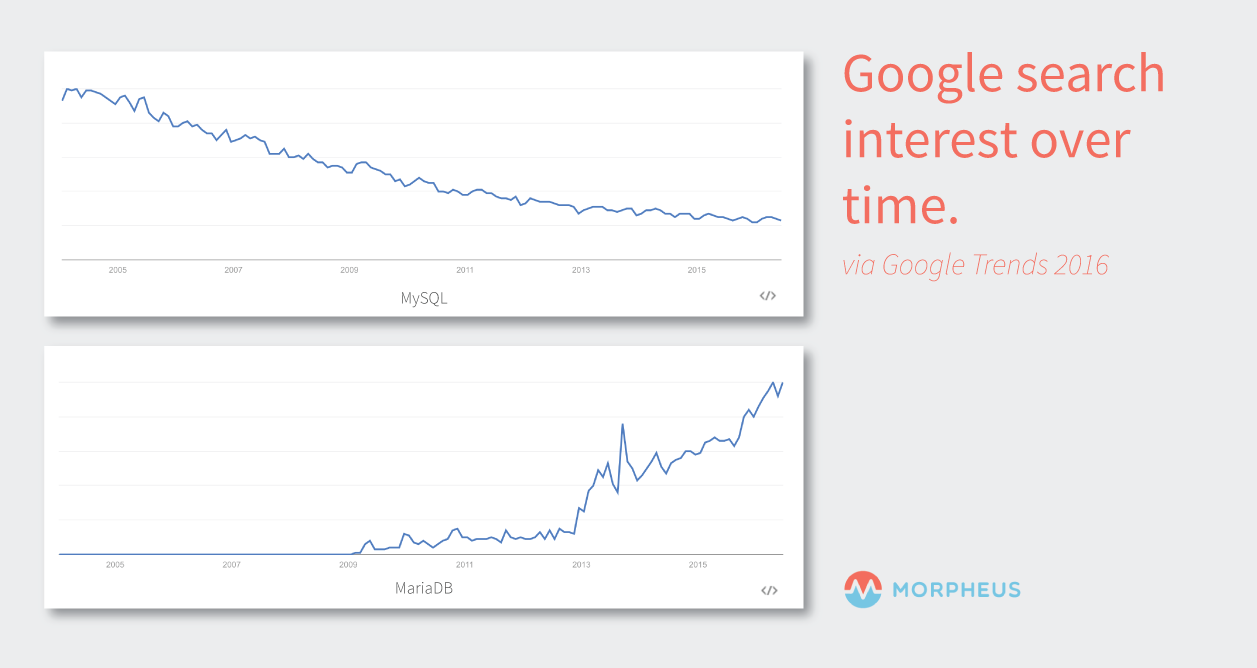
    MariaDB is a database growing in popularity. Its lead developer is Michael “Monty” Widenius, who was part of the team that created MySQL. When MySQL was acquired by Oracle, Widenius and some of the other original MySQL developers decided to launch MariaDB as a fork of MySQL and keep it as open source to mitigate any issues around Oracle’s ownership of MySQL.

    MySQL-vs-MariaDB

    In 2009, Sun Microsystems acquired MySQL. Sun’s subsequent acquisition by Oracle brought about a movement headed by Widenius to “save MySQL.” Widenius and many others in the open source community felt Oracle’s ownership might be a conflict of interest, since Oracle already had a competing closed source commercial database. They believed Oracle would be slow to further develop the MySQL database, given the potentially greater focus on the commercial Oracle database.

    In response to this, Widenius began working on MariaDB and helped form the MariaDB Foundation, which uses a community governance model. Because of the separation between the open source and commercial sides of the foundation, its governance generally is seen by the open source community as positive. This is in contrast to Oracle, which has both its commercial Oracle database and the open source MySQL both under the same governance. Often this is perceived as a conflict of interest, especially when it comes to keeping MySQL up to date.

    MariaDB vs. MySQL

    While MariaDB isn’t yet replacing MySQL, it has brought about good competition between the two, which can be good for innovation. With its backing of Oracle, MySQL may reign supreme for at least the near future; however, technically speaking, MariaDB could replace MySQL if a company decides it wants to make the switch.

    The developers designed it as a drop-in replacement of MySQL. Since it was forked from MySQL, basically all of the structures MariaDB uses are the same. This means switching from MySQL almost surely won’t require a company to alter its application in any way, since the data and data structures won’t need to be adjusted.

    In fact, the command-line tools such as mysqladmin, mysqldump, the daemon and others all keep their original names, so MariaDB is very much a drop-in replacement for database administrators as well. Indeed, many organizations have already either switched to it or simply began using it on its own: It replaced MySQL as the default database in Fedora and Red Hat. It is also used by Booking.com, CraigsList and Wikipedia, among others.

    What Else Does MariaDB Offer?

    Community improvements to MariaDB have been made by notable organizations such as Facebook, Twitter and Google. For example, Google contributed data-at-rest encryption to release 10.1.3, which is quite helpful given the security issues that can arise quickly in this ever-changing environment. In addition, it offers performance improvements such as subquery optimization and faster joins. It also has added row-based replication.

    While MariaDB may not replace MySQL immediately, it is worth watching: It is gaining traction as a potentially serious contender in the marketplace.

  • Red Hat Launches Red Hat Open Innovation Labs, Introducing Collaborative Open Source Cloud and DevOps Residency Program

    Red Hat Open Innovation Labs is designed to enable customers to jumpstart innovation and software development initiatives the open source way

    AUSTIN, Texas–(BUSINESS WIRE)–Red Hat, Inc. (NYSE: RHT), the world’s leading provider of open source solutions, today announced the creation of Red Hat Open Innovation Labs, a consulting service that helps companies integrate people, methodology, and technology to solve business challenges in an accelerated fashion. As part of an Open Innovation Labs consulting engagement, customers will work collaboratively in a residency-oriented lab environment with Red Hat experts to jumpstart innovation and software development initiatives using open source technology and DevOps methods.

    Digitalization is increasingly connecting people, process, data and devices and enabling new business innovation platforms. Software is powering this shift and enabling companies to build innovation-driven advantages. The Red Hat Open Innovation Labs service helps customers rapidly develop and integrate applications using microservices, deploy them in containers, and deliver them using DevOps methodologies across physical, cloud and mobile environments that can quickly scale up or down on-demand. With Red Hat, customers can innovate with speed, agility, scalability and increased security.

    Red Hat Open Innovation Labs aims to help customers achieve this transformation, enabling them to:

    • Work on real business problems from day one, using Red Hat’s push-button infrastructure and automated development environments, teams can more quickly start development once the residency begins, enabling quicker time to value.
    • Learn how to take advantage of modern application development technologies and methodologies, including migrations, microservice architectures, container application platforms, DevOps, application and data integration, mobile and hybrid cloud strategies.
    • Re-platform existing applications for scale-out with OpenStack and public cloud infrastructures.
    • Bridge legacy and new application development efforts on one platform, helping teams design and develop solutions to modernize applications, or take on entirely new challenges.
    • Learn to innovate the Red Hat way by engaging with the Open Source community and collaborating in upstream projects.
    • Innovate onsite and virtually, meeting new requirements as a result of digital transformations, offering distributed teams access to environments in different locations. Red Hat provides a more secure cloud environment so authorized team members can work together, and development can happen on your site, in a Red Hat lab environment, or virtually.

    Availability

    Red Hat Open Innovation Labs is available immediately in North America, with full global availability planned within the year.

    Supporting Quote

    John Allessio, vice president, Global Services, Red Hat

    “We’ve heard from customers around the globe who want to get new initiatives off the ground quickly – whether they are talking about application modernization, or cloud, mobile and microservices – to help them meet their goals and stay ahead of competitors. To these customers, Red Hat Open Innovation Labs offers the ability to innovate faster and to solve business problems alongside Red Hat experts, and the open source way – through collaboration, and using DevOps methodologies and open source technologies.”

    Additional Resources

    Connect with Red Hat

    About Red Hat, Inc.

    Red Hat is the world’s leading provider of open source software solutions, using a community-powered approach to reliable and high-performing cloud, Linux, middleware, storage and virtualization technologies. Red Hat also offers award-winning support, training, and consulting services. As a connective hub in a global network of enterprises, partners, and open source communities, Red Hat helps create relevant, innovative technologies that liberate resources for growth and prepare customers for the future of IT. Learn more at http://www.redhat.com.

    Forward-Looking Statements

    Certain statements contained in this press release may constitute “forward-looking statements” within the meaning of the Private Securities Litigation Reform Act of 1995. Forward-looking statements provide current expectations of future events based on certain assumptions and include any statement that does not directly relate to any historical or current fact. Actual results may differ materially from those indicated by such forward-looking statements as a result of various important factors, including: risks related to the ability of the Company to compete effectively; the ability to deliver and stimulate demand for new products and technological innovations on a timely basis; delays or reductions in information technology spending; the effects of industry consolidation; the integration of acquisitions and the ability to market successfully acquired technologies and products; uncertainty and adverse results in litigation and related settlements; the inability to adequately protect Company intellectual property and the potential for infringement or breach of license claims of or relating to third party intellectual property; risks related to data and information security vulnerabilities; ineffective management of, and control over, the Company’s growth and international operations; fluctuations in exchange rates; and changes in and a dependence on key personnel, as well as other factors contained in our most recent filings with the Securities and Exchange Commission (copies of which may be accessed through the Securities and Exchange Commission’s website at http://www.sec.gov), including those found therein under the captions “Risk Factors” and “Management’s Discussion and Analysis of Financial Condition and Results of Operations.” In addition to these factors, actual future performance, outcomes, and results may differ materially because of more general factors including (without limitation) general industry and market conditions and growth rates, economic and political conditions, governmental and public policy changes and the impact of natural disasters such as earthquakes and floods. The forward-looking statements included in this press release represent the Company’s views as of the date of this press release and these views could change. However, while the Company may elect to update these forward-looking statements at some point in the future, the Company specifically disclaims any obligation to do so. These forward-looking statements should not be relied upon as representing the Company’s views as of any date subsequent to the date of this press release.

    Red Hat is a trademark of Red Hat, Inc., registered in the U.S. and other countries. Linux® is the registered trademark of Linus Torvalds in the U.S. and other countries. The OpenStack Word Mark is either a registered trademark/service mark or trademark/service mark of the OpenStack Foundation, in the United States and other countries and is used with the OpenStack Foundation’s permission. We are not affiliated with, endorsed or sponsored by the OpenStack Foundation, or the OpenStack community.

    Contacts

    Red Hat, Inc.
    Stephanie Wonderlick, +1 571-421-8169
    swonderl@redhat.com

  • Open source and Samsung take center stage at Red Hat Summit

    Open source and Samsung take center stage at Red Hat Summit

    While much of the DevOps world was focused on DockerCon in San Francisco this week, there was also big news happening on the east coast. While DockerCon was shaking things up with the announcement of the Open Container Project the Red Hat Summit in Boston held its own share of big news and much of it spotlighted the important role of open source.

    “Red Hat is really the independent voice of Linux focused entirely on business,” said Rob Enderle, principal analyst with the Enderle Group. “It is also a showcase of how to make money on the platform without taking advantage of anyone in the process and largely remaining true to the core tenets that created Linux in the first place.”

    Focus on Open Source

    One of the primary core tenets—if not the defining core tenet—of Linux is open source. The shared development and collaborative nature of the operating system as an open source project is its main strength. At the Red Hat Summit open source played an even larger role than normal.

    “The company continues to show strong momentum for OpenShift Commons as the re-write of the technology is moving forward showing that the platform-as-a-service (PaaS) battles are alive and well,” explained Al Hilwa, program director of software development research for IDC. “Red Hat also rebranded and updated its FeedHenry platform as it continues to turn it fully into open source and integrate it with OpenShift.”

    Samsung Partnership

    Aside from the focus on open source, the other big news out of the Red Hat Summit was a new strategic alliance with Samsung. Samsung will push Red Hat’s mobile platform and potentially other software into the enterprise in a more integrated fashion as a function of the new partnership.

    The relationship has potential, but according to Enderle there are both positive and negative outcomes possible. “Samsung needs Red Hat far more than Red Hat needs Samsung because Red Hat provided the enterprise brand that Samsung needs to penetrate the space. Samsung is a firm that has never found a platform they didn’t like and have historically been unable to focus on any one of them for extended periods of time,” cautions Enderle. “Red Hat alone won’t be able to fix that and Samsung’s behavior could actually tarnish Red Hat if they aren’t careful.”

    Strong Momentum

    Hilwa also made another observation about the strength of Red Hat’s business model. “That the company will cruise through the two billion dollar annual revenue barrier sometime this year is all but certain with its posted rates of growth. This is an enormous milestone for the open source world.”

    We’ll have to wait and see how the Red Hat / Samsung partnership pans out for either company, but the Red Hat Summit highlighted the strength of Red Hat’s momentum and the unstoppable juggernaut of open source development.