Tag: red hat

  • AlmaLinux Foundation Delivers on CentOS Promise

    AlmaLinux Foundation Delivers on CentOS Promise

    A nonprofit organization launched this week to oversee future development of AlmaLinux, a distribution of Linux based on code originally contributed to the open source CentOS project.

    At the same time, CloudLinux, which created AlmaLinux in response to a decision by Red Hat to pull financial support for CentOS, announced that a stable version of the operating system is now available. CentOS itself was based on the Red Hat Enterprise Linux (RHEL) distribution that is made available via a subscription.

    Jack Aboutboul, community manager of AlmaLinux, said AlmaLinux is the result of the $1 million that CloudLinux committed toward creating a distribution of Linux based on a CentOS project used by hosting providers, such as CloudLinux, to run RHEL-compatible applications at a lower cost. AlmaLinux OS is a binary compatible fork of RHEL 8, which the foundation pledged to update to maintain that compatibility.
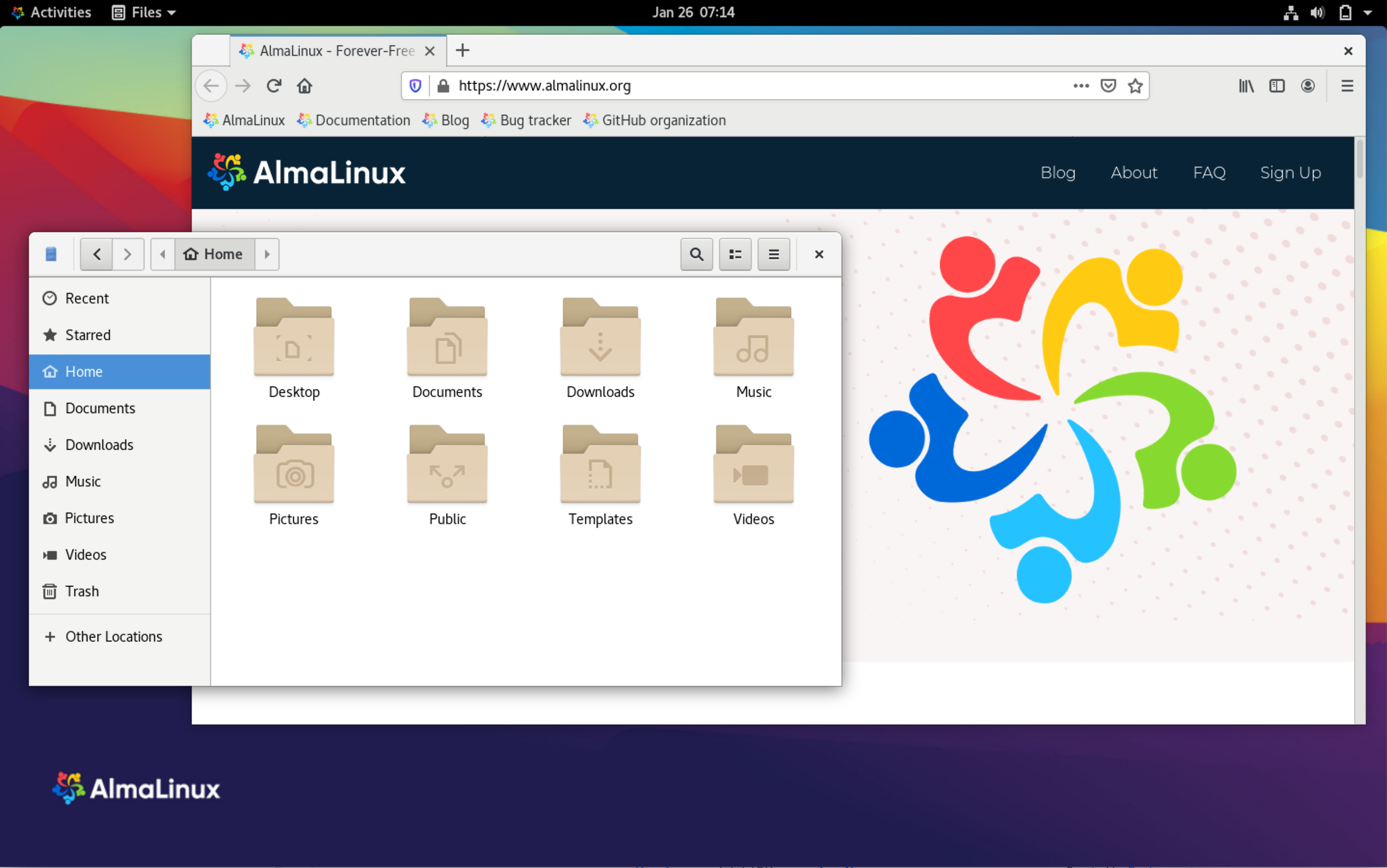
    AlmaLinux is one of two distributions based on CentOS that have been created. The other, RockyLinux was created by Gregory Kurtzer, one of the original creators of a CentOS project. Red Hat, in the meantime, has moved to make RHEL subscriptions available for free to individual developers.

    Aboutboul said AlmaLinux is more mature than RockyLinux, because it is based on a Linux distribution that has been battle-tested by IT service providers. AlmaLinux also added a SecureBoot capability as well as support for VMware and the Amazon Web Services (AWS) public cloud, noted Aboutboul.

    The AlmaLinux Foundation also decided to publicly share errata about the ongoing development of the operating system, to make it easier for IT teams to troubleshoot issues that might arise in a production environment.

    It’s not clear yet how much support either AlmaLinux or RockyLinux have. However, at this juncture, forks are becoming fairly common across the open source community. Those disruptions, however, don’t seem to be dampening enthusiasm for open source software. A global survey of 1,250 IT leaders conducted by Red Hat finds nearly 80% of respondents expect to increase their use of emerging open source software technologies over the next two years, with the top three use cases being infrastructure modernization (64%), application development (54%) and digital transformation (53%).

    As Winston Churchill famously said, democracies are messy, and the open source community is no exception. Passions run high. At the same time, the various business models that spring up around open source projects often conflict; because of animosity, greed or differences of opinion, it is not uncommon for multiple forks of an open source project to emerge and evolve over time.

    Despite that issue, IT organizations remain committed to open source for two primary reasons. First, no one needs permission to download open source software to a laptop. That enables developers to more easily experiment with new technologies. Second, cost. Many IT organizations prefer to use free open source software, rather than paying to license commercial software. They may one day pay for support, but the number of open source software users still dwarfs the number willing to pay for support; especially since knowledge and expertise is freely and equally shared across a growing open source community.

    Given those benefits, any friction in the open source community itself is largely seen as an acceptable risk and just the potential cost of doing business.

  • Red Hat Survey Reveals More Confidence in Open Source

    Red Hat Survey Reveals More Confidence in Open Source

    A recent Red Hat survey revealed how DevOps teams increasingly depend on open source to support their shift to cloud-native environments and digital transformations, and to maintain security in these highly distributed environments.

    Based on a survey of 1,250 IT professionals, Red Hat maintains that the survey respondents — from organizations that were Red Hat customers — were unaware that Red Hat sponsored the study to help avoid “biased or influenced responses,” Red Hat said in a statement. 

    During the past two years, the number of organizations that deemed open source necessary for their digital transformations increased 11% to 53%, representing the majority of the respondents’ organizations. 

    The vast majority (87%) of the respondents considered open source to be “more secure” than or “as secure” as proprietary software, while 84% indicated that enterprise open source “is a key part of my organization’s security strategy.”

    While the survey reflects open source’s importance for security for IT professionals in DevOps, its support of the overall business mission is key, as well, says Momodou Jaiteh, application security consultant at nVisium, an application security provider.

     “Information security is about reducing and mitigating risk to enterprises, from technology, people and process perspectives. It helps enable the business to operate securely in the best interest of its shareholders and customers,” Jaiteh said. “Thus, security typically plays a supporting, [but] nonetheless critical role in the success of the business, especially in a digitally connected world.” 

    Open source software often helps businesses reduce overhead cost in delivering services to their customers through reduced time to market, Jaiteh said. One major additional advantage is “visibility and input from a lot of different people,” Jaiteh added. 

    “Greater visibility often translates to more observing eyes on all aspects of the open source software, which often translates to better security. This is even better for mission-critical software that deals with sensitive information, such as cryptographic algorithms, etc.,” Jaiteh said. “It is not a surprise to see open source used more in infrastructure modernization, because as we move to DevSecOps models of software delivery, infrastructure often is the bottleneck. Therefore, solving for infrastructure helps developers focus on aspects that are unique to their business.”

    While survey respondents ranked improving collaboration between IT and business stakeholders to achieve a digital transformation as their highest priority, implementing cloud technologies or infrastructure ranked second. Infrastructure modernization is thus seen as a prerequisite for a full digital transformation, said Dirk Schrader, global vice president, security research at New Net Technologies (NNT), a cybersecurity and compliance software provider.

     “Open source plays a vital, pivotal role in almost all digital trends driving any industry sector today,” Schrader said. “Cloud computing or containerization is rooted in open source technology, many development libraries are open source, and the market for open source solutions has been a model for servitization; the changes in one’s business model away from selling a product to selling a service, or an integration of service, and product that focus on additional value-add for the customer.”

     For security, the main advantages consist of being able to review, inspect and audit “each and every piece of code,” Schrader said. 

    “The ability of open source to be a base for services makes it the natural companion for any digital initiative,” Schrader said.

  • How Open Source Software Powers Digital Innovation

    How Open Source Software Powers Digital Innovation

    Open source has permanently altered how we work and conduct business. Linux, and thousands of other open source projects and open standards, now dominate the software landscape, supporting emerging technologies like artificial intelligence and edge computing. Without open source, the DevOps tooling ecosystem would lack Docker, Kubernetes, service mesh, popular databases, and many CI/CD tools used by DevOps teams daily.

    Now, more than ever, companies are searching for ways to meet escalating user demands. The pandemic has amplified this urgency, accelerating existing digital transformation initiatives. Arguably, open source is the engine that now powers the digital innovation required to compete. Leveraging open source could also help check rising cloud costs. With proprietary solutions falling out of favor, many enterprise leaders are adopting open source alternatives for infrastructure modernization and application development.

    Red Hat recently released its third annual State of Enterprise Open Source report. The report surveyed 1,250 IT leaders worldwide on their open source adoption and usage patterns. The findings validate what most of us already know — open source is now fundamental to most technology stacks. Without it, most development projects would fall flat in an instant.

    Open Source Use Cases

    Open source is at the heart of modern software development. According to the report, 90% of enterprise IT leaders are using open source. So, where is open source being applied? Well, 64% of enterprises use open source software for IT infrastructure modernization. The report surmised that this could be due to Linux and open source infrastructure replacing proprietary systems.

    The report also found 54% of enterprises use open source for application development. This is no surprise, as engineers routinely adopt open source libraries and packages to construct B2B and user-facing experiences. In a digital-only environment, applications are the lifeblood for many businesses, and open source is critical scaffolding.

    The third top use case for enterprise open source is digital transformation, at 53%. This figure has increased by 11 percentage points in the last two years alone. Open source will likely continue to replace non-digital or manual processes with software-based, automated processes.

    In the enterprise, open source is used in networking, adopted by 54% of enterprises, databases, at 53% and security, at 52%. Other areas mentioned in the report include big data analytics and cloud management tools.

    In recent years, multi-cloud has become a notable trend. The idea is that organizations will seek out multiple cloud vendors to support different use cases. The Red Hat report confirmed that hypothesis, finding that 69% of respondents prefer to use multiple vendors for their cloud. As hybrid, multi-cloud setups profligate, cloud expertise and smart multi-cloud economic practices continue to gain importance.

    Containers and K8s

    Open source components are the foundation for containers and container management utilities. As reliance on containers grows, so will the dependence on open source technology. The report found just under half of enterprises now use containers in production. An additional 37% also use containers for development-only purposes.

    To orchestrate these containers, IT teams have coalesced around Kubernetes. Sixty-six percent of respondents view Kubernetes as very or extremely important. As Kubernetes becomes ubiquitous, growth in container usage is slated to continue — about one in three respondents reported their container usage will increase significantly in the next 12 months.

    “Kubernetes has become the de facto standard for Linux container development,” said Michael Hinterland, team lead, ICS cloud & automation and ICS system & middleware, Porsche Informatik.

    While Kubernetes is flourishing, there are certainly variances across industries. For example, 62% of financial services and telecommunications respondents adopted containers in production, while other sectors, such as health care and retail, saw a lower adoption of containers in production, at 47% and 50%, respectively. The highly-regulated financial services sector also scored high on Database DevOps, a separate report recently concluded.

    Open Source Benefits and Barriers

    There are numerous benefits to using enterprise open source software. For one, a commitment to open source brings transparency and collaboration improvements. Respondents also cited higher quality software, access to the latest innovations and improved security as being among the top benefits to adopting open source software.

    But open source has its drawbacks, too; 42% of tech leaders reported a lack of support as a top hurdle to enterprise open source adoption. This checks out – community-driven projects don’t typically offer traditional support systems. Without accessible frameworks for learning, creating a Center of Excellence at scale becomes difficult.

    Other top barriers to enterprise open source adoption include compatibility, code security and a lack of internal skills. Introducing open source within an enterprise means upskilling the workforce and encouraging secure-by-default settings to avoid costly misconfigurations. It could also mean working with trusted allies that further open source initiatives, the report recommended.

    Open Source Fuels Emerging Tech

    “Open source has solidified itself as an innovation engine for the software industry,” wrote Paul Cormier, president and CEO, Red Hat.

    Indeed, open source is at the heart of most cutting-edge emerging technologies. For example, 55% of respondents report using enterprise open source in edge computing and internet of things (IoT) settings. Simultaneously, 48% of respondents use open source for artificial intelligence and machine learning (AI/ML). Amid open source projects like OpenAI and GPT–3, AI is eating the software world, Forbes reported.

    Both categories are slated to increase by nearly 20 percentage points in the next two years, whereas the use of proprietary solutions for AI/ML will decrease. Open source will continue to affect buying decisions, as 83% of IT leaders are more likely to choose a vendor that has contributed to the open source community.

    Within a COVID-19-influenced world, “the problems are too big for one person, one company or one organization to solve,” said Cormier. “But it’s in moments like this where open source truly shows its power.”

  • IBM Power Systems Enhances Hybrid Cloud Capabilities with Red Hat

    New pre-configured private cloud platform, innovative cloud-consumption payment model, and more Red Hat software now supported on IBM Power Virtual Servers

    ARMONK, NY – February 23, 2021 – IBM (NYSE:IBM) announced availability of Red Hat software on IBM Power Systems as well as new IBM Power Systems hardware. These announcements further expand IBM Systems commitment to help clients modernize by empowering them with the latest tools from Red Hat to develop cloud-native applications and deploy them into hybrid cloud environments.

    Today’s announcements include:

    • Expanded Red Hat Capabilities on IBM Power Systems – IBM Power Systems will now feature Red Hat OpenShift on IBM Power Virtual Server leveraging OpenShift’s platform-agnostic installeri, Red Hat Runtimes, and new certifiedii Red Hat Ansible
    • New IBM Power Private Cloud Rack Solution – Providing clients an optimized, production level environment to modernize traditional environments to cloud native applications, the IBM Power Private Cloud Rack combines on-premise hardware, a complete software stack of IBM and Red Hat tools, and installation from IBM Systems Lab Services to deliver 49% lower cost per request x86iii.
    • Extended Cloud-Like Capacity Scaling on IBM Power Systems – Enhancements to IBM Power System’s capacity management to quickly scale processing power across the hybrid cloud on Linux, IBM i, and

    “Twelve months ago, IT practitioners faced a vastly different landscape before the world was transformed by the global COVID-19 pandemic,” said General Manager of IBM Cognitive Systems Stephen Leonard. “But despite the challenges, they recognize that a hybrid cloud approach can offer 2.5x the value derived from a single public cloud, as measured by IBM’s Institute of Business Valueiv. IBM Power Systems, along with the greater IBM Systems portfolio, plays a critical role in this transition to hybrid environments.”

    IBM Power Systems and Red Hat Drive Client Success with Hybrid Cloud

    Shree Cement Ltd., one of India’s largest cement producers with nearly $2 billion in revenue last year, selected IBM POWER9-based IBM Power Systems to run a combination of Red Hat and AIX to help them modernize their IT infrastructure with hybrid cloud. When Shree needed to streamline their supply chain while also increasing its computing capacity, they knew they needed to refresh their existing Oracle- based infrastructure.

    “We were in the midst of technology modernization and were looking for a dependable IT infrastructure support that could deliver 24/7 capabilities and integrate the operations, logistics, resources, export- import supply chain, said Manoranjan Kumar, Chief Information Officer, Shree Cement Ltd. “The two operating systems on IBM Power Systems, namely IBM AIX and Red Hat Enterprise Linux, helped us move away from vertical business silo approach. This allows us to operate horizontally across thecompany to bring in synergy amongst multiple manufacturing plants to drive business results and ensure business continuity even during the migrations.”

    Shree Cement wanted to build around an infrastructure that would allow them to scale with future business expansion while maximizing the utility of their hardware, and by selecting Red Hat Enterprise Linux on IBM Power Systems, Shree Cement has laid a foundation that positions them to capitalize on the expanding hybrid cloud capabilities from IBM Power Systems and Red Hat, such as:

    • Red Hat OpenShift on IBM Power Virtual Server – Recognizing that OpenShift is a critical part in helping organizations build an agile hybrid cloud, the container platform is now available on IBM Power Virtual Server leveraging OpenShift’s platform-agnostic installer1. The IBM Power Virtual Server is an enterprise Infrastructure-as-a-Service offering built around IBM POWER9 and offering low-latency access to over 200 IBM Cloud services. In addition, IBM Power Virtual Server clients can now run leading business applications like SAP HANA in an IBM POWER9-based
    • Red Hat Runtimes on IBM Power Systems – To help organizations and developers create cloud-native applications, Red Hat Runtimes is now supported on IBM Power Systems. Red Hat Runtimes is a set of products, tools and components designed to develop and maintain cloud-native applications. Now, developers looking to create cloud-native applications on IBM Power Systems have access to leading open-source frameworks and runtimes that provide a single development experience for hybrid applications spanning IBM Power Systems and other platforms.
    • New Red Hat Ansible Modules – Red Hat Ansible, made available on IBM Power Systems last year, is an open-source based tool that allows for simple automation of common IT jobs, freeing up IT administrator time as well as compute resources. IBM Power Systems has added 22 new Ansibles modules that bring new automation capabilities for common tasks like Patch Management, Security Management, OS & Application Deployment, Continuous Delivery, Centralized Backup and Recovery, and Virtualization Management & Provisioning, bringing the total number of POWER-supported Ansible modules to 102, and they have been downloaded over 11,000 times on GitHub as of February 23,

    Simplified Deployment and Management of Hybrid Cloud

    To help clients not only quickly deploy a hybrid cloud, but also scale with agility to respond to spikes in demand, IBM is announcing two new technologies designed to bring simplicity to hybrid cloud deployment and management:

    • The IBM Power Private Cloud Rack Solution – A pre-configured system with compute, storage, networking and pre-installed software to match an organization’s existing infrastructure, be it based around Linux, IBM i, or AIX, to help organizations operationalize their cloud management and provide an IaaS environment to help clients accelerate development and operations for Kubernetes container-based cloud-native applications with Red Hat OpenShift Container
    • Cloud-like Capacity and Pricing Across the Hybrid Cloud – IBM had already enabled scalable capacity for select on-premises IBM i and AIX IBM Power Systems servers, allowing users to

    unlock additional compute cores as needed and get cloud-like consumption-based pricing. Now, IBM is extending that ability to the hybrid cloud by piloting hybrid capacity credits, which can be purchased and used to unlock capacity on on-premises servers as well as IBM Power Virtual Servers. IBM is also working with other ecosystem partners to further extend dynamic capacity across multiple Linux distributions.

    “IBM’s latest expanded support of their hybrid cloud and application modernization initiatives will enable our customers to easily attain the efficiencies and flexibility of combining on-premises and cloud solutions using the latest open source and tooling,” said Jim Dixon, Vice President, Software & IBM Power Systems at Mainline Information Systems. “Availability of hybrid cloud credits and appliance-like options of hardware and Red Hat software solutions, combined with Red Hat OpenShift consistency between on-premises IBM Power Systems and off-premises clouds, will surely offer ease of entry into this new and important IT paradigm.”

    IBM IT Infrastructure Continues to Evolve for Hybrid Cloud

    Later this year, the next generation of the IBM Power Systems servers based on the IBM POWER10 processor, which was built from the ground up for hybrid cloud, will debut. In addition, later this year the next generation of the AIX operating system, version 7.3, is expected to continue the legacy of innovation with enhanced capabilities that deliver the resiliency, security, and scale needed for the hybrid cloud.

    To round out a hybrid cloud ready infrastructure, IBM Storage recently announced new entry-level IBM FlashSystem models with comprehensive container support as well as support for Red Hat OpenShift and Ansible, while IBM Z and IBM Power Systems also announced new hybrid

    cloud container offerings for IBM Z across Red Hat OpenShift and IBM Cloud Paks.

    For more information on IBM, please visit http://www.ibm.com.

    For more information on IBM IT Infrastructure, please visit https://www.ibm.com/it– infrastructure/power.

    ii Red Hat Ansible certification involves Red Hat testing the Collections developed by IBM and a commitment to provide enterprise support. The Collections for AIX and IBM i are maintained and supported by IBM.i Red Hat Knowledge Base article, “Deploying OpenShift 4.x on non-tested platforms using the bare metal install method – https://access.redhat.com/articles/4207611 [2] Power Systems encryption based on IBM Hyper Protect Crypto Service, the only service in the industry built on NIST FIPS 140-2 Level 4-certified hardware.

    iii The results were obtained under laboratory conditions, not in an actual customer environment. IBM’s internal workload studies are not benchmark applications. Prices, where applicable, are based on U.S. prices as of 09/20/2020 from IBM and x86 hardware pricing is based on IBM analysis of U.S. prices as of 09/20/2020 from IDC. Price comparison is based on a 3-year total cost of ownership including HW, SW, networking, floor space, people, energy/cooling costs and three years of service & support for production and non-production (dev, test and high availability) environments.

    iv Based on IBM internal, cross-industry assessment

  • CentOS Rebellion Against Red Hat Gains Momentum

    CentOS Rebellion Against Red Hat Gains Momentum

    Two insurgent efforts to make sure the CentOS distribution remains viable have been launched following a decision by Red Hat to no longer invest in that fork of the Red Hat Enterprise Linux (RHEL) distribution.

    Launched in 2006, CentOS is widely employed by IT organizations that need an open source distribution of Linux to, for example, deploy a web server. Red Hat gained control over the CentOS trademark in 2014 as the primary sponsor of the project. Starting next year, Red Hat will only support CentOS Stream, which provides IT teams with a “rolling preview” of capabilities the company plans to make available on RHEL. Both RHEL and CentOS Stream are available via a subscription from Red Hat.

    The backlash to that announcement has been swift. Gregory Kurtzer, one of the co-founders of CentOS, has launched Rocky Linux with the support of more than 650 contributors to make sure IT organizations have access to a distribution of a fork of RHEL that doesn’t require a subscription.

    Kurtzer said many of those contributors work at independent software vendors (ISVs) that would prefer to see forks of RHEL continue to be available to their customers. Ultimately, the goal will be to add new capabilities to a Linux distribution in a more agile manner than what has occurred under the stewardship of Red Hat, added Kurtzer.

    At the same time, CloudLinux is pledging to spend $1 million annually to create a distribution of Linux dubbed Project Lenix that is also based on a fork of RHEL. CloudLinux has previously provided a hardened edition of CentOS that has been installed more than 200,000 times by 4,000-plus customers.

    CloudLinux CEO Igor Seletskiy noted the only other existing RHEL-compatible distribution of Linux is Oracle Linux. However, given Oracle’s stewardship of the open source MySQL and database, and the way the transition to open source editions of Java technologies has progressed, Seletskiy said there are many in the open source community who would prefer an alternative.

    As for the Rocky Linux effort, Seletskiy said Project Lenix not only will appear sooner but also IT teams will be able to convert entire fleets of servers over to it via a single command with no reinstallation or reboot required.

    Red Hat can do little to quell these initiatives because RHEL itself is based on open source code that anyone can employ to create a separate distribution. It’s not clear what impact this nascent rebellion will have on the ability of Red Hat to further monetize RHEL; however, it does illustrate how difficult it really is for a provider of any open source code to maintain control over the community that evolves around a given project.

    Many contributors to these projects are also becoming resentful of vendors that productize their efforts by converting open source software into, for example, a cloud service or subscription service that goes on to be the dominant means through which open source software is consumed. As a result, there is increased pressure for vendors to find a way to better reward contributors to these projects. Initiatives such as Rocky Linux and Project Lenix are clearly tapping into an egalitarian spirit within the open source community that runs counter to the way some vendors monetize these initiatives.

    It’s not clear to what degree these two efforts might inspire other revolts based on forks of open source code. However, it’s clear that the stewards of the primary open source project may not be the complete masters of their domain regardless of who may own the trademark for a specific distribution.

  • Red Hat Automates More Operating System Tasks

    Red Hat Automates More Operating System Tasks

    Red Hat today announced an update to Red Hat Enterprise Linux (RHEL) that automates a wide range of manual tasks.

    Scott McBrien, a principal product manager for Red Hat, said RHEL 8.3, available in a few weeks, expands the Red Hat System Roles capability that provides a prescriptive and automated means of managing operating system configurations. Red Hat System Role now addresses kernel and log settings, identity management, certificate management and Network-Bound Disk Encryption (NBDE), as well as deployments of SAP HANA databases and SAP NetWeaver middleware. Red Hat has also updated Tuned, a set of pre-configured performance profiles it makes available.

    In addition, RHEL 8.3 provides an update to Application Streams, a set of developer frameworks, databases, container tools and other resources that now adds support for Node.js 14, Ruby 2.7 and other current versions of tools and languages. Red Hat is now committed to streaming support for updates to the frameworks include in Application Streams versus only making updates available each time the entire platform is updated, said McBrien. That approach is intended to make it possible for developers to embrace new capabilities faster while maintaining support for previous versions of frameworks, said McBrien.

    Red Hat is also furthering its effort to encourage organizations that have standardized on RHEL to embrace its tools for building and managing container applications. Updated container images for Buildah, a tool for building container images and Skopeo, a tool for moving container images across storage platform, have been added along with version 2.0 of Podman, a tool for managing containers and images that adds a REST application programming interface (API) that is compatible with Docker Container Engine.

    Red Hat is making the cases for a more modular approach to deploying tools for building and maintaining containers as an alternative to a more monolithic approach pursued by Docker Inc., said McBrien.

    Finally, Red Hat has added Secure Content Automation Protocol (SCAP) profiles for the Center for Internet Security (CIS) Benchmark and the Health Insurance Portability and Accountability Act (HIPAA).

    RHEL and the Red Hat OpenShift application development and deployment platform are at the core of the hybrid cloud computing strategy being advanced by Red Hat and its parent company, IBM. According to a Red Hat Enterprise Open Source Report, 63% of organizations surveyed have a hybrid cloud architecture today, with more than half of those who do not have one in place planning to implement one in the next two years.

    Beyond bundling developer tools with RHEL to reduce the number of IT vendors, an organization needs to engage, McBrien said Red Hat is committed to automating as many low-level IT tasks as possible. IT teams should be able to deploy operating systems in the cloud just as easily as they might in an on-premises IT environment, he noted.

    It may be a little while yet before every manual IT task becomes automated, but with each new update to the operating system the number of those rote tasks that IT administrators need to devote time to continues to diminish.

  • Red Hat Expands Scope, Reach of Ansible Automation Framework

    Red Hat Expands Scope, Reach of Ansible Automation Framework

    Red Hat, its online AnsibleFest 2020 conference today, announced an on-premises edition of Ansible Automation Platform dubbed Private Automation Hub and previewed technology to connect the Ansible Automation Platform managed as a cloud service by Red Hat and the on-premises edition.

    In addition, Red Hat is making available more pre-integrated workflows to its certified Ansible Content Collections service for Red Hat OpenShift, Kubernetes Core and the VMware vSphere REST application programming interface (API).

    Finally, the company previewed integration between Ansible Automation Platform and Red Hat Advanced Cluster Management, a tool originally developed by parent company IBM for managing Kubernetes clusters at scale. As part of that effort, Red Hat will integrate its implementation of Kubernetes Operators tools for deploying applications on the Red Hat OpenShift platform, which is built on top of Kubernetes, with a Resource Operator for Red Hat Advanced Cluster Management that will enable Ansible Automation Platform to execute tasks outside of the Kubernetes cluster when required.

    Joe Fitzgerald, vice president of management for Red Hat, said there are now more than 60 Ansible Content Collections available that can be deployed on-premises or in a cloud service managed by Red Hat. The connectors will make it easier for IT teams to access workflow content curated by Red Hat and its partners while continuing to create automated playbooks for their own unique IT environments that are stored locally, he said.

    As the number of IT domains to which a declarative IT automation framework can be applied continues to expand, Fitzgerald said the playbooks an IT team can create are becoming more comprehensive. Unlike other IT automation platforms, however, Ansible doesn’t require the IT operations team to learn how to code. In the wake of the COVID-19 pandemic and most employees working from home, the number of workflows that IT teams are trying to automate has increased substantially, he said.

    That framework can now also be applied to both legacy IT environments as well as Kubernetes clusters upon which the cloud-native technologies are being deployed. During AnsibleFest, Red Hat will be showing proofs of concept of support for Knative, open source middleware developed by Google that integrates serverless computing frameworks with Kubernetes clusters.

    While there are still DevOps teams that have adopted programmable frameworks to manage IT as code, many traditional IT administrators are embracing Ansible as a means to automate increasingly complex IT environments. Rather than acquiring and deploying automation tools for each platform in the IT environment, Ansible provides a common framework through which IT teams can automate the provisioning of servers, virtual machines, clusters, switches, routers and storage systems. With vendors such as Cisco Systems supporting Ansible, the number of workflows capable of spanning multiple IT domains continues to expand as internal IT teams share the playbooks either they created or had crafted for them by an IT services firm.

    Regardless of how an internal IT gains access to those playbooks, it’s probable that no matter what the automation requirement is, there is now somewhere a playbook written in Ansible to address it.

  • DevOps Deeper Dive: IBM to ‘Maniacally Focus’ on Hybrid Cloud, AI

    DevOps Deeper Dive: IBM to ‘Maniacally Focus’ on Hybrid Cloud, AI

    IBM this week announced its intention to spin out a new company next year focused primarily on managed infrastructure as part of a plan to focus more on hybrid cloud computing and artificial intelligence (AI) initiatives.

    IBM is combining the Red Hat assets it gained last year via a $34 billion acquisition with its investment in Watson AI technologies, while an as-yet-unnamed company will assume control over IBM outsourcing services currently provided by the Managed Infrastructure Services unit of IBM’s Global Technology Services division.

    IBM CEO Arvind Krishna, appointed last April, on a conference call with analysts said IBM will primarily focus on high-growth opportunities driven by Red Hat OpenShift, Linux, Kubernetes, containers and DevSecOps software technologies that will drive a trillion-dollar hybrid cloud computing opportunity, while the new company will become the world’s largest IT services provider with more than 90,000 employees serving a base of more than 4,600 clients generating more than $19 billion in revenue. Today IBM generates a little more than half of its revenue from those services and claims to have a services backlog of $60 billion.

    The new approach will enable IBM to “maniacally focus” on hybrid cloud computing and AI opportunities, Krishna said. That shift will also create a separate company capable of generating double-digit growth that should result in a higher stock valuation at a time when investors are pouring billions of dollars into software companies. IBM this week disclosed it has 2,400 hybrid cloud platform clients and that the number of larger deals driven by Red Hat software has increased by a factor of two.

    To achieve its financial engineering goal, IBM will incur multiple charges, including $2.5 billion to spin out the new company and another $2.3 billion to set it up.

    IBM has a long history of spinning out companies. In its new form, the company will grow both organically and inorganically as it makes additional acquisitions, noted Krishna.

    The “new” IBM will look and feel a lot more like Red Hat than it will IBM prior to its acquisition of Red Hat, said Mitch Ashley, CEO and managing analyst of Accelerated Strategies Group (ASG).

    “It’s starting to head toward looking more like Red Hat acquired IBM,” he said.

    The degree to which IBM will be able to dominate hybrid cloud computing is unclear. IBM is making case for unifying the management of IT by standardizing on the Red Hat OpenShift platform based on Kubernetes that can be deployed on any public cloud or on-premises IT environments, including those that also house mainframes and x86 servers. In the wake of the economic downturn brought on by the COVID-19 pandemic, the rate at which IT organizations are expected to reduce costs by centralizing the management of cloud computing platforms is expected to increase.

    Adoption of multiple cloud computing platforms in the enterprise has tended to be reactive and any effort to centralize the management of those platforms is still in the planning stages, said Judith Hurwitz, president and CEO of Hurwitz and Associates, a research and consulting firm.

    “It’s not easy,” she said. “It’s not like you can go out and buy a control plane.”

    Ultimately, however, IT teams will have multiple options to choose from that don’t necessarily require them to adopt the Red Hat OpenShift platform.

    Similarly, IT organizations have access to a wide array of open source AI frameworks via cloud services that provide alternatives to Watson offerings.

    In the meantime, the rate at which organizations are transitioning to hybrid cloud and AI platforms is increasing. The issue IBM will need to contend with is making sure it doesn’t become distracted by its own internal issues over the course of the divestiture, which might take well over a year to ultimately complete.

  • Red Hat Ansible Automation Platform Enhancements and New Certified Ansible Content Collections Refine the Automation Experience to Drive Business Imperatives

    Ready-to-use, curated automation for a wide range of platforms, public clouds, network and security technologies help organizations more easily get started with the latest trusted automation

    RALEIGH, N.C. —  —Red Hat, Inc., the world’s leading provider of open source solutions, today announced key enhancements to the Ansible Automation portfolio, including the latest version of Red Hat Ansible Automation Platform and new Red Hat Certified Ansible Content Collections available on Automation Hub. The latest release of Red Hat Ansible Automation Platform helps organizations expand automation to new domains while increasing productivity and cross-team collaboration. As a component of the latest platform release, new Ansible Content Collections developed, tested, and supported by Red Hat enable organizations to get the most up-to-date automation content.

    A new report from Forrester Research highlights that, “Your intelligent automation roadmap and maturity will make you a winner (or a loser).”1 In light of shifting global dynamics, automation has moved to the forefront of IT priorities in an effort to help organizations move faster and more efficiently. To get the most out of automation, however, IT teams need more than just an automation tool — they require smarter, more reliable automation technologies.

    Red Hat Ansible Automation Platform helps organizations accelerate their automation efforts with access to the latest Ansible innovations and technology as they need it, while still providing the security features required for production ready workloads. In addition to Ansible Content Collections, the latest version of the Red Hat Ansible Automation Platform includes the availability of Ansible Tower 3.7, the introduction of automation services catalog, and updates to Automation Analytics.

    A faster path to the latest tested and trusted Ansible automation innovations
    As automation requirements evolve, organizations need the ability to extend automation capabilities to help them expand into new domains more quickly and safely. First announced with Red Hat Ansible Automation Platform in Fall 2019, Ansible Content Collections provides a continuously updated set of curated automation content, helping to shorten the time to value and improve the efficiency of maintaining and consuming automation by enabling organizations to reuse Ansible content at scale.

    With the launch of Red Hat-maintained Ansible Content Collections, Red Hat is publishing 17 new Collections that are all written and supported by Red Hat. Collections are available for many popular network, security and cloud partners, including AWS, Arista, Cisco, IBM, Juniper, Splunk, VyOS platforms and more. This feature can help organizations deploy automation with greater confidence, knowing that it has been tested and is backed by Red Hat’s award-winning support. Collections are published asynchronously from Ansible product releases, making it easier for organizations to access the latest Collections as they become available. With the addition of these Red Hat-written Collections, there are now 49 certified Collections available from Red Hat and partners in Automation Hub.

    A full list of supported and certified Ansible Content Collections can be found at cloud.redhat.com.

    Deeper integration across Red Hat’s management portfolio
    In addition to extending automation for partner technologies, Ansible Content Collections help further integrate Red Hat’s management products. New Collections are available for:

    To meet evolving business demands in the face of uncertain global conditions, we see IT organizations accelerating their automation efforts to help drive faster innovation while managing demand surges due to remote workforces. The latest release of Red Hat Ansible Automation Platform helps to further meld automation innovation with production stability, offering greater confidence to organizations that they can adopt new automation technologies to expand IT footprints while still supporting mission-critical environments.

    THOMAS ANDERSONVICE PRESIDENT, ANSIBLE AUTOMATION, RED HAT
    • Ansible Tower Content Collection enables organizations to configure, manage, and operate their Ansible Tower environments at scale. With the Collection, users can create and modify inventories, credentials, and Ansible Tower job templates, as well as launch and monitor Ansible Tower jobs.
    • Red Hat Insights Content Collection enables organizations to automate manual tasks by using the Red Hat Insights API. These common tasks include installation and registration of Red Hat Insights clients, executing Ansible Playbooks for issue remediation and, through integration with Ansible Tower, automating compliance activities and serving as a dynamic inventory source.
    • Red Hat Satellite Content Collection enables organizations to automate manual tasks by using the Red Hat Satellite API. Users can build and configure a Satellite environment from start to finish, providing complete end-to-end management of Red Hat Satellite via Ansible.

    New levels of intelligence and increased ease of use
    In addition to Ansible Content Collections, the latest release of Red Hat Ansible Automation Platform includes new features and enhancements that help simplify automation for new as well as experienced users while increasing the speed and flexibility of Ansible. These updates include:

    • Red Hat Ansible Tower 3.7 adds new capabilities that help enable customers to engage automation faster and at a larger scale. New updates include tweaks to help eliminate bottlenecks in job processing, as well as optimizing the processing of common API queries and a rework of the user interface communication protocols to maintain performance.
    • Automation Analytics automation calculator, an addition to Automation Analytics, enables users to evaluate the value of automation at their organization and customize it to their individual company’s data. It can measure past, current and future return on investment, providing real-time metrics around effectiveness to encourage wider adoption of automation across more domains.
    • Automation services catalog provides lifecycle management for automation resources, spanning the provisioning, retirement and logging of Ansible platforms across physical, virtual, cloud or container-based environments. This delivers greater visibility over what is being automated and helps organizations to maintain the controls and compliance prescribed by their business.

    Availability
    The latest innovations available in Red Hat Ansible Automation Platform, including Ansible Content Collections, are available now on cloud.redhat.com. New Collections will be released on a rolling basis.

    1Your Automation Psychology And Roadmap Just Shifted Gears, Craig LeClair, Forrester Research, May 2020

    ABOUT RED HAT

    Red Hat is the world’s leading provider of enterprise open source software solutions, using a community-powered approach to deliver reliable and high-performing Linux, hybrid cloud, container, and Kubernetes technologies. Red Hat helps customers integrate new and existing IT applications, develop cloud-native applications, standardize on our industry-leading operating system, and automate, secure, and manage complex environments. Award-winning support, training, and consulting services make Red Hat a trusted adviser to the Fortune 500. As a strategic partner to cloud providers, system integrators, application vendors, customers, and open source communities, Red Hat can help organizations prepare for the digital future.

    FORWARD-LOOKING STATEMENTS

    Certain statements contained in this press release may constitute “forward-looking statements” within the meaning of the Private Securities Litigation Reform Act of 1995. Forward-looking statements provide current expectations of future events based on certain assumptions and include any statement that does not directly relate to any historical or current fact. Actual results may differ materially from those indicated by such forward-looking statements as a result of various important factors, including: risks related to our pending merger with International Business Machines Corporation, the ability of the Company to compete effectively; the ability to deliver and stimulate demand for new products and technological innovations on a timely basis; delays or reductions in information technology spending; the integration of acquisitions and the ability to market successfully acquired technologies and products; risks related to errors or defects in our offerings and third-party products upon which our offerings depend; risks related to the security of our offerings and other data security vulnerabilities; fluctuations in exchange rates; changes in and a dependence on key personnel; the effects of industry consolidation; uncertainty and adverse results in litigation and related settlements; the inability to adequately protect Company intellectual property and the potential for infringement or breach of license claims of or relating to third party intellectual property; the ability to meet financial and operational challenges encountered in our international operations; and ineffective management of, and control over, the Company’s growth and international operations, as well as other factors contained in our most recent Quarterly Report on Form 10-Q (copies of which may be accessed through the Securities and Exchange Commission’s website at www.sec.gov), including those found therein under the captions “Risk Factors” and “Management’s Discussion and Analysis of Financial Condition and Results of Operations”. In addition to these factors, actual future performance, outcomes, and results may differ materially because of more general factors including (without limitation) general industry and market conditions and growth rates, economic and political conditions, governmental and public policy changes and the impact of natural disasters such as earthquakes and floods. The forward-looking statements included in this press release represent the Company’s views as of the date of this press release and these views could change. However, while the Company may elect to update these forward-looking statements at some point in the future, the Company specifically disclaims any obligation to do so. These forward-looking statements should not be relied upon as representing the Company’s views as of any date subsequent to the date of this press release.

    ###

    Red Hat, Red Hat Enterprise Linux, the Red Hat logo, JBoss, Ansible, Ceph, CloudForms, Gluster and OpenShift are trademarks or registered trademarks of Red Hat, Inc. or its subsidiaries in the U.S. and other countries. Linux® is the registered trademark of Linus Torvalds in the U.S. and other countries. The OpenStack Word Mark is either a registered trademark/service mark or trademark/service mark of the OpenStack Foundation, in the United States and other countries, and is used with the OpenStack Foundation’s permission. Red Hat is not affiliated with, endorsed or sponsored by the OpenStack Foundation, or the OpenStack community.

  • Red Hat Extends Scope of Ansible Tools

    Red Hat Extends Scope of Ansible Tools

    Red Hat today announced it has extended the analytics capabilities it makes available for instances of the Ansible IT automation platform and has made the Ansible Automation Services Catalog now generally available.

    In addition, Red Hat has increased the number of certified playbooks it makes available from both the company and third-party partners within the Ansible Content Collections. That repository now houses more than 1,200 certified Ansible Modules.

    Announced prior to the Red Hat Summit, which is taking place online this week, these offerings are part of a series of cloud services the company has developed to foster the adoption of Ansible to automate a wide range of processes.

    Tom Anderson, vice president for the Red Hat Ansible Automation Platform at Red Hat, said that as Ansible is employed to automate more IT processes, more IT teams want to better understand how the playbooks being created using Ansible are being used within their organizations. The latest updates to the Ansible Analytics module add the ability to filter analysis by Red Hat Ansible Tower cluster, by date and between organizations. IT teams can also discover job statistics by total runs, total time, average time, success rate, most failed tasks and the failure percentage of that task.

    At the same time, the Ansible Services Catalog makes it easier to access curated playbooks that have been vetted thoroughly, he said.

    Anderson noted Ansible continues to gain traction because it provides a declarative approach to automating IT processes that can span multiple platforms. Interest in automation has increased substantially in the last several years. The challenge that many organizations now face is that as various providers of platforms have made IT automation tools available, organizations now are managing multiple islands of automation, he said, adding Ansible provides a means to unify IT automation under a common open source framework.

    The pace at which organizations have been automating the management of IT is expected to increase substantially in the weeks and months ahead. In the wake of the economic downturn brought on by the COVID-19 pandemic, organizations that are reducing IT staff will look to automate processes to enable the remaining IT employees to manage more efficiently IT environments that continue to grow in size and complexity.

    That increased reliance on automation should also advance adoption of best DevOps practices, as more IT operations teams embrace managing IT infrastructure as code.

    Ansible, of course, is not the only platform capable of automating IT processes. However, because of its reliance on a declarative approach, Ansible is more accessible to IT operations staff who lack programming skills. In theory, DevOps teams are increasingly taking control over the management of IT infrastructure using programmatic tools. However, there are still many IT organizations that prefer to have access to IT infrastructure centrally managed by IT operations teams that typically make resources available to developers via a self-service portal. However, while there may be a debate over who will automate IT processes, the one thing everyone does agree on is the time to do so is now more than ever.