Tag: red hat

  • Red Hat Brings Ansible Automation to Google Cloud

    Red Hat Brings Ansible Automation to Google Cloud

    Red Hat today announced that the Red Hat Ansible Automation Platform is now available on Google Cloud to simplify the management of yet another cloud platform.

    Using the Ansible Automation Platform, it’s now possible for IT teams that invoke Google Cloud to access pre-integrated services such as Google Virtual Private Cloud, security groups, load balancers and compute and instance groups.

    Pete Cruz, head of product and technical marketing for Red Hat Advanced Cluster Management for Red Hat, said Google Cloud—alongside existing support for rival cloud services—will make it simpler to consistently apply automation across multiple cloud and on-premises IT environments.

    In addition, IT teams can also count the consumption of the Ansible Automation Platform toward any existing enterprise spend agreements with Google.

    Ansible has emerged as a de facto standard for IT automation and is widely embraced by IT vendors and cloud service providers. That level of support has fostered the creation of a level of automation content that is now unrivaled by any other automation framework, noted Cruz.

    In the meantime, the pressure to automate IT processes is building during uncertain economic times. As IT environments continue to become more complex—thanks, in part, to the rise of cloud-native applications—many IT organizations are finding it more challenging to convince business executives to hire additional full-time employees. As a result, many of those IT organizations are now looking to automate as many processes as possible as more workloads are distributed from the network edge to the cloud.

    Rather than create a single playbook to automate every IT process on an end-to-end basis, organizations generally mix-and-match content created by others to automate workflows across highly distributed computing environments, noted Cruz.

    The biggest challenge when automating IT processes is simply overcoming inertia. Many processes are still manual simply because they always have been. In other cases, IT teams are still relying on undocumented scripts created by IT administrators who have left the organization. As the IT environment continues to evolve, it’s not likely those scripts will continue to scale.

    One way or another, IT is becoming more automated. The irony is that after using IT to automate almost every business process imaginable, it’s only recently that IT teams are getting around to automating their own workflows. Many of the rote tasks that used to be performed by entry-level personnel have been steadily disappearing thanks to automation.

    DevOps teams, of course, have always been ruthlessly committed to automating as many IT processes as possible in the name of efficiency. The rise of Ansible, however, makes it easier for every IT organization to achieve that same goal because they don’t have to wait for a specialist to create a playbook to automate a process. An Ansible playbook that can be easily customized or extended often already exists. The real issue may simply be knowing where to look for it.

  • Red Hat CEO: Out | Blind Users: Revolt | ARM: Google Joins Party

    Red Hat CEO: Out | Blind Users: Revolt | ARM: Google Joins Party

    Welcome to The Long View—where we peruse the news of the week and strip it to the essentials. Let’s work out what really matters.

    This week: Matt Hicks is the new Red Hat CEO, visual accessibility is in focus, and Google Cloud rolls out ARM instances. (more…)

  • Red Hat Releases Open Source StackRox to the Community

    Red Hat is excited to announce that Red Hat Advanced Cluster Security for Kubernetes is now available as an open source project: StackRox. Kubernetes users and developers can join the community and test and contribute to the codebase of the project on GitHub.

    Kubernetes is at the foundation of cloud-native development and one of the fastest growing open source projects. According to the Cloud Native Computing Foundation (CNCF) 2021 survey, 96% of respondents reported that they are using or evaluating Kubernetes. The open sourcing of Red Hat Advanced Cluster Security gives organizations a way to help shape the future of how they can better manage and protect their Kubernetes environments.

    Strengthen application security across build, deploy and runtime

    The data breaches and supply chain exploits of the past year reiterate just how critical security is for organizations building and running Kubernetes applications. The StackRox community aims to deliver an open source project that helps users experiment with new approaches in how they protect their Kubernetes environments.

    The StackRox project aims to help simplify DevSecOps by integrating security capabilities within the development and deployment lifecycle, effectively shifting application security “to the left” in software creation. This helps to more efficiently identify and address issues earlier in the development cycle while providing a more cohesive approach to cloud-native security throughout the entire IT stack and application lifecycle. Built to encourage adoption of DevSecOps principles, the project helps to address common cloud-native security challenges, including visibility, vulnerability management, configuration management, network segmentation, compliance, threat detection and incident response, as well as risk profiling.

    Red Hat plans to be an active member of the community, and the StackRox project will be the code behind Red Hat Advanced Cluster Security for Kubernetes with the project helping to drive future product roadmaps. Red Hat Advanced Cluster Security for Kubernetes provides customers using Red Hat OpenShift with enterprise-ready, Kubernetes-native security to enhance the security of infrastructure and workloads throughout the entire application lifecycle.

    Open innovation

    At Red Hat, we believe using an open development model helps create security-focused, stable and innovative technologies. This commitment to the tenets of open source is the core of our business model today and the open sourcing of StackRox is another example of how closely we hold the value of open code and development.

    More information about the StackRox community and future updates can be found at StackRox.io.

  • Application Modernization Report Shows Need For Kubernetes-Specific Migration Tooling

    Konveyor is a community of people passionate about helping others modernize and migrate their applications to the hybrid cloud by building tools, identifying patterns, and providing advice on how to break down monoliths, adopt containers, and embrace Kubernetes. To do so, the Konveyor community is currently working on five projects to help users rehost, replatform, and refactor their applications to Kubernetes. 

    While conversations with users and data from various sources gave us some visibility into how migrations were taking place, we wanted to inform our priorities with recent detailed data. To do so, Red Hat, a Konveyor community contributor, sponsored a survey of 600 IT decision makers, backend developers, and software architects in the US, UK, and English-speaking Asia-Pacific (APAC) to better understand the application modernization landscape.

    Here are some of the findings that relate to Konveyor and application modernization:

    Application modernization is happening now

    It’s clear that there is urgency to roll out migration tooling. Among those we surveyed, those who were migrating or planning to, we found that they plan to modernize 54% of their custom applications during the next year and over a quarter during the next six months. Only 20% expected the modernization to take more than two years. It’s clear this is happening right now.

    That said, it’s not all smooth sailing and this doesn’t happen overnight. While some regions haven’t progressed far enough in their application modernization journey to experience serious barriers, others (notably the US) report that choosing a straightforward approach can be challenging. Organizations have many options to choose from and each option presents varying levels of complexity. 

    Motivators for modernizing existing applications to Kubernetes

    The survey tells us modernization is mostly being driven by the need for reliability, scalability and security. Decreasing costs were also on the list but, as we frequently see in other surveys about technology adoption or change, it’s not the driving factor.

    Konveyor’s tool suite can be used to help realize an organization’s migration plans. 

    The Konveyor tool suite maps closely to the migration strategies companies intend to use based on this survey: rehosting, replatforming, and refactoring.  

    Rehost applications to cloud with Forklift and Crane

    Rehosting (20% of total) involves copying applications to a cloud (whether hosted or on-prem) with minimal changes, i.e. “lift and shift.” This will be familiar to anyone with experience in virtualization early on when bare metal servers were often moved to a virtual machine (VM) for greater efficiency but with little or no changes to the software and with relatively modest operational changes. 

    While rehosting doesn’t provide the same depth of benefits as replatforming or refactoring, it’s the first step in the right direction. Rehosting was the single most common approach 

    Forklift and Crane are the relevant Konveyor projects here. Forklift is focused on migrating VMs to Kubernetes and provides the ability to migrate multiple VMs to KubeVirt with minimal downtime. 

    Crane is a rehosting tool that meets a different use case. Crane helps organizations to migrate applications between Kubernetes clusters. There are many times when developers and operations teams want to migrate between older and newer versions of Kubernetes, evacuate a cluster, or migrate to different underlying infrastructure. 

    Replatforming applications with Move2Kube

    Replatforming (18% of total) is using a cloud migration to upgrade operating systems, databases, and other components as needed in order to cloud-enable applications without changing core application code or architecture. Think of it as “lift, tinker, and shift.” 

    This is effectively an intermediate step between just rehosting and refactoring. In fact, it’s often a stepping stone; the survey found that 90% of those planning to refactor their apps plan to replatform them first.

    Move2Kube is a Konveyor project that allows customers to replatform their applications to Kubernetes orchestrated platforms. One area where replatforming is taking place is in the consolidation of container orchestration platforms to Kubernetes. 

    Due to this consolidation, the Move2Kube project was started to focus on accelerating the process of replatforming to Kubernetes from platforms such as Swarm and Cloud Foundry. This project translates existing artifacts to Kubernetes artifacts to speed up the process of being able to run applications on Kubernetes.

    Refactoring applications with Tackle

    Refactoring (17%) is often viewed as the most challenging application modernization strategy but it’s the one with the most long-term impact. Refactoring involves re-architecting as cloud-native, for example, by containerizing workloads, transforming a monolith to microservices, or moving functions to a serverless architecture.

    While Tackle is not a full refactoring tool, it provides a series of interrelated tools that allow users to assess, analyze, and ultimately move their applications onto a Kubernetes orchestrated platform. 

    As you can see, organizations are taking a thoughtful approach to app migration and there’s no single right path. This data supports the Konveyor community’s approach of providing a toolbox, rather than just a singular tool, that can support transitioning applications however it is happening. Read the full State of Application Modernization report here.

  • Red Hat Adds Managed Ansible Service on Azure

    Red Hat Adds Managed Ansible Service on Azure

    Red Hat today announced general availability of a managed instance of the Red Hat Ansible Automation Platform on the Microsoft Azure cloud.

    Announced at the Red Hat Summit 2022 event, this offering makes it possible to deploy the control plane for Ansible on the Microsoft Azure cloud as an alternative to existing support for Amazon Web Services (AWS) or an on-premises IT environment.

    In addition, in version 2.2 of the Ansible Automation platform, Red Hat is previewing support for content signing technology that automatically validates content to improve overall security.

    Thomas Anderson, vice president of Ansible for Red Hat, said this managed service enables IT teams to take advantage of integrated Microsoft billing in addition to the latest features and content provided for the platform and other capabilities that have been added to optimize Microsoft Azure environments.

    The open source Ansible platform has been gaining traction as an automation framework that enables IT teams to declaratively automate tasks. It requires less programming expertise than rival automation frameworks, which Anderson said is the primary reason so many third-party vendors have adopted Ansible to automate a range of IT tasks.

    The challenge many organizations encounter today is managing multiple islands of automation across multiple clouds and on-premises IT environments. Ansible presents IT teams with the ability to begin unifying all those islands under a single framework, said Anderson.

    It’s not clear to what degree DevOps teams that have embraced rival automation frameworks might be willing to replace them with Ansible. However, as more IT teams embrace automation to make up for shortages of IT personnel, it’s apparent that Ansible is being used across a wide range of IT disciplines spanning everything from DevOps to network management.

    Regardless of the approach, the need to automate as many tasks as possible is becoming critical as IT environments grow increasingly more complex. Many of the scripts that IT teams created on their own simply don’t scale. More challenging still, they are not often documented, so every time the IT professional that created that script leaves the organization it becomes difficult to maintain that scripting code.

    In the longer term, of course, automation frameworks will be increasingly infused with machine learning algorithms capable of learning the unique nuances of individual IT environments. It’s not likely those algorithms will replace the need for IT professionals any time soon. However, rather than resisting automation, more IT professionals have concluded that the tasks required are simply too challenging to manually perform. Many will conclude they simply prefer to work for organizations that have a consistent approach to IT automation that makes it feasible for them to manage a wide range of IT tasks.

    One way or another, IT automation is becoming a standard capability that now goes well beyond the scope of a few isolated DevOps workflows. The issue is finding a way for IT professionals with varying skill levels to collaborate across a common framework that is both easily accessible and highly extensible.

  • Red Hat Adds Service to Customize RHEL Images

    Red Hat Adds Service to Customize RHEL Images

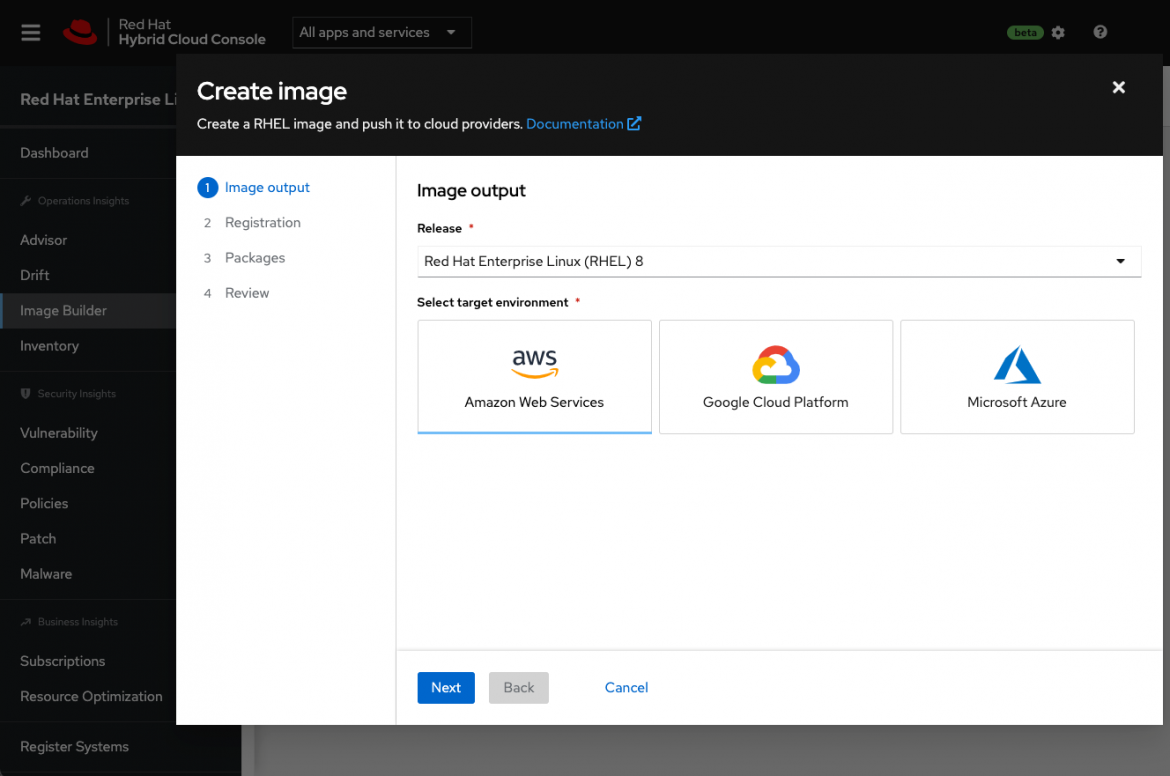
    Red Hat this week announced a public beta of an Image Builder service that streamlines the process of building customized instances of the Red Hat Enterprise Linux (RHEL) operating system.

    Scott Herold, director of product management for RHEL at Red Hat, said the Image Builder service enables an IT team to define a “gold” template for each target deployment environment that only contains the RHEL code required. Initially, Image Builder is configured to default to build a minimal, recommended RHEL server image for Amazon EC2, Microsoft Azure and Google Cloud Platform (GCP) cloud services.

    Future updates to the service will add support for VMware vSphere platforms as well as downloadable images and installation media for physical servers, customized filesystem layouts and versions 9.0, 8.5, 8.4 and 7.9 of RHEL. The service itself is accessed via the Red Hat Hybrid Cloud Console that is currently being made available in beta.

    Herold said building or installing operating systems is often a slow, tedious and error-prone process that needs to be manually performed in a slightly different way for each platform. Each physical server or edge computing platform requires different configurations and workflows. As a result, the chances mistakes will be made is high; Image Builder can greatly reduce the possibility of mistakes because there is no guesswork required, noted Herold.

    IT teams can also opt to include additional content from Red Hat in those builds to further streamline deployment processes, noted Herold. Those images can then be automatically registered with Red Hat to ensure future updates are received.

    The ability to customize those images also serves to reduce the overall size of the codebase that needs to be secured, added Herold. At a time when there is increased focus on software supply chains in the wake of a series of high-profile security breaches, many IT teams are revisiting their software deployment processes, he noted.

    Ultimately, Herold said Red Hat is moving toward providing IT teams with a more cloud-like experience regardless of where they deploy Red Hat’s curated open source software. The goal is to reduce as much friction as possible so that IT teams can more easily manage infrastructure at scale, he added.

    One way or another, the entiree software deployment process is becoming more automated. Much of the drudgery that has historically made it challenging to deploy and manage IT platforms at scale can be traced back to manual processes created when organizations ran a much smaller number of applications in on-premises IT environments. As IT teams increasingly deploy more applications in the cloud and at the network edge, it’s become more apparent that manual legacy processes won’t scale—especially when it’s already challenging to hire and retain IT personnel.

    It’s not clear how quickly IT teams will modernize software deployment processes using automated DevOps processes. Simple inertia is often a powerful force to overcome; however, most IT professionals can easily find something more compelling to do with their time that doesn’t involve using manually customizing operating system images.

  • Red Hat Brings Ansible Automation to Microsoft Azure Cloud

    Red Hat Brings Ansible Automation to Microsoft Azure Cloud

    Red Hat this week announced that a private preview of the Red Hat Ansible Automation Platform is now available on the Microsoft Azure Cloud.

    Tom Anderson, vice president of Red Hat Ansible automation, said making the Red Hat instance of the open source automation framework available on Azure is the first step toward making it possible for IT teams to use the IT automation framework across multiple clouds.

    The goal is to make it simpler for IT teams to bridge multiple IT environments using a common framework to automatically configure everything from operating systems to security platforms across a hybrid cloud computing environment.

    Ansible is emerging as a de facto standard for automating IT environments largely because it provides an IT team with a declarative approach to automating IT processes. An IT team can write a playbook that describes their desired state for a platform without having to know anything about its current state.

    Interest in IT automation has soared as the number of workloads being deployed in the cloud and on-premises IT environments have steadily increased. The simple truth is that many organizations can’t keep pace with the rate at which applications are built and deployed because they are unable to hire and retain enough IT staff. The challenge is that writing a playbook to automate any IT process requires a fair amount of expertise that many organizations lack. There are, however, now large numbers of existing templates that organizations can reuse.

    Anderson also noted that security concerns will also force the IT automation issue. Many of the application workloads running in cloud computing environments are misconfigured because they were provisioned by developers that have little to no security expertise. A playbook greatly reduces the chances an application workload will be misconfigured in the cloud without having to turn every developer into a security expert, Anderson explained.

    Ultimately, IT automation frameworks reduce the level of friction that often exists between developers and the rest of the IT operations team in a way that actually serves to increase developer productivity, added Anderson.

    Regardless of how IT organizations automate IT processes, it’s now a question of the rate at which that goal will be achieved rather than if. DevOps teams, of course, have always been at the forefront of automation, but now it’s clear that as IT environments become more complex, IT organizations are embracing automation more aggressively. Most of those initial efforts are focused on repetitive, tedious and manual IT tasks, but the potential to automate IT processes at levels of unprecedented scale has never been greater.

    In fact, many organizations may soon discover it’s difficult to retain IT professionals without investing in automation. After all, the most talented IT professionals will not want to work for an organization that requires them to always manually configure IT resources. Many IT teams might also discover that automation frameworks like Ansible are the gateway to embracing additional DevOps best practices. The challenge, of course, is finding the time to get started automating processes when there are so many immediate issues that IT teams can’t ignore.

  • What Developers Need to Know About Edge Computing

    What Developers Need to Know About Edge Computing

    More and more companies are living “on the edge” as they move from “I’ll think about edge computing” to “I don’t think our business can optimally grow and compete without edge computing.” Developers will play a key role in helping organizations use the edge, but their effectiveness will depend on having edge-aligned processes, products and people in place.

    Edge computing takes place near the physical location of either the user or a data source. It’s one way that organizations can use and distribute a common pool of resources across multiple locations. The edge model provides users with faster, more reliable services while expanding the potential of hybrid cloud computing for organizations. Customers and businesses alike will benefit from the way in which edge computing optimizes the use and application of artificial intelligence and machine learning by running data-intensive applications closer to the data source.

    While it is in many ways a question of architecture, applications are key to effectively exploiting the edge. Here are some of the things developers—and their organizations—need to know.

    Edge computing and cloud computing are not mutually exclusive. The best solutions will leverage both platforms. For example, centralized computing might be used for storage and compute-intensive workloads, while edge computing would be used to exploit data at the source, in near-real-time. Infrastructure and company culture need to be in place to support this, but developers must be thinking in terms of building applications that can cross and bridge computing platforms.

    Consistent tooling is essential. Developing for legacy IoT was very specific and required specialized tools and skills. The modern edge, in contrast, is part of a technology continuum, and developers need tools that they can use across that continuum, including:

    • Provider/enterprise core: The “non-edge” tiers, owned and operated by public cloud providers, telco service providers or large enterprises.
    • Service provider edge: Tiers are located between the core or regional data centers and the last mile access.
    • End user premises edge: Tiers on the end-user side of the last mile access can include the enterprise or the consumer edge.
    • Device edge: Standalone (non-clustered) systems that directly connect sensors/actuators via non-internet protocols. This represents the far edge of the network.

    Containerization enables flexibility, scale: Linux container technology wasn’t built for the edge, but the model fits perfectly with edge requirements for modularity, segregation and immutability. 

    Keep an “open” mind. Open APIs open up new opportunities. Developers using open APIs can access real-time data programmatically, making it possible to build applications that can leverage data as it’s “born.” Likewise, a focus on open source development tools and platforms will help to ensure that organizations can continue to leverage the edge as the model evolves. 

    What’s different is the devices. Developing for the edge is just like developing for any other platform–except that developers must write consistent and secure code that can be seamlessly copied to all device types. 

    Edge computing may not start with developers, but developers will play a huge role in organizations’ ability to leverage the edge. A focus on flexibility, openness and the future will help ensure that developers build applications that fully exploit and expand the edge advantage. 

  • Red Hat Makes DevOps a Reality with OpenShift GitOps and OpenShift Pipelines

    New Red Hat OpenShift features provide fully-integrated CI/CD pipeline for organizations to deliver applications more consistently and with greater predictability across the open hybrid cloud

    RALEIGH, N.C. — —

    Red Hat, Inc., the world’s leading provider of open source solutions, today announced the general availability of OpenShift GitOps and OpenShift Pipelines, new features of Red Hat OpenShift, the industry’s leading enterprise Kubernetes platform. These capabilities help organizations to further reduce friction between development and operations teams by streamlining application development and deployment across the hybrid cloud.

    DevOps methodologies promote a cultural shift by linking the work of development and operations teams into a more unified approach rather than separate silos, helping to bring applications to production more quickly. But many organizations still struggle in fully converting to DevOps, especially as much of the associated tooling is workflow- or software-specific, leading to disparate approaches across teams. OpenShift GitOps and OpenShift Pipelines help better unite application development and IT operations by enabling the teams to work together earlier in the development process while helping to deliver greater security, predictability and visibility throughout the entire application lifecycle.

    With OpenShift GitOps and OpenShift Pipelines, we are working to remove the false wall between developers and IT operations, enabling the teams to work together earlier in the application development process. This not only helps to find and prevent defects more quickly in the software delivery process, but also streamlines the process as a whole by providing increased visibility and security across the lifecycle.

    Ashesh Badanisenior vice president, Cloud Platforms, Red Hat

    Faster, more scalable development

    DevOps is the culture most IT organizations are striving for and CI/CD is a tool that can help them get there — but a bridge is still needed between the two. OpenShift GitOps helps to provide that bridge.

    GitOps takes a developer-centric approach to building applications, using the Git repository as the single source of truth for both developers and operations teams. OpenShift GitOps, built from the open source Argo CD project, enables IT teams to implement GitOps workflows for cluster configuration and application delivery. By implementing a GitOps framework, updates and changes are pushed through declarative code, automating infrastructure and deployment requirements, and CI/CD, helping organizations to realize faster, more secure, scalable software development.

    Additionally, OpenShift GitOps increases visibility into the state of clusters and applications and corrects deviations from the desired state if needed. The capability enables teams to have full visibility and traceability into changes rolled out to clusters, as every change is represented in the Git repository. This makes it easier to achieve consistency across Kuberenetes clusters spanning the open hybrid cloud.

    Complete control over Pipelines

    Based on the Tekton open source project, OpenShift Pipelines is designed to run each step of the CI/CD pipeline in its own container and allows each step to scale independently to meet the demands of the pipeline. For an operations team that is trying to optimize its infrastructure resources, limiting the resources required to support pipelines during quiet periods helps reduce the cost and overhead for running the pipeline the developers need.

    OpenShift Pipelines provides a streamlined experience, enabling full control over a team’s delivery pipeline, plugins and access control with no central CI/CD server to manage.

    Availability
    OpenShift GitOps and OpenShift Pipelines are now available through the OperatorHub for subscribers to all Managed OpenShift services and the self-managed OpenShift Container Platform and OpenShift Platform Plus running Red Hat OpenShift 4.7 and higher.

    Supporting Quotes
    Ashesh Badani, senior vice president, Cloud Platforms, Red Hat
    “With OpenShift GitOps and OpenShift Pipelines, we are working to remove the false wall between developers and IT operations, enabling the teams to work together earlier in the application development process. This not only helps to find and prevent defects more quickly in the software delivery process, but also streamlines the process as a whole by providing increased visibility and security across the lifecycle.”

    Nikolas Philips, DevOps engineer, Baloise Group
    “We are long time users of the Argo CD open source project which enables us to take a GitOps approach to application development and deliver applications more consistently. We’re looking forward to using OpenShift GitOps so that we have an enterprise version of the tool we already leverage, helping us to further scale our application development.”

    Stefan Luthardt, tribe lead, Container Services, Fiducia & GAD IT AG 
    “We have around 500 active developers working on our Vertriebsplattform application suite alone, so leveraging Git repositories as a single source of truth is imperative to our application development process. As long-time OpenShift users, we look forward to taking advantage of the capabilities that OpenShift GitOps provides.”

    Tobias Denzler, DevOps solution architect, Helvetia
    “As we continue to scale our use of Kubernetes and containers in production we need to ensure our developer and IT operations teams are in sync every step of the way. We are excited about the release of OpenShift GitOps and OpenShift Pipelines to help our teams align earlier in the process to streamline our application development processes.”


    Additional Resources


    Connect with Red Hat

    About Red Hat

    Red Hat is the world’s leading provider of enterprise open source software solutions, using a community-powered approach to deliver reliable and high-performing Linux, hybrid cloud, container, and Kubernetes technologies. Red Hat helps customers integrate new and existing IT applications, develop cloud-native applications, standardize on our industry-leading operating system, and automate, secure, and manage complex environments. Award-winning support, training, and consulting services make Red Hat a trusted adviser to the Fortune 500. As a strategic partner to cloud providers, system integrators, application vendors, customers, and open source communities, Red Hat can help organizations prepare for the digital future.

    Forward-looking statements

    Certain statements contained in this press release may constitute “forward-looking statements” within the meaning of the Private Securities Litigation Reform Act of 1995. Forward-looking statements provide current expectations of future events based on certain assumptions and include any statement that does not directly relate to any historical or current fact. Actual results may differ materially from those indicated by such forward-looking statements. The forward-looking statements included in this press release represent the Company’s views as of the date of this press release and these views could change. However, while the Company or its parent International Business Machines Corporation (NYSE:IBM) may elect to update these forward-looking statements at some point in the future, the Company specifically disclaims any obligation to do so. These forward-looking statements should not be relied upon as representing the Company’s views as of any date subsequent to the date of this press release.

    ###

    Red Hat, Red Hat Enterprise Linux, the Red Hat logo, JBoss, Ansible, Ceph, CloudForms, Gluster and OpenShift are trademarks or registered trademarks of Red Hat, Inc. or its subsidiaries in the U.S. and other countries. Linux® is the registered trademark of Linus Torvalds in the U.S. and other countries. The OpenStack Word Mark is either a registered trademark/service mark or trademark/service mark of the OpenStack Foundation, in the United States and other countries, and is used with the OpenStack Foundation’s permission. Red Hat is not affiliated with, endorsed or sponsored by the OpenStack Foundation, or the OpenStack community.

  • Red Hat Extends Reach and Scope of Insights Analytics Service

    Red Hat Extends Reach and Scope of Insights Analytics Service

    During its online Red Hat Summit event, Red Hat today announced it has extended the Red Hat Insights predictive analytics cloud platform for managing IT to now include support for editions of Red Hat OpenShift based on Kubernetes and the Red Hat Ansible Automation Platform.

    In addition, Red Hat has extended Red Hat Insights for Red Hat Enterprise Linux (RHEL) to include the ability to prioritize security alerts, streamline notifications and track Red Hat subscription consumption.

    In total, since launching Red Hat Insights in 2019, Red Hat claims there are now more than 600,000 RHEL hosts analyzed per day.

    Joe Fitzgerald, vice president and general manager for the management business unit at Red Hat, said Red Hat Insights provides IT teams with the equivalent of a co-pilot for managing IT environments. In general, advances in automation and artificial intelligence (AI) are making it easier to manage complex IT environments at scale, noted Fitzgerald. However, it’s not likely IT environments will be automated to the point where lights-out management without human intervention is likely to be achieved any time soon, added Fitzgerald.

    However, it’s also becoming apparent that it’s not possible for IT teams to manage complex IT environments without help in the form of advanced analytics tools. In fact, while many IT professionals are leery of automation tools because of the perceived threat to their jobs, it’s also becoming apparent that IT teams will not be able to manage modern IT environments without these tools. Organizations can’t afford to hire small armies of IT personnel. In addition, finding and retaining IT professionals that have, for example, Red Hat OpenShift skills remains a significant challenge.

    Red Hat Insights provides IT teams with additional levels of context required to manage these environments that goes beyond simple monitoring, noted Fitzgerald. That’s critical, as the IT environment becomes more extended in the age of hybrid cloud and the rate at which platforms are updated steadily increases, added Fitzgerald. Platforms such as Red Hat OpenShift, for example, are now typically updated every three to four months.

    DevOps, of course, has always been about ruthlessly applying automation whenever possible. As analytics applications become more robust, IT teams gain the visibility required to automate a wider range of complex tasks, noted Fitzgerald. In fact, in the absence of that visibility, automation can be a dangerous thing when mistakes caused by a lack of visibility and insight are made, added Fitzgerald.

    In the longer term, Red Hat expects to see continued convergence of job functions and roles as IT teams become more cross-functional, said Fitzgerald. Platforms such as Red Hat Insights will provide a single console around which these teams can collaborate, added Fitzgerald.

    Going forward, there won’t be a handful of administrators with augmented capabilities. Rather, IT specialists that have a particular set of skills will be able to collaborate more easily in a way that both creates a better outcome and ultimately keeps a lid on the total cost of IT.