Tag: perforce

  • Perforce Acquires Perfecto Mobile to Drive DevOps Consolidation

    Perforce Acquires Perfecto Mobile to Drive DevOps Consolidation

    Perforce this week announced it plans to acquire Perfecto Mobile, a provider of automated application development tools, in a move that signals a potential wave of consolidation across the DevOps sector. Perfecto Mobile is the fifth acquisition Perforce has made in the last two years, and company CEO Mark Ties said there will be more to come.

    Schedule to close later this year, the acquisition is estimated to be about $200 million.

    The primary driver of this wave of consolidation is access to inexpensive capital coupled with mainstream adoption of DevOps processes that is requiring many startup companies to scale beyond their means, Ties said.

    As a provider of a cloud-based set of tools for automating the testing of web and mobile applications using a variety of open source frameworks, Perfecto Mobile will complement a portfolio of application testing tools based mainly on the technologies Perforce gained when it acquired PRKA earlier this year. Perfecto Mobile currently has more than 3,000 customers.

    Application testing, along with application development and deployment, increasingly is shifting to the left as developers assume more responsibility for the overall application environment. Instead of relying mainly on a dedicated team to test applications after they have been developed, companies now are continually testing modules as they are developed. Sometimes that’s done by the developers themselves, while other organizations prefer to maintain testing teams made up of individuals who did not write the code being tested. Proponents of the latter approach contend that approach leads to higher-quality code because the individuals testing the code are not as invested in how the code was written. Of course, in an ideal world, an organization would be able to embrace both approaches.

    Regardless of the approach taken, the one thing that is clear is that the rate of at which applications are being developed requires more reliance on automated testing than ever. Not only are there more applications being developed, but increasingly each one is made up of microservices. There often are multiple versions of those microservices that are subject to frequent change. To make matters even more challenging, the number of dependencies between microservices that make up an application are increasing exponentially. That means the days when organizations could rely mainly on manual testing are coming to an end.

    There may come a day when machine learning algorithms are able to play a bigger role in automating application testing and DevOps. But for now, that day is still far off. In the meantime, most organizations are still incorporating multiple approaches to automated testing into their application development processes. The issue is no longer so much about whether to automate testing as much as it is to what degree.

    In the meantime, the more acquisitions that occur across the DevOps landscape, the greater the validation of DevOps becomes as vendors scramble to extend portfolios that, in many cases, are still optimized for legacy approaches to building and deploying applications that increasingly are falling by the wayside.
    — Mike Vizard

  • Clearlake Capital-Backed Perforce Software to Acquire Perfecto Mobil

    Enhanced Perforce solutions portfolio to include cloud-based continuous automated testing at scale for enterprise mobile and web applications

    MINNEAPOLIS and SANTA MONICA, Calif., Oct. 8, 2018 /PRNewswire/ — Perforce Software (“Perforce”), a global provider of enterprise-grade DevOps-focused software solutions, backed by Clearlake Capital Group, L.P. (together with its affiliates, “Clearlake”), today announced it has reached a definitive agreement to acquire Perfecto Mobile (“Perfecto”), a market leader in cloud-based automated mobile and web application test software solutions. The acquisition augments Perforce’s software portfolio with additional capabilities for enterprise DevOps teams to achieve continuous testing at scale across web, mobile and IoT applications.  The acquisition is expected to close this year.

    Perfecto is the industry pioneer delivering the only true enterprise-grade mobile & web automation testing software platform through its globally accessible Continuous Quality Lab. The company is the go-to provider for large organizations that need to accelerate their digital transformation and provide their customers with the best online mobile and web experiences. Leading enterprises in banking, retail, telecommunications, and insurance rely on Perfecto’s robust automated testing software to deliver quality experiences faster and retain users in highly competitive markets.

    “Enterprises continue to need more automation to both scale and accelerate their application delivery,” said Mark Ties, Perforce CEO. “Perfecto adds a critical component to our DevOps capabilities allowing Perforce to deliver more value for large enterprise customers that value scalability and security.”

    Perforce continues to add capabilities to its software portfolio that uniquely meet the needs of technology development teams that are challenged with multiple dimensions of scale but still must deliver products at a rapid pace.  The acquisition of Perfecto will represent Perforce’s fifth acquisition in the past two years.

    “With this strategic acquisition, Perforce is well positioned to capitalize on the significant market trends around demand for continuous testing from enterprise DevOps teams,” added Prashant Mehrotra and Paul Huber of Clearlake. “We are excited to continue our support of Mark and the Perforce management team as they drive consolidation in the industry and accelerate organic growth.”

    “Perfecto is the mobile and web testing software platform of choice for enterprise clients. The digital transformation is driving accelerated adoption of DevOps and its activities such as continuous integration, test automation and continuous delivery to more quickly capture and engage customers online. Our Continuous Quality Lab enables enterprises to remove bottlenecks and rapidly validate and deliver mobile and web applications that engage their customers,” said Eran Yaniv, Perfecto Co-Founder and CEO. “We are thrilled to join the Perforce team and are confident that this partnership provides us increased resources to capitalize on the continuous testing market opportunity.”

    About Perforce
    Perforce is a leading provider of enterprise scale software solutions to technology developers and development operations (“DevOps”) teams requiring productivity, visibility and scale during all phases of the development lifecycle. Enterprises across the globe rely on its agile planning and ALM tools, developer collaboration, static code analysis, version control and repository management solutions as the foundation for successful DevOps at scale. Perforce is trusted by the world’s most innovative brands, including NVIDIA, Pixar, Scania, Ubisoft, and VMware. For more information, please visit www.perforce.com.

    About Perfecto
    Perfecto is the leader in continuous testing and monitoring for today’s dynamic DevOps environments. Our Continuous Quality Lab enables DevOps teams to accelerate development, achieve continuous testing and monitoring, and drive fast feedback through actionable analytics for web, mobile, and IoT applications. More than 3,000 customers rely on our cloud-based Continuous Quality Lab as their digital application test environment and for authoring test automation executed on real browsers, smartphones, and devices under real end-user conditions. For more information about Perfecto, visit perfecto.io.

    About Clearlake Capital
    Clearlake Capital Group, L.P. is a leading private investment firm founded in 2006. With a sector-focused approach, the firm seeks to partner with world-class management teams by providing patient, long-term capital to dynamic businesses that can benefit from Clearlake’s operational improvement approach, O.P.S.® The firm’s core target sectors are software and technology-enabled services; industrials and energy; and consumer. Clearlake has managed over $8 billion of institutional capital since inception and its senior investment principals have led or co-led over 100 investments. More information is available at www.clearlake.com.

  • Helix Core From Perforce Chosen to Support Agile and DevOps for Transurban’s IoT Urban Road Infrastructure Projects

    With Helix Core, Transurban Can Now Release Larger Deployments Faster – 75% Faster

    MINNEAPOLIS, MN, April 26, 2018 – Perforce Software, a provider of solutions to enterprise teams requiring productivity, visibility, and scale along the development lifecycle, announced that Helix Core is the chosen version control system to support Transurban’s extremely large DevOps-based development projects. Transurban’s projects include express lanes and tunnels in the US and Australia, which incorporate extensive deployment of IoT smart sensors to support their innovative “smart” roads vision.

    Transurban’s technology collects vehicle information from the roadside, then integrates with third-party payment and customer servicing systems. The sophistication of Transurban’s solutions means that development projects involve large amounts of code and other assets. To release large deployments quickly and efficiently, Transurban uses Helix Core to manage all digital content securely in a single source of truth. Large releases now take just a couple of hours.

    Helix Core also supports Transurban’s transition toward Agile and DevOps-based development, including integrations with other systems in the stack, such as Jenkins. Said Matthew de Vanny, Technical Environment Specialist at Transurban, “With Helix Core, our teams can now deploy major releases rapidly, efficiently, and securely. Late in 2017 we had an enormous release when we brought the systems from our Queensland office on board. We completed that release in a weekend, and with our previous methodologies, it wouldn’t have even been deployable,” said de Vanny.

    About Transurban

    Headquartered in Melbourne, Australia, Transurban develops and manages urban toll road networks in Australia and the USA. A top 20 company on the Australian Securities Exchange (ASX), the company has been in business since 1996 and partners with governments to provide infrastructure solutions. Projects include the NorthConnex tunnel in Sydney, the West Gate Tunnel Project in Melbourne, and the 395 Express Lanes in Virginia. The company has 2,000 employees, of which approximately 200 of which use Helix Core.

    About Perforce

    Enterprises across the globe rely on Perforce to build and deliver digital products faster and with higher quality. Perforce offers complete developer collaboration and agile project management tools to accelerate delivery cycles — from agile planning tools to requirements, issues and test management, which then link to all source code, binary assets and artifacts for full build and release tracking and visibility. The company’s version control solutions are well known for securely managing change across all digital content — source code, art files, video files, images, libraries — while supporting the developer and build tools your teams need to be productive, such as Git, Visual Studio, Jenkins, Adobe, Maya and many others. Perforce is trusted by the world’s most innovative brands, including NVIDIA, Pixar, Scania, Ubisoft, and VMware. The company has offices in Minneapolis, MN, Alameda, CA, Mason, OH, the United Kingdom, Finland, Sweden, Germany, and Australia, and sales partners around the globe. For more information, please visit www.perforce.com.

    #

    Media Contacts

    Global

    Colleen Kulhanek

    Perforce Software

    Ph: +1 612-517-2069

    ckulhanek@perforce.com


    UK/EMEA

    Maxine Ambrose

    Ambrose Communications

    Ph: +44 1491 412944

    perforce@ambrosecomms.co.uk


  • Scania: Adopting DevOps for Auto Production

    Scania: Adopting DevOps for Auto Production

    When you think of large vehicles, chances are you think heavy-duty front and rear axles, suspensions and cab parts. When you think of large engines, chances are you think crankshafts, cylinder heads, pistons and injectors. When you think of the brains behind a company that produces all this, you should think software and the processes that create it.

    Swedish automotive company Scania was building its software intelligence using large, legacy development approaches, coding entire software packages as a single project. The organization’s teams were couched in silos. Releases were highly infrequent.

    Everything changed when Scania scaled and conquered the partitions and divisions that separated teams and adopted agile practices and DevOps.

    Scania and its Software

    Scania, a large global maker of heavy transport buses and trucks and marine and industrial engines, runs many software departments. Its Connected Services department creates web-based portals, APIs and embedded software that transmits live and historical data transmitted to and from drivers and vehicles for logistics including positioning, tracking, service planning, geofencing and messaging.

    Scania’s move toward DevOps accelerated in the 2012-2013 time frame, when the company combined developers and testers into feature teams and molded its first DevOps practices. The company had a host of development issues before that.

    “Before 2012, we were organized around traditional big software projects, which slowed progress and hindered communication. We had long lived branches and a product release cycle of about three releases a year. Silos existed between Dev, Ops, Test and Marketing,” said Anders Lundsgard, technical architect at Scania Connected Services. By 2013, he added, feature teams were adopting processed based on a strict adherence to Scrum.

    Scania’s Dev and Ops teams were housed in different locations and working separate goals that were not aligned or cohesive. These teams suffered from confused communications and increasing stress as development worked only on new features while operations tried to use the new software in a stable way in production.

    Pivotal Changes

    Everything started coming together when Scania formed feature teams that progressively shouldered more of the responsibility for forwarding code to all environments and making it work. “There was no involvement in this from operations or infrastructure as they supported tooling and automation for on-premise infrastructure and shifted software to a cloud platform,” Lundsgard said.

    Scania ultimately added Perforce Helix, a software configuration management tool. As long as software engineers know that the focal point of their work is checking in their code, the Perforce product can be the single point of storage of any one software component for all projects in the deployment pipelines. This way there are no multiple, correct current versions of any piece of code that could cause confusion. “Perforce has a number of capabilities that help engineers collocate software for reviews and even shelve files as they pass between developers,” says Lundsgard.

    Scania uses Perforce Helix in combination with its continuous integration (CI) environment and processes to improve quality beyond what manual testing could ever accomplish. “The goal is that software engineers check code into Perforce Helix at least daily,” Lundsgard said.

    Scania DevOps Processes Today

    Scania now versions every change and automates builds, tests and deployments, with CI as a central development practice. The company no longer uses feature branches, with everyone adding code directly to the mainline. “We use a microservice-oriented architecture in order that each feature team can manage and own certain services,” Lundsgard said.

    Different teams approach development with varying degrees of DevOps maturity. Some teams deploy software continuously, sometimes many times per day. Other teams benefit from using some manual testing and may not deploy software for a few weeks. “The tooling has enabled all teams to have a fully automated process for pushing their code into all environments if they choose—automatically or via a click of a button,” Lundsgard said.

    Remaining Challenges

    Scania next plans to fully automate every component of infrastructure from the network to the servers. “Some of our infrastructure and operations people have started to adopt infrastructure as code and they version that code in Perforce Helix as well,” Lundsgard said.

  • Perforce Adds Emerasoft to Its Global Channel Program

    Partnership Helps Companies in Italy Adopt DevOps Practices and Bring Products to Market Faster

    Wokingham (UK) and Rome, (Italy), February 16, 2016 – Perforce Software today announced a partnership with Emerasoft, the leading distributor of application lifecycle management (ALM) solutions and consulting services in Italy. The agreement allows Emerasoft to sell and support thePerforce Helix version control and collaboration platform as part of its extensive product portfolio.

    Based in Turin, Italy, Emerasoft has been providing products and services that enable agile development, continuous delivery and DevOps for more than 10 years.

    “The advanced capabilities of Perforce Helix are exactly what our customers have been asking for—a collaborative version control solution that also meets enterprise needs for scalability and security,” said Riccardo Bernasconi, CEO at Emerasoft. “We are particularly impressed with Helix GitSwarm and its ability to provide Git users with a much more comprehensive Git experience while making Git enterprise-ready. This makes Helix an incredibly strong addition to our product mix.”

    Emerasoft joins a growing community of Perforce sales partners across Europe, the Middle East, Asia Pacific, Africa, India and the Americas.

    “We are excited to add a partner of Emerasoft’s caliber to our expanding partner ecosystem,” said Philip O’Hara, EMEA partner manager at Perforce Software. “Emerasoft’s track record of creating solutions for complex environments and their strong understanding of the Italian application development market makes them the perfect partner to expand our footprint to new geographies.”

    ###

    About Emerasoft
    Emerasoft is an Italian company providing IT products and services. Founded in 2005 Emerasoft provides products and services in the areas of Application Lifecycle Management, Software Testing, DevOps, Security, Business Intelligence and Process Discovery. Its mission is to develop, select, and integrate the best technologies for customer satisfaction. Emerasoft has expertise in the Automotive, Telecommunication, Manufacturing, Bank and Insurance industry sectors, serving innovative customers, including Ferrero, CNH Industrial, Lombardia Informatica, Fiat Chrysler Automobiles, Finmeccanica, Ferragamo, Juventus. For more information, please visitwww.emerasoft.com.

    About Perforce Software
    Perforce Software helps companies build complex products more collaboratively and securely. Its highly scalable source code management (SCM) and collaboration platform, Perforce Helix, enables global teams to collaborate on any type or size of file. It supports both centralized and distributed (DVCS) workflows while safeguarding intellectual property with advanced behavioral analytics. Perforce is trusted by the world’s most innovative brands, including adidas, Samsung, NVIDIA, Intuit, Pixar, Salesforce, EA, Ubisoft and VMware. The company is headquartered in Alameda, California, with offices in the United Kingdom, Canada and Australia, and sales partners around the globe. For more information, please visit www.perforce.com.

    Media Contacts

    Global
    Ivana Gaspic
    Perforce Software
    Ph: +1 510-473-3186
    Mob: +1 415-955-7483
    igaspic@perforce.com

    US
    Michael Thomas
    Edelman
    Ph: +1 312-233-1361
    Mob: +1 773-822-6182
    michael.thomas@edelman.com

    UK/EMEA
    Maxine Ambrose/Nicola Males
    Ambrose Communications
    Ph: +44 1491 412944
    perforce@ambrosecomms.co.uk

  • Perforce: The biggest little secret in DevOps

    Perforce: The biggest little secret in DevOps

    Quick can you name a company that is 15 years old, never took a dime of venture money, has over 250 employees, over 10,000 customers and was widely profitable from day one? Until last week me neither. That was when I  was briefed by Dhruv Gupta, Director, Product Marketing and Bob Dever, Director, Corporate Marketing for Perforce.

    perforce customersPerforce is a DevOps powerhouse. Take a look at the customer cloud to the right to get an idea of who some of the 10,000+ customers they have are. Perforce is all about version control. They do that and do it well. Whether you are talking about version control of your code, documents or analytics, Perforce has a solution for you.

    When you think about it, you can see why Perforce is such a DevOps play.  DevOps is all about continuous delivery or at least rapid release.  How can you accelerate your releases without keeping track of the different versions? Without version control you quickly have a mess. Perforce has in some ways enabled continuous delivery and rapid iteration. They truly are the biggest, little secret in DevOps.

    For many years Perforce was really the only choice in town for version control (there were others, but it became a leader in the space pretty quickly) but the rise of GIT, a distributed version control system (DVCS) gave some an alternative. But GIT lacked the enterprise features (read security and team management) that larger organizations needed.  Its popularity among lone wolf and smaller dev teams though was unmistakable. It is easy.

    Perforce has recognized this and has just released a new hybrid version of their solution. This hybrid version allows developers and dev team managers to use GIT and Perforce’s P4 in one hybrid version control platform. A best of both world solutions give DevOps teams the ability to move fast with GIT and have the security and enterprise functionality that P4 allows.

    When you start thinking about DevOps Unicorns like Netflix for instance or Salesforce, the sheer magnitude of what Perforce is managing comes into clarity. In Salesforce for instance you have 3,000 Engineers making 4,000 – 9,000 Code Changes a day with 550,000 Tests / Hour. Keeping versions straight is not the kind of thing you do in a spread sheet.

    It in a Continuous Delivery environment where Perforce really shines. They are making a big bet on enterprises adopting the Continuous Delivery model. However there are some fundamental questions to answer first. According to Perforce though you need to define what does Continuous Delivery mean to you? They conducted a survey:

     perforce cd


    According to Perforce they think of Continuous Delivery as this:

    • Deliver working product to users as quickly as possible
    • Every change (check-in) leads to a potential release
    • Give business the option to release – what, when, to whom
    • A change in process and culture

     perforce cd pipeline

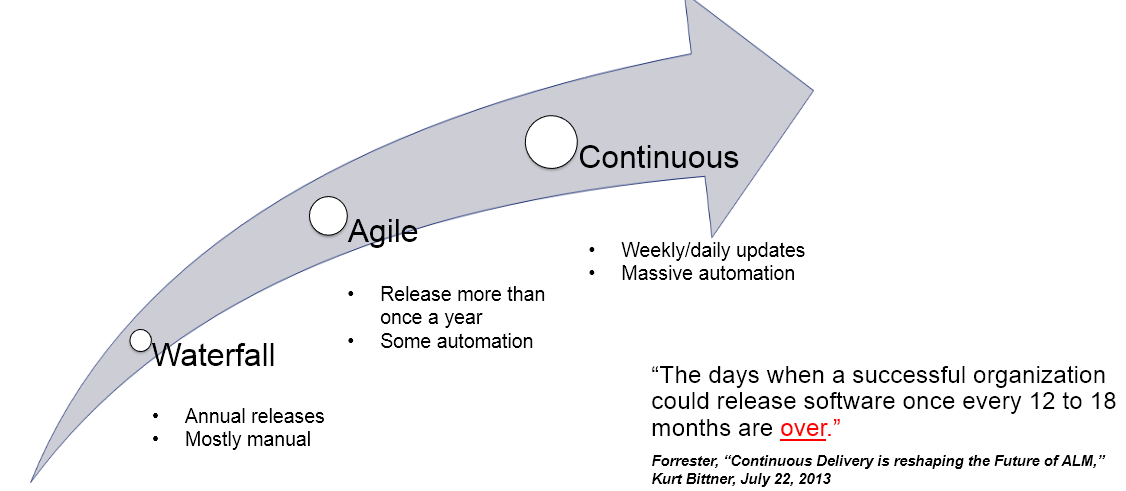
    Most importantly though, Continuous Delivery is not just something Perforce thinks is crucial. Waterfall release models are obsolete and even Agile is just a way stop towards Continuous.

     perforce cd arrow


    According to Perforce’s own survey they see Continous Delivery attaining critical mass:

     perforce cd adoption

     Is this a case of when you are a hammer everything is a nail or are we at the dawn of the age of Continuous Delivery? Perforce is making a bet that it is. They are already very successful, any more and they may just lose their status as the biggest, little secret in DevOps.