Nearly 2,000 new employees will support customer growth, product innovation, and data center expansion
Redwood Shores, Calif.—Oct 8, 2019
Oracle today announced plans to hire nearly 2,000 employees worldwide to work on its growing Oracle Cloud Infrastructure business. The new roles, which include software development, cloud operations, and business operations, will support Oracle’s rapidly expanding infrastructure customer base, and come as the company rolls out new product innovations and rapidly opens cloud regions around the globe.
“Cloud is still in its early days with less than 20 percent penetration today, and enterprises are just beginning to use cloud for mission-critical workloads,” said Don Johnson, executive vice president, Oracle Cloud Infrastructure. “Our aggressive hiring and growth plans are mapped to meet the needs of our customers, providing them reliability, high performance, and robust security as they continue to move to the cloud.”
Oracle Cloud Infrastructure’s portfolio has experienced significant growth. Recent product innovations include new automated cloud security services, the launch of Autonomous Linux, and a host of new cloud data services. Only Oracle Gen 2 Cloud is built to run Oracle’s leading suite of enterprise cloud applications and uses machine learning to deliver category-defining autonomous services, including Oracle Autonomous Database and Oracle Autonomous Linux. Additionally, Oracle is the only cloud infrastructure company in the world that delivers enterprise applications. This gives customers huge cost and competitive advantages and enables them to extend their applications as they grow.
In the past year, Oracle has opened 12 new Gen 2 Cloud regions and currently operates 16 regions globally, the fastest expansion by any major cloud provider. Continuing its rapid cadence of Oracle Gen 2 Cloud region launches, Oracle plans to add 20 more regions by the end of 2020, bringing the global footprint to 36 total regions. Eleven countries or jurisdictions will have region pairs that facilitate enterprise-class, multi-region, disaster-recovery strategies to better support those customers who want to store their data in-country or in-region.
Today, Oracle is the only company delivering a complete and integrated set of cloud services and building intelligence into every layer of the cloud. Oracle Cloud Infrastructure’s growing talent base will ensure customers continue to benefit from best-in-class security, consistent high performance, simple predictable pricing, and the tools and expertise needed to bring enterprise workloads to cloud quickly and efficiently.
In addition to rapid hiring, Oracle will make additional real estate investments to support the expanded Oracle Cloud Infrastructure workforce.
Tag: Oracle
-
Oracle Cloud Infrastructure Momentum Accelerates with New Hires
-

Pivotal Software Embraces OpenJDK
Pivotal Software has officially thrown its weight behind OpenJDK, the open source version of the standard edition of Java, by adding support for OpenJDK to the Pivotal Spring Runtime on its Spring framework.
At the same time, Pivotal announced it is extending its commercial support for open source Apache Tomcat servers in addition to providing commercial support for all the major open source Spring projects, including Spring Framework, Spring Boot, Spring Cloud and Spring Cloud Dataflow.
Since 2011, Oracle, IBM and SAP have been making a case for employing OpenJDK. Ryan Morgan, vice president of engineering for the application platform at Pivotal, said that while other languages have become increasingly popular, the primary workhorse for building back-end applications in the enterprise remains Java. Now that Oracle has formally relinquished control over Java source code to The Eclipse Foundation, research and development into the legacy programming environment should accelerate. Oracle retains licensing rights to the name Java, but versions 8 and higher of Java Enterprise Edition are being converted to an open source platform known as Jakarta.
Morgan said much of the work going forward would be focused on modernizing monolithic Java applications to make it either to turn them into microservices or at least make it easier for microservices developed in other languages to make calls via application programming interfaces (APIs) to those back-end applications. As enterprise IT organizations make the shift, they increasingly will rely on DevOps processes to manage the transition. The effort should accelerate the extent to which many organizations will need to rely on modern best DevOps practices.
As both OpenJDK and Jakarta continue to move forward, Morgan said Pivotal is committed to continuing investment in the Spring framework, which has done much to make developing Java applications a much more agile endeavor. The most immediate benefit, of course, is the reduction of licensing fees associated with employing Java platforms. Many IT organizations that have mandated open source code-first and adopted alternative programming languages now may want to reconsider their options, especially when the number of developers who know how to write applications in more modern languages is comparatively small.
Of course, it will take many years for enterprise IT organizations to fully make this transition. In the meantime, many of them will continue developing applications in Java simply because they have large teams that have mastered a programming construct that has been in place for three decades or more. Many of those same organizations may be making greater use of rival programming constructs, but Java and its descendants will play a major role in the enterprise well into the next decade. The primary challenge Pivotal will face is maintaining dominance of the frameworks employed to build new applications based on Jakarta and OpenJDK, in addition to updated existing Java applications.
-
DBmaestro DevOps Platform 7.5 released with PostgreSQL Support – DB2, SQL, Oracle, and PostgreSQL
Manages multi-database environments for DB2, SQL, Oracle, and PostgreSQL
BOSTON, MA, October 11th, 2018 – DBmaestro, the pioneer and leading DevOps for database solution provider announced today the launch of DBmaestro DevOps Platform 7.5 which enables CI/CD and release automation for PostgreSQL. PostgreSQL is becoming the preferred database for more and more enterprises and smaller organizations. It is currently ranked #4 in popularity amongst hundreds of databases worldwide (See more info at DB-Engines Ranking).
DBmaestro’s DevOps Platform 7.5 includes database release automation solutions to streamline database changes with confidence and control while enabling companies to reduce the time to market for their applications. The fast adoption of continuous delivery and deployment methodologies to accelerate application development has created a strong demand for database release automation tools to prevent errors and downtime. According to the 2018 DevOps for Database Report, 83% of companies have already embraced DevOps, while continuous delivery for databases lags behind, with only a 37% adoption rate.
DBmaestro’s DevOps Platform 7.5 zero-friction solution provides the ability for DevOps teams and database professionals to manage multiple databases more easily, without having to change existing processes. Providing an overarching solution for CI/CD adoption across platforms and operating systems including Oracle, DB2, Microsoft SQL Server and now PostgreSQL, DBmaestro meets the evolving database release automation needs of enterprises across industries and borders.
“Our DevOps platform unleashes the power of PostgreSQL databases by enabling DevOps and database teams to implement DevOps best practices and accelerate time to market with a high level of confidence, minimal risk and maximum efficiency,” said Yaniv Yehuda, CTO at DBmaestro.
DBmaestro will be demonstrating DBmaestro DevOps Platform 7.5 solution at DOES18 from October 22– 24th in Las Vegas, Booth #811.
About DBmaestro
DBmaestro brings DevOps best practices to the database, delivering a new level of efficiency, speed, security and process integration for databases. DBmaestro’s platform enables organizations to run database deployments securely and methodically, increase development team productivity and significantly decrease time-to-market. The solution enables organizations to implement CI/CD practices for database activities, with repeatable pipeline release automation and automatic drift prevention mechanisms. For more information, visit www.dbmaestro.com.
-
Oracle Adds Low-Code Tool to Autonomous Platform
Oracle this week extended the scope of the cloud services it manages on behalf of customers to include a low-code application development platform based on the company’s Visual Builder development tools.
Jeff Price, vice president of product Management at Oracle, said Oracle Autonomous Visual Builder (VB) Cloud makes it possible to employ a tool based on JavaScript to build applications that might be written, for example, in Java or, going forward, Jakarta EE. Autonomous Visual Builder Cloud is available via a managed service that can easily integrated with a variety of back-end services managed by Oracle or running on-premises.
To complement that effort, Oracle also announced the availability of Oracle Autonomous Analytics Cloud and Oracle Autonomous Integration Cloud. Oracle Autonomous Visual Builder comes with tools for accessing back-end services, while Oracle Autonomous Integration Cloud provides a raft of additional connectors for accessing a wide variety of other Oracle and third-party services, Price said.
Oracle also committed to delivering additional autonomous services later this year to address mobile and chatbots, data integration, blockchain, security and management and additional database workloads such as online transaction processing (OLTP). Those services will complement existing Oracle autonomous database and platform-as-a-service (PaaS) environments.
Price said interest in low-code development tools is accelerating as organizations look to extend business processes that have been automated using either packaged applications running on-premises or in a software-as-a-service (SaaS) application. Rather than trying to achieve that goal using low-level application programming interfaces (APIs) that are fragile, Price said low-code tools such as Oracle VB make it simpler for even citizen developers to construct applications leveraging code developed by professional developers.
Organizations need to decide for themselves when to customize those application environments versus taking advantage of them in a turnkey manner, Price said. Organizations tend to heavily customize customer experience and customer relationship management (CRM) applications, while relying on best practices that have been coded into enterprise resource planning (ERP) applications. Oracle is changing the way it supports those applications—base-level support for these applications is now free, but Oracle will continue to charge for premium services.
The need to customize applications at scale is driving many more traditional enterprise IT organizations to adopt DevOps processes that now need to span multiple IT environments, Price said. He added Oracle now provides integration with multiple continuous integration/continuous deployment (CI/CD) platforms to facilitate that transition.
As Oracle assumes more responsibility for managing the underlying platforms, organizations in theory should be able to devote more resources to developing applications. To achieve that goal, however, many of them will need to figure out how to extend their DevOps processes to include Oracle as a managed service provider.
Oracle also provides access to unmanaged infrastructure-as-a-service (IaaS) and (PaaS) services in much the same way Amazon Web Services (AWS) and Microsoft do. Oracle has been late to the cloud game, but this week announced a slew of new cloud customers, including Atomitech Inc., Edith Cowan University, Future Robot, Barrick Gold Corporation, C’s NEXT, Colegio de Bachilleres, Contribute NV, DP World Ltd., Dubai Airport Freezone Authority, Emirates Flight Catering, Hytera Communications Ltd., Ildong Pharmaceutical Co. Ltd., Konyang University, Land O’Lakes Inc., Leshan City Commercial Bank, McDermott, MCore Group, New Hope Liuhe Co. Ltd., Promata, Stallion Oilfield, Ornua Co-Operative, RecVue, Saga d.o.o Beograd, TCI, TaskUs, University of Wisconsin Hospital and Clinics Authority, and Zeneral Heatpump Industry Co. Ltd. All told, Oracle claims to be processing 55 billion transactions a day on its cloud.
It may take a while for Oracle to catch up to AWS. But if it doesn’t achieve that goal it won’t be for a lack of development tools.
-

Oracle Unveils Autonomous Cloud Service
Oracle today unfurled at an Oracle CloudWorld event what it describes as a completely autonomous cloud service the company will manage primarily on behalf of application developers.
The Oracle Autonomous Cloud Platform is a managed service that makes extensive use of machine and deep learning algorithms across instances of Oracle software that can invoked on a public cloud or deployed in an on-premises IT environment, said Amit Zavery, executive vice president of product development for Oracle Cloud Platform.
“We’re taking away all the day-to-day management issues,” Zavery said.
The Oracle Autonomous Cloud Platform builds on the Autonomous Database service launched last year. This latest service essentially puts all the responsibility for managing IT operations on Oracle, which is relying on a major investment in machine learning algorithms to automate DevOps processes.
The implications of that capability are profound for IT organizations, many of which Zavery said now will be able to shift more resources over to developing and maintaining applications. At a time when more organizations are focusing on digital business transformation, those organizations need to be able to free up resources to focus in application development, he said.

Amit Zavery, Oracle Examples of how Oracle envisions the transformation of both DevOps and DevSecOps include chatbots that can be interacted with using natural language processing to automate repetitive tasks to automatically identifying and remediating security issues in code within the context of a continuous integration/continuous development (CI/CD) deployment. There are also controls to prevent data leaks across structured and unstructured data repositories, along with built-in security monitoring tools.
Other capabilities include an ability to create data flows with automated data lake and data prep pipeline creation for ingesting both stream and batch-oriented data, as well as automating the integration of various on-premises and software-as-a-service (SaaS) applications.
Advanced analytics tools span everything from automated data discovery and preparation to visualization tools for displaying trends.
Oracle may have come late to the cloud computing game, but clearly it intends to make up lost ground by infusing higher levels of automation into cloud services that rivals don’t yet provide. Most cloud service providers are headed in the same general direction as Oracle. But the scope of automation being provided by Oracle, spanning both a public cloud and on-premises IT environments, is unprecedented.
In many ways that level of automation may represent an existential threat to a larger number of IT operations professionals. At the same time, it presents an opportunity. IT professionals should be able to spend more time adding true value to the business instead of having all their time and energy consumed by merely keeping the proverbial lights on in the data center.
Of course, it may take a while for most organizations to make a transition to a single stack of integrated hardware and software provided by a single vendor. Most organizations have decades worth of IT infrastructure consisting of databases, middleware, virtual machines, servers and storage systems all from different vendors. Even if organizations decided the time had come to rationalize those investments in favor of a suite of managed cloud services, it would take several years to make that transition.
In addition, many organizations would also still need to evaluate the total cost of acquiring and managing IT infrastructure over several years versus contracting for services over the same period of time.
Regardless of the path a company chooses, IT operations is about to be transformer utterly by artificial intelligence (AI)-infused automaton.
-
Oracle on the March Toward Automated CI/CD Services
At its OpenWorld 2017 conference today, Oracle charted a course forward that essentially creates a managed DevOps platform spanning a broad number of application types and styles.
The Oracle Application Development Platform is a subset of the Oracle Cloud Platform optimized for application development. Siddhartha Agarwal, vice president of product management and strategy, says the company is working to automate every aspect of DevOps with an eye toward making it possible for organizations to concentrate all their efforts on developing applications versus managing them.
The latest step in achieving that goal are updates to the Oracle Application Development Platform, which now incorporates the Oracle Container Native Application Development Platform based on the open-source Kubernetes container orchestration engine, and Oracle Container Engines, a container pipeline management service based on the Wercker software the company acquired earlier this year. The company also announced it is adding support for the Go and Java Enterprise Edition programming languages to existing support for Java Standard Edition, Node.js, PHP Ruby and Python runtimes.
Other options being added to the Oracle Application Development Platform include Fn.a, an open source serverless computing project based on software the company gained when it acquired Iron.io, as well as an implementation of the Open Service Broker that enables applications developed for the Cloud Foundry platform-as-a-service (PaaS) environment to be deployed on Oracle Cloud. The company is also making available an instance of a BOSH Cloud Provider Interface to automate the deployment of those Cloud Foundry workloads.
Meanwhile, the Oracle Data Hub Cloud Service now also supports the open-source Cassandra database alongside existing support for MongoDB, Postgres and other databases to be added in the future. However, the core Oracle database remains the primary data engine service. In fact, Oracle Database 18c, announced earlier in the week, employs machine learning algorithms to manage instances of the company’s relational database autonomously with no human intervention required.
Finally, the company is adding a Blockchain Cloud Service that allows developers to access an implementation of open-source Hyperledger blockchain software, as well as an intelligent chatbot platform that can incorporate in mobile computing applications.
Agarwal says his company is committed to making available both commercial and open-source platforms available via an Oracle Cloud Platform that provides access to x86, Sparc and graphical processing units (GPUs). Agarwal says the company expects IT organizations to mix and match back-end services as they see fit. But increasingly all those back-end services will be managed under the auspices of a fully managed continuous integration/continuous development (CI/CD) platform.
Long-term, Agarwal says there may even come a day when application workloads are able to self-describe themselves, which would then enable the company to deploy them automatically on the best-suited back end.Naturally, it may be a while before the level of DevOps nirvana gets achieved. But as machine learning algorithms and other forms of artificial intelligence (AI) advance, it’s clear that the weight IT organizations are expected to carry is increasingly shifting more toward building applications than managing the underlying infrastructure on which they run.
-
Will MariaDB Soon Replace MySQL?
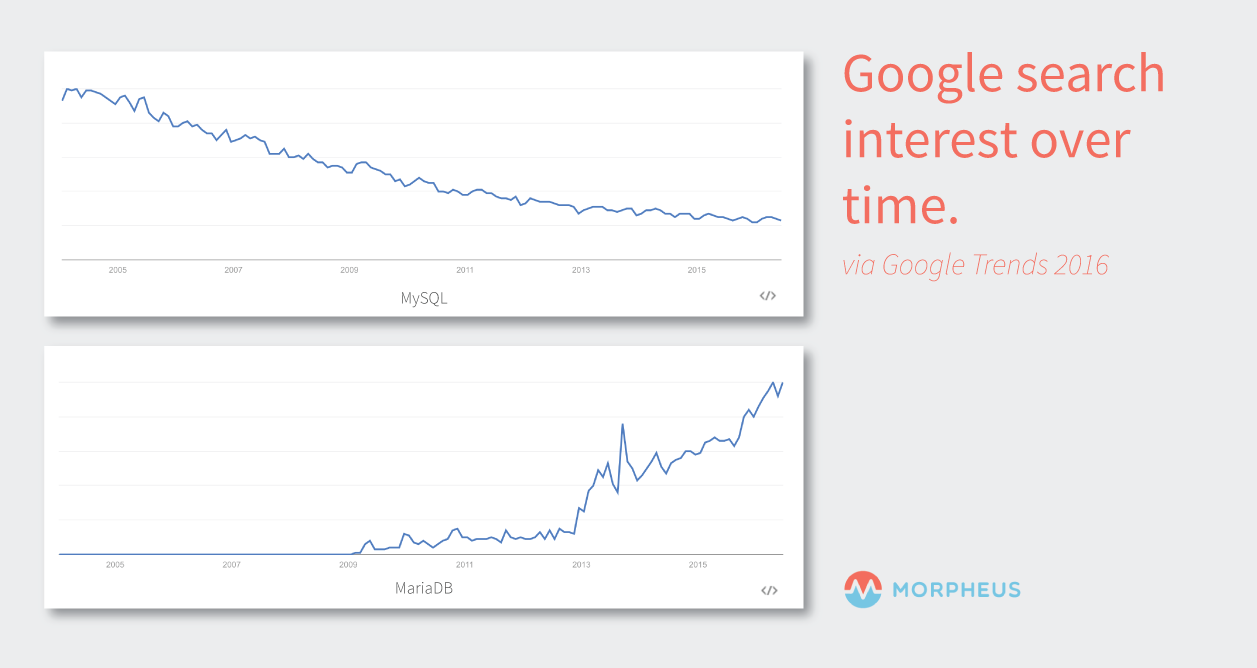
MariaDB is a database growing in popularity. Its lead developer is Michael “Monty” Widenius, who was part of the team that created MySQL. When MySQL was acquired by Oracle, Widenius and some of the other original MySQL developers decided to launch MariaDB as a fork of MySQL and keep it as open source to mitigate any issues around Oracle’s ownership of MySQL.
In 2009, Sun Microsystems acquired MySQL. Sun’s subsequent acquisition by Oracle brought about a movement headed by Widenius to “save MySQL.” Widenius and many others in the open source community felt Oracle’s ownership might be a conflict of interest, since Oracle already had a competing closed source commercial database. They believed Oracle would be slow to further develop the MySQL database, given the potentially greater focus on the commercial Oracle database.
In response to this, Widenius began working on MariaDB and helped form the MariaDB Foundation, which uses a community governance model. Because of the separation between the open source and commercial sides of the foundation, its governance generally is seen by the open source community as positive. This is in contrast to Oracle, which has both its commercial Oracle database and the open source MySQL both under the same governance. Often this is perceived as a conflict of interest, especially when it comes to keeping MySQL up to date.
MariaDB vs. MySQL
While MariaDB isn’t yet replacing MySQL, it has brought about good competition between the two, which can be good for innovation. With its backing of Oracle, MySQL may reign supreme for at least the near future; however, technically speaking, MariaDB could replace MySQL if a company decides it wants to make the switch.
The developers designed it as a drop-in replacement of MySQL. Since it was forked from MySQL, basically all of the structures MariaDB uses are the same. This means switching from MySQL almost surely won’t require a company to alter its application in any way, since the data and data structures won’t need to be adjusted.
In fact, the command-line tools such as mysqladmin, mysqldump, the daemon and others all keep their original names, so MariaDB is very much a drop-in replacement for database administrators as well. Indeed, many organizations have already either switched to it or simply began using it on its own: It replaced MySQL as the default database in Fedora and Red Hat. It is also used by Booking.com, CraigsList and Wikipedia, among others.
What Else Does MariaDB Offer?
Community improvements to MariaDB have been made by notable organizations such as Facebook, Twitter and Google. For example, Google contributed data-at-rest encryption to release 10.1.3, which is quite helpful given the security issues that can arise quickly in this ever-changing environment. In addition, it offers performance improvements such as subquery optimization and faster joins. It also has added row-based replication.
While MariaDB may not replace MySQL immediately, it is worth watching: It is gaining traction as a potentially serious contender in the marketplace.

