Tag: Oracle

  • Oracle Enables Partners to Reuse Cloud Platform

    Oracle Enables Partners to Reuse Cloud Platform

    At its CloudWorld event, Oracle today announced it will enable IT teams to deploy the same platform it uses to independently deliver cloud services anywhere they see fit.

    Leo Leung, vice president of products and strategy for Oracle, said an Oracle Alloy offering will enable organizations to provide a full set of cloud services they can extend and brand as their own. All of the more than 100 infrastructure and platform services that the company makes available on Oracle Cloud can now be deployed anywhere, he said.

    In addition, Oracle unfurled a MySQL HeatWave service through which IT teams can access instances of the open source MySQL database running on the Amazon Web Services (AWS) cloud. A similar offering for the Microsoft Azure cloud is also planned.

    As part of an ongoing effort to gain share against rival cloud service providers, Oracle has been making a wide range of services available at a lower cost. Oracle Alloy now extends those efforts by making it possible for a wide range of organizations, including traditional enterprise IT organizations and internet service providers, to benefit from the company’s research and development efforts.

    Organizations that ally with Oracle can set their own pricing, rate cards, account types and discount schedules and define the support structure and service levels. A preconfigured instance of Oracle Fusion Financials to enable Oracle Alloy partners to manage customer invoicing and billing is also provided.

    It’s not clear to what degree these organizations might want to compete with cloud service providers such as Amazon Web Services (AWS), Microsoft and Google, but Oracle Alloy does provide an alternative approach to cloud computing that enables organizations to retain more control over the IT services they provide to others. The challenge, of course, is that acquiring the infrastructure is only one part of the equation. Organizations will also need to hire and retain IT specialists needed to manage cloud platforms on an ongoing basis.

    As the volume of applications being deployed in cloud computing environments steadily increases, Oracle clearly views Oracle Alloy as an opportunity to make up for lost ground in a market segment that it initially all but ignored when cloud computing first emerged more than a decade ago. Now, Oracle provides cloud services in 40 commercial and government regions across 22 countries. It has added 10 public cloud regions over the past year and has plans to add six additional commercial regions.

    Oracle is betting that, in some cases, partners will opt to deploy some cloud services themselves while relying on Oracle for others depending on the level of demand for specific classes of services. In effect, Oracle is enabling a set of federated cloud services to emerge that are no longer specifically tied to a single provider. It remains to be seen how receptive organizations will be to that approach, but it’s certain that the number of organizations that could afford to deliver cloud services could substantially increase. In theory, at least, increased competition should also lead to lower cloud costs for the organizations that consume those services.

  • Recession! DevOps Hiring Freeze | Data Centers Suck (Power) | Intel to ‘be’ Wi-Fi 7

    Recession! DevOps Hiring Freeze | Data Centers Suck (Power) | Intel to ‘be’ Wi-Fi 7

    Welcome to The Long View—where we peruse the news of the week and strip it to the essentials. Let’s work out what really matters.

    This week: Engineer jobs are being cut, cloud infrastructure is using too much energy, and Intel’s 802.11be silicon is alive. (more…)

  • Oracle’s Free Managed Service Integrates With Microsoft Azure

    Oracle’s Free Managed Service Integrates With Microsoft Azure

    Oracle today extended its alliance with Microsoft to include a managed service that makes it simpler for IT organizations to embrace hybrid cloud computing. Oracle Database Service for Microsoft Azure integrates Windows applications with Oracle databases running on Oracle Cloud Infrastructure.

    Leo Leung, vice president of products and strategy for Oracle, said the managed service is an extension of an existing capability that was rolled out in 2019. However, many IT organizations found it too difficult to provision hybrid cloud computing environments themselves. The managed service makes it easier to access Oracle databases across a high-speed network spanning 11 global regions, Leung said.

    There is no charge for the Oracle Database Service for Microsoft Azure, the Oracle Interconnect for Microsoft Azure, data egress or ingress when moving data between OCI and Azure, said Leung. Organizations will pay only for the other Azure or Oracle services they consume.

    DevOps teams have often spent significant amounts of time trying to integrate diverse cloud computing environments. Now, with just a few clicks, Oracle is making it possible to connect Azure subscriptions to OCI. The service automatically configures OCI and Azure environments, federates Azure Active Directory identities and enables monitoring with Azure Application Insights.

    Oracle and Microsoft, of course, are locked in a fierce database contest as Microsoft looks to drive adoption of SQL Server as an alternative to the Oracle relational database. However, there are many organizations that today run Oracle databases on Windows servers in on-premises IT environments. Oracle is looking to make it easier to migrate those environments to the cloud with minimal disruption, noted Leung.

    Theoretically, organizations are embracing multi-cloud computing to ensure they don’t find themselves locked into a single provider. The challenge is that each cloud computing environment has its own set of management tools that need to be mastered. As organizations add additional clouds, the actual total cost of IT rises as more specialists are brought on board to manage those environments. Oracle’s approach addresses that issue by enabling IT teams to manage Oracle databases via a single pane of glass that resides on the Azure cloud, said Leung.

    Oracle has been trying to gain market share in the cloud by reducing the total cost of cloud services. A free managed service for integrating Azure cloud with OCI also reduces the incentive any existing Oracle customer might have to replace Oracle databases as they migrate to the cloud.

    It’s not clear how far the Oracle service will advance hybrid and multi-cloud computing, but it does set a new benchmark for what IT organizations should expect. The days when cloud service providers largely ignored each other are coming to an end. In this day and age, IT teams should not have to devote resources to integrating low-level APIs simply because cloud service providers don’t want to acknowledge the fact that application workloads are routinely deployed on multiple clouds.

  • Oracle Adds AI Services to Cloud Portfolio

    Oracle Adds AI Services to Cloud Portfolio

    Oracle today unfurled Oracle Cloud Infrastructure (OCI) AI services, a collection of services that make it easier for developers to use application programming interfaces (APIs) to invoke a wide range of services based on algorithms trained by Oracle on their behalf.

    Elad Ziklik, vice president of product management for AI services and data science at Oracle, said the primary goal is to offload the data engineering tasks associated with machine learning operations (MLOps) from organizations that simply want their developers to include AI capabilities within their applications without having to necessarily hire and then retain a dedicated data science team.

    However, organizations also have the option of uploading their own data into OCI AI services to retrain the models provided by Oracle, he noted.

    Ultimate, the goal is to make OCI AI services a simple extension of DevOps workflows by making it simpler to employ AI models; these models become just another software artifact that can be stored and updated in a Git repository alongside all the other artifacts managed by a DevOps team, said Ziklik. In effect, Oracle wants to make AI ‘boring’ in the sense that these capabilities can now be readily invoked by any development team, he added.

    The OCA AI services include OCI Language, a text analysis capability that enables developers to add sentiment analysis, key-phrase extraction, text classification, named entity recognition and other similar capabilities to their applications, and OCI Speech, which converts file-based audio data containing human speech into text transcriptions.

    Oracle has also included OCI Vision for image recognition and document analysis tasks, OCI Anomaly Detection to create models that flag irregularities in processes, OCI Forecasting for tracking business metrics over time and OCI Data Labeling for creating datasets to train AI models.

    These services are designed to address the most critical AI requirements of the average enterprise rather than attempting to outperform on a set of AI benchmarks that don’t reflect the requirements of business development teams, said Ziklik.

    In addition, Ziklik noted Oracle has also made it easier to address AI compliance requirements that will eventually require organizations to document precisely how their AI models work.

    At some point soon, just about every application will be invoking AI capabilities to one degree or another. That shift creates a major workflow challenge for DevOps teams. AI models are typically created by data science teams that typically don’t successfully deploy an AI model in a production environment more than a handful of times a year. Those AI models, however, need to be integrated with applications that, in many cases, are being continuously updated via DevOps workflows.

    Oracle said that goal becomes easier to achieve using models it creates versus allowing data science teams to build out a set of custom MLOps workflows on platforms that then need to be maintained by IT professionals. Instead of having to set up, for example, a feature store to track and manage AI models, the models created using OCI AI can be stored in an existing Git repository.

    Naturally, each organization will need to determine the degree to which they will converge MLOps and DevOps best practices. Oracle, however, is betting that the simplest way to achieve that goal is via AI models surfaced via a cloud service that developers can readily invoke whenever required.

  • Oracle and Allies Launch ARM-Based Cloud Service

    Oracle and Allies Launch ARM-Based Cloud Service

    Oracle announced today it will make available for the first time ARM-based processors on the Oracle Cloud Infrastructure (OCI) that will also be supported as targets for deploying applications using GitHub, GitLab or Jenkins platforms. The latest Oracle service is based on processors from Ampere Computing.

    The company also revealed today it has joined the Continuous Delivery Foundation (CDF), an arm of the Linux Foundation that oversees the development of open source DevOps platforms and tools such as Jenkins and Spinnaker.

    Matt Leonard, vice president of compute for OCI, said the OCI Ampere A1 Compute provides an alternative to existing support for the x86-based processors that Oracle provides. That service will be offered at a cost of one cent per core hour with virtual machine sizes ranging from one to 80 OCPUs configured with one to 64 GB of memory per core or as a bare-metal service with 160 core and 1 TB of memory. Pricing per GB of RAM per hour is $0.0015. At that price point, Leonard said Oracle is now offering the lowest price per core of any cloud service provider.

    The growing availability of ARM-based processors is starting to have an impact on cloud economics at a time when organizations are significantly increasing the number of applications being built and deployed on public clouds. Many of those organizations, to reduce overall costs, are now actively evaluating ARM-based services, noted Leonard.

    To help jumpstart application development on the platform, Oracle is providing organizations with three classes of OCI Ampere A1 Compute services. An Oracle Cloud Free Tier gives developers $300 in free credits for 30 days. The Always Free ARM option gives developers four A1 cores and 24 GB memory, while an ARM Accelerator option provides open source developers, independent software vendors (ISV) partners, customers and universities with ARM-based development projects that need additional resources beyond what the Oracle Cloud Free Tier provides with credits for a 12-month period.

    Oracle Linux, Java, MySQL, GraalVM and the Oracle Container Engine for Kubernetes (OKE) service are also all available on the OCI Ampere A1 Compute along with integrations with DevOps platforms from GitHub, GitLab and/or Jenkins. Other vendors providing support for OCI Ampere A1 Compute include SUSE, Datadog, OnSpecta, NGINX and Genymobile.

    Oracle has also made available an Oracle Linux Cloud Developer image that enables DevOps teams to install, configure and launch a development environment via an OCI console that includes OCI client tools, utilities and common programming languages such as Java, GraalVM, Python, PHP, Node.js, Go and C/C++.

    Finally, each Ampere core is single threaded by design with its own 64 KB L1 I-cache, 64 KB L1 D-cache and a huge one MB L2 D-cache to eliminate any ‘noisy neighbor’ issues that IT organizations might otherwise encounter.

    Oracle is clearly betting that ARM-based processors will present the company with an opportunity to gain share at the expense of larger infrastructure-as-a-service (IaaS) rivals such as Amazon Web Services (AWS) and Microsoft Azure. It’s not clear to what degree IT teams might employ a different cloud service just to access ARM-based processors. However, in a world where IT teams now routinely employ multiple clouds, as far as Oracle is concerned, the playing field has never been more level.

  • Oracle Extends Capabilities of Enterprise Manager Platform

    Oracle Extends Capabilities of Enterprise Manager Platform

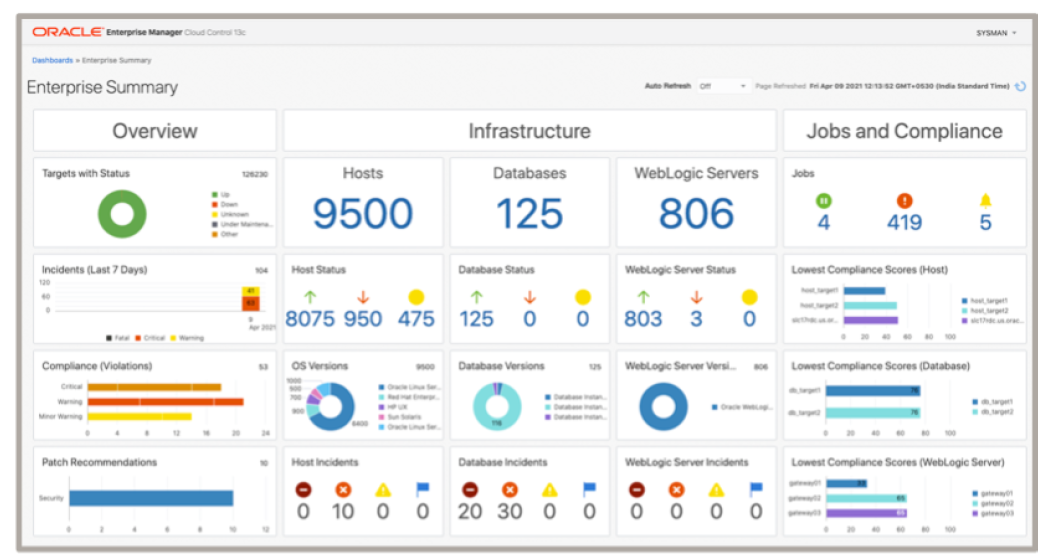
    Oracle today announced it has updated its core management platform to provide capabilities that make it easier to manage a hybrid cloud computing environment spanning millions of endpoints.

    The latest release of Oracle Enterprise Manager (EM) 13c, in addition to greater scalability, also provides support for dynamic groups, dynamic runbooks, automated workload analysis, monitoring templates, event compression and other capabilities that make it easier to manage IT operations at scale.

    Oracle Enterprise Manager (EM) 13c Release 5 also extends the reach of the management platform further into the realm of packaged Oracle applications and integrated hardware and software platforms such as Oracle Exadata, Oracle Database Appliance (ODA), Zero Data Loss Recovery Appliance (ZDLRA) and Private Cloud Appliance (PCA).

    Oracle has also updated the compliance framework it includes with Oracle Enterprise EM to support additional regulatory requirements and refreshed the user interface for the fleet management tool provided.

    Finally, the company is adding a tool that makes it easier to copy data stored within Oracle EM 13c to the Oracle Cloud Infrastructure (OCI) service. Dubbed OCI bridge, this tool copies data to an OCI object store where it is accessed by OCI services such as logging analytics and operations insights.

    Mughees Minhas, vice president of product management for enterprise and cloud manageability at Oracle, said as hybrid cloud computing continues to evolve, the need for a single management platform that spans infrastructure, databases and applications is becoming more apparent.

    Minhas said Oracle EM 13c is part of larger observability initiative that Oracle has embraced to provide more context across disparate services in a way that reduces the total number of tools an IT team needs to deploy and master. That effort complements a series of autonomous computing initiatives Oracle has previously launched that eliminates the need for database administrators (DBAs) to manage lower level systems administration tasks such as performance tuning. In general, Oracle is making a case for an IT world where platforms are co-managed by Oracle and internal IT teams that are focused on higher-level tasks.

    As IT environments become more distributed it’s clear IT is becoming more complex to manage. The issue that IT teams need to come to terms with is to what degree can they automate management tasks that today conspire to limit the size of the IT environment any given IT team can effectively manage. DevOps teams, of course, have been ruthlessly automating application development and deployment tasks for years. That philosophy is now being extended to include a broader range of IT operations tasks being automated by vendors themselves.

    Each IT team will ultimately need to decide just how many automation platforms it requires. In many cases, IT teams are now struggling to unite various islands of automation that have now emerged within their organization. Regardless of approach, however, rote tasks that once consumed hours, sometimes days to complete, are now no longer required which, theoretically at least, should leave more time to focus on more complex challenges that are getting thornier by the day.

  • Oracle Updates Java Development Platform

    Oracle Updates Java Development Platform

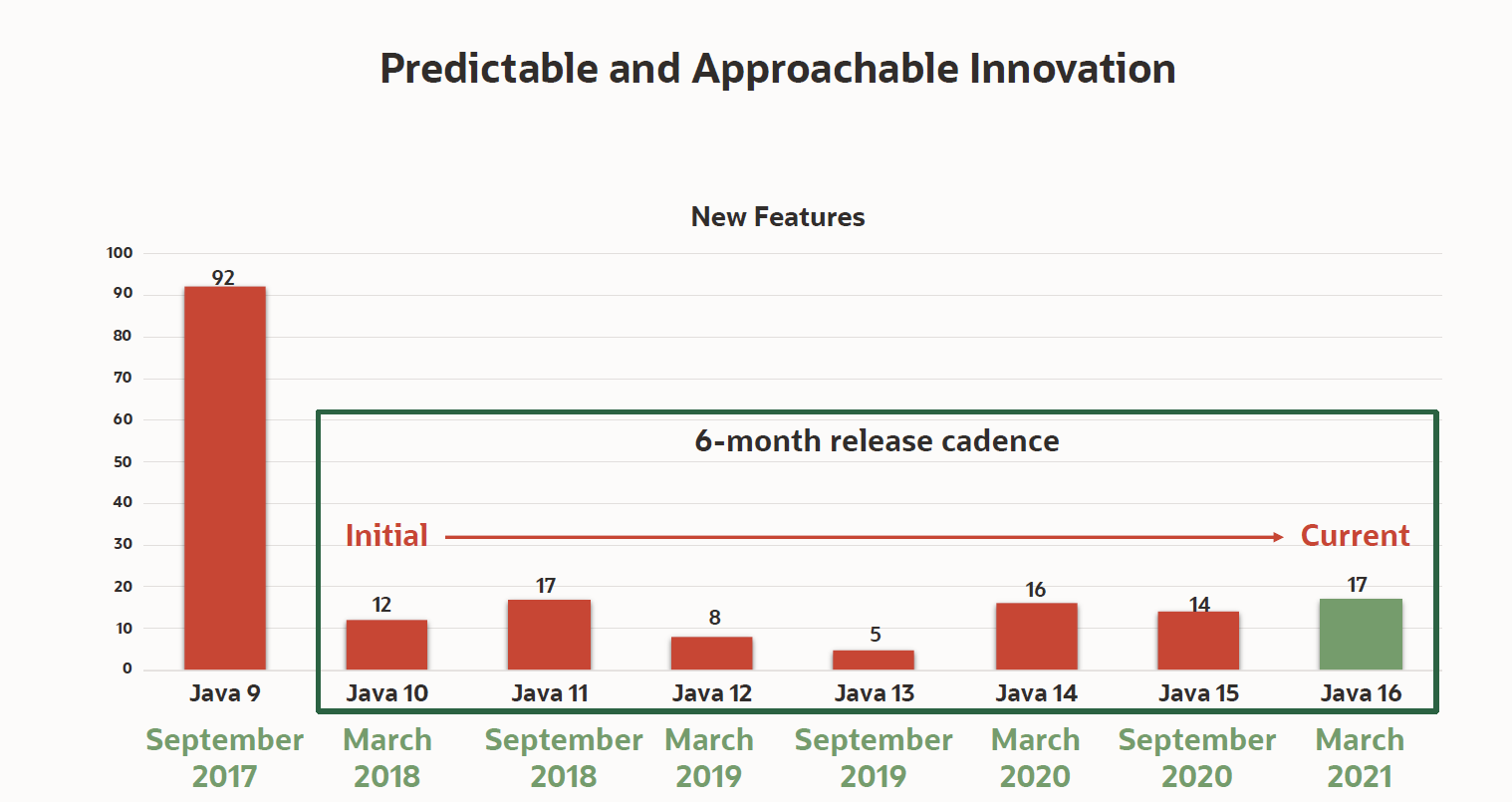
    Oracle announced today the availability of Java 16, which adds 17 enhancements to a software development kit that is now being updated every six months.

    Georges Saab, vice president of development for the Java Platform Group at Oracle, said while most Java development teams are still using Java 8 or earlier editions of the platform, the expectation is that many of them will soon move forward, as updates are made available in smaller increments that are easier to test and vet.

    At the same time, Oracle is committing to make available long term release editions of Java that won’t be updated as frequently. While there are many organizations anxious to take advantage of new capabilities as quickly as possible, Saab noted there are just as many that value stability more than innovation.

    The latest edition adds support for finalized pattern matching for instances and records, as well as other language enhancements that were previewed in Java 14. Developers can also employ a packaging tool to ship self-contained Java applications that will make it easier to deploy in modern IT environments, said Saab.

    Additional capabilities now available include the Vector application programming interface (API), the Foreign Linker API (JEP 389), and the Foreign-Memory Access API that are all available in incubations as well as a sealed classes capability that is being made available as a preview.

    In general, Saab said, one of the primary reasons many organizations don’t tend to update Java more frequently is the frameworks they rely on to employ it at a higher level of abstraction are still optimized for older versions. However, as Java updates are delivered in a more modular fashion, it will become easier for the providers of those frameworks to keep pace.

    It’s not precisely clear to what degree IT teams are employing Java to build next-generation applications based on microservices. However, a recent survey published by VMware, found 95% of respondents have either already used the open source Spring framework, based on Java, to either containerize an application (65%) or plan to do so (30%).

    A quarter of a century after its initial development, Java is still the dominant programming language relied on to build enterprise applications. In many instances, the lack of tools for building Java applications for Kubernetes platforms was a significant inhibitor of adoption for the cloud-native platform. In the last six months, however, the number of tools for building and deploying Java applications on Kubernetes clusters has increased.

    Despite the proliferation of alternative platforms for building and deploying applications on Kubernetes platforms, the appetite for retraining legions of Java developers is low. Most developers will rely on the programming tool they already know, especially when it comes to building mission-critical applications for the enterprise. That may mean some of those applications might not be as fast as they could be, but, given the level of risk, there’s always going to be a natural tendency toward being safe rather than sorry.

  • Eclipse Foundation Formally Releases Jakarta EE 9 Spec

    Eclipse Foundation Formally Releases Jakarta EE 9 Spec

    The post-Java Enterprise Edition (EE) era has formally begun with the release of a long-awaited Jakarta EE 9 Platform and Web Profile specification from the Eclipse Foundation.

    In addition, the Eclipse Foundation has announced that version 6.0.0 of the open source Glassfish application server has now been certified to be compliant with Jakarta EE 9.

    Functionally equivalent to the existing Java EE 8 specification, the release of a Jakarta EE 9 Platform and Web Profile specification is intended to enable IT vendors that have built offerings based on Java to shift their naming conventions to Jakarta EE 9.

    Mike Milinkovich, executive director of the Eclipse Foundation, said now that the Jakarta EE 9 specification is in place IT organizations should expect to see the members of the Eclipse Foundation that contribute to the project begin working more aggressively on a Jakarta EE 10 specification that adds more features.

    Under the auspices of the Eclipse Foundation, Milinkovich added there will be a lot more focus on developing a truly cloud-native implementation of Java EE as work on the next generation of Jakarta EE platform advances.

    The rate at which new capabilities were being added to Java under the stewardship of Oracle had become an issue given the rate at which other programming languages are being advanced. Oracle agreed to relinquish control of the Java specification to the Eclipse Foundation, which in theory should lead to a faster rate of innovation as more contributors participate in an open source project.

    However, Oracle insisted on retaining the rights to the Java trademark because it has support contracts in place for existing instances of Java that provide a significant stream of revenue. Providers of rival platforms based on Java are hoping enterprise IT organizations will shift quickly to Jakarta as part of a way to reduce their support costs at a time when IT teams are under intense pressure to reduce the total cost of IT.

    Despite the rise of a wide range of programming languages in recent years, Java is still widely employed with most enterprise IT organizations, many of whom have been using Java since it was first made available by Sun Microsystems. Reliance on Java is not likely to significantly decline anytime soon; however, most IT organizations are now making greater use of additional programming languages alongside Java. In fact, many of the applications that DevOps teams are building and deploying are made up of modules that were built using different programming languages.

    It may still be a while before a Jakarta EE platform is pervasively employed in IT environments. However, it’s clear a new era that should result in advances that make it easier to deploy applications that are compatible with Java faster has arrived. How those capabilities will manifest themselves may still be unclear, but the fact that they are being worked on should be a comfort to IT organizations that have already invested millions of dollars in training developers how to build Java applications optimally.

  • Oracle Adds APIs to Java SDK To Advance DevOps

    Oracle Adds APIs to Java SDK To Advance DevOps

    Oracle announced it is making available the Java 14 software development kit (SDK), which provides access to several additional capabilities designed to help advance DevOps adoptions within IT organizations that still rely heavily on Java to build enterprise applications.

    Those capabilities include a set of application programming interfaces (APIs) to enable continuous monitoring of JDK Flight Recorder data and a set of APIs that make it easier to access foreign memory.

    In addition, via an incubator module Oracle is now providing access to a Packaging Tool that will enable developers to package Java applications and runtimes for distribution in platform-specific formats. That capability is being exposed as an incubator module because the associated APIs have not been finalized, which means they are subject to change in future releases.

    The Java 14 SDK adds Java language support for switch expressions to be used as either an expression or statement and extends the availability of the low-latency Z Garbage Collector to macOS and Windows.

    Finally, Oracle has added support for a Pattern Matching capability that eliminates the need for boilerplate code and a preview of a tool that makes it simpler to declare data immutable.

    Aurelio Garcia-Ribeyro, director of product management for Java SE, said a lot of the capabilities being added to Java SDK were developed as part of the ongoing Panama and Amber research projects that in some cases have been in development and testing for years.

    Despite the rise of rival programming languages, Garcia-Ribeyro said enterprise IT organizations continue to rely on Java to build most of their applications, especially mission-critical backend systems.

    The challenge is modernizing the processes via which Java applications are built and deployed. Many organizations, for example, are embracing containers and microservices to build next-generation applications. As that transition occurs the need to embrace best DevOps practices becomes more apparent because applications themselves are becoming more complex. The upside, of course, is that microservices also make it possible to build more robust applications faster, which has become a critical requirement as organizations embrace digital business transformation.

    Of course, no two organizations are likely to be at the same point on the DevOps maturity curve. In fact, in many cases, DevOps adoption is being driven from the bottom up as developers embrace new capabilities being added to familiar tools such as the Java Development Kit from Oracle. In some cases, the SDK will be used to build new applications while other members of the development team employ it to modernize legacy applications. Before long, however, IT operations teams start to realize how monitoring APIs and packaging tools are transforming how IT operations are managed.

    Naturally, Oracle is hoping all these new capabilities will help keep organizations focused on Java as the primary means for building enterprise applications at a time when developers have more options than ever. The one thing that Oracle has most in its favor is that most organizations don’t want to retrain developers to learn how to master a new programming language unless it can’t be avoided.

    — Mike Vizard

  • Oracle v. Google and Its Impact on APIs and Code

    Oracle v. Google and Its Impact on APIs and Code

    What, if any, impact will the Supreme Court’s rulings on Oracle v. Google have on the industry at large?

    TL/DR: It is unlikely to impact the vast majority of us, vendor and enterprise developer alike.

    Disclaimer: I am a technologist, not a lawyer. I have done some research, and talked to lawyers, but all that I say here is opinion—even my direct quotes of lawyers are their opinion. The Supreme Court can and has caught people off guard and taken cases in different directions than expected. Though I believe this path is the one it will follow, nothing is assured until the Court rules.

    Throughout this blog, references to The Case are actually using Harvard’s case document.


    Background

    On Nov. 15, the U.S. Supreme Court agreed to hear a dispute between Oracle and Google. The Oracle v. Google case has been going on for nearly a decade. And its roots go further back than that.

    The origins of the case go back to 2005, when Google and Sun Microsystems discussed the licensing of Java for Android. This will likely be important because it shows that Google knew it was someone else’s intellectual property (IP). More on this later.

    The crux of the case falls into three parts:

    1. Eight files that were decompiled and used. In one court case, these were found to never have made it into distribution and only used for testing (which limits liability).
    2. Two source files from Java used directly. These were found to be infringing, but damages were set to zero with consent of both legal teams.
    3. The part at issue: the copying of the entirety of Java’s interface from 37 modules. Most tech writers imply this as 37 APIs. It is not—it is hundreds of classes and thousands of methods. The 37 is the number of Java packages.

    The case has been through four court hearings/rulings so far. To sum up the relevant parts of these cases:

    1. The first case (split between a jury and district court, running at the same time) included patent violations. Those were defeated and Oracle has not appealed that defeat. On copyright infringement, the court found that Google did violate copyright on the 37 packages and the directly copied source code, but not on the eight decompiled files. The jury could not settle the issue of “fair use” of the 37 packages.
    2. The district court decided that the eight decompiled files and the copied source code for one function were violations, but remanded the rest back to the jury trial to settle the issue of fair use.
    3. In the end, the district court determined that APIs are not protected by copyright. Their decision involved two parts:
      1. That there is only one way to write a given API.
      2. The interface code and hierarchy can be replicated by third parties without violating copyright because it is an interface and not content.
    4. On appeal, the finding was reversed, and APIs were deemed copyrightable, sending the case back again.
    5. At this point, Google asked the U.S. Supreme Court to intervene. The court chose not to.
    6. Back at jury trial, the court found that while APIs may be copyrightable, Google’s use was fair use in the legal sense. This is the one topic the jury could not originally agree upon.
    7. Oracle appealed this decision, and the District Court ruled that it indeed was not fair use to copy the structure and exact interfaces.
      1. Where the jury and the district court appear to disagree is in the idea of APIs. Calling a publicly documented API is obviously fair use, and the jury latched onto that idea. The District Court appears to acknowledge the difference between calling an API and copying it.
    8. And after some tumultuous hearings and years in the court, the Supreme Court has agreed to weigh in on the issue.

    The real problem here is that copyright law is not a great fit for software. It never has been. If I rewrite your Java application in Python, using the same exact structure and naming, is that protected? All of the “words” have changed. It is akin to rewriting your Hindi book in English without a direct translation  … except that in software there is the added issue of it behaving exactly the same.

    But we can’t fix the misapplication of copyright law to software—only Congress can. So what to expect?

    A fair number of people, from the open source community and from businesses that see opportunity in a ruling that favors their world  view, are advocating that affording copyright protection to APIs is a horrible idea because it would hurt independent developers. This is not quite true. Independent developers are not generally copying Java. While this case does have bearing on coding practices and what developers can do, it does not have a huge impact on innovation, just on copying others’ work and how that is achieved—much like the “reverse engineering” court cases of the ’80s.

    There are good arguments on both sides of this case, but it seems to me that fair use will lose. They are public APIs in the sense that anyone can call them; indeed, some of these packages are so core to the system that you could argue every app must call them. But calling a function is not the same as re-creating it. In that sense, they are not in the public domain. Anyone can read a book, but that does not make it public domain.

    But no matter how this turns out, it is all good for the industry. This uncertainty has hung over the IT sector for nearly a decade. Just like when a new boss comes along and there is uncertainty in the department until everyone adjusts to the new demands/style of the boss, a solid ruling will allow settling to start. The industry can adapt once it knows what the rules are and we can move along.

    The real long-term answer is to have an equivalent to copyright and patent that is designed around the unique parts of computer code. Clearly, software is not the same beast as a book or magazine. The considerations are half-patent and half-copyright, and trying to bend those two to meet the needs of software has created some serious issues. Oracle quoted a 1995 case to showcase this problem—the company is quoting it to win the appeal, but it should be quoted as the reason the protections need to be designed for this medium that is not a publication and yet consists of words whose sequence matters: “Applying copyright law to computer programs is like assembling a jigsaw puzzle whose pieces do not quite fit.” (attributed by Oracle to the concurring opinion of J. Boudin in Lotus Dev. Corp. v. Borland Int’l, Inc., 1995).

    One interesting bit that the courts thus far have ignored, and I would love to see the Supreme Court take up, is this: If Google entered into licensing negotiations, the company knew it was Sun/Oracle’s IP. To then go and copy parts of it without licensing appears wrong on its face. It would be interesting to understand the process that ended in the copying and hear whether that bears upon the legal standing of the case. I can think of both malicious and innocent routes to get there; it would be interesting to hear testimony about motivations and thought processes.

    But even without delving into the licensing negotiations, this case stands to redefine copyright with regards to software. J. Michael Keyes, a partner at the international law firm Dorsey & Whitney, had this (and more) to say:

    “One of the issues that the court may decide is the scope of copyright protection for software. Google had early success below in convincing the trial judge that the snippets of copied code were not copyrightable. Google may urge to have the court take a look at this issue anew. Another huge implication is the scope of fair use. The jury found that Google’s use was “fair” and that it was not liable for infringement. The appellate court overturned that jury conclusion and found that Google’s use was not fair as a matter of law. The Supreme Court will likely wade into this thicket and provide guidance on the scope of fair use in the context of software code and what role an appellate court plays in reviewing jury decisions in that regard.”

    What we (all of us) do not want to do is confuse “good for the industry” with “legal standard.” It is not the court’s job to do what we think is best for the industry; it is the court’s job to determine applicable law and what that implies needs to happen. Presumably, the Supreme Court will do just that. And it may not please any of us. But if we think the current iteration of the law is flawed, that is something to take up with elected representatives, not ask a court to “fix” on the fly.

    For the vast majority of us, though, it impacts our development not at all. Using APIs or forking open source projects are all still perfectly acceptable, and no ruling by the Supreme Court is going to change that—because copying someone’s APIs is the issue here, not using them. And open source licenses allow for copying and improving projects. So carry on. Get the job done. And read about the Supreme Court’s final decision with a smile, because either way, the industry will adapt to the new normal and continue forward.

    — Don Macvittie