Tag: microservices

  • Introduction to MACH Architecture

    Introduction to MACH Architecture

    In recent years, the need to construct end-to-end digital experiences has become increasingly important. But to deliver new features and services promptly, organizations must double down on agility and reusability. As part of this trend, applications have become increasingly modular, often constructed using pre-built microservices and integrating common SaaS to avoid reinventing the wheel.

    MACH is an architectural style that fits into these trends quite well. It stands for Microservices-based, API-first, Cloud-native, and Headless. The locus of the movement is The Mach Alliance, a group of API-first companies abiding by these principles. At the time of writing, MACH is gaining mindshare as more API-first companies enter the market and the appetite for cloud-native technology grows.

    I recently chatted with Gary Ballabio, VP of technology partnerships, Cloudinary, about the ongoing MACH trend. According to Ballabio, MACH delivers “best of breed” technologies that avoid the bloat of larger platforms. Yet, for software consumers, building in a MACH style will require stitching together individual components and orchestrating them effectively. Below, we’ll explore MACH and consider the benefits and drawbacks of utilizing tools that conform to this approach.

    What Is MACH?

    MACH is an emerging software architecture style adopted by a number of commerce and digital experience tools. To understand MACH a bit deeper, it’s necessary to understand the underlying concepts of microservices, API-first, cloud-native and headless. So, let’s first break apart these familiar terms:

    • Microservices: Unlike monolithic development, a microservices architecture organizes functionality into self-contained, specialized components. This improves reusability and allows for more frequent, targeted software updates.
    • API-first: API-first takes design-first one step further. It means putting the consumption model, the API, ahead of other concerns, like the application or UI. Web APIs have become ubiquitous for connecting a microservices ecosystem and exposing data and functionality to partners and public consumers.
    • Cloud-native: An umbrella term for projects purpose-built for the elasticity and scalability of the cloud.
    • Headless: Headless means separating the front end, or “head,” from the back end. By decoupling development this way, websites and apps are better equipped to cater to multiple platforms and devices.

    According to Ballabio, companies can leverage cloud-ready best-of-breed functionality by integrating tools that adopt MACH principles. Incorporating one single SaaS to fit a specialized need can also be considered an alternative to using large, comprehensive enterprise commerce suites like Salesforce, Adobe or SAP, said Ballabio.

    There are many examples of specialized SaaS services built in the MACH style. Some include Algolia for search and recommendations, Cloudinary for media management, Builder.io for mobile experiences, or Contentstack as a headless CMS. All these tools are members of The MACH Alliance, a group of over 70 vendors, partners, startups, systems integrators and other ambassadors dedicated to fostering the MACH approach. And although the emphasis has been on commerce and digital experiences, MACH is expanding beyond that scope to other areas.

    MACH technologies support a composable enterprise in which every component is pluggable, scalable, replaceable.

    Some readers may wonder, “How is this different than Jamstack (JavaScript, APIs and markdown)? In a way, MACH is similar to Jamstack, as both approaches aim for headless frontend experiences and a modular backend powered by APIs. But a key difference, said Ballabio, is that MACH doesn’t dictate the use of specific programming languages.

    Benefits and Drawbacks of MACH

    MACH combines many development trends we’re seeing in the software landscape. Digital applications are becoming more composable, cloud-first is rising, and headless models can deliver customization benefits. Yet, there are some potential drawbacks to introducing this style too. So, let’s weigh some of the positives and negatives of adopting MACH architecture.

    Benefits

    • Flexibility: The most significant benefit of MACH is the flexibility it offers, said Ballabio. “There’s value in being able to choose the services you want to use based on your own unique requirements.” Looping in a specific API-first tool for something like e-commerce, payments, CMS or email can enable a lot of customization.
    • Reduced waste: This can create less waste, too, as you create a leaner footprint by acquiring only what you need for each project, and freemium models enable consumers to pay for only what they use. This is helpful when you want a single component but don’t require the bells and whistles of a more holistic platform.
    • Best-of-breed: Niche API-first products are focused on doing one thing really well, and this particular focus can improve quality and agility. It also releases engineers from being at the whim of an extensive product’s development life cycle.
    • Developer-first: Lastly, most digital experiences share common functionalities that developers shouldn’t have to reinvent. MACH supports being developer-first, says Ballabio, which is an asset to companies investing in developer experience.

    Drawbacks

    • Increased maintenance: Consuming many third-party cloud services will inevitably bring new maintenance hurdles. These include tracking, monitoring and securing all integration points. It also requires responding to new version updates.
    • Stitching together: Naturally, when you add a cloud-based abstraction layer to the services you consume, the onus is on the consumer to then to stitch them together to make components talk to one another.
    • Startup costs: Due to the coordination between services, initial costs and engineering time could be more than implementing a holistic suite, admitted Ballabio. “But you get more long-term benefits,” he said.
    • Assistance may be required: Those unaccustomed to microservices development and API integration may need help. This may require the support of systems integrators or middleware to orchestrate connections.
    • Lack of standards: MACH is more of a general architecture rather than a standard specification. Thus, the precise technologies under the hood and the specific behaviors may differ from service to service.

    Future of MACH

    A recent MACH Alliance study found 79% of tech leaders plan to invest more in MACH technologies in the next year. Although the style has been primarily trending in Europe, Ballabio predicts the U.S. will soon pick it up. The MACH Alliance presents and advocates for an open and best-of-breed enterprise technology ecosystem.

    Along with the rise of composable architecture, the MACH approach is gaining interest among cloud-native leaders who see the advantage of assembling applications using pre-fabricated building blocks. MACH is especially a good fit for greenfield development, where the slate is clean to integrate new technology.

    MACH represents a new category of companies that are growing together. Ballabio remarks that he feels part of a movement, part of an industry—and, arguably, this movement can potentially disrupt larger commerce ecosystems.

    But although MACH gives a name to a face, most techies still aren’t aware of the acronym. While the concept may, for now, live in the domain of vendor-speak, Ballabio foresees it becoming a more common parlance for consumers and end developers.

  • A DevOps Reset for a Multi-Cloud World

    A DevOps Reset for a Multi-Cloud World

    In the world of DevOps, only two things really matter: 

    • To release applications and updates as quickly as possible
    • To have access to resources (processing, storage, networks) able to run those apps, as cost-effectively as possible. 

    The measures used to achieve these twin goals should work together seamlessly–otherwise, you’re inefficient. But software development and IT operations have been on separate journeys, and it now takes layers of tools, specialized expertise and lots of precious time to distribute and manage applications where they need to run. Organizations tolerate all this complexity (and the delays and costs that come with it) since they see no alternative. But what if there was an easier way?  I’ll examine the two fundamental shifts driving software development and IT operations and see why current processes are so cumbersome.  

    Shift One: From Monolithic Applications to Microservices

    In the beginning, applications were monolithic, with all functions and code packaged together. That approach was manageable when apps were updated once or twice a year, but not when updates are expected multiple times each day. Finally someone realized that applications would be much easier to build, improve and maintain if they were divided into smaller units called microservices—independent, loosely coupled, individually deployable services, each one addressing a specific function. 

    To support microservices, a technology stack has emerged, similar to steps on a ladder:

    • To make them portable, microservices are packaged in containers—a lightweight, standard way for applications to move between environments and run independently. Everything needed to run the microservice such as settings, system tools, libraries and dependencies is packaged inside the container.
    • A single application could have hundreds of containers associated with it. How do you manage them? Along came Kubernetes (aka K8s), open source software for deploying and orchestrating containers within a cluster of virtual machines. (Note the word cluster—the significance will be discussed momentarily.)
    • Since microservices are updated constantly, how do you make sure the correct version is running? Along came GitOps to provide version control for all updates to all those microservices. Git repositories provide a single source of truth for the desired application state, as well as a record of every code change.

    Finally, we need to set up continuous integration/continuous delivery (CI/CD) for rolling out application improvements and new features. Along came ArgoCD, a GitOps continuous delivery tool for Kubernetes that continuously monitors running applications, compares the current, live state against the target state specified in a Git repository, and resolves discrepancies.

    Shift Two:  From On-Premises to Multi-Cloud 

    Not long ago, IT departments were having hot debates about this strange new concept called the public cloud and whether it could possibly play a role in their operations. But once they discovered how easy it was to spin up resources, the floodgates opened.

    The first tentative steps typically involved hybrid clouds combining an on-site private cloud with spillover into a public cloud for workload spikes. These initial forays mushroomed to dozens or hundreds of clouds, in different locations and with different providers. It’s a mind shift happening in enterprises globally—where they once had a small number of clouds, now their cloud operations are huge, growing and boundless. Companies are also discovering that the cloud is not just an easier, more cost-effective way to run their applications, it unlocks new opportunities.

    Now there are core clouds, edge clouds for hyper-local applications, regional clouds, clouds for high availability and resilience and more. Edge computing is another option, where low latency is required for operations at the customer-facing frontend cloud while backend processing happens in the primary cloud. But this is just the beginning.

    Continuous Delivery is Now Way Too Complicated

    Today, an application may have dozens of microservices distributed across different clouds that need to work together—perhaps some in cloud one, a few in cloud two, others in cloud 40, etc. The scale gets huge very quickly; for example, if 100 microservices are being delivered to 100 clouds, there are 10,000 mutations that have to be configured and managed. 

    This is the new normal, and DevOps needs to adapt to it. Processes should mesh transparently, but connecting microservices across multiple clouds and cloud instances requires inter-cluster communication, which Kubernetes (and GitOps/ArgoCD on top of it) does not natively support.

    To make all this work requires specialized skill sets, so organizations hire teams with expertise in continuous delivery, multi-cloud, networking, security and automation. The first step involves distributing K8s containers to clouds where the microservices are going to run. Some enterprises create their own distribution system, others choose to download, install, and manage third-party software such as open source ArgoCD.

    The second step is more complex: Securely connecting those microservices across different clouds and K8s clusters. This involves integrating complex service meshes, load balancers, API gateways and network/firewall automation tools, all feeding into a centralized console for configuration and monitoring.

    The result is inevitable: Lots of extra costs, inefficiency, potential security risk and delayed time to market with resulting risks to the business. Development teams update microservices daily but depend on CloudOps, NetOps, SecOps and other flavors of Ops to deliver them to the different clouds and clusters where they need to run. 

    Despite the best efforts of these different stakeholders, it can take days or weeks to update cloud networks and security for each change.

    Simplifying Multi-Cloud Operations With an Overlay Network

    When hundreds of microservices are being distributed across more and more clouds and updated constantly, you need an alternative—one that streamlines current operations without sacrificing security or application performance. Let’s set aside traditional methods and think about how it should be done.

    First, the solution should be easy to use, so DevOps people don’t have to be proficient with the underlying technology or be dependent on NetOps, SecOps and/or CloudOps people who are. Instead, just provide some basic information about the Git repository and the clouds where you want the microservices to run, and an overlay network handles the rest.

    It should be comprehensive—integrating ArgoCD, the service mesh, the K8s ingress gateway, zero-trust security, resilience/failover, load balancing and multi-cloud networking — all those elements that normally require assembling and configuring individual tools.

    It should make multi-cloud Kubernetes application operations easy to manage, with a single dashboard where you can securely deploy, connect and monitor microservices in all your clouds and clusters.

    Finally, the solution should be available as a service, rather than having to install an ArgoCD server and try to manage it yourself (or hire a team to support it). And if you have questions or need help, competent people should be available to give you a hand.

    Disruptive – In a Good Way

    Get ready for self-service multi-cloud Kubernetes decoupled from the underlying networking and security details. It’s an approach that’s about to upend how microservices are deployed and managed, so DevOps can get back to what really matters:  Delivering applications as fast as possible, on the resources where they need to run. The ability to deliver new features in a fraction of the previous times while significantly reducing costs and without compromising security will mean a competitive advantage and a stronger bottom line. 

  • Microservices Explained: Not Your Father’s SOA

    Microservices Explained: Not Your Father’s SOA

    Microservices are frequently referred to as a variant or derivative of service-oriented architecture (SOA), if not essentially the same thing. While there are similarities and both are designed around the concept of services, that’s where the similarities end. Each was created around a different set of principles and intended to address different problems.

    Microservices architecture is built around key concepts that, when applied, not only differentiate it from other architectures but deliver advantages that accelerate software delivery and help to scale large, complex applications. To deliver on the promise of cloud-native, microservices must be loosely coupled so that, ultimately, they are independently deployable. Any microservice can be updated and deployed—just that containerized microservice—without requiring changes to other microservice(s). Loosely coupled microservices mean they are not sharing databases or maintaining state, for example.

    How big should a microservice be? Or, in other words, how much should it do? The answers range from ‘a single thing’ to ‘a small set of related code with high cohesion’. Another factor is that getting too granular can overrun a microservices-based application with large numbers of microservices, increasing complexity and making triage through observability and tracing very challenging.

    Scaling microservices-based apps is another important factor. Autonomous microservices can be replicated and scaled for performance and workload using container orchestration tools such as Kubernetes.

    Microservice communications are achieved through well-thought-out APIs created around the business or operational capabilities the microservice provides to anyone or anything engaging through the API. The API, and data provided through the API, are often referred to as ‘technology-independent.’ It’s probably better stated that microservice APIs are built using approaches like RESTful and GraphQL over networks that are not tied to any one specific operating environment, technology or programming language. JSON, YAML and XML similarly represent data that is transferable across technologies.

    The following diagram of a media application demonstrates the principles of microservices architecture. Microservices for scheduling media, digital rights management, tracking impressions and adding new ad insertions are loosely coupled, autonomous and have well-defined API interfaces. Each microservice can be changed, enhanced and deployed rapidly and independently of other microservices.
    Microservices SOA

    Service-oriented Architecture, or SOA, emerged to solve a very different problem; the overwhelming size and complexity of monolithic applications. Monolithic applications have very large codebases that often don’t do a good job of compartmentalizing functional or business logic. This makes changes to the codebase challenging even to developers who know much of the codebase well.

    Services in SOA were often used to gather a collection of similar business logic together and then share them as a service with other parts of the application, as needed. Technologies like message buses are used to make requests of a service and operate as traffic managers for requests across multiple services and other parts of the application. While reusability was a critical design consideration, SOA services were still quite large, and deploying services at high velocity was not an important design consideration. SOA services often take considerable time to code and test the service including interdependencies across other parts of the application before deploying as part of a larger software release.

    One important note: There are benefits and drawbacks to microservices and SOA architectures; neither is ‘better’ than the other. Which architecture to use when mainly depends on the purpose of the application you are building. For larger, more complex enterprise application environments that require integration with many other applications, you might choose SOA. That’s a better fit than for smaller applications that don’t require middleware elements for managing the requests within the app or between other applications. Microservices, on the other hand, are better-suited for smaller and well-partitioned web-based systems. They are becoming the standard for today’s cloud-native applications, and also are a great fit for developing a mobile or web application because they give developers more control.

  • Governing Microservices in an Enterprise Architecture

    Governing Microservices in an Enterprise Architecture

    Software development strategies continue to evolve to meet changing business needs. There has been a lot of discussion of digital transformation recently, and custom software development is driving much of that transformation. Agile software development and DevOps have become the norm as companies strive to develop better, faster, more flexible applications. Microservices offer the next step in the evolution of enterprise application development.

    DevOps separates developers (Dev) and operations (Ops) into teams collaborating on new enterprise solutions. Similarly, microservices expand on the idea of specialization, creating specialized app building blocks to build new applications. Microservices enable an even shorter development time and greater agility. They also present a new set of challenges for enterprise architects who must oversee these microservices and govern the development process.

    A Series of Building Blocks

    If you are unfamiliar with the term, microservices are a series of building blocks assembled to make new applications. Just as agile software development is a philosophy as well as an approach to development, microservices are an architectural and organizational approach to enterprise software development.

    The value of microservices is in the building block approach. With old-school monolithic services, you must design and maintain a single application and its various components to act as a unit. Change or remove one element, and the entire application needs to be rewritten and tested, which is costly and time-consuming.

    With microservices, the individual services function as self-contained functional units that can be mixed and matched as needed to create different custom applications. Using microservices is faster, more versatile, and more reliable, simplifying the delivery of large, complex applications.

    Microservices also are built around business capabilities so that business application components can be created in tandem with DevOps agile enterprise development. And with different teams working to create smaller components, there is less chance of having a single point of failure.

    No-code/low-code development solutions are placing the power of microservices in the hands of business users. Domain experts in product development, finance, logistics, and other departments can use a drag-and-drop interface to develop microservices that can then be incorporated into other applications. In short, microservices gives subject matter experts the tools to create custom apps that can be added to the enterprise architecture.

    The Pros and Cons of Microservices

    Microservices offer businesses and enterprise architects several benefits. Deployment of new applications is faster, and you have more flexibility to adapt to changing enterprise and business needs. They also scale quickly and make it simple to add new features to existing applications. And microservice elements are reusable.

    Of course, there are challenges as well, including governance. As the architecture evolves, there are more components to be managed. In addition to different departments building microservices, the DevOps team is still responsible for overseeing application development and solving everyday problems. Having a mature engineering culture helps automate app development and track microservices, providing the necessary guidance to ensure app development supports larger business objectives.

    Microservices also create architectural overhead. Applications must be documented to ensure ongoing business value. Trying to document everything, however, creates delays, so the documentation is never current with the stage of development. The challenge is providing enough documentation to be useful without delaying ongoing software changes.

    This requires a new enterprise application mindset. DevOps needs to closely watch autonomous teams to control development and ensure they support larger corporate goals. The use of no-code/low-code tools also could result in shadow IT not being sanctioned by the network architects or DevOps.

    Governing Development

    One of the market forces driving microservices adoption is the need for “outside-in” application development. All microservices should be developed at the request of a customer, whether that customer is inside or outside the organization. Customer requirements continually change, and microservices can accommodate those changes faster and more efficiently.

    Microservice development works best in a domain-driven architecture, which models the applications based on the organization’s real-world challenges. A domain-driven architecture assesses the enterprise infrastructure in light of business requirements and how to fulfill them. Most organizations already have a domain-driven design strategy in place that maps the architecture to business capabilities.

    Bounded Context is a strategy that is part of domain-driven design. Autonomous teams responsible for microservices are formed around areas of responsibility such as inventory management, product discovery, order management, and online transactions, i.e., bounded context. The domain expertise resides within the team, so the enterprise architect’s responsibility is to guide development to align with strategic goals, balancing immediate needs and future business objectives.

    When governing microservices as part of the enterprise, applying the C4 model for software architecture—context, containers, components and code—makes sense. The context defines the relationship between the customer or end user and the application. The container represents the microservice itself and how it is packaged to serve as an application building block.

    The secret to governing microservices in any enterprise architecture is to map business capabilities to the digital infrastructure, then promote the vision behind the enterprise architecture as well as the guidelines to achieve that vision. Focus on organization-wide objectives for both business transformation and IT strategy. Educate the stakeholders on when to involve the enterprise architect. Also, try to anticipate topics beyond the perspective of the DevOps team and focus on the big picture—what is the long-term business strategy and how do microservices contribute to that strategy?

  • 5 Testing Strategies For Deploying Microservices

    5 Testing Strategies For Deploying Microservices

    With rigorous development and pre-production testing, your microservices will perform as they should. However, microservices need to be continuously tested against actual end-user activity to adapt the application to changing preferences and requests. This article will cover five deployment strategies that will help developers and DevOps teams when releasing new features or making changes to microservices-based applications.

    Always Test in Production

    A staging environment is a necessary but insufficient step toward building a robust microservices infrastructure. Although indicative, it is not a substitute for evolving user traffic and behavior. When real users interact with the software during production, the services may not perform as efficiently.

    Users are unpredictable. They may make requests you have not accounted for when drawing up communication paths. Or your microservices architecture may not sustain the actual production traffic. When testing with real end-users, you are sure of your software’s performance and can improve it or add new functionality. 

    The disadvantage of working with real users is that they will be impacted by any errors. However, with specific deployment strategies, you can identify the issues and minimize their impact on those users. 

    Depending on your goals, you can implement the following testing strategies in the deployment stage. They can be performed individually or in various combinations, as each approach varies in its contribution to deployment.

    Blue-Green Deployment

    A blue-green deployment uses two distinct yet identical production environments. For example, you deploy an inactive version of your application in the blue environment. At the same time, the latest version available to end users runs in the green environment. Next, you push code to add new functionality to the blue environment. 

    At this stage, you test the services in the blue environment to ensure that they are running smoothly. You can automate this process by using basic smoke tests. When the microservices pass these tests, you can instruct the load balancer to gradually redirect user traffic to this new environment.

    If the new functionality poses no problems, the router moves all traffic from the green to blue environment, but can immediately revert traffic in case of any errors. 

    Due to the identical nature of both environments and their reliance on each other, there is little to no downtime. The end user’s experience is largely unaffected and the developers can move quickly to fix any bugs.

    The old environment serves as a backup, making it possible to execute a rollback without any downtime. After releasing the latest version, you can decide to kill the old instances, but only after you are confident that the new environment will continue running without errors. You can also clone both blue and green environments to repeat the process with other feature deployments in the future.

    Canary Deployment

    Canary deployment is similar to blue-green testing in that it protects against release-related risks.

    The phrase “canary deployment” originates from an old mining practice of placing caged birds in mine shafts to detect the presence of harmful gases. If present, the gases would kill the canary before affecting the miners, thus providing an early warning to vacate the mine immediately.

    A canary deployment works on a similar principle. Instead of creating two separate environments, a canary deployment operates within the same microservice or infrastructure. The developers roll out a new service or application version with changes only to a fraction of the end-users.

    You can quickly detect errors or vulnerabilities while using the new service. The impact is temporary and minimal as the experiment is only run on a subset of users with most remaining unaffected. Once they are working and have passed verification, you can scale up the changes. 

    The biggest challenge for those running canary deployments is the requirement to run multiple versions of the same microservices so that they can be deployed to a few users at a time. Implementing multiple versions also means you need to keep track of which users are on which versions to run accurate business metrics and analytics. Such monitoring can get increasingly complex with multiple canary deployments within the same application.

    Feature Flags

    A feature flag or feature toggle is a change or feature written inside conditional code. Developers can turn the feature on or off depending on their testing requirements while the application is running and in use.

    The code is already deployed and there are two code paths: One with the code that implements the feature and one without it. The developer only needs to choose one of the two paths. When the switch is toggled on, the code chunk is executed as part of the flow. When switched off, that code is skipped and the feature is not implemented. The rest of the source code continues to run as usual, independent of the feature flag’s condition, with no disturbances in the end user’s experience.

    Once integrated, a feature flag allows you to turn on a feature for a select group of users. Unlike a canary deployment where the selection is random, feature toggles are usually employed in specific cases. For example, developers do not create two separate applications to implement free and paid subscription tiers. Instead, operating a feature flag allows you to make a particular feature accessible only to subscription users.

    Feature flags are especially attractive during testing as developers can use them to run small experiments throughout the application without relinquishing control. Being able to flip the switch remotely also makes rollbacks easier. The risk is negligible as the application is self-sufficient in that it can continue to run without the feature. 

    Feature flags generate complex user-to-service paths by way of permutations and combinations. For a specific user, it is difficult to determine the exact route they took when using the services. Feature flags complicate this by allowing each user to have a different experience, ultimately making the application hard to debug. These toggles are easy to get started with minimal risks, but their maintenance can quickly become complex. It is best to use them only when needed and with other deployment strategies.

    Traffic Shadowing

    With traffic shadowing or mirroring, the router duplicates incoming traffic to an already-released service and gives the copy to another service. The request and response mechanism between the user and the existing service remains intact. On the other hand, the second service with a copy of the traffic contains new features that require testing. Consequently, it does not interfere with the existing process. Instead, the copy is used to test its functionality.

    Its most significant benefit is that it allows the new version to receive the same traffic that is currently being received by the service it seeks to replace. There is no need to create test data or worry about replicating scale. This accuracy comes with little risk, as there is no tangible impact on the existing services. Developers can run all relevant tests on this production environment, such as testing for errors and performance metrics. The new version’s responses, which are not sent to users, can also be compared to those of the production service. Both versions operate independently of each other with different end goals. This can happen in real-time or a copy can be saved and replayed for future testing.

    Traffic shadowing can be used with other deployment techniques like blue-green or canary deployments. After successfully shadowing a production environment, the changes can be rolled out gradually using a canary deployment to gain maximum confidence before a full release.

    Shadowing can have unintended consequences, though, so you should exercise caution when deploying this strategy with services that have third-party dependencies. 

    A/B Testing

    Unlike blue-green and canary deployments, A/B testing is focused on user perception and experience of new features. It measures if and how end users are interacting with these features, whether they are easy to notice and use and gauges the application’s overall functionality. It provides developer teams with business-level insight to improve their application as the features are ultimately implemented using code.

    A/B testing divides users into groups that access different features. Group A, for example, sees a different user interface than group B, although members in both groups are making the same requests to access the application. Traffic is routed to separate builds or different configurations on a common build. This is done by considering aspects like the users’ operating systems and user agents. It must be run on a sample that is representative of your end users. The test also needs to display statistically significant results to be valid.

    This test can be combined with blue-green or canary deployments as they handle the actual feature deployments that this strategy tests. After comparing the versions shown to the groups, the one that has performed better can be pushed to release for all users. 

    Building your Deployment Strategy

    Each strategy outlined can be used independently or together in a combination that best suits your goals, workflow and microservices requirements. They allow you to identify and reduce the impact of any vulnerabilities that may only surface at the final stage of your software’s release. Implementing them can be a somewhat complex process, especially with larger architectures and dependencies. But by implementing any of these strategies, your team will release the best possible version of your application. 

  • Splunk Survey Surfaces Gains in Observability

    Splunk Survey Surfaces Gains in Observability

    A global survey of 1,250 observability practitioners, managers and other experts published today by Splunk found that sophisticated observability practitioners are able to cut downtime costs by 90%. That figure is based on an estimated cost of $23.8 million annually for comparative newcomers to $2.5 million. However, only 9% of respondents are advanced enough to be considered observability leaders compared to 59% that are still beginners.

    Those leaders reported they are seeing a 69% better mean-time-to-resolution (MTTR) for unplanned downtime or performance degradation thanks to investment in observability. The survey also noted those same organizations launched 60% more products or revenue streams from application development initiatives in the last year.

    Observability has always been a core DevOps tenet, but achieving and maintaining is a challenge. Most DevOps teams today aspire to be able to maintain some level of continuous monitoring. However, as it becomes easier and less costly to instrument applications, interest is rising in observability platforms that make it simpler to launch queries and investigate anomalies.

    Spiros Xanthos, senior vice president and general manager for observability at Splunk, said observability platforms are clearly driving down the cost of downtime. There is also a clear correlation between organizations that have embraced observability and the number of microservices-based cloud-native applications that have been deployed, he noted. In effect, increased complexity is driving organizations to turn to observability platforms to manage IT environments in the age of the cloud, said Xanthos.

    The survey found 75% of respondents have multiple cloud-native applications that run in multiple environments. Just over one-third (34%) of internally developed applications are based on microservices constructed using containers, with 28% of respondents reporting they exclusively run cloud-native applications on public cloud infrastructure.

    Overall, the survey also found that two-thirds of leaders reported their visibility into application performance is excellent compared to 44% of beginners, while 64% of leaders reported that visibility into their security posture is excellent compared to 42% for beginners.

    The survey also found 59% of leaders can push code to production on demand for most internally developed applications compared to 28% of beginners. A total of 41% of leaders said they can detect problems associated with internally developed applications within minutes compared to 20% for beginners.

    It’s still early days as far as adoption of observability platforms is concerned but, theoretically, IT should become easier to manage even as the number of platforms employed continues to expand. Advances in analytics and artificial intelligence (AI) are improving the signal-to-noise ratio so that not only are more issues being surfaced sooner but that more trusted recommendations are being made, said Xanthos.

    Observability is, of course, a journey. Most organizations are not even quite sure what type of questions they should formulate to get the most value from investment in an observability platform. Organizations should start small, with a finite project to gain an understanding of how to leverage observability more broadly as they gain more maturity, said Xanthos.

    Regardless of the approach to observability, the one thing that is certain is that traditional IT monitoring is no longer sufficient in an era where IT environments get more complex by the day.

  • vFunction Tool Uses AI to Help Convert Monolithic Java Apps

    vFunction Tool Uses AI to Help Convert Monolithic Java Apps

    vFunction today added the ability to employ artificial intelligence (AI) to automatically assess the level of effort required to convert a monolithic Java application into a set of microservices.

    Bob Quillin, chief ecosystem officer for vFunction, said the goal is to make it simpler for IT teams to more effectively employ the company’s vFunction Application Transformation Engine by using a vFunction Assessment Hub that assesses the level of technical debt involved.

    Legacy monolithic Java applications tend to have a lot of technical debt and dependencies that make them a challenge to convert into microservices, he noted. Most simpler Java applications have either already been converted or are in process, Quillin added.

    The vFunction Assessment Hub enables IT teams to better predict the outcome of refactoring a Java application to better prioritize which Java application should be converted first based on, for example, the level of scalability that can be achieved, said Quillin. Current assessment approaches involve a lot of manual effort and which typically requires organizations to hire external contractors to perform, he added.

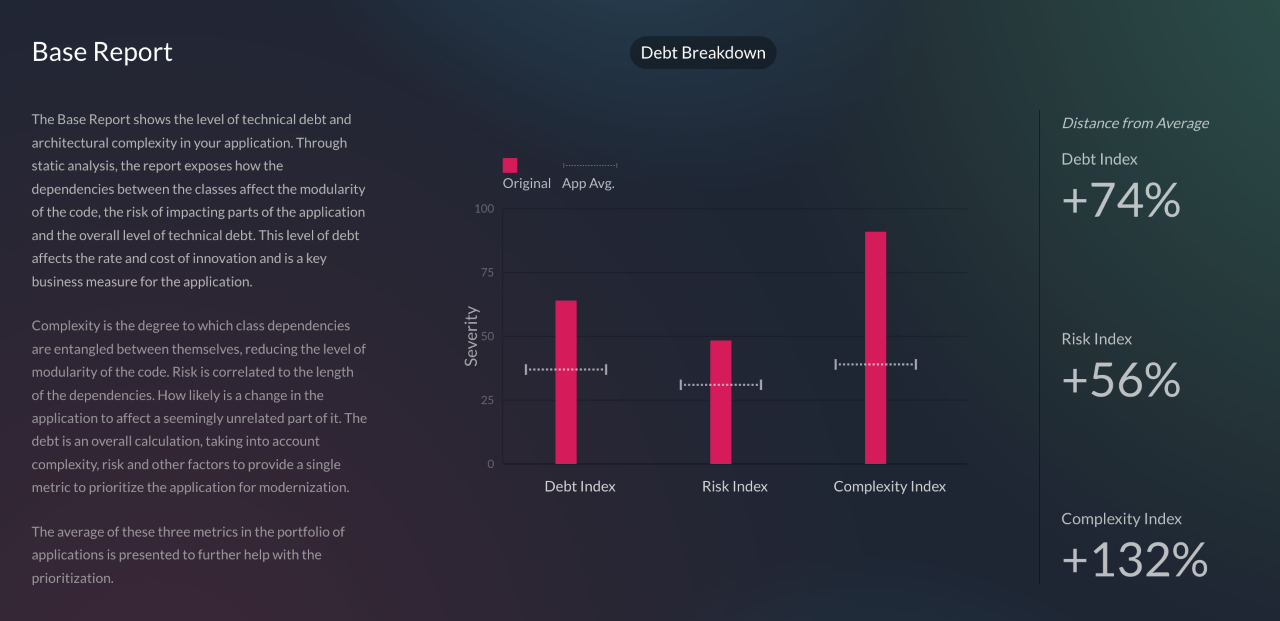
    An AI-based approach reduces the total cost of creating a business case and constructing a roadmap for modernizing existing Java applications, said Quillin. The vFunction Assessment Hub measures application complexity based on code modularity and dependency entanglements and then assesses the level of risk changes might have on the stability of the application based on the depth and length of the dependency chains. It then surfaces benchmarks for debt, risk and complexity in addition to identifying aging frameworks that could create security risks and licensing issues.

    Thus far most organizations have been content to lift and shift Java applications into the cloud without modernizing them. The application simply now runs on infrastructure that is managed by an external cloud service provider. That approach does little to improve the scalability of a monolithic Java application, noted Quillin. The goal should be to convert that Java application into a set of microservices that run natively in the cloud, he added.

    The vFunction Assessment Hub is already being used within a Java Refactoring Service for the Azure cloud provided by Microsoft that is based on agent software to analyze code and the vFunction Application Transformation Engine.

    In general, organizations are embracing microservices to build applications that are both more scable and resilient. In the event a microservice becomes unavailable, requests for services are rerouted to another microservice to make sure the application degrades gracefully, rather than simply crashing altogether. The challenge, of course, is that the dependencies that can exist between hundreds of microservices can be more challenging to manage over time than those of the monolithic application being replaced.

    It’s not likely that microservices-based applications will entirely replace monolithic applications any time soon, but the bulk of new applications are being built on top of a microservices-based framework. As such, many DevOps teams are now managing a broad mix of monolithic and microservices-based applications across IT environments that become increasingly more complex to manage with each passing day.

  • Microsoft Taps vFunction to Refactor Java Apps for Azure

    Microsoft Taps vFunction to Refactor Java Apps for Azure

    Microsoft has teamed up with vFunction to make it easier to convert monolithic Java applications into a set of microservices that can be deployed on the Microsoft Azure cloud.

    The Microsoft Services Industry Solutions group is making available the Java Refactoring Service, through which IT teams will be able to both lift and shift Java applications to the cloud and then convert them into a set of microservices using agent software and the vFunction Application Transformation Engine, which is infused with artificial intelligence (AI), to analyze Java code.

    vFunction CEO Moti Rafalin said the goal is to eliminate the heavy lifting currently required to shift Java applications into the cloud. The vFunction Application Transformation Engine is required because most of the Java applications that were easy to move to the cloud have been, Rafalin noted. The remaining Java applications, he said, have levels of dependencies that make them too complex to move to the cloud without the aid of a static byte code analysis platform capable of parsing more than 10 million lines of code and thousands of Java class libraries.

    Once those applications are converted into a set of microservices, it then becomes possible to achieve a level of scale that would otherwise be beyond the reach of any on-premises IT environment, he added, noting the same vFunction platform can be used also to help organizations continuously optimize microservices applications as they continue to evolve in a cloud computing environment.

    Longer-term, vFunction is also looking to add support for Microsoft.Net applications that need to be migrated to the cloud, said Rafalin. Many complex Java and Microsoft.Net applications are still running in an on-premises IT environment because organizations are encountering inertia that arises from paralysis of analysis, he noted.

    In general, Microsoft continues to gain momentum in its battle for cloud supremacy against Amazon Web Services (AWS). It’s not clear at what rate Java applications are being shifted to the cloud. However, most monolithic applications have components that would be easier to maintain and support as a distinct microservice. In general, organizations are embracing microservices to build applications that are more resilient. In the event a microservice becomes unavailable, requests for services are rerouted to another microservice to make sure the application degrades gracefully, rather than simply crashing altogether. The challenge, of course, is that over time the dependencies that can exist between hundreds of microservices can be more challenging to manage than those of the monolithic application being replaced.

    It’s not likely that microservices-based applications with entire replace monolithic applications anytime soon, but the bulk of new applications are being built on top of a microservices-based framework. As such, many DevOps teams are now managing a broad mix of monolithic and microservices-based applications across an increasingly complex IT environment. Less clear is to what degree teams will be able to leverage existing DevOps tools and platforms to build and deploy both types of applications at the scale enterprise IT organizations require.

  • 3 Steps to Jumpstart Your App Modernization Journey

    3 Steps to Jumpstart Your App Modernization Journey

    Like organizing your garage, modernizing your applications can seem daunting before you start, but you know it will pay off once done. So, instead of thinking about this project as a technical challenge, let’s look at it in the wider context of the business. Just as getting rid of old junk in your garage frees up the space you need for things you actually use, modernizing your apps helps your business run more efficiently and scale more easily. Based on my experience with many application modernization projects, here’s how developers can best approach app modernization, including what you’ll need from your team and technology, six key ways to tackle the task and how to prioritize.

    Start With a Business Assessment

    Before you can make any changes to your applications themselves, you need to lay out a plan based on your company’s needs. That means assessing every application in your portfolio, not just as individual properties but in the way they interconnect.

    Like most developers and engineers, when you have a technical background, it’s tempting to build a strategy around the most exciting technical opportunities. But the purpose of all the applications your company uses is to enhance the business. For example, your organization is likely considering an app modernization initiative to better serve customers and clients; to increase revenue or cut costs.

    That means when you approach modernization from a business perspective, you should prioritize apps based on business value. Large modernization projects can get complicated, so you won’t necessarily be able to complete this process for every app.

    When it comes to large-scale, complex applications, the effort required to modernize every piece is significant. So, it’s important to decide what applications are of the highest value and plan your modernization efforts starting there.

    There are several business-focused questions to consider, such as:

    • What are the business’ needs now and in the future?
    • Which problems are we trying to solve as an organization and as a department?
    • What capabilities does the business need to add in order to grow?
    • What does the business need to do to better support customers?

    Smaller organizations may be able to modernize every app and component. But if you’re in a large business or an enterprise, you will have to choose the apps and components that are most critical to the business goals. Of course, if you’re successful with the first crop of applications, it’s more likely you’ll get the go-ahead to move on to other apps and components.

    It’s important to stress how important this kind of assessment and planning process is. You need to get that business buy-in for that ultimate alignment and for delivering the most value for your business in the shortest amount of time.

    Choose Your Application Modernization Program

    Different applications require different modernization approaches, some of which are more labor-intensive than others. Here are six methods (the six Rs) used to modernize an app and how to assess which one is right in each case:

    • Retain: If an application is working as well as it possibly can in its current environment, leave it alone. This is rare, but it does happen.
    • Rehost: In the case of apps that already work well, you’re more likely to want to move them to a new platform than leave them completely untouched.
    • Retire: If an app no longer serves a useful purpose, is outdated or runs on technology that no longer exists, retire it.
    • Repurchase: Switching apps from perpetual licenses to software-as-a-service (SaaS), subscription-style models means less hardware maintenance, easier access to updates and cloud storage for all users.
    • Replatform: Transfer an app from a hardware-based option to the cloud, with a few small changes.
    • Refactor: The most work-intensive option—and the most interesting! This is the coding equivalent of a movie remake, in which you update the code to improve performance, availability, security and more.

    Follow App Modernization Best Practices

    All right. You’ve got leadership buy-in and you’ve categorized all your business’ apps according to the six Rs we mentioned above. Now, the real work begins. There are app modernization best practices to follow as you continue on this journey. Most importantly, remember that the effectiveness of your modernization efforts comes down to two key components: Your team and your tech. Here’s what you need from both for a successful mission.

    Deploy the Most Advanced Technology

    The underlying purpose of application modernization is to bring your apps up-to-date with the latest cloud technology. For the best results, you need to use the best available tech. There are a few elements of modern cloud technology you should consider. Serverless infrastructure is one. With serverless, you can make large-scale changes in real-time without having to maintain servers.

    Data management is another area where you should employ cutting-edge tech. You can use purpose-built databases that best suit different types of data for faster and more efficient processes.

    Autoscaling is also a key benefit of moving to the cloud. Be sure to factor in the need to scale from the start of your modernization project to avoid bottlenecks further down the line.

    Hire an Agile Team

    The most advanced tools in the world are useless if the people using them aren’t sufficiently trained or skilled. When hiring a team, look for agility. Application modernization processes are a lot of work. You need a team that moves quickly in order to hit your deadlines.

    Culture and responsibility, as well as ownership are also important. A demanding work environment requires open communication and people who will take responsibility for their part in the system. Consistency is another crucial factor. Involve the people who will be responsible for managing the apps from the start of the modernization process. This makes it easier for them to continue the work once the app is ready.

    Summary

    Getting the most out of your application modernization project requires the right tools, personnel and services. And while taking your first steps into the cloud can seem intimidating, by following tried-and-true best practices, you can stay on the right path toward a big payoff in the cloud.

  • Credit Karma Looks to Open Source Distributed App Platform

    Credit Karma Looks to Open Source Distributed App Platform

    Credit Karma has launched an application platform, dubbed Talon Polly, that makes it simpler to deploy microservices across multiple runtime environments.

    Richard Pounder, principal software engineer at Credit Karma, said the consumer financial services provider expects to make Talon Polly available as an open source project next year.

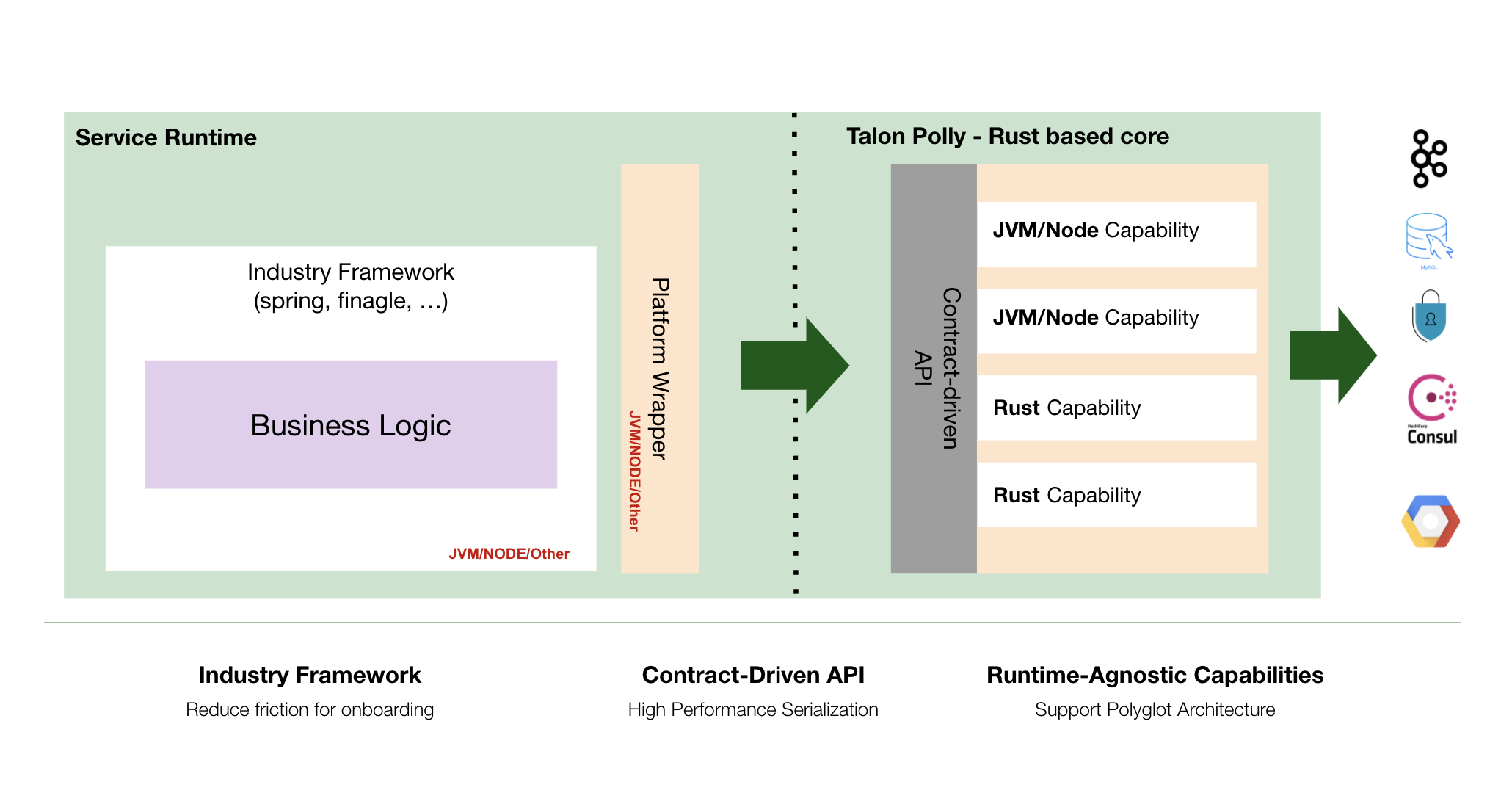
    Written in the Rust programming language, Pounder said Credit Karma created Talon Polly to provide its developers with a language-agnostic platform for building and deploying applications. Talon Polly can be deployed as a sidecar using containers or as a process running within a software environment.

    While there is no shortage of frameworks for building and deploying software, Pounder said Talon Polly is designed to make it easier for development teams to reuse code and components across multiple applications using, for example, a contract-based library included in the framework. That approach also enables Credit Karma to ensure a common set of security policies are enforced across those application environments, he noted.

    Ultimately, the goal is to enable developers to spend more time writing business logic rather than mastering the nuances of multiple application development frameworks created for specific application environments, said Pounder.

    It’s not clear to what degree other frameworks may emerge to address the same issues at Talon Polly. Odds are good that other organizations that need to deploy distributed applications built using multiple programming languages have faced similar challenges. The Cloud Native Computing Foundation (CNCF) has also adopted Dapr, a set of application programming interfaces (APIs) created by Microsoft that are deployed as container sidecars to make it simpler to build distributed applications, as an incubating project.

    Regardless of approach, the rise of distributed microservices-based applications is creating a significant management challenge for DevOps teams. Each microservice is built by different development teams that prefer one programming language over another for any number of reasons. Deploying and updating those microservices across a distributed computing environment requires more sophisticated orchestration of workflows, given all the dependencies that exist between microservices.

    Of course, it’s not quite clear yet the degree to which microservices-based applications will supplant legacy monolithic applications. Most new applications are being constructed using microservices to make applications more resilient. However, the number of legacy monolithic applications running in existing IT environments means it could be years before microservices-based applications will ever outpace them. As such, DevOps teams will be managing a mix of monolithic and microservices well into the second half of this decade.

    The paradox is that while microservices-based applications are more resilient because calls to services can be rerouted in the event of a disruption, the overall application environment becomes more complex as the dependencies between distributed microservices increases. As such, many organizations are opting to use microservices to build applications only when a certain level of resiliency is required or it’s been determined that a function likely to be used by multiple applications is more easily accessed via a microservice that has its own API.

    One way or another, going forward, it’s not so much a question of whether microservices will be employed but rather to what degree and across how many applications.