Tag: microservices

  • NGINX Delivers New Products to Manage Microservices

    NGINX Delivers New Products to Manage Microservices

    At its annual user conference in Portland, Oregon, in September, NGINX delivered releases focusing on the application platform market and support of delivering microservices architectures:

    • NGINX Plus, an application delivery controller that combines a load balancer, content cache and web server.
    • NGINX Controller, a centralized management and monitoring platform for NGINX Plus, which orchestrates the delivery of applications across multiple environments, enabling companies to continuously deploy and update applications using tested and proven policies.
    • NGINX Unit, a multi-language server for applications, designed to work in highly dynamic environments. It features a full REST API that can be fully automated and used to deploy new application versions with no service disruption. It currently supports PHP, Python and Go with more language support coming soon.
    • The NGINX Web Application Firewall (WAF), powered by ModSecurity, which protects web applications against various Layer 7 attacks and provides DDoS mitigation, real-time blacklisting and audit logging.

    In addition to launching the NGINX Application Platform, the company has added the ability to use NGINX Plus as a Kubernetes Ingress Controller. Based on the open-source NGINX Ingress Controller for Kubernetes, this new feature enables the deployment of applications within Kubernetes and Red Hat OpenShift anywhere across a cluster so they can be reached by outside traffic.

    While these products combine to deliver a complete and manageable microservices solution, the most interesting of these is NGINX Unit. According to Owen Garrett, head of products, the complement of tools facilitates management of both north/south and east/west traffic for cloud-native applications. It’s small, lightweight, fast, polygot-enabled and programmable through an API and works with other Unit instances to deliver a service mesh.

    Key features of Unit that should be of particular interest to businesses deploying microservices relate to the ability to foster continuous delivery. For example, when the router accepts new configurations from the Controller process, the worker threads start to handle new incoming connections with the new configuration, while old connections can continue to be processed by the threads according to the previous configuration. That is: Router worker threads can work simultaneously with several generations of configurations.

    Additionally, Unit uses interprocess memory to communicate with the applications, thus allowing the Unit to provide greater agility in routing of HTTP requests. So, rather than forcing the application to directly listen, they can delegate network handling to the service mesh providing for increased scalability. They accept the clients’ requests, pass the requests to the application processes, get responses back from the applications and send the responses back to the clients. Each worker thread polls epoll or kqueue and can asynchronously work with thousands of simultaneous connections.

    — Alan Shimel

  • Axway Extends API Management Reach

    Axway Extends API Management Reach

    With application programming interfaces playing a larger role in the DevOps environment, Axway has added to its API toolkit for developers. The company expanded its AMPLIFY API management platform to include a visual tool for composing and integrating APIs and enhanced its API Manager tool so that it now can be invoked to scale resources up or down as needed. In addition, Axway unveiled API Central Service that makes it easier to integrate APIs across an ecosystem of organizations that make their services available via the AMPLIFY marketplace.

    Other new capabilities include an open-source MQTT connector for building internet of things (IoT) applications, a connector to the Microsoft Azure Cloud and tighter integration between Axway’s MFT file transfer software and the Syncplicity file synchronization software it acquired earlier this year.

    Axway also merged the Titantium SDK for building native mobile applications using JavaScript into the Core SDK for developers and is previewing the Query Builder Analytics tool, which enables users to do ad hoc query of mobile statistics. The Titanium code is based on technology developed by Appcelerator, which Axway acquired early last year.

    The announcements were made at the recent Axway SPARK 2017 conference. Vince Padua, vice president of platform and products for Axway, says these and other enhancements to the Axway API portfolio are intended to make it easier for organizations to craft microservices spanning multiple platforms. In some instances, those microservices will be crafted by developers, but Axway believes more advanced users will be stitching together microservices on their own using visual tools, says Padua.

    While most early use of APIs was driven by web-based applications facing external users, using APIs to interconnect services inside the enterprise now dwarfs the number of instances of published external APIs, he notes. The proliferation of those APIs has created a significant DevOps challenge for organizations and requires an API management platform to streamline the management of various back-end service. At the same time, Padua notes that DevOps teams working in collaboration with line-of-business units have taken over much of the API management, which previously was left up to individual developers. Now, IT organizations are trying to strike a balance between maintaining control and developer productivity, he says.

    The shift in API management responsibilities has also driven a wave of mergers and acquisitions over the last two years as API management has become embedded in mainstream application development platforms. But there’s also a fierce debate over the degree to which legacy API management platforms can support microservices. As microservices based on emerging technologies such as containers or more mature Java programming tools continue to evolve, API management is becoming more critically important. Each microservice generates its own API that needs to be maintained as each microservice gets continually updated. That requires an API management platform that can support all levels of API call activity that once would have been assumed to be unimaginable.

    — Mike Vizard

  • The Executive’s Guide to Microservices: Chapter 1

    The Executive’s Guide to Microservices: Chapter 1

    Meet Steve. Steve is responsible for a mission-critical application for a very large enterprise. He has a problem: It takes Steve and his team a very long time to make changes to this application and release it to production. Steve has been talking to vendors, consultants and peers about agile software development techniques and DevOps, but Steve and his team have assessed that his application does not lend itself to these approaches.

    See, the system Steve looks after is called a monolith, which is a very confusing title since it was developed using the latest modular software development approaches when it was created, in the latter half of the 1990s and early 2000s. Steve and his team are constantly advised that they need to decompose their monolith into microservices. However, this advice only confuses Steve and his team even more, since the system was designed using a service oriented architecture (SOA) with the intent of ensuring that it was easier to maintain and scale.

    Steve’s team fell into a very common trap associated with many SOA-based designs: The services were designed with deep dependencies, they share a common database and they are very coarse-grained. Indeed, the collections service, which is one of eight services in the system, handles every potential operation a collections agent might ever need. Modifying any operation within the collections service means the entire collections service must go through regression testing and production must enact a very cumbersome deployment strategy that requires a five-hour maintenance window.

    Needless to say, Steve cannot keep up with the requested changes from the business with these constraints. Steve’s advisers have given him some good advice on organizing to develop faster, but he would only be applying Band-Aids faster. However, once the constraints identified above had been pointed out to Steve and his team, they better understood the challenge ahead of them.

    Steve and team are going to have to redefine the data models so they support service independence, then extract subsets of functionality out of the large, intertwined services to deploy as within a well-defined business context—following the “do one thing well” mantra. They then can start to extricate the complex business logic trapped inside the enterprise service bus so it can be incorporated into the services at the edge.

    Steve and his team realize that continuing to enhance the monolithic code base avoids the challenges of redevelopment but reduces the value of that codebase to the business. While there will be a cost of untangling the monolith, the cost of not doing so is lack of competitiveness, lack of agility, long wait times for new features, possible opportunity loss and continued investment in technical debt. Steve’s job will be to present the justification for this to the business based on these risks.

    When the task is completed, Steve and team will be able to deploy new services and modify existing services within weeks. The costs related to development and testing will drop significantly and the finer-grained services will allow developers to address business needs more quickly.

    We’ll check in with Steve and his team as they embark on this journey and deal with the challenges ahead.

    — JP Morgenthal

  • Low-Risk Monolith-to-Microservice Evolution, Part 1

    Low-Risk Monolith-to-Microservice Evolution, Part 1

    In designing and organizing a two-day workshop on microservices, I’ve been thinking a lot about how to explain monolith application decomposition and what a transition to microservices might look like. This is a small subset of that material, but I wanted to share it to get feedback (in the workshop we go into more detail about whether you should even break up your monolith). This is based on my own tried-and-true real-life experience, as well as my work with the many Red Hat customers I’ve met in North America over the last few years. Part I explores the architecture, while the second part (to be released shortly) will cover some technology that can greatly help in this area.

    Before we dig in, let’s set up some assumptions:

    • Microservices architecture is not appropriate all the time (to be discussed in length)
    • If we find we should go to a microservices architecture, we have to decide what happens with the monolith
    • In rare cases, we’ll want to break out parts of the monolith as is; in most other cases we’ll want to either build new features or re-implement existing business processes around the monolith (in a strangler fashion)
    • In the cases where we need to break out functionality or re-implement, we cannot ignore the fact that the monolith is currently in production taking load and probably bringing lots of business value
    • We need a way to attack this problem with very little disruption to the overall business value of the system
    • Since the monolith is the monolith, it will be very difficult/nearly impossible to make changes to the data model/database underneath it
    • The approach we take should reduce the risk of the evolution and may take multiple deployments and releases to make it all happen

    Extracting Microservices

    If you dig into the conference/blog posts this topic, often times you’ll find it offers these words of advice:

    • Organize around nouns
    • Do one thing and one thing well
    • Single responsibility principle
    • It’s hard

    I’m afraid this advice is quite useless.

    The more useful material discusses an approach that at times look something like this:

    • Identify modules (either existing or new ones to write)
    • Break out tables that correspond to those modules and wrap with a service
    • Update the code that once relied on the DB tables directly to call this new service
    • Rinse and repeat

    Let’s take a closer look:

    Step 1: Identify modules

    You start off with some nasty monolith. In the image above I’ve simplified this to denote the different modules and database tables that may be involved here. We identify which modules we wish to break out of the monolith and figure out which tables are involved and then go from there. Of course, the reality is monoliths are far more entangled with modules conflated with each other (if any modules). More on that in a bit.


    Step 2: Break out database tables, wrap with service, update dependencies

    The next step is to identify which tables are used by the Foo module and break those out into its own service. This service is now the only thing that can access those Foo tables. No more sharing tables! This is a good thing. And anything that once did refer to Foo must now go through the API of the newly created service. In the above image, we update the Bar and Cheese service to now refer to Foo service whenever it needs Foo things.


    Step 3: Rinse and repeat

    The last step is to repeat this effort until you’re left with no more monolith. In the above image, we’ve done the same thing for the Bar service and you can see that we’re moving to an architecture in which services own their data and expose APIs—which sounds similar to what we hear about microservices.

    While this approach is generally a decent set of guidelines, it misses a lot of the fidelity that we really need when going down this path. For example, this approach glosses over the fact that we cannot just stop the world to remove tables from databases. Also:

    • Rarely do monoliths lend themselves to nice and neat modularization
    • The relationships between tables can be highly normalized and exhibit tight coupling/integrity constraints among entities
    • We may not fully understand what code in the monolith uses which tables
    • Just because we’ve extracted tables to a new service doesn’t mean the existing business processes stop so we can migrate everyone to use the service
    • There will be some ugly migration steps that cannot be wished away
    • There is probably a point of diminishing returns where it doesn’t make sense to break things out of the monolith

    – Etc., etc.

    Let’s take a look at a concrete example and what the approach/pattern would look like and the options we may have as we go.

    Concrete example

    This example comes from the aforementioned workshop. I’ll be adding some color around the splitting of the services, but there are more detailed guidelines around Domain Driven Design, coupling models and physical/logical architecture that we go into for the workshop that we’ll leave out for now. On the surface, this approach appears to deal with decomposition of existing monolith functionality but applies equally well to adding new functionality around the monolith; this may be the more likely case, since making changes to the monolith can be quite risky.

    Meet the monolith

    This is the Monolith that we’ll be exploring. It’s based on the TicketMonster tutorial from developers.redhat.com. That tutorial explores building a typical Java EE application and ends up being a good example—it’s not overly complicated but has enough meat to it we can use it to illustrate key points. In part two of this blog post we’ll actually go deeper into the technology frameworks/platforms.

    From this image, we’re illustrating that the Monolith has all modules/components/UI co-deployed talking to a single monolithic database. Whenever we need to make a change, we need to deploy all of it. Imagine the application is 10+ years old and very difficult to change (for all the technical reasons, but also for team/organization structure reasons). We would like to break out the UI and key services that will allow the business to make changes faster and independently from each other to experiment with delivering new customer and/or business value.

    Considerations

    • Monolith (code and database schema) is hard to change.
    • Changes require complete re-deployment and high coordination between teams.
    • We need to have lots of tests in place to catch regressions.
    • We need a fully automated way to deploy.

    Extract the UI

    In this step, we’re going to decouple the UI from the Monolith. Actually in this architecture, we don’t actually remove anything from the Monolith. We start to reduce risk just by adding a new deployment that contains the UI. The new UI component in this architecture should be very close (exactly?) to the same UI that’s in the Monolith and just calls back to the Monolith’s REST API. Of course, this implies the monolith has a reasonable API that an external UI could use. We may find this is not the case; typically, this type of API may resemble more of an “internal” API, at which point we’d need to think about some integration between the separate UI component and the backend monolith and what a more consumable public-facing API might look like.

    We can deploy this new UI component into our architecture and use our platform to slowly route traffic to it while still routing to the old monolith—this way we can introduce it without taking downtime. Again, in the second part of the blog post we’ll look at this in more detail; however, the concept of dark launch/canary release/rolling release are all very important here (and for subsequent steps).

    Considerations

    • Don’t modify the monolith for this first step; just copy/past UI into separate component.
    • We need to have a reasonable remoting API between the UI and monolith—this may not always be the case.
    • Security surface increases.
    • We need a way to route/split traffic in a controlled manner to the new UI and/or the monolith directly to support dark launch/canary/rolling release.

    Drop the UI from the monolith

    In the previous step, we introduced a UI and slowly rolled over traffic to the new UI (which communicated directly with the Monolith). In this step we do a similar deployment strategy, except now we slowly release a new deployment of the monolith with the UI removed. We can bleed traffic over and stop/rollback if we see issues. Once we have all traffic going to our Monolith without the UI (termed Backend from here on) we can remove the Monolith deployment completely. By separating out the UI, we’ve now made a small decomposition to our monolith and reduced our risk by relying on dark launches/canaries/rolling releases.

    Considerations

    • We are removing the UI component from the monolith.
    • This requires (hopefully) minimal changes to the monolith (deprecating/removing/disabling the UI).
    • Again, we use a controlled routing/shaping approach to introduce this change without downtime.

    Introduce a new service


    In the next step, and skipping the detail of coupling, Domain Driven Design, etc., we’re introducing a new service: the Orders service. This is a critical service that the business wants to change more frequently than the rest of the application and has a fairly complicated write model. We may also explore architectural patterns such as CQRS with this model, but I digress.

    We want to focus on the boundary and API of the Orders service in terms of the existing implementation in the Backend. In reality, this implementation is more likely to be a rewrite than a port of existing code, but the idea/approach here is the same either way. Notice in this architecture, the Orders service has its own database. This is good; we’re shooting for a complete decoupling. However, we’re not there yet. There are a few more steps we need to consider/undertake.

    This step would also be a good time to consider how this service plays in the overall service architecture by focusing on the Events it may emit or consume. Now is a great time to perform an activity such as Event Storming and think through the events we should publish as we start to take transactional workloads. These events will come in handy when we try to integrate with other systems and even as we evolve the monolith.

    • We want to focus on the API design/boundary of our extracted service.
    • This may be a rewrite from what exists in the monolith.
    • Once we have the API decided, we will implement a simple scaffolding/place holder for the service.
    • The new Orders service will have its own database.
    • The new Orders service will not be taking any kind of traffic at this point.

    Connect the API with an implementation

    At this point, we should be continuing to evolve the service’s API and domain model and how it’s implemented in code. This service will store any new transactional workloads into its own database and keep it separate from any other services. Any services needing access to this data would have to go through an API.

    One thing we will not be able to ignore: Our new service and its data is intimately related (if not exactly the same in some areas) to the data in the monolith. This is highly inconvenient, actually: As we start to build the new service, we’ll need existing data from the Backend service’s database. This could get really tricky because of the normalization/FK constraints/relationships in the data model. Reusing an existing API on the monolith/backend may be too coarse-grained and we’d have to reinvent a lot of gymnastics to get the data in the shape we want.

    What we want to do is get access to the data from the Backend in read-only mode through a lower-level API and have a way to shape the data/data model into the model that fits better with the domain model in our new service. In this architecture, we’re going to temporarily connect to the Backend database directly and query the data directly as we need. For this step, we need a consistency model that reflects a direct database access.

    Some of you may cringe initially at this approach. And you should. However, the plain fact is this approach is totally valid and has been used successfully in highly critical systems—and more importantly, is not the end-state architecture (if you think this may end up being end-state architecture, stop and do not do this). You also may point out that connecting up to the Backend database, querying data and massaging it into the right shape we need for our new service’s domain model involves a lot of nasty integration/boilerplate. I’d argue that since this is temporary in our evolution of the monolith, it’s probably OK: ie, use technical debt to your advantage and then quickly pay it down. However, there is a better way. I’ll discuss this in part 2 of this blog post.

    Alternatively, some of you might be saying, “Well, just stand up a REST API in front of the Backend database that gives lower-level data access and have the new service call that.” This is also a viable approach, but not without its own drawbacks. Again, will discuss this in more detail in part 2.

    Considerations

    • The extracted/new service has a data model that has tight coupling with the monolith’s data model by definition.
    • The monolith most likely does not provide an API at the right level to get this data.
    • Shaping the data even if we do get it requires lots of boilerplate code.
    • We can connect directly to the backend database temporarily for read-only queries.
    • The monolith rarely (if ever) changes its database.

    Start sending shadow traffic to the new service (dark launch)

    In our next step of this approach/pattern, we need a way to actually direct traffic to our new service. However, we don’t want to do a big-bang release. We don’t want to just throw this into our production traffic (especially considering that this example uses an “order” service that takes orders! We don’t want to introduce any issues with taking orders!). Although we cannot easily change the underlying monolith database, if there’s hope, you may be able to make changes to the monolith application carefully to call our new orders service. I highly recommend Michael Feather’s “Working Effectively with Legacy Code” if you’re unsure of how best to do this. There are patterns such as the Sprout Method/Class and/or Wrap Method/Class that could help.

    When we make a change to our monolith/backend, we don’t want to replace the old code path. We want to put in just enough code to allow both the old or the new code path to run—potentially even in parallel—as deemed fit. Ideally, the new version of the monolith with this change will allow us to, at run time, control whether we’re sending to the new Orders service, the old monolith code path or both. In any combination of call paths, we want to instrument heavily to understand any potential deviations between the old and new execution path.

    Another thing to note: If we enable the monolith to send the execution to the old code path as well as calling our new service, we need a way to flag this transaction/call to the new service as a “synthetic” call. If your new service is less critical than in this example, an order service, and you can deal with duplicates, then maybe this synthetic-request identification is less important. If your new service tends to serve more read-only traffic, again, you may not worry as much about identifying synthetic transactions. In the case of a synthentic transaction, however, you want to be able to run the entire service end to end including storing into the database. You may take options here to either store the data with a “synthetic” flag or just roll back the transaction if your data store supports that.
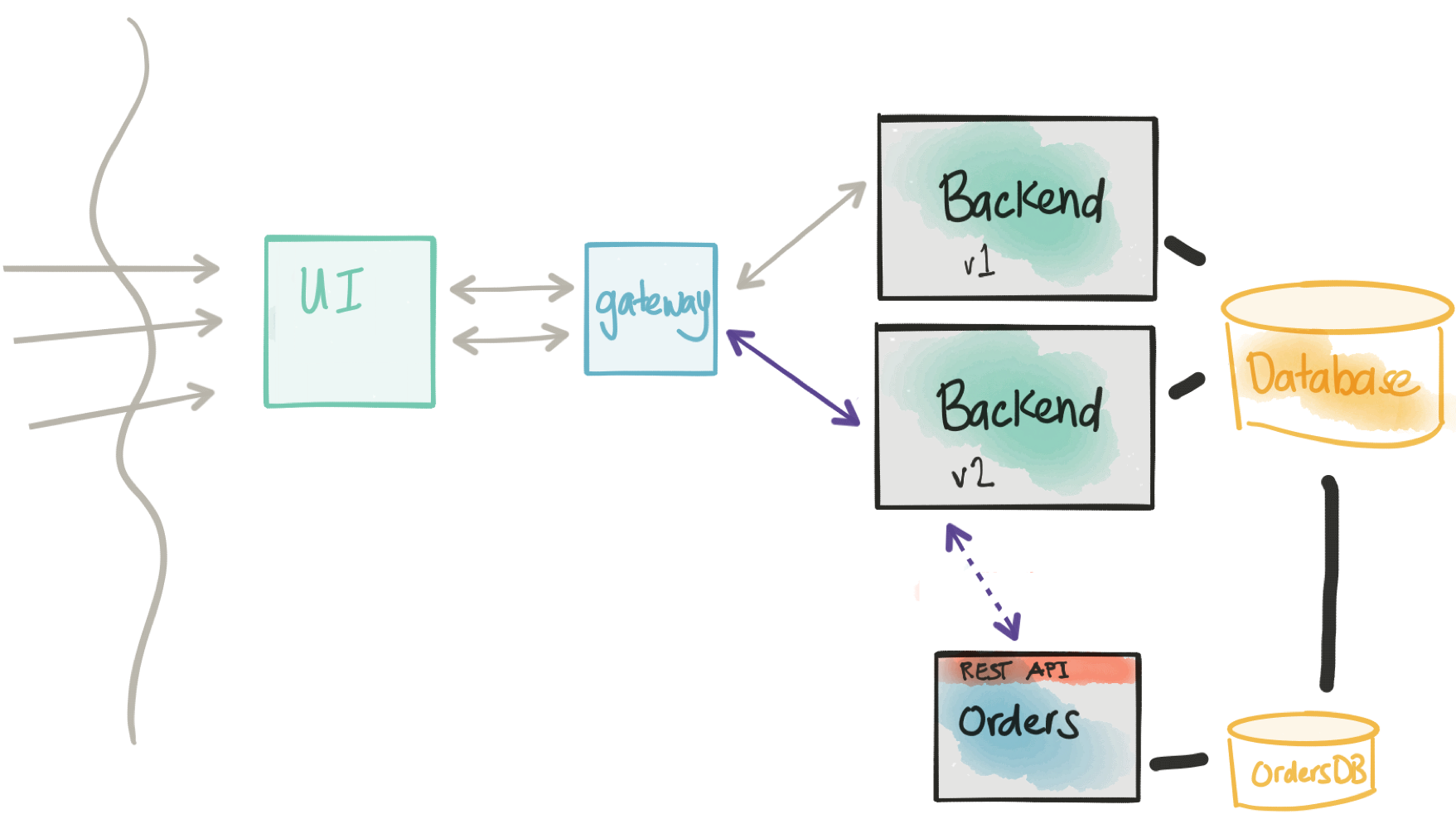
    The last thing to note here is when we make our change to the monolith/backend, we again want to use a dark launch/canary/rolling release approach. We will need our infrastructure to support this. We will look closer at this in the second part.

    At this point, we’re forcing the traffic back through the monolith. We’re trying not to perturb the main call flow as much as possible so we can quickly roll back in the event a canary doesn’t go well. On the other hand, it may be useful to deploy a gateway/control component that can more finely control the call to the new service instead of forcing to the monolith. In this case, the gateway would have the control logic whether to send the transaction to the monolith, to the new service or both.

    Considerations

    • Introducing the new Orders service into the code path introduces risk.
    • We need to send traffic to the new service in a controlled manner.
    • We want to be able to direct traffic to the new service as well as the old code path.
    • We need to instrument and monitor the impact of the new service.
    • We need ways to flag transactions as “synthetic” so we don’t end up in nasty business consistency problems.
    • We wish to deploy this new functionality to certain cohorts/groups/users.

    Canary/Rolling Release to new service

    If we find the previous step does not introduce negative impacts to our transaction path and we have high confidence through our testing and initial experimentation in production with shadowing the traffic, we can configure the monolith to actually send traffic over to the new service. In this case, we need to be able to specify certain cohorts/groups/users to always go to the new service and we’re slowly draining the real production traffic that goes through the old code path. We can increase the rolling release of our Backend service until all of our users are on the new Orders microservice.

    One point of risk we need to make concrete: Once we start rolling live traffic (non-shadow/synthetic traffic) over to the new service, we’re expecting users that match the cohort group to go to this new service always. We’re not able to switch back and forth between old and new code paths. In this case, if we do need to rollback, this will involve more coordination to move any new transactions from the new service back to a state that the old monolith could use. Hopefully this doesn’t happen, but is something to note and plan for (and test!).

    Considerations

    • We can identify cohort groups and send live transaction traffic to our new microservice.
    • We still need the direct database connection to the monolith because there will be a period of time where transactions will still be going to both code paths.
    • Once we’ve moved all traffic over to our microservice, we should be in position to retire the old functionality.
    • Note that once we’re sending live traffic over to the new service, we have to consider the fact a rollback to the old code path will involve some difficulty and coordination.

    Offline data ETL/migration

    At this point, we should have our Orders microservice taking live production traffic. The Monolith or Backend is still around handling other concerns, but we have successfully migrated service functionality out of the monolith. Our immediate pressing concern now is to pay off the technical debt we’ve borrowed when we created a direct database connection between our new microservice and the Backend service. Most likely this would involve some kind of one-time ETL from the monolith database to the new service. The monolith may be required to still keep that data around in a read-only mode (think: regulatory compliance, etc.). If this is shared reference data (ie, read only) this should be okay. We must make sure that the data in the monolith and the data in the new microservice is not some shared/mutable data. If the data is shared/mutable, then we can end up in divergent data/data ownership problems.

    Considerations

    • Our new Orders microservice is now in the last throes of becoming fully autonomous.
    • We need to pay down the technical debt we borrowed when we connected the Orders service database to the Backend
    • We will have a one-time ETL for the data that should reside in the Orders
    • We need to be mindful of divergent data problems.

    Disconnect/decouple the datastores

    Once we’ve completed the previous step, we should have our new Orders microservice-independent and ready to participate in a services architecture. The steps presented here all have their own considerations, pros and cons. We should aim to satisfy all of the steps and not leave technical debt to accrue interest. Of course, there will be variations on this pattern, but the approach is sound.

    In the next blog post, I’ll show how to do these steps with the example service I’ve referred to previously and dig deeper into some of the tools, frameworks and infrastructure that helps assist. We’ll look at things such as Kubernetes, Istio, feature-flag frameworks, data-view tools, and test frameworks.

    Part 2 will follow in December

    Follow along (@christianposta) on twitter or http://blog.christianposta.com for the latest updates and discussion.

    — Christian Posta

  • IBM Brings Cloud-native Environment to Private Clouds

    New IBM Cloud Private software – based on containers, microservices and APIs –bridges Public Cloud and traditional IT environments

    ARMONK, N.Y. – 01 Nov 2017: IBM (NYSE: IBM) today announced a new IBM Cloud Private software platform to help companies unlock billions of dollars in technology investment in core data and applications and extend cloud-native tools across public and private clouds.

    IBM Cloud Private software is designed to enable companies to create on-premises cloud capabilities similar to public clouds to accelerate app development. The new platform is built on the open source Kubernetes-based container architecture and supports both Docker containers and Cloud Foundry. This facilitates integration and portability of workloads as they evolve to any cloud environment, including the public IBM Cloud.IBM also announced new container-optimized versions of core enterprise software, such as IBM WebSphere Liberty, Db2 and MQ – widely used to run and help secure the world’s most business-critical applications and data. This makes it easier to share data and evolve applications as needed across IBM Cloud private and public clouds and other cloud environments with a consistent experience.

    An airline, for example, could use IBM Cloud Private to bring a core application that tracks frequent flyer miles into a private cloud environment and connect it to a new mobile app in the public cloud. A financial services firm could use it to keep customer data in-house as it works to meet its security and regulatory requirements while taking advantage of new analytic tools and machine learning in the public cloud to quickly identify investment trends and opportunities.

    Enterprises to Spend More Than $50 Billion a Year on Private Clouds

    While public cloud adoption continues to grow at a rapid pace, organizations, especially in regulated industries such as finance and health care, are continuing to leverage private clouds as part of their journey to public cloud environments to quickly launch and update applications. IBM estimates companies will spend more than $50 billion globally starting in 2017 to create and evolve private clouds with growth rates of 15 to 20 percent a year through 2020, according to IBM market projections.

    “Innovation and adoption of public cloud services has been constrained by the challenge of transitioning complex enterprise systems and applications into a true cloud-native environment,” said Arvind Krishna, Senior Vice President for IBM Hybrid Cloud and Director of IBM Research. “IBM Cloud Private brings rapid application development and modernization to existing IT infrastructure and positions it to be combined with the services and experience of a public cloud platform.”

    Hertz, Ilmarinen Transforming IT with Private Cloud

    The Hertz Corporation, one of the top car rental companies in the world, believes both public and private cloud is critical to achieving its technology objectives.

    “Private cloud is a must for many enterprises such as ours working to reduce or eliminate their dependence on internal data centers,” said Tyler Best, Hertz Chief Information Officer. “A strategy consisting of public, private and hybrid cloud are essential for large enterprises to effectively make the transition from legacy systems to cloud. Hertz is an early adopter of both public and private IBM cloud and we could not accomplish our technology goals without private cloud as part of our overall cloud portfolio.”

    Ilmarinen, a Finland firm responsible for the pensions covering approximately 900,000 Finns, has started a pilot project with IBM Cloud Private and plans to be in production in early 2018.  “Ilmarinen is excited about the capabilities in IBM Cloud Private as a flexible, compliant cloud-native platform that it can deploy and manage behind our firewall for creating new applications and modernizing traditional workloads,” said Jani Itkonen, Production Manager, Ilmarinen.

    IBM Cloud Private Provides Flexible Platform with Support for Enterprise Developers

    Innovations used in IBM Cloud Private are designed to simplify cloud management, accelerate app develop and maintain security across cloud environments. Key features include:

    • Cloud Management Automation – Streamlined management across cloud environments to help launch, monitor and manage services and help ensure consistent security protocols.
    • Security & Data Encryption – Security Vulnerability Advisor to scan containers across the cloud to surface potentially serious issues and weaknesses; Ability to encrypt all data in flight and provide for strict access control by users within a cluster.
    • Core Cloud Platform – Includes a container engine, Kubernetes orchestration, Cloud Foundry and essential management tools surrounding developer runtimes, which are fully integrated and automated.
    • Infrastructure Choice – Compatible with systems from leading manufacturers including Cisco, Dell EMC, Intel, Lenovo and NetApp, as well as IBM Systems, including IBM Power Systems, IBM Z and IBM Hyperconverged Systems powered by Nutanix software.
    • Data and Analytics – Integrations with database services, such as IBM Db2, PostgreSQL and MongoDB, to leverage data and gain business insights.
    • Application Support & DevOps Tools – Containerized versions of software and development frameworks, including IBM WebSphere Liberty, Open Liberty, MQ and Microservice Builder, as part of software bundles; Optimized management and DevOps tools, including APM, Netcool and UrbanCode, which can be added for a separate fee.

    IBM also offers cloud deployment, management, brokerage and storage services to help clients manage multiple clouds and can help clients with migration of applications to IBM Cloud Private. More details on Cloud Private can be found in the product overview.

    IBM Cloud Private Reinforces IBM Commitment to Open Source

    IBM Cloud Private is another significant step in IBM’s support for organizations to create, deploy and manage apps in the cloud environment of their choice. IBM and Google recently announced an effort to create and open source the Grafeas project to help developers with security of containers. Last month, IBM released Open Liberty, a new lightweight, open-source version of its WebSphere Liberty Java application server, to make it easier for developers to get apps up and running in any cloud environment.

    IBM also is a founding member of the Cloud Native Computing Foundation, which hosts Kubernetes and Cloud Private is in compliance with its interoperability conformance tests. To get started with IBM Developer Journeys as they relate to Kubernetes, please visit: https://developer.ibm.com/code/journey/

    For more about IBM Cloud Private, visit here.

    For more about IBM Cloud, visit here.

    Contact(s) information

    Joe Guy Collier
    IBM Media Relations
    1 (248) 990-4707
    jgcollie@us.ibm.com

  • The Need for Speed Demands New-Era APM

    The Need for Speed Demands New-Era APM

    Applications have become the primary conduit by which customers experience a brand, making the application experience critical to business success. As such, continuous delivery and highly available systems that deliver optimal end user experiences at lightning speed have become top priorities for organizations. Modern IT is all about speed, efficiency and customer experience. Simply put, companies that develop new applications and services the fastest will win.

    That’s where containers and microservices come in. Containerized microservice applications enable organizations of all sizes to approach the ultimate goal of continuous integration and continuous delivery. This accelerates everything within the application life cycle, from initial development to component updates and new functionality.

    To match the development speed that microservices and containers enable, Ops teams need tools that can also operate hyper-fast, providing an immediate understanding of the impact of changes made, real-time analysis of vast amounts of data across applications and technologies, visibility across a range of languages and infrastructures, and knowledge of how the application is performing for end users.

    In fact, we are at a critical inflection point in application performance management (APM), where a generational shift is needed to keep pace with the new hyper-dynamic application architectures consisting of microservices, containers and hybrid cloud environments. To fully understand the impact of this shift, we can examine the genealogy of APM.

    APM Evolution

    The first generation of APM, established at the end of the last century, collected statistics and metrics out of system and application components, providing a first generation of user-defined transaction profiling by using instrumentation technology. APM 1.0 required a lot of effort to implement and maintain, but helped to monitor and analyze the performance of newly developed 3-tier applications.

    The second generation of APM was driven by more distributed, service-oriented architectures (SOA) and the rise of more elastic, virtualized or cloud-based infrastructure. APM 2.0 added application topology discovery and could analyze distributed applications. User experience monitoring of web and mobile apps quickly became part of APM 2.0 as more businesses depended on the service quality of their applications. With a primary focus on application monitoring, not management, APM 2.0 required an even broader set of subject matter experts to configure and interpret monitoring data from dashboards and reports. Similar to APM 1.0, the second generation still required way too much human analysis and setup to fully understand application problems and derive actions.

    The continuous change in today’s modern dynamic applications makes it difficult, if not impossible, for those older tools to keep up. Throw in additional architectural challenges such as hybrid clouds, containers and orchestration (such as Kubernetes and Mesosphere) and the picture gets murkier, all in the name of high-speed delivery. Meanwhile, the microservice architecture and development strategy spawns wide technology diversity—each engineer can choose the programing language, middleware and databases best suited to code their individual microservice. Scale, complexity and constant change is the new reality for today’s dynamic applications.

    Wanted: A New Breed of APM

    In this environment, traditional IT monitoring tools won’t work. These new applications use a vastly larger set of technologies, must scale dynamically and are in a constant state of flux.

    In this effort to engineer for speed and efficiency, complexity and scalability have increased exponentially, requiring continuous monitoring and more visibility than ever before. As organizations embrace agile methodologies for development and containerized microservices for deployment, developers have shifted their thinking in technology choices. Developers now continually select the most optimal technology for their individual goals regardless of DevOps’s ability to configure, deploy and manage the specific technology.

    With several teams across the enterprise constantly publishing new software releases, understanding the impact of these new releases and changes to the overall environment has become a significant challenge. Today there is no single source of truth assisting communication between various organizations, resulting in what seems a wild west–like environment for IT. With so many groups and technologies in play, everybody seems to be speaking a different language, especially when it comes to delivering high-quality applications. In this environment, a new breed of APM  is needed that can provide a “Truth Machine”—complete with deep visibility across all application components in the technology stack.

    This new breed of APM must be automatic and dynamic to deal with the ever-changing world of applications running in containerized microservices. To deliver these critical capabilities, the tool must provide real-time visibility into dynamic, containerized, microservice applications, regardless of language or infrastructure. New thinking is required to meet the challenges of these complex, large and dynamic application environments; a new monitoring and management approach that can handle dynamism by:

    • Delivering real-time analysis of vast amounts of data across all applications and technologies.
    • Conducting continuous discovery and automatically mapping every component, host and container, (hosted on-prem, private cloud, public cloud), to the exact architecture of complete technology stack.
    • Visualizing the application architecture and delivering actionable suggestions that assure the operational health of systems and applications.
    • Providing real-time accuracy to visualize, structure and identify problems immediately.
    • Monitoring the complete set of diverse technologies that run in microservice environments.
    • Operating in a heterogeneous environment and automating deployment across nearly all programming languages.

    Artificial Intelligence for Next-Generation APM

    DevOps and IT organizations are struggling to match the speed of agile development, and this is creating exponentially more challenges around new application architectures. The only constant in these modern application environments is change. Whether change is due to microservice architectures, container orchestration or simply more agile delivery execution to effectively manage microservice applications, DevOps needs up-to-date visibility, a precise picture of the application’s structure and an immediate understanding of its health. To accomplish that, DevOps must be able to apply artificial intelligence to the act of monitoring modern dynamic applications.

    Rather than spending time configuring and reconfiguring monitoring tools, organizations must automate management steps with as little human setup and configuration as possible. To have complete control and visibility of their environments, regardless of language and infrastructure, organizations must use a modern application management solution that is automatic and AI-powered to deal with the ever-changing world of dynamic containerized microservice applications.

    About the Author / Pete Abrams

    Pete Abrams is a co-founder and the chief operating officer at Instana, the leader in application performance management for containerized microservices applications. Formerly vice president of customer centric innovation at AppDynamics, Pete has spent more than two decades in the technology industry focused on introducing new products to market and ensuring customer feedback and desired capabilities are incorporated into future product innovation. Connect with him on LinkedIn.


  • SOA vs Microservices

    SOA vs Microservices

    Some say microservices architecture is proof that SOA is still alive. I contend that microservices architecture replaces SOA due to deficiencies in how SOA has been implemented as well as the original intent.

    In the mid-1990s there was a surge of investment for implementing enterprise applications to replace the aging homegrown legacy applications. These new applications managed complex activities around accounting, supply chain, human resource and manufacturing. They also were easy to integrate with other facets of the business, including existing legacy applications that were not going away and new and emerging web applications for customer and internal use.

    Out of necessity, there was a rise in the number of point-to-point integrations occurring. Over time, the web of point-to-point integrations became so complex to manage that even small changes resulted in major failures. To correct this problem, a category of software emerged to make integration easier by simplifying the control plane that focused on cataloging the endpoints, fostering connections and marshalling the data. These control planes were identified as enterprise application integration (EAI). Early EAI products did not inspect or act on the data.

    Somewhere along the line, vendors became aware that there was another underlying issue: The old system and the new system used different vocabularies and message structures. Initially, the consumer of the EAI tool output did the translation itself, but then vendors saw an opportunity to increase the capabilities of the EAI tooling to also become a data plane. So, then, the EAI tooling would also handle mapping and translation.

    Now, if your source systems never change, the value of an intelligent middleware that acted as a control and data plane seems both logical and of great value. However, when the source systems change, middleware comprised of dynamic routing and mappings from the source to the target becomes a considerable limitation. Any change to the source requires comprehensive regression testing on the entire system, and you must hope you have an example of every permutation of every message that may ever be delivered as input to ensure the change does not introduce future problems.

    Having been an integration consultant during this era, I can attest to weekly failures due to message combinations that no one had ever conceived of during testing.

    So, what does any of this have to do with SOA and microservices?

    The above approach I just described evolved with the products that acted as a control and data plane morphing into the enterprise service bus (ESB). The ESB became the cornerstone of the SOA strategy and together they formed the strategy for modernizing legacy systems. Hence, SOA, as it was ultimately delivered, ended up being an expensive mapping exercise from legacy data structures and messages to a newly appointed business language, also called the canonical representation. In some cases, these new SOA services would derive these new business data structures by querying and massaging data from multiple legacy systems, while in other cases, new business logic would be made available via the bus expanding the ecosystem of available capabilities.

    With SOA, the canonical message became the product of innovation and, hence, ultimately its downfall. Perhaps unfairly so, but, SOA never fostered continued modernization of the legacy systems into re-platformed and redeveloped services. It was about exposing the systems of record, both data and process, for inclusion into business processes, facilitating minimal changes to the legacy systems all handled through intelligent pipes.

    While digital transformation may be a popular concept that every business is now chasing, SOA’s failure demonstrates that simply exposing the existing systems was not enough to become the agile business we strive to be. Indeed, the systems of record that are brittle, burdened with technical debt and developed in a monolithic fashion were already impairing businesses’ ability to compete long before Uber and Airbnb came into existence. The appearance of these businesses just increased the urgency to address the legacy issue.

    Enter microservices architectures. First, I’ll reiterate my favorite soapbox topic: Putting a legacy app inside a Docker container does not in and of itself define a microservice. A microservice follows specific tenets of design. One of these tenets—and one that is very relevant to this discussion—is smart endpoints and dumb pipes. I find this design principle very interesting, considering what I’ve stated above about SOA. For me, it’s clearly a rebellion against SOA strategies.

    Also, I believe microservices approaches legacy modernization from a slightly different perspective. Microservices architectures by nature focus less on tooling (they’re polyglots by design) and more on the contextual bindings to business domains. Additionally, as someone eloquently stated on Twitter (which I cannot find now and so will paraphrase here), a microservice should be designed to be easily deleted without impacting the operations of the system. I believe the statement illustrates that a well-designed microservice isn’t intertwined with other services nor does it share intimacy of design.

    Some will debate—present company included—that this is what SOA was supposed to deliver. Unfortunately, this was not how it got implemented. So, this time we reduce the scope. Instead of a SOA service that represents the entire business domain, we deliver smaller, more well-focused entities representing subsets of the business domain. Subsequently, these services are designed to operate more independently, allowing them to better align with greater use of agile techniques.

    In microservices, architecture agility is the product of innovation. Ultimately, the improvements in speed, cost and quality are why microservices will succeed where SOA has failed.

    — JP Morgenthal

  • CA Technologies Acquires Runscope for API Monitoring

    CA Technologies Acquires Runscope for API Monitoring

    There’s a pressing need for a variety of monitoring tools more than ever. But given the proliferation of application programming interfaces (APIs) inside the enterprise, demand for API monitoring tools in particular is rapidly expanding. To address that requirement, CA Technologies has acquired Runscope, a provider of an API monitoring service delivered as a software-as-a-service (SaaS) application.

    Ali Siddiqui, general manager for agile operations at CA Technologies, says Runscope will complement CA Blazemeter continuous testing tools the company acquired last year and the CA API Management platform based on the technology CA Technologies gained when it acquired Layer 7 Technologies in 2013.

    While the API Economy has been a phenomenon for external-facing web and mobile applications for years now, Siddiqui notes that IT organizations have only begun to rely on APIs to ingrate internal applications in recent years. The number of private internal APIs that have been published already dwarf the number of external public APIs. Because those internal APIs have now reached a critical mass, Siddiqui says the time is now right for CA Technologies to add an API monitoring service to portfolio of DevOps tools.

    He notes that the rise of microservices inside enterprise IT organizations also will exacerbate existing API monitoring and management challenges. Each microservice generates its own API, which needs to be maintained and monitored. Before too long IT organizations will find themselves trying to unravel the interdependencies of thousands of microservices that all expose an API that can be developed in any number of programming languages.

    These days it’s not uncommon to see dedicated management teams focusing on specific APIs. Rather than treating the API as an afterthought, many IT organizations have come to realize it’s the quality and robustness of the API that ultimately determines the quality of the application experience. In fact, most service level agreements (SLAs) going forward will require access to data being generated by APIs to make sure the terms of any agreement are being met. As such, it’s starting to make sense in some organizations to organize DevOps teams around critical APIs, rather than specific elements of application logic that, in the age of the containers, will soon be more frequently updated.

    There’s no shortage of API monitoring tools these days, and Siggiqui says CA Technologies is committed to making sure the Runscope service remains open in terms of integration with other API management and testing tools. However, eventually there will be incentives provided to organizations that choose to standardize on multiple DevOps tools from CA Technologies.

    Despite the proliferation of monitoring tools, the percentage of application workloads that are instrumented remains relatively small. The reason for this is that the cost of monitoring every enterprise application has often proven prohibitive. The issue that enterprise IT organizations will have to confront as dependencies between microservices increase will be figuring out how to implement instrumentation across all those services in a way that doesn’t wind up breaking the budget.

    — Mike Vizard

  • Continuous Deployment and Monitoring of Microservices

    Continuous Deployment and Monitoring of Microservices

    Continuous deployment and continuous monitoring have grown up in DevOps, and microservices have grown up as a delivery platform. While all are relatively stable concepts at this point, there are still a fair number of practitioners that are struggling with the merging of these concepts to create a holistic environment that allows for deep understanding and easy deployments.

    So I thought we could take a look at what’s out there, how it’s going, and even mention a resource or two for you.

    Continuous Deployment

    While continuous delivery (CD) and continuous integration (CI) are well in hand, continuous deployment has lagged a bit behind. There are reasons—both good and bad—why this is true, but true it is. Continuous deployment is the act of actually deploying the results of the CI/CD cycle. The whole point of continuous deployment is to speed the release of new features to market by releasing them as soon as they pass the CI/CD muster, or soon after, or for some industries, on demand. Continuous delivery is a little different from CI/CD in that the rest of the organization—sales, support, marketing, accounting, etc.—have to be ready for the release, so in the slowest case, the point is that IT is not the hold-up to releasing new features under the continuous deployment model.

    Microservices

    Simply put, microservices are decomposition of an application into smaller parts that can be run independently. There are a lot of different ideas for what “smaller parts” means, with some shops breaking their application down to the functional level similar to serverless functions, so an API named calculateSalesTax would do that and only that, given location and dollar information, while others prefer a more broad definition that includes entire groupings of APIs. In this scenario, one company split all database work into a single microservice that was scalable. Either way, you will have more instances (normally containers, but sometimes VMs or even physical servers) running to build the application than historically would be the case.

    Why Containers

    As mentioned above, normally a microservices architecture is built on containers. The portability of a container definition is one of the major reasons why companies lean this direction. The ability to say, “This container can run on our hardware, on our private cloud, on a public cloud, in a public cloud VPC or on a VM,” is a way to ensure that you can target the system to the environment most suited to the organization’s needs.

    Containers are also far lighter than VMs, meaning faster spin-up times, and an easier time expanding the microservices architecture to meet changing user needs.

    Container Management

    Speaking of containers, container management systems are used to make certain that containers are alive and responding. In advanced cases, they can be made to check that a container is doing what it is supposed to do also. While I am a fan of Apache Mesos, the world seems to have gone for Kubernetes, so we’ll focus on it, without further reference to the others out there.

    On top of making certain the correct number of a given container are running, and taking steps to spin up new ones if one disappears, Kubernetes does things such as manage secrets for containers, perform load balancing between instances in a group (these groups are generally called a service in container management speak), scaling up/down of instances as directed, and provide rolling updates to services so the service is not down while being updated.

    This makes a container management tool an important part of any continuous delivery and continuous monitoring effort.

    Taken together

    That gives us tools including Jenkins for CI and CD, and often for release management, though other tools specialize in the release portion, too. Combine Jenkins with an infrastructure-as-code solution such as Teraform or any of the others we’ve discussed in the past. Add in a tool such as Prometheus for gathering monitoring data, and a tool such as Grafana for visualizing the data, and you’re on the road to continuous delivery and continuous monitoring.

    Of course, it isn’t that simple, I’m overviewing here. While researching this blog, the people at Infostretch shared some information with me, and they too would see this as the 50,000-foot view. But that’s where we start. For a more complete picture, here is a simple diagram of continuous deployment that Infostretch shared with me:

    And as long as we’re discussing the information that Infostretch shared with me, let’s also look at a sample of what the company monitors. You’ll see it isn’t “everything under the sun,” but focused points that give them actionable intelligence. A few application-specific monitoring points from within the application, and this turns into an application performance gold mine.

    Classification Metrics
    Cluster Metrics Overall Cluster Memory Utilization
    Overall Cluster CPU Utilization
    Overall Cluster FS Utilization
    Multi-series graph for individual service CPU Utilization
    Multi-series graph for individual service Memory Utilization
    Multi-series graph for individual service FS Utilization
    Application Metrics


    Service Request rate
    Service Error rate
    Service latency

    There is so much more

    There really simply isn’t enough room in a single blog to cover all that is required and possible in continuous delivery and continuous monitoring. I’ll continue to try continuous blogging to help you out, and the other authors here on devopsy.kinsta.cloud have good things to share on the topics also.

    — Don Macvittie

  • DevOps Predictions for the Future

    DevOps Predictions for the Future

     Among the few powerful trends we had experienced in the recent times, one is undoubtedly the adoption of DevOps practices. As we are move closer to 2018, it is becoming more obvious that DevOps is becoming mainstream, with many large organizations getting on board with DevOps.

    DevOps Within Enterprises

    DevOps is becoming the standard way of working for businesses. Adoption of DevOps within the organization is rising on a broader scale, and businesses are trending toward it.

    Enterprises of today are well-aware of the trending technology services in modernizing environments. DevOps is growing its recognition due to changes in complexities of today’s software that lies more in the diverse set of operation systems and platforms. It is less about doing things a particular way and more about moving the business forward and turning technology into a strategic advantage.

    DevOps builds upon best practices to help drive enterprise performance in the modern digital economy. It offers organizations a new way to deliver value to their customers quickly. An increasing number of businesses are recognizing the power that DevOps can bring for operational efficiency and overall performance.

    DevOps Key Trends

    As businesses are trending toward DevOps adoption, let’s look at the changing landscape and key trends in DevOps, along with its trajectory.

    Some of the DevOps trends include:

    • Many organizations will challenge agile and recognize DevOps as the new ALM methodology.
    • Many DevOps automation tools are going to roll up.
    • Automation and testing would gain their prominence.
    • DevOps Engineers are highest paid IT practitioners today.
    • Testing and deployment are done more frequently as Ops people are getting their DevOps knowledge in production for testing and automation operations.

    DevOps Predictions

    Based on the market so far, here are my predictions for the future of DevOps.

    Adoption of Microservices and Containers

    Several software enterprises are pushing toward microservices infrastructure. Microservices architect an enterprise solution, independently, over a set of services.

    Microservices are best-suited for DevOps due to its features including:

    • Isolated nature
    • Improvised cycle times
    • Well-defined interfaces
    • Aligned architecture

    Containerization also is growing in popularity. Containers are designed to run one process at a time with minimal deployment, serving as an ideal deployment model. According to one study, 50 percent of enterprises are expected to run containers in production by the end of 2018.

    If an enterprise has decided to leverage microservices and containers, it is highly essential to incorporate solutions that support microservices and containers along with traditional application model.

    Culture, the Top Prerequisite

    Culture is the key differentiator for DevOps. Culture and process are the principal paths for the successful DevOps journey. Culture breaks down the organizational silos and encourages integration across all the groups that need to work together to achieve a great business outcome. Implementing DevOps culture makes an organization achieve success easier. It even enables continuous learning environment that will see bigger benefits.

    Notion of Shifting Left

    DevOps tools and solutions always prefer to shift left. DevOps orchestration tools automate from end to end, making traceability easier. Activities that are performed traditionally, at the later stages of development and release process, are making a shift to the left of the pipeline. The ultimate goal of it is to recognize issues earlier, along with performance and disaster recovery testing.

    Downtime   

    Adopting DevOps holds a lot of benefits. For one, it enables enterprises to ensure uptime and enhance cadence and quality. High-performing IT organizations employing DevOps practices deploy 200 times more frequently than the low-performing enterprises. Similarly, they also enjoy faster recovery from failure and minimize downtime.

    Collaboration of Big Data and DevOps

    Big Data and DevOps are together taking a step forward toward the design of predictive analytics. DevOps has now become an expert in automating the process and automating configuration.

    Consolidation is Critical

    Large and complex organizations are focusing on consolidation and standardization of DevOps processes so as to scale DevOps within the enterprise. A shared and self-service DevOps automation enables end-to-end pipelines. Eventually, consolidation allows reusability, visibility, auditability and security.

    Supporting Hybrid

    “Hybrid-everything” makes DevOps solutions future-ready to support any tool, application and process in the hyper-hybrid state. “Hybrid” state of existence is achieved for infrastructure, architecture, release pipelines and more. 

    DevOps Monitoring                       

    Until now, the focus has been on pre-production provisioning. However, more attention is being given to the post-deploy feedback loop. With the application of new architectures including microservices, new monitoring technologies and pricing models are effectively introduced.

    Expansion of DevOps Across IT

    DevOps is maturing in other areas such as database management, security and testing, all with the goal of application release.

    Business-centric Agile

    The development methodology approach is becoming more critical to the continuous integration and continuous delivery process.

    DevOps Skills 

    People with DevOps skills are in demand in the industry and expected to proliferate as businesses are witnessing great results from DevOps. Organizations incorporating DevOps training practices are extremely high-functioning. If you aim to build your career in DevOps, below are certain notable skills.

    Most common DevOps positions include:

    • Site reliability engineer
    • DevOps engineer

    The core skills of DevOps are:

    • Coding skills
    • Knowledge of automation tools
    • Communication skills

    Roles of a DevOps Engineer

    Many DevOps developers find interest in deployment and network operations. A core set of DevOps skills includes:

    • Ability to code and script using various technologies and tools.
    • Close relation with Systems and IT operations.
    • Strong base of automation tools and its skills.
    • Incremental code testing and deployment.
    • Strong focus on data management skills and business outcomes.

    Final Words…

    DevOps skills will only continue to grow and DevOps is here to stay. Dev and Ops teams are increasingly moving to rapid development and reliable, high-performance services delivery.

    DevOps is being adopted by more and more companies, particularly smaller enterprises. Many industries today are keen on incorporating DevOps and its key points into their respective departments. It will continue to evolve for the foreseeable future, by incorporating executives and other business units into it. Companies that utilize DevOps effectively will experience higher innovation and quality and easier adoption to other changing conditions.

    Adoption of DevOps enables applications and technology solutions. It power businesses with faster and better quality. Investing in DevOps helps organizations better develop and release software.

    About the Author / Sirisha Paladhi

    Sirisha Paladhi is a content writer at TekSlate. During her career, she has written many articles on technology innovations.


    LinkedIn URL: https://www.linkedin.com/in/paladhi-sirisha-74987881/