Tag: microservices

  • How Service Mesh Addresses 3 Key Microservices Challenges

    How Service Mesh Addresses 3 Key Microservices Challenges

    I was recently reading the “Global Microservices Trends” report by Dimensional Research and found myself thinking, “A service mesh could help with that.” Let’s look at three key challenges listed in the report.

    A couple key points in the report make it clear microservices are seeing widespread adoption. It’s also clear that along with the myriad benefits they bring, there are also tough challenges that come as part of the package. From the report:

    • 91 percent of enterprises are using microservices or have plans to.
    • 99 percent of users report challenges with using microservices.

    Major Microservices Challenges

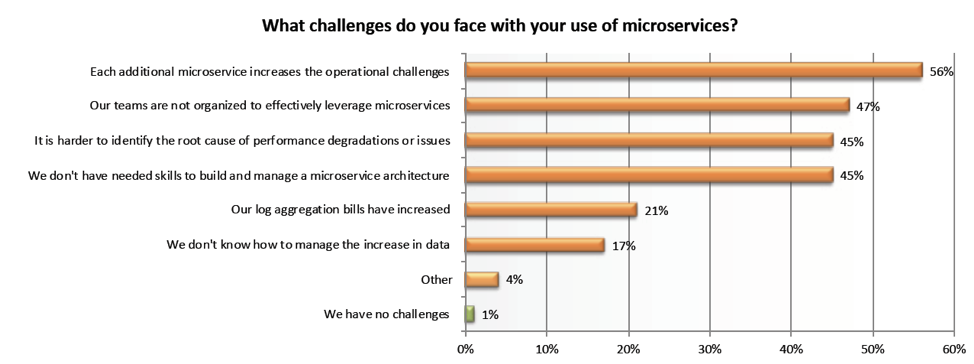
    The report identifies a range of challenges companies are facing.

    Companies are seeing a mix of technology and organizational challenges. We’ll focus on the technological challenges a service mesh solves, but it’s worth noting that one thing a service mesh does is bring uniformity so it’s possible to for all teams to have the same view, reducing the need for certain skills.

    Each Additional Microservice Increases the Operational Challenges

    Not with a service mesh! A service mesh provides monitoring, scalability and high availability through APIs instead of using discrete appliances. This flexible framework removes the operational complexity associated with modern applications. Infrastructure services were traditionally implemented as discrete appliances, which meant going to the actual appliance to get the service. Each appliance is unique, which makes monitoring, scaling and providing high availability difficult. A service mesh delivers these services inside the compute cluster itself through APIs and doesn’t require any additional appliances. Implementing a service mesh means adding new microservices without adding complexity.

    It is More Difficult to Identify the Root Cause of Performance Issues

    The service mesh toolbox gives you a couple of things that help solve this problem:

    Distributed Tracing: Tracing provides service dependency analysis for different microservices and tracking for requests as they are traced through multiple microservices. It’s also a powerful way to identify performance bottlenecks and zoom into a particular request to identify which microservice contributed to the latency of a request or which service created an error.

    Metrics Collection: With service mesh you also get the ability to collect consistent metrics across your mesh. Metrics are key to understanding what has happened in your applications, and when they were healthy compared to when they were not. A service mesh can gather telemetry data from across the mesh and produce consistent metrics for every hop. This makes it easier to quickly solve problems and build more resilient applications.


    Differing Development Languages and Frameworks

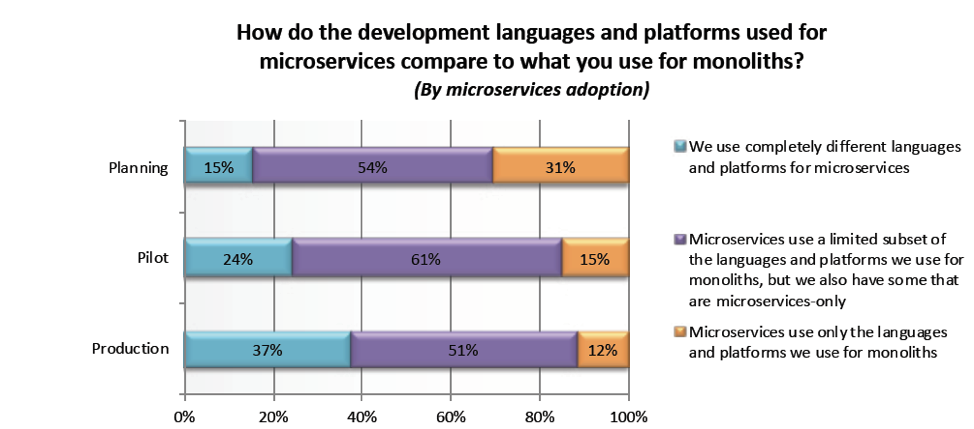
    Another major challenge that report respondents noted facing was the challenge of maintaining a distributed architecture in a polyglot world. When making the move from monolith to microservices, many companies struggle with the reality that, to make things work, they have to use different languages and tools. Large enterprises can be especially affected by this, as they have many large, distributed teams. Service mesh provides uniformity by providing programming language agnosticism, which addresses inconsistencies in a polyglot world where different teams, each with its own microservice, are likely to be using different programming languages and frameworks. A mesh also provides a uniform, applicationwide point for introducing visibility and control into the application runtime, moving service communication out of the realm of implied infrastructure, to where it can be easily seen, monitored, managed and controlled.

    Microservices are cool, but service mesh makes them ice cold. If you’re on the microservices journey and are finding it difficult to manage the infrastructure challenges, a service mesh may be the right answer. Let me know if you have any questions on how to get the most out of service mesh, I’m happy to talk and you can find me @zjory.

    — Zach Jory

  • Why Serverless Needs DevOps

    Why Serverless Needs DevOps

    EDITOR’S NOTE: This article was updated July 2, 2018

    Serverless, like Kubernetes and microservices, is a new technology. Yet, despite the amount of blog, forum and news-related posts published about serverless, it represents only a fraction of all IT deployments.

    Aside from the new factor, serverless shares few similarities with Kubernetes and microservices. Organizations turn to Kubernetes and microservices platforms to add more agility and, in many cases, computing power to their IT operations. Serverless deployments, meanwhile, are seen mainly as a way to save resources by relegating server management to third parties.

    Ultimately, cost savings is the main benefit. A successful migration largely hinges on DevOps, especially at the early adoption stage.

    “There are ways to use serverless while delivering a very rich customer experience,” said Sanjay Challa, senior product marketing manager at Datical. “It is about putting the pieces together in a very right way to do that.”

    More specifically, Challa said DevOps is relevant to serverless deployments because:

    • DevOps promotes collaboration between development and operations — a core mantra is “you build it, you run it,” Challa said. “Serverless deployments essentially embody this central tenant: it’s frankly difficult to separate development from operations because any edit to a serverless function needs to be in the context of its operation in the cloud (the cost of the resources the function will incur and the net user experience),” Challa said.
    • With serverless architecture, there is no longer a line between cloud operations engineers and developers. This is because “the roles are collapsed into one, thus embodying the fundamental core of DevOps, to collapse and harmonize the development and operations functions.” Challa said.

    For data and database management, Challa said it’s also important for teams not to forget about the underlying database and data architecture, when moving to the cloud and to new serverless architectures. “If teams only focus on the application code and forget about the database, they are setup to fail as changes to the data/persistence layer simply will not be able to keep up and scale with application changes,” Challa said. “This potentially leads to quality issues, outages or even data loss in the event of a hastily made or erroneous database change.”

    Serverless Not 

    The definition of serverless can vary, but among the many offerings available, it usually refers to functions-as-a-service (FaaS) and backend-as-a-service (BaaS) services. Despite its name, serverless has a lot to do with servers—but organizations delegate the management of those servers and the associated infrastructure to third-party cloud providers. In this way, organizations upload code or applications and the third party maintains and runs the servers. Amazon Web Services’ (AWS) Lambda, Google’s Cloud Functions, IBM’s OpenWhisk and Docker’s Serverless Docker are among the leading offerings.

    When an organization decides to migrate some or all of its data to a serverless platform, it’s important to note the technology’s drawbacks, especially as they relate to DevOps. Common downsides include slower computing performance and less capacity to run code compared to what is available when using servers on-premises or on the cloud. In the case of AWS Lambda, for example, the maximum total of concurrent executions per account is set to 1,000 by default per region and memory capacity for applications is limited to just over 3GB.

    Also, by shifting server management to a third party, organizations also are delegating those management functions, including many associated server-related security and monitoring capabilities.

    Ultimately, it will be up to the DevOps group to weigh the advantages versus the disadvantages when deciding whether to migrate to serverless platforms. While serverless technologies could potentially frustrate some developers because of the performance constraints on computing, memory, etc.; the key issue is to choose the right tool to solve the right problem, Challa said.

    “Each tool has its place,” Challa said. “Serverless is not a cure-all – but is just another tool for enterprises to consider.”

    Job Description

    Migrating to serverless also means job responsibilities will be affected, which will require DevOps to manage. “When you move to serverless, a lot of roles are disrupted. You need your network and infrastructure guys less than you did before, for example,” Challa said. “So, your team will look very different, since serverless teams in general looks very different compared to traditional IT operations.”

    It is also necessary to solve any existing DevOps challenges you have first before you make the switch to serverless, Challa said. “Otherwise, you are setting yourself up to fail,” Challa said. “Without transparency and strong coordination, moving to the cloud and to a serverless architecture will only slow things down—or, worse, lead to outages and quality issues.”

    However, once a serverless platform has been successfully set up and is running, DevOps’ workloads should decrease, since there will be less server maintenance work to do, said Holger Mueller, an analyst for Constellation Research.

    “With FaaS, DevOps is less relevant as deployments take place within the FaaS framework,” Mueller said. “There is no need for DevOps to write scripts or manually do anything. Normally, everything should just run itself.”

    However, Challa disagreed that serverless deployments completely run on their own once deployed. “Someone had to set up and configure a pipeline to enable developers to validate, build and ultimately deploy their serverless code. That someone must also play a DevOps function in enabling a path from a developer’s workstation to the cloud that supports the serverless capabilities—not to mention the work that needs to be done to connect the serverless application code running in the cloud to meaningful data,” he said.

    — B. Cameron Gain

  • Developer Trend Chat: Microservices, Node.js, Kubernetes

    Developer Trend Chat: Microservices, Node.js, Kubernetes

    The role of software developers has never been more important. Developers touch almost every corner of our lives, from health care and retail to education. It’s an extremely rewarding career—so much so that software development is now ranked the Best Job in the United States.

    The nature of software development demands that developers be fast-moving. New tools and technologies are providing developers the ability to adopt new skills, work faster and reshape how they work. In this Q&A, CEO of LunchBadger Al Tsang discusses trends in software development.

    Q: Data distribution is still a difficult and complex aspect of breaking down a monolithic architecture. How can enterprise architects avoid this or what is a good strategy for dealing with this snag when they will encounter it eventually?

    Al Tsang, CEO, LunchBadger

    Al: The data’s location, its dependencies and varying levels of data normalization, make breaking down monolithic architectures a challenge. Microservices initiatives can address these challenges by constructing a comprehensive data model. In the past, we had UML tools such as ERD diagrams. These tools are not as common anymore, however, the practice of what they represent still brings value in understanding what data your applications currently use, what’s obsolete, what’s redundant, and what’s related with dependencies.

    Microservices and the tie in to data should be atomic enough so that the data that it operates against is wholly owned and contained. This is easier said than done. There are often dividing lines that can be carved out that mirror the business functionality itself—whether that be by domain, by entity or by business process. In some cases, it’s a combination of all the above.

    Q: Why do you think serverless and FaaS (functions as a service) is growing at such a rapid rate and what specific pain points do serverless platforms (such as LunchBadger) address?

    Al: I believe serverless and FaaS is growing rapidly for a number of key reasons:

    (1) Infrastructure and application platform [are] becoming highly commoditized where a developer can pass the buck to have operational concerns placed on a third party.

    (2) The pressure and need to innovate requires an intense focus on working on your core IP as a differentiator while everything else in your code is a supporting role and oftentimes something that is completely boilerplate (e.g. think persistence to a database or NoSQL data source).

    (3) The movement and drive behind attaining microservices means getting down to bite-sized pieces of functionality means whittling down your logic do distinct reusable compartmentalized pieces of code—i.e., functions—and “serverless” fits this paradigm nicely by adding that you should only concern yourself with the piece of code on an event driven basis.

    (4) New and old companies alike have amassed a zoo of technological languages and platforms where skill sets and resources can be more efficiently utilized if you have a common runtime paradigm and can write your business functionality that supports polyglot usage.

    Q: According to a survey in 2017, Node.js was primarily used as back-end infrastructure for APIs. One of the main strengths of Node.js is that you can use the same language on the entire stack. How do you think Express.js and other minimal frameworks like it contribute to its popularity and why?

    Al: One reason Node.js has had rapid and wide adoption is because it is a massive equalizer. Node.js developers don’t need to have ninja-level domain expertise in high scalability, multi-concurrent connectivity, threads or similar complex topics just to be able to build a scalable app.

    Node.js takes advantage of a language that had the principles of high scalability built inside, namely evented asynchronous programming. Node.js also has an advantage as it’s the language that any web developer would have exposure to thanks to the ubiquity of browsers. Moving the same language and its strengths to the server was a huge win for folks to truly become “full stack.”

    Express.js has further contributed to Node.js’ success by adding the basics of web utility to Node.js. Every web application needs a web/app server that exposes URLs as routes. All servers have consumers making requests and processing those requests can often time be chained from one piece of logic to another. Express took the learnings from Ruby and Sinatra and brought them to Node.js.  You scaffolded a template project and filled in the blanks, as needed and where needed. It’s highly productive because the starting point for many web applications follow this same model.

    Express Gateway galvanizes the success of Express.js—its rich ecosystem of middleware modules and ubiquitous understanding among many developers and make its cloud ready and cloud native by separating out the configuration, metadata and conditionality to be declarative and dynamic. By doing this, Express Gateway runs in containers and orchestrators in a distributed way without worrying about being coupled at any given tier of the application.

    Q: Node.js and Kubernetes is a popular combination, but many developers and companies are confused on where to start or how it will affect their tech stack. Can you explain the top roadblocks you’re seeing and how companies can overcome them?

    Al: Roadblock #1: Where should you extend Kubernetes or where should you extend your Node.js application?

    I think this entangled mess is actually not as bad as it’s often perceived it to be. If it’s a core part of your application and you’ve written it in Node.js, then it should be completely independent of where and how you run it. Before the wide adoption of containers, many Node.js applications were being run in process managers. Many are still running in process managers within a container. In short, if it’s a core piece of your application logic, it should be in Node.js. If it concerns how and where you run the application logic, now you’re looking at configuration or extensions within Kubernetes.

    Roadblock #2: Should I use Node.js to orchestrate my application or leave that to Kubernetes and why?

    Orchestration means wiring up your application at the infrastructure level. Leave this piece to Kubernetes, which can expose and manage your microservices truly as “services.” When you’re writing Node.js applications, you shouldn’t have to worry about the “I/O” of how different Node.js processes interoperate. The whole premise behind microservices is that there are distinct lines drawn where processes must interoperate without assuming the other process may even be up and running.

    Roadblock #3: What if I have a component that has both infrastructure AND application concerns?

    This is a tough one where a lot of companies, large and small, are feeling pain. Kubernetes has a notion of an ingress controller, which is really nothing more than routing and exposure of requests externally to a resource designated internally to handle it somewhere with the Kubernetes cluster. This raises the question: Should you put application-level concerns on that ingress controller?

    I believe in a clean separation of concerns, even if that means having some runtime overhead. If your business requirements don’t require super low latency or other cases that drive you to blur the lines between infrastructure and application, then it’s much easier to maintain if there is a clean separation. This is really no different than slicing and dicing your application into smaller microservices. It’s just executed in your stack at a horizontal rather than vertical level. Build an ingress controller that is only concerned about routing to the right resource. Then build a separate API gateway that sits in front of the microservice(s) to take care of application-level concerns.

    — Malia Powers

  • Knowing What Your Microservices Are Doing

    Knowing What Your Microservices Are Doing

    Microservicin’ ain’t easy, but it’s necessary. Breaking your monolith down into microservices is a must in a cloud-native world, but it doesn’t automatically make everything easier. Some things actually become more difficult. An obvious area where it adds complexity is communications between services; visibility into service to service communications can be hard to achieve, but is critical to building an optimized and resilient architecture.

    The idea of monitoring has been around for a while, but observability has become increasingly important in a cloud-native landscape. Monitoring aims to give an idea of the overall health of a system, while observability aims to provide insights into the behavior of systems. Observability is about data exposure and easy access to information which is critical when you need a way to see when communications fail, do not occur as expected or occur when they shouldn’t. The way services interact with each other at runtime needs to be monitored, managed and controlled. This begins with observability and the ability to understand the behavior of your microservices architecture.

    A primary microservices challenge is trying to understand how individual pieces of the overall system are interacting. A single transaction can flow through many independently deployed microservices, or pods, and discovering where performance bottlenecks have occurred provides valuable information.

    It depends who you ask, but many considering or implementing a service mesh say that the No. 1 feature they are looking for is observability. There are many other features a mesh provides, but those are for another blog. Here, I’m going to cover the top observability features provided by a service mesh.

    Tracing

    An overwhelmingly important thing to know about your microservices architecture is specifically which microservices are involved in a user transaction. If many teams are deploying their dozens of microservices, all independently of one another, it’s difficult to understand the dependencies across your services. Service mesh provides uniformity, which means tracing is programming language-agnostic, addressing inconsistencies in a polyglot world where different teams, each with its own microservice, can be using different programming languages and frameworks.

    Distributed tracing is great for debugging and understanding your application’s behavior. The key to making sense of all the tracing data is being able to correlate spans from different microservices related to a single client request. To achieve this, all microservices in your application should propagate tracing headers. If you’re using a service mesh such as Aspen Mesh, which is built on Istio, the ingress and sidecar proxies automatically add the appropriate tracing headers and report the spans to a tracing collector backend. Istio provides distributed tracing out of the box, making it easy to integrate tracing into your system. Propagating tracing headers in an application can provide nice hierarchical traces that graph the relationship between your microservices. This makes it easy to understand what is happening when your services interact and if there are any problems.

    Metrics

    A service mesh can gather telemetry data from across the mesh and produce consistent metrics for every hop. Deploying your service traffic through the mesh means you automatically collect metrics that are fine-grained and provide high-level application information since they are reported for every service proxy. Telemetry is automatically collected from any service pod providing network and L7 protocol metrics. Service mesh metrics provide a consistent view by generating uniform metrics throughout. You don’t have to worry about reconciling different types of metrics emitted by various runtime agents or add arbitrary agents to gather metrics for legacy apps. It’s also no longer necessary to rely on the development process to properly instrument the application to generate metrics. The service mesh sees all the traffic, even into and out of legacy “black box” services, and generates metrics for all of it.

    Valuable metrics that a service mesh gathers and standardizes include:

    • Success rates.
    • Request volume.
    • Request duration.
    • Request size.
    • Request and error counts.
    • Latency.
    • HTTP Error codes.

    These metrics make it easier to understand what is going on across your architecture and how to optimize performance.

    Most failures in the microservices space occur during the interactions between services, so a view into those transactions helps teams better manage architectures to avoid failures. Observability provided by a service mesh makes it much easier to see what is happening when your services interact with each other, making it easier to build a more efficient, resilient and secure microservice architecture.

    — Zach Jory

  • DevOps Chat: Modern Apps in DevOps w/ Andrea Martinez Crawford, IBM

    DevOps Chat: Modern Apps in DevOps w/ Andrea Martinez Crawford, IBM

    Andrea Martinez, now Andrea Crawford, is the CTO for DevOps for IBM Hybrid Cloud. In this DevOps Chat we had a great discussion on what is “modern apps in DevOps,” how to upgrade your legacy apps, what to do if your legacy apps are not upgradeable and what this all means for DevOps.

    Great discussion and as usual, the streaming media audio of our conversation is immediately below, followed by a transcript of our conversation.

    Alan Shimel: Hey everyone, it’s Alan Shimel and you’re listening to another DevOps Chat. DevOps Chat today is going to be a good one. We have with us Andrea C. Martinez who is the CTO for DevOps for IBM’s hybrid cloud.

    Andrea, welcome to DevOps Chat.

    Andrea Martinez: Hey, thanks for having me, Alan.

    Shimel: Thank you. Did I get that all right?

    Martinez: So, I’m mostly known as Andrea C. Martinez but I’ve recently gotten married so my new last name is Andrea Crawford. Different last name but the same cowboy hat. So I always wear my cowboy hat in my profile pics. If you’ve got the hat you’ve got the right gal.

    Shimel: And it’s the right Andrea. Okay. No hyphen – Martinez-Crawford or something like that?

    Martinez: Nah, I’m not that fancy. It’s just Crawford.

    Shimel: I’ve got to tell you I just got back from China last week and I was with my partner Jayne Groll, one of the co-founders of the DevOps Institute, and one of my co-founders there, Jayne Groll, is actually now Jayne Groll-Ray because she’s also recently married and what a mess on the – hats off to you – getting your passports done and redone and what name to use because you know it has to match exactly and all your other IDs – I didn’t realize what a –

    Martinez: Alan, that’s why we get the diamonds in our ring.

    Shimel: I guess so. Yeah, and well-deserved. Anyway, congratulations on your recent marriage but we’re going to talk DevOps and we’re going to talk a little bit about modern applications here today, okay?

    Martinez: Awesome. Sounds good.

    Shimel: Great. All right. So I should mention that we have a webinar coming up on June 28 at 1 p.m. Eastern time on this topic and really this chat is just sort of a lead-in to the full hour-long webinar and that webinar is on DevOps for application modernization and we’ll put the link to it in our show notes here but if you find what we’re talking about today interesting by all means check out the webinar.

    But let’s dive in. So Andrea, let’s talk a little bit about modern applications versus non-modern applications: Do we have archaic applications, are they obsolete applications? What do we mean when we say a modern application?

    Martinez: Yeah, I think to – and by the way, I like your archaic reference there. I think to really appreciate the modern application we really have to understand how applications use to be designed and built not all that long ago.

    So, if I were to go back to the N-1 generation of applications I could make some pretty broad characterizations of how they were designed, built and delivered. So, if we were to like take it back to around the late-Clinton era of post-dot.com boom, world wide web and the internet, you know, that was really becoming the network platform where enterprises were exposing business function and really more of nascent digital economy.

    So some of the characteristics of what I’ll call “heritage applications” were, No. 1, they were monolithic so the applications lived on these things called “application servers,” typically running on maybe like higher end commodity infrastructure – think like X86, power hardware with large amounts of disk and memory, we had big centralized databases and these memory hog application servers.

    So the applications ran inside these app servers and they were fairly monolithic – that means they basically bundled the presentation or the view, the business logic and the data model components all together.

    The second characterization I would say for heritage applications is that they lived on these app servers that resided on these sort of heavyweight operating systems and although at the time Linux was very much on the scene overall. The trust in Linux was not yet solidified so you had these operating systems that were sort of these enterprise, server, big and bold editions of this OS – and it was pretty prevalent, you know? Windows and proprietary Unix based operating systems pretty much ruled the day.

    And, No. 3, the – in terms of the infrastructure on-premises data centers ruled the roost. I mean virtualization technology’s around, we had this notion of logical partitions, L-pars, VMware, virtualization, but it was mostly a hardware OS story, okay?

    And then we had, in terms of looking at the actual heritage applications themselves, we had the rise and dominance of function-rich languages like Java and dot-net because the application server middleware pretty much dictated the language of what an application was coded in, right? So we still have a lot of these skills around today.

    And I think the last characterization of a heritage app was in the way that they were delivered. So we had the waterfall delivery – very sequential, big-bang releases with siloed organizations, dev teams didn’t really talk to the operations teams and having that kind of silo was pretty much the norm.

    So, that’s how I would sort of characterize the heritage applications.

    Shimel: Yeah, dead on for me Andrea. We didn’t talk about this but in my background I had started a web hosting company in those dot-com days and I sold it to a company and started to work with them and we were one of the first big, what they called ASPs, if you remember those days – application service provider – and so this is – we wound up doing the whole IPO and all of that – this is 1997, ’98, ’99, 2000, into 2001 –

    Martinez: Absolutely. Yep.

    Shimel: Oh, they were glory days. We were probably one of the largest Lotus notes, if you – you know,

    Martinez: Yeah, all right.

    Shimel: So, picture this: We’re hosting – we are offering hosted Lotus notes as a service – it’s not even IBM WebSphere yet, I think it was still notes server –

    Martinez: Domino?

    Shimel: No, it wasn’t even Domino. What came before Domino? I mean this is old. And then Domino came out and it kind of rocked our world because it was really a big thing for us. But there’s no – it was on dedicated hardware, there was no cloud, T1 lines were about $1,200 a month, and so you had to deliver it over a T1 line oftentimes – you know, a dedicated T1 line point to point – and then we expanded to PeopleSoft and Oracle apps and stuff like that, and what a disaster. I’ve got to be honest. I mean we went through about $500 million – a half-a-billion dollars in monies raised between the IPO and so forth – but it was hard. It was really, really hard.

    And then we tried to get into the whole custom app kind of hosting with ISVs and so forth.

    Martinez: Oh boy.

    Shimel: So, what you just described I had a déjà vu to my bones and, yeah, I wouldn’t call those modern applications but I think we’ve done a good job.

    Now contrast that, though, with what modern applications are like today, Andrea.

    Martinez: Yeah. So there’s sort of been an inflection point where some pretty emergent things have happened since those days, right? And you know we dealt with all of those issues around the heritage environments and applications. And now all of the sudden if we take a look at what I call “modern applications” today – Alan, you mentioned the cloud – No. 1, modern applications live in the cloud. So these applications leverage the elastic, infrastructure and platform that comes with it.

    When we develop modern applications – you also may have heard them referred to as “cloud-native applications” or “born-on-the-cloud applications” – and really what has happened here is to leverage that type of virtualized infrastructure we’ve started to breakdown the monolith and the applications that run on them.

    So, now we’re taking our bundled model-view controller applications and frameworks and we’re deploying them separately as components and hopefully we’re using architectural styles like microservices so that the monolith becomes broken down into choreographed microservices that can be managed separately, okay?

    So, we have technologies that actually support this today. And so Docker, Kubernetes are some of the technologies that have come on the scene since that have allowed us to have a control plane and an environment to manage smaller-granularity applications which are hopefully services.

    So, the other thing about modern applications that I think is interesting and has fostered the adoption of these microservices and smaller components is the fact that the solution stack has become more and more commoditized, right? And so, when you think about the solution stack of network hardware, operating system, middleware layer and so on, we’re seeing a commoditization of the solutions stack from the bottom up, okay? And that is – the whole notion of cloud computing, right? – We’re no longer concerned so much about CPUs and CPU architecture, you know, X86 versus Power P Series, this or that – it sort of doesn’t matter as much anymore, right?

    And because of that, I think that has also fostered in some cases where critical proprietary software was not necessarily needed for enterprise applications. And so, when you start to break down the monolith and deploy smaller services, you’re isolating your risk because you’re isolating business functions and smaller chunks that are lighter-weight and it’s really analogous to the difference between deploying a 10-ton gorilla and deploying a colony of ants. If one ant dies it’s not a big deal, right?

    But commoditization has even spread to the way that these little ants or microservices talk to each other with the advent of API interfaces and as long as you use rest APIs over HTTP or a lightweight messaging protocol that’s pretty much the lingua franca of modern applications today.

    So, I think there’s probably this notion of componentization and that is actually fed into the notion of polyglot programming, and so enabling modern apps to be programmed in just about any language. So, you’re no longer bounded to this big, proprietary application server; you can program in just about any language, and as long as you can talk – rest over HTTP or send an A-synch message over a lightweight message hub – it sort of doesn’t matter.

    You know, you can be a Java or a dot-net bigot but, hey, the new guy who knows Python and is really good at it, he can get in on the action, too. It’s all good.

    Shimel: Absolutely. So, Andrea a lot of what you – you know, it was more than a mouthful there – and a lot of what you’re talking about really describes DevOps, right? This idea of chunking down stuff so it’s not the monolith, right, and doing small – you know, lots of smaller, little things rather than one large, bigger thing and learning and feedback looping and all of that – I mean this is – it’s DevOps 101, right?

    And to me – and this is – you know, I speak to a lot of people obviously around the world about this stuff – but to me there’s a chicken-and-egg relationship between DevOps and modern application infrastructure, development and deployment as you’ve described. I don’t know if you could have one without the other. I just don’t know which one comes first. But they’re intrinsically linked, right?

    And this is why, in my mind anyway, we need – you know, there’s a special relationship, if you will, between DevOps and modern application and how we do modern applications today.

    Martinez: Spot on, Alan. I mean, when you think about the gorilla versus colony of ants analogy. Think about having to deploy the 10-ton gorilla – it’s typically pretty complicated but there’s a lot of dependencies and release management is of utmost concern – but deploying the colony of ants you’re deploying a lot of little things at different times – so you’re achieving the multispeed IT – if you don’t have DevOps, if you don’t have that kind of automation to do the build, compile, package, test, deploy and you’re doing it intra daily – if you don’t have that automated then your cost case is going to fly out the window.

    DevOps is essential for modern applications. Period.

    Shimel: Dead on. Dead on. Amen. You know, you’re preaching to the choir here, Andrea – we’re devopsy.kinsta.cloud – but it really is essential and there is this sort of hand-in-glove type of relationship.

    We are, as I promised you when we started – the time goes so quickly and there’s more I want to cover. So we talk about how DevOps fits into the story on the how and why of modern applications.

    You know IBM has this history now – and as I mentioned to you four or four-and-a-half years ago when I launched devopsy.kinsta.cloud IBM was one of the leading advocates for what was kind of the rise of the DevOps community and culture. And then you guys had the garage method, which was really kind of intrinsically again all about DevOps and DevOps ways, if you will – how does all of that fit in to modernizing applications and the way we’re doing it now?

    Martinez: So the IBM cloud garage method is IBM’s opinionated view on how to deliver especially modern applications: It combines Agile, DevOps, Lean and our enterprise-design thinking and sort of rolls it all up into this wonderful burrito of reference architectures, practices and techniques – you know, it’s lunchtime, so I’ve got food on the mind – but it’s basically a way to help our clients act like a startup so that they can achieve the kind of agility that they need.

    So, DevOps is also about organizational and behavioral changes because that’s really paramount. At the heart of our method is culture – how to organize our teams, the collaborative practices, social coding, pair programming – breaking down the silos, right – that’s what DevOps is all about, having product owners sit with the squads, right? – sit with them. You know, DevOps is a behavior story – a tool automation story – and it’s all in the name of enabling business agility.

    Shimel: Absolutely. Andrea, I’ve got another final area I want to click on if you don’t mind. And that is for our folks listening out here – and it’s a worldwide audience at devopsy.kinsta.cloud – and I’ve traveled the world doing this, and though we all want to do DevOps we move at different speeds and we’re at different stages of our journey.

    What advice, if we can kind of give blanket advice – what advice around DevOps would you give to our listeners who – and again, Andrea, this is something you’ve probably learned, right? – I wish we all had a greenfield to play in, but we don’t, right? We have brownfields and there’s heritage apps, as you call them, and there’s modern apps, there’s old and new, fat and skinny, ants and gorillas – even burritos – what advice can you give our listeners on how to deal with all of these things?

    Martinez: I think just recognizing that you may have to approach DevOps a little bit differently depending upon whether you’re modern or heritage or even somewhere in-between. Typically DevOps for heritage applications, you’re retrofitting automation in situ, right? So, you’re sort of bringing the automation to the app. Whereas for modern applications, you definitely want to have a DevOps Day One approach, right?

    Because the ability to create a cloud-native application and have the automation in your mind right on day one is critical. But just know that you may have instances where you may not be able to bring a heritage application all the way to modern – you might be somewhere in between Fred Flintstone and George Jetson, right?

    Shimel: Two of my favorites.

    Martinez: But that’s okay, right? I mean that’s real-world. Because it may not be cost-effective to automate everything but that’s all right, you know?

    So I think we can engineer our way through some of this – and there are products out there – you know, you mentioned before that hybrid cloud was really sort of the area that I was focused in terms of DevOps – and we have proprietary products, open source products, we have our Urban Code Deploy, our IBM Cloud Private – that really sort of helps bridge the gap between applications living in this cloud or that cloud – whether they’re modern or heritage there is an answer.

    It’s not cookie-cutter, but we have the piece parts and the emerging technologies on the scene to help navigate.

    Shimel: Yep. Excellent. So Andrea that is important for people to know but where do we go – where can people go to find out more about this?

    Martinez: So I think the first place I would point them to is the IBM Cloud Garage method website – and I’m sure we’ll be providing links as part of the podcast references – but at that site you can definitely find reference architectures for DevOps, reference architectures for microservices in cloud-native development – and one of my favorites – the practices and techniques that we employ with our garage method for automation, tooling and social collaboration throughout the software delivery life cycle.

    Shimel: Perfect. So, Andrea, as I mentioned, the time here it goes so quick. It was delightful, refreshing and fantastic having you as a guest here. I’d love to have you – you know, where else are we going to learn about gorillas, ants and everything else? I need to have you back on the show. We’ll talk off-mic about it, but if it’s not too much – and we’re Florida neighbors – so I’d love to have you back here. But we’re going to wrap it up for this episode of DevOps Chat.

    Andrea Martinez-Crawford, welcome and thank you for being our guest on DevOps Chat today. We will have links to a lot of what you’re speaking about in our show notes, so folks, please take a look at that. But for now, we’re going to call it a wrap on this episode of DevOps Chat.

    You’ve just listened to another DevOps Chat and hope to see you soon everyone. Have a great day. Bye-bye.

    — Alan Shimel

  • Functional Programming: Island of Misfit Functional Programming

    Functional Programming: Island of Misfit Functional Programming

    The age of functional programming is dawning. The hype cycle has heated up, and IT departments are getting both real and perceived benefits out of the idea that a function runs on demand only.

    For some, the benefits are very real. Bursty processing, or things that are frequent and quickly resolved, see a benefit from being implemented on functional architectures, and the cost of functional architectures is arguably far better than the cost of cloud instances. I say “arguably” because you can always cram more onto an underused cloud instance, but you pay as you go—even more literally for functional programming, so additions each have an incremental cost. But it is incremental, and you have the power to choose whether functional is right for any given bit of the architecture.

    So why the title? Remember The Island of Misfit Toys from the much-beloved Christmas story, “Rudolph the Red Nosed Reindeer”? They were all just a little off. In a world flooded with perfectly good toys, they were left unattended and unwanted.

    That is a risk functional runs in the long run, also. The idea that you can pop a function out there, configure the access point (almost ubiquitously a web application firewall entry point, but things change so we’ll stick with the generic “entry point”), and start sending requests is great. The fact that you only pay for that bit of time when your request is actually being serviced is great, too.

    But this ideas assumes security is baked in at the functional level. If you are deploying this function anywhere with a public IP, it assumes hardcore security is baked in.

    And failure to have that security baked in is the first reason you might have a misfit toy.

    By definition, functional programming-based systems are complex systems. They are the ultimate evolution of microservices. They will suffer all of the headaches and heartaches associated with SOA and add on the issues with REST versioning, etc. There will be 50 or 500 functions, each clipping along and doing its thing, composed to make a single application (in a purist world, composed in a functional programming app).

    Some of these functions will become outdated and unused. You can’t leave them laying around, waiting to be abused. Indeed, a new form of financial attack might be to look for just such abandoned toys and start calling them repeatedly and rapidly.

    Imagine coming in one day and having Finance ask you why your bill at functional provider X tripled in the last month, only to find a function you left hanging around was being called for no good reason?

    But the complexity inherent in lots of small bits of code, each doing a specific task, pretty much guarantees there will be cruft left lying around unless you are very careful.

    And that, my friends, is (finally, I know) the point of this blog. Our monitoring tools today lean toward watching the performance of the application, but you need more than that before you go all-in on functional programming. You need build tools that can tell you when a given function is no longer called—from anywhere. That is a tall order which none of the previous distributed methodologies has managed to master, but it is more important in a world where you have functions sitting in various public clouds with public-facing IP addresses.

    There also needs to be a definitive source code scanner. Those are slowly getting better, but imagine if a library the build system pulls in and uses for 20 or 30 different functional programming microbits becomes compromised? We’ve seen enough instances of ignoring the problem is begging to be a victim, so scanning on build is more important with more systems using external libraries. Or more accurately, with external libraries being pulled into more microservices. There are companies/service providers that will validate your external dependencies and only let you load open source libraries they have certified as safe. I’ve never used one, but they’re worth looking into.

    A list of entry points and places they are accessed from is useful for internal-only applications. You can’t do that with a publicly exposed REST API that anyone can call, of course. I’m a developer and a D&D player, so I’ll use that example: Wizards/Hasbro cannot control where this API is being called from. The same is true for any web services APIs that exist to give others access. But internal APIs that are an integral part of internal systems and not called externally? Those you need an automated way to find references to them in internal source and keep a count. Much like garbage collection, you’ll want to take down ones whose count reaches zero.

    The thing is that in many ways functional programming reduces operational complexity. It certainly reduces operational overhead. But that complexity is replaced with a different kind of operational complexity; maintenance becomes a bigger issue, and the already occurring breakup of code into smaller chunks increases, bringing cross-reference complexity along with it.

    Keep that in mind. You will have orphaned functions, you will have security concerns, you will have changed operational complexity. Plan for these things from day one. They are not at all deal breakers, and the benefits of functional are already clear in certain verticals with more general benefits being discovered as I type. But they’re the new problems that will require answers in this new architecture.

    So, build in oversight and tools from the beginning and go see how functional programming could benefit your project. At this time, it isn’t the answer to every problem, but—like most cool new IT things—it is another tool to have at hand when solving problems for the business.

    And don’t let your functional programming microservices end up on the Island of Misfit Functional Programming.

    — Don Macvittie

  • Microservices Momentum Accelerates

    Microservices Momentum Accelerates

    A global survey of 353 application development professionals conducted by Dimensional Research on behalf of LightStep, a provider of application performance management (APM) tools, finds a full 86 percent of respondents expect microservices to be the default architecture within five years.

    A total of 60 percent of respondents said they already have microservices in production or deployed as part of a pilot, and 92 percent said they expect to grow their use in the coming year.

    Top reasons cited for employing microservices are agility (82 percent) and scalability (78 percent).

    The downside of increased reliance of microservices is the need to manage them all. The survey finds 99 percent report challenges in using them. More than half (56 percent) reported that each additional microservice increases operational challenges, and 87 percent of those that have deployed microservices in a production environment reported they are generating more application data.

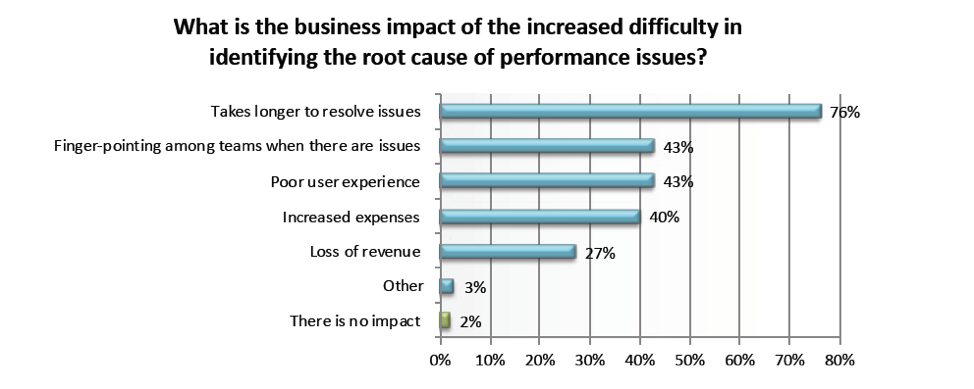
    To make matters more challenging, a full 98 percent of respondents said they have trouble identifying the root cause of performance issues associated with microservices. More than three-quarters (76 percent) said it also takes longer to resolve issues. In fact, 73 percent said it is more difficult to troubleshoot application performance problems compared to a traditional monolithic application.

    Not surprisingly, just less than three-quarters (74 percent) said they plan to increase investments in microservice performance management tools in the next year.

    LightStep CEO Ben Sigelman said that while microservices come in many forms, advances in how software is developed is clearly coming at a cost. Not only is software becoming more challenging to manage, APM tools are now a prerequisite. Historically, IT organizations only monitored their most mission-critical applications. But the level of dependency each microservice has on others requires a more holistic approach to APM, Sigelman said, noting that IT teams now need to be able to see well beyond the border of any one microservice.

    Challenges associated with managing microservices are not likely to deter organizations from eventually adopting them. The level of agility and resilience inherently built into in a microservices-based application are too high to ignore. But the rate at which they are employed might be impacted. There’s usually a direct relationship between the availability of tooling and expertise and the rate at which any emerging technology gets deployed in a production environment. The good news is advances in machine learning algorithms and other forms of artificial intelligence (AI) should make it easier to manage microservices in the years ahead.

    In the meantime, IT organizations can take some comfort in the fact that developers are being held more accountable for the microservices they build. That level of accountability tends to vary widely by organization. But the end result is generally higher levels of software quality because developers increasingly realize they can’t throw code over the proverbial IT operations wall without it coming back to them. The challenge now is to bridge the historic divide between developers and IT operations teams in a way that works best for everyone concerned.

    — Mike Vizard

  • The Road Ahead for Service Mesh

    The Road Ahead for Service Mesh

    If you’re struggling to manage microservices as architectures continue to scale, there’s a good chance you’ve at least heard of service mesh. For the purposes of this blog, I’ll assume you’re familiar with the basic tenets of a service mesh.

    I believe that service mesh is advancing microservice communication to a new level that is unachievable with the one-off solutions that were previously being used. DNS patterns, configuration management and other technologies provide some capabilities such as service discovery, but they don’t provide fast retries, load balancing, tracing and health monitoring. The old approach also requires that you cobble together several things each time rather than bundle everything into a reusable tool.

    While it’s possible to accomplish much of what a service mesh manages with individual tools and processes, the process is a pain in the ass. The image below provides a good idea of how a mesh simplifies the management of microservices.

    Right Around the Corner

    So what’s in the immediate future? I think we’ll see the technology quickly mature and add more capabilities as standard features in response to enterprises realizing the efficiency gains created by a mesh and look to implement them as the standard for managing microservice architectures. Service mesh is likely immature for production deployments, but the road map is progressing quickly and it seems we’ll be to v1 in short order. Security is a feature provided by service mesh, but for most enterprises it’s a major consideration and I see policy enforcement and monitoring options becoming more robust for enterprise production deployments.

    A feature I see on the near horizon—and one that will provide tremendous value—is an analytics dashboard to show insights from the huge amount of telemetry data in a service mesh. I think an emerging value proposition we’ll see is that the mesh allows you to gain and act on data that will allow you to more efficiently manage your entire architecture.

    Further Down the Road

    There is a lot of discussion on what’s on the immediate horizon for service mesh, but what is more interesting is considering what the long term will bring. My guess is that we ultimately come to a mesh being an embedded value-add in a platform. Microservices are clearly the way of the future, so organizations are going to demand an effortless way to manage them. They’ll want something automated, running in the background that never has to be thought about. This is probably years down the road, but I do believe service mesh will eventually be a ubiquitous technology that is a fully managed plug and play config. It will be interesting to see new ways of using the technology to manage infrastructure, services and applications.

    We’re excited to be part of the journey, and are inspired by how users are leveraging service mesh to solve direct problems created by the explosion of microservices and also find new efficiencies with it. I look forward to seeing what the community comes up with that I have not yet even imagined.

    — Zach Jory

  • NGINX Extends Microservices Ambitions

    NGINX Extends Microservices Ambitions

    NGINX has extended the reach and scope of a namesake application platform that the company is positioning as a bridge between legacy applications and emerging microservices architectures.

    The NGINX Application Platform now includes NGINX Unit 1.0, an open source application server designed to simplify microservices across multiple application types simultaneously using a single instance of a server. It supports Go, Perl, Python, PHP and Ruby, with additional support planned for Java and JavaScript support soon. Sidney Rabsatt, vice president of product management at NGINX, said NGINIX Unit 1.0 is different from other application servers in that it is configured via an application programming interface (API) and is 30 percent faster than existing app servers.

    NGINX in the second quarter plans to add new monitoring dashboards, alerting and management via NGINX Controller R1 offering that provides the capabilities of a service mesh for microservices without having to set up a separate dedicated framework. Service meshes are a critical capability because they provide a means to manage interdependent microservices at scale.

    Finally, NGINX Plus R15 for enterprise customers builds on new HTTP/2, gRPC and JavaScript features that have been added to the core open source NGINX platform to provide support for high-availability clustering and OpenID Connect capabilities. These capabilities extend the ability to deploy NGINX as a web server, load balancer, API gateway, Kubernetes Ingress controller and sidecar proxy, said Rabsatt.

    Rabsatt noted most IT organizations do not want to set up separate infrastructure for managing microservices. Managing legacy and microservices-based applications in DevOps environments will be a fact of life for years to come, he said, adding that based on the number of downloads of NGINX software being used on Kubernetes platforms running Docker containers, that message is already resonating.

    NGINX claims users have pulled a billion NGINX instances from the Docker Store, including more than a million pulls of the NGINX Kubernetes Ingress controller. According to the company, more than 3 million NGINX instances are deployed in production microservices environments across more than 250 customers. That’s critical for the company because some rivals have positioned service meshes as an existential threat to the NGINIX platform. Overall, NGINIX says there are more than 11 million instances of NGINX are downloaded each month, an average of four instances every second.

    Rabsatt said most developers have made it clear they don’t have the patience to wait for IT operations teams to stand up dedicated microservices infrastructures. Most IT operations teams still don’t have the skills required. NGINX provides the ability to deploy microservices at scale using a platform most developers already know how to programmatically invoke on their own, he said.

    At the same time, NGINX is also committed to making available best practices that DevOps teams can employ when trying to manage what amounts to a new type of hybrid computing environment spanning legacy applications and microservices, he added.

    It remains to be seen exactly where the divide between microservices and legacy applications will be laid down inside most organizations. Some will draw a proverbial line in the sand, while others will look to deconstruct existing applications into series of microservices. Regardless of the approach taken, all those existing legacy applications will not be disappearing anytime soon.

    — Mike Vizard

  • IBM Unfurls Cloud Platform for Building Microservices

    IBM Unfurls Cloud Platform for Building Microservices

    IBM has unveiled a new development environment in the cloud designed to make it easier to build microservices.

    John Duimovich, IBM CTO for Java, said Microclimate provides a complete framework building applications based on microservices written in Java, Node.js or Swift.

    Microclimate runs on an instance of IBM Cloud Private, a private cloud based on Docker containers that is hosted on the IBM public cloud. Once those applications are developed, organizations can either deploy them on-premises or in a public cloud of their choice.

    Microclimate makes use of Kubernetes and Docker containers to create and orchestrate the microservices development process, which can quickly become a complex endeavor. Because of the issue, Duimovich said, more organizations will be pushing development of microservices into cloud computing environments that provide access to what amounts to a turnkey application development pipeline.

    Duimovich noted it’s possible to more closely mirror the production environment an application will be deployed on using compute resources that can be invoked on demand. Instead of developing an application on a laptop, developers can stress test microservices in the cloud by, for example, engage in “chaos monkey” testing, wherein developers allow a microservice to fail to see how the overall application reroutes requests to other microservices, said Duimovich.

    Developers also can engage in A/B testing in a way that would not be economically feasible to engage in when applications are developed on-premises simply because of the amount of additional IT infrastructure that would have to acquired and provisioned, said Duimovich.

    The cloud also makes it easier for teams of developers to collaborate on the development of microservices-based applications regardless of geographic location, Duimovich added. Developers may still choose to write code on their local PC, but when it comes time to load it into an application, the Microclimate platform makes it easier for everyone on the team to observe how that microservice behaves within the context of a larger application.

    IBM will also make available diagnostics tools to enable developers to more easily discover why their applications might be behaving in a certain way.

    While not every application may lend itself to being constructed using microservices, many organizations are now concluding they are simply a better way to develop reliable software. In addition, developers can be given ownership of specific sets of microservices end to end, which not only gives them more control but also makes them accountable for their overall quality. Of course, building applications made up of hundreds of microservices is going to require organization to implement DevOps best practices, which Duimovich said IBM is more than willing to share with customers.

    No one knows for sure when most applications running in a production environment will be made mainly of microservices. But given the rate at which they are now being used to develop applications, it’s now only a matter of time before such applications become dominant.

    — Mike Vizard