Tag: machine learning

  • AWS Brings Machine Learning to Code Optimization

    AWS Brings Machine Learning to Code Optimization

    Amazon Web Services (AWS) has made generally available a tool dubbed Amazon CodeGuru that employs machine learning algorithms to recommend ways to improve code quality and identify which lines of code are the most expensive to run on its cloud service.

    Peder Ulander, director of open source for AWS, said Amazon CodeGuru not only helps improve performance and resource utilization but also reduces the time and effort spent optimizing applications before and after they are deployed.

    Amazon CodeGuru is based on a set of AWS machine learning algorithms to identify best practices for deploying code. It creates a profile of the code deployed and then surfaces recommendations to improve performance and reduce costs by employing the most appropriate tier of the cloud service.

    That latter capability is critical because developers don’t always factor costs into deciding which tier of a cloud service to employ. Amazon CodeGuru enables IT teams to proactively optimize their cloud usage, noted Ulander.

    Amazon CodeGuru can pull code from either GitHub or CodeCommit repositories, with support for other repositories planned. It requires developers to insert agent software developed by AWS into their code. Once a pull request is made, Amazon CodeGuru automatically starts evaluating the code using trained artificial intelligence (AI) models developed using data gathered from thousands of different open source software projects by AWS and its parent company.

    Once the analysis is completed, Amazon CodeGuru will generate a graph showing such metrics as latency issues and CPU utilization rates, as well as human-readable recommendations to surface specific issues and remediations that include example code and links to relevant documentation for any line of code. Amazon CodeGuru can observe application runtimes and profile application code every five minutes.

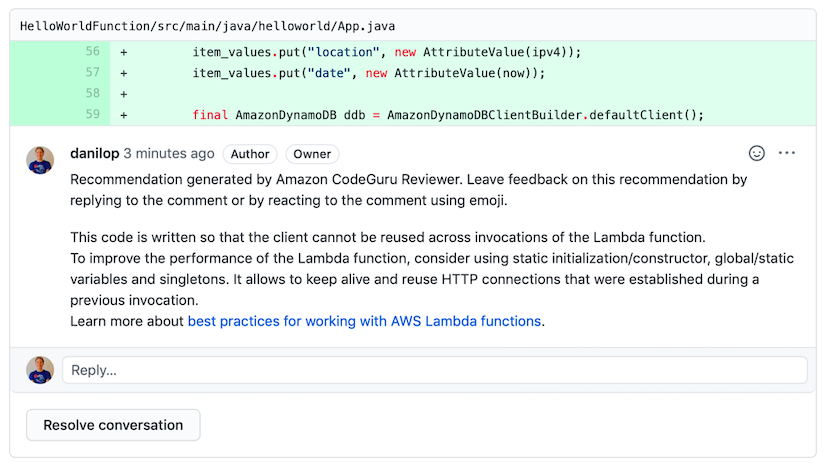
    Amazon CodeGuru has two core components. Amazon CodeGuru Reviewer automatically flags common issues that deviate from best practices and provides recommendations to fix them, including example code and links to relevant documentation. It then opens a pull request and automatically starts evaluating the code using machine learning models to identify the line of code, specific issue and recommended remediation, and provides access to a pull request dashboard that lists all the information gathered by all code reviews.

    IT teams can provide feedback on CodeGuru Reviewer recommendations by clicking on a thumbs up or thumbs down icon, which helps improve recommendations over time using machine learning.

    The second component is Amazon CodeGuru Profiler, which identifies the most expensive lines of code by analyzing the runtime behavior of their applications. Armed with those insights, IT teams can identify and remove code inefficiencies, improve performance and decrease compute costs.

    IT teams today spend an inordinate amount of time debugging code to address a broad range of issues. The paradox is the more applications they deploy, the more time they spend debugging. Perhaps the time has come to finally let machines discover code issues in the hopes that developers will use their time writing new code, not fixing it.

  • IT Modernization Yields Business Benefits Even in Early Stages

    IT Modernization Yields Business Benefits Even in Early Stages

    In recent years, with the emergence of newer technologies ranging from the cloud to machine learning, IT modernization has evolved from a replacement of end-of-life infrastructure to an enabler of innovation and business value. It is a complex process that can take months or even years, but a recent survey shows that the effort begins to deliver measurable results almost as soon as an organization executes the first steps on its roadmap.

    In The State of IT Modernization 2020, an IDG Research Services survey of 200 IT executives commissioned last December by Insight Enterprises’ Cloud + Data Center Transformation team, respondents that had completed 25% or less of their initial modernization objectives reported achieving business improvements in each of the eight categories measured. Sixty-five percent had already achieved better quality of service. Significant progress had also been made in improving customer experience/satisfaction (52%), cost savings (50%), uptime (44%) and the ability to create new revenue-generating products and services (42%). 

    Organizations that had completed their initial modernization objectives reported even better outcomes on all eight measures, notably including the ability to extract business value from data (56%) and faster time to market for new products and services (50%). 

    The findings clearly demonstrate that a modernized IT ecosystem is a core building block of business transformation. Whether it’s spinning up a new service or application quickly, doing a deep data dive to identify new market opportunities or using artificial intelligence to improve sales forecasts or warehouse operations, it’s essential to have the horsepower, agility and advanced data analysis capabilities to do the job.

    The survey of CIOs, CTOs, CSOs and IT directors working at organizations with an average of 29,294 employees also revealed a wide range of details about the status of IT modernization efforts. Let’s look at some examples.

    Progress Made

    Fifty-six percent of the enterprises surveyed have either achieved initial IT modernization objectives or have made significant progress toward doing so, while 19% have made moderate progress and 26% are in the beginning stages. Interestingly, even those in the earliest stages are pursuing emerging technologies such as AI, machine and/or deep learning (43%), automation to support scale-out and other cloud strategies (37%), cloud native application development (35%) and public cloud container services (35%). 

    Projects Derailed 

    Despite this progress, the road to IT modernization can be bumpy. Forty-one percent of survey respondents reported having delayed or abandoned some of their 2019 IT modernization initiatives. The top reasons cited were competing priorities (46%) and lack of a clear roadmap or strategy (45%). Other causes included data security concerns (39%), inadequate in-house expertise (38%), poor preparation (29%) and outdated processes or tools (27%). 

    Shifting Cloud Strategy

    Whether they have just embarked on their IT modernization journey or have made significant progress on their roadmap, organizations continue to grapple with optimizing their cloud strategy. The survey showed that:

    • Ninety-two percent of survey respondents increased workloads deployed in the public cloud and 91% in the private cloud in 2019, reflecting the ongoing increase in cloud adoption as well as migration from one platform to another.  
    • Eighty-nine percent switched or planned to switch from an all-private or all-public cloud strategy to a hybrid cloud approach – and 87% adopted a multicloud approach using more than one public cloud provider – as they attempted to find the right path for their cloud needs.
    • Eighty-four percent moved select workloads from a public cloud to an alternative cloud or non-cloud location, suggesting a failure to perform appropriate cost modeling, workload/platform alignment and other due diligence before the initial move.

    Poor Public Cloud Cost Controls

    More than two-thirds of survey respondents reported that public cloud costs exceeded their expectations, with cost overruns for roughly half that group ranging from 51% to 100%. Most of the causes can be traced to inadequate due diligence, governance or cloud optimization efforts, often due to a lack of in-house expertise in these areas. Examples include: unexpected data egress charges, subscribing to more cloud resources than required, failure to take advantage of vendor volume discounts, lack of knowledge to analyze monthly cloud costs and failure to optimize cloud workloads to extract maximum value from cloud platforms.

    Managed Services

    Adoption of managed services is widespread at every stage of the IT modernization journey, with an average of 95% of respondents outsourcing one or more IT operating environment functions to a managed services provider and 84% outsourcing cloud management. 

    Top Challenges Faced

    Governance is the number one modernization challenge in 2020, according to survey respondents, with new strategies and processes required to ensure control over areas ranging from cloud deployments to continuous integration and continuous delivery (CI/CD), automation and orchestration, and infrastructure as code. Optimizing and managing the centers of data that are replacing the traditional data center ranks as number two, with workloads located on-premises and in multiple clouds as well as on the edge.

    At the same time, most IT organizations have long-standing cultural and technological norms that need to change in order to move modernization initiatives forward. Hurdles cited elsewhere in the survey range from IT silos to outdated processes and tools, understaffed or underskilled DevOps teams and lack of enabling technology for containerization and automation.

    These challenges also need to be overcome in order to take full advantage of today’s technology to drive innovation, business transformation and the competitive edge that can help businesses both survive and thrive in today’s economy.

  • Eggplant Injects AI Into Application Testing

    Eggplant Injects AI Into Application Testing

    Eggplant has infused its automated testing platform with deep learning algorithms that automatically identify and classify user interface (UI) elements such as buttons and text fields across any platform and then generate all the automation assets needed to instantly run a test.

    In addition, Eggplant has made it easier to visualize the overlap between common application failure patterns that can be used to automatically optimize testing.

    Finally, Eggplant has also revamped its own user interface to make it easier to deploy its platform across multiple test machines.

    Company CTO Gareth Smith said in the months and years ahead it’s apparent AI will be playing a much larger role in application testing. There are simply too many platforms on which application code is now being deployed for testing teams to keep pace manually.

    Each platform requires tweaks to the user interface to optimize the customer experience. At a time when many organizations are accelerating digital business transformation initiatives, the user application experience has never been more critical, he noted.

    Eggplant’s Digital Automation Intelligence (DAI) platform is designed to automate the entire testing lifecycle process as part of a larger best DevOps practice. The rate at which application tests can be built and run can be a bottleneck as applications are being built. The DAI platform looks to first automate the creation of UI tests and then launch them against application code to eliminate as much testing friction as possible, said Smith.

    IT teams also can track user behavior to create journeys based on user interactions with applications and store tests created using modeling tools provides by Eggplant in its cloud service. That approach not only accelerates the application development process, but it also serves to reduce the total cost of application development, which is critical at a time when IT budgets are squeezed because of the economic downturn brought on by the COVID-19 pandemic.

    As part of that effort, Eggplant provides DevOps teams with access to an application programming interface (API) through which they can self-service their own tests. That may not eliminate the need for a separate testing function within the application development process, but Smith noted it does make it easier for developers to discover potential issues on their own versus having to wait on application testers to discover them.

    Regardless of who conducts the testing, the rise of DevOps means there’s more application code to be tested than ever. As such, testing backlogs within many IT organizations are growing. The challenge is finding a way to conduct application testing that doesn’t result in application deadlines being missed. After all, when deadlines are missed, typically the first thing that gets scaled back is testing. Many DevOps teams convince themselves that any issues that come up can be addressed in the next update.

    Of course, once end users reject an application because issues were never discovered during testing, it’s not uncommon for an application to be rolled back. Rather than having to choose between those two evils, it might be better for all concerned to rely more on automation and AI to accelerate the testing process as much as possible.

  • It’s Time to Take a Customer-First Approach to AIOps

    It’s Time to Take a Customer-First Approach to AIOps

    Artificial intelligence for IT operations (AIOps) has several use cases that IT operations managers can’t deny: reduce alert noise with statistically significant outcomes (up to 80%), correlate alerts and events to uncover the critical business issues immediately, analyze data across environments to find root causes and resolve routine issues (like patching) automatically. Gartner predicts that large enterprise use of AIOps tools to monitor applications and infrastructure will rise from 5% in 2018 to 30% in 2023.

    I’ve been working in the AIOps field for a few years now, and I’ve learned that many organizations, even with relatively modern IT operations management (ITOM) software, are behind the curve. Vendors keep releasing new algorithms, yet the original ones are barely being used or worse, still sitting on the shelf in the customer’s environment. This is because it can be difficult to understand when and how to use artificial intelligence (AI) tools in the daily workflow, and because IT professionals may not inherently trust (or even want) machine-driven recommendations and actions. 

    AI and machine learning technologies are upending traditional assumptions and conventions in many industries – and IT is no exception. In the land grab to bring to market the latest sensational AIOps capabilities, vendors have unwittingly deprioritized customer adoption. This has resulted in a chasm: The technology is getting ahead of the customer’s willingness and ability to implement these solutions in their production environment. 

    The feature-first perspective in the software industry is nothing new, yet for AIOps to reach its full potential, it’s time to take a customer-first perspective.

    Let’s walk through a few ideas to minimize barriers to adoption and speed up time to value for AIOps:

    Start on Adoption During Build

    Machine learning developers and product managers need to understand potential customer barriers during the design and test phase and put themselves in the user’s shoes. How will an individual interact with the system and what level of transparency is appropriate to ensure a frictionless experience? This is a best practice for any software development team, but given the mystique of AI software, it’s even more important. Document expectations for the user experience by giving users early access to the software, such as a beta program, where they can freely deliver feedback on UI, workflows and outcomes of AIOps features.

    Connect the Dots with Visualizations

    A significant barrier for any machine learning application is that users may not fully understand the use cases nor trust what the algorithms are doing. Ensure that software-driven actions and recommendations are transparent at the moment and location they occur in the application. It should be easy for users to see the cause and effect of machine-driven actions as well as how the AI reached a conclusion.

    The concept of “explainable AI” has become popular in the last year and vendors can help by introducing visualizations into their tools.  For instance, you could have graphs showing the progression of a model being trained or the learned sequences in alert correlations. In-app simulation tools can help a customer see the impact of an AI-delivered recommendation without actually making the change.

    Amp Up Training

    Create internal-facing white papers or videos to demonstrate the workings behind algorithms to your technical staff and tools especially designed for users. The best way to learn is by doing, so designing visual cues and tutorials within the application will be most effective. Ensure that you have dedicated AIOps subject matter experts who can guide customers through implementations and be on call for advice as needed. Common questions include, when should the AI be allowed to automate an action or decision and how can you override an automated decision? It’s not a bad idea to involve machine learning developers in creating training sessions and guides. Finally, the age-old concept of nurturing power users within the customer organization can go a long way.

    Diffuse Concerns Over Jobs

    Nobody wants to use a new technology which might eventually replace them. For the most part, AIOps is not going to jettison IT operations staff. Instead, AIOps will empower operations and support teams to handle increasing alert volume and complexity with existing staff, while ensuring that expensive engineers such as SREs can focus on higher-level data performance analysis and optimization initiatives.

    Design Algorithms for Flexibility

    Machine learning algorithms break if they cannot respond to the dynamic nature of modern workloads. For instance, if you design the algorithm based on rules dictating actions between specific applications and infrastructure components, what happens when those technologies disappear or are replaced, as they often do in the cloud? Now you’ve got gaps that could result in a catastrophic system failure and an AIOps tool that requires heavy maintenance. Algorithms should be responsive to environmental changes – such as incorporating neural net technology that can adapt to the shifting sands of the IT landscape.

    A survey conducted in April by OpsRamp found that nearly 70% of IT operations leaders plan to invest in AIOps to improve incident diagnosis, troubleshooting and resolution. By all accounts, the year 2020 has raised the bar for IT expectations around resiliency and user experience. AIOps promises to be a pivotal strategy for IT operations success, but it all depends upon user satisfaction and adoption of the technology. Vendors that incorporate customer adoption and value tactics into their development processes will be instrumental in pushing this market forward in a positive way.

  • How DevOps Powered by AI and Machine Learning Is Delivering Business Transformation

    How DevOps Powered by AI and Machine Learning Is Delivering Business Transformation

    The use of artificial intelligence (AI) and machine learning (ML) is fundamentally changing the way we think about DevOps. Most notably, it is delivering a new form of DevOps that recognizes the need to have systems that are intelligent by design and underpinned by comprehensive security (DevSecOps). For many, this will be the crucial next step if DevOps is to shorten the software development lifecycle for all connected intelligent systems, ensuring the continuous delivery of secure high-quality software.

    By now, most organizations understand DevOps is a substantial discipline that they must adopt – according to Deloitte, organizations adopting DevOps see an 18%-21% reduction in time to market. By breaking down the silos between business and IT operations, DevOps can ensure consistent levels of productivity, efficiency and service delivery, all of which hold weight in these times of heightened uncertainty.

    To put it simply, DevOps can help businesses compete in already congested marketplaces. Through a foundation of continuous integration (CI) and continuous delivery (CD), organizations can ensure the customer receives the product they demand in the fastest time possible, while mitigating any elongated frustrations experienced from a lack of harmony between systems engineers and operations teams. Incorporating AI and ML into that DevOps strategy will take things to the next level.

    AI and ML Are the Next Evolutionary Step for DevOps

    Today’s companies are data-driven and being built as digital platforms. However, just 28% of organizations are currently succeeding in their digital transformation journeys. Increasingly, corporations are looking at what AI and ML can do to help them realize their transformative ambitions.

    Both the AI and ML markets are expected to experience huge growth over the next three to four years. Analyst firm IDC, predicts worldwide spending on AI systems will reach a href=”https://www.marketresearchfuture.com/reports/machine-learning-market-2494″>42.8% by 2024.

    What AI and ML reveals for these companies, and the increasing value of what Al, ML and devices can do together, are changing the way organizations view the world as they digitally transform. Coupling AI and ML with DevOps will lead to a significant shift in what DevOps gets involved with. 

    Primarily, it sets DevOps front and center of an organization’s wider digital transformation ambitions. If digital companies run on living data, then the development of these intelligent systems is an enticing environment for DevOps to prove its wider value to the organization like never before.

    Security Takes the Center Stage

    According to a TechTarget survey of key IT decision makers, cybersecurity and risk management were found to be the number one area for spending this year, with more than 53% of respondents saying they saw budgets increase in this area. And security is a crucial element that any organization employing a DevOps strategy should be considering. 

    DevSecOps is the simple premise that everyone involved in the software development cycle is responsible for security. In fact, the saying “security is everyone’s responsibility,” is a mantra that has been repeated often, and just as often ignored. Embedding security within every part of the development process, ensures security and compliance monitoring tools keep pace with the speed and agility that DevOps offers. It is a common understanding that security is the biggest block to the rapid and seamless development and deployment of systems, as security solutions have not traditionally been built to test and code at the speed DevOps requires. 

    Ultimately though, more automation from the start, reducing the need for manual configuration from security architect is where DevSecOps shines. This reduces the chance of misadministration and occurring faults, which can lead to downtime, and potential breaches or attacks. Quite often, the best ways to secure your organization is through simple hygiene factors, such as regular patching and software updates. 

    The reality is that every organization employing DevOps should really be approaching it as DevSecOps. Security is of ever growing importance to each and every organization and, through empowering it with AI and ML processes, it can be enhanced too, simplifying the processing of data to easily identify threats or potential vulnerabilities in the security makeup. 

    Reaching Beyond Human Capability

    The future will be made up of connected intelligent systems that span the intelligent edge, all the way to the cloud. The expectations of these systems are based on the lifecycle of a typical mobile application with constant feature enhancements. But, how do you know what to deliver next, especially when things are moving so quickly, and as developers are inundated with information and data from a number of different sources? This data deluge can be powerful, but it can also be overwhelming.

    Crucially, this is where the power of AI and ML comes into play. AI and ML will aid developers in making sense of the information housed across various data warehouses. In DevSecOps, there has always been an approach to automate everything, and AI and ML will be instrumental in automating the analysis and processing of data – a task that is now far beyond the capabilities of humans.

    Incorporating AI and ML will enable developers to better understand and use the data at hand. This will see developers understand not only the error, or the occurrence of a fault, but the detail of what happened in the run up to the fault – vastly reducing the chances of incurring that fault again. AI and ML will also be responsible for enabling the transformation from diagnostics to prognostics across any and all tools and systems, making it easier for developers to anticipate, identify and resolve faults or errors. 

    Increasingly, we’ll see organizations benefit and drive value from real-time insights. They’ll do this through AI and ML frameworks deployed on active systems to deliver optimizations based on real-time development, validation and operational data. This level of real-time actionable insight bolsters DevSecOps’ ability to achieve CI and CD, through improved, reduced mean time to resolution, easing the impact on operations and, ultimately, enhancing the end-user experience. It remains to be seen if incorporating AI and ML into the DevSecOps cycle will achieve the delivery of self-healing systems that can detect and resolve issues without the need for human intervention. With true AI, however, this might well be possible.

    The benefits and potential use cases of AI and ML are widely acclaimed, and while we are still some way from seeing their full potential, the capabilities they currently possess are revolutionizing many sectors. The fact is, if DevSecOps is to continue to keep pace with the vastly growing digital data economy, then it will become reliant on advanced technologies such as AI and ML. Data is powerful if used correctly, but with so much of it to process and analyze, that can be a challenge.

    A move toward secure automated processes is the progressive step that many organizations need to consider if they are to realize their digital transformation ambitions. Organizations cannot continue to do things the traditional way and expect to get the results that the new world is looking for.

  • Report: Debugging Efforts Cost Companies $61B Annually

    Report: Debugging Efforts Cost Companies $61B Annually

    Undo, a provider of a software failure replay platform, this week published a report in collaboration with a Cambridge Judge Business School MBA project that estimates 620 million developer hours a year are wasted on debugging software failures, at a cost of roughly $61 billion.

    The report also notes software engineers spend on average of 13 hours to fix a single software failure.

    According to the report, 41% said identified reproducing a bug as the biggest barrier to finding and fixing bugs faster, followed by wiring tests (23%) and actually fixing the bug (23%). Well over half (56%) said they could release software one to two days faster if reproducing failures were not an issue. Just over a quarter of developer time (26%) is spent reproducing and fixing failing tests.

    On the plus side, 88% of respondents said their organizations have adopted continuous integration (CI) practices, with more than 50% of businesses reporting they can deploy new code changes and updates at least daily. Over a third (35%) said they can make hourly deployments.

    Undo CEO Barry Morris said the report makes it clear organizations need to be able to record software to reduce the amount of time it takes to find bugs. Unfortunately, even then finding a bug is still a labor-intensive process that can involve analyzing millions of lines of code. In the future, software replay systems will be infused with machine learning algorithms to accelerate the bug discovery process, he noted. As software becomes more instrumented, the observability data and metrics that machine learning algorithms require to detect patterns is becoming more accessible.

    In the meantime, while CI has been embraced, the continuous delivery (CD) side of the DevOps equation remains a challenge. Each platform software is deployed on is unique, so most organizations find automating software delivery problematic.

    Regardless of DevOps approach, it’s clear there’s still lots of room for improvement when it comes to developing software. Even the most advanced practitioners of DevOps are limited by the rate at which software bugs, including security flaws, can be discovered and remediated. Of course, there may come a day when machine learning algorithms automate much of that process, including determining which types of tests to run. For now, however, many organizations could streamline the software debugging process by recording instances of applications when they are built and when they are deployed. After all, each platform that software is deployed on has attributes that inevitably impact how software on the platform runs.

    As software continues to become more complex in the years ahead, challenges associated with debugging applications will only continue to grow. In the age of microservices, the issue that software engineers are trying to troubleshoot might not have anything to do with the code they wrote; rather, the issue emanates from a service they invoked via an application programming interface (API). Whatever the source of the problem, it’s apparent to all a lot of time and money is being wasted on debugging software that could be put to far better use.

  • A Buyer’s Guide to AI and Machine Learning

    A Buyer’s Guide to AI and Machine Learning

    B2B software sales and marketing teams love hearing the term “artificial intelligence” (AI). AI has a smoke and mirrors effect. It sounds impressive. But, when we say “AI is doing this,” our buyers often know so little about AI that they don’t ask the hard questions.

    In industries like the DevTools space, it is crucial that buyers understand both what products do and what their limitations are to ensure that these products meet their needs. If the purpose of AI is to make good decisions for humans, to accept that “AI is doing this” is to accept that we don’t really know how the product works or if it is making good decisions for us.

    When we’re in the buyer role, we often don’t hold ourselves responsible for understanding AI and machine learning (ML) products because these technologies are intimidating. They’re incredibly complex.

    This article addresses the limitations of AI and ML, so software buyers can ask the right questions to understand what they are buying. 

    The Test Oracle Problem

    One limitation of some AI or ML products is that for certain applications of the technology, there is no source of absolute truth to compare against the accuracy of the output. For example, neither humans nor machines know how to produce the perfect set of end-to-end tests for any given application. This is the test oracle problem: there is no objective standard of truth. No one wants to introduce this kind of uncertainty into their sales process. Yet, our buyers deserve well-informed answers about our products.

    As a buyer, you need to understand the intended advantage of your seller’s AI product before making a purchase decision. Is it meant to make a decision that is more accurate—against an objective standard—than a human? Is it meant to make a faster decision with less cost? Or introduce an alternative methodology that uses new data in a new way? Answers to these questions influence how you will use the product and what value it provides.

    AI Versus ML

    Though AI is commonly accepted as “any machine that uses math to make decisions,” true AI is self-taught. AI has a neural net that mimics neurons in a human brain which allows it to teach, update and evolve itself. Because of this, true AI is difficult to build and is often experimental rather than commercial.

    More often, what’s being described when we say AI is actually ML. ML is human-taught: Machines learn through human feedback using a probabilistic decision-making process that improves via ongoing correction. Machines take in data, run algorithms against it and output a decision — or series of assertions — based on probabilities. Humans correct the machine by telling it whether it was accurate in its assessment, and the machine updates. As it receives accuracy feedback, machines learn to make better decisions. And because ML is based on probabilities, it will sometimes make the wrong decisions.

    Based on how you plan to use a product, you need to determine how rigorous its accuracy needs to be. How often a machine can make the wrong decisions and still serve its purpose is application-specific. Self-driving vehicles must be nearly perfectly accurate to be adopted. Paralegal ML toolsets likely need to be less accurate. How accurate does your product need to be?

    Asking the Right Questions

    Regardless of how you plan to use a product, it’s important to ask the right questions to understand the product and build resiliency around its accuracy levels. The next time a seller tells you “AI is doing this,” you can ask the following: 

    1. Is this product an ML product? Does it need to be ML to get a meaningful result? To be ML, a product needs to learn through human feedback, not just make decisions using probabilities. Do you just need a product that uses logic to make decisions, or a product that improves in accuracy over time?
    2. How is the accuracy of this product calculated? You won’t know if the machine is more accurate than humans if you don’t know the conditions used to calculate accuracy. If a machine is 30% more accurate than humans, who assessed this accuracy and how did they determine this?
    3. How do you know when the product makes the wrong decisions? Any ML product will sometimes produce the wrong output. Typically, a seller’s most successful customers have already adopted business processes to build resiliency to this wrong output. If so, the seller can help you adopt them as well.
    4. In its current state, how often does the product make the wrong decisions? Knowing the frequency of mistakes and the stakes of those mistakes will be crucial to deciding how you use the product, and whether it’s safe to do so at this stage in its development.
    5. How many teaching hours have been put into this product? This number will provide a simple approximation of how much effort has gone into making the product more accurate. A low number can be fine, depending on the application.
    6. How does my usage improve the accuracy of this product? As a buyer, you are an integral part of the machine testing and teaching process. You should be willing to use your data to improve their accuracy, because you want these products to improve in the future.

    Why Knowing AI and ML Matters

    Not only is there a lot of “AI” that isn’t AI, but there is also algorithmic technology that isn’t ML. It is thus essential for buyers to know enough to ask the right questions and understand how these products make decisions.

    There are limitations to all ML products, though the limitations differ by product and the way the product is applied. When a product’s accuracy levels are unknown, all you can do is ask if its methodology is valid for decision-making: Does it have access to better data than humans? Can it make smarter and faster decisions than humans with this data? If the answer is yes, you should consider buying the product rather than having your people do the work.

  • Moogsoft Expands Reach of AIOps Platform

    Moogsoft Expands Reach of AIOps Platform

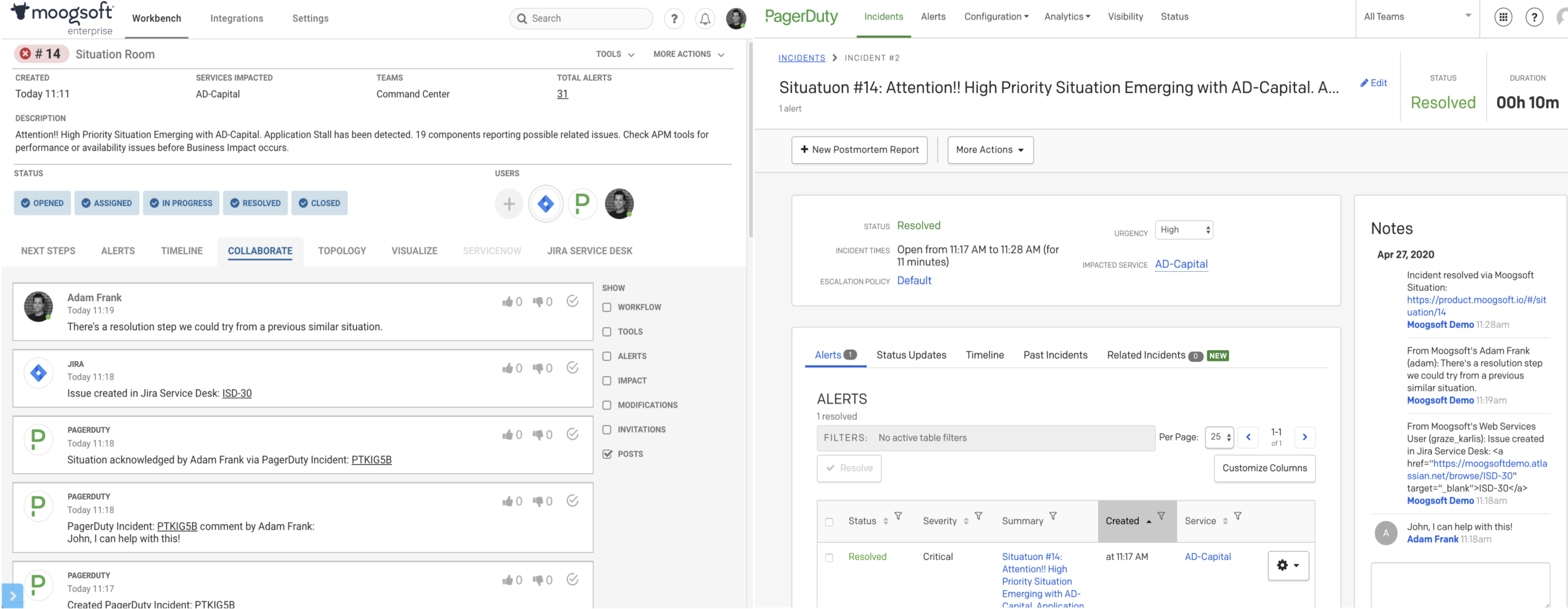
    Moogsoft this week updated its AIOps platform to enable IT organizations to construct a virtual network operations center (NOC) that pulls in data from incident management and DevOps platforms for remote IT management.

    Adam Frank, vice president of product and design at Moogsoft, said version 8.0 of Moogsoft Enterprise enables IT teams to aggregate alerts from multiple platforms in a way that enables machine learning algorithms to identify high-priority issues that require immediate attention.

    Moogsoft accomplishes that goal using noise reduction analytics to better prioritize alerts, which are then surfaced via an automated topology visualization tool that makes it easier to identify the root cause of any issue, he said.

    Version 8.0 of Moogsoft Enterprise adds integration with the Amazon Web Services (AWS) Firelens services to ingest EC2 log files, the PagerDuty incident management platform and the Opsgenie incident management platform from Atlassian.

    Moogsoft has also revamped its user interface and enhanced its Workflow Engine (WE) to ease the process of aggregating data from a variety of IT management platforms.

    Even before the start of the COVID-19 pandemic, IT organizations had been moving to embrace machine learning algorithms and other forms of AIOps to help manage increasingly complex IT environments. In the wake of the pandemic, Frank said it’s clear IT teams will be relying more on AIOps platforms. Many organizations simply will not be able to afford to maintain the current size of their IT teams, noted Frank. At the same time, resistance to adopting AI to manage IT is likely to decline because IT staff simply will not have the time to manually perform as many rote tasks as they do today.

    In the meantime, the debate over AIOps continues to heat up. Incumbent providers of IT management platforms contend they already have collected the relevant data, so it makes sense to apply algorithms to data where it already resides. Providers of AIOps platforms such as Moogsoft contend that for AI to be effective at scale machine learning algorithms need to be applied to data that currently resides in multiple IT platforms. As such it makes more sense to apply machine learning algorithms to data that has been aggregated in a single repository.

    Of course, machine learning algorithms will soon be pervasively applied throughout the IT landscape. The decision IT teams will need to make is which platform will ultimately serve as its primary control point for managing enterprise IT.

    While some IT organizations may be tempted to postpone that decision in the wake of the COVID-19 pandemic, Frank notes the pandemic has also highlighted the need to modernize IT management platforms that increasingly need to be accessed remotely. Legacy IT management platforms generally assumed the IT staff would be working on-premises. Moogsoft is designed to enable organizations to employ a virtual NOC that can be accessed more easily from anywhere.

    It remains to be seen just how the management of IT will evolve in the weeks and months ahead. The one thing that is certain is the way IT is managed is never going to be the same again.

  • DevOps Trends for 2020 and Beyond

    DevOps Trends for 2020 and Beyond

    Since the ideation of DevOps, technologists have made great strides to benefit from it. Despite advancements and the success that teams have seen within pockets, many of its core challenges are still prevalent: scaling across the enterprise due to manual processes, poor visibility between dev and ops teams, and tool sprawl that hurts agility. Luckily, there’s light at the end of the tunnel for organizations hoping to get the most from DevOps.

    In order to succeed in DevOps and foster agility in this next decade, the secret is pretty simple: Get the right work to the right team at the right time. Here are three ways development and operations teams will get closer to this formula over the coming years. 

    Change Automation Based on Policies, Data and Automation Will Take Hold

    Despite large investments to double down on DevOps initiatives, the reality is most organizations have only made progress on development processes, while downstream gates and processes such as change management are still manual and time consuming. Too often are developers having to log in, create change requests and fill out forms manually–a frustrating, drawn out and overall unnecessary process. The reality is, manual processes in DevOps simply cannot continue in the next decade. They create unnecessary friction, disrupt the flow between dev and ops, and get in the way of other essential work.

    However, the tide is starting to turn as organizations look to automate tasks like change management by leveraging dynamic controls through data and policy automation to achieve true CI/CD. As automation becomes more commonplace, developers will spend more time actually developing and will be able to deploy apps faster and with greater efficiency. 

    Organizations Will Rely on AI/ML and Analytics to Drive Efficiency and Greater Visibility

    Despite all the advancements in DevOps over the past 10 years, one hurdle hasn’t been addressed: the limited visibility across all the pipelines from development, and the connection to how those deliverables run in the real world–i.e., knowing what changed, how it’s been tested, understanding the impact and assessing the risk, how something performs in production etc. The lack of visibility presents challenges of its own (distrust among teams, slower approvals, bottlenecks and inefficient processes). 

    Organizations are starting to recognize and address this challenge, realizing the gains from local optimization within departments along the way. As this continues, they will increasingly rely on analytics to drive efficiency and end-to-end visibility across processes. What’s more, analytical tools will draw planning, repository, test, deployment and performance data from across the DevOps lifecycle to provide insights into reducing cycle times, risk and improving project outcomes. AI and ML will play a role in leveraging that information to better direct work, to adjust stage gates and policies based on prior performance and more.

    At its core, analytics enables IT teams to make changes at the pace of DevOps, while unprecedented visibility assisted by ML puts IT at the center of developers’ culture and mindset.

    Tool Sprawl Will Continue to Be a Problem but DevOps Management Platforms Will Emerge

    With continued adoption of cloud and microservices architectures, new tools will continue to emerge–different teams within an organization often use different tools for planning, version control, build automation, testing, deployment, etc. But, a new trend is emerging as the industry moves toward platforms that streamline management across various tools and teams to improve development speed and agility. Platforms also enable IT teams to quickly accommodate the rapid addition of features to software, while automating the approval process–making product development faster and more efficient, while also breaking down silos.

    The Bottom Line

    Despite advancements from the last 10 years, there are still many ways to deliver on the value of DevOps and grow adoption. The vast number of tools used by developers and IT makes it difficult for leaders to get a holistic view of how each team is performing. Lack of visibility paired with manual processes slows the behavioral and cultural change needed to succeed with DevOps.

    But, as we enter the next 10 years of DevOps, the combination of automation, analytics and workflow platforms will arm teams for success.

  • Accelerating IoT by Switching Gears to 5G

    Accelerating IoT by Switching Gears to 5G

    Unprecedented breakthroughs in technology have often resulted in the emergence of disruptive technologies and outstanding innovations. A major development in one technology always fuels the growth and advancement of several other technology domains and industries that take advantage of it, resulting in a need to transform businesses to address new opportunities.

    The evolution and development of various generations of mobile wireless technologies—mobile phones, mobile application development, eCommerce, banking, transportation, hotels, etc.—have seen a cascading impact on the growth and advancement of various applications. We are about to witness a similar multi-dimensional growth in several industries with the advent of the 5G wireless technology. With speeds that could be at least 10 times faster than 4G networks, 5G is expected to create pathbreaking opportunities for innovation and development in a variety of domains including but not limited to education, IoT, artificial intelligence (AI) and health care.

    5G networks offer three major benefits, bigger channels, reduced latency and scalability, which allow the connection to a large number of sensors and devices. This combination will enable the government and other industries to introduce advanced digital initiatives involving AI, machine learning (ML), Industrial IoT (IIoT) and a variety of other data intensive applications.

    This article focuses on the effect of 5G networks on IoT, and the role that DevOps could play in this mix.

    Where Does 5G Fit with Regards to IoT?

    At a high level, the focus areas for the five generations of mobile network technologies can be summarized as: 1G, voice; 2G, voice and texting; 3G, voice, texting and data; 4G, everything as in 3G but much faster; and 5G is expected to be everything in 4G but extremely faster. 

    IoT devices employ a wide range of wireless technologies such as WiFi and Bluetooth, in addition to cellular technologies such as GSM, LTE, 4G and 5G. In the field of IoT, cellular technologies such as 4G, have helped a great deal with regards to device provisioning and device management. These technologies have also improved and ensured coverage, performance, reliability and security of IoT devices and applications.

    5G brings in a variety of other benefits that are not available with 4G. The speed, higher capacity and low latency of 5G will make it more ideal for simultaneously connecting a large number of devices. Further, additional enhancements made by some 5G service providers aim at expanding the frequencies for data transfer by digital cellular technologies. These features will also make 5G a major enabler in applications that use IoT where real-time performance and decision making are critical. Remote medical diagnosis and remote surgery are some examples where 5G’s ultra-low latency will help improve the virtual and augmented reality experience, making them more powerful tools in the medical industry—especially at a time of crisis like the currently prevalent COVID-19 pandemic. 

    The bandwidth reliability and resiliency offered by 5G will pave the way for several new applications for IIoT systems. For example, factors such as operator productivity in manufacturing, reduction in cost of quality management and enhanced quality through continuous monitoring and improvement, are some examples where IIoT can be made more effective with the use of 5G.

    The volume of real-time data exchanges with IIoT devices will be greatly increased with 5G. This helps with obtaining more frequent and reliable data on several KPIs in manufacturing, worker productivity, root-cause analysis, etc. Predictive maintenance, which is turning out to be a major use case for 5G and IIoT, aims at predicting failures before they occur by leveraging AI.

    The Difference that 5G Makes on IoT Data 

    Prior to the advent of 5G, technology required to offer a higher bandwidth and reliable network connectivity were quite limited and have further prevented from realizing the fullest potential of several edge devices. These devices can potentially generate and transmit large volumes of data that can be processed and analyzed by cloud-based applications. With 5G, there will be a sharp increase in the capture and use of valuable data from edge devices leading to greater insights and predictive analytics on IoT implementations.

    5G technology offers a significant increase in transmission bandwidth, theoretically up to 10 Gbps, as opposed to 4G which only offers 100 Mbps. This increase in bandwidth will result in significant growth in the volume and quality of IoT data and a proportional growth in AI applications leveraging ML and big data. The mass volumes of data created by IoT under the influence of 5G have the power to revolutionize everything, from education to healthcare to manufacturing and even autonomous vehicles.

    With 5G, there will be a surge in the volume of data generated by sensors, cameras, drones and edge IoT devices. Integration of data from different sources will lead to the development of several large data-intensive applications that help draw valuable insights regarding the domains in which they are implemented. The convergence of 5G technology, IoT and data analytics will also pave the way for innovation and several new business opportunities. IoT applications leveraging 5G technology will proliferate wearables, smart home appliances, industrial automation and also future self-driven vehicles.

    All Things Considered

    There is absolutely no doubt that IoT is already taking the world by storm. The power of IoT, when harnessed with the power of 5G technology, will certainly lead to several innovative approaches and open up new business opportunities. Overall, the speed, reliability and low-latency offered by 5G makes it ideal for connecting a large number of IoT devices.

    IIoT devices will find a great use for 5G as they can now collect and report large volumes of real-time data from manufacturing units and sensors, helping companies obtain valuable insights and take well informed decisions. The large bandwidth supported by 5G additionally provides edge devices the ability to transmit larger volumes of data more frequently to applications that can process and use the data effectively for AI and ML.

    We will definitely see the industry witness a sharp growth in IoT, AI and ML applications relatively soon, given the fast growth of 5G and the enhancements that several service providers are already making in this technology.