Tag: Low Code

  • How No-Code Software Development Speeds Digital Transformation

    How No-Code Software Development Speeds Digital Transformation

    More organizations are democratizing software development through no-code solutions that empower anyone to write applications

    In today’s fast-paced and digital business world, organizations must revise their goals and processes to achieve digital transformation and remain a viable business.

    However, most transformation efforts fail. Recent McKinsey research shows that 70% of complex, large-scale change programs don’t reach their stated goals. For most organizations, the complexity of the technology environment and the inability to swiftly implement necessary changes are major roadblocks.

    No-code solutions allow organizations to stay agile and accelerate their strategy execution by empowering power users (or business users) and developers to rapidly develop applications. Such solutions also improve the ability of IT to respond to business demands, shorten time-to-market and accelerate digital transformation.

    What Is a No-Code Solution?

    A no-code solution mitigates the need for manual programming in application development. Instead of writing lines of code, users can develop applications through simple point-and-click on specific components that can be arranged into logical sequences to create functional and feature-rich applications.

    The inherent value no-code software development is it accelerates and democratizes the application development process. With such a solution, your power users can build applications to solve critical business problems and automate tasks to increase productivity.

    5 Benefits of No-Code Software Development Solutions

    • Reduce the load on IT: As mentioned before, no-code solutions allow business users to build applications without any coding knowledge. By enabling such a change, the solution reduces the burden on the understaffed IT department. Applications to solve business challenges and increase productivity can be built quickly without relying on IT. This in turn allows the IT department to dedicate more time to business-critical apps and projects.
    • Accelerate development time: No-code solutions enable business users to take application development into their own hands; they don’t have to wait for their requests to be answered by the IT department. Tasks that used to take months (even years) to complete can now be done in a few hours or days, depending on its complexity. That is the level of acceleration a no-code solution can provide to the application development life cycle.
    • Ensure more targeted outcomes: The point-and-click configuration of no-code solutions empowers the business users and developers to quickly build solutions to meet their exact requirements and specifications. Such applications then can be updated on the fly. These aspects are important to keep the business competitive and agile. While a no-code solution allows the development of applications for immediate impact, it can also prove to be cost-efficient in the long run.
    • Fight shadow IT: When the IT department is unable to act on the requests of business users, those users start seeking solutions on their own. With the rapid rise of SaaS, they can quickly find an application to meet their needs. However, adopting such applications can lead to security vulnerabilities. A no-code solution enables businesses to eliminate the problem of shadow IT by allowing the business (power) users to develop their solutions to meet specific business needs while enabling IT to centrally control the data and user accesses.
    • Enable experimentation without risks: Experimentation is an essential part of digital transformation. No-code solutions allow organizations to test their ideas on a small scale to eliminate the setbacks. It empowers business users to experiment with their ideas, iterate projects efficiently and create solutions that can transform organizations and keep them adaptable to changes in the industry.

    To meet the challenges of digital transformation and remain competitive in the marketplace, organizations need to create an environment that enables agility and flexibility of the internal workflows and customer-facing operations. When powered by a comprehensive no-code solution, organizations can create an infrastructure that allows them to transform and innovate faster, which generates new growth opportunities and provides a competitive advantage.

  • Unlocking Enterprise Blockchain Potential with Low-Code Capabilities

    Unlocking Enterprise Blockchain Potential with Low-Code Capabilities

    Since the rise of Bitcoin more than a decade ago, companies have been trying to harness the potential of blockchain technology for enterprise applications. Industries that used to operate in silos are becoming increasingly connected, and the lines of where one ecosystem ends and another begins are blurring. In this connected age, blockchain can provide organizations with new opportunities to share and collaborate with their partners, other industry-players, government organizations and even academia. 

    On a more tangible front, integration would ultimately help establish new end-customer experience possibilities and establish new revenue streams. Especially, as we continue to navigate forward in the midst of COVID-19, enterprises are looking for innovative ways to adapt their business to best operate in the new world. Beyond that, supply chain operations are more critical than ever before. Across industries, maintaining a steady flow of essential goods, protective equipment and much more is critical to the health and safety of our frontline workers. Blockchain can help manage this flow and mitigate risks, helping deliver on that need for instant agile flexibility.

    Understanding the Opportunities

    Use cases are innumerable and it’s impossible to ignore the ongoing COVID-19 crisis as we discuss the potential applications for any technology. In the short-term, blockchain provides an added layer of transparency and data accuracy — minimizing the risk for any potential fallout from supply and value chain disruption during this time. With this transparency and data accuracy comes improved tracking of important supplies and materials such as PPE and ventilators, streamlined patient consent and triage capabilities for overwhelmed hospital staff and much more.

    With that, the applications will only continue to expand as industry operations return to normal in the hopefully-near future. Government agencies can develop a seamless international credit bureau, for example. As it stands, different countries have different processes and standards for credit scores or distribution of stimulus funding. With blockchain, governments could potentially develop a universal credit system that allows for international travelers and frequent movers to reap the benefits of their positive credit scores, no matter where they are. 

    Manufacturers can use blockchain to truly optimize their supply chain operations — understanding as much information about a purchase order throughout the lifecycle of a product or part. Take a heavy equipment manufacturer, for example. Blockchain provides access to data that will allow them to understand how their equipment is being used by their customers, when each particular piece of machinery will need maintenance, how to optimize predictive and emergency repair and replacement services, and more — all while understanding and contextualizing what the impact of these external operations will have on its own internal supply chain as well. In today’s world, this information is especially valuable for manufacturers who are shifting their focus to help support the development of PPE and other COVID-19 response essentials.

    Within banking and financial services, cross-bank and cross-border transfers are exponentially streamlined with blockchain integration. Instead of requiring validation and authentication from intermediaries, blockchain allows for instant transfers, with the same level of security and assurance. From a functionality standpoint, this also brings an added layer of convenience for both the end-user and the banks involved. These same conveniences provide a crucial layer of service during times of crisis as well. Through blockchain integration, stimulus allocation can be instantly approved and deposited into bank accounts for all citizens, regardless of existing banking preferences like direct deposit.

    Similarly, in the education sector, blockchain can make it easier for student records to be transferred between universities and other academic institutions — whether a student plans to transfer a few credits, transfer full-time or study abroad. 

    These are just a few of the many use cases for enterprise blockchain. So, what’s keeping them from becoming mainstream?

    Acknowledging the Barriers of Entry

    While the benefits are undeniable, adoption has been slow. But there is definitely interest, and adoption can soon surge. Gartner reported back in 2018 that business value added by blockchain adoption is projected to reach a whopping $3.1 trillion by 2030. But, only 10% of businesses will undergo radical blockchain-driven transformation by 2022. 

    Why is adoption slow to start? Companies are dipping their toes into the water, but studies have shown that a majority of enterprises are holding back due to regulatory uncertainty (48%), trust issues (45%) and an inability to bring partners together to build a network (44%). Other studies have reported that the “very high” difficulty in platform selection, a lack of in-house expertise on use case development and questions about privacy are the top barriers of entry. 

    What will change between now and 2030? How will these concerns be directly addressed? To answer this, it is important to note that these barriers of entry derive from a lack of foundational understanding of blockchain. More education will come, and more experts will rise. That said, integration doesn’t happen overnight. Blockchain, like any other emerging technology, takes time to integrate at scale.

    It’s understandable why companies are hesitant to go all in at the moment — as organizations are often strapped for resources, and the talent that is needed to build a blockchain platform from scratch is hard to come by. That said, those who don’t invest early are likely to be left behind by thriving early-adopters. Luckily, there is a solution to the challenges that are holding adoption back — one that takes away the need for resource expenditure and dedicated developer teams.

    Leveraging Low-Code

    Low-code development platforms allow enterprises to reap the benefits of complex code, without the need to dedicate valuable time and resources toward development from the ground-up. “Plug and play” customization allows them to address specific needs within their organization, and prioritize implementation on a smaller scale without the stress of diving head-first into an infrastructural overhaul. 

    Especially during our ongoing COVID-19 crisis, low-code eliminates the need for large dev teams to develop new software applications, allowing for a streamlined, timely transition as organizations dedicate their valuable resources elsewhere to help minimize the negative impact of COVID-19 on their workforce and their surrounding communities.

    Beyond this epidemic, these benefits provide risk-averse C-level decision makers with an easy and confident investment opportunity, as well as disruptive tools that deliver on the growing need for constant innovation — in an era where agility and digital transformation are now a necessity. In fact, the main reasoning behind an organization’s low-code adoption is to accelerate said digital transformation and increase responsiveness to the business (66%, respectively).  

    Low-code directly addresses the aforementioned barriers of entry that come with blockchain investment — or any complex, resource-dependent software investment for that matter. With low-code, even non-developers can build high-tech applications. Devs are often expensive and good talent is often hard to come by. Because of this, the ability to get the same quality output with minimal input is extremely valuable.

    Beyond the simple cost and scarcity of good talent, dev teams often have significant backlogs, which make it hard for them to keep up with industry and business demands. There are benefits of having a non-developer heavily ingrained in the development process as well, as they will have an overall better understanding of the function that the application will serve, and how it fits into the overall business structure.

    Bridging Together Low-Code and Blockchain

    Upon evaluation of the barriers of entry that keep blockchain from widespread adoption, as well as the glaring benefits that low-code programming brings to enterprises with limited resources and talent, the potential for low-code blockchain to minimize enterprise concerns and justify investment is obvious.

    By reducing the need for dedicated network developers that would originally be required to build the blockchain platform from the ground-up, enterprises can build and maintain a trusted network with clicks, not code. Users will be able to create and share blockchain objects with familiar functionality — essentially interacting with the platform in the same way they would interact with any CRM data object.

    The simplicity and ease of use of low-code blockchain makes it so that trusted networks can grow organically, faster. Integration across the entire partner network is simple and can be completed with just a few clicks — making it easier to bring new third-parties on board to join the trusted network, ultimately making the blockchain platform and user network exponentially more valuable in the long-term.

    Blockchain adoption will undoubtedly pick up steam, aided by the low-code capabilities that now exist. The minimized risk and resource expenditure that comes with low-code will make blockchain adoption much more appealing to those who are currently skeptical. Additionally, once low-code serves as the entry-point for enterprise adoption, organizations will begin to expand upon the capabilities of their own blockchain networks — and ultimately drive further innovation. 

    Eventually, we’ll see new ecosystem partnerships forming, and end-customer experiences improving. Early leaders will become more comfortable with the idea of experimenting with new, previously unimaginable use cases of their own.

    Looking Ahead to 2030

    We are approaching a turning point with blockchain in the enterprise. Low-code development platforms will provide enterprises with the opportunity to adopt blockchain technology with minimal risk and proven ROI. As more enterprises build trusted networks through low-code blockchain, industry-agnostic innovation will elevate all participating organizations and deliver truly exceptional results — for both, the network partners and their end-customers as well. 

    The blockchain hype is justified. We have been searching for a way to manifest its potential without over-complicating the process of bringing it to life. Low-code does just this, without fault.

  • Low-Code and RPA With Appian CTO Michael Beckley

    Low-Code and RPA With Appian CTO Michael Beckley

    On the eve of the first virtual Appian World, we caught up with Appian founder and CTO Michael Beckley. Michael spoke to us about low-code and RPA as well as AI and robotics, all being leveraged to help organizations during the COVID-19 crisis.

    Obviously, given the current situation, developing applications quickly with a minimum of coding while harnessing automation and AI would be a big premium. This is a situation that seems perfect for Appian.

    In fact, the whole low-code and RPA model seems tailor-made for a COVID-like situation. Michael shares with us several instances of healthcare and governmental agencies using Appian and RPA to deliver massively scalable applications to measure and gather data around COVID-19.

    Low-code and RPA are not just COVID-19 trends, either. Michael and I discussed why the new normal will reward organizations that use RPA and low-code, as well as harnessing AI and robotics to build apps that can scale massively quickly with minimal coding.

    If Michael is correct, Appian is in an enviable position to deliver a robust, proven platform that will allow organizations to harness the power of low-code and RPA.

    My discussion with Michael is below. While Appian World virtual kicks off today, Michael actually delivers the keynote for the second day of Appian World on Wednesday. If you get a moment, don’t miss Michael’s talk. He has some great insight into how low-code and RPA can be a benefit during the COVID-19 crisis.

    While you’re at it, I highly recommend attending as much of Appian World that you can. I had the pleasure of attending one in Miami two years ago and was very much looking forward to this year’s event in Ft. Lauderdale, before it was converted to a virtual event. Appian’s hackathon is usually a great event to check out at Appian World as well.

  • New Low-Code Innovations for Building the Apps You Need, Fast

    N

    The digital imperative has accelerated for every CIO. Organizations must build apps fast to respond to ever-evolving business and economic changes. This is where the power of the Salesforce Platform shines, empowering everyone to innovate fast and scale with confidence using low-code builders. Drag, drop and deliver modern apps that increase employee productivity with Lightning App Builder. Automate processes that improve operational efficiency with Flow Builder. Ultimately, delight every employee and customer with modern experiences that do not sacrifice enterprise quality, all without having to code.


    At Salesforce, our roadmap is driven by listening to our customers. And today, we are delivering two new highly requested capabilities to Lightning App Builder — Dynamic Forms and Dynamic Actions.


    What are Dynamic Forms and Dynamic Actions?

    Dynamic Forms is the ability to configure the behavior of forms as people fill them out.  With Dynamic Forms, every engagement is data driven and responsive in real time to user input.  Dynamic Actions further guide people through the experience with intuitive next steps. These features are a powerhouse of innovation for businesses to easily build and scale productive and engaging experiences that surface the right information at the right time to the right person without code.


    Why are Dynamic Forms and Dynamic Actions Important?

    Dynamic Forms and Actions are important for every company looking to transform into the digital world and embrace modern architectures. Apps of the past were static, trigger based, batch updated, and hard coded. Apps of today are dynamic, event driven, real-time, and responsive. Dynamic Forms and Actions further the power of the Salesforce Platform with its seamlessly integrated event, identity, and security model and its ability to build apps from components that serve as interchangeable building blocks. They can be combined with other platform services, including Flow, Einstein, Mobile, and Collaboration, and unlock the possibilities of a composable enterprise.


    In fact, automation by Flow Builder has been surging on the Salesforce Platform. In March 2020, we’ve seen 3.25B+ processes automated, an increase of 25% YOY, and 161M+ visual screenflows launched, an increase of 83% YOY, to help with repetitive tasks like closing cases or onboarding new hires. This helps increase productivity, improve efficiency, increase data quality, and provides peace of mind for security and governance.


    How do Dynamic Forms and Dynamic Actions Work?

    Dynamic Forms transform static data entry forms into responsive experiences that are intuitive and easy to use. You can place fields and sections anywhere on the page to provide structure and organization for the information. Further, you can ensure people stay focused by setting rules to only show certain fields based on other field values, for example only when a checkbox is selected or when a picklist has a certain value. Experiences can be personalized further by only showing data to people based on their role, location, or other identifying information.


    Dynamic Actions allow you to control the set of next steps, or actions, that are available in an experience. As with Dynamic Forms, you set the rules for when actions are shown based on field values or user information. This ensures that people only see actions relevant to them at the right time.


    Here’s an example of how these innovative capabilities can be used. Job candidates provide multiple documents and pieces of information when applying for a role – including salary information, resumes, job history, legal status and references – but not everyone in the hiring process needs to see it all. Using Dynamic Forms, you can quickly add visibility rules that surfaces different candidate information to the recruiter, HR department, hiring manager and interviewers. And with Dynamic Actions, you can assign specific actions for each person involved in the hiring process to ensure they are aware of next steps to move the candidate along. After the candidate is hired, users can leverage flow automation to create an onboarding journey that helps hiring managers assign the right equipment to their new hire, ensure they receive necessary training, and provide them with credentials to access online tools.


    “This is huge,” said Amber Boaz, Trailblazer and Salesforce MVP. “Dynamic Forms and Actions will allow me to create pages once and reuse them multiple times, all without any custom coding, managing permissions or moving between environments to get an app built. This won’t just make my life easier – it will make my organization more efficient overall.”


    Tune into Salesforce’s #LowCodeLove event today, May 7, 2020, at 11am PT to learn more. Event registration information can be found here.


  • COVID-19 Pandemic: Appian Offers Free HR App

    COVID-19 Pandemic: Appian Offers Free HR App

    Appian, a provider of a low-code platform for building applications, has decided to make available a free application to help organizations with 1,000 or more employees track healthcare incidents stemming from the COVID-19 pandemic.

    Designed mainly for human resources (HR) professionals, the COVID-19 Response Management application is designed to track the health and work status of all employees by geography and department, including their travel history.

    Appian CEO Matt Calkins said that while Appian has built a handful of applications for customers before by request, the company decided to leverage its expertise to provide a free application to help organizations maintain business continuity during the COVID-19 pandemic that is forcing employees to work remotely for the foreseeable future. Organizations can either access the COVID-19 Response Management application as a cloud-based service provided by Appian or download and install it themselves, he said.

    Organizations in highly regulated industries that need to still comply with rules concerning personally identifiable information (PII) are likely to want to run the COVID-19 Response Management application in a local data center, noted Calkins. The cloud-based instance of the application runs in an environment that is already certified to be compliant with the Health Insurance Portability and Accountability Act (HIPAA).

    Calkins said the COVID-19 Response Management application is designed to be set up and configured in less than two hours. Because the application was built using low-code tools, COVID-19 Response Management application is highly customizable using the company’s namesake low-code platform, so as the crisis continues to evolve, organizations will be able to extend the application as they best see fit.

    Millions of individuals, unfortunately, may contract the COVID-19 coronavirus or may be unable to work because they need to care for loved ones who have fallen sick in the weeks and months ahead. As organizations race to implement business continuity plans, many of them are likely to discover their existing HR applications were not designed to help manage a highly distributed workforce, which may need to be augmented with little notice. The COVID-19 Response Management application provides a way to manage talent in addition to other HR functions, noted Calkins.

    The Appian application is also designed to enable HR teams to function as the hub around which organizations can build online communities that employees can use to interact and provide mutual support. For example, employees can connect with each other to volunteer their time to go shopping on behalf of employees who may be quarantined.

    As the COVID-19 pandemic intensifies, many organizations are clearly entering unchartered territory. Workforces may be sharply reduced or increased depending on vertical. The number of temporary workers may skyrocket in some cases. Regardless of the outcome, most organizations will need access to applications that enable them to be as flexible as possible to deal with whatever lies ahead. In some cases, organizations may have HR applications in place that enable them to achieve that goal. In most cases, however, it’s probable they don’t.

    — Mike Vizard

  • What Developers Should Take Away from the Iowa Caucus App Debacle

    What Developers Should Take Away from the Iowa Caucus App Debacle

    In the wake of the recent Iowa caucus, vote-counting software has fallen under suspicion after a smartphone app built by Shadow, Inc., brought chaos and delays to the first 2020 Democratic caucuses. Stopgap measures, such as Nevada officials canceling the application’s use in its upcoming caucus, are not enough to ensure vote tallies the electorate can be comfortable with. What’s needed is to correctly identify and fix the underlying problem. 

    The flaw does not lie with a lack of end-user sophistication, dataset complexity or inappropriate app security. Remember, government officials around the world are transforming urban areas into connected, responsive smart cities. Students are live-streaming interstellar space flights to Mars and Saturn. Uber drivers navigate past traffic jams, while seniors use apps to make time-sensitive healthcare decisions and adjust their retirement portfolios. People of all ages and experience levels do this and more, on the fly, with handheld mobile devices. 

    The real problem lies in the way leadership teams drive software delivery. The Iowa app failed for a number of reasons: It was released with no product testing after a short, two-month development runway conducted under a cloud of secrecy. It was not built to scale. Worse, there was little to no input, transparency or communication among the application’s most important stakeholders—the Shadow management team, the software developers and the end-users, in this case, precinct captains running the Iowa caucuses and party.

    The IT professionals in charge could have avoided these problems by following three simple principles of successful software development: 

    • Collaborate With All Stakeholders: Applications are no longer stand-alone widgets. They are digital experiences. With even the most sophisticated design, experiences that don’t serve their target audience are failures. A development process that prioritizes collaboration with end users can prevent such failures. Feedback from those with a vested interest in the outcome would have quickly raised red flags for developers. In Iowa, collaborating with intended users would have highlighted a need for accessibility training and connectivity issues, since the app was deployed in buildings with high-speed internet along with remote, off-grid locations. 
    • Build to Scale: Every developer knows to build for performance at an order of magnitude larger than you expect. This includes ensuring performance on the widest possible range of handheld devices and phones. From a developer’s perspective, the phone model will impact application performance due to different hardware specs. It’s imperative for designers to build apps that are native, so that all users, devices and performance profiles will function as intended. A useful software solution should reap success, not failure, when more people use an application than initially expected. 
    • Be Transparent: Valid concerns over security risks and election integrity unfortunately led Shadow’s team to prioritize secrecy over transparency. That didn’t work. Problems are not detected and solved when siloed or when small groups of people work on a solution in secret. Proper vetting and testing falls by the wayside. The risk that the app will not be suitable for its intended users increases. The app may have additional, exploitable security vulnerabilities that can only be found when teams ensure proper openness and transparency during the development process. Proper governance and guardrails that protect core data mitigates the security risk for election-based applications (and software in general). There’s little to be gained and much to risk by closing off input and vetting at any point during the full application development cycle. 

    Developers Move From Stressed to Empowered 

    One simple, effective way to solve or avoid these issues is by adopting an enterprise-grade, low-code software development platform. The “low-code” label refers to visual, model-driven software development, which employs an unambiguous visual language throughout the application development lifecycle, enabling nontechnical stakeholders, end users and professional developers to work together. 

    Such a collaborative platform can surface issues with senior leadership before it’s too late. Feedback from citizen developers—that is, not citizens in the voting sense, but rather, non-traditional developers—can capture leadership’s careful attention, precisely because the feedback is from nontechnical users. The right low-code platform would have enabled the Iowa caucus volunteers and stakeholders to collaborate on every step of the process without slowing it down.

    Another benefit of a robust low-code platform is having more people on deck to meet product goals with tight deadlines. Insights from citizen developers with unique backgrounds can also help when testing applications. With suitable governance controls, low-code functionality speeds up a developer’s ability to deliver software without taking away their ability to dive deeply and extend functionality with coding when needed. 

    Market analysts have evaluated the strengths and merits of different low-code platforms. In multi-experience use cases—such as Iowa’s, particularly because the eyes of the world are watching—it’s important to use a low-code platform that enables applications that are truly device native. This allows the software to take advantage of core device capabilities, typically delivering better performance and supporting the interactivity users are familiar with. Additionally, continuity online and offline would address connectivity issues in areas where signals are weak or nonexistent; the data can be properly synced when a signal is available. Lastly, a robust low-code platform provides tools to enable apps to scale automatically, avoiding the coding work required to allow an app originally built for 1,000 people to service 100,000 or a million. 

    An Urgent Role for Software Developers

    When roughly half of all eligible voters sit out general elections, talented developers should not lose sight of the many ways technology can aid and expand civic participation. Eventually, we may live in a world where election-based apps for registered voters are accessible and secure, regardless of the user’s device, age, location, physical ability or educational background. Building in redundant systems of paper-based vote confirmation and other offline systems will add integrity, inspire greater confidence and drive adoption of these innovations.

    What happened in Iowa is, unfortunately, not an isolated case. These complications are endemic to how most leadership teams drive software delivery. Development teams of all types will continue to run into similar issues until their leadership makes transparency, accessibility and scalability a priority by investing in the appropriate resources. Organizations can leverage the strength and impact of fully robust low-code software development platform to that end. 

    Since the introduction of low-code in 2004, platform capabilities have matured at an accelerated rate, moving to widespread adoption for enterprise use. During the same period, elections have increasingly relied on software-driven electronics, leading to consistent issues. Citizens casting ballots is one of the most sacred mechanisms of our republic. Any software used to tally votes must be bulletproof. Truly open and holistic low-code software development platforms can make this happen by proactively bringing people together to make sure software works for those who need it most.

    — Jon Scolamiero

  • Low-Code Meets DevOps: A Smart Way to Manage Modern App Delivery Demands

    Low-Code Meets DevOps: A Smart Way to Manage Modern App Delivery Demands

    In a fast-moving and often fiercely competitive marketplace, companies need to embrace technology to stay relevant and drive growth. To this end, the business community is increasingly placing a high priority on digital transformation. In fact, more than 80% of organizations believe that digital transformation is crucial to business success.

    Digitally driven processes can power increased business speed and agility, as well as enhance competitive differentiation. Many organizations are now focusing on tools and methodologies that allow them to optimize more processes through accelerated internal application development efforts. Their goal is to be able to create, test and deploy the volume (and variety) of applications required to elevate performance and unlock more opportunities.

    In response to these growing needs for rapid app delivery, DevOps practices are evolving and becoming more critical to the success and agility of a business. According to a study conducted by Verified Market Research, the global DevOps market was valued at $3.62 billion in 2018 and is projected to reach USD 20.01 billion by 2026. Today, many businesses are combining DevOps approaches with low-code or no-code app development platforms, because these solutions provide them with the tools to build applications faster and more efficiently. This strategy helps to alleviate the immense pressures placed on developers today, by streamlining their workloads and responsibilities, while simultaneously enabling them to reduce their development cycle times.

    The Business Benefits of Fast, Agile Application Development

    Due to combining the roles, practices and culture of software developers and ITOps teams, DevOps allows a business to deploy apps more rapidly and with a higher degree of consistency. This is essential in organizations where there’s more pressure than ever before to deliver applications at the speed of internal and external demand.

    Often, the goal of adopting DevOps within a company is to reduce the tedious manual tasks that monopolize developers’ time and lead to app delivery backlogs. Solutions that help lighten and streamline the workload of DevOps–through automation and low-code development environments–are becoming more critical as a growing number of demands are being put on this still somewhat evolving, yet increasingly prioritized, team role and culture.

    Outlined below are a few examples of how low-code app development platforms can enhance the growing role of DevOps and improve the bottom line. This approach helps to:

    • Broaden the app development space to non-technical professionals: As mentioned before, low-code platforms enable a wider pool of less-technical users to work on and improve the speed at which applications can be built. Instead of the traditional app development team being solely responsible for a growing number of application requests, business users are now able to support digital transformation efforts by building and modifying their own processes, without writing complex lines of code.

    This approach makes the process of development more accessible to non-technical professionals. As a result, businesses can liberate their developers from routine coding work and redeploy these highly skilled individuals to more strategic projects that are critical to core business processes.

    • Facilitate faster application building: In addition to making application builds more accessible and less complex, the low-code environment also speeds up the entire development and deployment process. With this approach, companies can reduce development timelines from weeks or months to hours or days. Accelerating this cycle is crucial in any business that aims to outpace competitors.
    • Streamline consistent application deployment: Low-code platforms can integrate into toolchains (or a set of programming tools) that can automate the deployment of applications across various business environments. This ensures that apps created by non-developers can be deployed in the same manner as traditional, developer-based applications. This consistency provides a lower cost of ownership because it allows a low-code platform to more easily integrate into the business processes and workflows the organization already has in place. This minimizes the risk of disruption and irregularities.

    As businesses embrace innovation and elevate performance across the enterprise through agile, accelerated app delivery, the role and function of DevOps will continue to grow in influence and priority. Businesses that strategically leverage low-code solutions in combination with modern DevOps practices are likely to position themselves for growth, competitive differentiation and sustainable business success.

    — Holly Anderson

  • Mendix Injects More AI to Accelerate Low-Code Development

    Mendix Injects More AI to Accelerate Low-Code Development

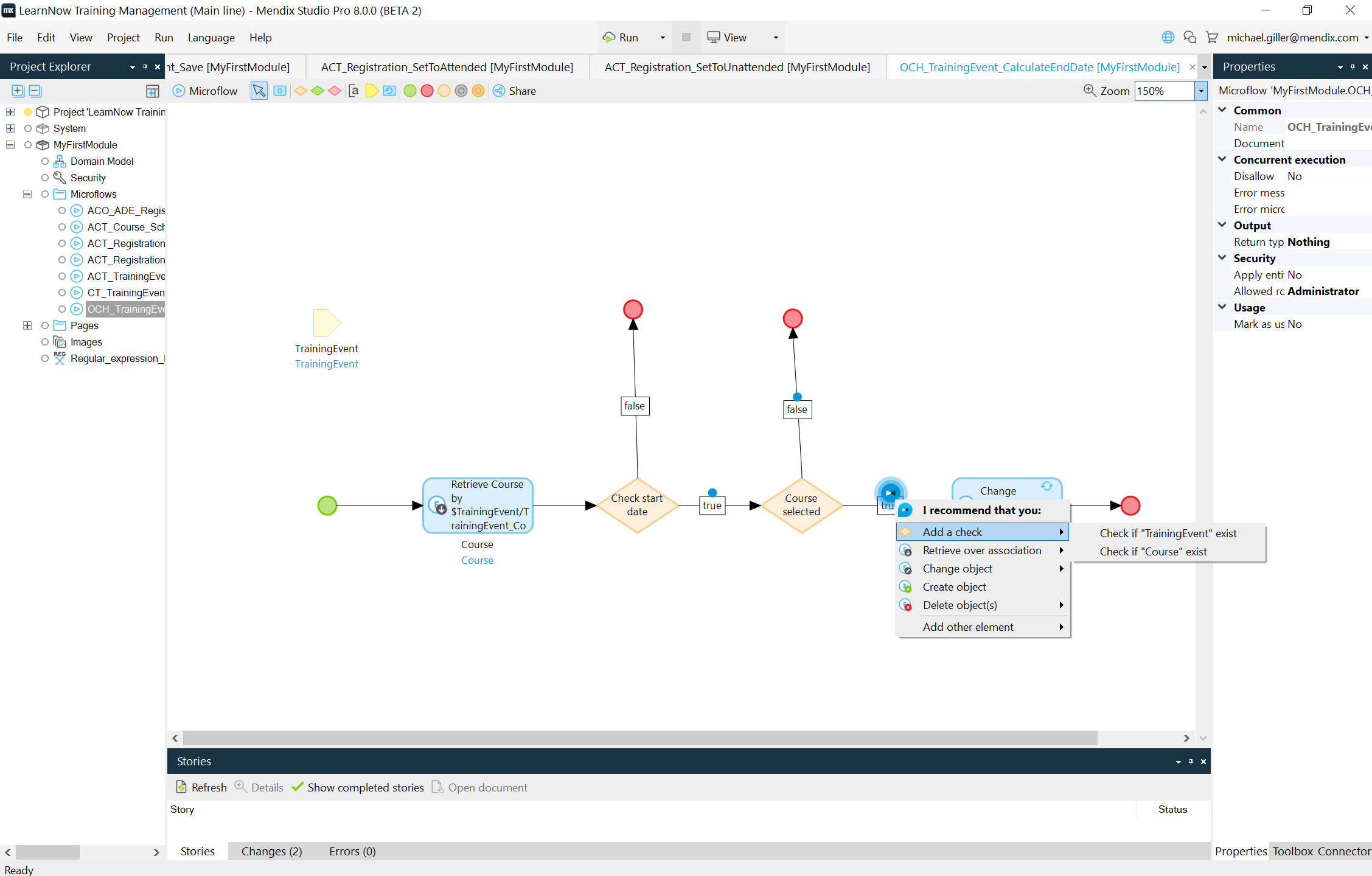
    The rate at which low-code applications are built and deployed will accelerate as developers begin to rely more on artificial intelligence (AI) to write code. The summer 2019 release of the Mendix low-code platform includes a revamped instance of Mendix Assist, which employs machine learning algorithms to make coding recommendations. Those algorithms have been trained using data drawn from 5 million application models employed across 15 industries over the last 10 years, and Mendix claims this version of Mendix Assist improves the accuracy rate of the recommendations being made to 95%.

    Sheryl Koenigsberg, director of product and solutions marketing for Mendix, said Mendix Assist will enable new developers to write better code faster, while experienced developers will be able to employ Mendix Assist to address routine issues that often get overlooked faster. Mendix Assist not only advises developers on what to do next but also generates recommended actions in previous logical steps based on whatever new code is introduced in the application.

    Mendix

    To make these capabilities more accessible, the summer release of Mendix adds Mendix Studio and Studio Pro, a set of integrated development environments designed to be accessible to both citizen and professional developers, to the low-code platform.

    In addition, Mendix is adding support for native mobile application development by adding support for React, a set of JavaScript libraries for building user interfaces for mobile applications, and including a native JavaScript editor. Those capabilities eliminate the need to rely on emulation software when building mobile computing applications, said Koenigsberg. Because the Mendix IDEs integrate low-code abstraction across iOS, Android, Java and Objective-C programming models, it also becomes easier for mobile developers to build reusable components. Mendix has also included more than 50 pre-built connectors to mobile device capabilities, such as camera, geolocation, biometric authentication and Bluetooth enablement, along with support for conversational chatbots and voice interfaces such as Alexa and Siri.

    Longer-term, Koenigsberg observed that it’s conceivable the AI capabilities being included in application development tools eventually will share insights with AI models being incorporated into continuous integration/continuous deployment (CI/CD) platforms. Proposed changes to an application could, for example, might be assessed from a performance perspective before any lines of code are written.

    In the meantime, the rate at which low-code applications will be moving through CI/CD platforms is about to increase substantially as developers augment their own skills by relying more on recommendations surfaced by AI engines. The quality of those applications should also improve as AI engines check, for example, to make sure all the appropriate compliance and cybersecurity controls are in place.

    It’s not likely AI engines will replace the need for developers anytime soon. However, it is apparent all the little things that routinely conspire to slow application development and delivery processes increasingly will be automated. That should make it easier for a larger number of organizations to embrace best DevOps processes. After all, the primary issue with DevOps adoption these days is not necessarily appreciating the value of the concept, but rather managing pipelines that still tend to get clogged every time an application fails to pass a gate because a developer forgot to do one thing or another.

    — Mike Vizard

  • How Low-Code and No-Code Solutions Compare to RAD

    How Low-Code and No-Code Solutions Compare to RAD

    Low-code and no-code solutions help line-of-business workers to create applications more quickly and advance business needs. But how do low-code solutions compare to the rapid application development (RAD) tools of yesterday for non-developers? Let’s take a look at the drawbacks and advantages of the low-code solutions of today, who should use these solutions and which application types are best-suited for low-code/no-code.

    RAD vs. Low-Code/No-Code

    First off, let’s discuss some of the key differences between RAD and low-code/no-code solutions. RAD solutions are development tools that combine an integrated development environment (IDE) with some code generation features, primarily on the UI side.

    No-code/low-code, on the other hand, refers to platforms on which codeless design time produces fully deployed applications, whether in the cloud or on-premises. This includes the entire application technology stack—back end, middle tier and UI. While it might not be accurate to say all low-code solutions are RAD solutions, it would be accurate to say low-code is an offshoot of RAD, though a far cry from the RAD solutions of the early ’90s.

    Low-Code and No-Code Advantages 

    Modern low-code and no-code platforms are advantageous to non-professional developers because of their shorter learning curves. These solutions cover the entire application stack and development, testing and deployment process. There is also no need to install multiple components to create a fully functional development environment, as most of the new tools run in a browser and deploy in the cloud.

    Low-Code and No-Code Drawbacks 

    The drawbacks of low-code/no-code platforms are similar to those experienced with RAD. You still need to deal with the code, since in many cases the developer has no control or knowledge of what files were generated or modified as a result of visual tool-related activities. This affects source control approaches and integrations of the code with third-party components. Furthermore, the quality of generated code can be questionable and proprietary in some implementations. This can lead to issues with code integrity across implementations if care is not taken.

    One of the key factors of measuring the quality of the generated code is it should use the most popular and widely available (open source) frameworks instead of proprietary frameworks, so further maintenance of the code is straightforward and does not require an additional learning curve. The quality and complexity of the generated code also should be measured using traditional tools.

    When to Use Low-Code/No-Code 

    Which applications work well with low-code/no-code development? Because low-code and no-code allow developers to concentrate on the business logic of building blocks, this strategy is well-suited for business-type applications. Low-code building blocks and components can be created by more technical people also by injecting some code into standard visual components, ending up with no-code required building blocks for businesspeople to construct applications. This approach also fits well into the “bimodal IT” approach popularized by Gartner.

    Low-code/no-code and RAD were both built with the same end goal in mind: to speed development and deliver applications more quickly and more consistently. However, low-code solutions offer a more visual way of building apps more well-suited for less experienced developers. It also can empower team members who otherwise would not be able to do so to create applications more easily. Modern low-code solutions also give the developer a great deal of flexibility because typically you can incorporate both the low-code building blocks with custom code, meaning the application can be customized.

    Whether you’re new to low-code or no-code or just getting started, this solution is a great choice to help accelerate part of (or even your entire) development pipeline. If you’ve tried RAD in the past, give no-code/low-code a try and see if it’s right for you.

    — Dmitry Binunsky

  • Low-Code Has Taken Development by Storm. Why Not the Web?

    Low-Code Has Taken Development by Storm. Why Not the Web?

    For more than a decade, development tools increasingly have made their way into the hands of less-technical people. On the web in particular, we’ve eliminated the webmaster as the middleman with content management systems and moved progressively toward a model where non-technical users could assemble their own sites with little to no coding experience of their own.

    Fast forward and today, the terms “no-code” and “low-code” are used to describe this idea. Furthermore, no-code and low-code tools have been on a decade-long rise, with an increasing impact on the web. Examples include:

    While this has been a strong, decade-long market trend, we’re only at the beginning. This trend won’t stop until new website experiences are automatically generated and optimized by machine learning.

    Trends Driving the Low-Code and No-Code Movements

    According to Wave, “In our survey of global developers, 23% reported using low-code platforms in 2018, and another 22% planned to do so within a year.”

    Major market forces driving this trend include a talent shortage among developers, with an estimated 1 million computer programming jobs expected to remain unfilled by 2020 in the U.S. alone. What’s more, the developers who are employed are often overloaded with work and struggle with how to prioritize it all. Some of this burden could be removed by low-code and no-code tools, allowing marketers and other non-technical professionals to do some of the development work themselves. In addition, the fact that technology has permeated every aspect of our lives, from our smartphones to our smart homes, has driven the need for more people to become creators.

    “As creating things on the internet becomes more accessible, more people will become makers. It’s no longer limited to the <1% of engineers that can code, resulting in an explosion of ideas from all kinds of people,” said Ryan Hoover, founder of Product Hunt, in a blog post.

    In other words, the supply of web creators must keep up with the demand for more digital experiences across more channels.

    But this does not only apply to individuals. Consider this: The typical large organization has to build and maintain hundreds of sites. These organizations need to build, launch and customize sites in days or weeks, not months. Today and in the future, marketers and other non-technical stakeholders can embrace no-code and low-code tools to develop websites rapidly.

    Abstraction Drives Innovation

    As predicted in my middleman blog post, developers won’t go away. Just as the role of the original webmaster has evolved with the advent of the CMS, the role of web developers is changing with the rise of low-code and no-code tools.

    Today, developers tend to focus on creating next-generation digital experiences that require new and emerging technologies not yet available in no-code solutions. In the process, they help invent and build new technologies such as React, Vue.js, etc.

    Successful no-code approaches abstract away complexity for web development. This enables less-technical people to do things that previously only could be done by developers. When those abstractions happen, developers can move on to the next area of innovation.

    Such abstractions are a good thing for both developers and non-technical website creators. When everyone is a builder, more good things will happen on the web. I was excited about this trend more than 12 years ago and remain excited today. I’m eager to see the progress no-code and low-code solutions will bring to the digital world in the next decade.

    — Dries Buytaret