Tag: KPIs

  • GitLab Strengthens Remote DevOps Management

    GitLab Strengthens Remote DevOps Management

    GitLab this week moved to provide remote developers with access to a more secure continuous integration/continuous delivery (CI/CD) platform while at the same time adding a dashboard that makes it simpler to track the overall status of application development projects.

    David DeSanto, chief product officer for GitLab, said GitLab Remote Development takes advantage of an instance of the GitLab CI/CD platform running on a Kubernetes cluster. That cluster is accessed via a Web-based integrated development environment (IDE) to eliminate the need for developers to create development environments on their local desktops.

    That capability reduces developers’ time and effort on tasks other than code and gives organizations more centralized control over the intellectual property being created, noted DeSanto. Organizations will no longer have to worry, for example, about theft of a developer’s laptop that has sensitive data on it, he added. In addition, organizations will be able to more easily create “golden” images that can be consistently accessed by developers residing in multiple locations.

    In addition to making it easier to centrally manage a distributed team of developers, GitLab is also adding a GitLab Value Streams Dashboard that provides senior executives with access to metrics that assess the overall health of an application development project. While GitLab has always provided metrics to DevOps teams, DeSanto said this dashboard, available as a private beta, makes it possible to identify, for example, bottlenecks that might result in delayed delivery of an application.

    Value stream management (VSM) is, of course, not a new idea. The issue that DevOps teams are trying to come to terms with is whether they need to adopt a dedicated VSM platform. The other option is to simply provide a set of dashboards that enable senior IT and business executives to track projects’ progress without deciphering a set of much lower key performance indicators (KPIs). Previously, the GitLab platform surfaced a lot of nitty-gritty details that don’t provide the context senior executives required, noted DeSanto. The Value Streams Dashboard metric surfaces KPIs based on DevOps Readiness Assessments (DORA) metrics from Google alongside other flow metrics.

    These latest offerings are part of a larger case being made for an integrated DevOps platform that reduces the total cost of application development by eliminating the need for organizations to integrate various tools themselves. Each DevOps team can employ as many of the modules GitLab makes available as they need. Once invoked, they take advantage of the same data store as every other element of the GitLab platform. That capability is becoming more critical as organizations embrace platform engineering to reduce the cost of application development using DevOps best practices, said DeSanto.

    It’s not clear how much interest there is in replacing legacy CI/CD platforms that, in some instances, have been in place for nearly a decade. However, as the pace at which applications are being built and deployed continues to accelerate, there is no doubt that organizations of all sizes will need to modernize application development processes.

  • Best of 2021 – Nine Pillars of DevOps Best Practices

    Best of 2021 – Nine Pillars of DevOps Best Practices

    As we close out 2021, we at devopsy.kinsta.cloud wanted to highlight the most popular articles of the year. Following is the fourteenth in our series of the Best of 2021.

    In a prior blog I explained my 27-factor DevOps assessment model which includes nine pillars of DevOps and three dimensions of people, process and technology.

    The nine pillars represent categories of practices. In this blog, I include examples of practices for each of the nine pillars. In a future blog I will explain how to use these practices to conduct a gap assessment for your DevOps practices.

    Leadership Practices for DevOps

    • Leaders demonstrate a long-term vision for organizational direction and team direction.
    • Leaders intellectually stimulate the team by encouraging them to ask new questions and question basic assumptions about the work.
    • Leaders provide inspirational communication that inspires pride in being part of the team, says positive things about the team, inspires passion and motivation and encourages people to see that change brings opportunities.
    • Leaders demonstrate support by considering others’ personal feelings before acting, being thoughtful of others’ personal needs and caring about individuals’ interests.
    • Leaders promote personal recognition by commending teams for better-than-average work, acknowledging improvements in the quality of work and personally complimenting individuals’ outstanding work.

    Collaborative Culture Practices for DevOps

    • The culture encourages cross-functional collaboration and shared responsibilities and avoids silos between Dev, Ops and QA.
    • The culture encourages learning from failures and cooperation between departments.
    • Communication flows fluidly across the end-to-end cross-functional team using collaboration tools where appropriate (for example Slack, HipChat, Yammer).
    • The DevOps system is created by an expert team, and reviewed by a coalition of stakeholders including Dev, Ops and QA.
    • Changes to end-to-end DevOps workflows are led by an expert team, and reviewed by a coalition of stakeholders including Dev, Ops and QA.
    • DevOps system changes follow a phased process to ensure the changes do not disturb the current DevOps operation. Examples of implementation phases include: proof of concept (POC) phase in a test environment, limited production and deployment to all live environments.
    • Key performance indicators (KPIs) are set and monitored by the entire team to validate the performance of the end-to-end DevOps pipeline, always. KPIs include the time for a new change to be deployed, the frequency of deliveries and the number of times changes fail to pass the tests for any stage in the DevOps pipeline.

    Design-for-DevOps Practices for DevOps

    • Products are architected to support modular independent packaging, testing and releases. In other words, the product itself is partitioned into modules with minimal dependencies between modules. In this way, the modules can be built, tested and released without requiring the entire product to be built, tested and released all at once.
    • Applications are architected as modular, immutable microservices ready for deployment in cloud infrastructures in accordance with the tenets of 12-factor apps, rather than monolithic, mutable architectures.
    • Software source code changes are pre-checked with static analysis tools, prior to commit to the integration branch. Static analysis tools are used to ensure the modified source code does not introduce critical software faults such as memory leaks, uninitialized variables, and array-boundary problems.
    • Software code changes are pre-checked using peer code reviews prior to commit to the integration/trunk branch.
    • Software code changes are pre-checked with dynamic analysis tests prior to committing to the integration/trunk branch to ensure the software performance has not degraded.
    • Software changes are integrated in a private environment, together with the most recent integration branch version, and tested using functional testing prior to committing the software changes to the integration/trunk branch.
    • Software features are tagged with software switches (i.e., feature tags or toggles) during check-in to enable selective feature-level testing, promotion and reverts.
    • Automated test cases are checked in to the integration branch at the same time code changes are checked in, together with evidence that the tests passed in a pre-flight test environment.
    • Developers commit their code changes regularly, at least once per day.

    Continuous Integration Practices for DevOps

    • A software version management (SVM) system is used to manage all source code changes. (Git, Perforce, Mercurial, etc.)
    • A software version management (SVM) system is used to manage all versions of code images changes used by the build process. (Git, Perforce, Mercurial, etc.)
    • A software version management (SVM) system is used to manage all versions of tools and infrastructure configurations and tests that are used in the build process. (Git, Perforce, Mercurial, etc.)
    • All production software changes are maintained in a single trunk or integration branch of the code.
    • The software version(s) for supporting each customer release are maintained in a separate release branch to support software updated for each release.
    • Every software commit automatically triggers a build process for all components of the module that has code changed by the commit. The system is engineered such that resources are always sufficient to execute a build.
    • Once triggered, the software build process is fully automated and produces build artifacts, provided the build time checks are successful.
    • The automated build process checks include unit tests.
    • Resources for builds are available on-demand and never block a build.
    • CI builds are fast enough to complete incremental builds in less than an hour.
    • The build process and resources for builds scale up and down automatically according to the complexity of the change. If a full build is required, the CI system automatically scales horizontally to ensure the builds are completed as quickly as possible.

    Continuous Testing Practices for DevOps

    • Development changes are pre-flight tested in a clone of the production environment prior to being integrated to the trunk branch. (Note: “production environment” means “variations of customer configurations of a product.”)
    • New unit and functional regression tests that are necessary to test a software change are created together with the code and integrated into the trunk branch at the same time the code is. The new tests are then used to test the code after integration.
    • A test script standard is used to guide test script creation, to ensure the scripts are performing the intended test purpose and are maintainable.
    • Tests are selected automatically according to the specific software changes. CT is orchestrated dynamically, whereby the execution of portions of the CT test suites may be accelerated, or skipped entirely, depending on how complex or risky the software changes are.
    • Test resources are scaled automatically according to the resource requirements of specific tests selected and the available time for testing.
    • Release regression tests are automated. At least 85% of the tests are fully automated and the remaining are auto-assisted if portions must be performed manually.
    • Release performance tests are automated to verify that no unacceptable degradations are released.
    • Blue/green testing methods are used to verify deployments in a staging environment before activating the environment to live. A/B testing methods are used together with feature toggles to try different versions of code with customers in separate live environments. Canary testing methods are used to try new code versions on selected live environments.
    • The entire testing life cycle, which may include pre-flight, integration, regression, performance and release acceptance tests are automatically orchestrated across the DevOps pipeline. The test suites for each phase include a predefined set of tests that may be selected automatically according to predefined criteria.

    Elastic Infrastructure Practices for DevOps

    • The data and executable files needed for building and testing builds are automatically archived frequently and can be reinstated on demand. Archives include all release and integration repositories. If an older version of a build needs to be updated, then the environment for building and testing that version can be retrieved and reinstated on demand and can be accomplished in a short time (for example, minutes to hours.)
    • Build and test processes are flexible enough to automatically handle a wide variety of exceptions gracefully. If the build or test process for a component is unable to complete, then the process for that failed component is reported and automatically scheduled for analysis, but build and test processes for other components continue. The reasons for the component failure are automatically analyzed and rescheduled if the reason for the failure can be corrected by the system; if not, then it is reported and suspended.
    • System configuration management and system inventory is stored and maintained in a configuration management database (CMDB).
    • Infrastructure changes are managed and automated using configuration management tools that assure idempotency.
    • Automated tools are used to support immutable infrastructure deployments.
    • Equal performance for all. The user performance experience of the build and test processes by different teams are consistent for all users, independent of location or other factors. There are SLAs and monitoring tools that ensure the user performance experience is consistent for all users.
    • Fault recovery mechanisms are provided. Build and test system fault monitoring, fault detection, system and data monitoring and recovery mechanisms exist. They are automated and are consistently verified through simulated failure conditions.
    • Infrastructure failure modes are frequently tested.
    • Disaster recovery procedures are automated.

    Continuous Monitoring Practices for DevOps

    • Logging and proactive alert systems make it easy to detect and correct DevOps system failures. Logs and proactive system alerts are in place for most DevOps component failures, and are organized in a manner to quickly identify the highest-priority problems.
    • Snapshot and trend results of each metric from each DevOps pipeline stage (for example, builds, artifacts, tests) are automatically calculated in process and visible to everyone in the Dev, QA and Ops Teams.
    • Key performance indicators (KPIs) for the DevOps infrastructure components are automatically gathered, calculated and made visible to anyone on the team that subscribes to them. Example metrics are availability (uptime) of computing resources for CI, CT and CD processes, time to complete builds, time to complete tests, number of commits that fail and number of changes that need to be reverted due to serious failures.
    • Metrics and thresholds for DevOps infrastructure components are automatically gathered, calculated and made visible to anyone on the team that subscribes to them. Example metrics are availability (uptime) of computing resources for CI, CT and CD processes, time to complete builds, time to complete tests, number of commits that fail and number of changes that need to be reverted due to serious failures.
    • Process analytics are used to monitor and improve the integration, test and release process. Descriptive build and test analytics drive process improvements.
    • Predictive analytics are used to dynamically adjust DevOps pipeline configurations. For analysis of test results, data may indicate a need to concentrate more testing in areas that have a higher failure trend.

    Continuous Security Practices for DevOps

    • Developers are empowered and trained to take personal responsibility for security.
    • Security assurance automation and security monitoring practices are embraced by the organization.
    • All information security platforms that are in use expose full functionality via APIs for automation capability.
    • Proven version control practices and tools are used for all application software, scripts, templates and blueprints that are used in DevOps environments.
    • Immutable infrastructure mindsets are adopted to ensure production systems are locked down.
    • Security controls are automated so as not to impede DevOps agility.
    • Security tools are integrated into the CI/CD pipeline.
    • Source code for key intellectual property on build or test machines are only accessible by trusted users with verified credentials. Build and test scripts do not contain credentials for access to any system that has intellectual property. Intellectual Property is divided such that not all of it exists on the same archive and each archive has different credentials.

    Continuous Delivery Practices for DevOps

    • Delivery and deployment stages are separate. The delivery stage precedes the deployment pipeline.
    • All deliverables that pass the delivery metrics are packaged and prepared for deployment using containers.
    • Deliverable packages include sufficient configuration and test data to validate each deployment. Configuration management tools are used to manage configuration information.
    • Deliverables from the delivery pipeline are automatically pushed to the deployment pipeline, once acceptable delivery measures are achieved.
    • Deployment decisions are determined according to predetermined metrics. The entire deployment process may take hours, but usually less than a day.
    • Deployments to production environments are staged such that failed deployments can be detected early and impact to customers isolated quickly.
    • Deployments are arranged with automated recovery and self-healing capabilities in case a deployment fails.

    What This Means

    DevOps is a powerful tool that enables many benefits for organizations that use it. Achieving performance efficiently with DevOps depends on following best practices. By following the nine pillars of practices enumerated in this blog, organizations can achieve the performance potential that DevOps has to offer.

  • Allstacks Adds Free Dashboard to Track Software Dev Benchmarks

    Allstacks Adds Free Dashboard to Track Software Dev Benchmarks

    Value stream intelligence platform provider Allstacks today added a free live dashboard populated with anonymized data that DevOps teams can use to benchmark their own progress.

    Hersh Tapadia, Allstacks co-founder and CEO, said the company is making this data available to make it easier for DevOps teams to uncover bottlenecks in their software development processes.

    As part of that effort, the dashboard includes pre-configured benchmarks for the following:

    How many days per week do benchmark teams write code?
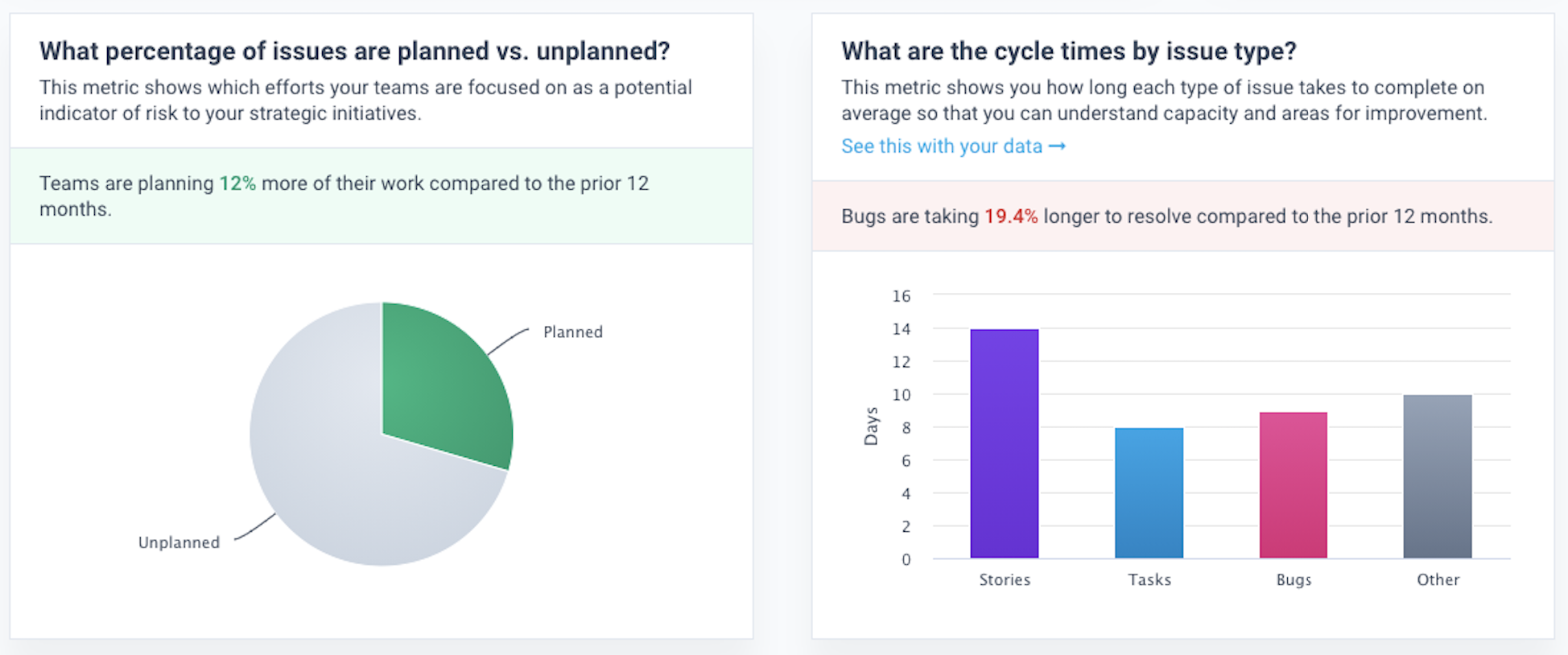
    What percentage of issues are planned versus unplanned for benchmark teams?
    What are the cycle times per issue type for benchmark teams?
    What types of code do benchmark companies produce?
    What is the average commit size for benchmark customers?

    Allstacks

    Allstacks has committed to making 12 months of data publicly available on the dashboard and said it will update that data on an ongoing basis. Allstacks customers, however, can also access five years of data to compare historical trends.

    Tapadia said Allstacks plans to add additional benchmarks to a dashboard that can collect data via the various application programming interfaces (APIs) that most DevOps tools now routinely provide. The overall goal is to increase transparency into software development processes, he said.

    Allstacks’ value stream intelligence platform uses machine learning algorithms and artificial intelligence (AI) models to identify projects that are at risk of not meeting delivery goals. That data is then used to analyze the impact those missed deadlines are likely to have on various business objectives.

    Value stream management platforms automatically take technical metrics, gathered via a DevOps process, and match them to a set of key performance indicators (KPIs) defined by business leaders. The challenge many organizations still face is making sure they have the tools in place to collect the appropriate technical metrics and then define the KPIs that truly matter to the business. Once those metrics are gathered and KPIs established, organizations are then able to apply advanced analytics to the massive amounts of DevOps data they collect.

    The concept of value stream management traces its lineage back to lean manufacturing methods, which called for each step of a manufacturing process to be continuously measured. As software development has evolved from being a craft to a process that is highly automated using DevOps best practices, an appreciation for the value of monitoring the impact of missed software development deadlines on the business has grown as organizations realize how dependent they are on software.

    As a result, more organizations realize there is a clear disconnect between their business goals and development processes, noted Tapadia. Business leaders are especially anxious to understand how a software development project delay might impact future revenue projections. Rather than being a set of tools employed mainly by IT leaders to track software development projects, value stream management platforms make it possible for other stakeholders to track KPIs spanning multiple software development projects. It then becomes easier to make informed decisions about how to reassign resources across various projects as different bottlenecks are encountered.

    It may be a while before organizations achieve that level of transparency into their software development processes, but as software continues to ‘eat the world,’ it’s only a matter of time before value stream management becomes a required set of DevOps tools for every organization.

  • How to Optimize Data in Software Development

    How to Optimize Data in Software Development

    Data can drive significant business value for every company. Globally, we are collecting more of it than ever before, and it keeps growing—from 45 zettabytes in 2019 to a projected 175 zettabytes by 2025, according to IDC. However, companies are struggling to monetize all the personal, behavioral, engagement and transactional data from customers and operations and turn it into actionable intelligence to drive their digital strategies. Leveraging insights from your data is critical for success and the development of new digital solutions to better serve customers, grow sales, improve operations and more.

    Data helps organizations develop the right software for the right customer at the right time. Data-driven organizations are 23 times more likely to acquire and retain customers than their peers, and are growing at an average of more than 30% annually, according to Forrester.

    Organizations with a deep and dedicated focus on data and analytics tend to follow three common paths to successfully drive their software development initiatives.

    Discovery Matters

    It is nearly impossible to draw value, understanding, and insights from the massive amount of data businesses collect without a proper discovery system in place. Having a comprehensive process of collecting data from various databases and silos and consolidating it into a single source that can be easily and instantly evaluated is critical for any software development project.

    During client engagements, data scientists perform deep-dive research into clients’ data pools and workflows to support client roadmaps. We recently partnered with a global e-commerce company to create a recommendation system for their customers. The discovery process allowed us to verify the feasibility of recommended products using their existing data before moving ahead with the project. Using machine learning, the team was able to clean and analyze information from multiple angles. With that knowledge and confidence, the rest of the development project proceeded quickly knowing the data was in place and the project was viable.

    Align KPIs

    Software development metrics help organizations and their partners track and measure how an application is performing and how effective the development team is in its work. IT organizations rely on a range of KPIs to fully understand software engineers’ progress, as well as gauge software quality including performance, engagement and user satisfaction. While each engagement is different and requires a different set of KPIs, ensuring that the organization and development team are on the same page is crucial.

    During the e-commerce project, success was measured through conversion and user retention rates. Other KPIs that are regularly used include developer productivity and performance metrics like cycle time and team velocity, and software developer metrics like response time, usability and UX data, among others.

    Deploy Agile

    By using agile methodologies at all stages of development, developers are able to focus on business results, not just architecture and new technologies. A similar agile approach can also be applied to data management. When it comes to data science, it’s all about extracting useful information from raw, structured and unstructured data and implementing machine learning models to analyze vast amounts of information. This process requires more creativity and is a key driver for understanding potential risks and failures over the course of any given project.

    With agile, data models and analyses are broken down into manageable bite-sized chunks that can be built and tested quickly—the same way software is developed. If the analytics do not yield the expected results, data scientists see the failures immediately and can correct their course. They could ask the team to analyze different data sets, adjust the models, tweak algorithms or make an educated decision about the project’s viability.

    A multinational credit company took this approach to the next level when it used agile to develop a new, big data hybrid cloud platform. After anonymizing, aggregating and storing information in a data lake, the team quickly realized the database it was planning to use was limited to a certain number of partitions and entities. By running agile sprints and developing and testing the minimum viable product (MVP) continuously, the team was able to seamlessly switch to a new database that had more scale and functionality.

    The value of data is only going to increase with time. Data-driven organizations embrace the use of data and analytics to gain unique business insights to support their software development projects and overall business. By focusing on the data in each and every development project, companies have a tremendous opportunity to gain a competitive advantage and grow their businesses.

  • CircleCI CEO Sees Growing Need for Developer Experience Engineers

    CircleCI CEO Sees Growing Need for Developer Experience Engineers

    There is no shortage of titles to go with all the tasks that make up a DevOps workflow, but given the critical role developers now play within any organization, it might be time for organizations to start creating a developer experience engineer (DXE) function within DevOps teams that is specifically tasked with increasing developer productivity.

    CircleCI CEO Jim Rose said it’s become apparent there is more friction than ever in the application development and deployment process, as more complex applications are constructed, thanks, in part, to the rise of microservices.

    A DXE, as outlined in a report published by CircleCI, would be responsible for implementing a common set of DevOps principles, maintaining the right tools and putting in place a cohesive set of standard processes that ensure developer success. Today, there are simply too many languages, frameworks, engineering styles and processes being employed within the same organization, and that conspires to reduce overall developer productivity, said Rose.

    While software engineers are, today, addressing subsets of these issues, Rose said the time has come to assign these tasks to an engineering team that views itself as an advocate for developers by making available more responsive infrastructure.

    As organizations of all sizes increasingly realize how dependent they are on software to drive digital business transformation initiatives, Rose noted that developer productivity is becoming a major corporate issue. Revenue forecasts and profit margins are now being directly impacted by the rate at which software is being delivered and updated.

    Software engineers today routinely build DevOps pipelines for developers, but not much time and effort is put into optimizing the developer experience, noted Rose. That’s become not only a major productivity issue, Rose said, it has a material impact on the ability of organizations to attract and retain developer talent. One of the reasons so many developers prefer to work for smaller startups than large enterprises is because their daily work experience is simply better. Large organizations need to reduce the amount of friction developers experience if they want to be able to compete for that same talent, said Rose.

    A DXE would also be more inclined to solicit input from developers on tool selection to best optimize productivity, noted Rose. Many software engineers today construct pipelines with little to no regard for how simple or hard it might be for a developer to employ tooling.

    Organization today are, of course, starting to become more obsessed with measuring application development velocity. However, in many cases, simply making someone responsible for achieving a goal is going to result in more gains at a lower cost. Analytics tools have a role to play, but obsessing over key performance indicators (KPIs) may not generate the same result as quickly as simply giving an engineer a specific mandate.

    As responsibility for application management continues to shift left toward developers, it should not come as a surprise that there is a lot more interest in automating the underlying infrastructure. The issue, at this point, is determining to what degree software engineers are going to achieve that goal versus forcing developers to seek out yet another platform that promises to do it on their behalf.