Tag: ITSM

  • Bringing Trust and Governance to AI-Driven DevOps

    Bringing Trust and Governance to AI-Driven DevOps

    At swampUP 2025 in Napa Valley, Alan Shimel sat down with three industry leaders whose companies sit at the heart of today’s AI-driven DevOps transformation: Rahul Tripathi, general vice president and GM of ITSM at ServiceNow; Justin Boitano, vice president of enterprise AI at NVIDIA; and Shlomi Ben Haim, co-founder and CEO of JFrog.

    Tripathi, only months into his role at ServiceNow, stressed the importance of grounding product strategy in lived practitioner experience. Having led DevOps teams himself, he emphasized that ITSM remains the “bread and butter” of ServiceNow, but AI integration is reshaping expectations for productivity and security across IT operations.

    Boitano reflected on NVIDIA’s long journey from pushing CUDA adoption in 2008—when many thought GPU computing was a stretch—to today, where GPUs and AI frameworks have become central to enterprise computing. He noted that partnerships with companies like ServiceNow and JFrog are critical to building out the ecosystem, particularly as organizations look to infuse AI into every layer of their development lifecycle.

    Ben Haim underscored the urgency behind what he called “AI FOMO.” With board-level pressure driving 40% of CIOs to expand AI budgets, enterprises are rapidly embedding AI into software supply chains. For JFrog, that means positioning itself as the “system of record” for DevOps, launching new platforms like JFrog Fly to simplify AI agent adoption while strengthening governance, traceability and security.

    Together, the panel painted a picture of an industry balancing excitement with pragmatism. AI agents may not replace developers anytime soon, but they are already changing workflows, tooling expectations, and the economics of software delivery. As the panelists made clear, success will depend less on hype and more on how well organizations align AI adoption with trust, verification, and long-term resilience.

  • Techstrong Group Launches Techstrong ITSM Community Platform to Bridge the Gap Between Agile, DevOps and ITSM

    Techstrong Group Launches Techstrong ITSM Community Platform to Bridge the Gap Between Agile, DevOps and ITSM

    Techstrong Group launches new ITSM site to empower organizations to navigate the complete IT life cycle with greater efficiency, quality and agility.

    Boca Raton, FL, February 28, 2024 — Techstrong Group, the power source for people and technology, today announced the launch of its latest community site, Techstrong ITSM. This new venture seamlessly integrates Agile, DevOps and IT service management (ITSM) methodologies into a unified resource for IT professionals, offering a holistic approach to managing the complete IT life cycle.

    “We recognized a critical gap in the current IT landscape: The need for a cohesive strategy that encompasses Agile’s adaptability, DevOps’ efficiency and ITSM’s reliability,” said Techstrong Group CEO Alan Shimel. “The mission of Techstrong ITSM is to offer a comprehensive resource that facilitates understanding, adoption and integration of these methodologies across the entire IT life cycle.”

    Techstrong ITSM offers a wealth of resources designed to empower IT professionals, managers and organizational leaders:

    • Educational Content: Articles, tutorials and case studies provide insights into best practices, challenges and solutions for integrating Agile, DevOps and ITSM.
    • Tools and Resources: Access to tools, templates and frameworks facilitate the practical application of these methodologies across the IT life cycle.
    • Community Engagement: Forums and discussion groups foster a community of continuous learning and improvement, allowing professionals to share experiences, advice and support.

    Techstrong ITSM offers a platform for organizations to enhance their IT capabilities and drive innovation in the digital era.

    For more information, read Alan Shimel’s blog or visit the Techstrong ITSM website.

    About Techstrong Group
    Techstrong Group is the power source for people and technology. Techstrong Group accelerates understanding of technologies that drive business. With a broad set of IT-related communities and offerings, Techstrong Group is the only media company serving the needs of IT leaders and practitioners with news, research, analysis, events, education, certifications and professional development. Our focus is DevOps, cybersecurity, AI, digital transformation, cloud and cloud native. Techstrong Group business units include: Techstrong Media (devopsy.kinsta.cloud, Security Boulevard, Cloud Native Now, Techstrong.ai, DigitalCxO, Techstrong ITSM, Techstrong TV and Techstrong Group Podcasts), Techstrong Research and Techstrong Learning. For technology providers, Techstrong business units offer many ways to share their stories, expand their audience and grow their business.

    Techstrong Group is based in Boca Raton, Florida. For more information, visit us on the web and follow us on LinkedIn.

    Contact
    Veronica Haggar
    veronica@techstronggroup.com

  • PagerDuty Previews Generative AI Copilot for ITSM

    PagerDuty Previews Generative AI Copilot for ITSM

    Under an early access program, PagerDuty, Inc. is making available a tool that brings generative artificial intelligence (AI) capabilities to its IT service management (ITSM) platform.

    Jonathan Rende, senior vice president of products for PagerDuty, said PagerDuty Copilot for the PagerDuty Operations Cloud extends previous investments in machine learning algorithms the company has made as part of an ongoing effort to apply AI to ITSM.

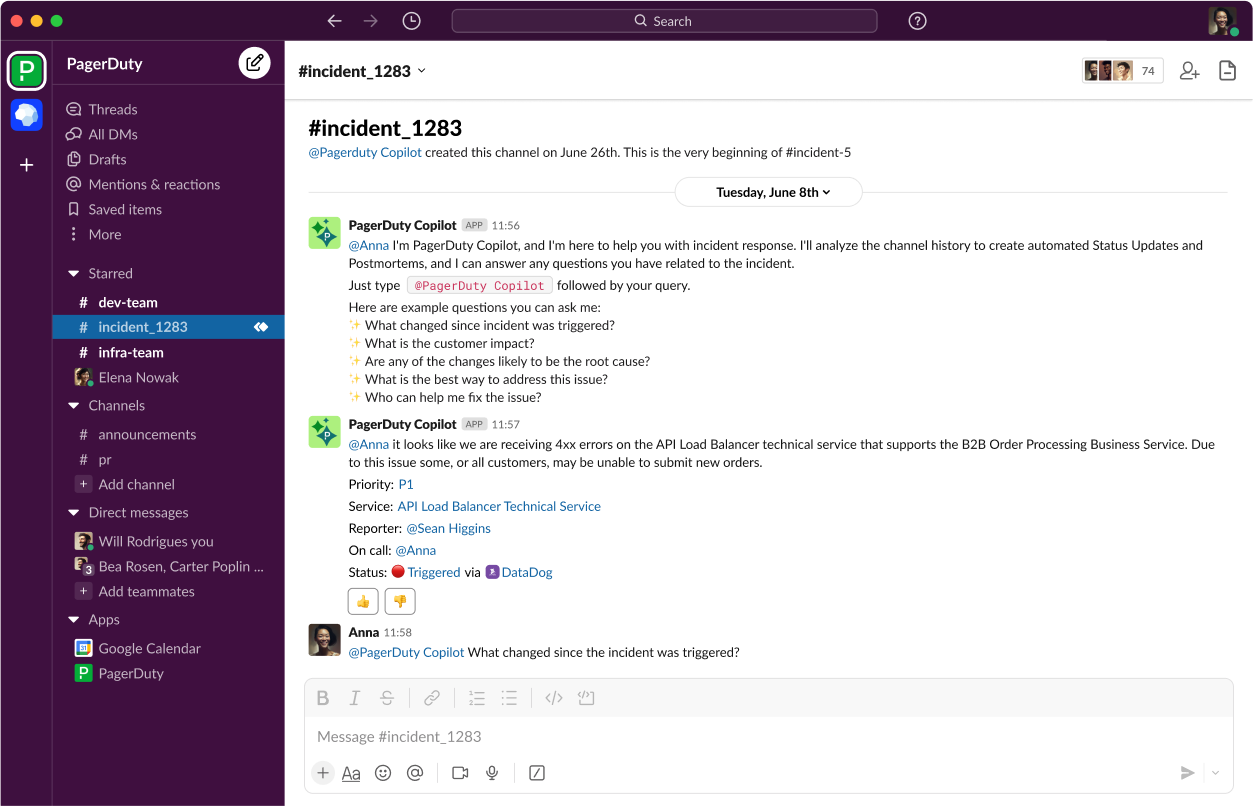
    Designed to be invoked via Slack, PagerDuty Copilot makes use of multiple large language models (LLMs) to automate tasks ranging from providing summarization of IT incidents to creating code to automate workflows. PagerDuty plans to transparently swap LLMs in and out of its platforms as AI advances continue to be rapidly made, noted Rende.

    PagerDuty Copilot provides a level of abstraction for invoking AI models along with appropriate guardrails that make it simpler to manage IT operations without IT teams needing to have AI expertise, said Rende.

    The overall goal is to boost the productivity of IT operations teams by eliminating much of the drudgery and toil that conspires to make working in IT tedious, noted Rende. AI technologies are not likely to replace the need for IT personnel as much as they will enable IT teams to focus on tasks that add more value to the business, he added.

    It’s now only a matter of time before generative AI capabilities are pervasively applied across both ITSM and DevOps workflows. Less clear is the impact those capabilities will have on the best practices currently relied on to manage those workflows as more tasks are automated. Ultimately, however, AI should make it easier for more organizations to embrace those best practices as the level of skill and expertise required to manage IT at scale is reduced.

    In addition, the whole concept of issuing tickets to manage tasks tracked by a central system of record may need to evolve simply because AI has automated requests for service. There will naturally need to be some system of record for tracking requests. Still, ultimately that process will be managed via copilots rather than by a ticket created by an end user that is then tracked via an ITSM platform.

    Savvy IT teams, in the meantime, are already moving to determine which tasks and workflows will be automated in anticipation of AI becoming more widely embedded in ITSM and DevOps platforms. Roles and responsibilities within IT teams will inevitably evolve as AI increasingly automates mainly mundane tasks, such as creating reports that many IT professionals would rather not spend time writing.

    The biggest IT management platform challenge in the future might not necessarily be adjusting to AI as much as it will be orchestrating requests that are likely to be generated by multiple types of copilots that have been embedded into almost every application.

    One way or another, AI is about to transform how IT operations are managed. As disruptive as those advances will be, AI, more importantly, will also enable organizations to manage IT at levels of scale that were previously unimaginable.

  • DevOps and ITIL Integration: Driving Collaborative Agility in ITSM

    DevOps and ITIL Integration: Driving Collaborative Agility in ITSM

    Businesses face continuous pressure to deliver high-quality IT services efficiently. One emerging integration to meet these goals is between DevOps and IT service management (ITSM), more commonly known as DevOps+.

    DevOps+ is becoming more than a trend and has emerged as a powerful collaborative approach to meet these challenges. By combining the strengths of DevOps’ agile software development practices and ITSM’s structured service management approach, organizations can foster better collaboration, enhance agility and improve overall service delivery efficiency.

    DevOps and ITSM Symbiosis

    DevOps and ITSM traditionally operated as separate frameworks with distinct focuses. DevOps emphasizes rapid software delivery and collaboration between development and operations teams. On the other hand, ITSM-based ITIL (information technology infrastructure library) provides best practices for ensuring service stability, reliability and adherence to governance and compliance.

    Integrating DevOps and ITIL creates a symbiotic relationship, allowing organizations to leverage the best of both worlds. DevOps+ encourages a cultural shift, breaking down silos and promoting cross-functional communication. This collaboration enhances the entire software development lifecycle, leading to faster feedback loops, accelerated innovation, and increased responsiveness to business needs.

    Enhancing Agility and Speed

    DevOps+ integration brings greater agility and speed to IT service management. Organizations can streamline the release process by automating deployment pipelines and implementing continuous integration and continuous delivery (CI/CD) practices, reducing time-to-market for new features and updates. Agile development methodologies enhance the adaptability of ITSM processes to meet evolving business requirements effectively.

    Ensuring Stability and Reliability

    While agility is crucial, it must not compromise service stability and reliability. ITIL’s best practices provide a strong foundation for maintaining service quality. By incorporating ITIL processes such as incident management, change management and problem management, organizations can effectively manage risks, reduce service disruptions and ensure the stability of critical IT services.

    Leveraging Automation and Orchestration

    Automation is central to both DevOps and ITIL. Through integration, organizations can leverage automation and orchestration tools effectively. Automated testing, infrastructure provisioning and configuration management improve efficiency and consistency across the ITSM lifecycle. This enables teams to focus on higher-value tasks, reducing manual errors and operational overhead.

    Emphasizing Customer-Centricity

    DevOps+ puts the end-user experience at the forefront of service delivery. By continuously seeking customer feedback and measuring service performance, organizations can better align their offerings with user expectations. A customer-centric approach fosters higher satisfaction, loyalty, and competitive advantage.

    Breaking Down Barriers to Change

    Change management is vital in ITIL, ensuring that modifications are planned and controlled. In the context of DevOps+, change management becomes more adaptive and responsive, facilitating a culture that embraces change as an integral part of the development process. This promotes experimentation, reduces resistance to change, and accelerates innovation.

    Challenges of DevOps and ITIL Integration

    Despite the numerous benefits of DevOps+ integration, organizations may encounter challenges during implementation:

    Cultural Shift: Merging DevOps and ITIL requires a cultural shift. Overcoming resistance to change and fostering collaboration between traditionally separate teams can be challenging but is crucial for success.

    Process Alignment: DevOps and ITIL have different processes and terminologies. Aligning these methodologies while preserving their individual strengths can be complex.

    Skill Sets: Integrating DevOps and ITIL necessitates upskilling teams in both domains to operate effectively in the integrated environment.

    Tooling and Automation: Adopting suitable tools and technologies that support DevOps+ practices and integration is vital but may require significant investments.

    Metrics and Performance Measurement

    Measuring the success of DevOps+ integration is essential to understand its impact and effectiveness. Key performance indicators (KPIs) can help monitor progress and identify areas for improvement.

    Deployment Frequency: The frequency of software deployments indicates the efficiency of the integrated approach. Higher deployment frequency implies faster and more reliable releases.

    Mean Time to Resolve Incidents (MTTR): MTTR measures how quickly teams can resolve incidents and restore services after disruptions occur. A reduced MTTR demonstrates improved service reliability and faster incident resolution.

    Customer Satisfaction Scores: Measuring customer satisfaction provides insights into how well the integrated approach meets end-users’ needs and expectations.

    Continuous Improvement and Feedback Loops

    Continuous improvement is at the core of DevOps+. Establishing feedback loops and conducting regular retrospectives empowers teams to identify areas for improvement and implement iterative enhancements to processes and practices.

    Implementing DevOps+ integration requires a well-structured roadmap. For example, assessment and planning help leaders evaluate the organization’s current ITSM practices to understand how DevOps and ITIL principles align and define integration vision and goals.

    Additionally, your continuous optimization efforts allow you to continuously monitor performance metrics, gather feedback, and conduct retrospectives to identify improvement areas, leading to better team collaboration and communication. Fostering cross-functional collaboration between development, operations and other relevant teams is easily accomplished. To meet these goals, encourage regular meetings, schedule joint planning sessions and enable shared documentation to ensure everyone is aligned on goals and progress.

    When this happens, leverage automation tools to streamline manual processes and increase efficiency. Implement continuous integration and continuous delivery pipelines to automate software deployment and testing. Automation enhances consistency, reduces the risk of human errors and adds a new layer for measuring and evaluating to continuously measure the performance of the integrated approach using defined KPIs. In this vein, you can regularly review progress against the initial vision and goals to ensure the integration aligns with organizational objectives.

    Next, as the DevOps+ integration proves successful in pilot projects, gradually scale and expand it to other teams and departments. Share the success stories and best practices to encourage broader organizational adoption.

    Conclusion

    In conclusion, the integration of DevOps and ITIL, known as DevOps+, marks a transformative approach to IT service management. By combining the agility and rapid deployment of DevOps with the stability and reliability of ITIL, organizations can drive collaborative agility and achieve efficient service delivery.

    DevOps+ integration requires overcoming cultural barriers, aligning processes and upskilling teams, but the rewards are immense. With clear metrics to measure success, organizations can continually optimize their DevOps+ approach to meet customer needs and adapt to evolving market demands.

    As technology evolves, DevOps+ integration will remain at the forefront of cutting-edge IT service management, empowering organizations to embark on a journey of innovation, efficiency and excellence.

    By embracing DevOps+ as a guiding philosophy, organizations can cultivate a culture of collaboration, continuous improvement and customer-centricity, laying the groundwork for a prosperous future in the dynamic world of IT service management.