Tag: itil

  • DevOps Versus ITIL: How to Win the Battle Over Change Management

    DevOps Versus ITIL: How to Win the Battle Over Change Management

    Ever since DevOps came on the scene a decade ago, ITIL has been under siege.

    ITIL lays out a number of IT service management (ITSM) best practices, including release management, change management, incident management, problem management and many other aspects of running an IT shop so that its priorities align with the business’s. For many enterprises, ITIL is essential for governance and regulatory compliance–especially in heavily regulated industries.

    The basic idea of DevOps is that by leveraging better automation technology across the software lifecycle, it’s possible to rework the culture and organization of all the teams involved in software production and deployment. By breaking down the numerous silos and fostering greater collaboration, it should be possible to dramatically accelerate the ability to deploy quality software at scale.

    From the DevOps perspective, ITIL is nothing but a set of speed bumps and roadblocks, getting in the way of its continuous integration/continuous delivery (CI/CD) priorities.

    DevOps wants to speed up software release cycles, while change management often slows them down. Does this dichotomy mean that enterprises have to choose one or the other? Or perhaps we have to water down one of these approaches sufficiently so it’s marginally compatible with the other one?

    Is ITIL Part of the Problem?

    ITIL skeptics abound. “Frameworks like ITIL create the illusion of control that results in [the] organizational delusion that IT is efficient and manageable,” said Greg Ferro, long-time consultant and co-founder at Packet Pushers Interactive. “The single biggest problem in ITIL [is that] the creation of silos creates ‘not my problem’ attitudes.”

    One such silo is the change advisory board (CAB), a team that has the responsibility for making thumbs-up or thumbs-down decisions on numerous different activities across the IT organization. “Having the CAB review every single change request isn’t efficient,” said Kaimar Karu, head of ITSM at AXELOS, “and it’s definitely not common sense, especially when their costs can run to tens of thousands of deployments per hour in some organizations.”

    One organization that has struggled to transform their ITIL process as it moved to a DevOps model is financial services firm ING. In fact, its CABs were a point of contention for it. “We were just like an insurance company, always rejecting your first claim,” said Mark Heistek, IT specialist at ING. “And then come back if you have good arguments.”

    ING found it was able to modify ITIL to work within its new DevOps approach. “Don’t do everything the ITIL book says,” advised Jan-Joost Bouwman, ITSM process owner at ING. And yet, following ITIL for practices such as incident management are “still the best way to do it, because everybody knows what to do and you don’t get confused about the rules.”

    Or Is ITIL Part of the Solution?

    In spite of the skepticism, there are plenty of proponents of using ITIL with DevOps. “The DevOps Movement fits perfectly with ITSM,” according to Gene Kim, DevOps thought leader, author of The Unicorn Project and coauthor of The Phoenix Project. “ITIL and ITSM still are best codifications of the business processes that underpin IT operations, and actually describe many of the capabilities needed into order for IT operations to support a DevOps-style work stream.”

    Kim, however, focuses more on human capabilities than on the ITIL processes and procedures themselves. “ITSM practitioners are uniquely equipped to help in DevOps initiatives, and create value for the business,” said Kim. “ITSM skill sets are ever more important in a world where there is an ever-quickening business tempo.”

    Phil Tee, CEO and co-founder of Moogsoft, agrees with Kim–and also echoes the experience of Heistek and Bouwman at ING. “ITIL is not in conflict with DevOps,” said Tee, “but it must be adapted to DevOps practices in order to define clearly where issues arise and how to solve problems efficiently.”

    Adapting ITIL to work within the context of DevOps–without slowing it down–has become the crux of the discussion. “ITIL is not explicitly opposed to Agile and DevOps,” explained Charles Betz, principal analyst at Forrester Research. And yet, he found that “the overall ITIL narrative is still sequential, plan-centric and deterministic.”

    Rock and a Hard Place

    Part of the DevOps way of thinking is to reevaluate how the organization makes the decision to deploy software into production. “By combining developers and operations into smaller, more agile DevOps teams, organizations can build software more quickly than ever, enabling them to respond faster to changes in the market,” said RJ Jainendra, general manager and vice president, IT business management and DevOps business unit at ServiceNow. “But, that’s a difficult challenge for larger companies, however, that haven’t been able to realize the full benefits of DevOps for a variety of reasons, including the complexity of manual processes they manage, and a shortage of DevOps expertise.” 

    There are many business contexts where internal process or regulatory compliance concerns are the issue, introducing requirements beyond what current DevOps approaches can satisfy.

    Jumping to the opposite extreme and requiring rigid change management procedures, however, can easily be overkill. After all, even for the most heavily regulated, quality-conscious enterprise, some of the changes they put into production don’t have the same stringent requirements as the rest. Not all software changes carry the same level of risk.

    The challenge, therefore, is telling the difference–and putting into place proactive, automated ways of handling different change scenarios that are subject to different levels of rigor.

    Judicious Use of Automation

    In spite of what many DevOps zealots may say, the approach is inherently flexible and human-driven. People still create software, after all–and DevOps is more about encouraging new ways for people to cooperate to achieve a common goal than it is about offloading human tasks to automated processes.

    As a result, DevOps is not nearly as black and white as those zealots might have you believe. For example, the “continuous” in CI/CD doesn’t mean “all the time” or even “as fast as possible.” In practice, continuous means “as fast as practical given the particular business requirements that apply in this situation.”

    Sure, Amazon may deploy several times a minute and be able to easily integrate compliance and governance into their technologies, but that doesn’t mean you can, or even that you must. After all, enterprises have a very different business and technology context from web-scale, born in the cloud companies such as Amazon.

    You may simply have different requirements–and even more importantly, different software will likely have different deployment cadences, even within the same organization.

    These principles of flexibility and human-centeredness apply beyond deployment to all aspects of change–and thus, they apply to the change management and release management practices of ITIL more broadly. 

    Sometimes you need a CAB, and sometimes you don’t. Sometimes you need to change windows, and sometimes you don’t. Sometimes fully automated quality checks are sufficient for giving the green light for deployment, and sometimes they’re not–and so on.

    And perhaps most importantly, sometimes humans should make approval decisions, and sometimes those decisions should be automated. 

    The more you can automate these approvals, the faster your deployment will be. But if you are able to identify those changes that require human approval and route those accordingly, then you’ll have optimized how you handle change in a way that pulls together DevOps and ITIL practices.

    Bringing ITIL and DevOps Together in Practice

    Traditionally, ITSM products are ticketing systems. When some incident occurs or someone calls for a change, they must create a ticket that then kicks off a set of manual tasks, often by different people.

    DevOps can bring automation to this traditional ITSM context. “One of the modern miracles of DevOps principles and practices is that many parts of ITIL processes can now be automated, solving significant challenges, especially in the configuration, release and deployment management processes,” Kim explained.

    Such manual workflows are typically well-suited to supporting ITIL practices, but fall short of the speed that DevOps requires. “ServiceNow DevOps leverages the data and metadata it already has on its platform, combined with new information from the DevOps pipeline to create, automate, and manage ITSM changes from within DevOps workflows on an enterprise-wide scale,” said Jainendra.

    In fact, ServiceNow can oversee the full automation of the deployment, integrating with other DevOps tools as necessary to effect the change, eliminating the need for any additional action from a developer. On the flip side, when the policies in place require a human approval of a change, then ServiceNow routes the change to the appropriate person. 

    The Intellyx Take

    Automation, for all its benefits, has never been about taking humans out of the decision-making loop. On the contrary, automation takes low-value tasks off of people’s plates, allowing them to spend more time and effort on more valuable activities. Decision-making is often among those high-value activities.

    That being said, automation is getting better at making decisions, both because of the breadth of machine-understandable policy representations and other configuration metadata, as well as the increasing prevalence and sophistication of machine learning.

    For DevOps professionals, it’s essential to understand this increasing level of sophistication for the automation available in today’s tools. The choice between automated or manual is no longer a black-and-white affair. Instead, there are different levels of capability for automated decision-making depending upon the situation at hand.
    — Jason Bloomberg

  • ServiceNow Makes the DevOps Connection

    ServiceNow Makes the DevOps Connection

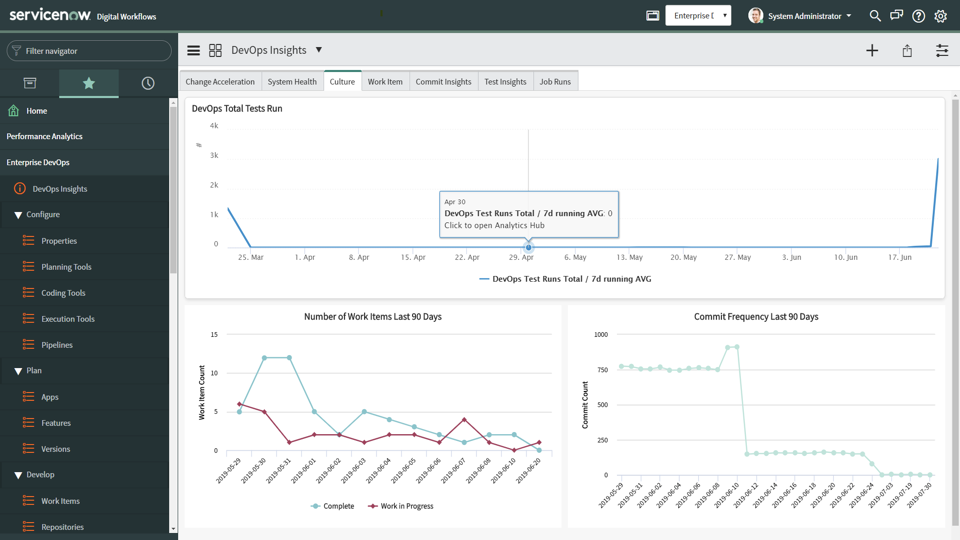
    ServiceNow today announced it is extending the reach of its IT operations management platform to integrate with a variety of DevOps platforms.

    Richard Hawes, director of product marketing for ServiceNow, said ServiceNow DevOps will provide IT operations teams relying on an ITIL-based framework accessed as a software-as-a-service (SaaS) application visibility into DevOps processes and events occurring in on-premises environments or public clouds.

    At present, ServiceNow DevOps is available for financial services organizations based in the Northeast region of the United States and the UK. The service gradually will be rolled out to additional ServiceNow customers over the course of 2020. ServiceNow DevOps initially integrates with Jira Software, GitHub, BitBucket and Jenkins, with more integrations expected to be rolled out periodically.

    Hawes said ServiceNow recognizes that IT organizations are building and deploying applications at rates that are faster than existing ITIL-based approaches can track. However, ITIL-based frameworks provide the highly structured set of processes around which the bulk of IT environments are managed. ServiceNow DevOps enables IT teams to automate change management tasks such as planning, development, testing, deployment and operations via a single dashboard surfacing a common set of metrics, he said. He added in many cases, those preset rules and policies will eliminate manual processes that often conspire to slow the rate at which applications can be deployed and updated within any IT environment, said Hawes.

    No developers need to be involved in those processes because IT operations teams can set rules and policies, and developers will see their code running in production environments in a matter of minutes regardless of what tools they employ, said Hawes. That approach also will make it easier to scale DevOps across an enterprise IT organization at a time when adoption of DevOps is still uneven at best, he noted.

    At the same time, that level of integration should also make it easier for IT teams to audit DevOps processes using a common framework to capture events such as when code is checked into a DevOps platform, he said. That capability is a critical requirement for any company trying to apply best DevOps processes with the context of a highly regulated industry such as financial services.

    Hawes said the majority of organizations that have adopted ServiceNow to manage IT have also adopted a DevOps platform. Overall, Forrester Research reports 56% of global infrastructure decision-makers now report that their organizations are implementing, have implemented or are actively expanding their DevOps initiatives. ServiceNow doesn’t expect DevOps processes to supplant ITIL-based frameworks as much as it anticipates both approaches co-existing as they continue to evolve, he said.

    With the release of the latest version of the ITIL framework, it’s apparent that the proponents of ITIL have come to recognize that IT needs to become more agile to meet the needs of digital business. The challenge they face is finding ways to enable IT teams to become more agile without sacrificing the gains in stability achieved over the course of the last two decades. With the launch of ServiceNow DevOps, the effort to find a middle ground between those two extremes can now begin in earnest.

    — Mike Vizard

  • Splunk to Acquire SignalFx to Gain APM Platform

    Splunk to Acquire SignalFx to Gain APM Platform

    Splunk today announced it will acquire SignalFx as part of an effort to extend its reach beyond IT operational analytics and into the realm of application performance management (APM).

    Valued at approximately $1.05 billion, the deal to acquire an APM platform delivered as a software-as-a-service (SaaS) offering will expand and accelerate Splunk’s overall transition to a recurring revenue model based on cloud services, said Splunk CEO Doug Merritt during a call with industry analysts.

    Splunk is currently on pace to generate over $300 million per year from the cloud version of its IT operational analytics platform. Splunk revenues for the second quarter were $517 million, up 33% year over year, with software generating $350 million of that total. However, as Splunk transitions to more of a subscription-based pricing model, the company has some financial management challenges. GAAP operating loss for the company’s second quarter was $87 million. However, non-GAAP operating income was $47 million, even though operating cash flow was negative $129 million. That cash-flow issue is a direct result of the transition away from a perpetual software license model based on the volume of data consumed by the Splunk platform. Overall, Merritt said Splunk is firing on all cylinders and is still on track to have 20,000 customers by the end of its fiscal year.

    Merritt said once the deal is approved, sometime in the second half of fiscal 2020, SignalFx will provide a complementary set of services for monitoring legacy monolithic applications as well as cloud-native applications based on containers, Kubernetes and serverless computing frameworks. There are very few customers at this point who have not adopted cloud-native technologies, but for now they remain a small percentage of the overall number of application workloads being managed, he added.

    The goal is to provide a suite of services that will enable IT teams to investigate, analyze, monitor and act on data in real-time, said Merritt.

    Splunk is already widely employed by internal IT operations teams, many of whom already rely on a complementary APM platform. Splunk clearly expects organizations will prefer to acquire an IT operational analytics platform and an APM service from the same vendor. However, competition between APM platform providers is already fierce. That said, Splunk appears to be counting on increased demand for real-time application monitoring to differentiate SignalFx from rivals.

    It’s not clear to what degree Splunk might converge the various services now being provided separately by both companies. It’s also not clear how or whether this deal will accelerate acquisitions of the remaining independent APM platform providers.

    In the meantime, Merritt said SignalFx and Splunk’s earlier acquisition of VictorOps, provider of incident management platform based on best DevOps practices, will expand the amount of visibility Splunk has with application development teams.

    Ultimately, acquisitions of smaller, DevOps-oriented companies by vendors that today are still more closely identified with legacy ITIL-based IT processes, such as Splunk, are only like to increase. What will be interesting to watch is whether the tools and services being acquired by those companies wind up being the DevOps tail that wags the proverbial ITIL dog.

    — Mike Vizard

  • DevOps Deeper Dive: BMC Software Bets on AIOps Transformation

    DevOps Deeper Dive: BMC Software Bets on AIOps Transformation

    As BMC tests the AIOps waters, the company seeks to find a balance in serving both the DevOps and ITIL populations

    It’s clear in the enterprise IT space that artificial intelligence (AI) is poised to play a significant role in IT operations, a phenomenon known as AIOps. Often with this level of IT disruption, new entrants funded by venture capitalists flood the segment, leaving incumbents to either fend off the new rivals, cede ground or, in many cases, put an end to the threat by acquiring one or more those startup companies that pose a threat to their existence.

    In the case of BMC Software, it has decided to stand its ground by aggressively investing in AIOps research and development. Most recently, BMC extended the AIOps capabilities of its existing portfolio of TrueSight IT management software through additional advanced analytics to identify patterns and anomalies within an IT environment. Other examples of BMC employing machine learning algorithms to automate IT environments tools include the ability to surface continuous recommendations for cost optimizations and automated event remediation workflows that promise to reduce the mean time to repair (MTTR).

    BMC has been making a case for AIOps as far back as 2017, but it’s only now that many organizations have enough confidence in AI to start embracing AIOps beyond the pilot stage. The challenge organizations face with AIOps are both technical and cultural: It requires a significant amount of time and effort to train and tune an AI model of each customer environment.

    [su_box title=”BMC Software Milestones”]

    • Dec. 2016: Peter Leav succeeded Bob Beauchamp as president and chief executive officer. Beauchamp remains chairman of the board of directors.
    • Oct. 2017: BMC Launches First AIOps Initiative for TrueSight
    • Nov. 2017: BMC Refinances Debt
    • Oct. 2018: BMC Software Goes Private After Being Acquired by Investors
    • Feb. 2019: BMC Partners with IBM on AI
    • April 2019: Bob Beauchamp resumes role as CEO
    • June 2019: BMC Extends AIOps Capabilities of TrueSight

    [/su_box]

    In addition, the effectiveness of any AIOps model varies based on the complexity of the IT environment. Organizations also should be concerned about the potential impact any flawed AI model might have on IT operations—it’s one thing for a human to make a mistake, but an AI model making a mistake at a level of scale could be catastrophic.

    From a cultural perspective, not every organization is yet comfortable with those AI models on current staffing, which can make some members of the IT staff less than comfortable with the whole concept.

    BMC CEO Bob Beauchamp

    It is early days for AIOps in DevOps processes. But the increased complexity of modern IT environments based on cloud-native technologies will force the issue within most organizations. BMC’s challenge is that while its management platform is employed widely in IT environments relying on ITIL-based frameworks, its footprint is comparatively nascent within organizations that have embraced best DevOps practices.

    Bill Talbot, vice president of solutions marketing for BMC, said one of the company’s advantages is access to the massive amounts of data required to train an AI model effectively. Most startup companies in this space don’t have nearly the same depth in terms of customer base, he said. That puts BMC in a better position to employ big data analytics to identify patterns and trends across multiple customers without having to know what data came from any one specific customer, unless the customer elects to share its data with BMC.

    BMC makes it a point to caution customers about rivals that make AIOps claims about their platforms but don’t actually solve a specific problem—a process known as “AIOps washing.” An AIOps platform not only needs to leverage Big Data analytics and machine learning, but it also provides the code and functionality needed to customize specific IT operations use cases, including capabilities such as automated event remediation and service resolution, optimized cost and capacity management and proactive vulnerability mitigation.

    BMC Software today stands at a crossroads. The company recently brought back former longtime CEO Bob Beauchamp to run the company day to day and has made no secret of the fact it is looking for additional investors. Making a pivot to AIOps requires access to massive amounts of funding for incumbents and startups alike.

    The next BMC act undoubtedly will involve employing AIOps across both DevOps and ITIL-based environments running on-premises and in the cloud. By any measure, that effort represents one of the most ambitious transformations ever attempted by any IT vendor.

    — Mike Vizard

  • IT Operations: PagerDuty Unveils Hybrid ITSM Platform

    IT Operations: PagerDuty Unveils Hybrid ITSM Platform

    PagerDuty today unveiled a framework intended to make it possible for organizations to bridge multiple styles of IT service management (ITSM) methodologies for IT operations.

    Rachel Obstler, vice president of product for PagerDuty, said PagerDuty Solution for HybridOps provides a comprehensive incident management framework capable of spanning both ITIL and DevOps processes for IT operations.

    PagerDuty Solution for HybridOps combines existing and new product capabilities such as Event Intelligence and Modern Incident Response with machine learning algorithms and bi-directional integrations the company has developed between its incident management software and more than 300 third-party products.

    Those capabilities make it possible to facilitate real-time communications between platforms that tend to be favored by IT shops relying mainly on ITIL processes, such as ServiceNow, and DevOps teams that rely on Slack to communicate with one another, Obstler said.

    IT Operations: PagerDuty Unveils Hybrid ITSM Platform

    Rather than forcing an entire IT organization to transition to single framework for IT operations, PagerDuty Solution for HybridOps allows organizations to selectively apply each model where and when they best see fit, she said.

    The latest version of the ITIL framework goes a long way toward injecting some flexibility into what historically has been viewed as a rigid approach to managing IT. The ITIL framework is still a long way from being as agile as the various forms of DevOps that many organizations have adopted over the last several years to accelerate application development and deployment.

    Obstler said PagerDuty is moving to bridge that divide by leveraging machine learning algorithms to group all the various alerts generated by all the tools in an IT environment. That capability not only reduces the amount of alert fatigue any IT operations group is likely to suffer, but it also makes it easier to identify the root cause of any IT incident, she noted.

    One of the primary reasons DevOps has been adopted evenly in the enterprise is that IT operations teams are expected to be able to programmatically adapt IT infrastructure to meet the demands of developers. The number of IT operations that have those skills, however, is limited. In theory, IT operations teams without programming skills could rely on automated frameworks to achieve that goal. But that approach requires IT organizations to standardize on a single IT automation framework across compute, storage and networking services. The number of organizations that have been able to bridge all the islands of automation that have been adopted across all the services they deliver are few and far between. Put it altogether and it’s clear that both legacy and modern approaches to ITSM will need to coexist well through the next decade.

    In the meantime, IT leaders might want to consider that old proverb about leading a horse to water. IT leaders can issue all the mandates they want. But when it comes time to accomplish a task, most IT professionals are naturally going to fall back on what they know. The challenge is to create ways to wean the IT operations staff off those legacy processes in a way that doesn’t necessarily result in everything grinding to a halt because nobody knows how to fix an issue that simply wouldn’t otherwise wait.

    — Mike Vizard

  • xMatters Looks to Meld DevOps and ITIL

    xMatters Looks to Meld DevOps and ITIL

    With the launch today of a flow design tool from xMatters, the divide between DevOps and ITIL-based approaches to managing IT is narrowing.

    xMatters Flow Designer is a drag-and-drop graphical tool that either developers or IT operation teams can employ to create incident management workflows on top of xMatters incident management software. Doug Peete, chief product officer of xMatters, said those workflows feed data into a variety of third-party IT management tools to enable IT operations and DevOps teams to consume the same data in different tools—for example, in an instance of ServiceNow for IT operations and as a message in Jira or Slack for DevOps teams.

    Peete said the goal is to enable organizations to develop a more consistent approach to incident management. A recent survey of more than 1,000 IT professionals conducted by xMatters and Atlassian found that while 81 percent of developers and operation teams share information and tools, only 17 percent provide open access to information without time restrictions. The survey also found that 50 percent of respondents said the tools, processes and steps they employ vary from incident to incident.

    Most of those organizations have very little in the way tools that enable them to effectively conduct a post-mortem analysis of those incidents, added Peete.

    The arrival of the xMatters Flow Designer tool comes at a time when organizations are trying to find ways to meld the highly structured ITIL processes that most IT organizations rely on today and the inherently more agile approaches based on best DevOps practices. The most recent iteration of the ITIL framework incorporates some DevOps principles, but it’s apparent the two approaches to managing IT will be employed side by side in many organizations for many years to come. Developers these days tend to prefer DevOps methodologies, while IT administrators tend to appreciate the consistency of an ITIL framework that was designed to address IT governance concerns. By providing a set of workflow tools that span both those approaches, Peete said IT organizations can more easily meld those two approaches on their own terms.

    At the same time, an extensible approach to incident management makes it possible for IT organizations to incorporate new tools into those workflows as their IT environment evolves. That capability also should make it easier to integrate incident management workflows across multiple organizations as well as incorporate a new IT environment as a result of acquiring another company.

    Regardless of the path chosen, it’s clear that as organizations increasingly realize how dependent their business processes are on software in the age of digital business transformation, the more likely it is they will embrace DevOps practices. However, that doesn’t mean organizations need to abandon ITIL; there are plenty of IT processes that benefit from a highly structured approach. In fact, arguably the most important thing is to not let a philosophical debate over the merits of DevOps versus ITIL wind up becoming a major distraction that creates two isolated cultures who refuse to collaborate with one another.

    — Mike Vizard

  • Agile vs. ITIL: Two Divergent Paths to DevOps?

    Agile vs. ITIL: Two Divergent Paths to DevOps?

    Truth be told, there are dozens of different frameworks in existence and all have their unique perspectives on how a project is managed and executed. Frameworks such as Agile, ITIL, lean, cobit, six sigma and many others were built on an ideology of following a path defined by best practices.

    With DevOps, two of those frameworks, Agile and ITIL, have become the basis for arguments on how to do DevOps correctly. Yet, until recently those frameworks were very different in the paths offered to bring about project success. With the announcement of ITIL V4, things have changed a little: ITIL is becoming a little more like Agile, adding to the confusion of what path makes the most sense in the world of DevOps.

    A Quick Glance Backwards

    The foundations of DevOps were built upon the ruins of non-iterative application release cycles. Or look at it this way: DevOps is all about not taking a plunge over the waterfall. While those observations are little more than metaphors for something that rings true, DevOps has brought a new paradigm to software development and deployment. A new paradigm that comes with its own recommended practices.

    Yet, current DevOps practices—or let’s call them rules—can come up short in the modern enterprise, meaning that other management best practices—such as those illustrated in the Agile and ITIL methodologies—are borrowed to drive DevOps further forward. That said, the common DevOps ideology is built around a few foundational practices that define the framework of DevOps. The primary goal here is to bring application development and operations together as a functional team. Some of the generic best practices include:

    • Implement collaboration and teamwork tools to improve communications as well as improving the ability to share knowledge, ideas and automatically document interactions. Simply put, incorporating teamwork with an audit trail goes a long way toward bringing order to DevOps.
    • Incorporate tools to capture requests. One of the most important capabilities delivered from DevOps is the ability to adapt to change. Traditional application development frameworks are usually based on waterfall processes, where everything is defined at the outset and then an application is eventually delivered. Waterfall ideologies offer no leeway to adapt to change in the middle of a development cycle. DevOps eschews those limitations by incorporating the understanding that change is constant. However, requests for changes must be recorded, tracked and reported upon.
    • Adopt a framework ideology that can match workloads to team capacity. In other words, team leaders and managers need to have a clear view of what work is in progress and the context of that work as it applies to a team’s abilities.
    • Use systems to log metrics on automated and manual processes, which will give insight into productivity, as well as identifying where improvements can made.
    • Implement test automation. The idea here is to automate the testing of code using test data in a sandbox environment. Code that passes the tests can be forwarded further along the DevOps process, while code that fails is automatically returned to developers for correction.
    • Use a continuous feedback system in which a chain of communications can be established to keep developers and operators informed of the status of any issues, as well as change requests and the progress of any code through the framework.

    While the above best practices are simplified representations of a full DevOps framework, they do establish that DevOps relies heavily on collaboration and iterative processes to support the ideology of continuous development and deployment. Now, comparing the DevOps ideology to what constitutes either Agile software development practices or the ITIL Framework brings up some additional questions and establishes that Agile and ITIL may very well have different goals. A more simple way of looking at it is to think of Agile as a set of practices to provide faster software delivery, while ITIL is a framework squarely focused on processes and not practices.

    The Path Becomes Muddy

    Therein lies the real dilemma of establishing a path to DevOps using either Agile or ITIL ideologies. ITIL is designed from the perspective of the governance of IT service management and establishes a framework that supports continuous measurement and should deliver improvement of the quality of IT services. Agile is a set of processes designed for software development that meets the needs of customers and cross functional teams.

    Interestingly, Agile and ITIL prove to be complimentary in the world of DevOps, where ITIL can be used to ensure quality and value while Agile brings forth a continuous stream of improvements in applications. Ultimately, with the arrival of ITIL V4, Agile and ITIL will become more aligned with each other and offer benefits to DevOps.

    — Frank Ohlhorst

  • IBM Allies with ServiceNow to Bridge DevOps Divide with ITIL

    IBM Allies with ServiceNow to Bridge DevOps Divide with ITIL

    IBM and ServiceNow today announced an alliance under which IBM Global Technology Services (GTS) will collaborate with ServiceNow to make DevOps processes and events managed via the IBM Cloud Migration Factory visible to a cloud-based IT service management platform from ServiceNow based on the ITIL framework.

    Jim Comfort, general manager for cloud services at IBM GTS, said that from a governance and compliance perspective it has become clear IT organizations need more visibility in to DevOps processes. In general, enterprise IT organizations are increasingly adopting DevOps processes to accelerate application development and deployment, while still relying on ITIL to manage governance and compliance, he said.

    IBM GTS, via the alliance with ServiceNow, will be able to bridge that divide by integrating ServiceNow with a set of tools and services IBM provides across hybrid cloud computing environments that are based on DevOps process.

    The IBM Cloud Migration Factory is based on a methodology IBM developed to move applications to cloud. IBM Services claims it has completed more than 100,000 migrations. In addition to allying with ServiceNow, a new toolset is being added to IBM Cloud Migration Factory that employs algorithms based on the migrations IBM has completed that improve planning accuracy and uncover application dependencies. Included in that portfolio is cloud brokering software that IBM gained via the acquisition of Gravitant in 2015.

    Comfort said the alliance with ServiceNow will make it possible to have DevOps processes and events register automatically in the change management database (CMDB) provided by ServiceNow. That’s critical because it should allow IT organizations to maintain governance and compliance without having to impose an overhead that otherwise would slow down application development and deployment using DevOps processes, he said, adding there’s no need to impose an artificial construct on top of a DevOps process.

    As hybrid cloud computing continues to evolve, Comfort said IBM GTS expects IT organizations will be relying on a mix of ITIL and DevOps processes for the foreseeable future. In fact, he noted that while managing one to ten DevOps processes is relatively simple, keeping track of hundreds of DevOps processes requires a more static set of processes to maintain governance and compliance. The IBM approach is to create a unified approach to integrating DevOps and ITIL processes that doesn’t require organizations to integrate a variety of point products on their own.

    Proponents of DevOps processes have been making a case against ITIL processes that they tend to view as being too rigid to support agile application development. Comfort said the next iteration of the ITIL framework will incorporate many of the concepts advocated by DevOps proponents. But the two frameworks will remain distinct.

    The alliance between IBM and ServiceNow represents a clear signal that DevOps is going mainstream in enterprise IT environments. The challenge now is finding a way for organizations that have spent more than a decade adopting ITIL processes to embrace DevOps processes with a minimal amount of friction possible.

    — Mike Vizard

  • Integrating ITIL Change Management and DevOps

    Integrating ITIL Change Management and DevOps

    A DevOps solution to the DevOps problem

    Intel IT’s Enterprise landscape is highly complex and diverse. The Enterprise Change Management team has the responsibility of managing the changes in this landscape, which is of the order of hundreds of changes every week. On one hand, we had to make sure we keep the change management processes stringent so that defects/major incidents did not happen in the production environment, leading to productivity loss, shipment delays or cost impacts. On the other, there is a need to assist the capability teams to land changes into production faster than ever to meet their dynamic business demands.

    A challenge that many global IT organizations face is, How do we adhere to ITIL processes while teams transform into agile/DevOps way of working? In other words, how do we manage the two seemingly conflicting goals from two different IT organizations, one focusing on the agility of the development and measuring the success of the projects by their throughput time and the other measuring the success by the quality?

    In the IT enterprise, the quality is measured by the number of change induced incidents in production—incidents that are caused due to change(s) landing in production. Our team had a challenging goal of keeping it to zero! The year 2017 started with this million-dollar (or is it worth more than that?) question: How do we meet this goal while not impacting the speed of the agile teams? We came up with an agile solution. A DevOps solution for the DevOps problem sounds logical, right?

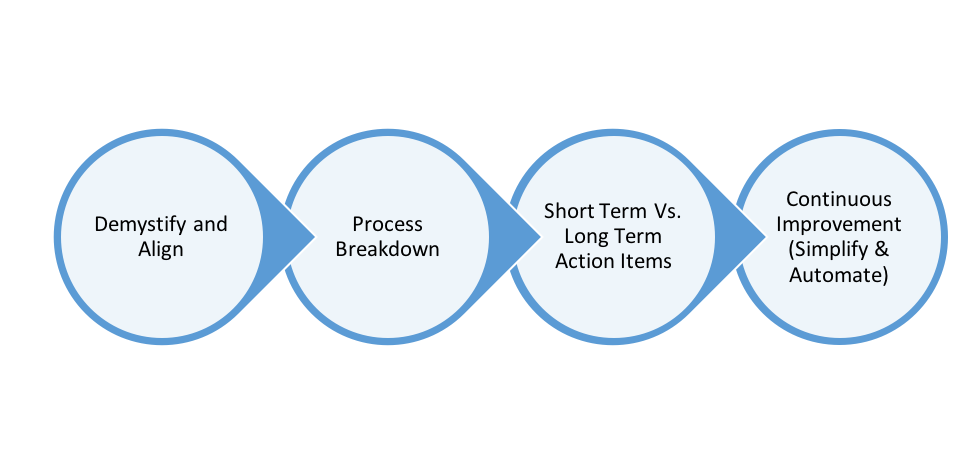
    We formed a scrum team to address this problem with the theme, “Simplify and automate, keeping the focus on quality, velocity and productivity.” The scrum team had change management process owners and the representatives from all the development technologies. The chart below summarizes the steps followed:

    Simplify and Automate, Keeping the Focus on Quality, Velocity and Productivity

    The first sprint was all about getting the alignment. As much as the number of teams that follow agile, as many definitions of agile exist! The focus was to demystify the myths about agile as well as ITIL change management processes. At a glance, processes look incompatible with Agile, but the goals are the same. Both aim to add business value incrementally in a continuous manner without disrupting the operations. They are not contradictory but complimentary.

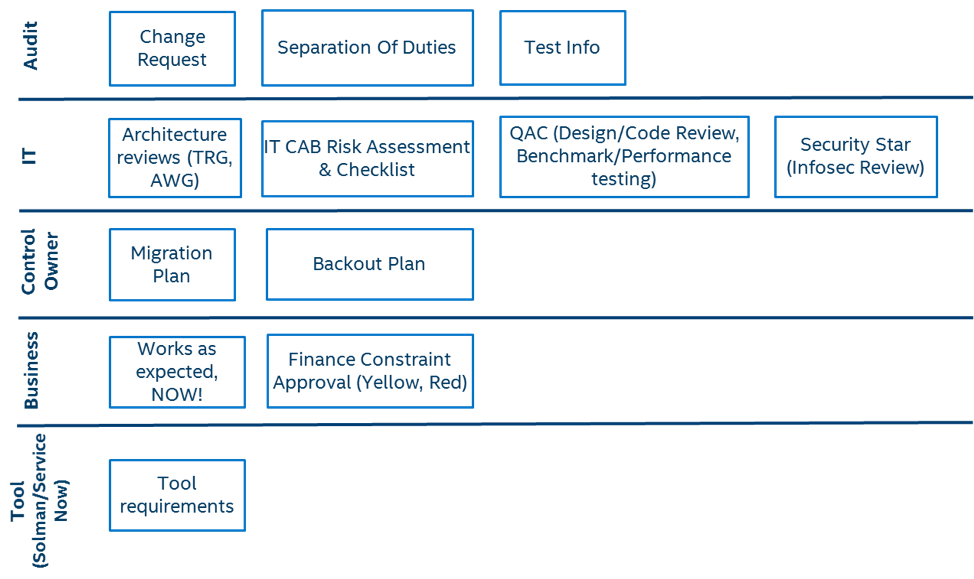
    Subsequent to this alignment, the second sprint went to the details of the enterprise change management process that’s in place. The process was broken down into the lowest level of details based on the 5W and 2H’s (who, why, what, when, where, how, how much). For example, there are process requirements from legal standpoint that are non-negotiable. There are certain processes required to ensure architectural compliance. We also acknowledged and aligned on some of the challenges and the time taken for process adherence. Multiple discussions happened in this space and it helped all of the teams to come to a common understanding on why these process requirements exist. Process swim-lane categorizing all of these aspects was internalized as part of this sprint.

    Change Management Process Swim Lane

    The third sprint got things into action mode. Each of those process steps was identified for potential simplification and automation. They were further classified as short-term and long-term based on the automation efforts on continuous integration/continuous delivery (CI/CD) that were underway. The development teams were shown the flexibility and empowered to meet the process need by way of automation rather than completing a manual checklist for every change. This way of policy and rule-based automation helps in a longer way in integrating ITIL Change Management and DevOps.

    All along these three sprints, process improvements were rolled out. Several automation efforts were launched. Objective risk assessment enabled us to identify changes that required advance communication to all segments. Multiple gate approvals were reduced into only two—one when the development starts and later before it goes to production. Test cases and results from the CI/CD tools were used effectively to replace documentation.

    Process refresher and engagement sessions were held across the organization to share the improvements, gather feedback and incorporate them into further sprints. This helped to gain the confidence of various teams and made the journey further better.

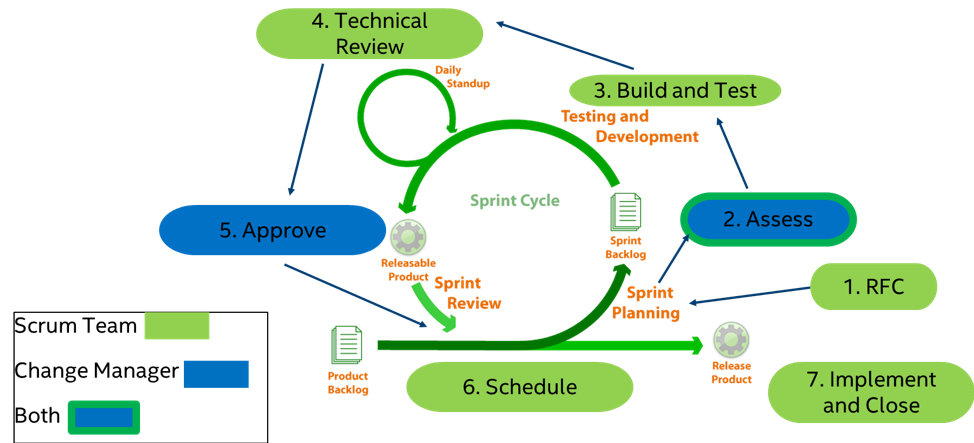
    Now the focus is on continuous improvement, which is to implement all those action items identified and also keep them updated as other factors change in the internal and external environments. Engagement between theAgile/DevOps teams and the change management teams are getting refined based on the scrum development models. The success of ITIL Change Management and DevOps integration relies on calling out the agile process followed for the project and having the right engagements at the right points in time. The below picture depicts the engagement in a simplistic manner:

    Scrum and Change Management Intersection

    The efforts yielded fruits and the organization met the goal. The number of change induced major incidents was ZERO for the Enterprise Segment for the whole of 2017. We need to remember that these process improvements were done without impacting anything underway; it was akin to servicing a flying aircraft in the middle of the sky. The feather in the cap was the positive feedback from the ERP vendor: “The change control process at Intel has become very agile in recent years, with transports to production now occurring nearly every day of the year. … In general, we do not consider such frequent changes to Production to be desirable due to the risks involved; however, Intel appears to be managing the process well as the quality of transports is closely monitored.”

    References:

    1. ITIL® Service Management v3
    2. The DevOps Handbook: How to Create World-Class Agility, Reliability, and Security in Technology Organizations by Gene Kim,‎ Jez Humble,‎ Patrick Debois &‎ John Willis

    This article was co-authored by Ramani Subramanian

    — Srinivasan Radhakrishnan

  • From Artisanal to Factory: The IT Pendulum is Swinging Back

    From Artisanal to Factory: The IT Pendulum is Swinging Back

    Splunk Vice President of IT Markets and Chief Technology Advocate Andi Mann sees DevOps moving from an artisanal approach to an IT factory.

    This represents a reversal: Historically, developers operated in a factory-like environment, passing chunks of work down the line, but that caused problems because “different managers owned different sections of the production line.”

    Agile and DevOps were a response to that issue, he said, resulting in “the artisan developer … the full-stack developer.”‘

    The trend is now flowing in the opposite direction, with Splunk customers wanting to see “the whole flow.” Furthermore, enterprise DevOps is too big for an artisanal approach.

    “I worry about that [reversal],” he said, but technology can help artisanal quality within an IT factory. Collaboration tools such as permanent video links between different locations enable specialists to work together and understand each others’ work.

    “That’s a different kind of factory,” said Mann, in which development, security, QA, operations and other staff do not need physical proximity to work closely together. This is particularly important for large enterprises, he observed, as you cannot pack 1,500 developers into a small space.

    One example he cites to show this approach can work is a telco with its developers spread across multiple locations in Sydney and Singapore using DevOps practices to achieve continuous delivery. Another is one of the largest UK retailers getting weekly releases from developers in London and Mumbai, with QA work done at another location in India.

    “Executives I talk to are very heavily committed to improving cycle time,” said Mann. But they are also concerned with quality (e.g., problems should be detected and fixed before they reach the user, and the percentage of changes sent for rework should be minimized) and business impact. Executives want to link DevOps to their own KPIs: “Are they moving the needle on my business requirements” such as shareholder value and reputation?

    “You get the changes you drive by your measures,” he said, so it is up to managers to make sure their measures make sense in the broader context. It may be time for a balanced scorecard to be applied to DevOps, with metrics in all three areas, he suggested.

    These metrics could include code coverage, error rates, customer complaints or trouble tickets raised, plus business impact measures such as click-through rates, cart abandonment, subscriptions cancelled, open rates (for mobile apps) and customer sentiment.

    Mann noted executive demand for the adoption of DevOps, even where “they don’t even know what they’re talking about.” He feels it is really about a desire for visibility into the development pipeline, and “that’s really challenging.”

    Part of the problem seems to come from the tension between traditional IT (especially “ITIL-owned shops”) and new-generation executives with titles such as head of digital.

    Slavish adherence to ITIL practices won’t allow the required speed, may not achieve the expected level of compliance and business goals probably won’t be met, he suggested.

    “ITIL came out of a fear of failure,” but failure is no longer catastrophic. “If you’re not failing, you’re not trying, you’re not innovating.” What’s important is to fail fast, fail small, and fail cheap—and DevOps allows IT to fail in low-impact ways. Even when an organization is making significant changes to software, the effects of failure can be contained through measures such as canary releases (where the new versions are initially made available to a small subset of users).

    Furthermore, customers are getting used to the idea that technology isn’t and doesn’t need to be perfect, largely because of their experiences with speech recognition services such as Siri, he said.

    — Stephen Withers