Tag: itil

  • DevOps and ITIL Integration: Driving Collaborative Agility in ITSM

    DevOps and ITIL Integration: Driving Collaborative Agility in ITSM

    Businesses face continuous pressure to deliver high-quality IT services efficiently. One emerging integration to meet these goals is between DevOps and IT service management (ITSM), more commonly known as DevOps+.

    DevOps+ is becoming more than a trend and has emerged as a powerful collaborative approach to meet these challenges. By combining the strengths of DevOps’ agile software development practices and ITSM’s structured service management approach, organizations can foster better collaboration, enhance agility and improve overall service delivery efficiency.

    DevOps and ITSM Symbiosis

    DevOps and ITSM traditionally operated as separate frameworks with distinct focuses. DevOps emphasizes rapid software delivery and collaboration between development and operations teams. On the other hand, ITSM-based ITIL (information technology infrastructure library) provides best practices for ensuring service stability, reliability and adherence to governance and compliance.

    Integrating DevOps and ITIL creates a symbiotic relationship, allowing organizations to leverage the best of both worlds. DevOps+ encourages a cultural shift, breaking down silos and promoting cross-functional communication. This collaboration enhances the entire software development lifecycle, leading to faster feedback loops, accelerated innovation, and increased responsiveness to business needs.

    Enhancing Agility and Speed

    DevOps+ integration brings greater agility and speed to IT service management. Organizations can streamline the release process by automating deployment pipelines and implementing continuous integration and continuous delivery (CI/CD) practices, reducing time-to-market for new features and updates. Agile development methodologies enhance the adaptability of ITSM processes to meet evolving business requirements effectively.

    Ensuring Stability and Reliability

    While agility is crucial, it must not compromise service stability and reliability. ITIL’s best practices provide a strong foundation for maintaining service quality. By incorporating ITIL processes such as incident management, change management and problem management, organizations can effectively manage risks, reduce service disruptions and ensure the stability of critical IT services.

    Leveraging Automation and Orchestration

    Automation is central to both DevOps and ITIL. Through integration, organizations can leverage automation and orchestration tools effectively. Automated testing, infrastructure provisioning and configuration management improve efficiency and consistency across the ITSM lifecycle. This enables teams to focus on higher-value tasks, reducing manual errors and operational overhead.

    Emphasizing Customer-Centricity

    DevOps+ puts the end-user experience at the forefront of service delivery. By continuously seeking customer feedback and measuring service performance, organizations can better align their offerings with user expectations. A customer-centric approach fosters higher satisfaction, loyalty, and competitive advantage.

    Breaking Down Barriers to Change

    Change management is vital in ITIL, ensuring that modifications are planned and controlled. In the context of DevOps+, change management becomes more adaptive and responsive, facilitating a culture that embraces change as an integral part of the development process. This promotes experimentation, reduces resistance to change, and accelerates innovation.

    Challenges of DevOps and ITIL Integration

    Despite the numerous benefits of DevOps+ integration, organizations may encounter challenges during implementation:

    Cultural Shift: Merging DevOps and ITIL requires a cultural shift. Overcoming resistance to change and fostering collaboration between traditionally separate teams can be challenging but is crucial for success.

    Process Alignment: DevOps and ITIL have different processes and terminologies. Aligning these methodologies while preserving their individual strengths can be complex.

    Skill Sets: Integrating DevOps and ITIL necessitates upskilling teams in both domains to operate effectively in the integrated environment.

    Tooling and Automation: Adopting suitable tools and technologies that support DevOps+ practices and integration is vital but may require significant investments.

    Metrics and Performance Measurement

    Measuring the success of DevOps+ integration is essential to understand its impact and effectiveness. Key performance indicators (KPIs) can help monitor progress and identify areas for improvement.

    Deployment Frequency: The frequency of software deployments indicates the efficiency of the integrated approach. Higher deployment frequency implies faster and more reliable releases.

    Mean Time to Resolve Incidents (MTTR): MTTR measures how quickly teams can resolve incidents and restore services after disruptions occur. A reduced MTTR demonstrates improved service reliability and faster incident resolution.

    Customer Satisfaction Scores: Measuring customer satisfaction provides insights into how well the integrated approach meets end-users’ needs and expectations.

    Continuous Improvement and Feedback Loops

    Continuous improvement is at the core of DevOps+. Establishing feedback loops and conducting regular retrospectives empowers teams to identify areas for improvement and implement iterative enhancements to processes and practices.

    Implementing DevOps+ integration requires a well-structured roadmap. For example, assessment and planning help leaders evaluate the organization’s current ITSM practices to understand how DevOps and ITIL principles align and define integration vision and goals.

    Additionally, your continuous optimization efforts allow you to continuously monitor performance metrics, gather feedback, and conduct retrospectives to identify improvement areas, leading to better team collaboration and communication. Fostering cross-functional collaboration between development, operations and other relevant teams is easily accomplished. To meet these goals, encourage regular meetings, schedule joint planning sessions and enable shared documentation to ensure everyone is aligned on goals and progress.

    When this happens, leverage automation tools to streamline manual processes and increase efficiency. Implement continuous integration and continuous delivery pipelines to automate software deployment and testing. Automation enhances consistency, reduces the risk of human errors and adds a new layer for measuring and evaluating to continuously measure the performance of the integrated approach using defined KPIs. In this vein, you can regularly review progress against the initial vision and goals to ensure the integration aligns with organizational objectives.

    Next, as the DevOps+ integration proves successful in pilot projects, gradually scale and expand it to other teams and departments. Share the success stories and best practices to encourage broader organizational adoption.

    Conclusion

    In conclusion, the integration of DevOps and ITIL, known as DevOps+, marks a transformative approach to IT service management. By combining the agility and rapid deployment of DevOps with the stability and reliability of ITIL, organizations can drive collaborative agility and achieve efficient service delivery.

    DevOps+ integration requires overcoming cultural barriers, aligning processes and upskilling teams, but the rewards are immense. With clear metrics to measure success, organizations can continually optimize their DevOps+ approach to meet customer needs and adapt to evolving market demands.

    As technology evolves, DevOps+ integration will remain at the forefront of cutting-edge IT service management, empowering organizations to embark on a journey of innovation, efficiency and excellence.

    By embracing DevOps+ as a guiding philosophy, organizations can cultivate a culture of collaboration, continuous improvement and customer-centricity, laying the groundwork for a prosperous future in the dynamic world of IT service management.

  • BMC Adds Generative AI Capabilities to Helix Management Platform

    BMC Adds Generative AI Capabilities to Helix Management Platform

    BMC today revealed it is embedding generative artificial intelligence (AI) capabilities across its BMC Helix service and operations management platforms.

    BMC CTO Ram Chakravarti said the company is incorporating the open source GPT-J large language models (LLMS) to build generative AI models. Those models are optimized for specific domains using data collected by BMC and imported from other data sources, like the Jira project management software from Atlassian. That persistent layer of storage is designed to aggregate multiple types of data within what amounts to a Helix data lake.

    The generative AI capabilities added to BMC’s portfolio include natural language summaries of issues and events captured by BMC Helix Operations Management, along with an ability to create a historical analysis of a user’s specific environment to identify recurring issues more easily.

    BMC Service Management, meanwhile, can now correlate incidents and provide resolution summaries that can be stored. It’s also now possible to run clustering analysis on chat archives to find new or improved utterances that help virtual agents answer queries better and execute workflows.

    BMC initially opted to build its own LLMs because general-purpose LLMs—such as the one created by OpenAI—are subject to “hallucinations.” Hallucinations are created when incorrect data is included in a model. BMC is training its LLMs on a narrow range of trusted data to ensure the recommendations and subsequent automations it creates are valid.

    Over time, BMC will add additional LLMs; the company hasn’t yet decided if there are use cases where it makes sense to rely on an existing general-purpose LLM to add additional capabilities, noted Chakravarti.

    Organizations can also opt to use a containerized version of the BMC LLM if they prefer, but BMC will encourage most organizations to invoke generative AI via its Helix SaaS platform, he added.

    BMC Helix is an IT services management (ITSM) platform that integrates with a range of DevOps platforms. Helix is part of a larger existing BMC Connected Digital Ops initiative that seeks to unify ServiceOps and DevOps with AIOps, DataOps and AutonomousOps. Generative AI will automate a range of tasks from within Helix that can then be extended to DevOps platforms such as Jenkins.

    It’s still early days as far as applying generative AI to processes, so organizations should focus on use cases where it will add some immediate value, said Chakravarti. Once they develop a level of trust in the automation created and executed, they can then pragmatically expand the number of generative AI use cases where they make sense, he added.

    One way or another, generative AI is going to be applied to the management of IT. Many routine tasks that conspire to limit the productivity of IT teams today will be eliminated, but there will always be a need for a human to remain in the loop to ensure the right outcomes are achieved. However, it will also soon become possible for existing teams to manage IT at levels of scale that were previously unattainable.

    Image source: Photo_Credite_Indira-Tjokorda via Unsplash

  • EP 18: Does Standardization Disrupt Innovation?

    EP 18: Does Standardization Disrupt Innovation?

    Although everyone has their own definition of DevOps, it all comes down to creating better software faster, empowering development and operations teams and delivering value to customers. However, there really isn’t a standard approach to DevOps.

    Should we standardize DevOps to introduce automation, avoid confusion and speed up the process? Will standardizing DevOps foster or disrupt innovation?

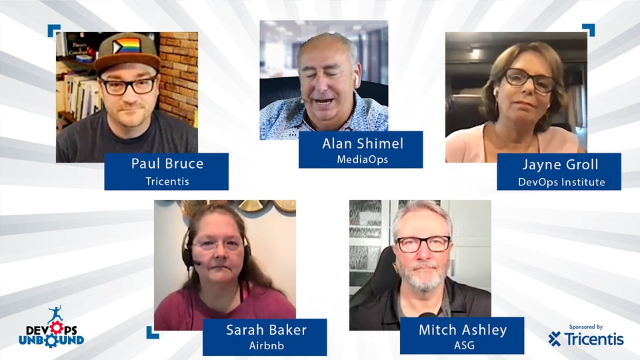
    In this episode of DevOps Unbound, hosts Alan Shimel and Mitch Ashley are joined by Jayne Groll from the DevOps Institute, Paul Bruce from Tricentis and Sarah Baker from Airbnb to discuss the pros and cons of standardizing DevOps, the challenges of standardization and possible solutions. The video is below, followed by a transcript of the converstation.

    Alan Shimel: Hey, everyone, welcome to another DevOps Unbound. If this is your first time catching a DevOps Unbound, welcome. DevOps Unbound is a biweekly video series where we talk about relevant topics in DevOps. In addition to the biweekly show, we do, it’s every four to six weeks, a live roundtable show where we invite the audience to participate and drive the discussion with online questions and comments and so forth, so we open it up to a live audience. Unfortunately, this show is not one of our live roundtables, it is prerecorded, but we have a great panel and I think you’re gonna enjoy it.

    I’m gonna get into today’s topic in a second, but before we do, let me introduce you to today’s panel. First of all, I wanna introduce a business partner of mine and my friend, Jayne Groll. Jayne, why don’t you introduce yourself to the audience, if you don’t mind?

    Jayne Groll: Thanks, Alan. Hi, everyone. I’m Jayne Groll, I’m CEO of The DevOps Institute, we’re a global member association and a certification body around topics related to DevOps. I’m really, really excited to be here and I’m hope everyone listening joins us at DevOps Institute and becomes a member.

    Shimel: Fantastic. Welcome, Jayne. Joining Jayne, I’m happy to have Paul Bruce. Hey, Paul, welcome, and if you wouldn’t mind, you know, introducing yourself?

    Paul Bruce: Yeah, hey, Alan. Good to be back. My name is Paul. In my full time job, I work with Tricentis in a number of different areas. I’m historically a performance and reliability nerd. In my off time, I organize a number of events, help to co-organize volunteer things like DevOps Days Boston, just did o11yfest this year about observability, we had that conversation, I think, with Christine Yen a couple months ago.

    Shimel: Good stuff. Mm-hmm.

    Bruce: And generally, I’m a people advocate. I had to pull DevOps out of my LinkedIn title because there were too many recruiters that I don’t need, because I’ve got a pretty good job. But also, because people advocate really describes what I care the most about, right? People are some of the hardest part of the DevOps people, process, and technology, really, software. So, I really focus my time on that.

    Shimel: That’s great to have you back on, too, Paul—good stuff. Next, we have a first time guest on DevOps Unbound today, a new member of the band, Sarah Baker. Sarah, welcome to DevOps Unbound, if you wouldn’t mind introducing yourself?

    Sarah Baker: Thank you. Wonderful. Welcome. My name is Sarah Baker, my pronouns are she and her. I’ve been working in Operations my entire career and I’ve moved into DevOps as something I always—I needed a name for it. I always wanted the people part of Ops and technology and DevOps was that. And I’ve been doing that as soon as I learned the term. And I’ve been moved and started working with Paul Bruce in the IEEE work group 2675, who is trying to create a standard for DevOps.

    Shimel: Fantastic.

    Baker: I work for—and today, I work as the Manager of Biztech in Airbnb.

    Shimel: Thank you, and thanks for joining us. That sounds like a great place for you to do this. And then the last member of our panel today is my co-host and another business partner, a long-time friend as well, Mitch Ashley. Mitch, if you wouldn’t mind introducing yourself?

    Mitch Ashley: You bet. Always good to have a good panel on with you, Alan. Mitch Ashley, I’m CEO of Accelerated Strategies, an analyst firm that’s focused on DevOps, and also on cloud native, cyber security, and digital transformation. I come to DevOps both as a practitioner and a vendor leveraging it, so very interested in hearing the perspective of folks on our topic today. So, thanks for joining us, everybody, too.

    And by the way, our DevOps Unbound is sponsored by Tricentis. I think you may have mentioned that, right, Alan?

    Shimel: No, I think I didn’t, Mitch, but thanks for picking it up for me. [Laughter]

    Groll: [Laughter]

    Ashley: I was trying to give you credit where credit may not be due.

    Shimel: Yeah, no, I don’t wanna take credit when I messed up. Yeah, DevOps Unbound is sponsored by Tricentis, and many thanks to them for their sponsorship. It makes all of this happen.

    So, let’s turn to the topic at hand today, guys. You know, when I first started devopsy.kinsta.cloud eight years ago, I met Jayne maybe a year, within a year of that or a year and a half of that. One of the interesting things about DevOps is, there was no manifesto. There was no hard definition of what is DevOps and what is not DevOps, you know, contrary.

    And ever since then, it’s been a double-edged sword. In some ways, it’s helped DevOps grow, it’s helped DevOps stay current over the last 8 to 10 years as the world has changed, DevOps has changed along with it. On the other hand, though, we’re still dealing with the, “So, what is DevOps?” Right? “What exactly is DevOps and what exactly is not DevOps?” which is sometimes harder than what is DevOps.

    And as we sit here now, August, 2021, there really still is not a quote-unquote standard for DevOps. There is no standard DevOps. It is what you want it to be, right? As I think Andrew Clay Shafer said, “The DevOps you get is the DevOps you deserve,” right? But have we outgrown that stage? You know, that seems like a terrible twos stage of DevOps to some; to others, it’s what kept it cool. Has DevOps matured? Do we need standardization? Will it be something that kills the goose that lays the golden eggs?

    We’re gonna discuss that today, and I’m interested in all of your views. Jayne, as the CEO of DevOps Institute, how many people have taken certified DevOps classes and certifications with DevOps Institute? It’s gotta be tens of thousands.

    Groll: Yeah, about 25,000 so far. So, it’s a pretty large community.

    Shimel: Mm-hmm.

    Groll: And if you don’t mind, I wanna kind of just lay the stage, because I’m really interested in the standardization initiative. So, you know, I had a privilege of seeing, going to DevOps Days in 2012 in California. So, if you can imagine, it was in an old, dusty data warehouse, right, and it was at the very, very early stages. And so, one of the reasons DevOps Institute emerged was because there was a lot of really cool things here culturally, from an automation perspective, right, doing things faster, collaboration.

    And so, we started up DevOps Institute because we wanted to make sure the humans were represented. And I love that Paul and Sarah in particular both represented people. The problem with that is, at that point, it was very, very open, it was very kind of organic. You know, it was really a group of passionate people that were trying to just change the way IT operates, right, from a people, process, and technology perspective.

    What happened after that, though, is that there’s so much noise about DevOps that if I were an enterprise CIO right now, my head would explode, right? Now, is there one right way to do DevOps? No. Is it only gonna get you there with automation? No. You know, is there a very, very strong human element—absolutely.

    So, it’s a double-edged sword, Alan, as you said, is that we wanna be able to kind of scale down, right, some of the common language, some of the common definitions. I always say I’m married to a CPA, they have generally accepted accounting principles; maybe someday, we have generally accepted IT principles. But how do we distill the noise, right, and everyone having a different interpretation of how to do DevOps and what it is compared to, let’s get past the, “what is it?” We’ve spent, what, 10 years trying to figure out what it is, to, “how do we do this?” Right?

    Bruce: Mm-hmm.

    Groll: And it isn’t just one roadway that takes you there. So, I think it’s a challenge. I mean, we introduced foundational certifications around DevSecOps and SRE and DevOps Foundation and DevOps Engineering, really, to create kind of a common vocabulary more than the, “here’s the single way to introduce CI/CD.”

    So, I don’t know if that helps kinda set the stage, but I think it’s a really big challenge right now that, if we standardize it, we run into the risk of what happened with ITIL where it couldn’t keep pace, right, and it became religious. I come from the ITIL space, right, so it’s like, open chapter 1, verse 3 and sing a hymn before you introduce change management to how do we then, on the other end of the spectrum, it’s so open and so undefined that it’s really complicated for legacy, I call them heritage organizations, to be able to move from this step to this step.

    Bruce: Mm-hmm.

    Shimel: The church of ITIL. Paul, what’s your feeling on that?

    Bruce: Well, everybody’s on a journey, right? Your personal journey, your professional career, whatever, maybe you go do a walkabout on a particular topic to learn more about that. And so, we started this venture, there was an early round of, “Who wants to be involved in something like this?” in 2016. I answered a call from Bob Aiello and Lynn Carter, who were kind of forming this idea of, there’s a bunch of people who really care deeply who have practitioner practical experience in the field. And the early part of this process was just learning, kinda level setting on what we have done, right?

    Jayne mentioned that it’s hard, maybe, to have accepted IT standards, even though there are standards, right, that not every organization applies the same way. I don’t think that invalidates some of the general principles that we know to be true, which is, you know, you ship broken software, you hurt people, you hurt yourself, right? But those are high level. How do we break this apart and start to make sense of the world, as you said, the heritage, Jayne, you said the heritage organizations—what is so wrong, what’s going on that we have these kind of security problems, these performance problems, this inability to be competitive in terms of acceleration and stuff.

    And so, I think the purpose of a standard is not necessarily to force people to do something a certain way. I think it’s simply just kind of like, if you’ve ever had the Christmas ornaments or just ornaments box that has the insert that allows for things to be put in careful places and also work together as a unit, right, to provide a normative, not a prescriptive standard, but a normative standard to say, “Look, these processes that you already know? Well, you already followed these from, let’s say, 12207, right?” These processes around supply acquisition, knowledge management, human resources? Right, human resourcing in DevOps is a big problem, at least in the Boston area. Try to hire an SRE—there’s only about 15,000 to 20,000 in the United States, legitimately. There’s a reason for that demand.

    So, how do we think about the processes we already know and start to say, how are these things different because there are some accepted principles and practices around DevOps? Now, the practices are not things that you would ever wanna dictate in a standard. This is not the same granularity level as some other standards that dictate how to encode time formats. That’s very important at that level. But the level that we were working on was how to level set across the things that, especially organizations in high compliance and high risk industries, right, risk-averse industries—how do they take the practices and processes that they know from a process standard and start to go, “I understand how to plug, now, what the DevOps principles are into the standard to encourage both of those practices in a more predictable manner?”

    So, when we did all this work—it’s taken years, right, of a lot of learning collaboration between a whole host of people I don’t have even time to list out, but a lot of people from a lot of various different aspects of software have a lot of experience in those aspects. You know, it took synthesis and refactoring, and I was up nights and weekends just rewriting some of the statements, you know? And each of these, it’s a line to 12207, so there’s multiple processes, process declarations like quality management, quality assurance, verification and validation.

    Like I said, these project enabling processes and then these technical processes, and each of those process sections have outcomes, activities, and tasks. Things that are likely to occur in this area, right, as well as, regardless of how you do this, right, not dictating what the DevOps looks like, it’s outcomes of these things that are auditable, that not compliance but conformance. That you can confirm at various levels to these outcomes to say, if it’s important to get this right, when you hit the piñata, what comes out should be candy, not garbage, right?

    So, I’ll pause there, because I wanna give Sarah a chance to kinda provide perspective, because she’s also been working a lot with us, for all those years. [Laughter]

    Baker: I think I counted 27 people on the final author list for the IEEE.

    Bruce: Yeah.

    Baker: And it was many, many weeks of arguing, reading together the exact language. And I agree very much with some parts of what Paul says, and I wanna step back and talk a little bit about how I see, you know, what, to me, was the big shifts. And so, the way we wrote the doc was to kinda look at the 12207 and say, “How does DevOps change it? How has it changed the game? What are the perspectives that you need to have in mind in order to get the outcomes that Paul’s talking about, there?”

    And so, when we were writing it, we were writing it to that. How is this different, and to what extent do you wanna consider these areas? It’s a framework of thinking. At its largest level, it’s a framework of, for me, the value chain of delivery of software. And it’s not—and it uses many of the concepts that come out of learnings of industrial engineering, way back in the ‘40s, ‘50s, ‘60s. But it had never really come into a lot of the thinking of software, because software is different. And the more I was working and kind of digging into what are the concepts underneath DevOps, I came quite aligned with a lot of industrial engineering concepts about how things flow and how things move back and what the peaceful aspects are in that.

    And so, that—actually, if you read through the standard, you’ll see a lot of those flow pieces and all of the pieces that you then say, “Oh, it’s the feedback loops, yeah, lots of feedback. Collaboration, it’s all there.” And it’s just applying a lot of those learnings into software engineering, to me. And it was stuff I was like, “Oh, it’s so wonderful to have this.”

    And the other thing, one of the big learnings that I think I brought into the conversation is how—and Paul will back me up on this—how security for a lot of us changed slightly as we started walking our way through the 2675 work. The terms of risk became a very interesting concept that flowed through the document more than I would have expected.

    Bruce: Mm-hmm.

    Baker: And so, there was some learning within the totality of our team as we wrote this. It was quite fascinating.

    Ashley: I’m really fascinated to hear from both of you that have been working on this, because it’s not something I’ve been involved in. I sorta have a mixed history with standards, because I’ve worked in areas like networking and things like that where standards are very beneficial or really fundamental, but I’ve also learned standards are kind of what you’re gonna do, not how you’re gonna do it. Because we ran a test lab that, even though it says we’re gonna do least cost routing in a network device this way, people implement it differently and they don’t always work together. So, it’s not a nirvana, but it’s also not a pariah, either.

    Bruce: Mm-hmm.

    Ashley: So, what I wrestle with here is that, I think some of the thinking—and Jayne can speak to this, but innovation happens so quickly now. So many things are created without standards; maybe they evolve into standards, maybe they don’t. And it doesn’t bother me that there’s lots of noise around DevOps, because we’ve all seen the cycles, the hype cycles, right? If it’s worthwhile, everyone and their brother, sister, cousin, uncle will all jump on the bandwidth and call what they’re doing fill in the blank—it’s AI, it’s DevOps, it’s whatever. That’s just part of our industry. And it’ll either fizzle—you know, value stream management, is it a real thing? We’ll see. It’ll fizzle or it’ll happen, right, if it’s a real thing. And DevOps has proven itself not only is it a real thing, but other parts of the organization now see an opportunity to play, to participate, to become part of the software creation process.

    Bruce: Mm-hmm.

    Ashley: And I think that’s what’s so powerful about DevOps—it’s not about a technology, it’s about how we create software. And if you were gonna start out, you know, Jayne, when you went to that meeting in 2012 when you said, “We’re gonna go create a standard for completely doing software differently because we have cloud and we have the ability to automate and we were gonna change the software architecture,” you couldn’t have known how to do that. But being the industry would’ve, you know, the antibodies would’ve crawled all over all of us and stopped it. So, I think there’s a lot of power in the innovative, organic nature of it.

    And I don’t want DevOps to turn into ITIL, [Laughter] because that’s sort of taken on a life of its own, and now it’s trying to catch up and it’s done some good things, too. So, I wrestle with trying to constrain it when I think it’s real power is the innovation behind what we’re doing.

    Bruce: Yeah, so, before I—

    Baker: If I could take a moment—

    Bruce: – yeah, go ahead.

    Baker: – I’d like to take a moment and call out something. Part of the problem with ITIL is like, it’s ITIL. And, you know, a gazillion managers said, “ITIL, let us get a hammer and hit you over the head with it.” And DevOps, fortunately doesn’t have that problem. It has, you know, a little fuzzier in its definition, but the great thing about DevOps is that it has that sort of fuzzy edges. You can’t, it’s really hard to beat someone over the head with it. You can try. I’ve seen it happen, you know? Everybody’s a DevOps engineer now, but it’s not necessary.

    And what people talk about is not that, but the work, you know? It’s not, “We’re conforming with ITIL,” it’s like, “We’re doing DevOps.” The doing part is the important part, not the compliance part. So, when you say, when you hear people talk about it, they talk about it differently, and that’s the good thing.

    I use ITIL, I just don’t tell anybody the word.

    Jayne Groll: Which is a shame. It’s such a shame because, you know, I come from the ITIL space, and in the early days, this was not what the intent was to be. It was very much like DevOps in terms of, “Let’s help IT grow up,” right, in terms of some things.

    And, you know, to what you’re all saying, you’re absolutely right. A framework, whether it’s a standard, is a guideline, right? It helps you with the journey, as Paul said. And so, if I wanna kinda check, check, check—you know, I’ve worked with some of the ISO standards, right? So, in the ITSM space, there was ISO 20,000, 27,000 for security, right? And it basically, like, in the one or service management says, “You should record all your changes.” It doesn’t say how to record it, it doesn’t—it’s a really great practice, you should do this.

    The problem, sometimes, with standards—and I’m sure you know this and it’s a risk—the pure intention is pure. The ability to weaponize it, right, from the auditors and from others is a real risk, right? Because we’ve seen that with other standards as well, where it becomes more about the compliance than it is about how having it being a guiding light. So, I think there’s always a risk there.

    And then the other risk is, you know, think about observability, right? So, observability has been trending, what, for a year, maybe two, right? Four—okay, but really mainstreaming, like, talking about observability as kind of a mainstream practice, right? And I will share with you, Mitch, to your point, when we launched DevOps Institute in 2015, we were not welcomed with open arms, right? We were vilified for trying to put some boundaries around this.

    Now, you know, move forward seven years and I think we’ve overcome a lot of those and we have some that were detractors or really great supporters. But I think they were concerned that it would become weaponized or commoditized or whatever.

    So, I’m just gonna say one last thing because I think it’s important. Commoditization of knowledge, which, this is kind of in support of the standard, right? Commoditization of knowledge where we make sure it’s available to everyone, some people see that as a negative—it’s not. What would happen if the whole world, right—every IT organization, every IT professional decided to take this standard and use it as a guiding light, according to the needs of their organization? They weren’t worried about the audit, they got trained, they shared knowledge—wouldn’t that be amazing? But that’s commoditization.

    So, I think the risk of good versus evil on initiatives like this is real, but I also think that distilling it to everybody, kind of like accountants have done, right, is important because IT needs to grow up.

    Bruce: Yeah, well—

    Ashley: Well, and if you look at the accounting standards, they don’t tell you how to do it, they tell you what to do.

    Groll: Right.

    Ashley: It isn’t prescriptive in the how very much, so it’s very much like an IEEE standard or whatever.

    Bruce: Yep. Well, first off, I forgot to mention when we first started—I speak as an individual contributor. If it isn’t abundantly clear, [Laughter] I don’t speak for the IEEE, and I don’t speak for the other people who have spent years contributing to this meaningfully.

    So, when I say certification processes inherit all the exact same things you just mentioned as problems—weaponizing, actually low ROI maybe in some cases—we see these deficiencies and these outcomes that aren’t so great. And if you’re somebody who’s just gonna sit back and say, “I’m not willing to hold myself accountable” to stand up and say, “What does this thing actually mean like a real engineer should, you know, to start to break apart the problem and see what are the components, how does this thing work and how do I want it to work? How does it work best for the people around me as well?” If you’re not willing to do that, then I would call you the nay-sayer, you know what I mean? Like, not any one in particular, but that would be a nay-saying, like, let’s avoid accountability, let’s avoid doing what we know needs to be improved?

    Continuous improvement is a huge element that is all throughout the entire standard. It’s one of the things that’s identified as some of the core principles in an ISO study that was done before we started in on this standard to see what are the common themes of people, when they’re really feeling like there is this DevOps mindset, this culture, these practices—what do they mean by it?

    And a number of things came out. One was a high degree of automation, right? Okay, well, that’s very tactical. No matter how you do it, right—high degree of automation. Duh, right? How about effective communication and collaboration? How about shifting things and continuous everything? The notion of, that these things are not this one time and then three years later, you get to come back. No, no, no. If it’s a good idea now, maybe don’t bite off a three-year apple. Maybe take a bite, but know that you started in, there’s a continuous improvement process.

    I can say, we mentioned earlier about a holy war that might exist when you start getting into what is DevOps and what is not DevOps. Like, I started—the best way I can describe to people, because like I say, half of my day is spent on and off of Slack with people who are actually doing, working this out in a highly statistical, large distribution across the country, you know, and sometimes outside the U.S., too, just time zone supply.

    But I can say, for sure, after seeing the complete garbage Dumpster fire where nobody is willing to stand up and say, “Hey, aren’t these things common and standard?” And oh, by the way, not vendors that have something to push, right? I mean, that’s, I think, Jayne, where you were talking about maybe observability is now a thing. You know, the only reason why it’s a thing for the most part is because it’s in our face now because all the vendors are hash tagging the crap out of it.

    Same thing happened with DevOps five, six years ago—everybody had to get on the bandwagon. I remember CEOs way back then going, “What is this DevOps thing?” Oh, man. You know, just talk to some of your engineers.

    And what I can say, right, I have developed at least an internal personal perspective on what is not DevOps. So, if I can borrow the last 30 seconds of the mic for a second, here are some things I wrote as notes as I’m going back over the standard, re-reading it, going what I violently agree with from both others and myself, we did not have a chance to see this before it went live many times, right?

    So, what I got from one of the higher order sections in Section 5 was this feeling of, like, what is not DevOps. And those things are burnout. DevOps is not burnout. You know, you’ve probably been burnt out if you’ve worked in DevOps before, so where is this coming from? Why is this the case? It’s not burnout, it’s not no help. You don’t get any help, go do this thing, you know? It’s not heroics. It’s not superheroes in capes, right? Single points of failure, as I call them. It’s not cliques—which, by cliques, I mean power silos. Huh-uh, there is no such thing as The DevOps Department, people. There’s no rogue decisions. There’s traceability in decisions. There’s accountability in decisions.

    Leadership thrash—not easy to, if you’re really adopting this DevOps mindset and way of thinking about how to do things better, leadership thrash doesn’t really fit in. Toil and debt, right? One of my biggest things is, you know, I seek to eradicate toil, which is not easy. [Laughter] Just reducing it a little is nice, but it’s, and it’s probably pragmatic to say so, but really eradicating toil from other people’s plates and from your own, that’s a challenge, right? That’s kind of a life goal. And if we do this stuff together, right, if we say these are not the things we want, the question is how do we move towards something that isn’t those things, right, and that is closer to where we all align and agree, like, this is a better way of delivering software and doing it faster, right?

    So, anyway, I’ll pause there.

    Ashley: You know, one of the things I’d love to hear from both Sarah and Paul is, there’s always sort of that, “So what?” answer—question, right? “If we did this, what is the result? What’s the impact of it?” And I mean that in a positive way, I’m not being critical.

    Bruce: Yep.

    Ashley: If this standard was widely adopted, how would it improve? How would it—what things are we wanting to improve and change from where we are today? Can you describe that in any way to kinda give myself and others maybe an idea about that?

    Bruce: I just did. People already implemented it.

    Baker: Well, at the base, there’s the vocabulary, yeah.

    Bruce: Sorry, people are—

    Baker: At the base, that is part of it. Sorry. Paul and I always get [Cross talk].

    Shimel: Sarah, go ahead. Paul spoke—you go.

    Bruce: Yeah, yeah.

    Baker: Vocabulary is that first piece, making sure we’re all talking about the same framework. And so that, when we’re exchanging ideas, how did you do it, how did you do it—you know, not any one way to do it is gonna it, but knowing what your options are and talking about it with others and trying something out and figuring out if it works or not in your environment is one way to get everybody on the same playing field. But if you’re not talking about the same thing, you can’t do that.

    So, it’s having the ability for a large corpus of options to apply to your situation. To me, that’s one of the biggest things that it provides, and it also gives you ways of interacting with the rest of the business that is not IT, and kind of, “Oh, this isn’t—it’s not just IT. You’re a stakeholder, you’re a customer.” And it includes all of those pieces for the collaboration and really helps support it.

    So, to me, that’s what the standard brings. It widens the organization’s perspective a lot, and allows that cooperation to seep into the organization across all of these different pieces. Because to me, that’s how it started as DevOps, DevSecOps, DevOps Observation Ops. I mean, it grows because that’s part of its DNA is to include.

    Bruce: Yeah.

    Baker: And so, it’s very natural that it has done that and it includes other parts of the organization into that basic thought processes. I totally could see DevOps marketing security—I mean, you see all that. That’s what’s, to me, the real advantage of thinking this way is that it includes the entire org.

    Groll: Well, and first of all, utmost respect to Paul, Sarah, and the other 25 people that are working on this, because this is a gargantuan task, right? Trying to encapsulate something that creates a common framework, that has the purest intention and also, you know, if you think about the heart of why DevOps emerged in the first place, it emerged because we were not collaborating together, right?

    So, you know, in the early days of IT—I always say I’ve been in IT longer than I really want to admit to—you know, there were 25 people that sat on the same floor, in the same office building, and we all knew each other and we went to happy hour. And then, you know, the tree grew and there were lots of branches and other things. So, you know, giving a central source of truth that everybody can kind of internalize, process, speak the same language—you know, IT, we have so many different languages, we’re like countries that are butt up right next to each other.

    And I said, I have so much respect, because this is a gargantuan task. And Sarah, I agree with what you said, the purpose is really to take this need for collaboration and optimizing automation, right, so making automation essentially members of your team, right, and then taking that out into the business because every business is a technology organization, it’s—I’m sure you’re aware of the risks. You know, we’re not telling you anything that you’re not aware of, but as I said, I just have so much respect. Because it’s not gonna be an easy road, right? There are so many different opinions from vendors and from everyone who’s involved in this space that are going to have an opinion or whatever. And I think, you know, that’s something that everybody’s gonna have to deal with.

    Again, the only thing I would suggest is build it in a way that it’s nimble—dare I use the word agile, so that—

    Bruce: So, this is already done, right?

    Groll: Yeah.

    Bruce: Like, this is not a draft, this is not an initiative. This has already been done for the past four years and is now an official standard. So, the good news is, to your point, I think, about suggestions about how to do this, we are working on the second version of this draft already.

    As soon as it was out, even before it was out, we knew there were things that we just couldn’t—we couldn’t spend the time properly addressing. Like I said before, there was a lot of refactoring, but there was a lot of careful avoidance of not already repeating what was already in a good security standard over here, or in a good risk management thing, or one of the folks that worked with us, Tafline Ramos, works at the ISO, right? And what is it, 29119, right, verification and validation, the processes—that was already stuff that’s already been, and great thinking and not slow, you know? Can fully be put into a modern, unicorn sneeze rainbows and fart sprinkles type approach as well as the large Fortune 100.

    So, just to say, this is already—we’ve already put a ton of, it’s already out there, and the easiest way is, I mean, some people might be wondering, “Oh, yeah, but it’s a standard, so now I gotta pay for it?” Some standards, you do; some standards, you don’t. This one, IEEE, they cover their costs with the standards. The easiest way, if you wanted to get a free copy, become part of the new, the next version of this, right? See what we’ve done, poke holes in it, have collaboration, let’s work on it together, because that’s the point of this is to bring a framework of how we are working together in a more effective manner.

    Jayne, I’m really sorry I cut you off.

    Groll: No, no, you didn’t cut me off. Just a cautionary tale. One of the reasons ITIL kind of lost a lot of its momentum—and I’ll be very frank, I owned an ITIL training company for 15 years and I was a chief evangelist, but it took 8 years between version 3 and version 4. And so, it wasn’t built, it was a monolith.

    Bruce: Mm-hmm.

    Groll: And I think that was—you know, in the meantime, lots of other things happened, and I think there’s a cautionary tale. I’m not suggesting you’re looking at eight years, please don’t misunderstand, but this market is so—

    Bruce: No, it’s probably about three, right?

    Groll: Yeah, this market’s pretty fast. Sorry.

    Bruce: Our target is about three, between where we officially started and now it’s out and the next revision, at most, would be another three, right, that’s our target. It could be earlier or later than that.

    Think about, we’re all citizens of the United States here, right? Or anybody in Canada?

    Shimel: Is that a HIPAA violation to answer?

    Bruce: Yeah, right.

    Shimel: Just kidding, just kidding, just kidding.

    Groll: [Laughter]

    Ashley: I’m not showing you my vaccine card.

    Bruce: I ask because, I ask because—

    Shimel: I didn’t wanna go there, but go ahead.

    Bruce: – we all know what the U.S. Constitution is and where it came from.

    Shimel: Mm-hmm.

    Bruce: Do we think that it was perfect and never has to be revised? Absolutely not. That’s what the Amendments are for. And arguably, I people wanna go back to the original version, there are some serious problems with that original version. Same thing with ITIL, same thing—remember with, I think you might have heard about The Agile Manifesto. You know, that was a drunken party with a bunch of white dudes, okay?

    Groll: I know. [Laughter]

    Bruce: So, yeah, there were some good ideas that were encoded in there, but do they not have to be revised and worked out? Even Dave Thomas says agile is dead, long live agile. Like, what people have taken it to is not the point.

    So, the goal of this is to really get a full perspective. To what Sarah was saying, it’s not just—I’ve talked with a lot of the DevOps Days, various different people from DevOps Days, from a number of different, like, The DevOps Enterprise Summit and stuff, and there are some people out there that are like, “No, DevOps is just about developers and operations and it’s about just these things, and if you start getting biz in there—no, no.” And it’s like, what a narrow perspective, because you know what, you had a good idea and then you screwed it up by not including other people, by not realizing there are meta learnings that come out of what you locally did—maybe, arguably, you did well—that apply broadly. And when they do apply broadly, they bring us back to the same premise, which is, we’re all in this together, right? We all win when we all win. As Tim O’Reilly might say, provide more value than you consume, right?

    So, that’s where we intend on taking this. It’s not to turn into a bunch of agile consultants again or ITIL consultants, right?

    Ashley: [Laughter]

    Groll: Framework growers, that’s what we call it.

    Shimel: Yep. Guys, I gotta pull the plug on ya, I’m sorry, guys, and ladies. We are out of time. I think a great way to end this, though, is—Sarah, Paul, where can people get more information on the standard from the IEEE?

    Bruce: Sure. Google it, Google IEEE 2675, you’ll get to that page if you wanna buy a copy.

    Shimel: 2675.

    Bruce: I think without being a member, it’s like 99 bucks—so, look, you know, if you wanna buy it for yourself—

    Shimel: It’s not breaking the bank.

    Bruce: You probably also have, in your organization already somebody’s a member, your Risk and Compliance are probably already members to IEEE.

    Baker: Yeah.

    Bruce: And again, like I said, the best way to get a free copy is to come work with us on what does the next standard mean. It’s not a huge effort and commitment like Sarah and I have put in. [Laughter]

    Baker: [Laughter]

    Bruce: You can dip your toes in, see what makes sense, what works for you, and we love to—we include people in that effort.

    Shimel: Great. Well, Paul, Sarah, Jayne—thanks for joining us on our panel today. Mitchell, as usual, great job. This is another edition of DevOps Unbound in the books, check it out. Go check out the IEEE standard. We’ll be back in two weeks with a fresh show and a fresh topic. Until then, this is Alan Shimel, be strong, be well—Tech Strong. Take care, everyone. Bye bye.

    [End of Audio]

  • AIOps in Service Management: Removing the Noise

    AIOps in Service Management: Removing the Noise

    AIOps (artificial intelligence for IT ops) refers to the automation of IT operations through AI and machine learning. With every organization working rapidly toward the ultimate goal of digital transformation, there is a natural place for AIOps within service management as a means to automate processes and automatically spot and react to issues in real-time. But what exactly is AIOps, and how does it remove the noise from service management?

    AIOps: Taming the Growing Complexity of IT

    Digital transformation has resulted in IT infrastructure complexity growing at an astronomical rate. The resultant increases in infrastructure data and alarms at the service desk far exceed the capacity of any human to meaningfully read, analyze and respond to them. The infrastructure itself is also constantly morphing and changing, yet service desks are still expected to resolve requests, incidents, and performance issues in seconds – an impossible task, given the volume of data.

    AIOps provides the necessary firepower to address this exponential rise in data, using artificial intelligence to continually monitor and analyze changes in the IT infrastructure in real-time. By combining these insights with service desk automation, organizations can benefit from a closed loop of discovery, analysis, detection, prediction and automation which, combined, bring us closer to the enviable goal of self-healing IT.

    Two Phases of AIOps Implementation

    The implementation of AIOps falls into two phases: discovery and analysis.

    Discovery

    The discovery phase involves uncovering all of the compute, network and storage entities across your ever-changing IT environment and ensuring your configuration management database (CMDB) is always kept up to date. But just knowing what is on your network is only the first step – you then need to determine how each asset relates to, or depends on, each other. This dependency mapping stage requires tracking of dynamic, multilayered relationships between applications and hybrid infrastructure, and creating rich, visual topology maps so that you can immediately see where dependencies lie within the network, and, therefore, where potential bottlenecks or risks reside.

    Analysis

    With your CMDB now kept up to date with automated discovery and dependency mapping, you now need to make sense of this data. After all, data is useless if you can’t use it to make informed decisions. By applying machine learning algorithms to analyze this data, AIOps can identify patterns, spot anomalies and predict future outages.

    Why AIOps in Service Management?

    AIOps has many benefits within the larger service management context. AIOps can:

    1. Support, not hinder, rapid digital transformation – with automatic discovery and dependency mapping, AIOps allow the business to continue to invest in new IT services without upsetting those in operations that need to keep the lights on.
    2. Reduce downtime – with automatic reporting of anomalies, operations can address potential issues before they result in a service outage.
    3. Automatically update the CMDB – An accurate CMDB is the foundation of successful IT operations. If your CMDB is out of date, then you are left trying to solve problems blindfolded. Just make sure your AIOps supports hybrid environments, so it can discover all IT assets from physical to virtual infrastructure, on-premises to public cloud, etc.
    4. Remove noise from the service desk – AIOps helps the service desk to overcome alarm noise and determine which events need their attention by eliminating false positives, performing advanced event correlation, reviewing time-series event playbacks and determining probable root cause.
    5. Actualize self-healing IT – no longer a myth or an IT operator’s dream, self-healing IT can be realized through AIOps. By automatically triggering actions based on the findings of the machine learning engine, AIOps can quickly fix issues or prevent them from happening, whether it’s a network link that’s gone down, an over-utilized disk or a service that simply requires a restart.

    Operations is not known for being a calm and relaxing environment in which to work. When your role is primarily a reactive one, there is rarely time to be proactive. You are bombarded with alarm bells and error reports all day long. How can you tell the difference between a false alarm, an isolated incident or the early indicators of a bigger problem? AIOps, leveraging machine learning, has finally provided IT operations with the tools needed to make sense of this growing barrage of data.

  • Change Management in a Fast-Paced DevOps World

    Change Management in a Fast-Paced DevOps World

    While DevOps speeds up software release cycles, change management often slows them down. So, how do you do change management in a fast-paced DevOps environment? Change control enables organizations to meet compliance and governance while managing changes at the speed of business.

    In this interview for TechStrong TV, Greg Sanker, former CIO, IT Operations specialist, author, speaker and contributor to the “ITL4 Change Enablement Guide,” joins us to share his views on the tremendous impact of Agile, DevOps and CI/CD on traditional change control teams. Greg talks about the new role of change control and his contributions to the “ITL4 Change Enablement Guide.”

    The video is immediately below, followed by the transcript of the conversation. Enjoy!

    Transcript: Change Management in DevOps

    Mitch Ashley: Well, I have the pleasure of being joined today by Greg Sanker who is former CIO, operations specialist, he’s a speaker/author, a bit of a futurist in leadership and digital transformation. He’s also a contributor to the “ITIL4 Change Enablement Guide” and a reviewer of a lot of other content—so, long introduction, there. Welcome, Greg, to [Cross talk].

    Greg Sanker: Yeah, wow—thank you. That’s kind of awesome. Thanks for having me. I appreciate being on the show. I think we’re gonna have—

    Ashley: It’s always—always good to have a fellow musician. Anybody with a Telecaster in their background can be on this any time you want.

    Sanker: Yeah.

    Ashley: So, tell us, [Laughter] in addition to your wonderful guitar sitting behind you, tell us a little bit about yourself.

    Sanker: Well, you mentioned, I am—I specialize in IT Operations. That’s what I’ve done for more decades than I’d maybe like to admit. But service management has been a core part of that, and it’s become really clear to me that my view of service management is a lot more streamlined and agile than a lot of people perceive it as. And so, I’ve begun speaking at conferences and whatnot. I have a book of my own that’s published—I’ll let you guys go find it if you’re interested—about change management.

    But most recently, I was asked to work on the ITIL project on a number of ways, but most notably, the change, what we now call “Enablement Guide.” And one of my prerequisites to get engaged with the project was, if you’re gonna ask me to write it, I’m gonna write it the way I see it, which is very different than what we’ve been doing in the past, and we’re gonna be pushing it forward, so. So, that’s a bit about me.

    Ashley: That’s wonderful. That’s definitely a consistent theme with ITIL4 and other folks, Mark Smalley and others that we’ve talked with is really recognizing—I think ITIL’s had its sort of process moniker, right?

    Sanker: Yeah, pretty much.

    Ashley: But there’s a huge emphasis on, you know, how do you fit ITIL and all of the aspects of operations into something that is more of a dynamic DevOps-y agile kind of world, if that’s a way to describe it. And not to say that it didn’t fit in before, but I think it’s making it more prescriptive in that kind of setting is what a lot of the good work that you and others have done.

    Sanker: You know, I was an early embracer of DevOps, and part of the reason for it is the mindset that explores possibility that ignores the boundaries in an organization to achieve outcomes. That’s, like, music to my ears—I’m all in. So, it’s a match made in heaven, but I can mention, it’s like, there’s a lot of organizations that have adopted service management, they have used ITIL in ways that are very prescriptive, very heavy weighted, very bureaucratic and slowed down. And it was never intended to be that way.

    Ashley: Mm-hmm.

    Sanker: It just is, it got adopted that way, right?

    Ashley: Well, and I think a lot of the work that’s gone into ITIL4 will help make some of that shift.

    Sanker: Yeah.

    Ashley: Certainly, it’s positioned that way, and I know from other authors, that was the mindset of how the contributions were made. Now, you specialize around change management and we were chatting when we first got introduced about, you know, how do you do change management in a rapid development, agile, DevOps kinda world? If you were gonna be ask that at a conference by somebody, how would you—what guidance would you give them?

    Sanker: Wow. So, I’ve got an hour and a half platform, right, for that?

    Ashley: [Laughter] At least an hour and a half compressed into 20 minutes, yes.

    Sanker: Twenty minutes, right? Yeah, absolutely. Well, see—well, let me put it this way. I think it really comes down to one fundamental paradigm that we need to change is, traditional change management, which is what I call your CAB-based, you know, Razor request for change, blah blah blah, is based on the idea that we inspect every single change. And as you probably know, Edwards Deming’s said many, many decades ago, “We’ve got to cease reliance on mass inspection to get quality products.” Well, that’s exactly what we’re doing when we say, “Hey, I need to make a change. Well, let’s just take a look at it,” you know, so on Thursday, we’re gonna get together and look at that. But you know full well that, in a DevOps environment or a continuous integration, I mean, we are moving all the time. We don’t slow down and stop.

    And so, that mindset, just the mindset of stop and let’s inspect is completely incompatible with a flow-based, whether it’s agile or DevOps or CI/CD or any of the others that are out there that are more flow based—you know, rapid feedback loops, short cycles, et cetera—it’s just incompatible.

    And so, what we have to do is elevate out of the inspect mindset into the expectation mindset. And that is—what is it that this organization needs from change management? And some of it’s governance and compliance, some of it’s operational stability and recoverability and some of those kinds of things. But let’s state what that is, we’ll state what those things are for the organization so that those that are working in the pipelines, the value streams can actually optimize how well we achieve those expectations and don’t dictate how they do it, let’s just dictate what the outcomes that are required by the organization. That’s the fundamental shift, and it’s big. I mean, it’s more than a 180-degree shift. It’s very significant.

    Ashley: Definitely a different mindset for sure, you know, the inspection versus not. It’s not unfamiliar, though—that’s what security is doing about shifting left and moving ______.

    Sanker: Yeah.

    Ashley: Iterating the process, DataOps is also—you know, everyone wants to move early in the process, but it’s more than that, because you’re talking about a pretty different mind shift change. So, talk about compliance. Talk about governance from a change management standpoint in this new paradigm.

    Sanker: Yeah. So, you jumped right to the jugular. That is the million dollar question.

    Ashley: [Laughter] No, but it needs to be done and, you know, we all sort of pooh-pooh it.

    Sanker: Right.

    Ashley: But you know what? If you don’t do it, it’s really not fun doing it at the end, right?

    Sanker: So, maybe you remember, because it certainly rattled my world—Dr. Forsgren said on stage at DevOps Enterprise Summit 2018, “CAB is useless.” And everybody in the audience laughed and cheered and duh duh duh duh duh.

    Ashley: You’re not talking about Cabernet, you mean change advisory board.

    Sanker: No. [Laughter] I bet you probably would enjoy a good Cabernet, and I’d—

    Ashley: CABs, yeah. Those others are still good, but anyway.

    Sanker: Merlot, et cetera, they’re all good. But the thing is, she’s not wrong. But she was looking at it from a very specific lens, and that lens was about failed changes—in other words, the success of changes and the recoverability of changes, two things that are really important to the stability of the business. And what she found in the data, she’s a data expert, she has a Ph.D. in this, so there’s no mistake, here.

    She’s absolutely right—however, CABs frequently are part of the compliance equation. In other words, it’s useless for those things, but it has a use elsewhere in the organization, and for many organizations, that’s a very scary thought. Because that’s where we’re able to document and demonstrate for internal and external auditors and validators—are we doing the things that we’re required to do? PCI DSS, HIPAA, GDPR—you know, all of those other compliance framework, NIST 800-53, which hopefully we’ll get to in a minute, but they all have requirements around managing changes within your organization. So, if we don’t do it in the CAB, how do we do it? And that’s precisely the point.

    So, what I’ve sought to do is help organizations build those compliance points into the pipeline itself. In other words, we can point directly to where that’s being done in the pipeline and don’t require a “let’s slow down and actually check the box, here.”

    You know, the governance is—well, can I just say this? There’s a difference between governance and compliance. They’re two very different topics, right?

    Ashley: Yeah.

    Sanker: So, governance is about how organizations make decisions, and making sure that those decisions that are made throughout the organization align with or help fulfill the purpose of that organization, whereas compliance really has to do with the conformance. Are we conforming to applicable standards or expectations, either that the organization has or we have externally?

    So, but when we talk about governance and compliance, we think about performance and conformance. I’m sure you’ve heard that—COBIT and lots of other frameworks have talked about that for years. But performance is about, you know, your strategy and are you utilizing your resources in pursuit, or are you producing value or value creation? And I think that’s fascinating.

    I’ll bet you’ve read or heard of Mark Schwartz’ new book, “The Art of Business Value.” It’s a fascinating read.

    Ashley: I actually haven’t read that one. I’ll have to check it out.

    Sanker: I would put it on your reading list, and I know that sometimes he rubs people the wrong way. I found out that he rubs me exactly the right way, because he asks some really challenging questions, like, “What is business value?” You’d think that’s an easy question to answer, right? It’s like, you know, for a for-profit corporation, it’s like, you know, making your market windows, making your profitability, adding features that attract and retain customers, those kinds of things.

    But what if you’re in—as I was as a CIO—what if you’re in a government agency? That’s not a for-profit organization, so what is business value? Delivery of services to citizens, upholding environmental standards? There’s a lot of things that governments do, but they’re not profit motive. In fact, in some cases, it’s not even financial, so what is business value?

    And so, when we’re running our backlog, you know, we’re scoring our user stories, like, how do we score that in that kinda context? And then, just when he, when I thought that he had confused me enough, he asked, “Well, what if your business strategy”—and I don’t wanna give away his book. Go buy his book. But—

    Ashley: No, just tell me the last chapter, that’s all I need.

    Sanker: Exactly. [Laughter] I actually sent him an e-mail. He’s a great guy and he thinks very, very big. But one of the things that he said was, “Well, what if your strategy is, we want to move customers off of this platform and onto one that’s more profitable to us, or one that’s in alignment with our roadmap and our strategy?”

    So, if we’re down in the value streams or in the pipelines, scoring our user stories against customer satisfaction, customer value, things that customers really, really demand and want, we’re actually creating negative value—these are my words, not his. We’re creating negative value because we’re making our customers like the platform that we want to get them off of.

    Ashley: Mm-hmm.

    Sanker: So, business value would actually be—no, do things that make them less likely to like this product. Make them want to migrate. Make it easy for them to say, “You know, this is really getting old. I’m gonna try your news service.” And so—

    Ashley: Right, that behavior change.

    Sanker: Yeah, exactly. And so, when we really start thinking about, we’re getting, you know, your governance, especially your governance and your compliance, we have to have adaptive, rapidly adaptive systems that allow us to, at any point in time, understand what the current strategy is and how it affects the decision making that we’re doing at any point in time—all without, of course, getting your board of directors involved with every single decision throughout the organization.

    Ashley: Well, let me ask you this. I’m really interested, I’m really curious about how you take this kinda shift in mindset and how you’ve woven that into the “Change Enablement Guide“ that you were the author of. So, you know, it isn’t a process discussion.

    Sanker: No.

    Ashley: You’re talking about viewing things a different way, valuing some things maybe we didn’t value before, maybe some other things less, and maybe delivering a different set of things. Let me just share, briefly. I remember a day, probably not too long ago, where CABs saw their role as saving us from developers and all the bad decisions and lousy code they were gonna create, so that’s what—

    Sanker: [Laughter] Oh, yeah! Absolutely.

    Ashley: – that’s what they say in those CAB meetings.

    Sanker: Yes. Oh, absolutely.

    Ashley: But, you know, that’s not what we’re talking about. Tell me how—so, how do you build that into, in a way that’s gonna help people make that shift through ITIL4?

    Sanker: So, thank you for saying that, because there is some unspoken or lightly spoken or spoken only in factions kind of frustration, there. It’s like—let’s be honest. I used to be a network engineer, I did network security, I did all things network. So, I used to be a change manager at one point in time, and who the heck are you, Greg, to cast judgment on this piece of code and decide whether that’s gonna work appropriately? Everybody knows that I can’t add value to that, and everybody knows that this external body who’s not familiar with it, certainly not at the pace—you can’t add value, and yet you act like you do. And that just—that doesn’t sit well with anybody.

    So, we really need to, if we shift our focus to, “What is it that we’re trying to achieve?”—so, I talk about putting the right measures on the pipeline. How well is this pipeline producing outcomes, those outcome expectations? Is it producing consistently high quality changes? Is it consistently not delivering failed changes—or, for the failed changes that do go through, how quickly and easily can we recover from that with minimizing impact to the customers?

    Those are the things that your CAB or whatever your body is should care about, not the individual changes. You’ve got to get away from the individual changes. You can’t add value to that.

    And so, I get asked a lot of the times, it’s like, “Well, what do we do with our CAB?” since, you know, they’re very unpopular. And in some cases, the best answer is—now I’m gonna say it publicly, so I’m gonna be quoted on this, but—“Blow it up. Just get rid of it. And don’t ever use the C-A-B word again, because it has such a bad name.”

    But it isn’t without value. So, if you have a CAB and the CAB starts saying, “Look, developers, we can’t add value to what you’re doing, but what we really care about is some of these things. So, let’s talk about those things.” And if you’re talking to, particularly DevOps, agile, automated pipeline folks—they were gonna welcome that conversation because they’ve already got it covered. They just do. You know, like you know, I’m the change manager—“Well, have you tested that code before you released it?” Well, dude, that’s the only way it gets in production, if it passed tests. There’s no way for it to make it into production. So, not only is it insulting, but it’s a dumb question, and undermines your credibility.

    Ashley: Well, let me ask you this, then. I think where you’re going—and tell me if this is right—is, “We have so much automation in this pipeline process, right? That’s the whole idea of being able to produce software more reliably, more rapidly.”

    Sanker: Oh, yeah.

    Ashley: There is so much data that’s generated and captured, but not leveraged.

    Sanker: Yep.

    Ashley: We treat it as data exhaust, right? That’s sort of this fancy term for it.

    Sanker: Yep.

    Ashley: In that is a lot of compliance, is a lot of governance information—

    Sanker: Yeah.

    Ashley: – that you can then elevate and connect, and basically save developers time and not having to produce reports at the end. “I’ve already got three-fourths of what I need or what you need, and let me help you put the finishing touches on it so you’ll sail through the next whatever NIST whatever it is.”

    Sanker: Yeah.  So, there, you get to write a chapter in my next book, because that’s exactly, exactly what we want to focus on is, we want to be—you know, alright, this is potentially controversial, but change management is a feedback loop. It helps us understand the quality of changes that are coming through our pipeline. Sitting there and passing judgment and saying, “Nothing passes until I say so”—that’s not adding value. That’s absolutely antithetical—you know this—to the DevOps continuous flow kinda mindset.

    Ashley: So, they’ll go every way around you you can think possible, you know?

    Sanker: Yeah, and the other thing, as we well know, is like, develop is most frequently used in the flagship products. “This is the core business. Get out of our way. We have to deliver these changes to maintain our profitability, maintain our market windows—all of those things that are core to the business, and you think I’m gonna stop for three days when I went from, you know, a user story to a value in under 24 hours in some cases? There is no way I’m gonna stop. I’m just not going to. I will take the risk of it failing and you saying, ‘You shouldn’t have done that.’” And that’s—

    Ashley: You can talk to the chief product officer about—

    Sanker: Exactly.

    Ashley: – the stock’s direction. [Laughter]

    Sanker: And I helped an organization who was, you know, they had agile coaches and they were doing all that. It’s a large company, but I’d rather not name them. And I was asked to come in and look at their change management.

    Well, what they had done was, rather than having one CAB a week, we were having daily CABs. And we were having daily pre-CABs and then the CABs. And one of the things that I tried to get them to understand is, these two are entirely incompatible. If you’re going towards agile DevOps as a development methodology, then you must move away from CAB. CAB has got to go.

    And what was interesting is, their flagship products, the ones that really made money for the organization, they could get away with murder. Why? Because it was so critical to massive revenue in the case of this organization.

    Ashley: Mm-hmm.

    Sanker: And so, we have a big outage, we recover, we move on, that’s okay, it’s an acceptable risk. And change management will still know, we can’t have any defects or whatever in production.

    And so, we’ve got to get ourselves wrapped around the idea of managing business risk. You know, you mentioned something about the compliance, and just this last week—like I said, I’m working on a new book, but I was looking at the NIST 800-53. Everybody’s familiar with it, but they finally released version 5. And so, I’m reading through and the author’s made a very fascinating statement, and I encourage everybody to go look at this. Version 5 is phenomenal, because what they said was, “We have eliminated or reduced the specification of who actually does the activity, and we’ve instead focused on the outcomes that need to be achieved.” In other words, some of the compliance requirements or the controls said, “IT will review” or, “The change manager will review.” And so, if you’re gonna comply with NIST 800-53 previous versions, there’s not a lot of wiggle room around that.

    But I’ve been saying for over 10 years and others have been saying, it’s like, if we focus on the outcomes, then who’s doing it, how they’re doing it is open for us to do it in the most effective way. And that gets us into the pipeline space. And it’s a major step forward, because we struggle with that. Like you said, we have to meet our compliance, you know? If you’re dealing with sensitive information, you know, pharmacy has HIPAA and credit cards and all that sort of stuff, you have to. It’s just not optional. But you don’t have to do it the way we’ve always done it, and that’s the piece that I like to bring to organizations. It’s like—how are you doing it, and can we demonstrate that we’re doing it? Those are basic audit business controls minimums.

    Ashley: I’m curious about, we’re sort of talking also about the whole issue of agility and speed, and on the other end of it of the belief of the best way for something to be stable is don’t change it.

    Sanker: Oh, yeah, absolutely.

    Ashley: Which is antithetical to the environment we’re in, for sure. And so, it’s kinda like you have to embrace, you just have to say, “We love change, and how do we be super effective at it?” instead of, “How do we not change so we don’t mess it up?”

    Sanker: So, there’s two places, two things that I’m gonna mention briefly, but we won’t have time to explore them. There’s the field of study around complex, you know, and Cynefin is one of the most notable frameworks. And the idea that there’s simplex, complex—or complicated, complex, and chaotic, and we treat changes frequently like they’re either simple or complex. Meaning, we need to get some eyeballs on this thing.

    But the fact of the matter is, most systems, especially systems that we’re DevOps-ing, are more like a complex adaptive system. There’s a level of complexity that we’ve not seen in days of old, like back in the ‘80s and ‘90s and early 2000s where these systems were, we could actually try to understand them. Modern system—

    Ashley: They’re not linear. They’re more, you know, dynamic and self-creating, if you will, in run time.

    Sanker: Yeah, exactly. So, that hit me a number of years back. It’s like, this whole mindset, it’s around the idea of, it either is simple or it should be simple, and we can understand it, and we can predict the outcomes, and you can’t. You cannot do that.

    And so, we need to build adaptive systems that say, “Hey, look, this is complex.” And you’re not gonna send it to a board of examiners, you know, a CAB who are gonna say, “Let’s take a look at all the risk,” because it would take you years to do that in a complex system. That’s just—that’s not gonna happen.

    So, we need to adopt practices that are more adaptive. And one of the things in that complex area within the Cynefin framework says that we need to run some experiments to better understand the mechanism. And how that applies to change management—see, this hit me between the eyes because it was like, “No failures in production. No failures will be allowed”—that’s antithetical to learning how the system works. If you don’t make some changes to see how the thing works in operation, you’re denying yourself learning and you’re probably deluding yourself that you’re actually actively controlling it, right?

    The other piece of study that I’ve brought to the table is—and you’ve probably heard of it—this study of anti-fragile. There’s a number of authors whose understanding is astronomically higher than my IQ, you know, Ph.D.s who actively debate such things. But I take complex things and make ‘em simple. Here’s the thing—some things, like a tree, when the wind is blowing, the tree is waving, but there’s more than that going on. It’s the actually fibers, the plant itself becomes more resilient to wind if it’s been exposed to wind.

    Here in Oregon, often there’s logging operations that have a lot of controls for the environment—trust me on that. It’s changed a lot since the good, ol’ days. But one of the things that we do hear is, we leave a segment of trees at the edge of a piece of property that’s being logged, and we do that for the animals, for the environment, we protect the riparian areas. But one thing that you’ll notice is, within one year of leaving that stand of trees that used to be next to a large strand of trees—they break. A storm comes, and they get hit. Why? Because they’ve relied on the strength of their neighbors up to this point, and they’re not suited to stand the wind alone, and so those trees break.

    Here’s the thing—if we don’t inject some failure into the system, for a system that is truly anti-fragile, we’re actually making our systems more fragile. And so, a mindset of change management that says, “No errors, no problems, no failures ever, ever, ever”—you are making your system more fragile, and you’re treating a complex system like it’s simple. And so, we’ve got to change our mindset.

    Now, you know full well—and let me just blast into this—you know full well that, as we take these mammoth changes that we used to make in the old days, you know, it took 6, 8, 12 months to produce, and we’ve turned it into these microscopic things that can go through your pipeline and ours and produce values is your blast radius. What bad thing could happen in production has materially changed. The risk has become very, very small. If that—

    Ashley: And your ability to fix it—

    Sanker: And your ability to fix it skyrockets.

    Ashley: – your responsiveness, it isn’t six months to fix it or three, it’s three minutes.

    Sanker: Yeah. So, one of the change outcome expectations that I encourage people to establish is, what are your expectations for recovery from any given change, and can we realistically do that?

    So, for instance, if I put something in my flagship product that doesn’t work as desired, if I can recover within two minutes, no harm, no foul, is that okay? In a lot of cases, it is. If it’s a defibrillator keeping somebody alive—probably not, that’s probably not okay. But in a financial transaction or a video streaming service or whatever, you know, modern digital services, it’s probably okay, especially if you’ve engineered the release in such a way that you do it like that. You know, blue/red switches, on/off—all of that kind of stuff that we’re engineering in become, you start seeing why we’re able to do that and what that actually does in production. It’s wonderful.

    Sorry, you got me excited about that.

    Ashley: Yeah, boy, I could take you a lot of places with that. [Laughter]

    Sanker: Yeah.

    Ashley: So, let’s take it back to someone who’s gonna pick up a digital version or a printed version of the “Change Enablement Guide” author.

    Sanker: Yeah.

    Ashley: How is that approachable for folks? Let me be honest. I’m probably not gonna go download that to get my heart pumping to go work out, get a better workout—or maybe I will.

    Sanker: [Laughter]

    Ashley: Maybe after listening to this, I will—but how do you make that engaging for people?

    Sanker: Yeah. Well, so, one of the things—well, I’ll put it this way. It’s like, we’re not selling a product, we’re selling an opportunity to solve some problems. That’s why we call it best practice, right? And there’s a lot of best practices, and I don’t feel like they’re nearly at odds as maybe some of the industry might feel like.

    But change enablement is—and I’ve been saying for years that this day has come and it’s now here is, change management is in the crosshairs of modern digital organizations. It’s a pesky remnant of days past. And what the “Change Enablement Guide” is—and there are was more. I mean, for production reasons, I had to kind of limit it. But what I wanted to do was point in this direction of what I’m talking about. It’s like—let’s get people moving towards that. Because like you said, we’re not gonna change overnight. I’m not gonna read the “Change Enablement Guide” and go back to work the next day and say, “Alright, I can save all the world’s problems.”

    And so, what I’ve subsequently started doing is writing guidance around, “But what do I do today? You know, I went to a DevOps conference, I’m excited, but what do I do when I go back to work? How do I start moving in that direction?” And blowing up the CAB, while we might all celebrate that, that’s not a good first step. Instead, what we need to do is start moving ourselves in a better direction. It’s not more of same, it’s—what do we actually need to be doing here, and what’s the best way to accomplish that?

    And it’s difficult, culturally, because it becomes more of a culture. Like you said, there are CABs galore who despise developers probably as much as developers despise CAB. It’s a match made in—

    Ashley: Cats and dogs, living together.

    Sanker: – yeah, exactly. [Laughter] Good reference. And so, that group of people who are widely known for having that kind of mindset are not gonna be welcome when they show up to your spring and say, “Hey, we’d really like to be involved earlier in your change management so that we can help you.” It’s like—yeah, sorry, bud. Let’s start somewhere else.

    So, if change management starts with, “We’ve gotta get out of your way. We’re gonna start delegating more and more of your changes into your value stream, and instead, we’re gonna be focusing on, we’re gonna partner with you on, let’s look at the results of what you’re doing. Because we believe that you are optimizing your delivery and we believe that you have the right tools and controls in place.” So, we are moving more towards, “Are we achieving all the outcomes that the organization has? Is the organization even clear on what those outcomes really, really are?”

    You know, the one that always—I love this one—“All changes must be tested before going into production.” It’s like—well, how many shops have you been in where that’s not true, at least in modern times?

    Ashley: Mm-hmm, yeah. I call that the “meh” policy. “We’re gonna test it? Meh.” No, of course we’re gonna test it.

    Sanker: Yeah, we call it blow testing, right? You know, it’s like, “Eh, okay, I think we’re alright.” That is true. In modern terms, though? For flagship products, for things that are really, really core to the business, most organizations have some form of automated testing, or that’s just part of the process. So, rather than make everybody say, “Did ya test it?” at a CAB, just, like, “Hey”—

    Ashley: “Of course you did.”

    Sanker: Yeah, exactly. Is that happening in the value stream? If it is, I’m not—don’t worry about it. We’ll just move on. Is somebody with the appropriate authority approving that? And that’s—I am gonna take a minute to talk about this one, Mitch, is that everybody talks about change approval in terms of who’s gonna approve this idea going into production, this change going into production? Because if something goes bad, we wanna know who to blame, right? In fact, we used to say, “Who has enough—who is sufficiently authority that they’ll get fired if something goes bad?” Which is, of course, the wrong question.

    Ashley: Yeah, [Cross talk].

    Sanker: Because the right question is, “Who has enough authority that, if it goes bad, they don’t get fired, because they have the authority to put on that level of business risk?” Right?

    But if we move—and we could talk for hours, but the idea of product ownership or taking a product view of services or modern systems is, “Isn’t it true that the product owner is accountable to the organization to decide what things we’re going to move into production?” So, to me, that’s the change approval. We’re approving that we want this change to happen.

    So, nobody’s adding value by making approval at the end of the chain. We’ve already decided that. We already know that we’re gonna make this change.

    So, those are two different approvals. One of them is about a product decision or a governance decision, the other is about a business risk decision of, “Is it actually going to achieve the results that we set out to do?” I believe that most of the latter can be automated. If it’s passed its test, if the testing systems are appropriate, if we’ve done—in some cases, I love peer reviews. It’s like, you know, the code needs to be reviewed by a peer, stamp it, and we ship it out. It happens in a minute or two, you know, not hours or days or whatnot like that.

    So, I think as we kind of retool or thinking around it, I think that’s where we can start really solving actual problems that organizations have.

    I am reminded, though, I saw this—you’ve seen these before, these overhead views of an Indy car or a Formula One car coming in for a pit stop and all this stuff happens and off they go. I saw one this week that was 1.8 seconds. It was awesome, right? And people like thus always share those on social media of, like, “That’s an agile organization, doing the things” and blah blah blah.

    And so, you can’t really argue with 1.8 seconds—four tires, top off the gas, and out you go.

    Ashley: Impressive.

    Sanker: But the question, to me, is—like, I’m a bit irreverent. Why isn’t it zero? Why can’t we make it zero? If faster is better, let’s make it zero. And the answer is, we won’t make it to the end of the race unless we have fuel. We won’t make it, because [Laughter] when you’re racing at 200 miles an hour around corners, your tires literally don’t last that long. It’s not a matter of preference, it’s a matter of life and death, right? So, we have to change tires.

    So, the question isn’t, “Are we balancing speed and agility against risk mitigation?” It’s what it is that we’re trying to accomplish here. And in the case of Formula One, we’re trying to win the race. And to do that, we have to take on certain activities that cause delay—that’s a requirement.

    So, the question isn’t, “Do we have to take a pit stop?” We do. We need tires and we need fuel and sometimes minor adjustments. So, the question then becomes, “How quickly can we achieve those outcomes?” And putting four tires on in under two seconds—that is phenomenal. Hats off to those folks that are doing that. And how do you get however many gallons of fuel we put in a Formula One car in two seconds, I don’t know, but that’s amazing, right?

    And I feel like that’s the mindset that we need to adopt. We need to quit asking, “Why do we have to do change management?” We have to do change management because part of it is to be compliant. That keeps us in business. That keeps us out of trouble.

    Ashley: But it’s a really good example, because it’s not an absolute, it’s not, “Do we need to fuel?” but, “What’s just enough fuel for us to win?” right?

    Sanker: Exactly. Oh, and trust me, you’ve watched it. I know, I can see it in your eye, you watch Formula One or Indy and there’s like a thousand computers over there and stopwatches and gauges and dials and they are calculating exactly how much fuel based on the game strategy or the race strategy, the conditions, who they’re up against, what they think their strategy is—that’s how much fuel we need to take on, right? So, it’s—

    Ashley: Great model for us to think about of, you know, it’s not absolute quality or absolute whatever.

    Sanker: Right.

    Ashley: It’s what’s appropriate for the organization. We’re gonna have to leave it at there.

    Sanker: Okay.

    Ashley: And I want you to come back some time, because the next topic is Stevie Ray Vaughan or Eric Clapton. But I’m gonna—

    Sanker: Oh!

    Ashley: You can’t answer it. You have to come back and answer that, so we’ll have you here another time. It’s been a real pleasure talking to you, Greg Sanker, who is the author of the “Change Enablement Guide” of ITIL4. So, I think you really gave us some compelling reasons to go check it out. So, thanks a lot—it was great talking with you.

    Sanker: Thanks for having me, Mitch.

    Ashley: You bet.

  • ITIL 4 in the Age of Agile and DevOps, With Axelos

    ITIL 4 in the Age of Agile and DevOps, With Axelos

    ITIL is well-established as the process, certification and information resource library for service management across many IT organizations globally. With the recent updates to ITIL 4, influences from Agile and DevOps are helping ITIL to expand and adapt to changes in ways to create software and build operations into the delivery process.

    In this DevOps Chat, Akshay Anand, product ambassador with AXELOS Global Best Practice, and Jon Stevens-Hall, principal product manager at BMC Software, join Accelerated Strategies Group CEO Mitch Ashley to discuss the new innovations in ITIL 4. As major contributors to ITIL 4, Akshay and Jon share the approach they took with ITIL 4, incorporating ideas from the world of Agile and DevOps.

    As usual, the streaming audio is immediately below, followed by the transcript of our conversation.

    Transcript

    Mitch Ashley: Hi, everyone, this is Mitch Ashley with devopsy.kinsta.cloud and you’re listening to another DevOps Chat podcast. I have the great pleasure of being joined by a couple of really cool gentlemen here with a great topic I’m excited to talk with you about.

    The first is Akshay Anand, who is Product Ambassador to AXELOS. Also, we have with us Jon Stevens-Hall, a Principal Product Manager with BMC Software. Welcome, gentlemen.

    Akshay Anand: Thanks for having us.

    Ashley: Yeah, I’m excited to talk with you about this. We’re gonna jump into ITIL, ITIL 4, and some of the work that you’ve been contributing to that, but first, why don’t we start out—Jon, would you introduce yourself, tell us a little bit about what you do and a little bit about BMC Software? I’m sure many people know that, but just for the folks who don’t?

    Jon Stevens-Hall: Sure. So, I’m the Principal Product Manager for BMC’s enterprise ITSM suite, which, you know, it comes from the Remedy heritage family of products, now titled BMC Helix ITSM, and I’ve been around service management for over 20 years now. I sort of walked out of university into my first job in the late ‘90s, implementing systems for ITIL 2 over at what became Yell Group.

    And so, I’ve been around service management and ITSM for all that time, and obviously, my primary role at BMC is producing and creating software and tools, but also, we always try to be active members of the ITSM community in general, which is what led me on a personal basis to being one of the contributors or ITIL 4.

    Ashley: Mm-hmm. Awesome, excellent. And Akshay, how about you?

    Anand: Oh, so, I joined AXELOS about four years ago. AXELOS, for those who don’t know, is a joint venture between Her Majesty’s Government and a private sector company called Capita. We like to see ourselves as the custodians of the IP, of not only ITIL, but other best practice arrangements like PRINCE2, which is about project management or MSP which is about program management. I’m Product Ambassador, so like the product evangelist for ITSM and ITIL in general. My background is mostly around consulting in the IT Service Management, consulting and advisory. I’ve also been Head of Service Management for Macmillan Publishing for a couple of years. And yeah, like I said, I joined AXELOS four years ago and it’s been a blast.

    Ashley: Excellent, excellent. Well, I’m sure that consulting, and also Jon, your experience with BMC gives you some real-world perspective on ITIL and ITIL 4.

    Well, talk about the publications that you’ve contributed to the IP. I think the Create, Deliver, and Support around ITIL 4 is one of the areas that you both contributed. Do you wanna jump in first, Akshay?

    Anand: Sure. So, Create, Deliver, and Support is one of four books in a learning stream that we call Managing Professional. All the books in that sort of learning stream are oriented toward managers or professionals who are either managing or designing systems, service management systems. Create, Deliver, and Support in particular talks about things like employee engagement and professionalism, a lot of the commonly used tools needed to create, deliver, and support services, things like value streams, value stream mapping, how to apply value streams within the context of ITIL 4, how to manage suppliers.

    So, it’s a very wide-ranging book, but it goes into a lot of detail about very, very specific techniques. Two of those techniques were actually authored by Jon, and one was around tickets and the use of tickets or the misuse of tickets and what to avoid, and the other was actually around swarming, and how swarming can be a good model to use within service management organizations, a technique that can be used to foster collaboration between development and engineering teams and frontline support teams.

    Ashley: Interesting. Jon, love to hear about that. I know, just to share you a bias about tickets, I think everybody’s impression of IT is, you can’t talk to IT unless you complete a ticket. Well, maybe that’s taking it a little bit far, right? [Laughter]

    Stevens-Hall: No, that’s definitely a true impression. I mean, one of the things I’ve spent much of the last six years doing is really, I’m a bit of a method actor, I’ve been very immersed in the DevOps community. And almost, I joke that I went to my first DevOps conference by accident because I signed up for something called Configuration Management Camp thinking, you know, ITSM, CMDB, configuration management. I soon learned very quickly we were talking more Puppet and Chef and Ansible.

    Anyway, and it was fantastic, because it’s opened up a door into a world that has evolved somewhat differently. And there were many aspects of culture that I think IT Service Management was not understanding very well, which was one of the reasons I was very keen to bring my kind of cross-domain perspective to ITIL 4, because I think a lot of us felt ITIL—bear in mind that version 3 originated before DevOps, it needed a big refresh. And that example of tickets absolutely is true. I mean, people sort of see this negative perception that, you know, to get infrastructure, we used to have to raise a ticket and wait three weeks—now, we can log onto a software-defined infrastructure tool and we can create it right away and it’s all delivered on cloud.

    And absolutely, I mean, one of the—you know, we sometimes, I think the heritage of IT has created these impressions not in a vacuum. You know, they’re not false impressions sometimes. But I mean, ultimately, what is it? You know, a ticket is just a data record that represents a piece of work, and a lot of the work we’ve done around developing systems at BMC has been to try and sort of take away this old way of very sort of skeuomorphically presenting a form to somebody who did all the fields on that piece of work, you know, all the things about that.

    And I wrote a blog on this a year or two ago where I likened it to an old taxi booking service I used to use in California if I flew to work, where you had to kind of fill in about three pages—box, box, box, box, box. All those things are important pieces, probably, for the taxi operator, but you know, this is the world where I can open up my smartphone and press one button and get a taxi, you know? I don’t have to care about all that stuff.

    Likewise, I think where we’ve had to move on is to sort of—you know, what we’ve had to learn as a community on the service management side and maybe, you know, have to convey more to the DevOps world is that, you know, we all record units of work, we just don’t have to necessarily present it in such a complicated way. And we can,  you know, we should focus on the actual flows and the people and not this sort of big-ticket data problem. You know, we probably still want to know that you’re deploying infrastructure, but we don’t have to make you fill out a great big form to do it.

    Ashley: Well, and software engineers kinda think in terms of Kanban cards and stories and epics, you know, applying agile kind of things. Have some of those concepts, then, creeped into the idea around tickets within ITIL 4? Is there some intersection of those ideas at all?

    Stevens-Hall: Yeah, I mean, [Cross talk]—go ahead, Akshay.

    Anand: Oh, I was gonna say, in general, I think we definitely had a lot of inspiration across the entire ITIL 4 contributing team, whether architects, authors, reviewers, et cetera. There were definitely a lot of people who pulled on a lot of lessons learned from the world of agile software development, of DevOps, and of lean, and we tried to incorporate a lot of that thinking into ITIL 4.

    It may have been there in ITIL version 3, but it possibly wasn’t at the forefront, it wasn’t embedded at the heart of the framework. But what we did with ITIL 4 was to say, “Look, these are important, you know? We need to be able to reinforce continual improvement, we need to be able to reinforce elimination of wasteful work. We need to reinforce, you know, that we’re working in complex environments.” Especially as we’re working in environments which are, at this level of service management, is a mix of human and non-human interactions, and that is inherently complex and we need to reinforce things like iterative progression and the role of feedback in such a system and so on.

    So, we brought a lot of those lessons in. Whether that was sort of very foundational models that we used in subsequent publications to present and frame certain arguments or whether that was highlighting specific techniques like Kanban or—I’m drawing a black, sorry, I haven’t had enough coffee. But highlighting specific techniques like Kanban and others in other publications.

    So, there’s another publication called High Velocity IT, and coincidentally, Jon was a contributor to that as well. And in that, we talk about how certain techniques can be used to meet certain objectives in high-velocity service organizations like fast development or creating faster feedback loops at the service level. Sure, we have it at a technical level, but we also need to be able to mirror that or replicate that in some shape or fashion at the service level. So, we definitely try to bring in as much of that foundational thinking from lean and agile and other best practices or emerging practices and bake that into ITIL 4.

    But for the specifics on how we did that is, with queueing and swarming and so on, that’s a lot of the stuff that Jon helped author.

    Stevens-Hall: Yeah, and I think one of the big—I mean, taking a step back from just the concept, you know, the rethinking about things like tickets, one of the things I’m very happy, one of the reasons I was happy to get involved with ITIL 4 was that it’s shifted a lot of thinking, and again, learning from DevOps and lean in particular and making us think much more about value than process and control. And, of course, that’s been a challenge for us to position that we’re thinking that way, but ultimately, I want to sort of talk about the positive things.

    You know, I talked to developers in the DevOps world who see huge value in people taking some of the leg work off their workload, you know? So, we all know that those developers are delivering the most value if they’re innovating the developing. If we can bring service management techniques, better align it with DevOps so that any of the support tickets that are coming the developer’s way, you know, the issues that inevitably come up when the—and especially as DevOps in enterprises goes from sort of small little startup exercises to big and normal and widespread, suddenly, those developers often find themselves doing half of their work resolving issues that have come in, you know, come in from the monitoring or from people. And one thing that service management has done extremely well for a long time is help to kind of industrialize and produce high quality support channels.

    So, what we are in a great position to do is actually, you know, with that focus on value, you know, in a lean culture, if it’s not valuable, why the hell are we doing it, by kind of moving on from some of the old concepts, but taking all the things we’ve done very well and working with the DevOps community with a much better understanding of the way they’ve learned, you know, drawing up their lessons, but at the same time, pushing the fact that there is huge value that we can deliver to help them do what they do, then, you know, suddenly, this IT service management and the ITIL framework, I’m in a much better position to help those things. And I’m seeing people who are very skeptical before now saying, “Actually, this is how we unlocked the organization’s confidence and give them that ability to go faster with DevOps.”

    Ashley: You know, it’s really heartening to hear that’s the approach that you both have taken with this, because it seems, you know, there’s sort of the impression of process for process’ sake where, no matter what we’re talking about, and of course, you know, many folks that are in this highly iterative—right, there’s process in the way we create software that way.

    But if the service management and the software creation processes can better mesh together, right, so that it’s not viewed as an impedance when someone gets a ticket, right, and has to conform to an old process—but it flows with how we develop software and release the change that might go through that. I think maybe that’s that continuity that we start to see between ITIL and DevOps and lean and agile to help everybody see how it can benefit what we’re doing.

    Anand: I remember a conversation with a gentleman called Greg Sanka, who is the CIO of Oregon State Administrative Services. This is a conversation maybe last summer, and we were talking about the guiding principles that we introduced in ITIL 4. In particular, we talked about focus on value. As a principle, we need to be able to focus on value—Jon has just referred to that, as well.

    But what we are talking about is, nobody—very few teams are consistently sure on what value means and how value changes from person to person. So, of course, there’s value for customers who are using the software and the applications that we’re deploying. But there’s also value for your risk officer, there’s value for your supplier, there’s value for your CFO.

    Now, a lot of these people aren’t involved in the actual use of the software day to day, they’re not involved in the development of the software, et cetera, but we’ve got to be able to architect the solutions, the service management wraparound, et cetera, et cetera to be able to create that value.

    Now, part of the reason why sometimes IT service management and ticketing that you were mentioning has a bad reputation is, that’s how that assurance was created at a certain point in time.

    Ashley: Mm-hmm.

    Anand: But we now have to go back and say—look, because technology has changed, we’ve removed certain risks that we were trying to mitigate 10 years ago, but we’ve introduced new risks that we didn’t have 10 years ago.

    Ashley: Mm-hmm.

    Anand: So, what does that assurance now need to look like? How do we re-architect our systems to accomplish that same assurance? How do we introduce more automation, remove the toil, et cetera, while providing—in order to provide that assurance?

    Stevens-Hall: Yeah, it’s almost like the ticket was almost the kind of, the manifestation of the internal memo in a digital system, you know, the old paper memo. I mean, I’m old enough to remember those envelopes where you crossed out the old address and put the next one on and it went around the internal mail system.

    But, you know, it is important to remember that these processes actually helped us to move that kind of customer support in the technical world from adhocracy and Post-it notes to a proper, robust, scalable solution. That moved us on to self-service, to knowledge management, to properly established professional ways of handling and resolving issues that are now extremely valuable when DevOps goes big in organizations and it hits the mainstream and it hits a large volume of users and starts having to deal with support issues.

    The more staff we can use these established service management practices—albeit modernized, heavily rethought, you know, focused much more on value than process for process’ sake? The more we can do that, the better—and this is proving itself over and over again with our customers—the better it actually helps us to enable DevOps to go, you know, to accelerate, to deliver that huge value that we know it can create.

    Ashley: Well, it seems like the, some of the process and the auditability, if you want to think about the benefits of why you have processes, right, so consistency and reaction to issues and resolving them—those are some things that can actually benefit people that are working in a philosophy environment, because sometimes that can be a bit chaotic, or it’s just extremely fast. Obviously, things are happening very quickly.

    And then when you need to start interfacing with other parts of the organization, whether it’s, you know, do we do vulnerability scanning for the security group, you know, how are we handling resolution time for production issues? That’s where that intersection can really be helpful, and some of those well-defined processes and ways of measuring value from an operational standpoint, development teams don’t have to do that, because you’ve already done that through, or are in the process, right?

    Stevens-Hall: Yeah, and also one of the good things in ITIL 4 that we’ve been able to do is actually learn very much hands-on from DevOps. So, one of the big subject areas that’s really growing in interest on both sides, as it were—and I kept on using the word “sides,” but you know where I’m coming from—is this idea of using a more swarming technique than kind of the traditional structures.

    And so, this is a really good example because, you know, very traditionally, service management has kind of operated a three-tier support structure where you’ll kind of have a front line at tier one, which we’ll try and probably mostly successfully fix most minor things, you know, then if they can’t, they’ll escalate to a more expert level, tier two. You know, back in the day, that would’ve been the service desk agency who then did their Microsoft certificates, for example, and became a slightly more specialist team.

    And then things that can’t be solved there, you know, 5, 10 percent or whatever would end up with tier three teams who are more likely to be developers, specialists. There’s nothing wrong with having those teams, but what is wrong is a couple of things. You know, the first is that issues can often take a long time to get to that team, because what we’re effectively doing is putting queues in the way, you know, so it goes into the tier two queue. Someone then has X hours or days to pick it up, so it sits in that queue. It then goes to tier three and sits in a queue, and by the time it’s got there, we’ve already got an angry customer, even though everyone might have met their operational agreements, the other thing that happens is the sort of ping pong effect where, you know, if it goes to a tier—these things that get, especially, to the tier-three level, they might need input from several development teams. They might need a database team to have input to it, they might need a network team or whatever.

    And with these kind of traditional silos, although they’re, if the ticket’s not gonna leave that silo, it’s absolutely the right place for it to be if the issue, I should talk issues, but things ping around and you end up with problems like champions emerging who’s the one person everybody knows can fix it every time, and so they pay their mortgage off in overtime, but they always look a bit unhealthy, and then they leave the company and everybody’s in trouble.

    So, swarming has helped us, actually, it really is taking much leaner techniques. It’s about sort of being more dynamic in the way things are brought together as a team, you know, tearing down some of these silo structures, and in particular, removing queues of unfulfilled work in progress.

    Ashley: Describe for us—

    Stevens-Hall: And that way, we’re really learning directly from lean, we’re really learning directly from the DevOps focus on having much better flow and reducing handoffs and, in particular, not letting things build up in queues.

    Ashley: For someone who’s not familiar with swarming, describe how that would work in this context.

    Stevens-Hall: Okay, well, I mean, at BMC, we’ve done this in our own customer service team for a while, and what it effectively means is a couple of things. You know, you’ll always have kinda, the most severe issues have always pretty much been swarmed everywhere. And that’s, you know, everything’s on fire, so we’ll get everybody we need into a room and we’ll sort it out. And so, that’s always kind of been the most basic form of swarming, even though we haven’t really called it that. And that’s not really where the novelty is.

    For us, the novelty is, we’ve collapsed that tier one and tier two, so instead of having that kinda chain where somebody fairly qualified takes a look and then if they can’t fix it, somebody more qualified takes a look, we kind of put those two people together. And instead of waiting for things to trickle through queues, we look at the things as they’re coming in, but the support people will, maybe every hour, just look at what’s coming in that hour and be very reactive—okay, we can fix those three things, we’ll just get it done—will qualify the rest very well. And you get this lovely sort of information sharing between the two levels as well. So, they learn from each other. I think pair programming is an interesting analogy from the modern software development world.

    So, that actually increases the flow very significantly through those first—you know, it gets things fixed quicker and it increases the throughput. Then when things do go to sort of the tier three product specialist groups, they’re not allowed to start assigning it around other tier-three groups. So, if they’ve got one of these more complicated issues, instead of doing that, they’ll pull together a group of people into a swarm and work it that way.

    And it’s all—they’ve got a lot of leeway to be very self-organizing which, again, probably doesn’t sound like the impression that service management have always given. So, it’s not that rigid, you know? They will figure out what works best for their team. So, we have some teams hold three sessions a day at fixed times and people can come in with issues. We have others that spin things up on a more ad hoc basis, but the interesting point is there, again, things are not going from bucket to bucket, you know, queue to queue, they’re being owned by the person who takes command of them and we’ve found there’s really great engagement, people coming together in a Microsoft Team session or on a call or face to face way back when. And again, it looks a lot more like the kind of practices that have evolved in the DevOps community. So, again, we’re learning to sort of focus on delivering the value rather than focus on hearing sort of a pre-defined, rigid process.

    Ashley: Mm-hmm. I’ve been there, actually. I know you were trying to—I think I may have stepped on what you were gonna say, so jump in.

    Anand: Oh, no. I think it works. As Jon was saying, you know, back in the day or probably even still to this day, you know, every time there’s a priority one incident or a severity one incident or one of those really big things, you know, everything’s on fire type of thing, you know, we used to call it a war room back in the day, we used to have conference breaches back in the day.

    You know, so that technique was perhaps limited in its application, but we’re now starting to see how that same technique is being, if you will, scaled-down or right scaled-down to the appropriate size and being used across the support organization and not just limited for use to, you know, the building’s falling down type of issues.

    Stevens-Hall: And one of the great things that’s happened as we’ve sort of distributed this messaging and talked more about it is, actually, it’s got huge engagement in DevOps community. I’ve presented on this at a number of DevOps events, you know, right up to DevOps Enterprise Summit.

    Because actually, what I believe it’s doing is, it’s sort of showing the DevOps community that there is, not only is the support, the world of kind of technical support and service management, you know, that sort of structured technical customer support and service management, we’re looking to try and offer value to the DevOps community, but we’re also doing it in a way that is much better aligned with the way the DevOps community has learned to work. And, you know, so rather than those developers ending up just being treated as a third line support team and having things thrown over the fence to them, it enables us to kind of bring a much more collaborative system together and reduce those kind of pockets of those silos where knowledge doesn’t escape.

    So, the value—again, thinking about the value—the value, again, to those teams working in the DevOps world is that we can actually be embedding support people much closer to what they do and those support people learn how to fix the issues. And then when there’s more of those issues, those support are there as professional support, you know, as support professionals who are good at this kind of thing can be figuring out ways to proactively resolve those things, automate those processes, move towards customer self-service as an ultimate goal, perhaps, or self-healing and get those developers developing.

    Ashley: Yeah, it also gets them more—I’d say more closely aligned to knowledge about what the application is, how it’s structured, who to contact, you know, help them maybe even diagnose more of the issues themselves.

    Stevens-Hall: Yeah, so again, it perhaps creates some parallels with what, again, companies like Google have innovated with site reliability engineering. It’s not quite the same, you know, these are not necessarily developers and I often caution people from kind of just saying you can just do SRE, you can get service management kind of spaces like the service desk and do SRE. You’re not really doing SRE in the strict sense the way it’s known in the DevOps community where it is kind of developers doing proactive things with infrastructure.

    You know, if you look at an SRE job spec, it’s gonna be a bunch of programming languages and related experience, but we can still take, again, those learning principles, you know, the idea, for example, of thinking in terms of ERA budgets, you know, so rather than every failure being a major—you know, every time we lose a bit of our remaining availability budget against that target, you know, that could be, that’s always been seen as negative, I think.

    But what SRE has introduced is the concept of actually using some of that spare availability capacity to be proactive and make things work better. I like—an analogy I do is, “Why don’t we take somebody off the service desk calls for an hour?” It means our call pickup percentage is 98 percent instead of 99 percent, but they could spend that time doing something that really, really drives improvement.

    So, again, these techniques that have evolved in DevOps really sort of cross-pollinate well in the service management space and enable us to better connect to the way DevOps works. And, again, help them develop.

    Ashley: Mm-hmm. Well, excellent. This has been fascinating. I’ve really enjoyed talking, and I’m sure the audience does, too, that’s listening in. It’s great to talk to the contributors, to the authors of this, because you get the benefit of both, you’re writing a knowledge that’s shared in that medium, but also—what was the thinking behind it? What were the influences and how did you get to those conclusions and sorta that context is also super helpful. So, this has been really great. I’ve enjoyed talking with both of you.

    Anand: Same here.

    Ashley: Great. Well, my thanks to Akshay Anand who is Product Ambassador with AXELOS and Jon Stevens-Hall, Principal Product Manager at BMC Software. Thank you, gentlemen.

    Stevens-Hall: Thank you.

    Anand: Thanks, Mitch, and thank you for listening to us today.

  • ServiceNow Extends Reach Into DevOps Ecosystem

    ServiceNow Extends Reach Into DevOps Ecosystem

    ServiceNow this week, as part of a massive Paris update to its core software-as-a-service (SaaS) platform for managing IT operations, has extended its DevOps integration efforts by adding connectors for Microsoft Azure DevOps (ADO) and Atlassian Jira platforms.

    Pablo Stern, senior vice president for IT workflow products at ServiceNow, said those connectors are the latest in a series of moves that ServiceNow is making available to bridge the divide between traditional IT service management (ITSM) and DevOps processes.

    ServiceNow this week also announced it adding a Process Automation Designer tool to its App Engine platform for building applications on the ServiceNow platform. IT teams will be able to use that tool to create workflows spanning ITSM and DevOps processes, noted Stern.

    In addition, ServiceNow announced enhancements to its Flow Designer and IntegrationHub tools to simplify the building of workflows, and unlocked a Source Control function across its application portfolio.

    Finally, Service Now is now bringing third-party data into the ServiceNow Service Graph and Configuration Management Database to make it easier to integrate ServiceNow tools with those from partners such as SolarWinds.

    Stern said the ServiceNow strategy is not to build a DevOps platform, but rather to foster interoperability across what has become a broad DevOps ecosystem. Most IT teams are now trying to create workflows that span traditional ticket-based approaches to manage IT processes and DevOps teams that routinely leverage programming tools to automate those processes, so the goal is to enable each organization to strike a balance between those approaches as they best see fit, said Stern, citing JP Morgan as a customer using ServiceNow connectors to DevOps platforms to achieve that goal.

    Very few IT organizations are relying on DevOps processes end to end to manage IT. Organizations have been managing IT using processes based on the ITIL framework for several decades. The challenge they face is ITIL-based processes are not often agile enough to support digital business initiatives that typically require rapid responses to any event, especially when the application involved generates revenue for the business. Every second of downtime or sub-optimal performance impacts the bottom line. Minimizing disruptions to those applications requires more reliance on both automated DevOps and DevSecOps processes.

    Naturally, the arguments over the merits of DevOps versus ITIL approaches to managing IT will remain unabated for years to come. Proponents of ITIL approaches often note there are applications that are so critical to the business that a more deliberate approach to rolling them out and updating them is an absolute requirement.

    Regardless of IT philosophy, it’s clear IT and DevOps processes will be employed side-by-side for many years come. The number of IT operations professionals who have the programming skills required to automate IT processes is still fairly limited compared to the total population of IT administrators. As such, IT teams might want to focus less on the debate itself in favor of determining where they are on the maturity curve when it comes to managing IT. Once that’s determined, it then becomes a lot easier to discern the next step in their IT journey.

  • ServiceNow Acquires Sweagle to Advance DevOps Agenda

    ServiceNow Acquires Sweagle to Advance DevOps Agenda

    ServiceNow has acquired Sweagle, a provider of a repository for collecting configuration data that makes it easier to manage IT environments at scale.

    RJ Jainendra, vice president and general manager of DevOps and IT business management at ServiceNow, said Sweagle advances the DevOps initiative his company launched last year by providing a way for IT teams to more easily share configurations created by a variety of tools within a single repository. Those configurations can then be vetted to make sure DevOps teams are not reusing configuration that might be propagating a cybersecurity vulnerability, he said.

    Sweagle is essentially a modern implementation of a configuration management database (CMDB). It will be revamped to have the same look and feel of a ServiceNow application once the deal formally closes in the early part of the third quarter, Jainendra added.

    ServiceNow also plans to integrate Sweagle with its Service Graph, which enables teams to visually track metrics across a service spanning multiple platforms.

    Jainendra said as IT teams deploy applications it’s not uncommon for them to track more than 50,000 data configurations. Sweagle provides an opportunity to bring some order to what historically is a set of IT processes that are becoming more complex as organizations embrace microservices based on containers and serverless computing frameworks.

    Sweagle complements a DevOps initiative ServiceNow launched late last year through which the company is providing increased visibility into DevOps processes to IT service desk staff. ServiceNow DevOps collects metrics from various DevOps platforms that can be analyzed alongside the metrics ServiceNow surfaces using an ITIL-based framework accessed via a software-as-a-service (SaaS) platform.

    Ultimately, ServiceNow doesn’t anticipate DevOps replacing ITIL as much as it sees both approaches creating a need for IT teams to strike a balance across disparate styles of managing IT, each of which places different levels of emphasis on agility and stability, Jainendra noted.

    Naturally, each IT organization will need to determine how best to balance those conflicting goals. In many cases, organizations will decide to manage applications very differently from the underlying IT infrastructure on which they are deployed.

    Regardless of approach, IT organizations have never been under more pressure. In the wake of the COVID-19 pandemic more applications are moving into the cloud to achieve flexibility and resiliency. At the same time, more application code is being pushed out to the network edge. As IT becomes complicated, many organizations are mixing and matching best ITIL and DevOps practices as they best see fit.

    As is the case with any philosophy, there are proponents of DevOps and ITIL frameworks that are not given to compromise. However, most IT organizations tend to gravitate to the middle ground. In the wake of the current economic downturn, it’s probable there will be an even larger inclination toward compromise. After all, the rate at which applications are moving into the cloud is accelerating. However, most of those applications are now being accessed by devices that are more distributed than ever now that more people are working from home.

  • ServiceNow Embraces AI to Manage IT

    ServiceNow Embraces AI to Manage IT

    ServiceNow has taken the wraps off the Orlando update to its cloud platform for managing IT that adds advanced analytics and artificial intelligence (AI) capabilities.

    In addition, an existing integration framework that enables the Now Platform from ServiceNow to manage DevOps pipelines created by third-party platforms is now part of the core platform. Previously, that capability was only available as an add-on that could be downloaded from the ServiceNow online store.

    Pablo Stern, senior vice president of IT workflows for ServiceNow, said that as ITIL-based frameworks and DevOps continue to converge it is apparent IT teams will also need to rely more on AI to manage IT environments that are becoming increasingly more complex.

    The Now Intelligence capabilities being embedded into the Now Platform will address that issue by surfacing insights and making recommendations to predict and resolve issues before they become a major problem, he said.

    IT teams can also take advantage of “always-on virtual agents” to track and automatically initiate specific workflows.
    Analytics capabilities provided by Now Intelligence also include recommendations on how to optimize usage of cloud assets based on the billing options available and the ability to asses risks to the business. That latter capability includes vulnerability assessments of software and hardware that can be used to automatically trigger a remediation process.

    ServiceNow has also enhanced its support for mobile computing platforms and added Agent Affinity for Work Assignment, which allows IT teams to assign work to agents that have the most expertise dealing with a specific issue or familiarity with certain end users.

    In general. Stern said IT organizations would be well-advised to starting walking back many of the biases that now exist among advocates of DevOps and legacy ITIL-based approaches to managing IT. Both approaches are equally relevant depending on the task at hand. The challenge now is providing access to a common pool of data that informs those processes, he said.

    There’s no doubt that ITIL and DevOps frameworks will continue to evolve side-by-side for many years to come. In fact, the latest iteration of the ITIL framework borrows many of the concepts for adroitly managing IT infrastructure from best practices that were pioneered by DevOps practitioners. The balance that needs to be struck is finding a way to respond faster to rapidly changing application and business conditions without sacrificing a structured approach to managing IT that makes it possible to consistently scale systems that are highly resilient.

    Naturally, it may be a while before that balance is struck. However, AI will play a critical role in enabling organizations to achieve that goal. Given the complexity of modern IT environments, it’s simply not possible to effectively manage IT by relying on manual processes or custom scripts that don’t scale. AI is not likely to replace the need for human IT expertise anytime soon, but it will go a long way to maximizing what is already an overtaxed resource often subject to more fallibility than anyone cares to admit.

    — Mike Vizard

  • SRE Is the Most Innovative Approach to ITSM Since ITIL

    SRE Is the Most Innovative Approach to ITSM Since ITIL

    For over a decade, ITIL has been the leading ITSM framework adopted by enterprises across the globe. So, what is driving a rapidly increasing interest in Site Reliability Engineering (SRE) as a service management alternative?

    In its own words, Google refers to SRE as its approach to service management: “The SRE team is responsible for the availability, latency, performance, efficiency, change management, monitoring, emergency response and capacity planning.”

    In traditional ITSM terms, the role of the SRE is responsible for service level, change, availability, event, incident, problem, capacity, performance, infrastructure and platform management. While the operational practice areas may be similar, there are significant differences in how the practices are approached.

    ITIL4 Framework Compared to SRE

    Released in 2019, the newest update to ITIL4 remains a complex governance model with four dimensions, seven guiding principles, a Service Value System and 34 processes (now renamed as practices). While ITIL4 pays homage to Agile and DevOps, there is little depth in the publications released to date—to be fair, several other publications in the series are in queue  for gradual release. The framework spans just about every aspect of software delivery and operations and seemingly is trying to be the single source of truth in both principle and practice for IT management.

    SRE Is More Closely Aligned to Agile and DevOps

    By comparison, SRE focuses specifically on the reliability and resilience of complex production system operations. As an engineering discipline, SRE more closely aligns with the Agile and DevOps patterns that are being adopted by product development teams including continuous integration, testing, delivery and deployment. SREs bring the wisdom of production into the teams thereby breaking down many of the silo walls that have impeded IT for so long.

    As a service management alternative, SRE also updates traditional ITSM activities with innovative and self-organizing concepts such as management to service level objectives, error budgets, toil reduction, release engineering, monitoring/observability and embracing risk as neutral approaches to service management. The core SRE book provides practical and actionable guidance for Site Reliability Engineers on managing incidents, learning from failure, testing for reliability, load balancing, handling different types of emergencies, software engineering and capacity planning. Related publications such as the Site Reliability Engineering Workbook and Seeking SRE provide additional insight.

    Most importantly, a Site Reliability Engineer is an actual hireable job with a defined role, set of responsibilities and skills. SREs and SRE teams are encouraged to be creative, accountable and must spend 50% of their time reducing toil by engineering automation in order to make tomorrow better than today. Like Agile and DevOps, SRE supports self-regulation with policies and consequences. In fact, some consider SRE to be the third piece of the Develop (Agile), Deploy (DevOps), Operate (SRE) feedback loop.

    What This Means for the “Humans of DevOps” in Operations and ITSM

    SRE is breathing new life and opening new career paths for operations and ITSM professionals who a few years ago were battling against the mantra of “NoOps.” According to Linkedin’s 2020 Emerging Jobs Report, SRE is the fifth fastest-growing job role with 34% growth.

    Services will always need to be managed. However, competing in a digital age requires new ways of working and thinking with speed and quality as key metrics. Agility must be instilled across the value stream spectrum in order to increase flow and deliver an exemplary customer experience. Your organization may not be as complex as Google’s, but the principles and practices of SRE are applicable to all environments.

    You can read the Site Reliability Engineering and Site Reliability Engineering Workbook publications for free from Google. For those wanting to learn more about the practices and patterns associated with SRE, DevOps Institute recently released its Site Reliability Foundation certification with accredited training being offered globally by its Global Registered Education Partner network. Either way, if you are an operations or ITSM professional, I would highly recommend learning more about SRE. It is the future of ITSM as we cross the digital divide.

    — Jayne Groll