Tag: ITaaS

  • Using DevOps to Be an Innovation Champion

    Using DevOps to Be an Innovation Champion

    Innovation, which increasingly is cited as the competitive advantage businesses need to meet their digital challenges, is widely misunderstood; it’s mistakenly reduced to the sophisticated features of a technology or a service.

    As a competitive matter, innovation is more than that; it’s primarily the process of translating ideas or inventions into high-value technology features or added-value services. In other words, to be called innovation, a technology or a service must satisfy a specific need and create value for customers.

    DevOps is very often seen as the perfect means to make an IT organization an innovation champion, it’s true. Yet, many CIOs and their solution vendors and consultants have failed to achieve that goal because they’ve oversimplified the process. DevOps is part of the process, not the process itself. DevOps isn’t the end but the means.

    In this article, I share two fantastic concepts—Innovation Virtuous Circle (IVC) and Value Stream—we leverage at ITaaSNow to enable DevOps and transform in a record time IT organizations into innovation champions.

    Define Your Strategy with the Innovation Virtuous Circle

    Making innovation your organization’s main competitive advantage isn’t as simplistic as investing in the most sophisticated technologies; it starts with defining your strategy, continues with implementing it throughout your IT organization’s value stream, and ends up with getting it adopted across your business.

    Improvisation and organizational transformation aren’t good friends. Rely on proven frameworks that safely guide the effort step by step; it’s the purpose of the IVC—it facilitates and accelerates the innovation strategy definition effort:

    The Innovation Virtuous Circle (IVC)

    The principle underneath the IVC is the notion that keeping customers loyal through innovation guarantees continuous revenue. The idea is, the more innovation, the more loyal customers and the more revenue.

    Put together your business and IT stakeholders to discuss the means by which customers will be kept loyal to ensure continuous revenue. Follow the steps suggested by the IVC:

    1. Clarify the agile processes and practices, the tools, skills and partners by which customer data will be captured and tracked for analytics purposes.
    2. Identify the agile analytics processes and practices, the tools, people, skills and partners that’ll help to spot innovative ideas, solutions and technologies.
    3. Clarify the agile processes and practices, the tools, skills and partners needed to ensure high frequency, high quality and speedy innovation delivery.
    4. Identify the agile processes and practices, the tools, people, skills and partners that’ll help to monitor customer satisfaction and improve customer experience.

    What you get out of this step is a comprehensive strategy including the targeted customers to keep loyal, the estimated expected revenue along with the organizational capability to achieve them.

    Reconfigure Your IT Value Stream with DevOps

    Once your innovation strategy is defined, the next step is to use the value stream framework to deploy it throughout your IT organization.

    The value stream represents the added-value interactions, people and skills, processes and practices and tools mobilized throughout your IT organization to deliver innovation:

    The Agile IT Value Stream

    It conceptually structures the IT organization’s value stream into a four-stage agile process. Each stage is associated with a specific goal and mobilizes specific elements of your innovation strategy.

    Again, put together your business and IT stakeholders to address the following:

    1. For Plan & Measure, discuss your future governance’s structure, members and roles, agenda along with the tools and infrastructure supporting your analytics-based innovations screening and prioritization and portfolio management processes.
    2. About Develop & Test, get a consensus on the staff to assign, the agile methodology along with the continuous testing and integration infrastructure that will support your innovation development processes.
    3. Regarding Release & Deploy, discuss the staff to assign, your release management and launching processes along with the continuous deployment infrastructure needed to support them.
    4. As for Monitor & Improve, discuss the staff to assign, your service continuous improvement processes, along with the analytics technologies intended to support them.

    What you get is a comprehensive and documented blueprint of your IT organization’s value stream transformed to DevOps. Use it as a baseline to hire the solution vendor and consulting firm that’ll concretely reconfigure your IT operational model to innovation.

     Wrapping up

    Using the concepts of IVC, Value Stream, and DevOps to establish IT operational models that boost innovation is a transformation approach we’ve been using to make businesses innovation champions.

    All of the companies that replicated the organizational transformation approach described in this article are:

    • Rolling out per year more than 20 services and products qualified as innovations
    • Either doubling or tripling their revenue
    • Keeping loyal 98 percent of their customers

    That’s the kind of contributions and impacts your business unit leaders expect from you as the CIO and your IT department.

    — Philippe Abdoulaye

  • DevOps and ITaaS: Two Sides of the Same Coin

    DevOps and ITaaS: Two Sides of the Same Coin

    It seems IT practitioners haven’t realized yet the scale of digital disruption. Mired in the old IT thinking, they firmly believe that sophisticated tools are all businesses need to survive the ongoing digital disruption waves. Most of them warn, “Digital transformation is changing the way we do business, the way we deliver IT services must change, businesses need to adapt the way they work.” The problem is, there’s nothing new in what they offer to help businesses work the “right” way.

    Indeed, the same old IT thinking’s practices are still applied with the illusion that deployment automation and configuration management tools on their own will make businesses agile, responsive to market opportunities, and therefore in line with the digital economy’s competitive challenges. That belief misses the point for two reasons: First, it’s an incorrect understanding of what business agility is, and second, it’s a misunderstanding of the global competitive environment’s transformation.

    Turning your IT organization lean and agile is the competitive differentiator your business lines desperately have been calling for. Authentic DevOps implementation is the way to go. That’s the price to pay to keep up with the pace imposed by new leading-edge companies such as Google, Apple, Uber and the like.

    The changing competitive environment forces businesses to focus on innovation, market responsiveness and timely revenue

    A digital economy threatens the existence of all businesses. Yes, you read it right, their existence is at stake. And that fact is underestimated by IT vendors and consulting firms.

    As illustrated, we’re shifting from business environments where established businesses (incumbents) control a large percentage of market segments to competitive contexts where, attracted by the amazing digital opportunities and the adoption of cloud which significantly reduces infrastructure expenses, a growing number of startups disrupt entire industries:

    The changing competitive environment (Credit: Philippe Abdoulaye ITaaS Now LLC)
    The changing competitive environment (Credit: Philippe Abdoulaye ITaaS Now LLC)

    The proliferation of startups created by highly qualified unemployed seniors and creative entrepreneurs, coupled with the propagation of highly innovative digital services (e.g., Internet of Things [IoT] applications) substituting traditional services, have been disrupting the vast majority of industries.

    Several examples substantiate that fact: the taxi industry shaken by the emergence of technology-driven companies such as Uber, the banking industry facing new breed of competitors including PayPal, Google and Apple; and the healthcare industry increasingly disrupted by companies such as GlowCap.

    To grow and prosper in the digital era, your scale, brand equity or market capitalization aren’t enough anymore. To succeed, your business lines must be on top of the digital economy’s competitive standards: competitive innovation (the ability to continuously improve customer experience), market responsiveness (the ability to deliver added-value services to the right market segments at the right moment) and timely revenue (the ability to continuously increase customer value).

    The digital economy has taken IT to an inflection point—deploying sophisticated tools isn’t enough; being lean and agile is the way to go

    The obligation for business lines to focus on innovation, market responsiveness and timely revenue is unprecedented for techies; it forces them to think beyond tools and address issues as unusual as organizational and operational effectiveness.
    Indeed, innovation, market responsiveness and timely revenue assume greater cross-functional collaboration, IT focus on business priorities, organizational flexibility and accelerated time to market. Make no mistake, you’ll never achieve them by only deploying tools, but by also making your IT operating model flexible through proactively eliminating the organizational and operational dysfunctions that prevent cross-functional collaboration, fast problem-solving and decision-making.

    That’s what is meant by making the business agile.

    The new IT thinking is summarized in that simple  arithmetic: Digital Competitiveness = Lean and Agile Operating Model + Effective and Efficient Tools. Without the lean and agile operating model, innovation and timely revenue are wishful thinking. Without effective and efficient tools, innovation and market responsiveness are wishful thinking as well.

    The organizational and technological dimensions are complementary. Adam Jacob, Chef’s CTO, confirms that fact in a very informative article, “The Secret of DevOps: It’s Always Been About People, Not Technology.” This is where DevOps can help businesses succeed.

    DevOps is the IT asset businesses need to succeed in the digital economy

    Contrary to a now (unfortunately) established belief, DevOps isn’t a technology; Chef, Puppet, Jenkins, OpsWorks, alike aren’t DevOps, they’re only pieces of it. It’s important to be clear about it.

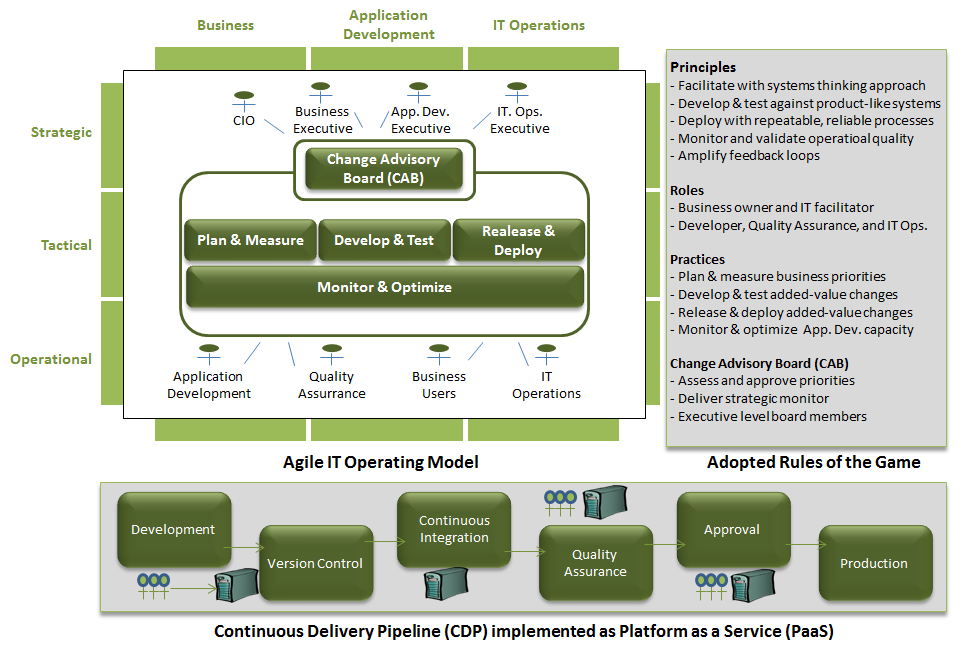
    As I’ve been implementing it, DevOps is a system of principles, practices, roles and responsibilities, governance structure and tools purposely arranged to establish cross-functional collaboration, enable accelerated applications delivery and, in turn, make the business responsive to market opportunities:

    DevOps Model (Credit: Philippe Abdoulaye ITaaS Now LLC)
    DevOps Model (Credit: Philippe Abdoulaye ITaaS Now LLC)

    As illustrated, DevOps as a business capability is made up of three components: the Rules of the Game, the IT Operating Model and the Continuous Delivery Pipeline (CDP). Let’s explore them.

    DevOps Rules of the Game create the conditions for lean and agile IT environments

    Rules of the Game are a fundamental dimension of DevOps: They enable the establishment of lean and agile environments. I refer to them as the DevOps non-technological piece.

    In practical terms, they’re a set of principles, practices, roles and responsibilities and tools institutionalized to ensure accelerated applications delivery.

    They serve as catalysts to specific organizational and operational effective practices. Let’s take the principle, “Facilitate with system thinking (involvement of all relevant stakeholders)”—it forces application development stakeholders to adopt a collaborative mindset, which in turn breaks down organizational silos to eliminate the impediments to operational flexibility and institutionalize cross-functional collaboration.

    They’re the poor cousin of today’s DevOps practices, which ignore them in favor of more technical and technology issues. That’s a terrible mistake that reduces DevOps influence vs. the digital economy’s challenges.

    The agile IT Operating Model establishes the lean and agile work environment

    The IT Operating Model reflects the interactions that take place across your application development value stream. In practical terms it represents the work environment derived from the application of DevOps’ rules of the game.

    I always remind my clients that DevOps’ rules of the game aren’t theories, they’re the foundations of a tangible strategic capability: the lean and agile IT  environment. They demand a thorough transformation of your application development work space to put together business, application development, and operations:

    The lean and agile IT work space illustrated (Credit: O.C. Tanner)
    The lean and agile IT work space for the digital era illustrated (Credit: O.C. Tanner)

    The picture illustrates what’s meant by lean and agile IT environment, it substantiates Adam Jacob’s point that “Fundamentally DevOps is about taking the behaviors and beliefs that draw us together as people, combining them with a deep understanding of our customers’ needs, and using that knowledge to ship better products to our customers.”

    The IT operating model is the poor cousin of today’s DevOps practices which ignore it in favor of more technical and technology issues. Once again, it’s a terrible mistake that reduces DevOps influence vs. the digital economy’s challenges.

    Make no mistake, technology matters, the CDP helps to meet digital technologies challenges

    The importance of the rules of the game and the resulting IT operating model don’t suggest at all that technology doesn’t matter. Make no mistake about it, the CDP is essential; I refer to it as the DevOps technological piece. Through deployment automation and configuration management tools, it significantly accelerates application development, testing, resources provisioning and deployment.

    However, one thing to be aware of is, digital economy raises technological challenges that transcend speedy delivery issues. They include:

    • The importance of IoT
    • The pivotal role of predictive analytics
    • The increasing importance of APIs

    As a matter of fact, IoT devices generate massive data and making use of it to generate revenue requires big data technologies to integrate, automate and analyze them.

    On the other hand, this ocean of IoT data has generated an API business; the idea is, to monetize their data and generate revenue, businesses must provide their customers and partners with APIs that easily give access to their systems.

    Implementing the CDP as part of PaaS cloud services can help to prosper in the digital economy; it allows businesses to benefit the cheap and on-demand computing, storage and network resources provided by the cloud.

    Takeaway

    In hindsight, with a business-oriented perspective, the ITaaS delivery model and DevOps follow the same goal: Provide business lines with the lean and agile IT environments they need to be flexible enough and responsive to meet the competitive challenges of digital economy:

    The ITaaS Delivery Model (Credit: Philippe Abdoulaye ITaaS Now LLC)
    The ITaaS Delivery Model (Credit: Philippe Abdoulaye ITaaS Now LLC)

    Like DevOps, the ITaaS delivery model (…) takes advantage of an agile IT operating model to help businesses succeed in the digital era. It implements consumer-provider relationships across the IT value stream to ensure organizational flexibility and operational agility.

    CIOs must realize that what matters to the business is to continuously generate revenue through improving customer experience and increasing customer value. Deploying applications at the speed of light for the sake of speed doesn’t make sense from a business perspective; as long as expected business benefits aren’t achieved, speed is a useless gadget.

    Implement DevOps as what it is: a three-dimension IT capability including rules of the game, IT operating model and, of course, continuous delivery pipeline.

  • Webinar: Evolve to ITaaS: Self Service Orchestration for the Business

    Webinar: Evolve to ITaaS: Self Service Orchestration for the Business

    In far too many organizations it takes weeks to request a server with an application that is configured correctly. With easy access to public cloud providers the business no longer has the patience to wait weeks, they want their service in hours. Want to know a secret to meet this demand!? You can leverage your existing environment, you don’t have to add another complex automation solution for application deployment and infrastructure orchestration.

    For Nordea, the largest financial services group in Northern Europe, deployment failures aren’t an option…unless they wanted to end up on a global watch list. Join us on March 11th in partnership with Automic, as Jesper Christensen, Chief IT Specialist at Nordea discusses how they utilized service orchestration and self-service handling to solve the top service requests from the business and evolved IT to become the ITaaS provider the business needed.

    Attend this complimentary webinar to learn how Nordea:

    • Designed and executed orchestration services in one convenient web GUI
    • Integrated their ITSM solutions that were already in place
    • Gained full transparency of their service requests and processes
    • Built their top orchestration and IT services for the business

     Video Recording

    Slides

    [seoslides embed_id=”cbdcd64027a1″ script_src=”https://devopsy.kinsta.cloud/embed-script/5337/auto-draft-26/” overview_src=”https://devopsy.kinsta.cloud/slides/5337/” site_src=”https://devopsy.kinsta.cloud” site_title=”devopsy.kinsta.cloud” title=” ” /]


     Date: Wednesday, March 11th, 2015

     Time: 10:30am eastern standard time

    REGISTRATION LINK:(EXPIRED) 

    Panelists


    Jesper-Christensen-Headshot-200x200Jesper Christensen is passionate about IT Process Automation (ITPA). He is always hard working on getting rid of boring time consuming repeatable manual tasks and on top waiting for a server to be delivered or an access to be granted.  You can describe Jesper best with the following words: Entrepreneur, innovative, out-of-the-box thinking, convincing, motivating and motivated, professional, eager to learn about new technologies, business orientated, always going for the bigger picture, cooperative, knowledge sharing, able to talk both the business and IT languages.


    Ralf_Pashen_Headshot_LargeRalf Paschen is currently running the solutions marketing department at Automic Software. Over the past years he has held a various number of positions in the software industry. Coming from a technical datacenter job role he moved into presales, sales to product management and product marketing in several software companies. He was responsible for the complete SAP portfolio for Automic and is now building the solutions marketing department to give customers and partners a clear understanding about the innovation value of the unique One Automation Platform.  You can connect with Ralf on LinkedIn: Ralf Paschen or Twitter: @RalfPaschen.

  • Bird’s Eye View of IT as a Service

    Bird’s Eye View of IT as a Service

    In working closely with large enterprises for several years, we consistently hear businesses talk of IT needs to achieve critical and strategic goals. Commonly these large enterprises span many verticals like technology, online media, finance, banking, and more.

    At the heart of their business goals, lie technology hurdles they need to overcome to scale as enterprises of the next decade.

    Visualizing IT as a service

    So we captured in this mind map high-level business goals that require a broad set of IT services ranging from infrastructure, applications, management, integration, service provider, and architecture.

    elasticbox-it-as-a-service-thumb

    If you look to the left, you see needs centered around applications. These detail all the services required to provision, deploy, and manage applications including application architecture models to design automated deployments and serve all the right infrastructure resources.

    On the right, you see needs that revolve around compliance, reporting, and integrating with various service providers to supply virtual infrastructure and a slew of related services to keep the infrastructure running smoothly and reliably.

    We find that this visual captures the entire IT-as-a-service industry as a whole and this exercise helps to understand where the customers’ needs are and where in that spectrum we assist them.

    See if you can pinpoint the areas where DevOps and IT Ops come into play.

    Enjoy the mind map and click to see a larger PDF view!