Tag: IT operations

  • AppDynamics Applies AIOps to Automate IT

    AppDynamics Applies AIOps to Automate IT

    AppDynamics, a unit of Cisco, today announced it is melding the worlds of AIOps and application performance management (APM) with the launch of Cognition Engine.

    At the same time, AppDynamics is making good on a promise to integrate metrics drawn from Cisco Application Centric Infrastructure (ACI), the software-defined networking (SDN) that Cisco is embedding in all its networking equipment.

    Finally, AppDynamics also announced Serverless Agent for AWS Lambda, which marks the first time the company’s APM platform has been extended to include the ability to capture metrics from every single invocation of a serverless computing framework.

    Matt Chotin, senior director of technology strategy at AppDynamics, said Cognition Engine represents an ambitious effort based on machine learning algorithms and predictive analytics to create a central nervous system for IT spanning applications, infrastructure and the network. The days when applications and infrastructure were managed in isolation are now coming to an end, he said.

    Available at no extra charge to AppDynamics customers, Cognition Engine infuses the Business Transaction data model underpinning the AppDynamics APM services with machine learning algorithms to run diagnostics and automate root-cause analysis in a way that reduces resolution times from minutes to seconds. The machine learning algorithms evolve constantly as data is gathered continuously using streaming analytics to ingest, processes and analyze millions of records per second. The Cognition Engine automatically understands how metrics correlate and instantly knows when there’s been a break in correlation among datasets.

    Cognition Engine also automatically isolates metrics that deviate from normal behavior to identify the top suspects of root cause for any application issue. As an open platform, that information then can be shared with orchestration and automation systems embedded within third-party incident response, intelligent workload placement and cloud cost optimization tools and platforms.

    These types of capabilities are now becoming an absolute requirement because IT in general is becoming too large and dynamic to manage relying on manual processes, said Chotin, adding what’s needed is a shift toward an AIOps mindset that automates the management of routine IT tasks at scale.

    AIOps is, of course, not so much a thing that can be purchased as much as it is a collection of technologies spanning machine learning algorithms, predictive analytics and other technologies that are employed in unison to automate IT operations. It usually takes a while for algorithms to learn a specific IT environment. But once they do, they bring with them the benefits of a more sophisticated approach to managing IT at scale (and they never take a sick day or decide to take another job). Of course, AIOps is not likely to replace the need for IT staff entirely. But roles and functions within IT organizations most certainly will evolve in the months and years ahead.

    In the meantime, organizations will increasingly vet AI models before deploying them in production environments. While AIOps will advance the state of IT as it is known today, the most worrisome thing about any form of current AI technology is being catastrophically wrong at a level of scale that is nearly impossible to recover from.

    — Mike Vizard

  • AIOps: How to Solve Performance Issues in Complex Data Pipelines

    AIOps: How to Solve Performance Issues in Complex Data Pipelines

    AIOps takes center stage to topple barriers as modern data application growth accelerates

    There seems to be a chasm between DevOps and big data teams in the enterprise, and the bridge over that chasm is long and treacherous.

    In fact, data analysts who are charged with managing and making sense of the growing volumes of data in most organizations traditionally have been excluded from the strategy-making and operations functions of DevOps personnel. Yet, data analysts are critical to the success of software development and at every stage of the software delivery pipeline.

    DevOps Under Siege as Modern Data Applications Proliferate

    Let’s take a deeper look. We know that DevOps personnel are on the front lines in ensuring that all systems, both new and existing, perform as expected in a production environment. But, even today, DevOps teams struggle in dealing with technical challenges when faced with complex data pipelines and the underlying big data stack that supports them, including:

    • Root cause analysis — determining if an application issue is due to application code, config errors or resource contention.
    • Correcting inefficiency in code.
    • Improperly configured auto-scale clusters.
    • Lack of actionable insight into how clusters were tuned at both a cluster and job level.
    • Difficult access to support engineers and promotion of DevOps collaboration.

    And these are just the tip of the iceberg.

    The pressure is on. On average, companies with data-driven environments garner up to 50 percent higher market value than their competitors, according to IDC, and big data is a contributing factor. Thus, big data implementations have become a top priority for businesses of all sizes, and on multiple fronts: revenue acceleration, creation of new products and contributing to better, quicker decision-making. But the unfortunate truth is that, as big data projects move from pilot to production, they invariably encounter serious performance problems that frustrate both data analysts and IT operations.

    What’s more, DevOps and big data personnel face a mutual problem: lack of centralized, top-down visibility into their end to end data pipelines and applications. And, as a result, they face challenges in pinpointing the source of problems—namely, that problems can become visible anywhere in the stack, but their root cause could be elsewhere in in the stack. And, these problems result from root causes as diverse as bad code, inefficient data partitioning, mismatched system configuration settings, best-guess resource allocation and infrastructure issues. Furthermore, a big data stack running multiple applications faces resource contention and prioritization issues that can reduce both individual application performance and overall system performance.  And streaming applications create their own challenges;: for example, if a streaming application starts to lag in processing data in real-time, diagnosing the root cause takes considerable time and effort.

    The industry is faced with a reality where the problems are outrunning the solutions. In the case at hand, organizations have relied on brute force and expensive custom solutions for making analytics-based recommendations more user-friendly to improve individual application and full-stack performance.

    AIOps Takes Aim

    AIOps, or artificial intelligence for IT operations, is gaining steam in the enterprise, with many new use cases appearing as data volumes grow and systems become more complicated. Gartner expects AI to pervade every aspect of managing IT, including application performance management (APM), IT infrastructure monitoring, cloud platform monitoring, performance management, capacity management, the delivery tool chain (CI/CD) and IT service management.

    In fact, AIOps is on a tear: Just three years ago, it was only a concept. Today, Gartner predicts that by 2019, 25 percent of global enterprises will have implemented an AIOps platform to support two or more major IT operations.

    But even as it continues to evolve, AIOps today can deliver automated recommendations to solve expensive, challenging and time-consuming problems with big data deployments and across entire complex stacks. Without AIOps, there would be simply too many variables to correlate manually.

    AIOps makes APM for modern data application possible. It does so by helping to eliminate painstaking, trial-and-error configuration, troubleshooting and remediation workflows that have long plagued big data operations teams. And, for the first time ever, dataOps and DevOps teams can troubleshoot, support SLAs, remediate issues and manage large-scale deployments in an agile and dependable manner.

    It’s a new environment for the modern data center. As part of an APM solution, AIOps is hard at work helping automate and guarantee the performance of big data applications and addressing the primary challenges that DevOps faces with the unrestrained growth of big data.

    It could still be a bumpy ride—organizations of all kinds face unprecedented increases in data volumes. But now, working together, DevOps and AIOps are better-equipped to contend with the challenges.

    — Bala Venkatrao

  • Virtual Instruments Extends Scope of AIOps Platform

    Virtual Instruments Extends Scope of AIOps Platform

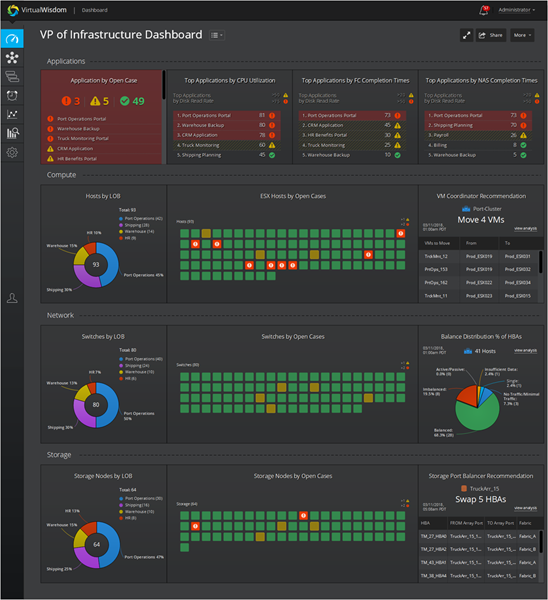
    Virtual Instruments has extended the reach of its AIOps platform to add application service assurance, predictive capacity management, workload infrastructure balancing and problem resolution and avoidance capabilities.

    Based on a combination of machine learning, statistical analysis, heuristics and expert systems technologies, VirtualWisdom is designed to enable DevOps teams to be able to apply analytics to resolve issues in near real time versus having to convene a “war room.”

    Len Rosenthal, chief marketing officer for Virtual Instruments, said the whole war room concept has become antiquated in the age of DevOps. Instead of wasting time having individual departments within an IT organization coming together to defend their innocents every time an issue arises, VirtualWisdom identifies the likely source of the problem instantly.

    The latest release of VirtualWisdom adds to that a predictive capability that identify workload balancing opportunities intended to prevent problems from arising in the first place, he added.

    As part of an ongoing effort to infuse AIOps into DevOps processes, the latest release of VirtualWisdom also adds integration with application performance management (APM) tools from Dynatrace, in addition to enhancements to existing support for APM tools from AppDynamics, a unit of Cisco.

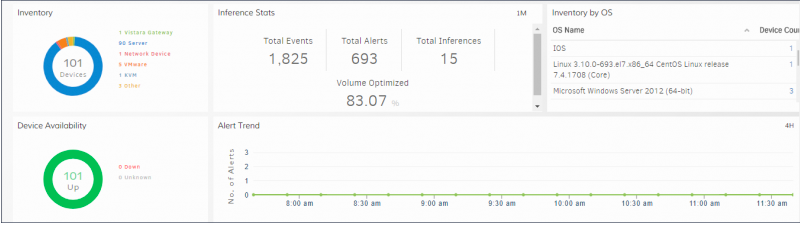
    VirtualWisdom is also now able to collect Linux and Windows operating systems along with metric generated on Amazon Web Services (AWS) or Microsoft Azure. There also a now iSCSI wire data monitoring support in the NAS Performance Probe, which complements existing NFS and SMB monitoring capabilities.

    Rosenthal said the rate at which applications are being developed and deployed soon will force the AIops issue in most organizations. As those applications become more distributed across hybrid cloud computing environments, it’s become impossible for any single IT team to manually keep track of all the dependencies that could adversely impact all their applications, he noted.

    While increased reliance on artificial intelligence (AI) is all but inevitable at this point, it’s less clear to what degree IT organizations themselves will be reorganized as a result. Most organizations have embraced DevOps to bridge the divide between their IT operations and application development teams. But many of the silos within their IT operations teams soon may be automated out of existence as the need for dedicated compute, storage and networking specialists declines. In some instances, developers are already taking advantage of application programming interfaces (APIs) to assume control over IT infrastructure end to end. That scenario may become even more common as AI continues to automate more of the rote IT operations tasks.

    None of that means there won’t be a need for someone to architect the IT operational workflows required to support applications at scale. But it does mean many lower-level administrator tasks soon might be sharply reduced or eliminated altogether. The challenge IT organizations soon will face is retraining those administrators to handle tasks beyond what’s possible to automate using AI.

    In the meantime, organizations will continue to experiment with AI. Not every organization is comfortable enough with AI to turn over control to what many still view as a “black box” that doesn’t provide any visibility into those processes being automated. But as more of that visibility is provided, it’s now only a matter of time before AI platforms take move control of the IT environment.

    — Mike Vizard

  • CA Technologies Report Highlights App Modernization Paradox

    CA Technologies Report Highlights App Modernization Paradox

    The rush to modernize IT environments using microservices, application programming interfaces (APIs) and containers may very well turn out to represent something of a double-edged sword.

    A survey of 1,087 IT and business professionals conducted by Frost & Sullivan on behalf of CA Technologies, a unit of Brocade, finds that organizations that have modernized their application environment are eight times more likely to achieve key performance indicators (KPIs) for the business. Four out of five respondents also said agile practices are helping them build what customers really need to improve overall customer satisfaction.

    On the downside, however, the study also finds more than half of respondents (56 percent) claimed that software issues can negatively affect the achievement of KPIs. A full 69 percent of all respondents say the pressure to release new applications or updates negatively affects quality and security, and 67 percent admit that their organization sometimes trades off security for application development and deployment speed.

    Nine out of 10 respondents who claimed to widely utilize modern application architectures also concede it’s challenging to manage and monitor APIs, microservices and containers, and that APIs and microservices add new risks for their organizations. A total of 80 percent of respondents also say they view continuous application security testing and DevSecOps as critical components of their strategy to help resolve those issues.

    Ashok Reddy, general manager for DevOps at CA Technologies, said that while organizations are clearly seeing a business benefit after embracing DevOps to modernize their application environments, the process hasn’t always been easy. The challenge they now face is that the rate at which digital business transformation projects are being launched has substantially increased. Most organizations are not going to achieve those goals in a timely fashion unless they modernize their application development and deployment processes, said Reddy, noting that only then can IT become flexible enough to meet the needs of the business versus continuing to try and force the business to bend to the way their applications work.

    The paradox many organizations find themselves wresting with is that making the business more agile requires a more complex approach to IT. In theory, each microservice deployed is easier to manage than a monolithic application. But as thousands of microservices get deployed, the number of dependencies between services becomes more than the average IT organization can track. In fact, all those dependencies is one reason more organizations are starting to investigate applying machine and deep learning algorithms within the context of an artificial intelligence (AI) model to automate IT management at scale. Clearly, most IT organizations are now on a journey that starts with a simple set of microservices and ends up fundamentally transforming enterprise IT, regardless of whether anyone likes it.

    It may take a while longer before the future of IT becomes a completely settled question. But for now, it’s apparent microservices in some regards are too much of good thing. The challenge is that from a digital business perspective, those microservices have become something most organizations can’t do without.

    — Mike Vizard

  • Survey: Rapid Automation of IT Ops Looms Ahead

    Survey: Rapid Automation of IT Ops Looms Ahead

    The rate at which IT operations will become automated is about to accelerate significantly over the next two years. A global survey of 1,500 senior IT leaders conducted by Cisco Systems finds that 64 percent of respondents today would describe their approach to IT operations as either reactive (26 percent) or proactive (38 percent), but within two years more than two-thirds expect their approach to be either become predictive (33 percent) or preemptive (33 percent). Only 14 percent of respondents describe their IT environments as being preemptive today.

    In general, the survey finds 88 percent of IT leaders said their investment in IT operations over the past 12 months had improved external customer satisfaction, while 89 percent said there have been improvements in innovation. But only 26 percent collect data on an ongoing basis and even fewer (17 percent) employ any kind of real-time automated analysis, the survey finds.

    Nevertheless, 42 percent of respondents said they expect artificial intelligence (AI) to have the biggest impact on their ability to automate. More than half (51 percent) said they already rely on AI to some extent today to automate IT operations.

    A full 82 percent also already collect operational and performance data about their security infrastructure.

    Joseph Bradley, global vice president for IoT, Blockchain, AI and Incubation Business at Cisco, said much of the investment in automating IT operations is being driven by the realization that IT has become a profit center rather than cost center. As organizations increasingly realize they are a software company that happens to make something, they are looking to maximize the return on their investments in IT wherever possible, said Bradley, adding as a result, line of business (LOB) executives are exercising more influence over what applications get built and deployed within the context of an overall digital business transformation strategy.

    Naturally, all that increased appreciation for the value of IT is putting more pressure on IT organizations to modernize their processes. As the number of applications that need to be built, deployed and maintained continue to increase, the need to embrace DevOps processes becomes a greater imperative. To facilitate that shift across enterprise IT environments that now routinely span multiple clouds, Cisco has been making a two-fold case for centralizing the management of highly distributed IT environments and upgrading to next-generation software-defined infrastructure that makes use of machine learning algorithms to automate IT management.

    Cisco is not the only IT vendor pursuing a similar strategy. The success of those strategies, however, depends as much on the ability of the IT organization to implement the processes required to modernize their IT environments as much as it does the technology platforms. That creates something of a chicken-and-egg relationship between processes and platforms. It is difficult, but not impossible, to implement some level of DevOps without having a lot of automation. But applying DevOps at any meaningful scale within an enterprise undoubtedly will require a lot more automation than currently exists within most IT environments.

    — Mike Vizard

  • DevOps Chat: Microclimate and IBM Cloud  Private with Toby Corbin

    DevOps Chat: Microclimate and IBM Cloud Private with Toby Corbin

     IBM Cloud Private has cemented itself in the DevOps space as a personal cloud environment, which is great for developers who need the agility and computing power of the cloud but don’t want to step into a public cloud setting. Tony Corbin, technical lead for the Microclimate Project, describes IBM Cloud Private as “a cloud specifically targeted at individual customer.”

    In this DevOps Chat, Corbin and I talk more about IBM Cloud Private and its role in DevOps. As usual, the streaming audio is immediately below, followed by the transcript of our conversation.

    Transcript

    Alan Shimel: Hey, everyone. It’s Alan Shimel, DevOps Chat, and you’re listening to another DevOps Chat. I happen to be joined today by a first-time guest on a podcast. So this’ll be an experience for him. It’s Mr. Toby Corbin of IBM. Toby, welcome to DevOps Chat.

    Toby Corbin: Thanks, Alan. How are you doing?

    Shimel: Doing great, and happy to have you on today’s show, Toby. Rather than introduce you to the audience in terms of your title and role and everything, I thought it would be a good icebreaker for you to kind of introduce yourself. So why don’t you kind of share with the audience, if you will, what your title is and what that means and kind of what you do with IBM?

    Corbin: Sure. So at the moment I’m Technical Lead for one of the squads in the Microclimate Project. Microclimate is our developing experience, which we’re targeting to help onboard customers and developers into the IBM Cloud Private. So my role and my squad is – we sort of deal with the backbone of Microclimate. So we deal with making sure everything runs smoothly. We add in things like analytics and the sort of analysis application. But we make sure the whole thing sort of runs. So we’re kind of the backbone. So the squad that I lead, we’re the backbone of Microclimate.

    Shimel: Excellent. So Toby, this sounds sort of like an Ops role, if you will, right? When we talk about the Microclimate – and you know what? Let’s back up. Some of our audience out here may not even be familiar with IBM’s Cloud Private offering. And I don’t claim to be an expert. I’m going to assume you know much more than I.

    Corbin: A little more.

    Shimel: Yeah, a little bit. I would hope so, so you’re not collecting your check under false pretenses, correct?

    Corbin: [Laughs]. Correct.

    Shimel: So Toby, let’s start with that. How would you describe Cloud Private to our audience?

    Corbin: So we’ve all heard of public cloud – things like Amazon have a cloud and Google have a cloud and IBM also has their public cloud. And these are quite large deployments. They’re hidden in the ether somewhere, no one knows where they are, and that’s where all the really, really clever analysis goes, and that computing power that IBM can bring. Cloud Private is sort of the onboarding into that. So Cloud Private is a cloud specifically targeted at individual customer. So they won’t be sharing that with anybody else. It will be an instance just for them and they’ll have the very similar applications and things on there that the public cloud would have. The intention being that when our customers are happy using this Cloud Private installation – so they don’t have to have their own machines. They can have the Cloud Private stuff working for them, doing all of their processing. When they’re happy having that working, we can then take them up to the public cloud, where they get even more of IBM’s processing power and they have an even better experience.

    So it’s kind of taking them from a private cloud that’s just for them up to the bigger public cloud, where although it’s still for them and they don’t share with other people, they have bigger computing power available to them.

    Shimel: Got it. So is it sort of a way station along an upgrade path? Or can someone stay on Private Cloud indefinitely?

    Corbin: Oh, you can absolutely stay on Private Cloud. You’re not forced to go up. But obviously as we go up through the clouds, the capabilities IBM can offer you get a lot greater. So that’s why often you’d find that the customers would want to move up to the next level, because there is an even greater amount of processing and a greater amount of options available to them and to their customer deployments.

    Shimel: So they grow into it, I guess. So Toby, I was under the impression, and maybe I’m wrong, that in Private Cloud there was also – I thought it was a Kubernetes-based offering. Is that –

    Corbin: That is correct, yes. So IBM’s Private Cloud is all based around Kubernetes. It’s IBM’s flavor. So it’s Kubernetes under the covers and IBM have made it sort of into their ICP, their private cloud offering. But it is Kubernetes-based, that’s correct.

    Shimel: So it’s containers with Kubernetes and this whole sort of – you know, the _____ _____, obviously, but now we’re starting to see the domination almost of Kubernetes kinds of architectures.

    Corbin: Yeah, and that’s how IBM’s helping our customers. So you think of the old way of doing things, you’d have a _____ application that was a huge monolith, a giant application that couldn’t really go anywhere. With IBM’s Private Cloud what we’re looking at is, how can we take these applications, deploy them on the cloud, free up all of the hardware – in a customer’s site they don’t have to worry about those things – and take these large-scale applications and deploy them into a cloud environment? And then it’s not just make them work in a cloud environment. How can we work with customers to actually make them change their applications and sort of rebuild them, if you like? Strip them down, put them back together again, as a microservice opportunity?

    And that’s where Microclimate comes in. That’s what we’re doing for the developers. It’s how you create those microservices.

    Shimel: Perfect. And of course, Toby – I think a lot of our audiences are familiar with the term “microservices,” and we see microservices being mentioned a lot around Kubernetes, around containers, around DevOps and cloud and so forth. And you anticipated my next question, which was, when we talk about a microclimate, is that sort of the climate in which we do microservices or perform microservices.

    Corbin: Yes. Well let’s say for this, yes. Effectively what microclimate is, it’s the environment that we want to give to our developers to go from having absolutely nothing to being able to develop their very first microservice, test it and then deploy it up into production through things like the Jenkins Pipeline and using Travis, and get it running in their cloud, all without actually having to need any prior knowledge. We sort of do this all for you. So in the past there was always ways of being able to create an application and there was always ways of pushing an application into a cloud, but it was several steps, different technologies. You had to rely on the customer having various knowledge themselves. So Microclimate is aimed to make this really seamless. You don’t have to leave your web browser; it’s entirely web-based. But we give you the ways to easily create an application, develop it in the cloud in a web-based editor, test, adding in these performance issues that we’ll talk about in a second, and then when you’re really happy, then get it run in production environments, all with the under-the-covers work being done for you by Microclimates.

    Shimel: That’s fantastic. So this whole Microclimate, if you will – excuse me, microenvironment and Microclimate, this is all managed via web browser? All web-based, huh?

    Corbin: Exactly. Because this gives you the opportunity that if you are fully running in the cloud, you don’t actually have to have anything on your laptop at all. Everything can be based in your ICP installation. You need nothing on your laptop to run it, which means then you don’t have to have Swift installed or Node installed. But you can still go and create and generate Swift and Node and _____ applications without having anything local to your machine. It frees up your environment to do everything in the cloud, so you’re straightaway using the power of the cloud to do your development.

    Shimel: hat’s fantastic. And Toby, it sounds to me, even more than that – you know, so I’m old, right? So I’ve been around for a while. And wen we first saw microservices and containers, to me this was like Heroku – better than Heroku. It was truly moving from infrastructure as a service to platform as a service. So that if you’re a developer and I want to write stuff let’s say in Swift or JS or whatever, I didn’t have to worry about, “Was that installed? What was the infrastructure like? What was going on? Was it installed in the OS level?” I could work directly on my application. Do these sort of Microclimate, microenvironments – is that what this really represents?

    Corbin: Absolutely yes. So that’s one of the beauties. Before coming on to work on Microclimate, I was doing Swift developments and Node developments, and I would have to have the latest versions of Swift on my machine and I had to keep up with them to make sure that I would have the latest bug fixes done or whatever it was to make my application run smoothly. With Microclimate, we take care of that whole environment for you. So when you say, “I want to create myself a Swift application,” you get a container running with the latest version of Swift. All of the security patches for that run are already applied. You don’t, as a developer, have to worry about, “Do I have the right installer? Do I have the right version of he compiler?” All taken care of. As a developer you can now just write code and we will do everything else in the background for you, so it really frees up the developer to do their job and not have to worry about keeping their machines up to date with all of the latest patches and run-suns and everything else to do that.

    Shimel: That’s pretty nifty. Good stuff right there. So then, Toby, as part of your – you know, you’re a team lead with portal, you had mentioned, and – but you know, but your whole team and what you’re doing – would you say most of the people you’re serving are developers? Or do you kind of correspond with their Ops team, who are still servicing the developers within their organizations?

    Corbin: So this is where Microclimate has nicely evolved. We started off s being the developer experience. So we were the developer experience _____. And we were aimed at, how do we nicely onboard the developer from having nothing on their laptop to being able to write their first microservice and deploy it to the cloud? But then we quickly realized that we need to have DevOps. So we brought on a whole DevOps pipeline to the backend of Microclimate. So Microclimate is really _____ _____ as an end-to-end story of two either distinct parts, if you like, but they actually work in one. You start with, “I’m on my laptop, even though I’m running in a cloud environment.” So I’m coding on my laptop and I’m writing my first microservice. And then when I’m happy, I’ll use Microclimate to actually send it to my preconfigured Jenkins Pipeline, and the backend of Microclimate that deals with DevOps will take that and will build you on your Jenkins Pipeline, it will push towards your production and you’ll actually go the full end-to-end now.

    So Microclimate is not just really about writing your first piece of code now. It’s taking any application and pushing it right through to deployment at the other end and have it run in production.

    Shimel: It’s end-to-end. That’s beautiful, man. That’s really nice. So share with our audience, if you can a little bit, what are the kinds of things that you and your team are actually doing as part of maintaining this environment?

    Corbin: So one of the things that we brought – so as I said before, my background in this, I actually came from doing tools monitoring for things like Java and Node. We now bring that to Microclimate. So we can think of things like a performance issue that you would typically see. You know, my CPU is going mad and it’s at 100 percent, or my disk is thrashing or running out of memory. And often it’s very difficult to know why that’s happening or even if it’s supposed to be happening. So what we do, what we bring to Microclimate is, we bring to the table our analysis tooling that we have outside Microclimate. So when you use Microclimate, we actually build in our monitoring stuff. So that means that when you write your very first line of code, we actually start monitoring it straightaway.

    So you don’t even have to think about, “Okay, do I have to monitor my application for performance problems?” or, “I’ve got my application written. We normally have a performance team that does this.” We give it all to the developer. Because if a developer can see a problem with a line of code they just put in – for example, they’ve just coded a new function and when they run that function their fan goes mad on their MacBook and it’s thrashing away and they think, “What have I just done?” If we can tell them what they’ve just done at the point they do it, this speeds up development in the future and your testing gets quicker, because you don’t get a performance team two months down the line saying, “Hey, we’ve just run your stuff and it performs like a dog,” and then it comes back to the developer to have to re-find-out what they’ve done. We show you straight away. As you type your code in and hit Run for your first test, we can show you what performance was, so you can see, am I regressing? I can see where my CPU is going mad or I can see where my hard disk is lighting up or I can see where I’m running out of memory.

    We build that in for you. So hitting the developer experience right from day one means that hopefully when you get to the end and your application deploys, there’ll be no surprises around, “Well it’s not running anywhere near as well as I thought it would.” So that’s what we bring to Microclimate.

    Shimel: Got it. Like you’re the developer’s best friend.

    Corbin: We’d like to think so, yes.

    Shimel: So Toby, as I mentioned before, I’ve been around the block a little bit. You know, one of the problems with what you’re describing is territorial issues, let’s call them, right? “Hey man, I’m the Ops guy here from my org, and I’ll help my developer, thank you. Don’t be giving away our secrets, telling the developer some of these performance things.” You know, performance kinds of insights. Do you run into having to deal with pre-existing performance teams as part of the Ops at these organizations?

    Corbin: Well not so much, because we actually find now is that the sort of dynamic of a team is changing. As we go into this sort of more agile world where each team is intended to be self-directing, we find by having smaller teams with sort of jack of all trades, we get away from this developing, developing, developing, testing, testing, testing situation that we _____ _____ five or ten years ago. And this means that much smaller teams can deliver functionality that’s fit for purpose a lot quicker, because you’re not waiting for a longer test run at the end or other sort of testings that happen that would typically end up in this loop of sort of, “I deliver my code, someone tests it, it comes back to me to make changes, someone tests it and it comes back.” This is a sort of way development has now evolved. So with the agile world, smaller teams can do things a lot faster, and that’s why giving them the tools they need means they can do that.

    But this doesn’t mean we put testings out of business, as it were. Because we aim our stuff at the developer, for like the piece of function they’ve just written or for what that application is doing as a whole. There will always be a need for sort of larger-scale teams that need to oversee the entire application. So whereas before, if we take the example of the giant _____ monolith that was one giant application, you might find in today’s environment that that’s actually seven, eight, nine, ten small microservices. So a developer would be working on one microservice and he’d get the performance stats back from that microservice in isolation. But what about the bigger picture? What about when all ten of those are working together? How do you get the overall view of your microservice environment that’s 10, 20, 30 things all talking to each other? So that’s where you still have DevOps teams and other teams working on that. And there’s software for that as well.

    So as an example, there’s Prometheus, that’s an open source monitoring solution that’s very good at taking data from different sources. And then what we do with the stuff that we add into the applications at the developer level so that the monitoring solutions we put into Microclimate for the developer, that will actually talk to Prometheus. Which means that if the developer is happy seeing their code running and their single microservice view of the world all looks good – “Yes, my database function is performing as I expect it too.” I’ll now put it into the cloud where there’s 20 other microservices running, all talking. And Prometheus, that sits over and above all of this, can now take the data from each of those 20, and the data they’ll be taking will be the same data that the developer has already been seeing when running it locally or in the small view. We just pass it up through. So this again gives the developer an easy way of seeing – or actually in fact _____ ____, the SysOps guys, what their applications are doing without any additional changes. Because the code has been in there from day one to provide this information.

    Now that’s one of the hardest things about monitoring. It’s, how do we get at the data? If you can get at the data, there’s plenty of ways to visualize it. All sorts of fantastic tools, even the simplest of just writing out to the screen. It’s always the case of, how do we get to the information? So we build the information in from day one, and that’s what makes Microclimate so cool, as it were, because it’s just there for you. And no matter what sort of environment you run in, we’ll be able to make the data available to see the performance at any level.

    Shimel: You know, Toby, that’s excellent. Hey, when we started – before we started recording I told you, “You’re going to be surprised when I tell you, ‘Hey, we’re going over time.’”

    Corbin: [Laughs].

    Shimel: So we’re really way over. That was a difficult interview. It was pulling teeth to get you to talk to us.

    Corbin: [Laughs]. I’m sorry.

    Shimel: No, not a problem. Toby Corbin, IBM’s Microclimate Developer Experience Tribe, thanks for being our guest on DevOps Chat today, and continued success with the Cloud Private team at IBM.

    Corbin: Thank you very much for having me on, Alan.

    Shimel: My pleasure. This is Alan Shimel. devopsy.kinsta.cloud. You’ve just listened to another DevOps Chat.

    — Alan Shimel

  • Cost Per IT Ticket: Think Beyond Opex in Your Cloud Journey

    Cost Per IT Ticket: Think Beyond Opex in Your Cloud Journey

     Globally, organizations have embraced cloud computing and delivery models for their numerous advantages. Gartner predicts  the public cloud market is expected to grow 21.4 percent by the end of 2018, from $153.5 billion in 2017. Cloud computing services provide an opportunity for organizations to consume specific services with delivery models that are most appropriate for them. They help increase the business velocity and reduce the capital expenditure by converting it into operating expenditure.

    Capex to Opex Structure

    Capital expenditure refers to the money spent in purchasing hardware and in building and managing in-house IT infrastructure. With cloud computing, it is easy to access the entire storage and network infrastructure from a data center without any in-house infrastructure requirements. Cloud service providers also offer the required hardware infrastructure and resource provisioning as per business requirements. Resources can be consumed according to the need of the hour. Cloud computing also offers flexibility and scalability as per business demands.

    All these factors help organizations move from a fixed cost structure for capital expenditure to a variable cost structure for the operating expenditure.

    Cost of Assets and IT Service Management

    After moving to a variable cost structure, organizations must look at the components of its cost structure. They include the cost of assets and the cost of service or cost of IT service management. Cost of assets show a considerable reduction after moving the entire infrastructure or assets to cloud. The cost of service remains vital as it depends on the day-to-day IT operations and represents the day-after-cloud scenario. The leverage of cloud computing can only be realized if the cost of IT service management is brought down.

    Growing ITSM or ITOPs Market and High Stakes

    While IT service management (ITSM) has taken a new avatar as IT operations management (ITOM), incident management remains the critical IT support process in every organization. The incident response market is expanding rapidly as more enterprises are moving to cloud every year. According to Markets and Markets, the incident response market is expected to grow to $33.76 billion by the year 2023 from $ 13.38 billion in 2018. The key factors that drive the incident response market are heavy financial losses post incident occurrence, rise in security breaches targeting enterprises and compliance requirements such as the EU’s General Data Protection Regulation (GDPR).

    Service fallout or service degradation can impact key business operations. A survey conducted by ITIC indicates that 33 percent of enterprises reported that one hour of downtime could cost them $1 million to more than $5 million.

    Cost per IT Ticket: The Least Common Denominator of Cost of ITSM

    As organizations have high stakes in ensuring that business services run smooth, IT ops teams have additional responsibility in responding to incidents faster without compromising on the quality of service. The two important metrics for any incident management process are 1) cost per IT ticket and 2) mean time to resolution (MTTR). While cost per ticket impacts the overall operating expenditure, MTTR impacts customer satisfaction. The higher the MTTR, the more time it takes to resolve the tickets and, hence, the lower customer satisfaction.

    Cost per ticket is the total monthly operating expenditure of the IT ops team (IT service desk) divided by its monthly ticket volume. According to an HDI study, the average cost per service desk ticket in North America is $15.56. Cost per ticket increases as the ticket gets escalated and moves up the life cycle. For an L3 ticket, the average cost per ticket in North America is about $80-$100+.

    Severity vs. Volume of IT Tickets

    With our experience in managing the cloud IT ops for our clients, we understand that organizations normally look at the volume and severity of IT tickets. They target the High Severity and High Volume quadrants to reduce the cost of the tickets. However, with our experience, we strongly feel that organizations should start their journey with the low hanging fruits such as the Low Severity tickets, which are repeatable in nature and can be automated using bots.

    In the next blog, we will elaborate on this approach that can help organizations in measuring and reducing the cost of IT tickets.

    — Neeraj Deuskar

  • OpsRamp Extends AIOps Visibility

    OpsRamp Extends AIOps Visibility

    OpsRamp has advanced its case for AIOps via a Fall update to its software-as-a-service (SaaS) applications that adds a Topology Explorer alongside an enhanced set of Service Maps.

    In addition, OpsRamp added a cloud database monitoring capabilities for relational databases deployed on public clouds including Amazon Web Services (AWS), Microsoft Azure and Google Cloud Platform (GCP).

    Mahesh Ramachandran, vice president of product management for OpsRamp, said the Topology Explorer makes it possible to automate network and application discovery to accelerate impact analysis and troubleshooting. An existing Service Map capability, meanwhile, has been enhanced to allow DevOps teams to invoke visualizations within an alert to better prioritize responses.

    OpsRamp has also added a pause capability for alerts, intended to be used during maintenance windows to prevent alert floods. Alert filters now include text-based search that, when combined with the AI Inference Engine, helps resolve issues faster. DevOps teams also can create policies to notify them of alert state changes.

    Finally, OpsRamp has added reporting tools that enable DevOps teams to determine not just the amount of resources being consumed on a public cloud, but also which public cloud or on-premises environment is generating the most trouble for the IT organization.

    In general, Ramachandran said most organizations have very little way in the way of tools that enable them to realistically compare how one platform performs over another when running specific classes of workloads. By leveraging the machine learning algorithms that OpsRamp includes in its SaaS applications, enough data becomes available to provide DevOps teams with actionable insights, he said.

    AI tools typically require access to massive amounts of data. By making available IT operations tools available as a cloud service, OpsRamp is trying to make it practical for DevOps teams to employ AI on both tactical and strategic levels without requiring an IT team to acquire special data science skills, Ramachandran said, adding such an approach also provides the added benefit of making it possible to holistically manage IT silos across multiple classes of infrastructure and applications.

    IT organizations are still in the early stages of coming to terms with AIOps and its potential impact on DevOps processes. Many of the manual processes that tend to inhibit widespread adoption of DevOps are clearly going to be automated. In fact, many of those tasks will be accomplished using voice commands that bots will be able to understand. In other cases, the bots will inform DevOps teams when an issue needs to be addressed long before they would otherwise be aware of it. Less clear is how job roles within DevOps teams will evolve as it becomes easier to manage applications and infrastructure comprehensively.

    Of course, the rate that transition will occur will vary widely by organization. But rather than debating the right approach to automation, it’s becoming increasingly apparent that many of those decisions will be made by machines. The unspoken assumption being made is that humans responsible for managing IT will be comfortable that the right decisions are being made on their behalf.

    — Mike Vizard

  • Atlassian Acquires OpsGenie to Automate Incident Management

    Atlassian Acquires OpsGenie to Automate Incident Management

    Atlassian this week announced its plans to acquire OpsGenie as part of an effort to apply DevOps principles to incident management. The announcement was made at the Altassian Summit Europe 2018 conference.

    Atlassian plans to integrate OpsGenie, which provides incident alerting and communications software, with its Jira service desk software to enable organizations to automate responses to a major incident such as a site outage using a Jira Ops incident management command center unveiled this week.

    Jens Schumacher, head of software teams for Atlassian, said that while most organizations today have processes in place to respond to minor incidents, very few have incident management processes in place to deal with significant catastrophic events. OpsGenie already has been adopted by more than 3,000 customers to enable organizations to put together a set of structure processes to recover as quickly as possible.

    Schumacher said a more structured approach to recovery is now required because so much more of a modern organization’s ability to drive revenue is tied to the availability of IT. Whenever there is a significant amount of downtime, the urgency attached to recovery process is now much greater. The combination of OpsGenie and Jira, available now via an early access program, makes it possible to predefine a structured set of workflow processes to be followed in the event of an emergency, he said, adding that by defining those processes within a common framework, IT organizations also will be able to significantly reduce the number of point products they need to navigate during a crisis.

    The combination of the two products will also aid in applying forensics to discover the root cause of any outage, Schumacher said.

    Incident management within IT environments over the last few years has been evolving into a science. There are several dedicated incident management platforms that mange everything from who needs to be alerted in what order to providing detailed instructions bringing applications back online. The challenge many organizations wrestle with today is that all the silos of IT make it difficult to approach incident management comprehensively.

    But as it becomes easier for finance officers to draw a straight line between IT downtime and lost revenues, interest in more structured approaches to recovery is on the rise. In fact, regardless of whether the root cause of an issue is a cybersecurity breach or a geological event, the recovery process is usually consistent. Incident management platforms provide the means to capture those processes in a way that creates institutional memory. Access to those best practices is often critical, because organizations can never be sure which members of the IT staff will be available during a crisis. If the one person who knows how to provision a storage system is unavailable, there should be enough information in an incident management system to enable another member of the IT team to accomplish that task.

    As is often the case when it comes to IT, the tools at hand only enables the battle to be joined. It’s the quality of the processes attached to those tools that decides whether the battle will be won or lost.

    — Mike Vizard

  • Moogsoft Extends AI Reach into IT Operations

    Moogsoft Extends AI Reach into IT Operations

    Moogsoft, at a Moogsoft 2018 AIOps Symposium last week, extended the reach of its IT operations analytics software out to where applications are deployed, rather than requiring data to be moved into a Big Data platform.

    Will Cappelli, CTO and vice president of product strategy for Moogsoft, said Moogsoft Observe, available in beta, discovers anomalies by applying algorithms where data is generated, versus requiring IT organizations go to the trouble and expense of moving massive amounts of data into a central data lake.

    Moogsoft Observe ingests time-series and metrics data in real-time and then applies artificial intelligence (AI) to detect incidents at the source of the problem. The single-agent technology can deployed anywhere, including cloud instances and on-premises systems and applications running containers and virtual machines.

    Cappelli noted Moogsoft Observe doesn’t require data scientists to configure it. IT generalists can employ Moogsoft Observe on their own without having to rely on a centrally managed IT operations analytics platform managed by someone else. Moogsoft claims this approach reduces the time to detect a problem by up to 60 percent while cutting nearly 90 percent of the storage and communication costs.

    Analytics generated by Moogsoft Observe can then be stored in the Moogsoft AIOps platform to enable IT organizations to run additional analysis against data collected from multiple data sources.

    Moogsoft also announced that version 7.0 of the Moogsoft AIOps platform will be available this October. This update adds Vertex Entropy and Situation Topology Visualization, algorithms that enable IT teams to visualize the root cause of an issue via a system topology map. That capability makes it possible to apply algorithms capable of generating contextual analysis that pinpoints the source of issues rather than generating a series of probabilities based on when a set of events occurred, said Cappelli.

    Advances in how AI can be applied to automate IT operations are now coming at a rapid rate. Those advances increasingly are becoming affordable for the average IT organization to employ. Most IT teams spend more time trying to determine the source of problem than they do fixing it once the root cause is discovered. AI technologies promise to eliminate many of the rote tasks that IT administrators are required to manually perform time and again, which will make it simpler to manage IT at scale. It also means more IT teams can expect to not have work as many odd hours of the day because fewer things are likely to go wrong. There may never be a perfect IT environment. But IT environments should be a lot more predictably reliable.

    Of course, the rise of AI undoubtedly will have a significant impact on the IT staff. Many IT administrators will need to be retrained as more processes become automated. It’s not likely the need for IT administrators will go away anytime soon. But as some tasks become automated, many entry-level IT roles will change dramatically or, in some cases, be eliminated. At this point, those changes are now all but inevitable.

    — Mike Vizard