Tag: IoT

  • 5 Development Trends Reshaping Testing

    5 Development Trends Reshaping Testing

    There’s no shortage of new development trends, but virtual reality, containers, big data, hyperconnected apps and IoT are affecting testing the most today.

    If you like change and challenge, it’s a fun time to work in software. Some technology developments, such as cloud computing, have been gaining speed slowly over many years. That steady progression has meant that developers can stay on top of trends easily and be informed about market changes. Other areas, such as containers, have come to fruition much faster without as much notice. Development teams have had to scramble to stay ahead of these trends, hoping to capitalize on a their efficiency gains while staying ahead of the curve. Here’s a look at five important software trends which are having a profound effect on testing.

    Containers

    Docker made containerization cool and exciting in 2013, even though containers have arguably been around for many years, if not decades. Developers love containers because the technology makes it much easier to set up and install software in different environments, such as in the public cloud or in a private data center. Containers wrap up all of the infrastructure components that otherwise would be installed separately into one easily portable package with a common standard. And since multiple containers can run on the same hardware without creating problems, you can do more with less infrastructure. Typically, containers can move between different environments with relative ease—a nice benefit for multicloud infrastructures. Containers have evolved quickly from an experimental platform to a mainstream infrastructure technology, with many major businesses taking advantage of containers to deliver their product at scale.

    Testing considerations: It’s hard to find much at fault for containers when it comes to facilitating software testing. Because of the ease in setting up test environments and moving code from one environment to another during the production cycle, testers can work much faster. Before containers, there was a lot more waiting around by both developers and testers. When it takes two weeks to set up an environment for a testing cycle that took two hours, teams would tend toward less frequent releases or would do less testing. Now, it is a matter of minutes to set up a testing environment. This is great for companies and development teams that value testing and want to test more frequently with greater access to a variety of environments.

    Another boon with containers is stability. In the past, bugs sometimes appeared due to configuration errors from setting up dev/test environments. Given the plug-and-play nature of containers, there’s little if any concern about the proper configurations being completed before a testing environment can be used. Security has been an ongoing concern with containers, especially in highly regulated sectors such as health care, government and financial services. In those cases, companies may have to support two versions of the code—one in a containerized platform and one in a more traditional virtual or bare-metal environment. We believe this will be a short-term situation as containerization technology matures and becomes adopted across all industries.

    Big Data

    Whether you want to use this vague and overhyped term or not, big data is simply a new way to refer to larger than normal data sets. Big data became a big trend as the hardware and software to store and manage it got a lot more powerful and cheaper, and the cloud shift helped to centralize data sets into one location. Some large companies and research organizations are seeing interesting results from big data projects already, whether in more targeted drug development (precision medicine) or just-in-time environmental data for farmers. Now, every Tom, Dick and Harry is trying to get into the big data market, which means there are too many solutions to count. A natural weeding-out process will occur over the next few years, as the prominent big data players and NoSQL standards converge into two or three leading providers.

    Testing considerations: Big data applications bring value through the way they manage and/or analyze data, not so much through the user interface. Therefore, testing for big data applications is going to require more technical, database-oriented skills. Those skills are also different from the typical relational database skills of the past, given the fact that big data platforms typically are designed to manage structured and unstructured data. These are open source tools and systems such as NoSQL and Hadoop, along with large vendor systems such as SAP HANA. Testers in this field will need to be constantly adapting learning these new technologies.

    Virtual Reality

    Investors have funneled $8.8 billion into the sector since 2012, according to SuperData Research. Google, Facebook, Microsoft, Samsung and HTC are all in the game. The market is segmented between VR, augmented reality (AR) and mixed reality (MR) and consists of both traditional (PC/console) and mobile device applications. VR is a fully immersive, fully virtual experience that mimics reality, while AR and MR are different variations of blending real and virtual environments together. VR applications aren’t just for gaming anymore: We now are seeing the technology being used for product design and collaboration, tourism/travel and entertainment, including film.

    Testing considerations: VR is an emerging technology still, with many different types of platforms, no clear leaders and no real standards in place. That makes it more difficult for developers and testers to make strategic decisions around technology. As well, there aren’t any great tools for automated testing in these environments yet. Therefore, the need for manual and real-world testing will add time and cost to the project. Yet, investing in doing this right is critical for ensuring optimal user experience. In virtual reality environments, it’s difficult to simulate experiences, such as testing for motion sickness, without actually playing with the real devices. This is especially challenging with the newer mobile platforms, such as Google Cardboard, which incorporate a viewing device that transforms the mobile phone into a VR headset. That experience simply can’t be simulated accurately on a PC, a common testing strategy for other mobile apps. Companies testing mobile VR apps may need to invest in the purchase of dozens or hundreds of different mobile devices to gain an accurate picture of how the application performs for most users.

    Hyperconnected Apps

    Web-based and consumer apps comprise the bulk of hyperconnected apps, characterized by having deep, often real-time integration with other applications. Instagram and Facebook, Gmail and Google Calendar, Salesforce and their wealth of apps—these are just a few examples of hyperconnectivity. The advent of REST APIs has facilitated far easier and cheaper integration so any company can build a platform of third-party software in ways they couldn’t have imagined five or 10 years ago. Similarly, with the explosion of the app economy, including open source software, it doesn’t make good economic sense to write 100 percent of code in your application any longer. Product value is increasing the result of how developers can patch together different technologies in innovative ways.

    Testing considerations: Given the importance of APIs in hyperconnected applications, a primary testing consideration will be ensuring the performance validity of those connection points. It’s imperative for both developers and testers to be aware of API update schedules and to test those updates immediately for any negative impact on the application. Beyond API testing, load and performance testing are also important considerations for hyperconnected applications, which typically involve heavy and/or unpredictable transaction processing. Overall, these types of testing are much more technical in nature than manual UI testing and will require testers to expand their skill set to optimize value.

    Internet of Things (IoT)

    The interest in (and hype) for the IoT sector rivals the largest IT trends, such as big data. Initial applications have focused on connecting devices, such as home lighting and thermostat systems, which use sensors to stream data to smartphones. Over time, we will see more device-to-device connections such as a thermostat collecting data from a smoke detector to ensure that the house isn’t on fire if the temperature rises dramatically. Products such as Amazon Echo and Google Nest might be at the heart of many new consumer-based IoT applications, but there is also ample potential in sectors such as utilities, health care, industrial equipment and government (a.k.a. smart city initiatives).

    Testing considerations: As IoT applications mature, connectivity complexity will grow. IoT applications can involve many components: the hardware of the smart device or product and the software that controls it, along with the user applications that interact with the product. When troubleshooting an issue or vulnerability, a tester must investigate the applications that collect, analyze and display the IoT data, the various network connections across which that data travels, the IoT appliance’s hardware and its software. Hardware testing must incorporate typical scenarios such as what happens to the user experience when a device starts to run low on battery or goes offline. Testers will be most valuable when they have experience in both hardware and software testing; alternatively, an organization can have two teams of testers but they must be in very close contact. IoT apps should also be configured to collect and deliver more alerts and logging data than mobile apps, due to the higher number of components involved. This will make it easier to prevent, troubleshoot and fix problems when they arise.

    About the author/Kevin Dunne

    Kevin Dunne picKevin Dunne is VP of Strategy and Business Development at QASymphony.


  • Embracing DevOps in the IoT Era

    Embracing DevOps in the IoT Era

    To those of us struggling to cope with the challenges of delivering software over the Internet of Things (IoT), DevOps can be the savior.

    Delivering software over the Internet is no easy task, and delivering it over the Internet of Things is even more formidable. How do you deliver software to so many “things,” many of which are “loners” unconnected to the rest of the world?

    What’s encouraging is that the software management processes and tools that we know and have learned to love still work in the IoT era. In fact, not only do they work, they are essential.

    We need teams to work together more smoothly and communicate more quickly to mitigate the higher technological risks. DevOps processes and tools, therefore, are critical in the IoT era because they facilitate smooth, well-oiled collaboration between teams.

    A Typical IoT Scenario

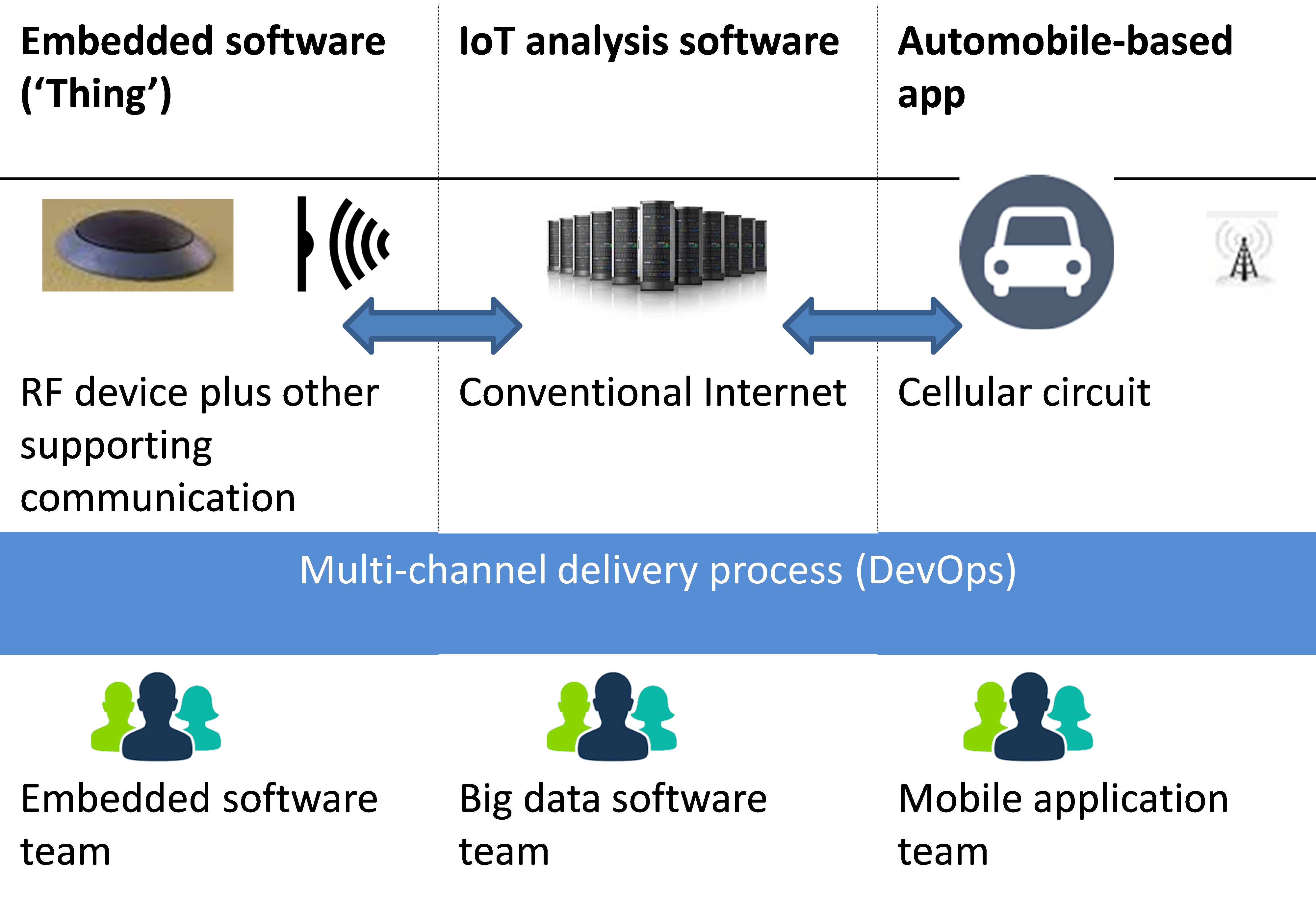
    Consider a scenario in which you need to develop a “smart” parking system for a “smart” city. The system will involve multiple sensors in the parking lots, a display device in each parking area along with communication equipment, a central server for control and analysis and a smart device in each car.

    Drivers can check how many slots are available in nearby parking lots on their automobile devices and navigate to the appropriate parking lot. They also can book slots in advance and start paying from the time they book the slot. When they leave a slot, the parking slot sensor automatically detects that the slot is free and updates a central server. The central server transmits slot availability to the car-based devices, where they become visible to drivers. The central server also generates various kinds of reports and performs various kinds of high-end analysis.

    As with any conventional Internet system, there are multiple software components. All of them have their respective delivery (development, testing and deployment) streams. These streams need to work interdependently and collaboratively, and they need centralized configuration management and dashboards.

    DevOps & IoT

    The Scale and Diversity of IoT

    The differences and challenge, however, lie in the sheer scale of deployment, the diversity of deployment environments and the multiple deployment channels. As you can imagine, any large city will have millions of cars, thousands of parking lots and, hence, hundreds of thousands of individual slots. The number of deployment devices easily can run into the millions.

    In the interest of preventing monopolies, not all the parking sensors will be from one manufacturer. The same holds for the car-based devices. While certain standards can be enforced, not all manufacturers will adhere to one universal protocol. It will be necessary to allow multiple communication and security protocols on these devices. This multiplicity of protocols can complicate software deployment on the devices.

    Other Considerations

    What makes the entire deployment process even more complex is the fact that most of the deployment will be done over the air (OTA). Given that OTA deployment is susceptible to radio-frequency interference and other transmission issues, the deployment process must allow for more robustness than conventional wired deployments.

    There are even more factors to consider: A city-based system can be extremely dynamic. New cars get registered every day, adding to the traffic. New parking lots may be built every now and then and get integrated into the smart city system. New kinds of chips from new sensor manufacturers could be added, as mentioned earlier, to increase competition. New, more sophisticated car-based devices coming into the market might offer to host the smart parking software. Of course, as in conventional systems, new functionality and patch fixes would be released frequently. Finally, as the system becomes part of city life, its utility as an analytical tool could increase beyond analyzing parking trends to other spheres of activity.

    These business and technological factors can exert tremendous evolutionary pressures on the system. A smart system in a smart evolving city must evolve, too. Yet, no change anywhere in the system must be allowed to break the system anywhere else. The chances of this happening are higher in an IoT system because interconnection protocols have not matured enough to become universal and because physical device conditions can never be predicted perfectly. For instance, a single extra field required by the central big data server could place an unsustainable additional burden on the fragile radio-frequency system in the parking lot and bring down the entire data transmission.

    How DevOps Can Help

    To offset the increase in technological and business risk in the IoT, we need robust processes and tools that mitigate the additional risk by improving communication and collaboration between teams. Tools that have the following features become indispensable:

    • A centralized dashboard providing a cross-stream view of the software development;
    • The ability to trace linkages between all related software artifacts across streams and lifecycle stages, given the stressful nature of interdependencies between streams; and
    • A tool that can detect broken linkages.

    The tools also need a well-oiled DevOps management culture that encourages close collaboration and rapid communication between development and operations.

    IoT heightens the need for close collaboration between multiple software streams and within streams between development and operations. Adopting a DevOps culture and DevOps enabling tools is the way to offset the risks of software delivery in the Internet of Things.

    About the Author / Vidhya V. Kumar

    Vidhya V Kumar

    Vidhya is an advisory software engineer at IBM. An evangelist and practitioner of agile methodologies, continuous delivery and documentation, she has about 10 years of experience in the IT industry. She is a subject matter expert in DevOps, application lifecycle management and search methodologies.

  • Lexumo Funded to Secure IoT and Embedded Devices, Critical Infrastructure, and Enterprise Applications from Widespread Open Source Vulnerabilities

    New cloud platform leverages “Big Code” analytics to continuously search, index and monitor code for open source vulnerabilities such as Heartbleed and Shellshock.

    Cambridge, Massachusetts – February 1, 2016 – Lexumo, developer of the world’s first automated cloud-based service for continuously monitoring software for vulnerable open source components, has closed $4.89M in seed funding from Accomplice, .406 Ventures, and Draper. Lexumo continuously searches and indexes software to immediately identify publicly-known open source vulnerabilities that can cause theft of sensitive data, failure of critical systems, and brand damage.  Lexumo’s cloud-based service integrates transparently with existing software development workflows, does not require access to source code, and provides specific, actionable recommendations for remediation.  Lexumo’s new funding will be used to further develop and commercialize the platform and build the company’s sales and marketing teams.

    “To gain speed and agility, the vast majority of development organizations today assemble software from reusable software ‘building blocks’ which are downloaded from open source repositories.  Yet many of these components contain published vulnerabilities which are extensively described in public forums and vulnerability databases – providing cyber attackers with a clear roadmap to attack critical systems, devices, and enterprise applications,” said Brad Gaynor, Ph.D., CEO and co-founder of Lexumo.  “The funding is a validation of our scalable, cloud-based approach to identifying and eliminating open source vulnerabilities in a new and innovative way.”

    According to industry analysts, open source software (OSS) is now used for mission-critical IT by 95 percent of all mainstream IT organizations, as well as in 85 percent of all commercial software packages.  Yet, in 2014, there were approximately 52 million downloads of vulnerable components from the Central Repository, which supplies widely-used shareable components developed by open source organizations such as The Apache Software Foundation, Atlassian, RedHat (JBoss), and Oracle (Java).  When these vulnerable components are integrated into a company’s software, their products and applications are at risk.

    Originally developed at Draper with DARPA funding, Lexumo’s “Big Code” technology combines big data analytics with software analysis techniques for the first time.  This unique approach uses indexed search techniques to continuously identify deep commonalities between the hundreds of millions of lines of open source code available today and the software used in a particular system, device or application.  It then identifies exactly which open source components and versions are present in the code – with a high level of granularity and accuracy.  Drill-downs provide detailed information about each vulnerability and its location in the code, along with automatically-generated instructions to patch them.

    Lexumo’s cloud-based service is easy to use and does not slow down development because it integrates with existing build and ticketing systems, and no developer interaction is required to analyze the code.

    “The premise of Lexumo’s Big Code technology is ambitious and its implementation is both elegant and impressive, which is a reflection of the team’s deep domain expertise and passion for solving security-related problems,” said Jeff Fagnan, General Partner at Accomplice.  “The Lexumo platform makes it incredibly simple for software developers to securely use open source software, raising the bar for application security.”

    “Security for the Internet of Things has been largely overlooked and, given the pace of IoT deployments, it presents a massive risk to technology developers, businesses and consumers,” said Maria Cirino, Managing Partner at .406 Ventures.  “Recent research cites that security solutions for IoT are at least two years away, but Lexumo has the right technology and business model to tackle this problem today.”

    “The IoT is vulnerable because humans are fallible,” said Kaigham J. Gabriel, president and CEO of Draper and former acting director of DARPA. “The Lexumo team applied automated big data analysis to eliminate open-source security vulnerabilities across all sectors of critical national infrastructure and commercial enterprises. The team built the first implementation of the initial concept at Draper, and we are thrilled to spin out Lexumo.”

    About Accomplice

    Accomplice (FKA Atlas Venture) is an early-stage venture capital firm that invests in technology startup companies, with specialties in cybersecurity, eSports, data analytics, SMB class software, emerging hardware platforms, and marketplaces. Our partners are Jeff Fagnan, Christopher P. Lynch, and Ryan Moore. For more information, visit www.accomplice.co.

    About 406 Ventures

    .406 Ventures is an early stage technology venture capital firm investing in enterprise technology companies founded by visionary entrepreneurs. .406 Ventures was founded in 2005 and has ~$600M under management. The .406 Ventures team is comprised of entrepreneurs and operators who became investors to apply real world experience and strong company-building skills to create value for entrepreneurs and LPs. The firm leads, or co-leads, first institutional investment rounds in market-changing Enterprise IT companies and world-class operators, who move quickly and embody successful entrepreneurial DNA with their passion, creativity and endurance. www.406ventures.com

    About Draper

    As a not-for-profit engineering research and development company, Draper focuses on the design, development and deployment of advanced technological solutions for the world’s most challenging and important problems. We provide engineering services directly to government, industry, and academia; work on teams as prime contractor or subcontractor; and participate as a collaborator in consortia. We provide unbiased assessments of technology or systems designed or recommended by other organizations — custom designed, as well as commercial-off-the-shelf.  www.draper.com

    About Lexumo

    Lexumo protects the world’s open source software.  Originally developed with DARPA funding, Lexumo’s Big Code technology combines big data analytics, machine learning and software analysis to detect vulnerabilities in software built with open source.  Lexumo’s automated cloud-based service continuously searches, indexes and monitors open source code and known vulnerabilities to provide the fastest, most effective way for identifying and patching even the most recently discovered security threats.  For more information about how Lexumo secures open source software used in IoT and embedded devices, critical infrastructure, and enterprise applications, visit https://lexumo.com.

  • Make ‘Mobile First’ an Innovation Strategy

    Make ‘Mobile First’ an Innovation Strategy

    The call for organizations to be “mobile first” in application development has been so heavily embraced by enterprises that today mobile first has become table stakes. Being mobile first is no longer cutting edge but merely keeping pace with the enterprise pack. And a big pack it has become: According to ABI Research, revenues generated by the enterprise mobile market are growing at twice the rate as consumer apps and will reach $340 billion by 2017.

    With that size of a market in place, and nearly every employee having as many as three mobile devices, and every enterprise cranking out mobile apps as quickly as they can, how are organizations supposed to leverage that mobile infrastructure?

    Here are a few ideas how:

    Capture the continuous, mobile data inputs that matter

    As readers of devopsy.kinsta.cloud are quite aware, the enterprise has evolved into a continuously integrated, continuous developed and continuously deployed software and data factory. If you’re reading this site, you are aware of the tremendous benefits of DevOps, as well as the the changes containerization and microservices are bringing to IT.

    But the continuous nature of the modern enterprise isn’t just about applications, especially in today’s mobile environment. It’s also about continuous data being captured by users and devices. To successfully innovate and compete today, IT leaders must take advantage of all of the real-time, continuous data inputs that are rolling in from their users’ mobile devices and, increasingly, IoT-connected enterprise devices. This data is critical when it comes to understanding customer trends, supply chain health, regional differences in demand, emergencies as they arise, and many other factors regarding business and IT health.

    This means IT leaders must look for ways to capture, store and analyze these continuous mobile data inputs—and they better start now while the task is still manageable. According to IDC, there are already 200 billion computerized things connected to the Internet, and in four years there will be more than 50 billion networked sensors. The amount of data—and the importance of this data—is astounding.

    Leverage citizen developers to meet mobile app demand

    Enterprise mobile app backlogs continue to be the bane of enterprise mobile efforts. As covered in Clearing through the app backlog clutter, 85 percent of enterprises have an app backlog, and about half of those that do lag behind 10 to 20 apps in their pipelines. These app backlogs are costing enterprises in lost productivity and revenue.

    Where should CIOs and IT leaders turn to clear these backlogs? To their citizen developers, of course. Citizen developers are not without their own risks, such as with cybersecurity and regulatory compliance. But through proper awareness training and monitoring, these risks can be mitigated.

    And the benefits of working with citizen developers are too great to ignore.

    For one, citizen developers can help free the mobile app backlog as well as free the core development team for more mission-critical apps. If the business needs apps that won’t be connected to sensitive systems, or managing sensitive or regulated data, let these business developers build apps on their own, if they are so inclined.

    And the data indicates that more and more are, in fact, so inclined: According to an Intuit QuickBase study, “State of Citizen Development Report,” of the 148 professionals surveyed who identified either as citizen developers or as IT pros who support a citizen developer, 62 percent reported being able to develop apps in less than two weeks.

    Citizen developers can also be encouraged through training to program with code-free development platforms or some of the high programming and scripting languages. This way, when business users find themselves not as effective as they want because of the lack of an app, they can build the app on their own and not have to worry about IT bottlenecks.

    Deep dive into mobile micromoments

    Another way to drive innovation through mobile is to ensure development teams are developing an optimized mobile experience. That means taking advantage of micromoments. Today, workers don’t sit and focus on work as much as they used to. Nope. These days, they are updating data on their phones while scurrying between meetings, standing in line or doing whatever it is that they happen to be doing in-between primary tasks.

    According to an article on The VAR Guy titled, “Survey: Poor User Experience Leading Cause of Enterprise App Failure,” a survey of more than 340 respondents reported that 50 percent said their projects didn’t move forward in the enterprise because of user interface problems. Such UI problems were also cited as one of the greatest reasons for app delays.

    Mobile applications have to be designed with this use in mind. Not only do apps have to be designed with the smaller form factor in mind, but they also must be designed with contexts of the moments in mind. That means taking into account features of the phone such as location, voice and ability to insert photos or video. Developers need to develop specifically for both the form factor and the context in which users engage these devices. Only then will more benefits of mobile be reaped.

    Embrace an IoT platform

    Most of the data generated by IoT will be managed by IoT platforms, or IoT brokers. In 2015, the industry witnessed a lot of action in both the independent IoT players as well as large cloud providers.

    According to ReportLinker, IoT platforms, hardware, services and software will become a multitrillion market. “Revenue generated in 2015 [by IoT] was approximately $330 billion and is projected to reach $453 billion by 2020 with a CAGR of 6.2%,” the firm stated in this release.

    The large enterprise software players didn’t stand still when it came to IoT, either. Amazon, IBM, Microsoft and Salesforce all jumped into the IoT fray with their platform offerings. And while 2015 was the year for technology platforms to come to market, 2016 will be the year IT leaders prepare their organizations to take advantage of the data, insights and control that IoT will provide their organizations in the years ahead.

    Provide continuous mobile insights to users wherever

    When it comes to mobile data and big data analytics, it’s easy to forget that mobile devices are more than mobile data inputs—workers need them to provide valuable, contextual insight as well. To make the most of all of the data being captured from mobile apps and IoT platforms, it’s crucial that data be accessible anywhere and be displayed in ways that make sense to your employees and users.

    To succeed here, it’s important that big data insights don’t languish in big, isolated databases. Enterprise data needs to be accessible on every type of device, including mobile.

  • 4 Tech Imperatives in 2016 to Prepare for Tomorrow

    4 Tech Imperatives in 2016 to Prepare for Tomorrow

    Around the start of every new year come a bevy of predictions about what’s coming (or what someone, or some vendor, or some analyst hopes is coming) in the year ahead. Rather than do that, based on recent conversations with many CIOs, I’ve collected what I think are imperative to-do’s for CIOs and IT leaders to ensure their enterprises can innovate in the years ahead.

    If you don’t already have these in your crosshairs, here are four tech imperatives for 2016:

    Action Item 1: While IoT gets the buzz, groom those mobile app backlogs
    The world has gone mobile. That’s no secret. Mobile analytics firm Flurry found that business productivity apps grew 125 percent in 2015, because most every employee today is armed with a mobile device and more comfortable than ever working on mobile devices. And mobile enterprise investments will continue.

    Currently, however, most enterprises still have considerable mobile backlogs. In the year ahead, it’s imperative they address those backlogs. This investment in mobile apps will continue, so enterprises must clear through the clutter and groom their mobile app backlogs. This year you’ll hear more and more about the Internet of Things, or IoT. (I know, I know, how can we expect to hear more about IoT in ’16 than we did in ’15? Trust me, we will.) Companies first must focus on enterprise and productivity-enhancing apps, while planning and preparing systems and plans for the expansion to IoT.

    In the next few years, IoT will include access to wearables and their data, enterprise office equipment, office buildings, cars and virtually anything else that can be tethered to the Internet. But, for now, the focus for most enterprises must be on clearing their mobile app backlog and grooming their mobile app pipelines, and then setting the stage for the architecture that will be required to support their eventual IoT efforts.

    Action Item 2: Get a tight focus on micromoments
    These days, employees are making every second of the business day count, even when they’re away from their desk. Most employees aren’t sitting, working in front of computer monitors; today, most everyone is on the move and spending more time working on small-screen tablets and smartphones. This has changed how we interact with each other—and our applications.

    Today, workers have short exchanges in text or on social media, short discussions on the phone, and short interactions with their apps. Rather than settling in and computing at a desktop PC, we are computing on our mobile devices while we walk office to office, or are waiting in a conference room for a meeting to start. We are computing, more than ever, in “micromoments.” Guiding developers to develop strategically for mobile is still an imperative for CIOs this year.

    What do I mean? Development teams must ensure their apps are built so users can engage in the context of their moment, based on their location, the task they are undertaking or perhaps the time of the day. Thus, apps must be developed so that data can be entered quickly and easily and consumed readily. And the micromoments app experience must be congruent with those on notebooks and tablets, when people typically are settling in for longer stretches of work and concentration.

    Action Item 3: If enterprises haven’t already, they need to develop their IoT brokers and management platform strategy
    All of those IoT devices we mentioned above will need to be managed. This will require cloud-based platforms that will:

    • look at the data,
    • protect the traffic from being attacked,
    • accept legitimate traffic,
    • dispatch it to where it needs to go,
    • save the appropriate data for long-term analytics,
    • send other data for real-time analytics and response, and
    • enforce security and privacy policies.

    Managing the security, storage and traffic will be a strategic effort in the years ahead, and the groundwork needs to be set sooner rather than later.

    This year is the time to build the strategy for your enterprise’s IoT platform strategy, so the IoT data can be managed properly and management can scale as the use of IoT grows. Think this won’t apply to you? Think again. Gartner predicts that there will be more than 25 billion IoT devices by 2020, up from 4.9 billion today—and a good portion of them will be enterprise IoT devices.

    Action Item 4: Create the data-driven culture
    Big data analytics has touched nearly every aspect of business, from health care, with data-driven medicine saving hundreds of millions annually, to electric utilities managing the grid more intelligently, to helping marketing teams understand and pinpoint their target audiences with more intelligence and precision than ever before possible.

    What’s often forgotten about big data analytics is that success here is about much more than databases, storage, dashboards and data scientists. It’s as much about creating a data-driven culture in which decision-makers in the organization are motivated to make the most of the data and analytics to move the organization forward in the best way possible. Strategically, CIOs want to create this culture, make as much data as possible available to employees, and deliver the data to them in the context of their roles. They want to develop platforms that democratize the data to as many people as possible so they can seek the insight they need.

    Enterprises today already have a lot of the critical data in their software, ERP systems, employees and customers. In the years ahead, IoT devices will create additional tsunamis of data to be analyzed and acted upon for strategic advantage in the earlier years and to simply maintain the status quo in the years beyond. That’s why it’s so important to get this on the strategic radar today.

  • The Internet of Things

    The Internet of Things

    Internet of Things


    Here are some other ROELBOB’s you might like

    RoelBob150x120


    A Unit Testing Dillema 

    The Pink Slip

    Another Pink Slip


    Hot off the Press – Other great devopsy.kinsta.cloud content

    HotPress

    Successful technology leaders will embrace the citizen developer

    Your DevOps subculture


    Upcoming devopsy.kinsta.cloud Events

    Events

    DevOps Connect: cdSummit SoCal

    Security automation for DevOps

    — ROELBOB

  • Five areas of software development innovation to watch

    Five areas of software development innovation to watch

    Software development has undergone a massive transformation in the last two decades. From the first wave of breakthrough do-it-all PC applications such as Lotus 1-2-3 and Microsoft Office, to the launch of the first iPhone and its all-new “app” category, to the recent release of the iWatch and its projected evolution of apps, developers have never been more in demand to support these new technologies.

    In May, my company Gemini Solutions will be celebrating our 10-year anniversary, and we’ve been fortunate to have worked first hand on huge advancements. Our close partnerships with some of the most innovative technology companies have given us firsthand insight into areas of significant change, growth and importance for software engineering. 

    1. Mobile Keeps on Rolling

    The biggest area on the horizon for developers is the increasing prominence of mobile. Active in the mobile space since 2007, we have seen the demand for mobile-focused projects explode in recent years, and anticipate it is only going to get more popular. This space has seen incredible change in just a few short years. iOS app development continues to be the most requested, but we’re seeing a lot of growth in Android as well and expect it to continue to gain prominence as more Android devices enter the market. As Microsoft establishes itself as a platform, its apps will not be as in demand as iOS or Android, but I have a feeling that we’ll see growth for them as well.

    2. Be Aware of Wearable Apps

    Apps are no longer limited to mobile and are branching out to new devices, such as smart watches and bracelets, as they gain in popularity. There’s been a lot of buzz around Apple’s iWatch and the demand for the device is expected to be huge. We’re already receiving requests for the development of wearable apps so companies can keep up with the technology. Many of the inquiries are consumer-focused at the moment, but are beginning to move into the enterprise as well as these devices have the potential to become a one-stop-shop for both everyday and business uses. In addition, we believe that connected app development is also going to increase sharply in prominence. As these new devices link to mobile phones, tablets and computers the demand for interconnectivity is going to be huge.

    3. Functional Programming Making a Comeback

    We’ve noticed that the functional programming model is starting to see an increased push again. Scala is very popular for functional programming and is gaining traction with developers. We’ve also noticed people using Scala in conjunction with big data installations. JavaScript is immensely popular right now as well and we’re also seeing increasing use of Angular. This space is constantly changing and we expect to see even more infrastructures appear to offer more variety and choice for development.

    4. It’s the Real Thing: The Internet of Things

    The Internet of Things is the perfect amalgamation of mobile, embedded and cloud. The Internet of Things is bigger than the Internet of Humans. We’re seeing a lot of intelligent connected devices appearing on the market, and this is only going to accelerate as demand increases. A prime example is the popular internet-based security systems, with web-enabled locks, internet-controlled light and heating/cooling accessibility and the ability to view your home at any time via the device of your choice. Companies continue to make large investments in this space, prompted by the growing popularity of connected devices. We’ve been working with the Internet of Things for several years, but it is still a new frontier in many ways and we’re looking forward to being part of the space as it continues to develop.

    5. Making a Big Deal About Big Data

    In just a few short years, the hype of Big Data has gone from dream to reality. Everyone has their own interpretations of what Big Data actually means, but don’t let that fool you into thinking it’s a flashy trend; it is here to stay. The cloud is emerging as an increasingly popular way to develop and test new analytics apps and for processing big data outside of the enterprise. Data agility will also become even more central as organizations begin regularly using massive amounts of data, as opposed to just capturing and managing it. The umbrella of big data covers many disparate applications. Being able to analyze massive amounts of data to determine user activities, actions and preferences will be priceless to companies, and is why we will continue to see this space explode in popularity.

    The software development space has never been constant or stagnant. Huge advancements and innovative new technologies are continuously appearing to change the game and open up new possibilities. We have been honored to be part of this movement for the past decade to help drive these crucial projects forward. If the past 10 years were any indication, the future of software engineering will be bright, unpredictable and unfathomable. I can’t wait to be there for the next chapter.

    About the Author/ Theo Nissim

    Theo headshotTheo Nissim, CEO, Gemini Solutions – Theo is a seasoned Silicon Valley technology executive with more than 20 years experience. He has led pre-IPO start-ups, built dozens of technical teams, developed technology strategies and driven innovative products and solutions to market. One of Theo’s many strengths and passions is managing large scale, cross-functional development efforts to high profile product releases. Theo has held executive and management positions with large public companies, Sun Microsystems and Wind River Systems, and served as the Engineering Vice President for VC funded start-ups, Digital Fountain and AdKnowledge.

    Theo has a Masters Degree in Computer Engineering from the Technion, Israeli Institute of Technology in Haifa Israel. He lives in Palo Alto, California, with his wife and twin boys.

  • Q & A Cloud Security Alliance’s Jim Reavis on securing the IoT

    Q & A Cloud Security Alliance’s Jim Reavis on securing the IoT

    Cloud Security Alliance CEO and co-founder, JIm Reavis

    Earlier this month at the RSA Conference 2015 the Cloud Security Alliance released security guidance for the Internet of Things (IoT). The guidance came out of the CSA’s Mobile Working Group — IoT Initiative. Many security researchers I’ve interviewed in recent years have repeatedly cited frustrations around what they see as lax security design and implementations of IoT devices. There is rarely an adequate threat and risk assessment conducted on devices, there’s no secure software development lifecycle, and access controls and usual patch processes for deployed devices is often non-existent.

    If their perceptions are accurate, a good way to think of IoT security maturing is to think of the way software and eCommerce sites were developed in 1999.

    This is why it’s important to help early adopters understand the security challenges associated with IoT, and share information on how these devices can be security designed, built, and deployed. With that in mind, along with the CSA’s recent IoT security announcement, we reached out to Jim Reavis, co-founder, CEO and driving force of the Cloud Security Alliance to get some of his thoughts about the issues. Reavis has been named as one of the Top 10 cloud computing leaders by SearchCloudComputing.com.

    devopsy.kinsta.cloud: Do you think it’s important to have the IoT security discussion now, and what do you see as the CSA’s role?

    Reavis: We think IoT is an area that’s not a future security challenge, but a present one. Not only because there is so much that’s happening right now, but because the application of IoT is so broad as to range from personal devices to those in the critical infrastructure. We also felt that we have a place here because all of these devices are going to be cloud-provisioned, cloud-managed, and their data stored in the cloud.

    We actually have 30 people on this guidance, and we tried to provide a lot of examples of different IoT implementations and we thing it is a good first cut of guidance directed at what we think the issues around IoT are, and what we need to be looking at. The guidance is also a call for action, because we are going to shortly publish about five additional, and more detailed, papers. We are hoping this generates a lot of interest, because now is the time to really start solving this problem.

    devopsy.kinsta.cloud: Where do you see the big challenges here? Is it with the device makers, or with the implementation? Or all or none of the above?

    Reavis: It’s a very wide problem. We think some of the device makers know that security is important enough, and that there’s an economical incentive for them to get this right. However, other devices are going to be so cheap, 3D printed and such, that it’s not going to be possible to get to the manufacturers – and so security there is going to have to come from the network. This is an area where standards can help.

    Security practices such as the secure development life cycle makes sense for certain aspects of securing the IoT. In other areas, security will come from cloud-delivered technologies like encryption and strong authentication. It is a broad ecosystem thing that we’re looking at and so there’s also governance challenges.

    And, right now, it’s not apparent to me that there’s a huge advantage in going to one, or a handful, of stakeholders here.

    devopsy.kinsta.cloud: That’s fascinating, so do you see this as a bigger challenge than securing eCommerce was 15 years ago?

    Reavis: Yes, we are looking at seven, eight billion Internet connected devices right now. Maybe it’s going to be a trillion in a few years. And if you go look industry by industry, and look at what companies are saying they’re going to do, that one trillion figure is not a crazy number to reach in about seven years.

    With that kind of scale, the Internet model is going to break. The Internet has worked very well, and I think we felt that it can handle anything we throw at it. But we think we’re really going to have to change the model for the growth that is associated with IoT.

    Part of that is the network needing to overlay a type of dark net on top of the open Internet, and that’s our software-defined perimeter. We’ve had the software-defined perimeter around for more than a year now. We’re creating the specification so that it separates the data channels and the control channels. It essentially knows the devices, knowing who’s authenticating on the devices, and then deciding what parts of networks are visible to them.

    devopsy.kinsta.cloud: What do we you in the future with IoT guidance coming from the CSA?

    Reavis: We are going to align each facet of IoT security with the corresponding cloud security standard and best practices. And upcoming research will identify and document critical vulnerabilities found in IoT in enterprise environments. We will provide guidance on how to mitigate those risks as well as give developers secure development guidance.

    The full report released can be found at New Security Guidance for Early Adopters of the IoT.

  • InterConnecting the Internet of Things

    InterConnecting the Internet of Things

    In every direction one turns in the so-called Internet of Things there is fragmentation. There are many programing languages, devices and, more recently, a disparate set of IoT development and management platforms that are all vying for the market and developer’s attention. They hope, to become the standard in IoT in the months and years ahead.

    One of the biggest obstacles to widespread IoT adoption has been the difficulty attracting developers to use the low-level programming languages on which most run. “IoT has been really hard to work with for a long time because a lot of it has required working with the Arduino tool set, for example, which is a lot of C++,” says RedMonk senior analyst Donnie Berkholz. “A lot of developers these days aren’t very interested in working in low level languages anymore,” he says.

    Enter the Ethernet IoT Starter Kit for the IBM IoT Foundation. The kit from chipmaker ARM, Freescale, and IBM aims at the industrial Internet of Things apps, and is based on ARM’s mbed operating system, the Freescale-designed development board, and BlueMix – IBM’s cloud service.

    According to the ARMmbed blog, the starter kit for the IBM IoT Foundation provides a slick user experience, and makes it possible to get data from the board sensors to the IBM BlueMix cloud within minutes. “It is particularly suitable for developers with no specific experience in embedded or web development, as it provides a platform for learning new concepts and creating working prototypes,” the announcement states.

    “After the initial out of box experience, the infinite possibilities of cloud applications can be explored through IBM’s production grade BlueMix platform, in which deployment and device management is as simple for one device as it is for one million. The starter kit hardware can be modified and extended to explore the device design space, and a finalised design can be taken to production using the mbed SDK and HDK,” according to the announcement.

    There were additional IoT announcements this week at the IBM InterConnect 2015 conference. Enterprise cloud provider CloudOne announced the launch of their CloudOne Internet of Things (IoT) Lab. The CloudOne IoT Lab hopes to be a platform for real-time collaboration to build IoT solutions. According to CloudOne, it will shortly build a technical center in Chicago, IL to house the companies technical team and provide a space for customers to get hands-on experience with the CloudOne platform, including IBM continuous engineering, asset management and analytics technologies.

    “The CloudOne IoT Lab allows our team to brainstorm IoT-enabled solutions with customers in real-time. This will speed delivery of connected products while embracing and extending existing customer investments in partner technologies, data and processes,” John McDonald, CEO of CloudOne, said in a statement.

    Also this week at InterConnect 2015, stream network PubNub announced that it is partnering with IBM to bring realtime data streaming and messaging capabilities to BlueMix.

    PubNub demonstrated what it called realtime secure device connectivity, powered by its easy-to-use data stream APIs, at the conference. And, according to PubNub, IBM BlueMix customers will be able to leverage PubNub to securely and reliably deliver large scale realtime IoT, web, and mobile solutions.

    There has been much movement in the IoT space in recent weeks. Earlier this month, the Raspberry Pi 2 was announced, with operating systems being provided by both Microsoft and Canonical. The increased processing power of the Pi 2 means in can be used in more smart devices from robots to drones.

    Many of the recent announcements hope to make devices, data, and development tools more accessible to more developers. All of that is a must if the IoT is to reach its full potential soon.

  • Donnie Berkholz on IoT and the Modern Developer

    Donnie Berkholz on IoT and the Modern Developer

    It’s been nearly four years since Marc Andreessen wrote his famous column Why software is eating the world. It’s proven to be incredibly prescient. While software and the Internet has removed many market frictions from many businesses, software is now just starting to “eat” the physical world as adoption of the so-called Internet of Things accelerates.

    Before his talk, IoT and the Modern Developer, at IBM InterConnect, we caught up with RedMonk senior analyst Donnie Berkholz to discuss how software is in fact now eating the physical world and how the Internet of Things is now more accessible than ever before, and like the description of Berkholz’s talk says, “We live in a world of glue code, where open building blocks are available to Developers to snap together the pieces of the next big thing.”


    devopsy.kinsta.cloud: Thanks for taking the time Donnie. Can you tell us a bit about your talk, IoT and the Modern Developer?

    Berkholz: The idea is that IoT has been really hard to work with for a long time because a lot of it has required working with the Arduino tool set, for example, which is a lot of C++ and a lot of developers these days aren’t very interested in working in low level languages anymore. A lot of them want to work in Python or maybe Go or Node, or some form of JavaScript. The challenge for a lot of these embedded devices has been that they’re just really inaccessible to the way people want to write software these days both from a perspective of languages, but also toolsets. For instance, the library support just is not great.

    It all kind of ties together into the same idea of IoT hadn’t taken off for a long time. Not from a developer perspective. Independent developers weren’t doing a lot of playing with, largely because it was a pain in the ass to work with. Whereas more recently we’ve seen stuff coming out like the Raspberry Pi, and the BeagleBone. The Espruino is a really good example and as is the Tessel of this new generation of IoT that is easy to work with and is super affordable, and you’re working with it, in most cases, in Node. Every one of those more current boards supports running Node on the embedded board itself which is a huge change.

    The old point of view used to be having JavaScript on the server and there was a central server that was dealing with all this stuff. But the new perspective is that all these embedded boards are powerful enough that you can actually run JavaScript on every single one. There’s never a point at which you have to interface down to some low level language that you’re not interested in working on.

    That’s basically the point of the talk and it obviously goes into a lot more detail with lots and lots of examples of what’s happening, how the trends have changed over time.


    devopsy.kinsta.cloud: That is very interesting, do you know of real-world examples?

    Berkholz: One that I particularly enjoyed is the Internet of toilets. There’s a good company called Hagleitner. They are doing smart restrooms. Big data with washrooms is how they frame it. They’ve Raspberry Pis sitting in these washrooms running, it was at an F50 conference, they’re running SQL Anywhere and integrating with the HANA Cloud platform. And they’ve all the kinds of instrumented paper towel dispensers and that sort of thing so that they can get on-demand maintenance instead of just basically pulling-based maintenance. Obviously it’s the way we want to write software. It’s the same way. It would be great if we could do that in the real world.


    devopsy.kinsta.cloud: Where do you think IoT is heading in the next years ahead?

    Berkholz: We’ve run a show called IoT at Scale. We ran one last fall. We’re going to run another one early summer in Europe. The last one was in Palo Alto and the basic premise is that the IoT that’s real today, the IoT that’s easily commercializable today is industrial IoT. With enterprises, all you have to do is show that there’s ROI there. You have to show that if they invest in this instrumentation, they’re going to save money. They’re going to lower risks.

    Whereas with consumer IoT, it’s basically a guessing game. You’re gambling every time you do and sometimes you win, but a lot of times you lose. And so the talk runs through all kinds of examples of what’s going on with industrial IoT and in retail, in construction, in smart buildings, in connected cars, fleets of trucks, all sorts of different things like this. In every one of those cases, it’s a commercial business that’s making money right now and keeping companies alive.


    devopsy.kinsta.cloud: That is great to see. Going back 13 years or so at InformationWeek, we actually had a beat called Telematics and it was about covering all of that. It was mostly transportation, but it was so far ahead of the time that we couldn’t find real use cases so we shut it down.

    Berkholz: Exactly. That’s the thing that we’ve been waiting for is all the vendors have been suggesting use cases for years and they think wouldn’t it be cool if somebody did this? That would be awesome, right? But they could never come up with any customers and I think that’s the big change is a lot of these examples are actually customers that have developed their own solutions using vendor products as part of them. GE is a reasonable example. They built their own software stack for IoT and they hit a billion dollars in revenue last year. If that’s not a proof point, I don’t know what is.


    devopsy.kinsta.cloud: That’s a great proof point. How do you see this affecting the work load of operations and developer teams? Are they going to have to manage an IT layer of physical devices?

    Berkholz: Yes. It’s definitely going to require extending the DevOps ideas of collaboration to field teams as well, to utility workers and that sort of thing that are out there actually maintaining smart meters. The equivalent of your rackers and stackers in the data center are these field techs who may not be well educated in the technology at all, but still have to understand enough to maintain the hardware on premise and to manage to do software updates. I think that’s one of the critical aspects and certainly one that probably resonates with you from a security perspective is all these embedded devices get sold and then either they’re never updated even though they’re connected or they’re updatable.


    devopsy.kinsta.cloud: That’s exactly right. A lot of it feels like it’s 1999 and the Web all over again.

    Berkholz: Yes, exactly. The Internet was not architected with the idea of hackers in mind. We should learn from that lesson as we’re building up the IoT and as we’re creating and experimenting with protocols so that we can make sure we architect in security from the ground up instead of doing the same thing all over again.


    devopsy.kinsta.cloud: What are the challenges in working with IoT management teams and building efficient Ops in this environment?

    Berkholz: Yes, I think it’s going to be a very different model. We’re going to have to take a step back in a lot of these cases because on the tech side of things we’re moving forward into more and more technological methods of collaboration, using more and more virtual, using tools like Slack or HipChat or others and relying on that to work together whereas a lot of these people are not at all comfortable with that. In many cases, they may not even use email. I live in Minnesota which is not exactly a software hub, as you, and I’m sure you know many people who may not own computers.

    I think a lot of it is going to have to rely on having field teams out there with much smarter devices themselves that are a step up from the deployed IoT stuff. Like the ruggedized laptops and PDAs that they’re carrying around. So there’s going to have to be a lot of intelligence on there that can cope with what’s happening out in the field and on the back end it’s obviously going to require very scalable and intelligent software to figure out what’s going on out there in the field.

    Techs need to know if alerts require action be taken, or if everything is all good. Because if I can’t figure out if I have to take action until later, that’s going to cost the company money to send somebody back there in person.


    devopsy.kinsta.cloud: That brings up a great point. Mistakes here could be potentially expensive, potentially much more expensive than software mistakes because you’re talking about physical devices. Errors in planning or design can be monumental.

    Berkholz: It absolutely increases the risk profile. It’s the same thing that software on things like space shuttles, satellites, airplanes have had to cope with for years and years and years. That’s why in a lot of cases they have to use specialized software development techniques and languages, like Ada is a particularly popular one, to basically prove that they’re going to be reliable, to prove that the architecture is solid, which interestingly is the same kind of approaches that Amazon is taking with building its cloud. I don’t know if you’ve looked into what they’re doing with TLA+?

    They’re proving that their architecture works from a mathematical perspective. I think that’s the same approach that’s going to have to happen with IoT is we’re going to have to do a lot better job of building automated testing and of being able to rapidly roll back and roll forward and of using much more strongly protected languages and testing tools.


    devopsy.kinsta.cloud: What things should developers who are looking at IoT for the first time now, as a potential platform to develop upon, be looking at or self-teaching themselves?

    Berkholz: I think for now, for the time being, the answer is the way we start a conversation which is picking up cheap embedded devices like BeagleBoards or Raspberry Pis and putting Node on them and playing with Node.

    That seems, to me, to be the place to be with the Internet of Things right now. Come up with a project that sounds interesting and do it.